.comment-link {margin-left:.6em;}

La Bloga la bloga mugs

Chicana, Chicano, Latina, Latino, & more. Literature, Writers, Children's Literature, News, Views & Reviews.

About La Bloga's Blogueras & Blogueros

Tuesday, September 30

Sucias Lose Charm; bits 'n pedazos

Michael Sedano

Review: Alisa Valdes-Rodriguez. Dirty Girls On Top. NY: St. Martin's Press, 2008.
ISBN: 978-0-312-34967-7. ISBN-10: 0-312-34967-X

For the majority of its 336 pages, Alisa Valdes-Rodriguez' sucias fail to live up to the optimistic title of their second outing. Not only has the author grown weary of her generally cutely endearing comadres, she treats them with undisguised contempt that defeats a purposeful reader looking for a good time in escapist comity.

The brashly reckless Usnavys, leads the story. Solidly married to househusband Juan, Usnavys thinks of herself as a plus-sized love goddess. That some men respond to her allure reaffirms her self image. Yet, one of her friends thinks Usnavys dresses outrageously and eats too much, and one man calls her a "fat bitch". Although he is a lethal misogynist, the ugly description carries some weight. Usnavy's narcissistic stupidity brings her marriage to a breaking point and as the novel ends, Usnavys finds herself alone and desperate.

Lauren acts the complete fool for the hot Amaury. A drug lord gone straight, he's an east coast promo man for a record company but also a cheating predator who hits on fourteen year olds. Lauren suspects Amaury's infidelity but convinces herself of his sincerity when he confesses his love. Think John Belushi and Carrie Fisher in The Blues Brothers. She punishes herself by binge eating and bulimic purging. A talented newspaper columnist, Lauren gets the wool pulled off her eyes when she agrees to mentor a talented boy-crazy high school writer, only to discover the child is Amaury's current sancha on the side.

Rebecca and Andre, the brilliant Nigerian-born Londoner with more money than midas, live a comfortable life, except she is an uptight straight-laced misfit who doesn't understand how to enjoy being with her oddball friends. The most "normal" appearing woman in the group, Rebecca suffers miscarriage after miscarriage, blaming a horseback ride for the one she experiences on the flight back home after her reunion with las sucias. When her paisana compañera Cuicatl offers to surrogate a child for Rebecca and Andre, Rebecca rejects the offer, in part because the Church forbids it, but mostly out of disgust because the rock star friend smokes pot.

Sara is the most benighted of the comadres. Single parenting her twins now that Antonio, her asshole abuser of a husband, has fled to Argentina after murdering the housekeeper and beating Sara into a stupor, Sara welcomes Antonio back into her life. In Valdes-Rodriguez' most chilling writing, she puts us into Antonio's mind where we understand his utter contempt for Sara, thus fear Sara's moth-to-flame self-destructiveness as she seeks Antonio's approval. She tells him she's taking karate, why doesn't she kick his ass for him?

Elizabeth has taken a wife, the miserable Selwyn, a whining woman who resents men and takes it out on their adopted son. When Lauren toys with Elizabeth's needy sexuality, the encounter nearly ends their friendship. Then Selwyn abandons Elizabeth and the child, proving Elizabeth's poor choice in mates and lovers. What is it about thirty-something women, they can't find a suitable mate?

Valdez-Rodriguez reserves her most bitter contempt for the chicana Cuicatl. In the singer-songwriter's manner of dress and speech, readers will detect an ethnic spite that grows either from mean-spiritedness or too little information about chicanidad. Cuicatl's "chicano" patois features frequent "órale" and "pinche" interjections, sometimes appropriately but as often in odd-sounding idioms. When Cuicatl has intercourse atop the Pyramid of the Sun the exaggeration is breathtaking.

True to her title, however, Valdez-Rodriguez manages to stretch everything back into a semblance of righteous order. The randy Usnavys becomes contrite and adapts to the lifestyle of a stay at home mom; Lauren checks into a clinic and plans to move down to TJ to write novels; Elizabeth finds true love--with a rich woman; Sara is head over heels in love with a twenty-three year old swain with a cute Tejano accent; Rebecca overcomes her religious hangups and finds her surrogate; Cuicatl/Amber finds a new stardom and cynically surrogates for a pair of East Los firebrands. They are on top.

Much as I have enjoyed Alisa Valdes-Rodriguez' work in the first sucias novel, and especially her well-crafted Make Him Look Good, I found much tedium and little to admire in Dirty Girls On Top. Rather than gaining some insight into the actions of a woman, and being able to enjoy these particular wild women's antics, I found little to explain their stupid mistakes. Instead, I found myself empathizing with an author in too deep to a story gone wrong, and unable to put herself into a better place. Let us hope her next work will prove a more satisfying experience for both author and reader.


Rigoberto Gonzales Reviews New Collection of Jose Antonio Burciaga Work

Burciaga's humor places him among the giants of chicano essay. His piece on the word "pendejo" invariably forces laughter from even the most seriously academic reader. Most moving work, however, are a pair of thoughtful pieces. The one at the beginning of Spilling the Beans, on learning of his aunt's cancer finds an eerie parallel when he later learns of his own cancer and writes of that as he closes that collection. It put me mindful of my dad's favorite saying "pa'lla va la sombra."

Here's Rigoberto on the The Last Supper of Chicano Heroes:

Burciaga's respect for his community and the unmistakable articulate phrasing of that respect are celebrated in this long-overdue volume edited by Mimi R. Gladstein and Daniel Chacón. Published 12 years after his untimely death, this project gathers a modest but no less powerful selection from Burciaga's body of influential critical essays, poems, fictions and portfolios of artistic work.

A pioneer of Chicano literature and activism, Burciaga was one of the founding members of Culture Clash, the comedic performance troupe known for its biting political satire. That humor is certainly highlighted here with the inclusion of such well-known pieces as "E.T. and Me" and "Pendejismo," and the never-before-published "For Whites Only,"...

The full essay appears in the El Paso Times of September 28, 2008.


Two 8-Book Winners. Contest Continues This Week.

La Bloga happily announces two winners of the La Bloga / Hachette Book Give-Away. Both submitted 100% correct answers to the Saturday quiz.

1. The oldest known photograph of Los Angeles’ plaza dates to this year.
1862. Dan Olivas' Monday column.

2. The four colors in the detective series The Havana Quartet.
Gold, Black, Blue, Red. Michael Sedano's Tuesday column.

3. She earned one of the 2008 Alfredo Cisneros Del Moral Foundation Awards as well as the 2006 Colorado Book Award.
Sheryl Luna. Rene Colato Lainez' Wednesday column.

4. This writer’s story, Fence Busters, is set for publication October 14, in the Rocky Mountain News.
Manuel Ramos. Manuel's Friday column.

5. Marta Aponte Alsina published her first novel when she was 49 because...
she didn't want to publish it when she was 50. Lydia Gil's Saturday guest column.

Look for this Saturday's questions at noon Pacific Time. Questions and answers all come out of the week's La Bloga columns. The earliest correspondents to submit 100% correct responses, along with their mailing address, will receive the following outstanding library:

Dream in Color by Linda Sánchez, Loretta Sánchez
Gunmetal Black by Daniel Serrano
The Gifted Gabaldón Sisters by Lorraine López
Bless Me, Ultima by Rudolfo Anaya
Brownsville by Oscar Casares
The Hummingbird's Daughter by Luis Urrea
The General and the Jaguar by Eileen Welsome
Tomorrow They Will Kiss by Eduardo Santiago

Our winners last week are:
Tom Miller from Tucson, Arizona
John Alba Cutler from Evanston, Illinois


And there's Tuesday, September 30. A day like any other day, except we are here.

mvs

La Bloga invites comments on this and any post. Simply click on the Comments counter below to share your views. La Bloga welcomes guest columnists. To seek your invitation to be our guest, click here and let las blogueras los blogueros know what you'd like to share.

Labels: , ,

Monday, September 29

New children’s book brings Cinco de Mayo history and fun to children

Cinco de Mayo: Celebrating the Traditions of Mexico (Holiday House, 2008)

By Diane Hoyt-Goldsmith
Photographs by Lawrence Migdale
(32 pp.; hardcover, $16.95)

Book review by Daniel Olivas

As Hoyt-Goldsmith notes, Mexican immigrants make up one third of the 33.1 million immigrants in the United States according to the last census. Thus, it is not surprising that the Mexican celebration, Cinco de Mayo, is observed by Mexicans and non-Mexicans alike in California and other southwestern states. But many celebrants do not understand the meaning of Cinco de Mayo and often think it is Mexico’s independence day, which it is not. For this reason, Hoyt-Goldsmith’s entertaining but educational book should be required reading for children and their parents who wish to know more about Cinco de Mayo.

Nicely illustrated with color photographs by Lawrence Migdale, Hoyt-Goldsmith uses a young girl, Rosalba Rosas, and her family in northern California to explain the history and traditions of the Cinco de Mayo celebration. Hoyt-Goldsmith explains that September 16 is actually Mexican independence day which commemorates Mexico’s independence from Spain in 1821. Cinco de Mayo, however, marks the date of May 5, 1862, the date that the Mexican poorly-equipped army defeated the French in an important battle in the town of Puebla. The French had invaded because Mexico was unable to pay back a large debt. Though the French army eventually prevailed with Napoleon installing a relative, Maximillian, to rule the country, Mexicans eventually ousted the French four years later.
Hoyt-Goldsmith offers a concise historical context with an explanation of the foods, songs, dances and other celebratory elements of Cinco de Mayo. The book includes a glossary of Spanish words and an index. This is a must-have for any school library.

[This review first appeared in the MultiCultural Review.]

Saturday, September 27

La Bloga / Hachette Book Give-Away

All answers for today's book give-away questions were published in La Bloga during the week of September 21-27. Spelling counts, it always does.


1. The oldest known photograph of Los Angeles’ plaza dates to this year.

2. The four colors in the detective series The Havana Quartet.

3. She earned one of the 2008 Alfredo Cisneros Del Moral Foundation Awards as well as the 2006 Colorado Book Award.

4. This writer’s story, Fence Busters, is set for publication October 14, in the Rocky Mountain News.


5. Marta Aponte Alsina published her first novel when she was 49 because...


Send your answers by clicking here.

The first response with correct answers to all four questions wins these eight titles, courtesy of the publisher:

Dream in Color by Linda Sánchez, Loretta Sánchez
Gunmetal Black by Daniel Serrano
The Gifted Gabaldón Sisters by Lorraine López
Bless Me, Ultima by Rudolfo Anaya
Brownsville by Oscar Casares
The Hummingbird's Daughter by Luis Urrea
The General and the Jaguar by Eileen Welsome
Tomorrow They Will Kiss by Eduardo Santiago

Labels: ,

Guest columnist: Lydia Gil

Puerto Rican writer Marta Aponte Alsina visited Colorado State University in Fort Collins September 23, to talk about Puerto Rican literature, the writing process, and her latest novel, Sexto Sueño (published last November in Madrid by Veintisieteletras).

Sexto sueño features a trippy juxtaposition of historical figures with little-known connections to the island: first is Sammy Davis, Jr., whose mother was Puerto Rican and who used to say: "My mother was born in San Juan. So I'm Puerto Rican, Jewish, colored and married to a white woman. When I move into a neighborhood, people start running four ways at the same time." Then comes Nathan Leopold, of Leopold & Loeb fame, the wealthy, University of Chicago child-prodigy, who in 1924 murdered 14-year old Bobby Franks, just to prove he and his friend/lover could in fact commit "the perfect murder". It turns out that after receiving 2 life sentences and spending 3 decades in prison, Leopold was exiled to a territory of the US, located far away from the continental US... You guessed it! In Puerto Rico he studied birds, taught mathematics at the UPR, and worked as an x-ray technician in a hospital. He willed his body to the UPR for medical research, which sets the novel in motion.

The story is told by Dr. Violeta Cruz, an anatomist in her 70s, who dissects bodies at work and composes boleros in her spare time. The character is based on a real person, a Puerto Rican woman said to be equally at ease in front of a corpse or a guitar, and who is an espiritista to boot! And if this crew were not enough to guarantee the reader's attention, there's also the character of the Egyptian mummy (one of three mysteriously residing on the UPR campus) whom the writer names Irenaki.

Aponte Alsina, who started her talk by unearthing connections between the sugar cane industry in Ft. Collins and the island, said her novel emerged precisely from connections made possible by colonialism. She says such connections allow her to "claim Harlem" as her own and, along the way, "return the gaze to the other who's so accustomed to observing us." A fine concept!

When asked about the process of writing, she candidly confessed to having written a first draft, "a horrific copy of the worst of García Márquez, full of magical realism," which she abandoned shortly after meeting the real Dr. Violeta Cruz and recognizing her as the perfect narrator for her story.

Aponte Alsina published her first book at age 49, "because I did not want to publish it at 50," and reports having taken over six years to work on this novel. "For the next one, I'll work a little faster," she said. "I don't have much time left." Nonsense, I say. This woman is all energy, imagination, wisdom and courage; just the right ingredients to break out of the mold of recent Puerto Rican literature.

Lydia Gil (Puerto Rico) teaches Spanish and Latin American literature at the University of Denver. She reports on cultural and literary news for the Hispanic News Services of EFE, and is the author of Mimí's Parranda/La parranda de Mimí, a bilingual children's book
(Arte Público 2007).

Labels: , ,

Friday, September 26

Mr. Spic Goes To Washington


Mr. Spic Goes To Washington
Ilan Stavans; Illustrated by Roberto Weil
Soft Skull Press (September 1, 2008)

I asked for this book at a couple of comic book stores where I have done a good deal of business. At the first, the young white men who looked up the book on their computer obviously were uncomfortable with the title. They breathed an audible sigh of relief when the book turned up in their search as legitimate. Can you imagine what they must have been thinking? But I knew what they were going through - I had been a bit uneasy myself about asking for something with spic in the title and I rushed through my query so that the word wouldn't hang in the air too long. It's ugly, and when I heard that Stavans had published a graphic novel under the title of Mr. Spic Goes to Washington, I thought the ugliness would hamper sales. And I wondered what he was up to.

The older guy at the second store impliedly agreed with my speculation. He rolled his eyes when I asked for the book, but when I mentioned that I didn't particularly like the title he nodded and said something like, "But, you know, sometimes political correctness gets in the way of the reality of the streets."

We engaged in a conversation that evolved from our musings about the word spic. He had grown up in a city other than Denver (Chicago, if I remember correctly), in a Latino neighborhood, and he knew the word and its ugliness. He had been surprised that in Denver the word wasn't used all that much. I concurred - there were plenty of hate words for Chicanos and Mexicanos in the Colorado where I grew up, but I can't remember that spic was one of them. At least, not one that confronted me directly.

He remembered the Japanese American who had run a convenience store across the street for years and how the old man was grouchy and unfriendly, but that eventually the two of them got along okay - "he treated me all right." The comic book guy learned from the store owner that the Japanese American had been interned in a camp in Colorado during World War II. "I hadn't known that there were those camps in Colorado," he said. I nodded and added what I knew about Camp Amache, near Granada, and he remarked that it "must have been racism" that produced the camps since no Germans were locked up, and, after all, the Germans were "more likely" to cause problems during the war than the Japanese Americans.

He said he didn't have the book in the store, but I should check again at the end of the month, when I promised to return for a few other books on my reading list.

The hero of Stavans' book is Samuel Patricio Inocencio Cárdenas, alias S.P.I.C. ¡El vato loco! Ex-gangbanger who straightened out his life and managed to get himself elected Mayor of Los Angeles.

Along the way he participated in a crime that haunted him for his entire life. César Chávez became his hero and Mr. Spic was compelled to become "active in the Chicano Movement." Roberto Weil's black-and-white artwork shows the young hero with icons of the Movement: Rubén Salazar, Oscar Zeta Acosta, Reies López Tijerina, and Rodolfo Corky Gonzales, as well as Chávez.

As L.A.'s mayor, Mr. Spic tries to remain true to his principles but the realities of the political arena intrude, and his radicalism is toned down. His big opportunity comes with the death of one of California's senators. The party bigwigs tap him as a replacement, sure that he will "play by the rules - our rules." Of course, he doesn't, and with unabashed enthusiasm for Frank Capra's Mr. Smith Goes to Washington, Stavans takes Mr. Spic through the corrupt and bizarre offices, meeting rooms, and congressional halls of Washington, D.C., culminating in a fantastic filibuster on the Senate floor that transforms Mr. Spic into a national hero, and, thus, a threat.

Stavans gives his readers a few surprises. For example, he peppers the pages with guest appearances by Paquito D'Rivera, Juan Felipe Herrera, Jorge Ramos, and the ghosts of Che Guevara and Abraham Lincoln; his characters allude to Lolita Lebrón and Puerto Rican nationalism. Liberal hypocrisy and conservative conspiracies play important roles in the story.

The book is a tragedy. Probably not a surprise in an election year in post-9/11 U.S.A. Sometimes with tragic endings the reader is still left with a sense of hope. I can't say I got that from Mr. Spic Goes to Washington. The hero is admirable and his causes are just, but one of the last images in the book is a poster of Uncle Sam, his finger to his lips, with the caption, "Shut The F#*&k Up!!"

And that's how it ends.

LA BLOGA'S GREAT BOOK GIVEAWAY
Remember that on Saturday (September 27, deadline noon, Pacific Time) La Bloga will be giving away books. All you have to do is provide answers to questions about La Bloga (of course.) Michael Sedano explained the contest in his post earlier this week; go back to Tuesday and get the details. Here are the books that you can win:

Dream in Color by Linda Sánchez, Loretta Sánchez
Gunmetal Black by Daniel Serrano
The Gifted Gabaldón Sisters by Lorraine López
Bless Me, Ultima
by Rudolfo Anaya
Brownsville
by Oscar Casares
The Hummingbird's Daughter
by Luis Urrea
The General and the Jaguar
by Eileen Welsome
Tomorrow They Will Kiss
by Eduardo Santiago


ROCKY MOUNTAIN NEWS CELEBRATES WITH FICTION
I posted a few weeks ago the Rocky Mountain News' initiative to celebrate Denver's 150th birthday with fictional short stories about the city's history. The project is called A Dozen On Denver and it is exactly that. Twelve writers will take a crack at a story about Denver, each from a different decade, beginning in 1860 and working up to the present, with the final story set in the future. That final story will be the winner of a fiction contest sponsored by the News. The contest is now closed; good luck to all of you who entered. Four of the twelve stories have already been published, and I think they are excellent, each in its own way. The writers and stories are a diverse and intriguing lot, just like Denver and its people. The writers so far include: Margaret Coel, Joanne Greenberg, Pam Houston, and Nick Arvin. You can find all of these stories on the News' website, in print as well as recorded versions available with just a mouse-click, and interviews with the writers. My contribution to this project, Fence Busters, is set for publication on October 14. I think the Rocky Mountain News deserves un aplauso - in these days of shrinking book sections in major newspapers, the disappearance of book reviews and reviewers from the Sunday pages, and the general newspaper malaise that has stymied journalists around the world, it is indeed refreshing and encouraging that one of Denver's major dailies has devoted a great deal of its resources and newsprint to the often overlooked art of the short story. I'm grateful to be a part of it.

Later.

Labels: , ,

Wednesday, September 24

2008 Alfredo Cisneros Del Moral Foundation Award Winners

San Antonio, TX -- September 19, 2008 -- The Alfredo Cisneros Del Moral Foundation is pleased to announce winners of the 2008 Foundation Award: poet Sheryl Luna (El Paso, TX) and writer Kristin vanNamen (Plano, TX) were each awarded $5,498.

Poet: Sheryl Luna was born and raised in El Paso, Texas. She currently lives in Lafayette, CO where she teaches at The University of Colorado at Boulder. A graduate of Texas Tech University, she earned a doctorate in contemporary literature from the University of North Texas and a M.F.A. from the University of Texas at El Paso. She also holds a M.A. in English from Texas Women's University. Her collection of poetry Pity the Drowned Horses won the first Andrés Montoya Poetry Prize at the University of Notre Dame. The collection was profiled in "18 Debut Poets Who Made their Mark in 2005" by Poets and Writers Magazine. Ms. Luna was a semi-finalist for the Nation's "Discovery Prize," a finalist for the National Poetry Series, the Perugia Press Prize and the 2006 Colorado Book awards.

Writer: Kristin S. vanNamen is currently earning her doctorate in Humanities at the University of Texas at Dallas. She earned her MA in Humanities, Aesthetic Studies at the University of Texas at Dallas and her BA in Women's Studies at the University of Kansas. She is the author of Glorie in a Small Town, and her short story collection, Sorrow Causes Crazy, explore ritualistic traditions and rites of passage through humorous narrators who are distinctly Southern and oftentimes proud of their status as small-town outcasts. Ms. vanNamen has taught Creative Writing at the University of Texas at Dallas. She is a Pushcart Prize nominee and was recently short-listed for a Glimmer Train prize.


The Alfredo Cisneros Del Moral Foundation was created in 2000 to honor the memory of Sandra Cisneros' father, an upholsterer. "My father lived his life as an example of generosity and honest labor," Cisneros has written; "Even as he warned us to save our centavitos, he was always giving away his own. A meticulous craftsman, he would sooner rip the seams of a cushion apart and do it over than put his name on an item that wasn't up to his high standards. I especially wanted to honor his memory by an award showcasing writers who are equally proud of their own craft."

The Alfredo Cisneros Del Moral Foundation invites a panel of nominators to recommend writers from across the writing disciplines who were born in Texas or who currently reside in Texas. Recipients are selected for exhibiting both exceptional talent and a profound commitment to their chosen form of expression.

The 2008 judges were poet Wanda Coleman, writer Lois-Ann Yamanaka, and San Antonio Library Director, Ramiro Salazar. Past judges have been journalists, memoirists, anthropologists, poets, historians, essayists, and novelists--including Edwidge Danticat, Linda Hogan, Dr. Antonia Castaneda, John Phillip Santos, Dagoberto Gilb, Dr. Arturo Madrid, Dr. Norma Elia Cantú, Dr. Carmen Tafolla, and Rubén Martínez.

[The Foundation does not accept individual solicitations, nominations, or funding requests.]


For more information contact:
Irma Carolina Rubio, Coordinator
Alfredo Cisneros Del Moral Foundation (ACDMF)
735 E. Guenther Street
San Antonio, TX
Phone- 210.534.0517
Email- acdmfoundation@yahoo.com
www.sandracisneros.com/foundation.php


Victor Villaseñor's Book Tour


Best-selling author goes on tour to promote his memoir, Crazy Loco Love


Crazy Loco Love marks Villaseñor's return to Arte Público, the independent press that published the best-selling Rain of Gold, which established the author as a literary force.

Villaseñor launched his latest work at the Barnes & Noble Arboretum in Austin, TX on September 21, 2008, and then set course on a national tour to promote Crazy Loco Love.

See below for a list of cities where Victor will appear.


Fall 2008 Tour Schedule:

California

Coronado
Thursday, Sept. 25, 7:00 p.m.
Bay Books

Encinitas
Saturday, Sept. 27, 1:00 p.m.
Barnes & Noble (Encinitas Town Center)

West Hollywood
Sunday, Sept. 28, 1:00 p.m.
West Hollywood Book Festival

Santa Ana
Thursday, Oct. 2, 7:00 p.m.
Martinez Books

Chula Vista
Saturday, Oct. 4, 3:00 p.m.
Barnes & Noble (Otay Ranch Town Center)

Lynwood
Sunday, Oct. 5, 3:00 p.m.
Martinez Books

Carson
Monday, Oct. 6, Time TBA
California State University Dominguez Hills

San Diego
Sunday, Oct. 19, 3:00 p.m.
The Grove at Juniper & 30th

Wednesday, Oct. 29, 7:00 p.m.
San Diego LGBT Center
Women's Resource Center - Library

Carlsbad
Thursday, Oct. 23, 7:00 p.m.
Carlsbad City Library Learning Center

Riverside
Friday, Oct. 24, 6:00 p.m.
Barnes & Noble (Galleria at Tyler)

Palm Springs
Saturday, Oct. 25, 2:00 p.m.
Latino Books y Más

Pasadena
Sunday, Oct. 26, 4:00 p.m.
Vroman's Bookstore

Sacramento
Saturday, Nov. 8, 7:00 p.m.
La Raza Galeria

Sunday, Nov. 9, 1:00 p.m.
Barnes & Noble (Arden Faire)

Los Angeles
Wednesday, Dec. 3, 6:30 p.m.
East Los Angeles Library

Long Beach
Thursday, Dec. 4, 7:00 p.m.
Cultura Latina Bookstore

Imperial Beach
Wednesday, Dec. 17, 6:30 p.m.
Imperial Beach Branch Library

New Mexico

Albuquerque
Wednesday, Oct. 12, 1:00 p.m.
Barnes & Noble (Coronado Mall)

"Readers will find Crazy Loco Love a departure in a new direction, for now the author, revisiting his late-adolescent self, becomes exceedingly interested in matters of the flesh."
-Kirkus Reviews

"Crazy Loco Love solidifies Villaseñor's status as an enchanting Mexican American storyteller. What makes this memoir so intriguing is that he isn't afraid to bear his soul and serve up every aspect of his life under the powerful, grueling lens of self-examination. Though readers may feel they know Villaseñor through his earlier works, this book gives us young Victor- defiant, rebellious and sexually charged- and the results are simply fascinating." -San Antonio Express-News

Labels: , , ,

Tuesday, September 23

Review: Havana Gold, Leonardo Padura | Alltop | 8 Free Books

London: Bitter Lemon Press, 2008.
ISBN: 9781904738282

Michael Sedano

Publisher Bitter Lemon Press' temperamental webpage calls its offerings, "The best crime and romans noirs from faraway places." That's no idle boast. Mexico and Cuba, while not so far away from a United States-based reader, the publisher's London headquarters introduces a distinctively alien flavour to the pages of such novels as Rolo Diez' Tequila Blue and Leonardo Padura's Havana Gold.

Havana Gold is the fourth in a series called The Havana Quartet (Havana Black, Red, Blue), all published by Bitter Lemon. Leonardo Padura published several titles, including his Adios Hemingway with Canongate of Edinburgh, first reviewed at La Bloga by Manuel Ramos.

Padura is a superb writer and story teller.

Despite the relentless Britishisms of translator Peter Bush (or John King for Adíos Hemingway), readers who enjoy good detective tales will enjoy the story, the characters, and the small insights into today's Cuba. Unlike Padura's Hemingway mystery--also featuring Conde--and other Cuba-set mysteries, there is more story and less privation. For example, Skinny's mother always has a great meal featuring meat. As a side benefit, Padura describes the recipe with sufficient detail that an adventurous cook might lift the meal off the pages and onto a dinner plate.

The grim story casts Cuba in a no punches pulled framework. A high school honors teacher is murdered. A marijuana roach provides a clue to more far-reaching crime. The young teacher, it turns out, enjoys an active sex life with her students, petty street criminals, the headmaster, and uncounted others. Corruption doesn't creep in so much as it is taken for granted; the school's only half painted owing to someone stealing half the paint for personal gain, ho hum. Color lines remain in high relief, characters identified by skin color, or weaving it within the fabric of everyday conversation. Absence of consumer goods defines shopping--the teacher exchanges sex for a new pair of sneakers. These are the type of feature that make a work distinctively Cubano.

Padura's Conde character is a gem. Straight-arrow but driven to distraction by horniness. Conde's a writer who doesn't, and feels pangs of guilt and frustration about not writing. As a literate man, he sees his world through the lens of Shakespeare and other writers. Padura takes full advantage of his character to use allusion and literature-derived metaphor to describe the world while adding to the reader's enjoyment. Here a quick allusion to Prospero's revels speech, there something from Cervantes.

Although Havana Gold is not a travelogue like Martin Cruz Smith's Havana Bay, there's a rich sense of place infusing the novel with a sentimentality echoed by Conde's own sense of loss, his failure with women, writer's block, devotion to friends, both those still in Cuba and the ones who are "off". Still, I worry that too much might have been lost in translation.

Anglophone Americans laugh with the old saying about themselves and Britons being separated by a common tongue. Havana Gold strikingly reaffirms the truth of that, in some unpleasing reminders that this is a work in translation from Spanish into British.

Most readers have no difficulty looking past -our spelling where US English calls for simple -or. But how alien indeed to hear old friends--one a cop, one a doctor, one a paralyzed war veteran--remembering back when, as boys, they played baseball: the fresh air, a prized leather glove, striding out to take their position on the pitch. No, not the fastball, the field, the pitch.

The most strident idiomatic conflict develops out of the novel's key romantic interlude, the cute meet when Conde fixes a flat tyre for a beautiful woman. He makes a pass, she takes it for a quick six. She's just playing him along but he's head-over-heels in love. When she dumps him, his bittersweet farewell loses its tender reminder of their meeting, when our separate tongues get in the way:

He held her shoulders, stroked her thick, damp hair and kissed her gently on the lips. "Tell me when you need a tyre changing. It's my speciality."

That variant spelling leads me to hear the broken-hearted Conde pronounce four syllables, "spe-shee-all-i-tea," and the charm evaporates. Sadly, this comes amidst a magical moment where Padura's writing approaches his most masterful. The author sets up a beautiful parallel of Conde and Karina with Bogart and Bergman in Casablanca. Bogie/Rick laments about all the gin joints in the world she walks into his and plays that song:

"Don't think ill of me, Mario," she replied, also standing up.

"Does it matter to you what I think?"

"Yes, it does. I think you're right, we should meet up in another life."


"Pity about the mistake. But don't worry, I'm always getting it wrong," he said opening the door. The sun was disappearing behind the old Marian Brothers school in La Víbora and the Count felt like crying. Recently he'd wanted to cry a lot. He looked at Karina and wondered: why? He held her shoulders, stroked her thick, damp hair and kissed her gently on the lips. "Tell me when you need a tyre changing. It's my speciality."


And he walked down the porch towards the garden.


He was sure she'd call out, tell him to hell with everything, she'd stay with him, she adored sad policemen, she'd always play her sax for him, he only had to say "play it again", they'd be birds of the night, hungry for love and lust, he heard her run towards him, arms outstretched and sweet music in the background, but each step he took in the direction of the street stuck the knife in a little deeper, quickly bled dry his last hope. When he reached the pavement he was a man alone. What a load of shit, he thought. There wasn't even any music.


Conde's tough luck is the reader's gain. An inspired character from a masterful creator, even when read through the fog of the mother tongue. This definitely is a quartet well worth following for the full spectrum.

Internet Search News - Alltop, Chicano, La Bloga

Futurists in the 1970s predicted that (print) media would become so diverse and far flung that people would need to hire the services of media sifters who would consume voluminous amounts of information, filter it through the sieve of topicality, and pass digests along to consumers hungry for specialized knowledge. Fast forward to the 21st century and the world of RSS feeds and the Google.

La Bloga friend and compañera Sol Ruiz, alerted me to Alltop. This service is something like the filtering service those futurists were describing. Navigate to Alltop, type in a few key words, like chicano, and click: a page of chicana chicano blogs, including above-the-fold, La Bloga.

Alltop has a few kinks to work through; type "chicanas" and get no result, "mexican american" to produce "all the top Mexican news." Still, the chicana chicano page contains a wealth of fun, so happy browsing!


Hachette Give-Away for Fiestas Patrias Month

Here's how to enter La Bloga's give-away of this exquisite list of highly thought-of titles, and some great discoveries:

Dream in Color By Linda Sánchez , Loretta Sánchez ISBN: 0446508047
Gunmetal Black By Daniel Serrano ISBN: 0446194131
The Gifted Gabaldón Sisters By Lorraine López ISBN: 0446699217
Bless Me, Ultima By Rudolfo Anaya ISBN: 0446675369
Brownsville By Oscar Casares ISBN: 9780316146807
The Hummingbird's Daughter By Luis Urrea ISBN: 0316154520
The General and the Jaguar By Eileen Welsome ISBN: 0316715999
Tomorrow They Will Kiss By Eduardo Santiago ISBN: 0316014125

Each Saturday at noon Pacific time, La Bloga will post a set of questions related to the week's / month's La Bloga columns. Attentive readers will know the answers, capable researchers will quickly teclar a few key words in the blogger search field to produce the answers. Click the entry button, fill in your name and mailing address, and the first entry with all the right answers will receive in the mail the set of 8 titles. Note, the noon Pacific time gives coast-to-coast readers the same chance to win.

Sample question: What Leonardo Padura novels have been reviewed at La Bloga? Click here for your answer.

That's September's penultimate Tuesday. Fall has fell, Californians will dine al fresco one last time then we move inside. Time to chop down a few orange trees and eucalyptus, get that cozy fire going.

La Bloga welcomes your comments on this or any column. Simply click the comments counter below. Remember, too, La Bloga welcomes guest columnists. To inquire about topics, or to submit a fully developed review, announcement, other idea, click here.

See you next Saturday for our first quiz. We're giving away 5 sets.

mvs

Labels: , , ,

Monday, September 22

Historian tells Los Angeles' story through its plaza

The Los Angeles Plaza: Sacred and Contested Space (University of Texas Press) by William David Estrada

Book review by Daniel Olivas

Historian William David Estrada brings us a fascinating and well-researched historical examination of his city's cultural and political heart in The Los Angeles Plaza: Sacred and Contested Space (University of Texas Press, $24.95 paperback).

As with many other cities and towns in the Southwest that had once been under Spanish and then Mexican rule, Los Angeles had a plaza around which the city's social and economic life revolved. Estrada informs us that such a configuration was far from random and that it had profound theoretical and philosophical underpinnings:

"The founding of El Pueblo de La Reina de Los Angeles in 1781 as envisioned by Governor Felipe de Neve was part of a complex historical process that was reflected in the development of the grid-plan plaza throughout the Americas." This central plaza concept "had its origins in European and pre-Columbian town planning models."

Of course, political and social forces changed the function, purpose and importance of the Los Angeles Plaza over the years. Estrada discusses this evolution beginning with the city's indigenous, pre-colonial inhabitants and moving to today's multicultural megalopolis by relying on a broad array of sources such as diaries, newspaper accounts, letters and the memories of those who lived near the Plaza.

The result is a historically intricate portrait that brings to life the great diversity of Los Angeles.

Estrada is the curator of California and American History and chairman of the history department for the Natural History Museum of Los Angeles County. He is also a native Angeleno with deep roots in the city going back to the early part of the last century.

He divides his book into nine sections with such titles as "Cultural and Historical Origins," "From Ciudad to City," "Revolution and Public Space" and "Parades, Murals, and Bulldozers." By focusing each chapter on a particular theme of the Plaza's development, Estrada allows the reader to be immersed in specific facets of city life.

He also includes a generous number of photographs as well as maps and drawings which add greatly to the text. Some of the photographs are truly remarkable -- for example, the oldest known photograph of the Plaza, taken in 1862. Others depict the faces of Los Angeles, such as a 1913 photograph of Mexican and Italian railroad workers, and one taken in 1895 of Chinese immigrants celebrating their New Year in the old Chinatown near the Plaza.

Los Angeles has suffered violent racial strife almost since its founding, and the Plaza provides a microcosm of these social rifts. While Estrada carefully documents these brutal clashes -- including the 1871 Chinese Massacre and the Zoot Suit Riots of 1943 --he also recounts the great cultural vibrancy symbolized by the Plaza and those who have lived near it throughout the centuries.

Despite hundreds of footnotes, a 17-page bibliography, and a highly detailed index, Estrada does not offer a dry history. Rather, he has written an enthralling, intricate and much-needed ethno-history of Los Angeles and its cultural heart, the Plaza.

[This review first appeared in the El Paso Times.]

◙ Well, I hope to see all of you at Seventh Annual West Hollywood Book Fair this Sunday!

WHEN: Sunday, September 28, 10 a.m. to 6 p.m.
WHERE: West Hollywood Park, 647 N. San Vicente Blvd.
COST: Free!

Not only will you enjoy 400+ authors and artists, by you can meet literary legends, celebrity guests, poets, storytellers and Los Angeles authors. There will be book signings, panel discussions, a children’s area (with crafts, games and performances), readings, and over 125 exhibitors of independent book stores, small press, authors and literary groups.

AND…I will be moderating a panel of authors featured in the anthology I edited, Latinos in Lotusland: An Anthology of Contemporary Southern California Literature (Bilingual Press, 2008). The panel includes three of the thirty-four authors featured in the anthology: Lisa Alvarez, Reyna Grande and S. Ramos O’Briant. There will be a book signing afterwards at the IMIX Books booth.

The day before, on Saturday, September 27, Melinda Palacio will be moderating a Latinos in Lotusland panel at the Santa Barbara Book and Author Fair on the grounds of the Santa Barbara Public Library, 11:00 a.m. at the Book Lover's Tent. Her panelists will be Reyna Grande, Sandra Ramos O'Briant and Alex Espinoza.

Many more Latinos in Lotusland events are planned. For a complete (but ever-growing) list, go here and scroll down until you find the schedule.

◙ All done. So, until next Monday, enjoy the intervening posts from my compadres y comadres at La Bloga. And remember: ¡Lea un libro!

Sunday, September 21

Raymation: An Interview with Artist/Director Ray Prado


You just don’t find men like Ray Prado in Vermont. I mean, motion picture director, storyboard artist, animator, music video producer, college football player, wine connoisseur and retailer, and that’s just for starters. Did I mention guapo? Well he is. Actually, you don’t find men like Ray Prado anywhere, so how did he come to co-own a small patisserie in Vermont you ask? Well, I’ll tell you.

Ray grew up in Denver Colorado, of Chicano/Native-American/Japanese heritage. He attended Dartmouth College and majored in visual studies, art history and anthropology. In his early 20s he made his way west again, and “lied” himself onto a game show and won enough money to last until he got his first job drawing storyboards (seriously, I couldn’t make this stuff up).

He was then hired by Marvel Productions to storyboard/direct a rap-oriented cartoon called "Kid N Play" based on the rap duo of the same name. “I think I was hired because I was young and cheap and understood the music.” He eventually went on to draw storyboards for major Hollywood motion pictures including Devil's Advocate and X-Men which, he says, nearly sent him into an early retirement. He is also a second unit director and has worked on such disparate movies as Dodgeball and Ray, for which director Taylor Hackford was nominated for best director by the DGA and by the Academy of Motion Picture Arts and Sciences.

But he and his wife Gesine eventually tired of the Hollywood lifestyle and they moved back east ostensibly for her to go to culinary school, but with the unexpected success of her macaroons they opened up a—as he refers to it--not-so-profit bakery called Gesine Confectionary in Montpelier, Vermont.

All this is dazzling enough (can you say hombre de Renaissance?) but what really impresses me about Ray is his versatility. This week he launched a music video that he directed and animated that is one of the most sophisticated and haunting pieces of animation I’ve ever seen. I spoke to Ray between lattes this afternoon:

Congratulations on your music video for Wasted. What a spectacular and complex piece of animation. How long did it take to complete?

Thank you. Well, I started it about a year ago in August of 2007. I had to stop altogether in December when I had to direct 2nd unit on Love Ranch in New Mexico and couldn't get back to it until after another movie I did in the spring in Boston called The Proposal. In all, I probably completed it in about six months elapsed time.

How did you get involved in the project?


I am a big fan of Matthew Bryan. We met here in Vermont and I thought, WOW, this guy is a unique raw talent that people need to know about. When he decided to move to Austin and pursue his career there, I offered to make him a video so he would have a kind of "calling card". As a painter, I would hire Matthew as a model and thought it would be great to combine the two mediums.

Is the process similar to what you do as a storyboard artist?

Similar in the way that in order to get it done I have to draw like a madman without even thinking about going back and making adjustments and changes to what I had already drawn. Very different in that it was much more of a creative endeavor with no restraints and I approached it as if I were just animating my doodles and free-form sketches that would reflect whatever was in my mind when I sat down that day to draw. The only constant was sticking to the mood of what I felt when I first heard his song and keeping Matthew well-rendered so that we could actually see him singing. He is amazing to watch.

When did you start drawing?

I always liked to draw, but somehow I was convinced that it wasn't a legit profession for an ivy leaguer to do for a living. I was a little ashamed of my talent, actually. I felt a bit like a living stereotype, in a way. The Latino artist making his way out of the barrio with a paint brush. Only there was no barrio. I was a football player and I couldn't speak Spanish.

I wised up eventually. Embraced my talents and have lived an incredible life.

There is so much in the video that is stylized like a graphic novel, are you influenced by that art form?

Of course I am. As I was drawing one day, I decided to turn Matt into one of my favorite comic book characters that Neal Adams used to draw for DC called Deadman. I also turned him, for a few seconds, into one of the Baseball Furies from the Walter Hill movie, The Warriors. I gotta say that the seminal 80's A-Ha video, Take on Me has been one of my biggest influences for drawing for film.

Do you see yourself working on more music videos?

I've directed other music videos, but they bore me if my only duty is to point a camera at a band lip-synching to one of their songs. I am lucky enough to do a video if I want to, or work on a movie here and there. So if the perfect scenario presents itself I'll do anything.

How is the Matthew Bryan going to use the video?

Hopefully he can use it to help get his name out there. Unfortunately, the days of MTV playing videos all day are over. Maybe he can reach a wide audience online. There are already thousands of people who have seen this video who otherwise wouldn't have heard of him. The video is posted on youtube and vimeo. He has it on his personal sites as well.

Tell us something that isn't on the official bio.

I want to make the Lawrence Welk biopic.

Labels: , , ,

Friday, September 19

The economic times, they are a-weirdin'

I didn't think it was weird when the Internet bubble burst because I knew it would happen. It wasn't my prediction; I was just repeating conclusions others had come up with.

It wasn't weird to me when the housing boom turned into a fragile bubble, because I expected it for the same reason--again, from others' ideas, not my own.

Same goes for gas nearing five dollars a gallon and the present chaos in financial sectors. Some of what's yet to come is too weird to repeat here, even though again they're suggested from other's work, not mine.

So what do I think would be good to share today? What's appropriate for these times? What might help you make sense of the depths into which we plunge?

Actually, I don't think this is the best time to share anything constructive. Weird times sometimes call for something weirder to take you out of reality's stiffling madness, if only for a short breath.

Consequently, below I reprint something which does happen to be my own original thoughts. It won a British spec-fiction website (AlternateSpecies.com) contest a few years ago.

While this piece of fiction won't convince you to put your money into energy, gold, foreign markets, euros and yuans, it might help you forget that the devalued dollar in your wallet soon won't buy much more than fish guts. Even if it doesn't accomplish that, at least it might make you feel luckier than Weird Ronnie's neighbor.

RudyG

Weird Ronnie's fish guts

I saw Weird Ronnie yesterday, the third-grader who lives down the street and around the block from me. As his obvious, roly-poly shape comes closer, I see he's up to his usual--kicking through a fence at a pit bull, catching wasps and pulling their wings off, and chasing first-graders and threatening to pull their legs off. I take a break from weeding discarded whiskey bottles from my cactus garden and ask him what he's doing 'cause he looks kind of sad.

"Nuttin."

He says that a lot. Like that time I saw him in an empty lot burying some red shoes and pink socks and asked him what he was doing, he said, "Nuttin." I take it to mean he's thinking of things to keep himself busy. Idle hands, you know.

Anyway, as I crouch there, pulling prickly pear needles out of my forearm, I ask him if he knows anything about the boy up the street who was reported missing.

"Nope."

"You know the boy," I say, "the one that use to call you loco. What'd you do, kill him?" I say jokingly, before I can catch myself.

I remember too late that the last time I made a remark like that my car wouldn't start for days. Whatever I worked on--the battery, plugs, wiring--when I tried starting it, nothing happened, except, Weird Ronnie'd be standing nearby, smirking his ghoulish little grimace. Finally I told him I was sorry if I'd hurt his feelings, and his beamy little eyes lit up and my car started--all by itself.

So I'm wondering now if I'm in trouble for joking with him about the missing kid, when he says, "Nope, he's okay. I made sure he had enough air and water for a couple of days."

Since that kid's already been missing for four days, I get distracted, my hand slips off a rock, and I get a cheek full of cactus. While I'm yanking those out, I decide to change the subject.

I'd also noticed Weird Ronnie looked a little thinner than usual. If you've never seen him, well, he's definitely plump, though he wasn't always that way. When he was real young he was pretty skinny, up until the time those kidnappers left that scrawled ransom note about getting his little sister back. His parents never could read the note to figure out where to send the ransom, so they never got her back. But Weird Ronnie did plump up. Go figure.

Anyway, I say, "You're looking trimmer. You been working out?" I can't help letting out a nervous chuckle.

"Nope."

"What you been eating?"

"Nuttin."

"Nuttin? Haven't your parents been feeding you?"

"Nope."

"Why not?"

"Ain't been home since Tuesday."

I'm worried again. The first time this happened, it took the cops a week, a subpoena and two court orders to get them to come back. I hoped this wasn't going to last as long because the neighborhood lost a lot of cats during that episode.

So, I have to ask, "Want something to eat?"

"Yup." (He also says that a lot.)

"What would you like? How 'bout some tamales?"

"Nope. Got any fish guts, or chicken lips?"

I laugh and say I don't think I have either one, but I take him in and fix him a peanut butter sandwich, with a little tuna laid on, and tell him it's close to fish guts. He gives me a big smile that shows his cracked, black teeth. While I'm looking for something for him to drink, I ask how school is.

"Okay."

"How the sixth-graders treating you?" I always hear they tease him something awful, for his weight, teeth, and all the rest.

"Fine."

We don't talk much while he finishes the tun-- ... uh ... fish guts sandwich.

Then he tells me, "You're always building things. You got any extra wood?"

"Yup." (Sometimes I say that.)

"You know how to build a cross, like a big crucifix?"

"Sure, that's easy. What size you need it?"

"Big enough for a sixth-grader."

I manage to think up a quick lie and tell him I don't have the right kind of wood for something like that. I'm not sure about the stare he gives me, but I can tell he's thinking.

As we head out onto the front deck, Weird Ronnie grabs my hand, jerking me so I have to look into his eyes. "You know, I know that wasn't at all like fish guts, right? It was tuna, huh? My uncle Mario used to give me tuna."

I don't know if it's his clammy hand or his tone of voice that bothers me more. Like the feeling your skin gets during a nightmare about swimming, when something underwater grabs your leg and you can't get away no matter how much you try to shake and shake it off.

The tone of his words bothers me 'cause I remember his uncle Mario was never the same after he babysat Weird Ronnie one week. Last I heard, the uncle had been transferred to a federal institution 'cause the state hospital decided they couldn't help him.

"I'll try to do better than tuna next time," is all I can think of saying. With that he lets go of my hand and strolls away down the sidewalk. He seems to have given my wrist a rash, but I'm glad he at least leaves with a half-smile on his face. I always try what I can to get along with him.

As I watch him turn the corner of the block, I remember the nice house that used to be on that vacant lot, before all the arsons. But since most of the adults do pretty much whatever Weird Ronnie wants now, luckily the fires don't happen as often anymore.

Just before I go in for the evening, I'm thinking how much could real fish guts cost. And what could it hurt to make him one measly cross?

© Rudy Ch. Garcia

Manuel Ramos, Friday's regular contributor, returns next week.

Labels: , , , ,

Wednesday, September 17

New Graphic Novel From Cinco Puntos Press

A graphic novel, a true story—a life lived underneath the New York City subway system.
Product Details
10-digit ISBN 1-933693-06-1
13-digit ISBN 978-1-933693-06-4
Format Hardback
Language English
Page Count 64
Product Dimensions 11" x 6"
Publication Date October 1, 2008


How do you tell the story of a life that starts something like this?


I was born to people who didn’t want me and so they gave me away. But I guess the people they gave me to didn’t want me either. No one wanted me. That’s why I ended up on the streets alone and uneducated. I couldn’t read or write. I didn’t know anything and the whole world knew it.


This is the voice of Anthony Horton. Born in 1968, Anthony is a homeless artist who lived underneath New York City. If you want to see his work, you’ll have to walk along the tunnel walls in the darkest parts of the transit system. In 2005, he met Youme Landowne, another artist, there at one of the subway stops and they began to talk. They rode downtown and uptown and downtown again, discussing art and life, and they decided to begin working together. They decided to write a book which would tell Tony’s story.

But here was the issue—how do you tell the story of a life that seems so bleak? Or, as Tony might say it, how do you turn your life into art? How do you bring light out of pitch black darkness?

Well, first the whole story had to be told, had to be heard, and that’s where Youme comes in. Youme considers part of her art to be her ears—she listens, often long and hard. Her listening ears have taken her all over the world to hear the stories of people who have been marginalized and ignored—Haiti, Laos. SELAVI, Youme’s acclaimed picture book, proves that Youme knows how to listen.

And the second part of her art is collaboration. She thrives in the context of public collaborative art.

The graphic novel was the form these two artists chose—rich, beautiful black and white drawings, gritty but tender, dark, with a minimum amount of text, allowing the reader to fill in all the places for which there aren’t any words. With art and words from both of them, they map out Anthony’s world—a tough one from many perspectives, startling and undoing from others, but from Anthony’s point of view, a life lived as art, light infusing the darkness.


Lifetime Achievement Award
For Alma Flor Ada


CABE 2008 Annual Gala Benefit Dinner
Honoring Alma Flor Ada with a
Lifetime Achievement Award

Join CABE on Saturday, October 4, 2008, 5:30pm
Hyatt Regency, 200 South Pine Avenue, Long Beach, CA, 90802
Reception and Silent Auction, Seaview Rotunda, 5:30pm
Dinner and Program, Seaview Ballroom, 7:30pm
RSVP ASAP to aida@bilingualeducation.org or 626-814-4441
Gala Flyer Gala Letter Gala Pledge


A noted author and a visionary leader dedicated to advocacy for language minority students, their families and teachers, Alma Flor Ada obtained a Ph.D. in Peru and did post doctoral work as a scholar of the Radcliffe Institute at Harvard. Author of over 200 children's books as well as educational books and adult novels, her books have received multiple awards and international recognition. As a professor at the University of San Francisco Alma Flor has mentored numerous educators who now continue her vision of education for social justice, equality and peace.

Labels: , ,

Tuesday, September 16

South Florida Alien Invasion. Win 8 Novels.

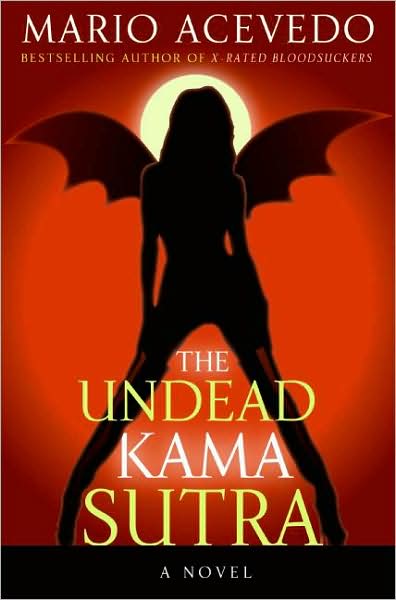
Mario Acevedo. The Undead Kama Sutra. NY: Harper Collins Publishers, 2008
ISBN-13: 9780060833282

Michael Sedano

Mario Acevedo has a great thing going for him with his Felix Gomez, vampire detective, series. Not only do the vampire characters possess a creepy allure, they get tangled up in wild adventures making such diverting intrigue, that fun-seeking readers will want to read each novel in the series.

In this third adventure, the detective travels to south Florida to mix it up with space aliens intent on corrupting the U.S. government while addicting the earth's men to virility-boosting pills, and women to breast-enhancement drugs that also increase libido. No problems with your HMO, either.

There's a nefarious motive behind this alien science that Felix uncovers with a little help from his undead friends.

The Kama Sutra of the title makes for a bit of silliness without getting too graphic. Carmen, with her friends and chalices (a human who willingly allows vampires to feed on their blood) helping, is discovering methods to use colorful sexual practices to attain transcendent levels of powerful spiritual energy. She wants to practice with a reluctant Felix and has to con him into bed.

Acevedo has a lot more confidence in his characters now. He devotes minimal space to Gomez' backstory--how he was turned into a vampire while fighting in Iraq--and the vampire world government, the Araneum, and its telecommunication system reliant upon carrier crows and arcane messages written on cured vampire skin that self-destructs on exposure to sunlight. The vampires enjoy an occasional nap in a coffin, and draughts of fresh blood that may cause momentary discomfort to queasy readers, even those who enjoy a nice boudin noir or morcilla nosh.

Gomez' friend, the luscious Carmen, has discovered a Caribbean secret: a spider whose venom tans the otherwise pale-skinned vampires. Being free to walk in daylight without heavy sunscreen makeup removes a key vulnerability. But there's a catch, for Felix: he loses his sure-fire vampire human chick magnetism. In fact, poor Felix grows depressed when a casual pick-up kicks him out of her apartment after testing his sexual athleticism. Felix, by the way, is one prideful vampire who prefers to conquer women without using his vampire hypnotic powers, so the loss of his magnetic allure is a source of shame as well as a looming ethical crisis.

Outside of seduction and feeding, Felix remains otherwise reliant upon vampire powers. Machine-gunned to shreds, he heals rapidly. When he infiltrates the high security military compound protecting the evil alien, Felix and pals float, climb walls, see in the dark, and zap human guards merely by making eye contact.

With all their undead power, however, Felix' vampire comrades are no match for the alien spy and his human hench seducers. Only an alien-ex-machina ending saves the day, sort of. Clever Acevedo, he disappears Carmen, leaving Felix frustrated at his inability to help her, but keeping the door wide open to what should be number four in the series, the quest to rescue Carmen and save her from her unimaginable fate.

Fiestas Patrias in America - Mes de la Herencia Hispana - Mes de Free Books

Hace unos años, in fact, since 1968, that the EUA has set aside a period of time to recognize and cerebrate things Latina Latino, Chicana Chicano, et al. The 90th Congress passed public law 90-498 authorizing and requesting the US President to declare an Hispanic Week. Gerald Ford did that. By the time the 100th Congress came about, in 1988, Public Law 100-402 declared a month would be enough, commencing the next year. So, ever since 1989, the United States has held its National Hispanic Heritage Month.

Little as I enjoy seeing "the 'H' word" associated with chicano literature, I feel the battle of the name is becoming passé as increasingly gente become inured to--or never felt the dagger of--accepting the government's imposition of its catch-all term in place of a preferred and more descriptive identity term. Like chicana chicano. Oh well, "so it goes," as the famous chicano writer Vonnegut used to say.

There's a point and here it is, from publisher Hachette:

In honor of Hispanic Heritage Month (Sept. 15-Oct 15) Hachette Book Group USA has rounded up a collection of our best books that celebrate Hispanic Americans to offer exclusively online as a free Hispanic Heritage Book Giveaway.


This exquisite list includes a number of highly thought-of titles, and some great discoveries:

Dream in Color By Linda Sánchez , Loretta Sánchez ISBN: 0446508047
Gunmetal Black By Daniel Serrano ISBN: 0446194131
The Gifted Gabaldón Sisters By Lorraine López ISBN: 0446699217
Bless Me, Ultima By Rudolfo Anaya ISBN: 0446675369
Brownsville By Oscar Casares ISBN: 9780316146807
The Hummingbird's Daughter By Luis Urrea ISBN: 0316154520
The General and the Jaguar By Eileen Welsome ISBN: 0316715999
Tomorrow They Will Kiss By Eduardo Santiago ISBN: 0316014125

Next week, look for details on how five La Bloga visitors can each win a set of all eight titles, mailed to the winner's home address by the publisher, in cooperation with las blogüeras los blogüeros here at La Bloga.


And that's the happenings from September's third Tuesday, a day like any other day, except we are here.

La Bloga welcomes your comments and questions. To participate, simply click on the Comments counter below. If you'd like to be a La Bloga Guest Columnist, you're welcome to click here to describe the book or arts review, issue, or other material you'd enjoy sharing.

See you next week.

mvs
c/s

Labels: , ,

Monday, September 15

Interview with Gustavo Arellano

Hot off the success of his bestselling ¡Ask a Mexican! (Scribner) which is based on his nationally-syndicated column of the same title, Gustavo Arellano roars back with a memoir, Orange County: A Personal History (Scribner), which is being released tomorrow (Mexican Independence Day!). The publisher describes Arellano’s book as “[p]art personal narrative, part cultural history, Orange County is the outrageous and true story of the man behind the wildly popular and controversial column ¡Ask a Mexican! and the locale that spawned him. It is a tale of growing up in an immigrant enclave in a crime-ridden neighborhood, but also in a promised land, a place that has nourished America's soul and Gustavo's family, both in this country and back in Mexico, for a century.”

I’ve had the opportunity to read an advance review copy of Orange County. Arellano’s new book is filled with his trademark sardonic humor blended effortlessly with facts, figures and historical context as he gleefully reveals the real Orange County, a place very different from that promoted by the county's business and political interests. I suspect his hometown will never be the same, at least in the eyes of the rest of the country.

Arellano kindly agreed to sit down with La Bloga and give an interview about Orange County.

DANIEL OLIVAS: Okay, let's just get it out of the way: Are you now an incredibly rich author?

GUSTAVO ARELLANO: I don't like to use these acronyms, but LOL :-)! My dad taught me to never ask someone how much money they make, but the reporter in me loves to leak information. Let's just say I'm still driving my 1999 Toyota Camry with 186,000 miles on it, but I was able to buy a near-mint 1974 Cadillac El Dorado convertible from my former boss with the advance I received--but I can't afford the steer horns for the hood that they require.

OLIVAS: Why did you decide to do a hybrid personal memoir/cultural history?

ARELLANO: The two books I always wanted to write were a history of Orange County and another telling the mass exodus of the ranchos of my mami y papi (El Cargadero and Jomulquillo, Jerez, Zacatecas, respectively) to Anaheim and points beyond. My agent was excited about the Orange County angle, but he was more enthralled by the tales of my family's four generations in Anaheim. He suggested I combine the two tales in our book pitch to publishers when we were shopping ¡Ask a Mexican! in 2006. While most of the companies to whom we pitched ¡Ask a Mexican! loved that compendium, Scribner was more excited with the Orange County memoir proposal. Guided by my editor Brant Rumble, I was able to accomplish the tricky feat of the hybrid that both told a serious history of a much-stereotyped region but also wove in the modern story of Mexican migration to los Estados Unidos.

OLIVAS: Was it liberating or horrifying to write a book that has real chapters longer than your usual answers to stupid questions about Mexicans?

ARELLANO: Ha ha, not all the questions I receive for my column are stupid--the ones I get on etymology are amazing. People who don't regularly read the OC Weekly usually are unaware that I'm still a reporter first and foremost, and part of my responsibility is writing 5,000-plus-word stories aspiring to the best of literary journalism. Taking that into consideration, I wrote each chapter of Orange County as if it were a cover story for the Weekly. The trick for me, however, was making sure that constant themes wove themselves through and through to make Orange County an actual book and not another collection of my writings. I enjoyed that process immensely and can't wait to do it again.

OLIVAS: It is clear that you gleefully take aim at the mythology created to promote Orange County. If you were forced to choose one myth to dispel, what would it be?

ARELLANO: That Orange County is Eden. It's not. I wouldn't want to live anywhere else on Earth, but I acknowledge the corruption, the Mexican-bashing, the iron grasp developers have on county residents, the class warfare across OC. All of what I just spoke of, however, is swept under the rug or--more deviously--celebrated as virtues in the official narrative followed and expounded by millions.

The main metaphor of my book is the Cult of the Orange Crate. Back when King Citrus ruled the land, orange farmers would ship their fruits in boxes with an ornate label--anyone who's spent their life in Southern California knows how they look: idyllic paintings of orange trees, pretty señoritas, rolling foothills, all with names like Esperanza, Old Mission and the like. The labels were both retelling reality and suppressing it. They didn't show the Mexicans like my great-grandfather and grandfather living in segregated citrus camps, the addiction to cheap labor the industry grew. Hey, Know Nothings: want to blame someone for illegal immigration in Southern California? Blame the citrus growers of yore.

Similarly, Orange County: A Personal History also addresses the idealization many Mexican immigrants maintain of the homeland they left, the insistence on maintaining culture and visiting as often as possible. Look, I'm about as Aztlanista as you can get, but there's a reason why millions of Mexicans have left la patria over the past century, and it's not because they're fleeing the Guatemalan invasion. I laugh when people say that life is better in Mexico than in the United States--yeah, tell that to the poor souls like my father who fold themselves into pretzels for a chance to break the shackles of poverty.

OLIVAS: You write about your family, warts and all. What has been their reaction?

ARELLANO: They haven't read the book yet. My mom's going to have a heart attack--whenever I'd tell her about what I was writing on a particular day, she scolded me like any good Mexican mami. But I tell those stories to specifically make a point to Americans--that Mexicans can and do escape from some of those pathologies they love to hoist on us as being exclusively Mexican: lack of a college or even high school degree, alcoholism, spousal abuse and the like. The crap I'm constantly debunking in my ¡Ask a Mexican! column. I'm proud to tell those warts. I'm proud that my dad has been sober for almost 25 years--millions of our young gabacho scholars in American colleges and universities can stand to learn from this 57-year-old Mexican.

OLIVAS: I cringed as I read how your father made you dress like a "real" Mexican and go to neighborhood dances. It is clear that you're emotionally scarred. But out of great pain comes great art, no?

ARELLANO: If you can wear a Stetson and cowboy boots, rock it. I'll stick with my Chucks and fedora.

OLIVAS: You pepper your book with restaurant recommendations (worth the price of the book alone!). Food obviously plays an important role in your life. If you were on death row, what would be your last meal?

ARELLANO: Food plays an important part in my life not just because of my mother's cooking but because I've been the food editor for the Weekly for the past four years (two years longer than the existence of ¡Ask a Mexican! column). Including the best restaurant in each of Orange County's 34 cities was an attempt to hoist another genre on my new book: the travel guide. All this said, my last meal would be my mom's rajas con papa y queso washed down with Honduran banana soda.

OLIVAS: You now have two books under your Mexican belt. What will the third one be about?

ARELLANO: La Bloga can break this news: I'm finalizing details to publish another book for Scribner with the tentative title Taco USA: How Mexican Food Conquered America (And Soon, the World). I want to examine the socio-culinary role that "Mexican" food has played in the United States--Tex-Mex, Taco Bell, the war against taco trucks, busboys, the Aztec gifts (tomato, chocolate, vanilla, etc.), the Mississippi Delta tamale, and how this vision is now influencing what "Mexican" food is in the world, and not, you know, actual Mexican food. Did you know that tacos are all the rage in Sweden, except their tacos make Taco Bell look like the masterwork of a lonchera?

OLIVAS: Finally, who do you want to play you in the movie version of Orange County (and if you say Robert Downey, Jr., I will kill you)?

ARELLANO: Funny you ask this question. My Facebook's status recently read that I was taking a bunch of ridiculous meetings--all I'll say at this point is that television execs LOVE to take meetings and that said meetings are farces. I've heard Sean Penn and Marc Anthony (shudder) should play me in a film, but I still say I'm the reincarnation of Buddy Holly and Ritchie Valens since they passed away on February 3, 1959 and I was born 20 years later. Or, if you need a flesh-and-bones version, a younger Woody Allen sans the gross womanizing.

OLIVAS: Mil gracias for spending time with La Bloga.

Here is Gustavo Arellano’s book tour schedule:

September 16 (LOS ANGELES): 7 pm, Borders, 8852 Washington Blvd., Pico Rivera, CA. Contact: Jan Wagner, 310-540-7000 ext. 552.

September 17 (PHOENIX): 7 pm, Changing Hands, 6428 S McClintock Dr., Tempe, AZ. Contact: Cindy Dach, 480-730-0205

September 18 (LOS ANGELES): Libreria Martinez (go to website for more information).

September 19 (AUSTIN): 7 pm, Book People, 603 N. Lamar, Austin, TX. Contact: Alison Kothe, 512-472-4288 ext. 207.

September 20 (DALLAS): 2 pm, Borders, 5500 Greenville Ave., Dallas, TX. Contact: Carlo Rich, 214-363-9305.

September 21 (HOUSTON): 2 pm, Nuestra Palabra, George R. Brown Convention Center, 1001 Avenida de las Americas, Houston, TX 77010. Contact: Tony Diaz, 832-630-6007.

September 23 (NEW YORK): 7:30 pm, Barnes & Noble, 396 Avenue of the Americas, New York, NY. Contact: Donna Rausch, 212-674-8780

September 24 (DENVER): Tattered Cover, 1628 16th St., Denver, CO. Contact: Charles Stillwagon, 303-436-9219 ext: 2736.

October 18 (LOS ANGELES): SCIBA Author Feast.

◙ I previously reported on the opening of Rancho Pancho, a new play by former Los Angeles Times journalist and San Antonio playwright Gregg Barrios. The play is about the short-lived but intense relationship between playwright Tennessee Williams and South Texan Pancho Rodriguez from 1946-1947. The other characters are Carson McCullers (with whom Williams and Pancho shared a summer home in Nantucket), and pioneer stage director Margo Jones (who was in P-town for Brando’s Streetcar audition). Well, the San Antonio Current just reviewed the play and said this, in part:

The hot ticket Saturday night seems to have been the premiere of the fully-staged version of “Rancho Pancho,” playwright Gregg Barrios' exploration of the tempestuous relationship between Tennessee Williams and Texan Pancho Rodriguez.

Jump-Start Theater was filled to the rafters for the performance — folding chairs were brought in to accommodate late-comers. Sunday's performance drew a healthy crowd as well, according to figures from the brand-new Classic Theatre, which staged it in collaboration with Jump-Start.

The crowds were rewarded with a satisfying piece tracing the relationship from its early, playful phase all the way to the explosive, emotionally draining break-up. Director Diane Malone has described the play as a love story, and that's exactly what she and her gifted cast delivered.

[The cast of Rancho Pancho is pictured above: Rick Frederick (clockwise from top left), Benny Briseño, Anna Gangai, and Annella Keys.]

Rigoberto González, writing for the El Paso Times, reviews first-time novelist Claudia Guadalupe Martínez’s young adult novel, The Smell of Old Lady Perfume (Cinco Puntos Press, $15.95 paperback), which he calls a “touching study of the heartaches that befall an 11-year-old girl living in El Paso's historic Segundo Barrio.” If you live in or near El Paso, you may meet Martínez who will be appearing for a reading and book signing to introduce The Smell of Old Lady Perfume. When: 6:30 p.m. this Saturday. Where: La Fe Cultural and Technology Center, 721 S. Ochoa (rear entrance). Information: 838-1625.

◙ Agustin Gurza, staff writer for the Los Angeles Times, tells us about a new outlook for singer Lila Downs:

Lila Downs is an artist who always seemed to have her act together. The Mexican American singer has a stunning voice, a confident multicultural vision grounded in her Mixtec Indian roots and a successful 15-year career in world music circles. What she doesn't have is a child.

Downs faced her inability to conceive as she approached her 40th birthday this month, and the productive artist suddenly felt barren. Depressed and drinking, the together performer fell apart. "What . . . am I doing in this life if I can't have children?" she asked herself. "That's the whole point of living as a woman."

The deteriorating political situation back home in her beloved Oaxaca, wracked by a violent teachers strike two years ago, only made matters worse. As a champion of the culture, she felt powerless and angry, and she started taking it out on her band. Once, in the middle of a concert in the Canary Islands, she walked off the stage, thinking, "You guys work it out yourselves. See how far you get without me."


To read the entire piece and how Downs got her groove back, click here. If you have story ideas for Gurza, email him at agustin.gurza@latimes.com. (Pictured: Lila Downs; photo credit: Los Angeles Times.)

Sarah Rafael García invites everyone to her first on-campus presentation. She will be presenting Las Niñas (Floricanto Press) at Cal-State University at Fullerton, to several classes but they will also provide an open special event:

Cal-State University at Fullerton
7 p.m., Tuesday, October 7th
TSU Ontiveros Room ABC

For address & directions, click here

Co-sponsored by CSUF's Researchers and Critical Educators (R.A.C.E.) and the Chicana & Chicano Resource Center.

◙ An announcement from the Cypress Park Branch Library:

Most of the attention the working-class, largely Latino community of Cypress Park northeast of downtown receives from major media comes from spasms of gang violence. The fatal shooting in August of a Los Angeles County sheriff's deputy. The February shooting outside Aragon Elementary School.

But the community is much more than that.

The Cypress Park Branch Library, a hub of community activity at 1150 Cypress Ave., will showcase another side of the neighborhood with a free reading 3 p.m. Saturday, Sept. 20, featuring two local authors, one of whom grew up in Cypress Park.

Reading from their work will be Reyna Grande, author of the critically acclaimed novel Across a Hundred Mountains, and Conrad Romo, who produces "Tongue and Groove," a five-year-old monthly reading event at the Hotel Cafe in Hollywood, and who grew up in Cypress Park a block from the former Southern Pacific railroad yard.

Grande, who was born in Mexico and came to the U.S. as an undocumented immigrant at the age of nine, received a 2007 American Book Award and the 2008 El Premio Aztlan Literary Award, for her first novel. She is currently finishing a master's program in creative writing and her second novel, Dancing with Butterflies, is scheduled to be released in 2009.

Romo, a second-generation Angeleno, has had short stories published in Palehouse, Wednesday magazine and Noveltown Review. His short story, "Cement God," was recently featured in Tu Ciudad magazine and also appears in the Anthology Latinos in Lotusland.

Romo organized the reading in an effort to give something back to the community where he grew up, to call attention to positive aspects of the tight-knit community, and to show that Cypress Park is defined by more than just the headline-grabbing violence of a few gang members.

"There are other stories," Romo said. "A whole community can be identified by just a few actions. . . . but there are other stories, other people who live there."

Contact: Conrad Romo, (323) 931-1200, or through his website. Branch Librarian: Patty Rostomian, (323) 224-0039.

◙ Happy to be back but I really did enjoy my family vacation to Yellowstone. Remember that Latino Heritage Month begins today. There are many ways to celebrate, of course, but how better than buying a book by your favorite Latino/a author? If you need ideas, check in with La Bloga each day. See you next Monday and remember: ¡Lea un libro!

Friday, September 12

Bibliocaust


A UNIVERSAL HISTORY OF THE DESTRUCTION OF BOOKS: FROM ANCIENT SUMER TO MODERN IRAQ
Fernando Báez, translated by Alfred MacAdam
Atlas & Co.

One of the first inquiries that Sarah Palin made when she became mayor of Wasilla, Alaska, in 1996, was to ask the city librarian if she would be open to banning books from the library. The librarian explained that all the library books had been "purchased in accordance with national standards and professional guidelines" and that she would fight anyone who tried to dictate what would sit on the library shelves. Ms. Palin went about her business of governing the town of 6,300 residents, performing tasks such as asking most of the city officials under her authority for their resignation, including the librarian, as part of a "loyalty" test. Ultimately, the librarian stayed on at the library and Ms. Palin moved on to other things.

The news splash of that almost-forgotten episode in the life of the person who may well end up only a heartbeat away from the Oval Office, as the morning talk show hosts like to say, instigated within me a thought-process that eventually led to Fernando Báez's Universal History of the Destruction of Books. It started with trying to put myself in the place of the small-town mayor who thought that a priority after winning the election was to worry about the subversive, dangerous and evil books in the city library. It ended with reading Báez's catalog of the incessant war against writers, ideas, history and identity.

Báez writes about much more than banning books, of course. His subject is the story of the obsessive violence committed by humans against books since books were first invented. He writes about the burning of books, about bibliocaust, which he defines as the destruction of books in "an attempt to annihilate a memory considered to be a direct or indirect threat to another memory thought superior."

Báez is the director of Venezuela's National Library and a recognized world authority on the history of libraries. His incredible saga about the destruction of books begins and ends in Iraq, where humanity's first books appeared, a "great paradox" according to Báez. In Sumer (southern Iraq), between 4100 and 3300 BC, Báez estimates that 100,000 clay tablets were destroyed, primarily because of the wars between the city states, which were always accompanied by fires. The last chapter describes the author's 2003 visit to Iraq as a member of the U.N. committee investigating the destruction of the country's libraries and museums.

Báez details the looting, ransacking, and burning of Iraq's libraries. He describes the destruction of books, tablets, artifacts, state records and documents - the heritage of the country. The numbers he cites are staggering: ten million documents disappeared from the Iraqi National Archive, including tomes from the Ottoman period such as registries and decrees; almost a million books were lost in the looting and burning of the National Library; more than 150,00 clay tablets have disappeared from archaeological sites. The University of Baghdad was attacked by looters in April, 2003, shortly after the U.S. invasion. The destruction was complete, rendering the University "desolate" and "burned-out." The library in the College of Physicians, which had a collection of medieval Arabic texts on medicine, was emptied. A student told Báez: "Someday someone will burn the Library of Congress, you know, but they won't lose anything like what's been destroyed here."

The destruction and looting had been expected and two months before the U.S invasion a group of archaeologists met with advisers to the U.S. President and warned them that museums and archaeological sites had be protected by U.S. troops. Five thousand essential sites were on a list presented to Martin Sullivan, President Bush's cultural adviser.The warnings and list were ignored and Sullivan resigned in frustration when the looting began. The litany of war crimes ascribed to the U.S. includes violations of the Hague Convention of 1954 because U.S. troops did not protect the cultural institutions of Baghdad. For example, after soldiers knocked down a statue of Saddam outside the National Library, they left, leaving the building open to looting and arson. Báez concludes that "Iraq was the first place to fall victim to cultural annihilation in the twenty-first century."

Among the Ten Worst Moments in the History of Books, compiled by Baez, is the destruction of Mayan books in 1562 in Mexico. In Maní, in the Yucatán, Diego de Landa burned 5000 idols and twenty-seven codices of the ancients. This statistic is found in the chapter entitled The Destruction of Pre-Hispanic Culture in the Americas and, again, the parade of horrors, the description of over five hundred years of plunder, is overwhelming.

In 1530, in Texcoco, the first bishop of Mexico, Juan de Zumárraga, made a bonfire of all the writings and idols of the natives. Ironically, Zumárraga introduced printing to Mexico; he also created the first public library in Mexico. In their zeal to obliterate native culture, the Spaniards destroyed and outlawed all symbolic manuscripts of the Indians including magic figures and charms. Gold objects were melted down or seized as "trophies" by European collectors. Báez notes that although the list is not long, the most important codices are now in Europe. These surviving Aztec codices are of colonial origin. Mayan theatrical performances were prohibited; only three pre-Hispanic Mayan codices survived the purges. The disappearance of the native culture was so complete that Báez can state: "No one imagines that a Christian cathedral could be built on top of the pyramids of Egypt or the Sphinx, but that is exactly what happened in Mexico during the sixteenth century."

The Introduction to this book explains Báez's basic theories about the type of person who burns books and why such destruction has been a consistent part of the world's history. He states that books are not destroyed as physical objects but as links to memory - "there is no identity without memory. If we do not remember what we are, we don't know what we are." When a group or nation attempts to subjugate another group or nation, the traces of memory must be erased. Báez also concludes that there are dozens of causes for the destruction of a book or library but the root of all such destruction is the "intent to induce historical amnesia that facilitates control of an individual or a society." Báez writes about the Culture of Destruction, and one of his most troubling observations is that, in general, bibliocasts are "well-educated people, cultured, sensitive, perfectionists, painstaking, with unusual intellectual gifts, depressive tendencies, incapable of tolerating criticism, egoists, mythomaniacs, members of the middle or upper classes, with minor traumas in their childhood or youth, with a tendency to belong to institutions that represent constituted power, charismatic, with religious and social hypersensitivity. To all that we would add a tendency to fantasy. In sum, we have to forget the stereotype of the savage book destroyer. Ignorant people are the most innocent."

There are chapters about the Library of Alexandria; China; Rome and Early Christianity; the Islamic World; the Renaissance; England; the Rise of Fascism and the infamous Nazi book-burnings; and the conflicts between battling ethnicities such as the Bosnian War (1992-1995) when some of the "most radical acts of violence in European cultural history were perpetrated." The book is complete and devastating in its indictment of the complicity in this violence of those in control, those who have the power or who are seizing power, whatever historical time period is discussed.

I took away from the book the important lesson that book burnings and censorship are products of the divide between us and them; that, as Báez writes, the negation of the other requires control, which in turn means barring information. This tendency in all of us can be opposed and stopped. We can resist the censors when they come to our town, and just like the librarian of a small Alaskan library, we can fight for
the books.

Later.

Labels: ,

Thursday, September 11

RAW SILK SUTURE

illustrated by Maria Arango


Gente: below is the press release for what is my latest book, Raw Silk Suture. It has been a blessed project, and a labor of love. My dedication is also posted, but I would be remiss if I did not also thank Maria Arango for her gorgeous illustrations, my editor Carlos Mock, my graphic designer, Bill Rattan, and my publisher, Roberto Cabello-Argandoña, and the talented and generous Susan Palmer Marshall for her invaluable feedback. Lastly, un abrazo to Juan Felipe Hererra, Demetria Martinez and Francisco Aragon for their encouragement and unflagging support.

xxxxxxxxxxxxxxxxxxxxxx


PRESS RELEASE


In this collection, Lisa Alvarado wields the pen and cuts deeply to the heart of Chicanisma, female identity, the use and misuse of the body, its restoration, and the power of love. With finely etched free verse, each subject is explored to the depth without hesitation, and boldly revealed.

PRAISE FOR RAW SILK SUTURE

"Figures in black abound in Alvarado’s “perishable craft,” her words of and for the unseen...her intensities are relentless. Alvarado is a poet of the abyss...Such an artist was Frida Kahlo....Lisa does not offer an exit; this is one of her superb contributions. She conjures, that is all....Caress this book as you would hold your soul-to-be gasping for life. That is all."
-- Juan Felipe Herrera, poet. Author of 187 Reasons Mexicans Can't Cross the Border and Half of the World in Light, New and Selected Poems; Professor, Tomás Rivera Endowed Chair, Department of Creative Writing University of California


"Alvarado's call for "a quiet remaking of cells" is nothing short of revolutionary. Read this book, look at yourself and the world around you and know: anything is possible."
-- Demetria Martínez
author, Confessions of a Berlitz-Tape Chicana

"Simply put, Raw Silk Suture is “a scar / that has / become a flower.”
-- Francisco Aragón Editor, The Wind Shifts: New Latino Poetry Founding Editor, Latino Poetry Review (LPR)


"The poetry of Lisa Alvarado thunders across the page. Fiery and smoky, these are poems for midnight whiskey and pre-dawn espresso. These are poems for what ails us." -- Manuel Ramos, Author, Moony's Road to Hell, and Founder and Columnist, La Bloga

Lisa will kickoff the national release, Saturday, September 20th, 7:30 PM, at: Decima Musa, 1901 S. Loomis St, Chicago, IL, hosted by Palabra Pura/Guild Complex. She will also be appearing at Acentos in the Bronx, New York, on September 23rd, 7 PM, as part of the national kickoff for this release. (The Bruckner Gallery at Bruckner Bar and Grill, One Bruckner Blvd.; corner of Third Ave. and Bruckner Blvd.)


BIO:


Lisa Alvarado is a poet, performer, and installation artist and is the author of two award-winning chapbooks, Reclamo and The Housekeeper's Diary; the latter also a one-woman performance which toured nationally. Lisa is also the co-author of the acclaimed young adult novel, Sister Chicas, written with Ann Hagman Cardinal and Jane Alberdeston Coralin. She is the recipient of grants from the Department of Cultural Affairs, The NEA, and the Ragdale Foundation, and is also a journalist, contributing reviews and interviews to La Bloga, and Blogcritics.org. If you are interested in booking Lisa to experience this groundbreaking work contact her at: lisa@lisaalvarado.net. For review copies or to purchase, contact: Roberto Cabello, Floricanto® Press 650 Castro St, Ste 120--331 Mountain View, California 94041-2055 415-552 1879 Fax 702-995 1410 http://floricantopress.com Inter American Development Inc.

ISBN: 978-1-888205-06-0

###### FIN ######

And I'll let the dedication page say what's in my heart:

For Luis Rodriguez and Maureen Seaton,
who laid the word ‘writer’ at my feet.

For Martín Espada, Odysseus de Nueva York.
For the clenched fist and the lion’s heart.

For Diane Ackerman,
who reminds me the divine is in every day beauty.

For Tara Betts, Sharmili Majmudar, for the flesh in the word.


To Michael Sedano, Manuel Ramos, Daniel Olivas, Rudy
Garcia, Gina Sol Ruiz, René Colato Laínez, for making me bring my ‘A’ game.

For Jay and June, heart of my heart, and Rose, dear sister mine.


And lastly, for my sisters, Ann Hagman Cardinal, Jane
Alberdeston Coralin, for writing that that comes from the deepest roots.

xxxxxxxxxxxxxxxxxxxxxxxxxxxxxxxxx

SAD NEWS FROM ACENTOS

The crew at Acentos extends its deepest sympathies to the family and friends of novelist Edgardo Vega Yunqué. He passed away on August 25th, age 72.

The New York Times' David Gonzalez eulogizes and remembers his friend
here: http://cityroom.blogs.nytimes.com/2008/09/08/chronicler-of-new-york-leaves-the-scene/?ei=5070&emc=eta1

Mr. Vega Yunqué's writing was of the fiercest variety: uncompromising, curious, surprising. Always a proud Boricua, a chronicler of New York, as Gonzalez notes, he never succumbed to
the popular notions of Boricua writings, breaking and challenging conventions wherever he could.

For our part, it is important to note that Ed spent his childhood in the Mott Haven section of the Bronx, where the Acentos series calls home. His sudden passing reminds us of the mission we share as writers to chronicle our barrios, our people, with the truest words we can pen.

Vaya Ed Vega Yunqué…and godspeed.

Paz,
The Acentos crew.

Labels: , , , ,

Wednesday, September 10

Book Trailers

René Colato Laínez

Inspired on the famous Movie Trailers, now writers and illustrators are making their own trailers. But instead of movie clips, they use the art and images of their books.

Take a look at LITTLE NIGHT by Yuyi Morales. This wonderful book won the Golden Kite Award given by the Society of Children's Book Writers and Illustrators (SCBWI).


Like a movie trailer, a book trailer can inspire you to go to a bookstore or library and look for that particular book. In the movie trailer, you can include your previous books and your websites. ESTELA'S SWAP was written by Alexis O'neill and Illustrated by Enrique O Sanchez.


A book trailer can make you laugh too. Do you know who are the Cheecharrones? You will know them after watching this book trailer. CAPTAIN CHEECH was written by Cheech Marin and illustrated by Orlando L. Ramirez.

Tuesday, September 9

Review: Black and White and Dead All Over

John Darnton
NY: A.A. Knopf, 2008.
ISBN: 978-0-307-26752-8 (0-307-26752-0)

Michael Sedano

Back when I was a kid, someone told me a homophone joke, "What's black and white and
read all over?" A newspaper. Shortly thereafter came the "sick joke" version, "What's black and white and red all over?" A dead nun.

I can't believe it's taken almost sixty years for some writer to use one or the other of those jokes as a title allusion, but it has. The culprit is John Darnton, and he's used both jokes to signal a newspaper-based murder mystery--there's neither convent nor nun. In keeping with the jokester heritage of the title, Darnton writes Black & White and Dead All Over as a roman à clef comedy that's well worth putting up with some cutesy stuff and an early give-away of the murder's identity.

Since a whodunit revolves around characters, Darnton elects to give his silly but often illustrative names. The predator mogul who wants to swallow up the newspaper is a New Zealander, Lester Moloch. The first murder victim is an unpopular editor surnamed Ratnoff. Less obscure, perhaps, are the detectives who unravel the crime. The police investigator is one Priscilla Bollingsworth--attractive but not readily approachable--and the reporter, Jude Hurley. For her, think homophone vulgarity, balling; for him think literarily, Hardy's character Jude Fawley.

After a brisk opening--the first body drops in the first pages--Darnton slows down the action, giving over lots of space to introducing the names of his characters and their foibles. I'm sure there are tons of newspaper in-jokes flying here. Darnton explains the ones that require more than insider knowledge, allows others to fly past. Some of this backgrounding is necessary to the story, like the vicious Ratnoff's penchant for savaging poor reporting, and his hardly compensatory practice of scribbling a one-liner of praise in purple ink. When Ratnoff's body is discovered, the murderer has spindled into the corpse that same one-liner in purple ink. But some of the characters, like Bavardez--such an unusual name--simply disappear, leaving the reader wondering what all the fuss was about.

The title is a bit of a misnomer. There are only three murders, but they are spectacular. The spindled editor in the City Room, the gossip columnist wrapped in bailing wire in the basement, the cook poisoned and flopped into her pear soufflé in the studio kitchen. But then, the "dead all over" could as well archly refer to Darnton's subtext, the death of print journalism and the rise of the internet. With the murders all occurring on the premises, the board locks out the frightened employees. Jude turns to the web-based paper to pursue the case and publish his stories. In fact, Darnton points to tabloids and web publications as reflections of what readers read and where journalism is making its last stand. Jude's paper, The Globe, populated with old-fashioned writers and colorful characters, is on its last legs.

With all the importance names have in this novel, the dead give-away of the fiend's identity comes at the absence of a name. When the gossip columnist sees her murderer, not yet realizing what his presence implies, she recognizes him by announcing, "Oh, it's you." In a world marked by camaraderie and spirited repartee, "you" offers a telling indicator of status and contempt. Then, in the next chapter, Jude has a similar encounter with a character, whom Jude recognizes with the same tell-tale, "Oh, it's you." That's right, "you," it turns out, is the killer. That is not a spoiler revelation. Readers will find Darnton's name play thoroughly enjoyable, so when a person pops into the story and is deprived of a name, that telegraphs significance. Too bad Darnton doesn't name that person Butler.

There are a couple of subplots running--a bastard heir, Moloch's spies, Jude's courtship of Bollingsworth, the impending death of newspapering--that keep the story running at an enjoyable pace. Several laugh out loud moments will be rewards beyond the sense of authenticity--or perhaps comfortable stereotypes--for newspapering Darnton weaves into the fabric of the novel.

It's interesting that there are several outstanding newspaper motion pictures, but not many newspaper novels. Kinky Friedman has a colorful columnist character, but for novels, I wracked my brain. The only other newspaper novel I can remember is The Last City Room, by the LA Times' Al Martinez. It's thus a pleasure now to add one more to the list, John Darnton's Black and White and Dead All Over. Got others? Leave a comment and recommend it.

mvs

La Bloga welcomes your comments on this and any column. Simply click on the Comments counter below. La Bloga welcomes guest columnists. If you have an extended reply, a book or arts review, or something of interest, click here to let las blogüeras los blogüeros know you'd enjoy an invitation for a Saturday guest spot.

Labels: ,

Monday, September 8

Lipstick Vogue


The other day I was at Gesine’s having a latte with my friend Rick and he mentioned he had had a long conversation with his mother the night before. I didn't know much about her, so I asked questions: what she had done in her life, what his relationship with her was like, who she was. As he spoke I imagined a well-coiffed, tailored, seventy year-old retired school teacher who sent floral-scented thank you notes and organized her husband’s sock drawer. He painted a comforting picture of his mother, a woman I imagined was a more traditional "Mom" than my own had been. Then as I took a bite of my pastry he added, “During our conversation last night my mother told me she was thinking of getting her lips tattooed.”

After I dislodged the small piece of carrot cake that I had nearly asphyxiated on in my shock, he quickly added, “Not with a design or anything. Just a color, like permanent lipstick, you know? Several of her friends have done it.” As I continued to stare at him, attempting to reconcile this bit of news with the image I had of his seventy-year old mother and deciding if he was merely pulling my chain, Bonnie came out from behind the counter and walked towards our table.

“I’m sorry, I hope you don’t think I was eavesdropping, but I just have to ask about this lip tattoo thing.” She turned to Rick, “Are you serious? Your mother’s considering this?” Rick confirmed that it was indeed true. Bonnie was shocked too, but clearly fascinated. Finally she offered, “Well, it kind of makes sense. My mother was on her deathbed and she just had to apply new lipstick before going into surgery. I think it is a generational thing.” She smiled as she remembered her mother groping for the tell tale green tube on the hospital night table.

I was prompted then to remember my Great Aunt Ana in Puerto Rico. She was a forceful woman with a military-like countenance, a series of tasteful length polyester dresses her uniform, and always armed with a completely practical and frugal approach to life. A former math teacher she saved everything, spent no money that wasn’t absolutely necessary, and always wore her salt and pepper hair in a sensible helmet of controlled curls. Needless to say she was not a woman prone to frivolity or vanity…with one exception: the hourly application of peppermint pink lipstick. I used to love to watch her do it. She would purse her lips as if she had just eaten a lemon then carefully apply the lipstick while looking into a tortoiseshell, compact mirror. As she neatly tucked the lipstick and mirror into their proper compartments in her black vinyl handbag, she would un-purse her lips, pink stripes going up and down her lips from where she had puckered them. No matter how much she was lacking in skill, I recognized that this was her one indulgence, her one nod to the girlhood that was robbed from her when she was told she was expected to care for her disabled sisters and not marry. Realizing this, I celebrated her candy-cane striped kisses.

But in my family this habit was not just restricted to Ana. My mother would not even go to the supermarket without lipstick. Her beauty routine included many more elements than her Aunt, but lipstick was as essential to her as her eyeglasses or shoes. When we traveled she carried around a hard-sided, Samsonite make-up case that coordinated with her teal luggage. I remember walking through the airport hand in hand as she carried the case in the other, the clean clicking sound of the Max Factor lipsticks rolling back and forth in the upper tray of the case. How many of you readers were once little girls (or boys) who smeared their mother’s lipstick haphazardly on their lips, proudly displaying what you thought was a badge of adulthood?

I had been half listening to Bonnie and Rick talk as this Viewmaster reel of memories ran through my head, when I became aware that they were looking at me.

“Did I freak you out with the tattooed lips story, Ann?” Rick asked. I thought for a minute as he and Bonnie waited for my reply.

“No. I think it is lovely that your mother enjoys festive colored lips enough to make it permanent. But what about being able to change the color with her outfits?” As my friends discussed this dilemma, I thought about these stylish, mature women with their paraffin smelling lipsticks, and smiled. Then I quietly put down my empty coffee cup, the tell tale kiss mark of Viva Glam IV on its white cardboard rim and reached for the lipstick tube from my purse. Pulling it out, I raised it up to Rick's and Bonnie's mothers, to my great aunt Ana, and to my own well-turned out mother, a generation of women who took care and pride in their appearance, and recognized that whether you were going to church, the supermarket or the operating room, you should always look your best. Then I pulled the top off of the black metallic tube and carefully reapplied the frosted wine color to my own lips.


[Monday's regular contributor,
Dan Olivas, returns next Monday, Sept. 15.]

Labels: ,

Saturday, September 6

The Whole Story


We all have them. In fact, some of us have more than others. Family stories. Historical ones, inspirational ones, and, of course, humiliating ones. Though I am certain that many of you hear your share of these at any family gathering, it is the storytellers (or cuentistas) among us who carry these tales forward. Though, as I came to find out about my mother’s tales, they are not always based in fact, but are sometimes closer to fiction, but I had to inherit the skill from somewhere, verdad?

I started telling stories when I was five. In the sixties, family vacations were road trips. Every summer my parents would load the five of us kids into our VW van and head down to Florida to visit our grandparents. We would stop at the South of the Border stores, purchase pounds of colorful plastic souvenirs, eat massive amounts of heavy comfort food, and stay at motels with tiki-themed pools. On one particular occasion we had been on the road for several days and had run out of things to talk about. My brothers and sisters surrounded me with arms crossed and sulky looks on their faces as we putted along highway 95. Seeing the possibilities for an audience I announced, “Once, I had a pony.”

Silence.

I looked over and saw that my brother John was smirking at me and suddenly realized that he would know I was lying since he was indeed six years older. I quickly added, pointing to John authoritatively, “I once had a pony, and then you were born.” Silence. Then uproarious laughter. Needless to say I will never live this down and though I am 45 it is still brought up at family gatherings, but that afternoon, when things calmed down in the car my mother gave me a lecture about not making up stories, and how I should always tell the truth.

My mother's insistence on the truth made sense to me as I never thought she had much of a flare for telling stories. There were certainly more talented cuentistas in the Davila family, but she had a few she would tell me from time to time, always with a seriousness that implied she was imparting a deep dark family truth for my own good. There was a room in her great aunt Ana's house, right next to the one we used to stay in when we went down to Puerto Rico for a visit. Ana would never let anyone in there: when she needed to get something out of it she would open the door just wide enough to slip through and close it behind her so I wasn’t able to follow. I couldn't imagine what was behind that slatted wooden door. Treasures? Scaly green monsters with glowing yellow eyes? I asked my mother about it one night as we tried to sleep to the whir of the air conditioner and the whine of mosquitoes above our heads.

"Why won't Anatia let anyone into that room?"

My mother replied, "Well, her father, my abuelo, shot himself in that room."

I gaped at her in the dark. "What? Why??" I squealed as she shushed me, looking toward the closed door as if Abuelo himself were listening from the other side.

"He was sick with TB and he didn't want to be a burden to his family, so he took out a pistol and shot himself in that very room. Anatia is the one who found him and since then no one can enter the room but her."

I lay there in silent awe, gently pulling my head away from the stucco wall that divided me from the memory of my great grand-father's violent death in the next room.

Over thirty years later, ten years after my mother's death, I was in a restaurant with my mother's siblings, and I mentioned the story of my great grandfather. Tio Jorge practically choked on his tostones.

"¿Que? Abuelo didn't shoot himself! He died very peacefully in a hospital! And that house Anatia lived in wasn't even built then!" I just stared at him, heat rising from my chest to my face.
Finally I sputtered, "What? Mom made it all up?" I began to recount the other stories she had told me. One after another, they were confirmed to be fiction. I was furious. Beyond furious. How could my mother feed me these lies year after year? And I believed her! I could just see her talking to me over her shoulder in the VW van, her self-righteous lecture about not telling stories ringing in my ears.

I stared at my half eaten lunch, tears gathering in my eyes. My cousin Jose Luis took my hand and said, "Annie, what does it matter if the stories are true or not? Isn't our family as defined by the stories that aren't true as by the ones that are? Write them down, Annie. That is your role in this family. Write them down, true or false. They are what makes us who we are."

It was this revelation that helped me become a writer as well as a storyteller. My cousin taught me a very important lesson that day and I often hear his wise words in my head. Every day we have less and less opportunities to hear these oral histories (or, in my family's case, historical fiction). Any hours spent traveling by car are now filled with Gameboys, individual DVD players watched with headsets on, our ears glued to cellular phones. Something has been lost in the electronic din. Something that once defined us. I want my son to hear the stories of his abuela, no matter how outrageous, how fabricated. It is the storytellers that continue to weave the fabric of our families by bringing these tales forward. So what if they add a bit of their own embroidery or embellishments along the way? I’ve come to believe that it is these intricate designs that define us, that reflect who we are as a family. So next Thanksgiving, let your drunken uncle Joaquin tell his tall tales. And be sure to take notes. You never know when you might want to remember it.

Friday, September 5

New American Music

Just in case we might like the same kinds of music, here are a few new selections that have earned time on the ole' turntable.


PISTOLERA - EN ESTE CAMINO
Luchadora
The second CD from this New York-based group does not have a weak spot in any of the twelve tracks. From Nuevos Ojos to Arena the songs are tight, full-bore Latino progressive, including the rendition of Bob Marley's War (Guerra). The group consists of Sandra Lilia Velásquez on vocals and guitar, Maria Elena on accordion and piano, Inca B. Saiz on bajo, and Ani Cordero on drums and vocals. These four musicians manage to produce a powerful and very danceable sound. There is a lot going on here, from the selection of song formats and instruments to the politically-charged lyrics - check out Extranjero and Policía for examples. As I did my best to keep up to the music, I heard a little banda, a little tejano, a bit more of ranchera, a dose of indie-pop, and a great deal of something else that this band brings all on its own. Go here for a video interview with the entire band as part of its selection as the Clandestino Artist of the Month for Go TV Networks. The band's website is here.


CALEXICO - CARRIED TO DUST
Quarterstick Records
Tuscon residents Joey Burns and John Convertino (and several guest musicians, some of whom are now members of the band) have been recording as Calexico since 1996. Their latest effort, Carried to Dust, is a pleasing combination of musicianship, lyrical free expression, and a soaring, almost romantic ambiance. There's a country style to the music, but somehow jazz plays a part. According to the record label website, this collection is a concept piece about a Los Angeles writer, the 2007 writer's strike, and a mind-bending tour of stops along the inspirational highway. I confess I haven't got that deep into the CD yet, but the song Writer's Minor Holiday sure is in that territory. You can watch Burns and Convertino perform Two Silver Trees. Amparo Sanchez and Jacob Valenzuela carry the vocals on the beautiful and intriguing Inspiración. The video does not do justice to the CD version, but you can watch the full Calexico band perform Inspiración here at this link.


LOS FABULOCOS FEATURING KID RAMOS - LOS FABULOCOS
Delta Grove
I confess. I'm an old timer. I dig oldies, roots music, blues, conjunto, a little country. Give me some rockabilly or a speeding accordion, and it's all good. Through in some Tex-Mex and a soul cover, a few catchy lyrics, and it's even better. And there you have Los Fabulocos. Veteran Southern California musicians Jesus Cuevas (vocals and accordion), Mike Molina (drums), and James Barrios (bass and background vocals) have teamed up with blues star Kid Ramos (vocals, guitar, bajo sexto, Spanish guitar) to form a high-energy, kick-ass party band that challenges you to stay in your seat once they get started. Hey, this CD has Un Mojado Sin Licencia (the guy just wanted to see his Chencha) from Flaco Jimenez's playlist, the zydeco classic You Ain't Nothin' But Fine, and Cornelia Reyna's Como Un Perro. Included are bangin' versions of Lloyd Price's Just Because (one of the all-time pachuco broken-hearted tunes) and Dr. Loco's Mexico Americano. See what I mean? How can this be anything but great. And the original material is just as solid: If You Know, Day After Day, and You Keep Drinkin' . This CD gets my highest recommendation. There's plenty of video of these guys already on the Internet. Here's one.

CD release party on September, 12 2008, 9:00 PM, at The Doll Hut with guests The 44’s - 107 Adams Avenue, Anaheim, California. (714)533-1286.

AND ...
I've heard only samples of the new Indigenous effort, Broken Lands, but it's getting good press. Need to get my hands on a full copy. Los Lonely Boys have struck again with another winner, Forgiven. Accordion giant Steve Jordan produced this gig. And for something different - Wynton Marsalis and Willie Nelson? It works. Contrary to the CD's title, Two Men with the Blues, this is not downbeat. Stardust is splendid.


A BIT AND A PIECE
Rigoberto González reviews Manuel Peña's Where The Ox Does Not Plow (University of New Mexico Press) in the El Paso Times, which you can read here. González says that "Peña's memoir is an insightful study of one man's journey toward political and social consciousness, and of his discovery that value is not in wages and class comforts, but in self-respect and the appreciation for his imperfect family and community. Education, he tells us, is not limited to the confines of the classroom."


Finally, I had some fun with Elmore Leonard and his Ten Rules For Writing in a piece I did for the Colorado Authors' League. You can read it here. As my grandson says, "Just kidding."

Later.

Labels: , , , , , , , ,

Thursday, September 4

Down to the Bone and Down to the Truth


My Take:

First, much in the way Rigoberto Gonzalez cracked the lavender ceiling with prose and poetry, LGBT youth, young women especially, can see their lives reflected in Down to the Bone. This books shatters the invisibility of young lesbians in Latino/a lit, and it does so with heart, with a finely etched, portrait of the protagonist, Laura. Laura falls in love and commits the cardinal sin of getting caught reading a love letter, and must face isolation from her family and expulsion from school.

But that's only one aspect of this book. Laura is thoughtful, tender, self-aware, and struggles between an authentic life and the closet---we get a bird's eye view of what losses she faces and what precious truth. This is a coming-of-age story worthy of a close read for anyone who wants to feel the razor's edge many LGBT youth face day in and day out. Down to the Bone is certainly a bright mirror in which our young women-loving sisters can see themselves. It's also a loving touchstone for those adult hermanas who have come before and opened the closet door.

What other people have written about Down to the Bone:

"Down to the Bone is a funny, bold, and poignant novel readers will quite enjoy. I loved the great characters, and the setting of Miami! I’ve never been to Miami, but reading these books set there (this and Total Constant Order, most recently) really makes me want to go! Also the fact that I am freezing here makes the weather there sound like heaven…

I loved this fresh, engaging, and honest book about love of all kinds, friendship, heartbreak, family, and life in general. Down to the Bone is a promising debut novel, and I look forward to Mayra Lazara Dole’s future writing."
Jocelyn Under, Teen Book Review Reviews & News on Young Adult/Teen Fiction

From Mayra's editor, Rosemary Brosnan, Executive Editor. Children's Books/Harper Collins:

"I’m delighted to share with you Down to the Bone, a first novel by Mayra Lazara Dole, a Cuban-born author with a fresh new voice. When I first read this manuscript, I was struck by Mayra’s portrayal of a Cuban Miami that is rarely written about—a Miami that is so alive that it almost becomes a character in her book. Mayra exposes intolerance on many levels within her community—an act of bravery on her part. But most of all, she reveals how her protagonist, Laura, learns how the word family can be defined in many different ways.

Mayra suffers from M.C.S., or Multiple Chemical Sensitivities, and must live in a “bubble” in order to survive—a glassed-in room. A chemical injury from pesticides damaged her immune system. I have never spoken with her, as it is too exhausting for her to speak on the phone. When she feels well enough, we communicate by e-mail, and our work together was done on the computer, rather than with hard copy, as paper and ink contain chemicals. Unless she recovers, Mayra will not be able to hold her book in her hand when it is finished; however, her life-partner, Damarys, who helped us a great deal throughout the book production process, will hold the book up to the glass so Mayra can see it, and she will read it to her via speakerphone.

Working on this book was a meaningful experience to me in many ways. I am glad that Mayra wrote this important and vibrant novel, and I’m proud to be publishing it."

xxxxxxxxxxxxxxxxxxxxxxxxxxxxxx


Hailed as a “truth-telling visionary” by Brass Magazine and a “lyrical prophet” by the Caymanian Compass, CARLOS ANDRÉS GÓMEZ is a leading voice at the vanguard of the oral poetry movement. The iconic slam poet, actor, and playwright is a Russell Simmons' HBO Def Poet and 2006 International Poetry Slam Champion. He co-stars in Spike Lee's #1 box office smash hit film "INSIDE MAN," with his breakout lead role as “Steve” alongside Denzel Washington, Jodie Foster, and Clive Owen. The award-winning New York artist recently closed the soloNOVA Theater Festival with a sold-out run of his one-man play, “MAN UP,” which he then took to Scotland for a critically acclaimed month-long run at the Edinburgh Fringe Festival. Carlos, described by Underrated Magazine as “raw and intense…a rebel Don Juan with a sensitive edge,” was called “a must-see” and given five out of five stars by Hairline Magazine in England.

A former social worker and public school teacher who has become a favorite on the college/university circuit, he just wrapped his 26-date REBEL WITH A CAUSE NATIONAL TOUR.

Most recently, he collaborated with Tony Award-winning tap dance legend Savion Glover at The Town Hall on Broadway. Their much lauded performance, featured as part of the Nuyorican Poets Café’s “Aloud and Alive at 35” anniversary show, received a standing ovation from the sold-out audience.

This is the central hub for all information regarding Carlos' touring schedule and upcoming gigs/projects, as well as a networking forum for fans of his work.

It will also include special "SECRET SHOW" invitations exclusively for friends on FACEBOOK - so keep checking in for those forthcoming announcements.

Want to know where to get tickets for one of his shows?

Wondering if he'll be visiting your city or town sometime soon?

Interested in bringing him to your college or university?

-------------------------------------

To book CARLOS for a college/university show or other engagement:

booking@carloslive.com
Contact Info
Website:
http://www.myspace.com/CarlosAndresGomez
Office:
www.CarlosLive.com
Location:
New York, NY
Recent News
UPCOMING SCHEDULE


*Aug. 23rd -- "FATE BY THE THROAT" Double Album Release Show/Party @ Bowery Poetry Club (New York, NY)

PLUS special guest appearances by:
- Felice Belle
- Celena Glenn a.k.a. Black Cracker
- Roger Bonair-Agard
- Lynne Procope

*Aug. 30th&31st -- Toronto Urban Music Festival (Toronto, Canada)

*Sep. 3rd-28th -- Travel to Kenya & Rwanda (shooting for MYTH OF THE MOTHERLAND documentary film)

*Sep. 29th-Oct. 4th -- POETRY AFRICA Festival
(Durban, South Africa)
United States Poetry Representative

*Oct. 21st-26th -- KOSMOPOLIS International Festival of Literature
(Barcelona, Spain)

*Dec. 10th-13th -- Individual World Poetry Slam Championships
(Charlotte, NC, United States)
NYC/louderARTS representative

Lisa Alvarado

Labels: , , , , ,

Wednesday, September 3

Authors on Air- Paulo Coelho


HarperCollins: AuthorTracker is presenting an exclusive video about Paulo Coelho and his bestselling novel The Alchemist. This is the third of four videos leading up to the historic web event with Paulo this fall.

Here is the link:
http://www.harpercollins.com/features/coelhovideo


Celebrate the 20th Anniversary of The Alchemist with Paulo Coelho. Join Paulo as he discusses his New York Times bestselling book The Alchemist. Ask questions via web chat, talk directly to Paulo over the phone, and listen in as he speaks about his own personal legend and shares the story behind his world-famous novel.

You can listen on your phone or listen live on the web. Plus, you can visit the site in advance to set up an automatic program reminder.

This chat with Paulo is part of the Authors on Air station. To learn more about Authors on Air and upcoming shows click this link: http://www.blogtalkradio.com


TWO SCARY FOLKTALES

from Cinco Puntos Press


La Llorona y El Cucuy

by Joe Hayes

10-digit ISBN 0-938317-88-1
13-digit ISBN 978-0-938317-88-3
Format CDPrice: $16.95
Language Bilingual - English & Spanish

Bilingual storyteller Joe Hayes tells two of the scariest stories on one CD! La Llorona / The Weeping Woman & El Cucuy: a bogeyman cuento, both told in English & Spanish.

This is one scary CD! Nobody tells these two cautionary tales quite like master bilingual storyteller Joe Hayes. Every Hispanic kid has heard these stories growing up. If the story of El Cucuy, with his big red ear that hears everything, doesn’t send chills down your kids’ spines, then the tale of the weeping woman who searches the riverbanks for wandering kids will surely do it. And, as Joe Hayes knows only too well, kids love to be scared! And they love to hear stories of bad kids—much worse than they are—who finally get the comeuppance they deserve! Joe tells these beloved tales in both English and Spanish, making for a fun and frightening way to get acquainted with a second language.

TOTAL Running Time: 52 minutes, 49 seconds

Running Time per story:
La Llorona
Tracks 1: English (9:24)
Track 16: Spanish (10:09)

El Cucuy
Track 31: English (15:40)
Track 39: Spanish (17:36)

Both of these stories are available in their original book format.
La Llorona / The Weeping Woman
!El Cucuy!

Labels: , ,

Tuesday, September 2

Review: Dream in Color.

Dream in Color: How the Sánchez Sisters Are Making History in Congress. Congresswoman Linda Sánchez and Congresswoman Loretta Sánchez. NY: Grand Central Publishing. 2008.
ISBN: 9780446508049

A couple weeks ago, publisher Hachette offered to send a free copy of the Sánchez sisters' political autobiography to the first five La Bloga readers to request it. I was pleased that a number of requests came from gente with House of Representatives email addresses. In my fantasy I see a group of interns and clerks, acutely aware of the attainments of the only sisters to serve simultaneously in Congress, poring through the pages looking for personal routes to success.

Three avenues stand out in the sisterly give-and-take style of this eminently readable account: Stick to your principles. Ask for help. Work with anyone who can advance your cause. Taking alternating voices, Loretta in serif, Linda sans-serif, each takes her turn expressing how those ways and means make her effective.

One corollary emerges most clearly: Pull your punches, or, more kindly, don't burn your bridges.

Finally, one key element comes clearly to the forefront, one that no political hopeful can fashion for herself or himself: Be raised female in a strict, old-fashioned Mexicano household.

Most clearly, the family culture has enormous influence in who these two women have become. Spanish is the language of el hogar, English outside, bilingualism because it makes good sense. Be obedient. Fit in. Take caca from no one.

Loretta, the elder, comes in for a lot more strict crap from her parents than does little sister Linda. By the time Linda reaches young adulthood, the parents have acquired a lot of English and transitioned from puro Mexicano attitudes to a less restrictive California casual parenting style. Loretta, as the older female offspring, is in charge of her younger siblings. Loretta's discipline is so much an extension of her parents' that the chamacos calls their sister The Warden.

Pulling punches is just another phrase for being political. The hard-headed Sánchez parents, especially the Dad, must have been genuinely impossible to tolerate without a lot of resentment. Yet, both sisters express grateful affection for the parents' rules and examples, even while describing the father's intolerable domination of his wife, or the double standard for boy rules and girl rules. The mother gets a lot of credit for running interference for the kids, for being a role model who, rather than simply insist the kids do well in school, enrolls in night school to complete a GED then a Bachelor of Arts. When a parent's drive for their kids to succeed is matched by parental behavior to be successful, the kids have to be total losers not to become successful in life.

A reader will understand that children will be protective of their parents and siblings, but such protectiveness of crummy people makes little sense and disappoints readers looking for more than mere generalization. Who is the unnamed congressman who uses procedural sleight-of-hand to pull the rug out from an amendment? Pull the punch in event the jerk can help in a future issue. Read about "a teacher" who behaves in outrageously racist ways, but the teacher is never named. Likewise unnamed the counselor who disparages college because the girl will just find a man and get pregnant, but in later years brags how he always knew she'd become successful. Such villains deserve to read their names, be singled out, even though such racism has been the norm in California schooling.

On the other hand, the writers leap at opportunities to name praiseworthy individuals, a kind teacher, a Republican committee chair who lends a hand, or, surprisingly, Tom Tancredo coming in for sympathetic descriptions. I find it alarming that of all the pendejos the Sánchez' could name, expose, or defend, that Tancredo gets the kid gloves treatment. Anathema must mean something different in Orange County than the rest of the country. I'm surprised there is no begruding affection for B-1 Bob Dornan.

Some punches aren't pulled. Al Gore receives extended calumny for hypocrisy--though we never learn the names of Gore's factotums who do the actual dirty work. Loretta has organized a conventiontime fundraiser for getting out the Latino vote. At the Playboy Mansion. Gore's campaign has accepted fifteen hundred dollars from the coney snatchers, yet "they" object to Loretta's plans as being counter to Gore's campaign based upon family values. To Loretta, the tawdry movidas Gore pulls predicts his failure in the general election. Still, she gives in and holds a successful event elsewhere. In Loretta's view, the real reason for Gore's opposition grows from the funds going to someone other than Gore. No punches pulled there.

Any politician's autobiography will be an exercise in ethos-creation. Ethos, which Aristotle defines as that form of proof found in the character of a speaker, real or assumed, is the life's blood of political campaigning, so a reader is advised to approach this dual autobiography with an agenda, to discern the real from the assumed. Take, for instance, Linda's summary of her political heritage:

My job is to be a passionate advocate of those who are forgotten, those who are neglected, those who are ignored, those who others don't consider to have much value, maybe because they're "just" gardeners or waitresses.

Taken out of context of the whole book, that sounds remarkably self-serving and singularly image-building. Until one considers how Linda abjures a big bucks career in corporate law in favor of serving the forgotten as a labor organizer. Now the nature of this politician becomes more clearly perceived.

Of all the valuable lessons to learn from these women's careers, holding to one's principles puts them, especially Loretta, at their finest. Glossing on compromise and how she and Tancredo will debate immigration standing alongside one another without coming to blows, Loretta Sánchez makes a tellingly important point that she backs up with her legislative example:

Part of mastering the art of compromise is realizing the few times it is not an option, with big votes there can be no compromise. The war is the war, and if you're going to send kids to war, you must be 100 percent sure of your reasons.

Although she does not make this clear here, Loretta Sánchez is one of only a handful in Congress to vote in 2002 against the war powers act that allowed the administration to invade Iraq in 2003. When the elder Sánchez sister tells you about principles and standing firm for important beliefs, that vote separates the real from the assumed in any examination of Character. She can whisper sweet nothings into Tom Tancredo's ear, that vote will always explain who is Loretta Sánchez.

Linda, on the other hand, is less forthcoming and a lot mealy-mouthed:

When it comes to the war, many constituents are angry . . . ultimately, aren't interested in the interim steps . . . It's like attacking the waitress when the chef has screwed up your meal, or having a go at the attendant when a flight is delayed due to bad weather.

No, actually, it's not. It is war. And Congress has failed to end it.

Other than their pulled punches, my only other problem with the book is the authors' interchangeable use of "Hispanic" with Mexican, Latina Latino. Neither "chicana" nor "chicano" appear in the text--though I welcome a correction from a more attentive reader. Ethnic identity forms such an important element in their ongoing story,that I'd like to have seen some directness in talking about this. The writers note their blonde guera-ness led Anglo acquaintances to disparage Mexicans without recognizing a Sánchez girl as Mexican, and the mother telling one to marry an "American" because he would be a not-Mexican husband.

I'm sure the women did not grow up in Anaheim calling themselves "Hispanic." They probably alternated between Mexican, Mexican-American, or, in the 1947 language of Westminster v. Mendez, citizens of the United States of Mexican descent, or some such allusion to their Mexicritude. There is one code-switched sentence that I recall, and at least one mi'ja, so not all ethnicity has been kept out of the story.

Perhaps one day the sisters will pen a coming-of-age story that does address the missing ethnic link. Until that book comes along, readers will find Dream in Color an involving, interesting set of formative and career highlights of two remarkable politicians on their way up.

I hope those who've read the book already--especially recipients of the free copies--will share their views of the Sánchez sisters book. With election season hard upon us and candidates to the left of us, candidates to the right of us, campaigns filling the media with their own ethos-forming messages, the feet-on-the-ground honesty and practicality of these two Congresswomen offers solid points of reference to help separate the real from the assumed.

La Bloga welcomes comments to this an all articles. To discuss your views, please click on the comments counter below. Note also, La Bloga invites and welcomes guests who have extended remarks, individual literary or arts reviews, or matters of significance. Email a daily La Bloga Bloguera Bloguero, or click here to explore your invitation to a guest column.

Labels: , , ,

Falling Angels Goes On Sale Now

Falling Angels is a must-have for all readers of chicana literature!


Falling Angels now can be purchased from the publishers and from the author.

Calaca Press: PO Box 2309, National City, CA 91951, calacapress.com, calacapress@cox.net
Chibcha Press: tel: (716) 886-3499, chibchapress@delatierra.net
Olga García Echeverría: mariposa@datapillar.com

Distributed by Small Press Distribution: http://spdbooks.org

Order online at:
http://www.spdbooks.org/root/pages/serp.asp?Title=&Author=&Subtitle=Calaca&ISBN=&submit=Search

Labels: ,

Monday, September 1

A terrorist on every barrio corner

[Dan Olivas, Monday's regular contributor, will return to posting in two weeks.]

With the DNC over, like Kitty Koch's 11-year-old grandson, delegates and Colorado residents might have asked, "Why are there so many police?" (Denver Post: Democracy sure takes a lot of police)

But there's stranger questions that I wonder about. Like, besides the reported 3300 police officers, how many undisclosed numbers of "non-officers" like ATF, CIA, FBI, HomelandStaffo, and their like invaded our fair city and apparently found little to take back to their office mantles, other than containers of feces? Denver skies rumbled with helicopters, the streets shook from military tanks, and I don't doubt anti-aircraft gear sat somewhere awaiting what never came.

Apparently, even this much "security" is not enough.

At least since 2007, "hundreds of police, firefighters, paramedics and even utility workers have been trained and recently dispatched as "Terrorism Liaison Officers" [TLO] in Colorado and a handful of other states to hunt for "suspicious activity" — and are reporting their findings into secret government databases." (Denver Post: Terror watch uses local eyes, 06/28/2008)

As a Homeland guy put it, the reason for putting aside our civil rights this time is: "Future terrorism is going to be noticed earliest at the most local level."

When I read that thefts of copper were on the list of suspicious activity because they "could be used in bomb-making," it got me wondering what a TLO would think of all the wire I save to sell to the recyclers. Can that utility worker on the pole in the alley report me because wire might equal bomb? Will those railroad workers who saw me salvage a propane tank from an abandoned house think I plan to use it to derail Amtrak (as if it wasn't already)?

To save time, I've spent considerable time comparing the "suspicious activities" on the TLOs list to what occurs everyday in my neighborhood and have come up with an astounding conclusion: there's a terrorist on every corner of my barrio. If yours is anything like mine, try hard to look innocent next time you engage in any of these. Here are my comparisons:

TLO List: • Engages in suspected pre-operational surveillance (uses binoculars or cameras, takes measurements, draws diagrams, etc.)

In my barrio: "Ese, I don't think this is such a good place to film our secret romantic video. And get that tape away from my chichis!"

TLO: • Appears to engage in counter-surveillance efforts (doubles back, changes appearance, drives evasively, etc.)

Barrio: "Ese, I told you something would happen if you kept driving around lost 'cause you don't think machos need maps! Plus, why can't you change T-shirts at home like normal esposos?"

• Engages security personnel in questions focusing on sensitive subjects (security information, hours of operation, shift changes, what security cameras film, etc.)

"Sir, could you tell me how much longer mí y mi familia have before you close down? It's taking us longer than we thought 'cause we have to translate everything for abuela. And are those really cameras?, 'cause she's a bruja and thinks you're trying to steal her soul."

• Takes pictures or video footage (with no apparent aesthetic value, for example, camera angles, security equipment, security personnel, traffic lights, building entrances, etc.)

"Esa, I told you not to buy your hija a cheap knockoff camera that only works sideways. And why did she have to have a picture of us in front of that cute Chicano guard? I always said she takes after you."

• Draws diagrams or takes notes (building plans, location of security cameras or security personnel, security shift changes, notes of weak security points, etc.)

"See, Ese? If you got two regular jobs instead of just looking for side-work landscaping, you wouldn't have to always be making all those drawings that keep getting us in trouble."

• Abandons a vehicle (in a secured or restricted location, such as the front of a government building, airport, sports venue, etc.)

"Come on now gente: everybody push! Just a little more, and we can leave the Chevy in that empty spot there. I'm sure it'll be alright for the night--who's gonna steal from in front of the FBI? And don't worry, Esa; nobody's gonna rob your boxes of garage sale stuff. People don't even think they're worth buying--ha, ha! Now, don't hit me again, or I'll scream for that ambulance driver staring at us."

• Makes or attempts to make suspicious purchases, such as large amounts of otherwise legal materials (for example, pool chemicals, fuel, fertilizer, potential explosive-device components, etc.)

"Esa, the price of oil is just going to keep going up. Acuérdate, in five years you'll be thanking heaven you married the burrito man who cornered the market on cheap fertilizer for his chiles y tomatillos. Don't worry; the smell won't stay."

• Acquires or attempts to acquire uniforms without a legitimate cause (service personnel, government uniforms, etc.)

"Remember this, next time you try to be cute with your 'let's buy used and save mucho moola, mama.' Who ever heard of a mechanic wearing a Post Office uniform, anyway?"

• Acquires or attempts to acquire an official or official-appearing vehicle without a legitimate cause (such as an emergency or government vehicle, etc.)

"What do you mean, will I ever go out with you again?! I'll be the only girl who walked home from senior dance 'cause her cheap novio borrowed a car from his uncle's work. Limousine, my ass!"

(If you find any humor here, make a copy so you'll have something to read to the driver on your way to the TLO detention center.)

Rudy Ch. Garcia

[Source: U.S. Department of Justice, Major Cities Chiefs Association and Department of Homeland Security final draft of the Suspicious Activity Report Support and Implementation Project]