Saturday, October 27, 2018

Rescuing a Historic Home in Battle Creek Michigan by Antonio SolisGomez

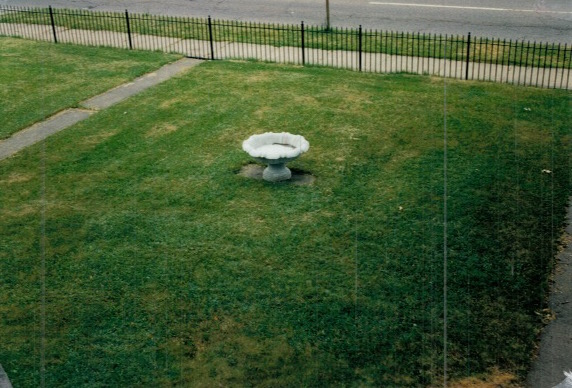
View from the corner- yes i had to rake all those leaves, several times before winter

My wife Margaret and I moved to Battle Creek Michigan in the summer of 1993, when I accepted employment with the W.K. Kellogg Foundation (WKKF).  At the turn of the 20th century Battle Creek was a thriving economic community with over two hundred different companies vying for supremacy in the emerging cereal business.

Brick carriage house that i had hoped to restore. Note my BMW 2002 which I bought new in 1972
Dr. John Harvey Kellogg operated a Health Sanitarium that catered to the rich and famous and promoted exercise and a vegetarian diet. It was in that facility that the process of flaking of corn was invented as an addition to the meals for patients. John Harvey’s brother, Will Keith, wanted to exploit their invention as others were already doing but was refused permission and a break took place between the brothers.

Will Keith was thus the sole owner of the Kellogg cereal brand and it was his genius in advertising that placed him at the forefront of the cereal companies that had taken hold.
The balcony, floor, columns and railings getting renewed

Thus in the early 1900’s Battle Creek experienced a boom in real estate and many fine homes were built with the money that was flowing in. Many of those homes were still standing when I arrived but most were in a state of disrepair.  I now question my motives but at the time it seemed prudent to buy one of those older homes and fix it up.
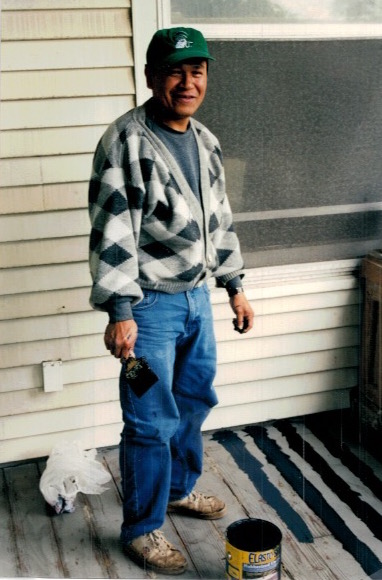
Odilion worked part-time with me for most of the 4 years. He had a full-time job in a grocery store

I did some of the electrical work like drilling holes in walls to pull electrical wire, wiring lights and outlets
Raising the1st floor ceiling to its original position in order to place a steel beam for support

The home we bought was rumored to have once been used by Sojourner Truth as a refuge for the freed slaves that were being smuggled out of the South by the Underground Railroad. My wife and I thought that a bed and breakfast was an ideal conversion for that old, historically designated house that had some 4000 plus square feet. And I also thought that in fixing that house I was giving back to the community because it had become an eyesore.

several walls were water damaged and before replastering we ran new electrical wire
newly applied insulation on wall and ceiling. note new electrical outlet

It was a corner house that sat on two acres on a main thoroughfare. It was built in the late 1800’s but an update in 1906 had added a red tile roof and some other architectural features as well as a beautiful brick carriage house. Nevertheless the house was dated, had no insulation and an antiquated electrical system.
lots of decorative glass throughout the house. This door led to the balcony on the 2nd floor

Naturally the vacant house had issues, the principal one being that a Non Profit Agency had bought the house with plans to occupy it after remodeling it to suit their needs. The Director, a person from out of town, had turned off the heat during winter and was unaware that the water should also have been turned off because the house was heated with radiators. Thus the water in the radiators froze and broke them and when they thawed in spring the whole place flooded.

One of the floors that was damaged sanded and and ready to be refinished
Some rooms had wallpaper that needed to be removed and the walls cleaned and primed for painting

The water damage was primarily in one half of the house in both the second and first floor. On the second level, the hardwood floors had warped. On the first floor, water had damaged the ceiling and the walls as well as the floor.
My wife Margaret cleaning a circular wall getting it ready to prime and paint

My colleagues at WKKF thought I was crazy to tackle such a daunting fixer-upper and years later, I agree with them. But then I was inspired and as luck would have it, I met several workers that helped me. The first one was Ed Case, a man that was about to become a full fledged pipe fitter, in other words a plumber. Ed and I worked long hours for a month after we both got off work and finally he had been able to replace the eleven radiators that were cracked. He tested the system with a blue dye and it failed. There were several more radiators that had cracks that weren’t visible. That failure was a very low point for me. We finally ended up having to install a gas heater for the second floor and left the first floor to be heated with the radiators.
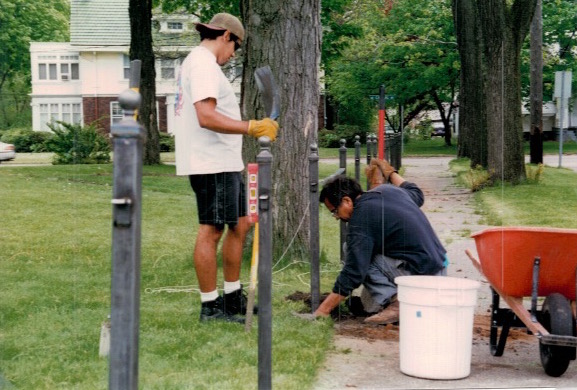
My brother Tito, Damien and I digging holes and mixing cement


Damien and I installing new end supports for the wrought iron fence on the side street side of the corner lot

After that first winter I hired Odilon, a Mexican man, to assist me with some of the work, primarily scarping old paint that was peeling and cracked on the beautiful wood trim. Another massive job was scraping the second floor balcony, the tall twenty foot wooden columns and the front entrance.

Another issue was discovered when a couple of raccoons were found living in the attic, gaining entrance through a section of the tile roof that was missing. I couldn’t believe it when I found out that the company that manufactured the tile was still in business.  I bought a pallet of tile and found a roofer that knew how to re-install them.
View of the front portion of the refurbished wrought iron fence

Many of the neighbors had been cutting through the yard for years to save a few steps and it became such an irritation that we decided that only a fence would deter them. Being a designated historical property the fence had to conform to certain requirements. We visited a place in Kalamazoo that sold junk and as we walked around, there in front of us were two ten foot piles of rusted, twisted wrought iron fencing. It was definitely old and perfect, I thought, but I had to convince my wife that it could be brought back to life.
side view looking towards the corner: note finished fence and painted columns and neighbor having to stay outside the fence.

We set up an assembly line to restore the fence. I used an electric grinder to de-rust, Margaret’s son Damien welded replacement parts and Margaret painted. It took us two months to finish this mammoth job: sixty plus 8’ sections of fence, stretching 500 plus feet. My brother Tito joined us to install the fence.

There were also some upkeep duties that needed attending. One of them was to cut the grass, which even in a small tractor mower took a few hours. In the fall, we had to rake leaves a few times before the snow arrived. The raking had to be by hand and each time it took several hours. In winter, I had to clear the 500 feet of snow on the sidewalk lest someone slip and get hurt and sue us.
The dining room completed note ceiling and pocket door, fireplace mantel on left

Once the major work of remodeling was completed we had to start insulating the walls, putting up plaster board, painting walls, refinishing the wood floors and installing the second floor bathroom.

All along my wife and I had been living in a section of the house that was the least affected by the flooding. We had sectioned off our living area with sheets of plastic and it was a marvelous day when we were able to inhabit the entire house.

View of front entrance from foyer. Note second exterior door beyond the glass door
We made plans for the B&B but the stars were moving in another direction. We had bought the house in 1995 and in the fall of 1999 we received an offer for the house from a medical doctor who wanted to set-up his practice in it. At about the same time the W.K. Kellogg Foundation offered me a small retirement package. We didn’t hesitate in saying yes to both offers, the harsh winters having worn us down long before. The house still functions as a business although much to my dismay the beautiful brick carriage house was torn down.

Friday, October 26, 2018

The Relevance (?) of Crime Fiction Escapist Literature in Twenty-first Century USA


The following was presented by Manuel Ramos at the 8th annual Conferencia Internacional de Literatura Detectivesca en Español (CILDE), also known as the International Hispanic Crime Fiction Conference, on September 22, 2018, on the campus of Texas Tech University in Lubbock, Texas.

____________________________________

THE RELEVANCE (?) OF CRIME FICTION ESCAPIST LITERATURE IN 21ST CENTURY USA
©Manuel Ramos

I thought that today I would offer my views on the relevance, and the possibility of the lack of relevance of genre fiction in today’s chaotic world. Or, as Edmund Wilson said in his infamous essay, “Who cares who killed Roger Ackroyd?”

 More specifically, the genre I’m speaking about is crime fiction, and even more specific than that, I’m focusing on Latinx crime fiction:  mystery or detective fiction centered in the North American communities of Latino culture.

Not that my opinions are any more legitimate than anyone else.  But I do have history with the crime fiction genre: I’ve published in this genre since 1993 -- numerous short stories, ten crime novels, several presentations, panels, Q&A’s, and a lifetime of reading mysteries, detective stories, noir novels, thrillers, and almost every other category of genre fiction that ends up on the book shelves.  My comments are rooted in that history.

Brutal, violent crime, unfortunately, is as old as the human race. And so is mystery storytelling.  The first murder, the killing of Abel by his brother Cain, was quickly investigated by an amateur detective who tried to solve the mystery.  According to the Book of Genesis, God questioned Cain about his missing sibling.  He was suspicious from the get-go.  After all, at that time in Earth’s history, there was a limited number of potential victims and likely suspects. Apparently, the interview, the original third degree, was so intense that the killer was reduced to whimpering, “Am I my brother’s keeper?” As if to say, “Why is everybody looking at me?”

The story of the Cain and Abel fratricide contains several constructs that a good reader of mysteries should recognize.
  
For example, jealousy provides the deadly motive.  Envy can cause brotherly love to turn into brotherly hate, with bloody consequences.

Or, how about the act itself?  Uncontrolled rage results in a cruel death. The killer tries to cover up his sin by acting as though all is calm and peaceful, and feigning ignorance of anything out-of-the ordinary.

The tough-talking detective solves the crime from scarce but important clues, a keen knowledge of human psychology, and the killer’s own mistakes. Punishment is administered, and justice prevails.

So, we could say that not only has crime existed since the human race began.  The mystery story itself is just as old.  And, of course, the major theme of all crime fiction was there at the beginning:  good vs. evil.


Edgar Allan Poe is often credited with inventing the modern detective  in his short story, The Murders in the Rue Morgue (1841.)  He created Aguste Dupin, a professional detective who uses deductive reasoning to solve a particularly horrific crime, the gruesome murder of a mother and her daughter in a locked upstairs room. According to Ross Macdonald, the North American crime writer who adroitly explored the conflicts and contradictions of middle-class Southern California in the first half and middle decades of the Twentieth Century, Poe devised his detective story as “a means of exorcising or controlling guilt and horror.”  Dupin solves the crime with logical reasoning, which seems out of place against the terror and fear generated by the murders of the women. But because he does solve the crime, the balance between good and evil is restored.  In a way, civilization triumphs over primitive savagery.  The chaos of evil is conquered by rational thought and ingenuity.

Crime fiction can do that. 

I think we can agree on some of the other reasons why we read and enjoy crime fiction.

For one, our sense of justice is appeased if the bad man or woman pays for his or her crimes at the end of the book. A satisfying ending gives us closure, resolution, finality. These concepts often are missing in our day-to-day lives of repetitive appointments, missed deadlines, and ever changing, ever expanding schedules.

Also, we can easily see ourselves in the starring role of detective as we go from page to page, clue to clue, chapter to chapter, with the secret desire, maybe not so secret, that eventually we ourselves will resolve the mystery and beat the fictional detective to the punch.  Identifying the killer before the final paragraph is a reward for careful crime fiction readers.  Just as long as the puzzle is not solved too quickly, or too obviously.

And there is the thrill of danger and risk that crime fiction often provides, even if these insecurities exist only in our imaginations, spurred on by the author’s skill.  But who doesn’t like a little paranoia at midnight?  Who can resist the sense of foreboding brought about by a well-written crime story, the kind of foreboding that has a reader checking the doors and windows, and jumping at every unknown sound or unusual rattle?  We like to be anxious, for a few minutes.  We even appreciate fear, as long as we know we can close the book, take a deep breath, and make ourselves a drink.


Franz Kafka is not known as a crime fiction writer, but his thoughts on reading and books were certainly hard-boiled. He wrote:

I think we ought to read only the kind of books that wound and stab us.  If the book we’re reading doesn’t wake us up with a blow to the head, what are we reading for?  So that it will make us happy …?  But we need the books that affect us like a disaster, that grieve us deeply, like the death of someone we loved more than ourselves, like being banished into forests far from everyone, like a suicide.  A book must be the axe for the frozen sea inside us. 

That's dark!

Raymond Chandler wrote about another reason we like crime fiction, although his observation went beyond the mystery story.

I’ll quote from his famous essay, The Simple Art of Murder.

All … who read escape from something else into what lies behind the printed page; the quality of the dream may be argued, but its release has become a functional reality.  … [People] must escape at times from the deadly rhythm of their private thoughts.  It is part of the process of life among thinking beings. It is one of the things that distinguish them from the three-toed sloth …. I hold no particular brief for the detective story as the ideal escape. I merely say that all reading for pleasure is escape …. To say otherwise is to be an intellectual snob, and a juvenile at the art of living.

But here is where the contradictions inherent in my role as a writer of escapist fiction become most apparent, which results, for me, in an inner struggle about my role as a writer, and a measurement of the value of what I create as a writer.

 Let me be frank about the context from which I speak. Just for a few minutes I’ll talk about the political situation and the danger that threatens some of our basic assumptions about the United States.

I believe that in the Twenty-first Century, the United States faces a serious and perhaps existential threat from radical political groups and individuals that have marshalled their forces and are engaged in a dismantling of many of the institutions, principals, and beliefs that this country has long supported and promoted.  Freedom of speech, religion, and of the press are under unrelenting attack.  Racism, in all its various ugly formats, literally parades across the landscape, and in more sinister, subversive acts by powerful men and women.  Decades of progress on issues such as gender equality, environmental protection, educational reform, and international relationships have been abandoned, ignored, or reversed.  The government has turned its official back on the concept of providing for the general welfare of its citizens, and instead is focused on meeting the needs and desires of the financial elite and the corporate power structure.  Lies have become the truth, and facts are irrelevant.  Perception controls the stage.  Too many of our neighbors, the people next door, hear only what they want to hear.  They are too eager to buy into the latest outlandish appeal to the lowest common denominator because such appeals are easier to accept than the painful realization of the phoniness and dishonesty, and threat, of the current reality.

 When I sit at my computer, and I try to imagine the next story line, or the latest twist for one of my characters, or the conflict that will move the plot forward, it can be too easy to come to a sudden stop.
  
It can be too easy to say, “What’s the use, why bother?”

Or, I can tell myself, “These are only stories, fictional creations that mean nothing in the bigger scheme of things.”

Or, “How can I spend my time working on a new book, when there’s so much else to do?  I should be organizing on the streets, teaching in the schools, speaking up at meetings, volunteering for actions against the repressive forces that line up against everything I believe in.”

I remind myself that even the mighty Chandler thought crime fiction was merely escapist literature, without any “higher purpose,” and no one was more critical of his art than Chandler himself. He wrote in a letter, “How could I possibly care a button about the detective story as form.  All I’m looking for is an excuse for certain experiments in dramatic dialogue.”  Talk about being cynical.

On the other hand, I’m also reminded that great art, including literature, has been created in other times of crisis, such as the Great Depression, World War II, the presidency of Richard Nixon.

I also know that Chandler wrote until his death. He drank himself into a fairly early grave, but he didn’t give up the idea of creating, as he said, “emotion through dialogue.”  Despite his cynicism, he needed to create.

And so I often find myself, in the late night, the only light in the house radiating from my computer screen.  Earlier, I listened to yet another day’s news of the latest crime against decency committed by the president of the United States and his following of parasites, sycophants, and demagogues.  I am, again, tired, frustrated, and insecure. But I tell myself that I need to write a story, maybe a chapter.

Where do I find it, and how do I justify the effort?

One place to start might be in the conclusion of Ralph Rodriguez’s seminal study of Chicana/Chicano detective fiction entitled Brown Gumshoes:  Detective Fiction and the Search for Chicana/o Identity. Professor Rodriguez says the following:

There can be no doubt that one reads detective novels, in part, for pleasure.  These novels also serve, however, as a significant index of the social, political, and historical features of a culture. 

Rodriguez adds to and explains his statement with the rather broad conclusion that “detective novels are about discerning the mysteries of identity.  At the heart of their narrative … is the quest to reveal who the criminal is.  In a diverse array of mystery novels, however, time and again the detective also unravels a mystery about him- or herself.  The novel is as much his or her story as it is the story of the crime.”

And I would add that the best crime fiction is not about crime, but about the people touched by the crime, whether it be the detective, the criminal, or the victim.

Ultimately, my decision to write or read crime fiction must rest on a personal set of values.  As a writer, I believe I am obligated to write the stories churning in my head. Fundamentally, I have no choice, and these stories must be honest and real.  They must create the emotion that Chandler talked about.

One motive is selfish.  I derive satisfaction from creating characters, settings, and story lines that readers will spend time on. Writing satisfies one of my creative urges.
  
On a bigger scale, away from the personal, crime fiction can reveal the truth, at least as the author understands that truth.  One book or one writer cannot express the complete story.  We must tell our immigrant stories and our coming-of-age metaphors.  We have to write the histories of our communities, praise the unknown heroes, and document the universal and singular passions that are undervalued, or ignored, in today’s United States.

But, sabes qué, ultimately, it doesn’t matter what form the writing takes. We just need to ensure that the writing continues.  Our story is too big, too important to be limited to one form.  That’s why it is so important for Latinx writers to produce all manner of literature.  From children’s’ books to multi-volume memoirs to gritty noir tales from the underground of existence. 

Creative energy in the form of writing, including popular culture and genre fiction, can oppose the dark forces loose in the world -- wars, oppression, racism, hatred.  The old good vs evil.

Crime fiction can be a form of resistance.  In an indirect way, the author can expose social issues confronting the characters. The characters can directly oppose the current situation.  A clever writer can blend plot and characters into a view of America that is not the view espoused by the hacks and flim-flam artists who think that America needs to be made “great again.”  The writer’s fiction can be part of the resistance.

On a subtler level, crime fiction is inherently revolutionary.  The detective, whether a police officer, private investigator, or accidental sleuth, battles against the status quo simply by trying to solve the mystery.  In the classic crime fiction manner, the detective knows something is not right and it must be corrected.

In the noir variation of the classic form, the decision to change the situation usually results in serious, and sometimes deadly consequences for the detective, or the anti-hero.  Still, he or she plods forward, sometimes aware of the encircling doom, sometimes caught off-guard.
  
And so, I too will continue to plod forward, struggling with my conflicting emotions, searching for the right character, the best plot, the ultimate caper.

It’s what I do. 

____________________________________
Manuel Ramos writes crime fiction.  His latest book is The Golden Havana Night:  A Sherlock Homie Mystery. 


Thursday, October 25, 2018

Chicanonautica: Ernesto Art in San Antonio


It was last year at the Bemis Center for Contemporary Arts, in Omaha, Nebraska. Some of my drawings, life-mutilated sketchbook covers, and copies of my novels Cortez on Jupiter and High Aztech were included in an installation by Josh Rios and Anthony Romero called Is Our Future a Thing of the Past?


Things are getting so chingada apocalyptic lately. But then they've been that way all my life.


Well, the Bemis Center has brought it to the Blue Star Contemporary gallery in San Antonio, Texas, Aztlán, from October 4, 2018 to January 6, 2019. 


So, if you couldn't make it to Omaha, but are near enough to San Anto, this is your chance to see some Ernesto art, up close and personal, or at least as close as the plexiglass will let you.


And for those of you who can't make it to San Anto, here's a closer look at my art from the show, naked, without any electronic augmentations:


Evening Spirits, captures what it's like to chill with cerveza under a darkening Aztláni sky.


Señor America is the spirit of the Border.


High Aztech Scene illustrated one of the many riots in the novel.


High Tech Voodootoons describes most of my work.


Galactic Aborginie Journal because we're all just aborigines in this galaxy.


Ernest Hogan is very busy with art and writing. Maybe it's a good thing.

Wednesday, October 24, 2018

Día de los Muertos


By Hannah Eliot
Illustrated by Jorge Gutierrez


  • Age Range: 2 - 4 years
  • Grade Level: Preschool and up
  • Series: Celebrate the World
  • Board book: 24 pages
  • Publisher: Little Simon; Brdbk edition
  • Language: English
  • ISBN-10: 1534415157
  • ISBN-13: 978-1534415157


Learn all about the traditions of Día de los Muertos with this second book in the brand-new board book series Celebrate the World, which highlights special occasions and holidays across the globe.

At the end of October each year, it’s time to celebrate an ancient tradition: ¡Día de los Muertos! With vibrant illustrations by Golden Globe–winning Mexican illustrator Jorge Gutierrez, this festive board book teaches that Día de los Muertos honors ancestors and loved ones who have passed. From sugar skulls to papel picado, this is a holiday that truly commemorates the cycle of life.


More Books About Día de los Muertos


La Catrina: Emotions/Emociones 


Written by Patty Rodriguez
Illustrated by Ariana Stein

Inspired by one of the most recognized symbols of Dia De Muertos or Day of the Dead, a holiday that celebrates life and remembers the dearly departed, this book will introduce little ones to emotional expressions and their first English and Spanish words.


Las almas de la fiesta y otros cuentos de Día de Muertos


Written by Judy Goldman
Illustrated by Israel Barrón

In this beautifully illustrated collection of Día de Muertos stories, Judy Goldman explores the cultural traditions rooted in honoring the dead throughout different Mexican cities. Each story includes a thoughtful section explaining the tradition portrayed in the tale. 


Día de Los Muertos 


Written by Roseanne Greenfield Thong
Illustrated by Carles Ballesteros

It’s Dia de Los Muertos (Day of the Dead) and children throughout the pueblo, or town, are getting ready to celebrate! They decorate with colored streamers, calaveras, or sugar skulls, and pan de muertos, or bread of the dead. There are altars draped in cloth and covered in marigolds and twinkling candles. Music fills the streets. Join the fun and festivities, learn about a different cultural tradition, and brush up on your Spanish vocabulary, as the town honors their dearly departed in a traditional, time-honored style.


The Remembering Day/El día de los muertos


Written by Pat Mora
Illustrated by Robert Casilla

Long, long, long ago, Bella and her grandmother Mamá Alma admired their vegetable garden. They liked gardening together. They grew sunflowers and lilies too, and chatted with lizards and hummingbirds. They walked around the flowers and vegetables holding hands, something they had done frequently since Bella was a baby. As her grandmother aged, Bella helped her to walk. “Every year, I need your help more and more,” said Mamá Alma.

In this special bilingual picture book for children, author Pat Mora creates an origin myth in which she imagines how the Mexican custom of remembering deceased loved ones—El día de los muertosor the Day of the Dead—came to be. With tender illustrations by Robert Casilla that depict Bella and Mamá Alma’s loving relationship, this book will encourage children to honor loved ones, whether by writing stories and poems or creating their own remembering place.


Funny Bones: Posada and His Day of the Dead Calaveras 


Written and illustrated by Duncan Tonatiuh


Funny Bones tells the story of how the amusing calaveras—skeletons performing various everyday or festive activities—came to be. They are the creation of Mexican artist José Guadalupe (Lupe) Posada (1852–1913). In a country that was not known for freedom of speech, he first drew political cartoons, much to the amusement of the local population but not the politicians. He continued to draw cartoons throughout much of his life, but he is best known today for his calavera drawings. They have become synonymous with Mexico’s Día de los Muertos (Day of the Dead) festival. Juxtaposing his own art with that of Lupe’s, author Duncan Tonatiuh brings to light the remarkable life and work of a man whose art is beloved by many but whose name has remained in obscurity.