Wednesday, January 19, 2022

Don't Ask Me Where I'm From


Written by Jennifer De Leon


Publisher: ‎ Atheneum/Caitlyn Dlouhy Books

Language: ‎ English

Paperback: ‎ 352 pages

ISBN-10: ‎ 1534438254

ISBN-13: ‎ 978-1534438255


“A funny, perceptive, and much-needed book telling a much-needed story.” —Celeste Ng, author of the New York Times bestseller Little Fires Everywhere


First-generation American LatinX Liliana Cruz does what it takes to fit in at her new nearly all-white school. But when family secrets spill out and racism at school ramps up, she must decide what she believes in and take a stand.


Liliana Cruz is a hitting a wall—or rather, walls.


There’s the wall her mom has put up ever since Liliana’s dad left—again.


There’s the wall that delineates Liliana’s diverse inner-city Boston neighborhood from Westburg, the wealthy—and white—suburban high school she’s just been accepted into.


And there’s the wall Liliana creates within herself, because to survive at Westburg, she can’t just lighten up, she has to whiten up.


So what if she changes her name? So what if she changes the way she talks? So what if she’s seeing her neighborhood in a different way? But then light is shed on some hard truths: It isn’t that her father doesn’t want to come home—he can’t…and her whole family is in jeopardy. And when racial tensions at school reach a fever pitch, the walls that divide feel insurmountable.


But a wall isn’t always a barrier. It can be a foundation for something better. And Liliana must choose: Use this foundation as a platform to speak her truth, or risk crumbling under its weight.


Jennifer De Leon is an author, editor, speaker, and creative writing professor who lives outside of Boston. She is the editor of Wise Latinas: Writers on Higher Education, the 2015–2016 Writer-in-Residence at the Boston Public Library, and a 2016–2017 City of Boston Artist-in-Residence. She is also the second recipient of the We Need Diverse Books grant. She is the author of Don’t Ask Me Where I’m From and Maya.


Tuesday, January 18, 2022

Why MLK Marched. Time Marches On Las Adelitas

Michael Sedano


Note: Esteban Torres, 8-time United States Congressman from California, graduated Los Angeles’ Garfield High Class of 1949. He and his friends left for Ft. Ord on graduation night. After the Army, Torres returns to ELA to lead the Chicano Moratorium.


In this excerpt from his unpublished, as-told-to-Michael Sedano autobiography, Torres recounts an incident that illustrates one reason we observe Martin Luther King, Jr. Day.


• • • •


I’d told the counselor at Garfield I knew about electricity, that I wanted him to enroll me in Aeronautics, that I didn’t want Electric Shop. He stuck me in Electric Shop anyway. I was ready to quit high school because of that, when I got a chance to convince the Aeronautics teacher to give me a seat, so I stayed in school.


Maybe that counselor saw something in me the Army discovered in its tests. After Basic, I was ordered to Ft. Belvoir, Virginia to train as an Electrician with the Combat Engineers.  Garfield did a decent job of preparing me for the Army’s electrical engineering training. Algebra, that I got to use in aeronautics class, made it easy for me to get into the electrical diagrams, to do line resistance calculations, for example. There’s a lot of technical knowledge a soldier needs, to pull wire for miles along the tops of poles, or string along ground terrain.  


Army training was a serious trade school with high expectations. When you pay attention in school, you find yourself getting good at any mental or manual skill an employer throws at you. 


I got my wish to see new parts of the country. Ft. Belvoir, Virginia sits outside Washington, D.C., in the middle of history. All that history I’d read about in books lay there before my eyes, and I was able to walk the same ground: Gettysburg; Appomattox; Andersonville.


Touring the nation’s capital, Washington, D.C., history and art-loving visitors squeeze-in as many places as they can, before they have to go home. 


For me, home was just a few miles down the railroad tracks and I could do a lot of squeezing and not miss the commuter train back to the Army.


The Smithsonian and the National Mall are endlessly involving, and free. I spent days exploring a single gallery then moving over to another artist or major event.


I fell in love with the city’s parks and scenic avenues and took breaks from museums to walk and wander and not spend money I didn’t have. I filled daydreams thinking someday, somehow, I’d live in the Capital again. 


But everything in the nation’s capital wasn’t rosy and enriching.Virginia, and Washington, D.C., are the Deep South. The depth of racism in the South is not something a guy from East L.A. understands. Back home, Ronnie Washington and I can walk into the drug store, order a soda, and, as long as we have a nickel, the drug store serves us. 


Ronnie and I walked into a drug store, not too far from the Lincoln Memorial, and got slapped in the face by racism. Ronnie, a black soldier, couldn’t buy a soda. I was astonished and completely unprepared for the ugly face of our country.


Every Army post across the world, Sunday chow is cold cuts at noon. That’s it until breakfast Monday, so Sunday afternoon is a time for freedom. 


One Sunday, after payday, four of us decide on making a day of it in D.C. We’d take in the sights, work up an appetite, and eat at a good restaurant.


After a couple hours looking at paintings and sculpture in the National Gallery, we go outside for a long walk down the reflecting pond to the Lincoln Memorial, opposite the United States Capitol.


We decide to walk into the business district for a quick lunch. We go into the first drugstore we see. The four of us sit at the lunch counter. 


The waitress asks us what we want. I sit next to “Arky,” a guy from Arkansas. Ronnie, who was from Alabama, is on my left. When the waitress gets to Ronnie she puts down her pad and looks at him scowling like she’s done this many times. 


"You know you're not supposed to be sitting here at the counter. You know where you're supposed to be." 


Ronnie looks around where the waitress nodded with her chin. The drugstore has a separate counter, where you couldn't sit, you stood up. There was a sign.


That's where soldiers like Ronnie Washington have to eat. It’s called Segregation. Ronnie got up to move over there to the Negro Section. He knew.


Arkie knew, but two of us weren’t from around here. We looked at the waitress. 


"Why is that?" 


“Why can't he sit here?" 


She wasn’t flustered at all. She acted like we were in the wrong.


"He knows why. He knows why." 


Like all soldiers, Ronnie had felt a lump in his throat the day he stood and recited The Soldier’s Creed, the one that begins, “I am an American soldier.” It doesn’t say “Negro Soldier,” and it concludes:


“I am proud of my country and its flag. I will try to make the people of this nation proud of the service I represent, for I am an American Soldier.”


Like all Black soldiers, Ronnie couldn’t sit with me at that lunch counter. Private First Class Ronnie Washington couldn’t order a soda and a hamburger in the capital of his own country.


The four of us left. We talked it over, decided to have dinner and call it a day. I felt defeated and disappointed, and struggled to keep my pride strong.


In a few days we’d have our Orders. Our country would send us overseas to defend that waitress and that drug store from the Communist menace that threatened our way of life.


“Pencil Me In”


The twentieth century spawned a welter of expressions that didn’t survive the next century’s technology. Case in point, “pencil me in.”

There’s nothing to pencil in when using an App. No pretty photographs to change with the month. Also, there’s no calendar when the device goes haywire. Or there’s User Error. Or you can’t find your phone!

Paper calendars to the rescue, and Edgewater, Colorado’s Las Adelitas to the rescue.

Michelle Sánchez

Las Adelitas Living the Arts programs organize to assist women healing from trauma, through the arts. Proceeds from the organization’s 2022 Las Adelitas Calendar support efforts, also, for members to embrace their professionalism through training in Mexico with Ballet Folklórico de México de Amalia Hernández.

Michelle Sánchez, who’s been a Las Adelitas member since 2018, and performs in the Asuka Baile Folklorico group, is also a visual artist seeking sponsorship for herself and the group.

Buying a $25 calendar is a small contribution to Sánchez’ efforts, and a great way for you to revive that old saying, “I’ll pencil you in”.

Details contact Las Adelitas or Sánchez directly: mssanchez@asu.edu On Facebook, search for fridafighter.

https://www.lasadelitaslivingthearts.org


Monday, January 17, 2022

Dr. Martin Luther King, Jr. by Xánath Caraza

 Dr. Martin Luther King, Jr.

Xánath Caraza


El Doctor Martin Luther King, Jr. es honrado en enero de cada año. Este 2022 lo recordamos hoy, lunes 17 de enero.  Comparto con los lectores de La Bloga un par de libros que escribió, entre otros tantos, más dos libros para niños que lo celebran y el enlace Nobelprize.org donde nuestros lectores pueden leer más sobre su vida, su visión y su trabajo con la comunidad.  Ayer y hoy el mensaje de Martin Luther King sigue vigente.

“At the age of thirty-five, Martin Luther King, Jr., was the youngest man to have received the Nobel Peace Prize. When notified of his selection, he announced that he would turn over the prize money of $54,123 to the furtherance of the civil rights movement.

On the evening of April 4, 1968, while standing on the balcony of his motel room in Memphis, Tennessee, where he was to lead a protest march in sympathy with striking garbage workers of that city, he was assassinated.”

(From Nobel Lectures, Peace 1951–1970, Editor Frederick W. Haberman, Elsevier Publishing Company, Amsterdam, 1972)


Where Do We Go from Here: Chaos or Community by Dr. Martin Luther King, Jr.


“In 1967, Dr. Martin Luther King, Jr., isolated himself from the demands of the civil rights movement, rented a house in Jamaica with no telephone, and labored over his final manuscript. In this prophetic work, which has been unavailable for more than ten years, he lays out his thoughts, plans, and dreams for America's future, including the need for better jobs, higher wages, decent housing, and quality education. With a universal message of hope that continues to resonate, King demanded an end to global suffering, asserting that humankind-for the first time-has the resources and technology to eradicate poverty.” (Amazon.com)


Strength to Love by Dr. Martin Luther King


Martin’s Big Words: The Life of Dr. Martin Luther King, Jr.


Be a King: Dr. Martin Luther King Jr.’s Dream and You


Friday, January 14, 2022

1963


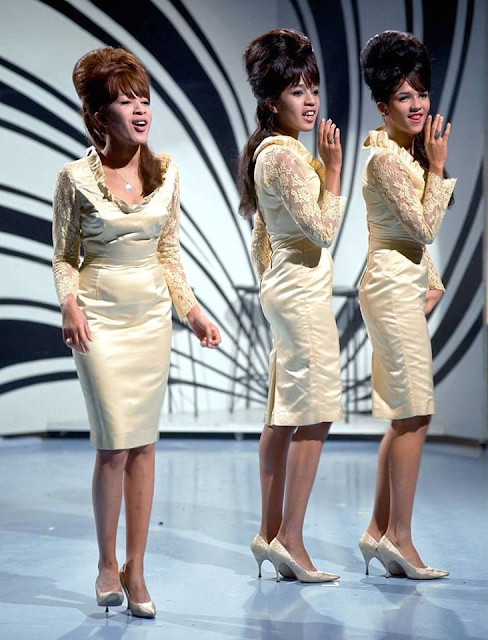
Ronnie and the Ronettes

The recent (January 12) passing of Ronnie Spector of Ronnie and the Ronettes stirred up a few nostalgic and bittersweet images in the slow moving crud otherwise known as my memory.  In 1963, when Be My Baby was an incredible international hit for the Ronettes, I was a naïve, arrogant fifteen-year-old trying hard to grow up in the almost forgotten small town of Florence, Colorado.  That summer I wanted to be as cool as my uncle "Boze" and his friends, who dressed sharp, talked in slang, and drove "souped up" Chevys and customized Fords from the 1950s. The truth is that it seemed I always said something stupid, or did something in ignorance that embarrassed my family, meaning my father.  "Cool" would not be the word picked to describe me by anyone who knew me back then.  

For example:  entering Florence High School (Go Huskies!) meant initiation (now known as hazing) inflicted on Freshmen by Seniors, which culminated during the annual "Pioneer Days" festival celebrated by the city of Florence with a parade and various events at City Park.  The entire day, Freshmen students were hunted by groups of Seniors.  If caught, the trapped students' faces were painted with lipstick.  We walked around all day with red streaks on our cheeks, "FHS" on our foreheads, and globs of lipstick in our hair.  I don't remember why I thought smearing bar soap on the large plate glass of a Main Street store would somehow compensate for the humiliation of lipstick initiation.  What made it worse was that not only did I scribble random shapes and lines on the glass, but I also included my last name.  RAMOS.  Just like that. Needless to say, my father gave me hell for exposing the family to ridicule and shame.  It didn't help that I tried to blame the graffiti on my cousins, who had the same last name.  That night, I shuffled to the scene of the crime with a bucket of water and a bunch of rags.  I did my best to erase my incriminating mistake, but my father never forgot.  And he didn't let me forget either.

I had extremes on both sides of my personality.  While I earned excellent grades and permanent residence on the academic honor roll, socially I was a disaster.  

I ogled the girls in my classes, especially the ones who flashed glimpses of pale legs and thighs under their desks. The girls laughed at us silly frustrated boys as they began to understand the power they had.  

I tried out for the football team and fractured my wrist at my first practice.  

I wanted to show my school spirit so I bought a Florence High School powder blue sweatshirt at the cheerleaders' fundraiser.  One of my teachers wondered out loud why "people with color" loved to wear such colorful clothes.  I think he was trying to make a joke.  

That teacher was funnier than the white boy who one day realized I was darker than him and thereafter he called me "Blackie" whenever he saw me.  That kid was in love with his Butch Wax ducktail but he had nothing but resentment (hatred?) for me. I didn't know why but I easily slipped into my own intense dislike of the boy who clearly admired himself too much. 

One night, during basketball practice, it all came to a head.  We pushed and shoved each other until the coach made us stop. I knew I would have to fight after practice but I  wasn't mad or fired up. More amused, even curious, than anything else. That was a mistake. I danced around the kid, waiting for something, not sure what.  Maybe I wanted someone to say Go! Or, stop!  Naturally, my nemesis was eager and ready to throw down.  While I waited, he acted.  With a quick outburst of pent-up aggression he popped me in the eye and I immediately felt the flesh around my eye socket swell and pulsate.  We wrestled for a few minutes more, neither one of us really connecting again.  Eventually, someone stopped the fight. I didn't think either of us had "won," but because I had a very ugly shiner that stayed on my face for weeks, going from raging purple-black to sickly yellow, the consensus at school was that I had lost our little rumble.  Big time. 

My most vivid recollection of that event was my grandmother's reaction when she saw my black eye for the first time.  Sadness rolled over her face.  She slowly shook her head.  She asked if it hurt and told me to stay away from "such people."  I could see she was concerned but I couldn't shake the notion that she wanted me to say that I had given as good as I got. I couldn't do it and we never talked about the fight again.

One day I bought a small sign for my room that I found in Woolworth's that said, "I'm a lover, not a fighter."  But I knew I was neither.

When I wasn't embarrassing my family or fighting with white boys, I hung out with the Mexican kids (we didn't call ourselves Chicanos yet.)  My pals had nicknames like Chopper and Mazola (I was Doc), but the leader of the group was simply Frankie, a real cool guy.  Frankie knew all the music, dances, and styles.  He was a couple of years older so he told the rest of us about the clubs in Pueblo, the girls of Pueblo, the parties in Pueblo.  I was almost old enough to join him in his trips to the fantastic world of Pueblo, and I used that summer to educate myself about Pueblo's R&B bands, dances like the Wiggle Wobble and the Stroll, and how to drive. Frankie and I constantly talked about what we would do the next year. Oh, the girls we would meet, the bands we would discover, the fun we would have. 

The summer highlight was a party someone hosted in Florence where, amazingly, girls from Pueblo actually showed up.  

And so, on a warm summer evening, with a soft breeze blowing across the town from the river, we danced in a covered driveway to Ronnie and the Ronettes, the Chiffons, the Shirelles.  Fats Domino and Major Lance.  Jimmy Soul. Gary U.S. Bonds. We did the Twist and the Locomotion.  Slow danced to Angel Baby and flirted during He's So Fine.  Words like sultry and passion come to mind.  Soft pastel colors frame the images I've saved from that night.  It was all too perfect.  At the end of the party I thought I was in love with two girls:  Maxine from Pueblo and Ronnie from the Ronettes.  

Turned out that 1963 was my last year in Florence.  My father decided he had enough of driving the eighty miles round trip to and from Colorado Springs five days a week for his construction job, and he moved our family to that city in the shadow of Pikes Peak to be closer to his work. I never really made it to Pueblo with Frankie and the boys in the way we had planned, although a few years later, when we were old enough to go to clubs without the need for fake I.D.s, Frankie and I did our best to capture the feeling and sentiment of our teenaged years. We got close. Of course, Frankie married a Pueblo girl and never gave up being cool.

Hey Ronnie --Thanks for the memories.


Later.

______________________________


Manuel Ramos writes crime fiction. His latest novel is Angels in the Wind.

Thursday, January 13, 2022

Chicanonautica: Ernesto Update 2022

by Ernest Hogan

2022 is off and running. We got past January 6 without serious mayhem. Covid is still mutating and rampaging, but civilization ambles on.

And I’m still here, alive and well, as the Father of Chicano Science Fiction, doing the day job, waiting for El Porvenir ¡Ya! Citlalzazanilli Mexicatl A Chicano Science-Fiction Anthology to come out with a new story by me. If you can’t wait for another new Ernesto story, there’s one in Speculative Fiction for Dreamers: A LatinxAnthology–buy it, review it now! And it’ll be a while, but my story collection, Pancho Villa’s Flying Circus, is still a go . . .


The main thing I’m doing is fighting to concentrate on finally finishing my novel, Zyx; Or, Bring Me the Brain of Victor Theremin. I’m at the point where it’s all starting to come together, the end is in sight, all I have to do is sit my ass down and nail the entire gonzo mess down. And that ain’t gonna be easy.


I’ve long said that while short stories are like a bout with the flu, novels are more like demonic possession. The monster has been growing in

the back of your brain; so far it’s been fun following it around, jotting notes on the havoc it wreaks on the landscape, but now it’s time to wrestle it down and hog tie it into a conclusion that will satisfy the reader.


Yeah, both rodeo and bullfighting metaphors apply.

This is more work. You have to engage the frontal lobes. The monster drains more brainpower. You start having trouble with the routine, “normal” part of your life . . .


And of course, this takes more of your time, which triggers the diabolical cosmic machinery that throws more demands for your attention your way–like this column, and my personal blog, and my social media activities. 


I struggle to keep a public spectacle dedicated to drawing attention to my writing, rather than me blathering about my life.


It’s amazing how people don’t notice that.


It’s also a good thing that writing takes up so much of my life, and brain, that there’s not much left of anything else.


So I should get back to work. I have this complicated sequence where a lot of subplots come together with giant monsters, artificial intelligences, aliens (extraterrestrial and other), gangsters, a Chicano science fiction writer, and his crazy friends. And dammit, I keep finding places where I need to write new scenes . . .


Later I’ll worry about how to market the chingadera, and wonder if it’s possible for a Chicano to write a worldwide bestseller.


Yeah, I know, some people wish they had these kinds of problems.


Ernest Hogan has too much imagination for his own damn good. He is also the author of High Aztech, Cortez on Jupiter, and Smoking Mirror Blues.

Wednesday, January 12, 2022

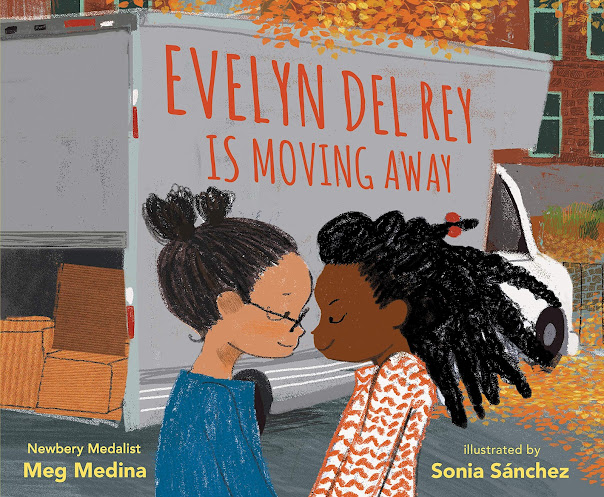
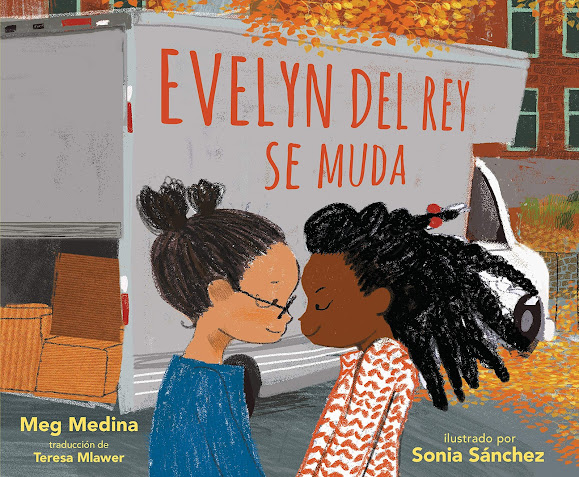
Evelyn Del Rey Is Moving Away - Evelyn Del Rey se muda


Written by Meg Medina

Illustrated by Sonia Sanchez


Publisher: ‎ Candlewick

Language: ‎ English

Hardcover‏: ‎ 32 pages

ISBN-10 : ‎ 1536207047

ISBN-13 : ‎ 978-1536207040


From Newbery Medalist and New York Times best-selling author Meg Medina comes the bittersweet story of two girls who will always be each other’s número uno, even though one is moving away.


A big truck with its mouth wide open is parked at the curb, ready to gobble up Evelyn’s mirror with the stickers around the edge . . . and the sofa that we bounce on to get to the moon.


Evelyn Del Rey is Daniela’s best friend. They do everything together and even live in twin apartments across the street from each other: Daniela with her mami and hamster, and Evelyn with her mami, papi, and cat. But not after today—not after Evelyn moves away. Until then, the girls play amid the moving boxes until it’s time to say goodbye, making promises to keep in touch, because they know that their friendship will always be special. The tenderness of Meg Medina’s beautifully written story about friendship and change is balanced by Sonia Sánchez’s colorful and vibrant depictions of the girls’ urban neighborhood.


·      The 2020 Jumpstart Read for the Record Selection (2.24 million readers)  

·       An American Library Association Notable Children’s Book 

·      A Publisher’s Weekly Best Children’s Book of the Year 

·      A Kirkus Reviews Best Picture Book of the Year 

·      A School Library Journal Best Book of the Year 


En Español


Evelyn Del Rey es la mejor amiga de Daniela. Hacen todo juntas e incluso viven una al frente de la otra en la misma calle en apartamentos que son casi iguales: Daniela con su mami y su hámster, y Evelyn con su mami, su papi y su gato. Pero no después de hoy—no después de que Evelyn se mudé de su casa. Mientras tanto, las niñas juegan entre las cajas de mudanza hasta la hora de despedirse, y se prometen mantenerse en contacto, pues saben que su amistad siempre será especial. Esta es una tierna historia sobre la amistad y los cambios en la vida, bellamente escrita por Meg Medina, realzada con las ilustraciones coloridas y vibrantes de Sonia Sánchez que describen el vecindario urbano de las niñas.


A Bank Street College Best Spanish Language Picture Book of the Year/El mejor libro infantil en español del año


Tuesday, January 11, 2022

Not Shot: Photographs. Director's Advice for Good Shoots.

Chuparosa Foto Gallery
Michael Sedano


Colibrí, picaflor, chupaflor, chuparosa, huitzitzilin, what's in a name? I call my photographic work by a variety of names reflecting their nature as files, or frames, images, or portraits, vistas, or perspectives. They are not shots, not in my vocabulary.

As a kid, I was fond of shooting a .22 caliber rifle plinking cans. I killed the occasional jackrabbit. Each kill, I got heartsick staring at the dead eyes and limp body. I preferred not to kill. You kill when you shoot. Gives "shoot" a bad name, sabes?


My aversion to killing accompanied me to Basic Combat Training at Ft. Ord, which I started on January 15, 1969. The first day of physical training, I carried a soldier on my back and, running as fast as possible piggy-backing 150 pounds of ride'em cowboy man, a knee gave out and we tumbled to earth. I crawled away with a hairline fracture.

It was never a coincidence my damaged knee sent me to the hospital on days my platoon ran to the rifle range. And ran back. A long run.

If I couldn't manage an extended orthopedic stay and skip training altogether, the hospital cured me and sent me back to the firing range with a "profile," a magical exemption from running to the range. 


I wasn't exempt from shooting my M-14. Confident in my sharpshooting from years of plinking cans with a .22, I approached the M-14 like a fool. Instead of lovingly cleaning my rifle in the evening, I took ol' Betsy into the shower with me and gave her a bath.

Down time in the Basic Training troop bay saw us putting a spit shine on combat boots (whose gloss would be sanded off in the morning's double time to P.T.) and cleaning our M-14. 

There's a scene in most Army movies where a guy disassembles and assembles a weapon blindfolded. We did that with our eyes closed. The U.S. rifle 7.62mm M-14 is a gas-operated shoulder fired semi- or fully-automatic individual weapon. The soldier quickly breaks down the weapon into major assemblies like barrel, receiver, stock, gas cylinder, a spring and some parts.

Gunoil leaves a smell you'll never forget. The soldier's rifle cleaning kit contains a rod and brush, absorbent cloth patches, and gun oil. The rod, brush, and rags, scrape flecks of gunpowder from muzzle to firing chamber. The interior of the barrel reflects itself along the mirrored tube of steel, rifling grooves glisten under a sheen of oil, there's light at the end of the tunnel. 

More oil on the receiver, the springs. Immediate action, click. Immediate action (pull back the receiver), dry fire the empty chamber. Oil the channel. Push the oil nozzle against the holes and cracks and seams and all the parts that go boom! Rub off all the excess oil and leave the M-14 clean and ready for tomorrow's inspection.


We shoot for record at a special qualifying range we've never seen, one we march to, no sick lame and lazy truck for me and my aching knee. As usual, it rains like the wettest Winter on record.

The Army's cleared a scar from the surrounding manzanita and scrub pines, leaving a wide naked slope where targets will pop up. At the base of the slope, ten pits lined with sandbags slowly fill with water in the Monterey Bay rain and constant drizzle. We huddle under plastic parkas waiting a turn. I'm in the last group to fire.

My boots stick in well-kneaded mud when I jump into my position. Mud puddles against the sandbag rim of my standup hole. Water and red mud flows between the sandbags where I settle the stock seeking a firm firing base. I have a handkerchief in my sleeve to dry my glasses. I'm wondering if I'll shoot Sharpshooter, or merely Marksman? A voice issues the commands.


"Commence Firing." 

With the last word, up the slope some 10 yards from my muzzle, a target pops up from the red earth. Obscured by rain, my target is distinctly what it is: shoulders, neck, helmeted head of another person. 

Down at the training range, we shoot at concentric circles, plinking paper targets instead of beer cans. This is serious shit. That's a man.  I'm supposed to pull the trigger, put a round in his neck, in his face, in his forehead, in his heart, and win a medal because I killed him with my clean and oiled M-14.

My sights come to rest on the target, I breathe out, hold it, squeeze the trigger. Boom!

The familiar recoil pounds into the shoulder muscles. A 7.62mm round speeds away from my firing position and I have no idea where it hits. With the explosion of gunpowder in the chamber, watery oil explodes out of Ol' Betsy splattering across my eyeglasses.

A muddy sleeve conceals a handkerchief to wipe my glasses. The cloth smears oil and mud across the lenses. Now I see a hazy impressionist mass out there where targets are popping up and I'm supposed to be killing them. Boom! Boom! Boom! 

I stop firing. Behind me a Drill Sergeant begins screaming to keep firing why are you not shooting?

"I can't see, Drill Sergeant!" 

When I turn to look up at him I can not see past the mud and oil smearing my lenses, my head wobbles like the blind. Disgustedly, Drill Sergeant tells me to do what I can. I stand in my hole and point the weapon into the rain going "bang bang" in my head. I don't shoot again.

Shooting and I don't mix. That's why, when I go into the garden with a lens, I capture images. Then I get the files into the computer, work those files into some really pleasing frames. Images. Pictures of flowers and hummingbirds.

Photographs are not shots, not my fotos. Fifty-four years ago next week, I entered Basic Training at Ft Ord, and eight weeks later, I proved I can't shoot. 


Latinopia Faces A Blank Wall

The worldwide web's definitive video-centric source of raza knowledge is Latinopia. The www's top social media utility, Facebook, bans Latinopia.com from the Face. This policy prevents gente from sharing Latinopia's essays and interviews, and requires a workaround to share Latinopia.com's rich menu of video resources.
La Bloga was once banned by the Face. We were terrorists, then got downgraded to spammers, then we were welcomed back with an apology. Latinopia hasn't gotten that far in the Face's twisted system. You can help.
Don't let the Face keep knowledge out of your grasp. Reach for it. Set a bookmark for Latinopia.com and check it regularly. Jesus Treviño, who sponsors the site out of his commitment to our cultura, shares new content every Sunday night.
Treviño's a retired Hollywood Director with stellar credits in episodic teevee and motion pictures. In this zoom video, Jesus enumerates a number of behaviors supporting an upward career in the Industry.

Trevino Dos and Don'ts of Directing.mp4 from Latinopia.com on Vimeo.

Give this a 2022 resist: On your Face wall, type latinopia.com and press Return. You'll read a pop-up message informing you that Latinopia.com is spammy. Click again, read the Face's excuses, then find the Disagree button and disagree with Face blocking Latinopia from people who read the Face. Will it do any good? La Bloga got forgiven. Give it a shot.