Thursday, March 17, 2022

A Question of War: What Is it Good for?

Daniel Cano 

Note: After watching the destruction of a once beautiful country, Ukraine, I decided to revise a past La Bloga post, exploring this writer's personal experience with war and its aftermath.                                                                                                         

A Time for Peace


                                                                                    1.

     It was a cool spring day in Santa Monica, California, as I walked across campus where I’d been teaching before my retirement. A colleague approached from the opposite direction. A few nights earlier, I’d run into him at a local movie theater. We’d both been there to watch the film, the Last Days in Vietnam, directed by Rory Kennedy, youngest daughter of Robert and Ethel Kennedy. At the end of the movie, Ms. Kennedy answered questions from the audience. The film disturbed me, so I didn’t hang around to hear her talk.     

     My friend, a Cornell grad and zealous 1960s anti-war protester, had spent a summer in Ho Chi Minh City where he taught English to Vietnamese students. Vietnam had seeped into his consciousness. He had read my book Shifting Loyalties, inspired by my year in Vietnam. We’d spent many hours talking, over coffee, about the 1960s politics, the anti-war protests, the war, the Vietnamese people, and culture. We’d formed an unlikely alliance.


Chicanos at war

     On this particular day, he waved me towards him and asked how I’d liked the movie. I told him I was disturbed by the images, even after all these years, mostly South Vietnamese trying to escape the northern mongrels at the city gates, not unlike the recent chaotic flight of Afghanis from the throes of the Taliban.

     I couldn’t exactly put my finger on the exact reason for my dismay. Honestly, much of it was simply reliving the experience and sensing emotions I believed I had locked away a long time ago, memories I’d worked through with some friends at the Veterans Administration in West Los Angeles.

     My friend told me he’d asked Rory Kennedy to screen her movie on campus, for students and faculty, even if Vietnam was a distant memory for most. She agreed. He asked if I’d say a few words of introduction before the screening.

     I appreciated the thought, but I declined. I’d had enough of war, writing, and talking about it. I was one of the few Vietnam veterans on the faculty. It had been nearly twenty years since I published the stories about my time in Vietnam. They’d been difficult to write, reliving tragic experiences that had lain dormant for so many years.  

     When my book was published, I’d driven across California participating in readings, panels, and lectures. I began receiving letters from Chicano veterans, expressing their gratitude for the slim book, telling me how appreciative they were that I’d given a voice to their stories. Family members of veterans would come up to me offer their thanks. I received a letter from a Latina who told me her father had been killed in Vietnam when she was a child. She never knew him. After reading my book, she said she felt closer to him, understanding what he might have experienced.

     Then there was an incident in one of my classes as I taught Charley Trujillo’s book Soldados, my own book, and Jorge Mariscal’s Aztlan in Vietnam: Chicano and Chicana Experiences of the War. A Vietnamese American student raised her hand, and said, shyly, “I never knew Mexican-Americans had fought in Vietnam.”

     Her words rocked me. Maybe, they shouldn’t have. The media had pretty much ignored the contribution of Mexican veterans, not only in Vietnam but in Korea and WWII, as well. In his book the Greatest Generation, Tom Brokaw failed to mention the sacrifices of Chicano veterans, even though they received more Medals of Honor than any other ethnic group during the war.

     He didn’t even mention the name of Marine Pvt. Guy Gabaldon, a Chicano from Bellflower, CA, who, in the Pacific, over the course of a month, single-handedly accounted for the capture of more than 1000 Japanese soldiers, the most enemy ever captured by an American in any war. For his efforts, Gabaldon received the Silver Star, yet hardly a word from the media once he returned home, his daring exploits conveniently forgotten. A movie finally did appear, an Anglo in the lead role, no mention of Gabaldon.

     I called my friend and told him I’d reconsidered.

                                                                    The Introduction 

     Good afternoon, and welcome. My name is Daniel Cano. I’m a faculty member here at Santa Monica College, and I’d like to say a few words before you begin watching Rory Kennedy's film, the Last Days in Vietnam.

     In 1969, I received my discharge from the Army, where I’d served in Vietnam with the 101st Airborne and stateside with the 82nd Airborne, two divisions with distinguished military histories, including a legacy among Chicano paratroopers who’d served honorably since the inception of both divisions.

     I tried to regain my footing in civilian life. The county was in turmoil. America protested the war in the streets, on college campuses, and in the home, disillusioned Vietnam veterans often leading protestors. They’d received no welcome home parades, nor did they expect them. Once discharged, we struggled to assimilate into society, many never did.

     To avoid the Vietnam stigma, I grew my hair long and enrolled in community college. Like other Vietnam veterans from my hometown, I rarely talked about the war. It was as if we’d gone away for a couple of years, returned, and were back in the neighborhood. "Hey, where you been?" a high school buddy asked me.

     It didn’t matter how many masks I donned, how long I grew my hair, how hard I labored at work or in school, or how many substances I abused, the war was always there, the albatross around my neck.

     Sometimes I’d wake before dawn, remembering the name of another location in Vietnam. I'd leap from my bed and go into the garage where I'd nailed a large map of Vietnam to a wall. I'd mark a new location with a colored thumbtack, the map a collage of reds, blues, greens, and yellows. While in-country, it had always been another plane, another convoy, another helicopter, and another mission, death in our wake, both theirs and ours. Dubbed by the media -- the “Nomads of Vietnam,” we rarely saw our base camp. 

     Since I couldn’t put the war behind me, I immersed myself in it, reading whatever I could about the land, people, history, culture, and politics -- always searching, I suppose, for the war’s elusive justification. 

     At the time, we still had troops in Vietnam, and, as a young veteran, barely 21, I heard rumors of drug use, racism, refusal to obey orders, and fragging going on, over there. No one sacrificed except those who served and their families. 90,000 people filled the Rose Bowl to watch UCLA play USC. I thought of my friends still in the jungle. 

     Then came April 29th, 1975. As I sat in my living room, I watched the news reporting the fall of Saigon, the chaos on the streets, mayhem at the embassy, and the desperation of the last helicopters leaving the rooftops. My emotions ranged from depression to anger, from bitterness to betrayal, and, I thought, what a waste it had all been, the loss of friends, of so many young lives -- for nothing, absolutely nothing.     

     The opening of T.S. Eliot’s "Wasteland" came to mind, “April is the cruelest month….”

     Then there was the voice of the young Vietnamese student in my class who had said, “I didn’t know Chicanos had fought in Vietnam.” 

     I think about the first American captured by North Vietnam, Everett Alvarez, an Air Force pilot from San Jose, California, who spent eight years in Hanoi military prison, the second longest term of any American. Then there was the last American serviceman to leave the country, Marine Sgt. Juan Vasquez, who wouldn't board the final chopper out until all his men were safely aboard.

     As our government's lies surfaced, I became so jaded. I refused to vote, to recite the Pledge of Allegiance, or to hold my hand over my heart during the National Anthem. I hid Vietnam in a cardboard box: the souvenirs, photos, medals, and citations. I didn’t want my son or any of my nephews seeing them and glamorizing war. I never wanted to see another Cano in uniform.

                                                                               3.

     My generation had been bred to hate communism. We hid under desks in elementary school as protection from the atomic bomb the Soviets were sure to drop. Our television news reported East Germany was being turned into a prison camp and Slavic countries were being crushed under communist rule. Politicians told us communists planned to rule the world and confiscate our property, our religion, and our rights as a free people. 

     Was that the war’s justification – communism? If that’s true then why then did Nixon open relations with communist China, after it armed Korea and North Vietnam, responsible for the lives of so many Americans? Why had the communist Soviet Union, East Germany, and Baltic countries collapsed under their own weight? Why do we trade with Vietnam and talk of opening relations with Cuba (finally)?

     Why did we kill two million Vietnamese, more civilians than soldiers, and sacrifice nearly 60,000 Americans and bring so much pain to hundreds of thousands more? And what of the terror wrought on Chile, Nicaragua, Honduras, and El Salvador under the auspices of salvation from communism? Today, except for the House of Saud, we are more indebted, financially, to China than to any other country.

     Everywhere I turned, I saw the reminders: Tet, Kent State, The Chicano Moratorium, My Lai, Hearts and Minds, Apocalypse Now, The Deer Hunter, the Vietnam Veterans’ Memorial, Desert Storm, Afghanistan, Iraq, Al Qaeda, and ISIS.

     In 1995, past Secretary of Defense Robert McNamara published his memoir, In Retrospect: The Tragedy and Lessons of Vietnam. The word “Lessons,” leaped out at me, as if the slaughter in Vietnam had been a scholarly exercise. Essentially, the point of McNamara’s book was to say: “Sorry. Looking back on it, we made a terrible mistake.”

     A terrible mistake? By 1967, when I left Vietnam, McNamara, Washington, and the Pentagon knew the war was wrong, immoral, and unwinnable. To his credit, though late in coming, McNamara told President Johnson the truth. It was time to end the war.

     Instead, Johnson, worried about losing the next election for being soft on communism, continued sending young Americans into those steaming jungles, like tossing wood into a fire. For speaking out, McNamara found himself gone as Defense Secretary and reassigned to the hinterlands, heading the World Bank. Americans began questioning the war.

     Nixon had promised to end the war if he won the presidency. After he took office in Washington, instead of pulling out troops, he continued to escalate the war, setting our bombers loose on Cambodia and Laos. When the North still didn't relent, Nixon, privately, threatened to use nuclear weapons. When he heard Nixon was considering the use of nuclear weapons, Daniel Ellsberg, a one-time hawk, working at Rand Corporation in Santa Monica, decided to release parts of what became known as the Pentagon Papers, proving Washington's lies about Vietnam, including its reason for entering the war.

     The Papers showed how, historically, South Vietnam had, flat-out, rejected Washington's offer to send troops to Vietnam. Our government threatened to cut the rogue dictator's funding. The South relented and accepted U.S. troops, fearing it would escalate the war and destroy the country, and, probably, expose the "take" of corrupt politicians.

     For eight more years, the slaughter continued, each U.S. administration fearful of “pulling the plug” and being labeled soft on communism and possibly losing the next election to the opposing party; all the while, young Americans were falling in horrible ways. The media hid the savagery from the American public.

                                                                                4.

     A few years ago, as I walked through a local bookstore, I noticed a title glaring up at me from the rack -- The Tiger Force: A True Story of Men at War. I thought...the Tiger Force, and the memories came flooding back.

     My unit, A battery, 2/320th Artillery, had supported a recon platoon from the 1/327 Infantry, called the Tiger Force, guys we admired, wild, insanely brave men (many kids), who’d go into the jungle in small teams to observe enemy movement but often ended up initiating contact with much larger forces. A creation of Colonel David Hackworth who tried convincing the generals: the only way to fight a guerilla war was with a guerrilla army, and not the stodgy, large-scale WWII style military operations.

     I bought the book, took it home, and read that from June through October 1967, in the Song Ve River Valley, the Tigers had self-destructed and executed an untold number of innocent villagers in the most heinous ways. They turned rice paddies and farms into blood-soaked fields, making the Manson families’ murders look like child’s play. And it hadn’t been a secret. The officers knew but did nothing to stop them, in fact, in some instances, encouraged it, anything to increase the ever-important “body count.”

     That’s when I was there, June through October 1967. We’d been in the Song Ve Valley during Operation Oregon, a mission some called “Rawhide” to remove all villagers from their ancestral homes and into relocation camps, a plan many villagers rejected, part of the “hearts and minds” policy, to win over the people. It did the opposite. It turned them against us.

     Of course, at the time, we knew none of this. We were ignorant of all military strategy and just followed orders, waiting for the next fire mission.

     Some evenings, at the end of a long day, the Tiger Force, in their dark tiger-striped fatigues and floppy hats, would come humping out of the jungle and into our battery area for a little security and much needed sleep. By dawn, the next day, they’d be gone, in the jungle, sometimes, 30 days straight, with no respite, hot meals, or showers, enough to drive any man insane.

     The Tigers called in artillery strikes. It was our battery firing the high-explosive and white phosphorous rounds that burned and destroyed villages, simply because the villagers hid, came out in the day to work their farms, and ignored the order to relocate.

     My hands had removed the shells from the canisters and handed them to the gun crews who loaded the rounds into the Howitzers and sent them on their fiery way into those rural settlements. Do I carry the blood of these villagers on my hands? Am I like Robert McNamara, saying, “Well, in retrospect, I was just following orders”? It hasn’t been so easy to pass it off as a lesson learned.

     In their book, the writers described a Chicano Tiger, Manuel Sanchez, one of the few experienced Tigers in the platoon (many had been killed or rotated home), who said of one murder he witnessed, “It was cold-blooded. The man had no weapon, and he offered no resistance.” Sanchez “believed…that when soldiers cross the line in the field ‘bad things happen.’” Karma?

                                                                             5.

     My year in Vietnam was nearly up. I’d survived. I caught the afternoon chopper out of the field, and, in an hour, I was in the rear area, enjoying beer and a movie. At approximately 2:00 AM, as I slept, the VC and North Vietnamese overran the battery. Among the dead, Wayne Podlesnik, a Pennsylvania boy who had slept by my side for nearly a year. Wayne must have woken to the sounds of mortar and gun fire. In the confusion, he ran out of the hooch, probably seeking the security of the nearest gun section. After the smoke cleared, they found his body on a hillside, a bullet from an AK-47 in the back. He hadn’t made it far. 

     Another friend, a big, hearty Chicagoan, Sgt. Nathaniel Dabon, happy at the recent birth of his new child, rushed into the middle of the battery area as a mortar round landed near him. There wasn’t much of him to recover. In 101st Airborne lore, it would become known as the “Battle of Sad Hill,” the guns leveled to fire at point blank range.

     The next morning, a friend, Big Tom, a Wyoming cowboy, shook me awake to tell me the news. He wanted me to meet him at the infirmary, I guess, to see which of our friends was still alive. Outside my tent, it was chaos, choppers landing and taking off, jeeps and trucks racing around, and men running wildly. A jeep stopped in front of me, a small wagon attached carrying a pile of enemy dead, their eyes distant, their bodies shredded. I decided not to go to the infirmary.  

     I gathered my bags and hitched a ride on a three-quarter pick-up to the local airbase in Chu-Lai, where I’d catch a hop to Cam Ran Bay, and back home.

                                                                            6.

     For Vietnam veterans, the War is not abstract nor theoretical, not like it was for technocrats and politicians in Washington. It isn’t an academic problem. It’s as visceral as a fist to the jaw. That’s why it is difficult for many of us to talk about it, or to think about the horror of war without thinking of ourselves in it.

     As I watched, Rory Kennedy’s film, “The Last Days in Vietnam,” I had I hoped I might find the justification for the war, but no, nothing, not even in the faces of those Vietnamese desperately seeking escape at the American Embassy, nor on the faces of the South Vietnamese throngs waving communist flags to welcome the conquering Viet Cong and North Vietnamese victors into Saigon, traipsing over the scattered uniforms discarded by South Vietnamese Army.

     What Kennedy’s film captured was the U.S. betrayal of a corrupt South Vietnamese government unable to rally the support of its own people. What I hoped she'd show, along with the fleeing throngs, was the reunification of a country fighting foreign occupation for more than 1,000 years, or the psychological wounds of another generation of veterans still grappling with questions about war, or as the song said, “What is war good for? Absolutely nothing.”

Wednesday, March 16, 2022

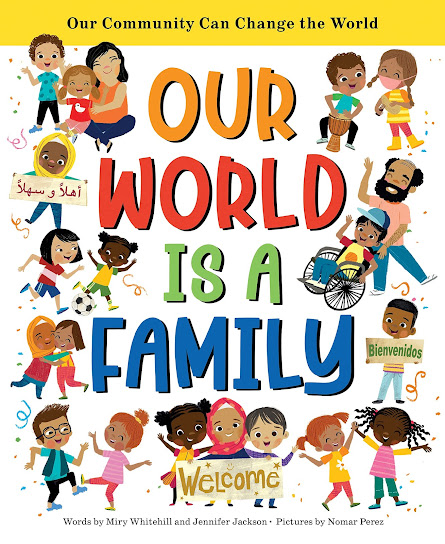
Our World Is a Family: Our Community Can Change the World


Written by Miry Whitehill and Jennifer Jackson  

Illusttrated by Nomar Perez


Publisher ‏ : ‎ Sourcebooks Explore (March 8, 2022)

Language ‏ : ‎ English

Hardcover ‏ : ‎ 32 pages

ISBN-10 ‏ : ‎ 1728231833

ISBN-13 ‏ : ‎ 978-1728231839


Learn how to welcome new neighbors into your community, particularly when they might be far from home, in this uplifting and diverse picture book that champions human connection and inclusivity. After all, the world is everyone's home and we're one big family!


When we see someone new in our neighborhood, how can we help them feel safe and loved and important?


How can we tell them, you're not alone?


There are so many ways!


From the creators of Miry's List, the nonprofit that has helped thousands of refugees, Our World is a Family is an all-ages picture book exploring the complicated topic of human migration in a gentle, loving, and affirming way. It lightly touches on the reason people might leave their homes, like climate change or lack of safety, and inspires children to welcome their new neighbors into their communities with love.


Review


"A good choice to inspire acts of kindness and galvanize positive change." ― Booklist


"A diverse cast of children and families traverse the pages of this uplifting book... promoting a sense of inclusivity and much-needed empathy." ― Youth Services Book Review


"An essential purchase for libraries to help teach empathy and understanding about refugees and migration" ― School Library Journal


Miry Whitehill is founder and executive director of the award-winning nonprofit organization Miry's List, which supports families resettling in the United States as refugees, from countries including Syria and Afghanistan. She is mom to Reuben and Sabo, whose curiosity and unending questions led to the writing of this book. To learn more about the needs of new arrival families and how your family can help, visit miryslist.org.


Jennifer Jackson has always been a storyteller. She began her career in live theater as a writer, director, and choreographer before transitioning to the page with her first picture book, The Punkydoos Take the Stage. Now, she is thrilled to be sharing a story that's so close to her heart. Jennifer lives in Los Angeles with her husband and son. Visit her online at jenniferjacksonbooks.com.


Nomar Perez is a Puerto Rican–born illustrator who immigrated to the United States at age ten and studied painting and computer animation at Bowling Green State University in Ohio. He has since worked as an illustrator inspired by the amazing array of colors from his homeland as well as all types of media from his work as a designer for over eight


Tuesday, March 15, 2022

Review: A Ballad of Love and Glory

 Michael Sedano

Author Reyna Grande must have watched news reports of the American president with an uncomfortable sense of déjà vu as Grande composed her historical novel, A Ballad of Love and Glory. The novel, released March 15, throws a man and woman into the losing side of a bloody war, he a soldier on the front lines, she a nurse and healer. The couple, and their country, face chaos from disastrous leadership.


An American president governs under a secret agreement with an enemy country. The president, a vain, rich man, surrounds himself with sycophants and indulgent women. When he’s alone with a woman, the president targets her for sex. The president is a hateful piece of flesh who blames others in the face of his own failure.

That’s Santa Anna, president of Mexico whose failures allowed an invading United States to keep the northern half Mexico’s land in 1848. The man is John Riley, leader of the San Patricio Battalion of the Mexican Army fighting invading US troops. Riley's a deserter from the US Army.  The woman is Ximena, a Tejana widow named from a poem by Whittier, and the most indomitable woman in literature today.


Grande’s written a beautiful love story that doesn’t get cluttered with sly allusions to current events, even though Grande draws an exceptionally despicable person in her portrayal of Santa Anna. The vain Mexican president sits back to let US soldiers slaughter a company of Mexican soldiers due to their Mexican commander needing to learn a lesson.


Animal lovers will emerge from the cock-fighting scene disgusted at the president’s affectionate cuddling with his favorite cock. Grande gets good mileage from it, though, when Santa Anna thinks he’s being tender, Grande points out the president strokes Ximena as if she were his favorite rooster. About the only way Grande could have indicted Santa Anna more is having him rape Ximena.


A Ballad of Love and Glory is a war novel about Mexicans getting their asses kicked.  But we know this going in. It’s in the telling, and this novel’s rich with telling. For instance, the author’s research informs such details as fort construction, the effects on limbs of cannon shot, herbal poultices and preparation. Rather than concentrate on battle fields, the most effective war scenes are those of the army in flight.


Grande’s military focus is the strategic failure of boastful Mexican generals. We see through Riley’s eyes winning tactics that are opposite of their orders. Mexican generals aren’t military but connected rich guys who love fancy uniforms. US officers are total jerks, but they’re West Pointers with superb military skills. One of the biggest jerk officers survives an inept attempt to frag his tent. The author lets that sit there and it doesn’t taste good, that that jerk of a U.S. soldier survived. Whose side are you on?


When the routed Mexican army flees on foot, they have to walk hundreds of miles to the next big city. Hundreds die along the way from wounds, hunger, suicide, weather. Thousands of nameless peons and soldiers die in the novel. This isn’t about them. But count them, 400 die overnight, hunkered down under their ponchos unable to weather a storm. After battles, thousands of limbs litter a battlefield pooled with blood. Why does blood always have "a metallic smell"?


Love happens. Riley’s guilt at leaving Ireland tortures him. He absorbs all manner of privation in a Catholic way, practicing denial and guilt. Ximena understands Riley’s religious bent. She tells him, after they’ve had sex, if he thinks he needs to do penance for loving her, “do not love me”.  The author sympathizes with the character’s dilemma and gives Riley a technicality. John’s wife is already dead when Riley finally gives in to lust. He doesn’t commit a Sin although he doesn’t know this. 


Readers will enjoy Reyna Grande’s smoothly flowing language and don’t need to interrupt the italicized gaelic ejaculations with English. Here and there, the author slips in some dialect spelling and syntax (“Jimmy, is that ye, boy?” / “Whist.  Don’t exert yourself Charlie, be easy. We shall do aught we can to save ya,” Riley said.”). Thankfully Grande doesn't attempt a novel full of dialect. 


It’s clear Grande’s research helped the author pick up colorful expressions lending authenticity to conversations, as when a comrade consoles the love-torn hero, “The sight of her fills one with the same delight as the first shovel of upturned earth after a hard winter.” That's not how city people talk nor see the world.


Reyna Grande has loaded A Ballad of Love and Glory with high-charged energy, excitement, adventure, frustration, anger, even a modicum of laughter. Grande has readers pulling for the Mexican side against “our” G.I.s. You won’t love the U.S. less because you enjoy the novel, and maybe see parallels in characters, or the setting of a powerful nation invading a neighbor without provocation. Current events don’t get in the way of a good story. 

Monday, March 14, 2022

_Red Teardrop, Κόκκινο δάκρυ_ by Xánath Caraza

 Red Teardrop, Κόκκινο δάκρυ by Xánath Caraza


Red Teardrop / Κόκκινο δάκρυ de Xánath Caraza

Traducido al inglés por Sandra Kingery y Aaron Willsea

Traducido al griego por Natasa Lambrou

Case editorial: Pandora Lobo Estepario Press (2022)

ISBN-10: 1940856469

ISBN-13: 978-4294289433


Con gran alegría comparto con los lectores de La Bloga que mi poemario Lágrima roja (2017), originalmente escrito en español y recipiente del primer lugar como “Mejor libro de poesía en español”, International Latino Book Awards de 2018, ahora se puede encontrar en su versión en inglés y en griego.  Red Teardrop / ha sido publicado por Pandora Lobo Estepario Press en este 2022.  La traducción al inglés es de Sandra Kingery y Aaron Willsea, la traducción al griego es de Natasa Lambrou y la imagen de la portada de Miguel Lopez Lemus quien también es editor de esta casa editorial junto con Kapra Fleming.  Pueden hacer sus pedidos aquí. También está disponible en Amazon. Que la poesía nos salve.


Lágrima roja, Xánath Caraza's award-winning poetry collection is now available in a bilingual English and Greek volume (Red Teardrop/Κόκκινο δάκρυ). These poems focus on the abuse of Mexican women but speak to the suffering of women and indigenous peoples the world over. The English translations by Sandra Kingery and Aaron Willsea are well-crafted and convey the passion and force of the Caraza's Spanish poetry. Natasa Lambrou's renditions in Greek are breathtaking: in the hands of this gifted translator, the musicality and the flexible syntax of Greek, the closeness of many sounds to the Spanish, and the easy coexistence of multiple registers in Greek all contribute to the beauty of these poems. Both the English and Greek versions bring to readers the striking imagery and passionate commitment, the unique voice of Caraza's Spanish poetry.


 — Thalia Pandiri

Professor of Classics and Comparative Literature at Smith College

Editor in Chief, METAMORPHOSES


Το Lágrima roja, η βραβευμένη ποιητική συλλογή της Σάναθ Καράσα διατίθεται τώρα σε μια δίγλωσση μετάφραση αγγλικά και ελληνικά (Red Teardrop/Κόκκινο δάκρυ).  Τα ποιήματα αυτά εστιάζουν στην κακομεταχείριση των γυναικών του Μεξικού αλλά μιλούν και για την οδύνη των γυναικών και των αυτοχθόνων λαών του κόσμου. Οι αγγλικές μεταφράσεις από την Σάντρα Κίνγκερι και τον Άαρον Γουίλσι είναι δουλεμένες με μεγάλη τέχνη και μεταδίδουν το πάθος και τη δύναμη της ισπανικής ποίησης της Καράσα. Η απόδοση της Νατάσας Λάμπρου στα ελληνικά είναι συγκλονιστική. Στα χέρια αυτής της χαρισματικής μεταφράστριας, η μουσικότητα και η ευέλικτη σύνταξη των ελληνικών, η εγγύτητα πολλών ήχων με την ισπανική, και η εύκολη συνύπαρξη των διαφορετικών επιπέδων στα ελληνικά, όλα συνεισφέρουν στην ομορφιά αυτών των ποιημάτων. Και οι δύο εκδοχές αγγλικών και ελληνικών μεταφέρουν στους αναγνώστες τον εντυπωσιακό μεταφορικό λόγο και την ενθουσιώδη αφοσίωση, με τη μοναδική φωνή της ισπανικής ποίησης της Καράσα.


Θάλεια Παντίρη

Καθηγήτρια Κλασικής και Συγκριτικής Λογοτεχνίας του Smith College

Αρχισυντάκτρια, METAMORPHOSES


Friday, March 11, 2022

Denver Events: Literary, Art, Music


There's always something happening in my hometown.  Here are a few upcoming options to feed your brain and stimulate your heart.

______________


The universally acclaimed Reyna Grande visits Denver as part of her book tour to promote her latest novel, The Ballad of Love and GloryMarch 19, 5:00 PM, Colfax Tattered Cover.   More info from the book store website:


This is a free event, but registration is required.

About the Book:

A Long Petal of the Sea meets Cold Mountain in this sweeping historical saga following a Mexican army nurse and an Irish soldier who must fight, at first for their survival and then for their love, amidst the atrocity of the Mexican-American War—from the author of the “timely and riveting” (People) Across a Hundred Mountains and The Distance Between Us.

A forgotten war. An unforgettable romance.

The year is 1846. After the controversial annexation of Texas, the US Army marches south to provoke war with México over the disputed Río Grande boundary.​

Ximena Salomé is a gifted Mexican healer who dreams of building a family with the man she loves on the coveted land she calls home. But when Texas Rangers storm her ranch and shoot her husband dead, her dreams are burned to ashes. Vowing to honor her husband’s memory and defend her country, Ximena uses her healing skills as an army nurse on the frontlines of the ravaging war.

Meanwhile, John Riley, an Irish immigrant in the Yankee army desperate to help his family escape the famine devastating his homeland, is sickened by the unjust war and the unspeakable atrocities against his countrymen by nativist officers. In a bold act of defiance, he swims across the Río Grande and joins the Mexican Army—a desertion punishable by execution. He forms the St. Patrick’s Battalion, a band of Irish soldiers willing to fight to the death for México’s freedom.

When Ximena and John meet, a dangerous attraction blooms between them. As the war intensifies, so does their passion. Swept up by forces with the power to change history, they fight not only for the fate of a nation but for their future together.

Heartbreaking and lyrical, Reyna Grande’s spellbinding saga, inspired by true events and historical figures, brings these two unforgettable characters to life and illuminates a largely forgotten moment in history that impacts the US-México border to this day.

Will Ximena and John survive the chaos of this bitter war, or will their love be devoured along with the land they strive to defend?

About the Author:

Reyna Grande is an award-winning author, motivational speaker, and writing teacher. As a young girl, she crossed the US–Mexico border to join her family in Los Angeles, a harrowing journey chronicled in The Distance Between Us, a National Book Critics Circle Award finalist. Her other books include the novels A Ballad of Love and Glory, Across a Hundred Mountains, and Dancing with Butterflies, the memoirs The Distance Between Us: Young Readers Edition, and A Dream Called Home, and the anthology Somewhere We Are Human: Authentic Voices on Migration, Survival, and New Beginnings. She lives in Woodland, California, with her husband and two children. Visit ReynaGrande.com for more information.

_________________


[from the event website]

A collaboration between IDEA Stages, Sasquatch Productions, Control Group Productions, and The Bug Theatre on a mission to bring new plays to Denver; written, directed, designed and acted by BIPOC or other traditionally marginalized folks. Puerto Rican Nocturne is a chronicle of the Cerro Maravilla murders, in which a group of police officers assassinated two Puerto Rican independence activists. The play alternates between the POV of the mother of one of the victims and the cop who organized the killings.

The reading is the precursor to the first ever Higher Ground Series. Higher Ground is a collaboration with The Bug Theater in which, every August, a play selected for Coffee & Cold Reads will be developed and given a full production.

All proceeds from this reading go towards the production of Puerto Rican Nocturne in August.

March 27, 2022
6:30 PM – 8:30 PM MDT
$10 - tickets here.

The Bug Theatre
3654 Navajo Street
Denver, CO 80211
_____________________


OPENING RECEPTION: MALINALLI ON THE ROCKS
March 17 @ 6:00 pm - 9:00 pm
[from event website]

Join us for the Opening Reception of our new exhibit: Malinalli on the Rocks.

Malinalli on the Rocks provides opportunities for Latinx and Chicanx artists to explore and re-discover one of the most enigmatic historical figures of the Americas: La Malinche.

We will have live music, food, and a bar. We can’t wait to see you at the Opening!


MUSEO DE LAS AMERICAS
861 Santa Fe Drive
Denver, CO 80204

303.571.4401
________________

[from the event website]
Join Babe Walls in celebrating Womxn at RiNo's Banshee House with art on display all month long. The opening reception for the gallery begins on March 11th from 5-8pm. A gallery exhibit featuring the artists of Babe Walls and beyond. Featuring over 35 artists from Colorado, Texas, California, New Mexico, and South Carolina.


_____________________


[from event website]

Join us Friday, April 8 for the second night of our opening celebration of the Holiday Theater with a concert featuring Chicano Batman and Los Mocochetes, plus an afterparty with DJ Lengua (aka exhibiting artist Eamon Ore-Giron) and special guests. What a lineup! Get ready for kickass music and be sure to bring your best dance moves…even if those moves are limited to the confines of your seat. Seating at the theater is first come first served, and the event is for 13+.

Beer, wine, canned cocktails, and non-alcoholic beverages will be available for purchase at the event. Come thirsty (for the bevs and the entertainment)!

MCA Denver at the Holiday is a hub for the arts located in the historic Holiday Theater, hosting lectures, music, performance, and more.

The Holiday Theater, 2644 W 32nd Ave, Denver, CO 80211

Doors open at 6PM
Performance begins at 7PM
After-party begins at 9pm

Tickets are limited. Book early. Refunds available up to 7 days before performance.

$40 GA tickets for MCA members, $45 GA tickets for non-members

Later.
__________________


Manuel Ramos writes crime fiction. His latest novel is Angels in the Wind.