Monday, October 17, 2005

SPOTLIGHT ON ESMERALDA SANTIAGO

Monday’s post from Daniel Olivas…

Esmeralda Santiago was born in San Juan, Puerto Rico. She came to the United States at thirteen, the eldest in a family that would eventually include eleven children. Santiago attended New York City’s Performing Arts High School, where she majored in drama and dance. After eight years of part-time study at community colleges, she transferred to Harvard University with a full scholarship. She graduated magna cum laude in 1976. In 1977, she and her husband, Frank Cantor, founded CANTOMEDIA, a film and media production company, which has won numerous awards for excellence in documentary filmmaking.

Upon publication of her first book, the memoir When I Was Puerto Rican, Santiago was hailed as “…a welcome new voice, full of passion and authority,” by the Washington Post Book World. Her first novel, America's Dream, was published in six languages, and was an Alternate Selection of the Literary Guild. Her second memoir, Almost a Woman, received numerous “Best of Year” mentions, in addition to an Alex Award from the American Library Association. Her third memoir, The Turkish Lover, has received enthusiastic reviews as “an earthy, heartfelt tale of liberation, desperation, and the crippling grip of love.” (Booklist) It was selected a BookSense recommendation for September 2004 and appeared on several “Best of 2004” lists. She is also the author of the illustrated children’s book, A Doll for Navidades. Santiago is currently at work on a novel.

ESCUCHE: Michael Jaime-Becerra, author of the short-story collection, Every Night Is Ladies' Night: Stories (HarperCollins/Ray), appeared on "The California Report” on Public Radio on October 10, 2005. You may listen to the program here. You may also read my review of this wonderful book.

STILL RUNNING: In yesterday’s book section of the L.A. Times, Kristina Lindgren offered a short essay about Luis J. Rodríguez. Here is an excerpt:

FROM DESPAIR, WORDS OF HOPE

When "Always Running" came out in 1993, its author — the poet, novelist and Chicano activist Luis J. Rodríguez — hoped that this gripping memoir of his career as a gang-banger in poverty-riddled East Los Angeles would dissuade his troubled teenage son, Ramiro, from la vida loca.

Since then, the author reports, "more of my homies from 30 years ago have died," and Ramiro is serving a 28-year prison sentence for three counts of attempted murder. Meanwhile, Rodríguez's graphic and unvarnished account of "stealing, shootings, stabbings, arrests, homelessness, drug use and overdoses" has become one of the nation's 100 most widely banned books, according to the American Library Assn.

"Always Running," reissued this month by Simon & Schuster, traces his path "from victim to perpetrator to witness to revolutionary." In a new introduction, Rodríguez writes: "The fact is I failed at everything I tried to do, but I kept working at it, failing some more, not giving up, so that eventually, at age 51, I've begun to center my life, get control over my destructive impulses, and become someone my wife, my kids, my grandchildren, and my community can learn from and respect." . . . .

You may read the entire essay along with a selection of Rodríguez’s poetry here.

DESPERATELY SEEKING LATINA WRITERS: Publisher’s Weekly (by way of our comadre, Gina, here at La Bloga) tells us that if you are an "established or emerging author" of commercial women's fiction aimed at "Latinas who are immersed in the American mainstream while maintaining ties to their culture," Warner has a new imprint to showcase your work. Solana (Spanish, we are told, for "where the sun shines"), will publish six such trade paperbacks a year, starting in early 2007, under the direction of associate editor Adrienne Avila.

9TH ANNUAL LOS ANGELES LATINO BOOK & FAMILY FESTIVAL: Authors, book signings, publishing seminars, Folklórico dance competition, entertainment, food, and fun for the entire family.

Venue: Fairplex
Dates: October 22 and 23
Address: 1101 W. McKinley Ave., Pomona, 91768
Ages: All Ages
Admission: Free
For more information call: 760-434-4484
Or visit: http://www.lbff.us/
E-mail: jim@LBFF.us

NEWS FROM THE UCLA CHICANO STUDIES RESEARCH CENTER (“CSRC”): The CSRC invites everyone to its annual open house at the UCLA campus on Thursday, October 20, 4:00-7:00 p.m., at Haines Hall 144.

Open House Activities:
Balcony—Eat and drink courtesy of Casablanca Restaurant!
Room 144—View Sleepy Lagoon and other archival information!
Room 180—Buy the center’s books, journals, DVDs, and t-shirts!
Room 179—Win door prizes!

Open House Speakers:
Assemblymember Cindy Montañez
Vice Chancellor Claudia Mitchell-Kernan
Professor Daniel Solorzano
Director Chon A. Noriega

CONFERENCE: El Clamor Público - 150 Years of Latino Newspapers in Southern California.

The Huntington Library, San Marino, CA
October 28, 2005
8:30 a.m.-4:00 p.m.

Sponsored by the Huntington-USC Institute on California and the West, USC Annenberg School for Communication, California State University, Northridge Graduate Studies Program Distinguished Speakers Series, and the John Randolph Haynes and Dora Haynes Foundation.Founded in Los Angeles in 1855, the newspaper El Clamor Público staunchly defended equal rights in California. Though labeled treacherous, incendiary, and anti-American, eighteen-year-old journalist Francisco P. Ramírez‘s newspaper courageously reported lynchings, land frauds, vigilante terror, racial profiling, and legal injustices targeting Spanish-language communities. Ramírez’s faith in the U.S. Constitution guided him as he urged readers to elect trustworthy representatives and to learn English so they could defend their rights. He printed the Declaration of Independence in Spanish and encouraged Californios and Anglos to “work together in the same spirit.” During its four and a half years, the newspaper published political opinion, international news, literary expressions, and social commentaries.This conference will examine the history and legacy of El Clamor Público through and exploration of Latino newspapers in Southern California’s past, present, and future. The conference is free and open to the public; registration is required by October 24. Luncheon will be provided for a prepaid fee. For registration information, go here. For more information on the conference contact conference coordinator Joseph Legaspi at his e-mail.

All done. So, until next Monday, enjoy the intervening posts from my compadres y comadre at La Bloga. ¡Lea un libro!

Friday, October 14, 2005

Chicano Music

Manuel Ramos


Not much about fiction this week, so let's do music.

CHICANO MUSIC? La cancíon mexicana, latin jazz, movimiento protest songs, oldies, tejano, conjunto, hip-hop, reggaeton, o qué? Maybe all of that. There is a good shelf's worth of books to help figure it out. Keep in mind, this post is mostly old school.


A good place to start is A Texas-Mexican Cancionero by Américo Paredes (University of Illinois Press, 1976, reprint by University of Texas Press, 1995) , subtitled, Folksongs of the Lower Border. Paredes, one of the masters of Chicano research and historical preservation, collected sixty-six songs that were representative of the folksongs of the Lower Rio Grande Border from 1750-1960. Here are the words, the compositions, and the stories behind the songs that tell how life was for the people along the border in the days of shoot-outs with the Texas Rangers (¡rinches cobardes!) - Jacinto Treviño; smuggling tequila across the border - Los tequileros; and the first appearance of television and easy-payment plans (ya no tengo pa' cerveza por estar viendo los monos) - Ya se va la televisión. Unique photographs, too.


Moving several years forward, take a look at Barrio Rhythm: Mexican American Music in Los Angeles by Steven Loza (University of Illinois Press, 1993). This book has it covered. The book jacket says, "Loza provides a historical overview of the music from the nineteenth century to the present and offers in-depth profiles of nine Mexican-American artists, groups, and entrepreneurs in Southern California from the post-World War II era to the present. His interviews with many of today's most influential barrio musicians, including members of Los Lobos, Eddie Cano, Lalo Guerrero, and Willie Herrón, chronicle the cultural forces active in this complex urban community."


The Old Barrio Guide To Low Rider Music, 1950 - 1975, by Ruben Molina (Mictlan Publishing, 2002), doesn't focus only on Chicano music. This book provides rundowns on the bands and singing groups that taken together defined and continue to define the urban sound of low rider culture - equal parts R&B, Chicano rock and oldies, with bits and pieces of jazz, blues, and maybe one or two corridos or rancheras. The book starts with Johnny Ace and ends with the Youngsters, and in between are thousands of details about everyone else who matters, from El Chicano to Thee Midniters, from the Premiers (photo at the top of this post) to Ritchie Valens. A fun book that looks fine, so fine, on the coffee table.


Back to Texas for The Billboard Guide to Tejano and Regional Mexican Music by Ramiro Burr (Billboard Books, 1999), another group-by-group, singer-by-singer compilation from Accordion to Henry Zimmerle y Conjunto San Antonio. Burr is a music journalist, syndicated columnist, radio personality and critic. This is the source for information about the wide range of Tejano formats and the diverse musicians who continue to produce the most popular Latino music in the country (yes, even more than salsa.) If the word Tejano means Selena and nothing more, this book is for you.


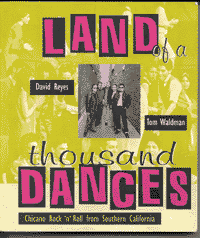
Land of a Thousand Dances: Chicano Rock 'n' Roll from Southern California, by David Reyes and Tom Waldman (University of New Mexico Press, 1998), is a more-or-less chronological analysis of the various personalities, influences, musical styles, low and high points of the Chicano rock scene in SoCal, from Chico Sesma and Lalo Guerrero to Los Lobos. Many, many details and personal insights that create an insider's attitude.

Two other excellent sources are Chicano Popular Culture: Que Hable el Pueblo, by Charles M. Tatum (University of Arizona Press, 2001), and Chicano Renaissance: Contemporary Cultural Trends, by David R. Maciel, Isidro D. Ortiz, and María Herrera-Sobek (University of Arizona Press, 2000), both of which have sections on Chicano music.

This list lacks a reference for the music scene in the Bay Area (California) - Santana, Malo, et al. - and a definitive work on the music of New Mexico - Al Hurricane, Roberto Griego, Tobias Rene, etc. Any suggestions? Also missing is the newest stuff, the current groups, singers and musicians - but that's the way it is with music. It evolves quickly, progresses constantly and the critics and analysts are usually a few years behind.


LAW AND LITERATURE
On October 18 I will have the pleasure of talking with the students in Mimi Wesson's Law and Literature class at the University of Colorado School of Law. Mimi has published several crime fiction novels and consistently attracts a very interesting group of students for this class. The students have been reading The Ballad of Rocky Ruiz and thinking up questions such as: why do so many lawyers write fiction; is there room in a busy lawyer's life for creativity? Daniel Olivas?

Later

Thursday, October 13, 2005

Doña Flor


Title: Doña Flor: A Tall Tale About a Giant Woman With a Great Big Heart
Author: Pat Mora
Illustrator: Raul Colón
Publisher: Knopf Books for Young Readers (October 25, 2005)
ISBN: 0679980024

Award winning Pat Mora and illustrator Raul Colón, an award winner in his own right have collaborated once again in this funny, touching and gorgeous book. They have partnered once before with Tomás and the Library Lady, which won several awards, including the Tomás Rivera Mexican-American Children’s Book Award.

Doña Flor is a giant woman who lives in the Southwest and makes giant tortillas which the children use as rafts and the grown ups use to roof their houses making the air smell of sunshine and warm corn. Her casa is as huge as a mountain, which she made herself adding estrellas to make the adobe shine. To cheer up the villagers, she scratches them out a rio. Everything she grows in her garden grows to amazing sizes and she lets the children in her pueblo use flowers for trumpets and the huge sunflowers for umbrellas. The people love the beautiful and kind Doña Flor and look up to her so it is no surprise when the villagers hear a loud roaring to call on her for help against the strange sound. What follows is a funny and wonderful tall tale of Doña Flor’s hunt for the creature that is terrifying the villagers she protects and loves. Pat Mora’s story telling is humorous, wonderful and filled with her love for the Southwest. The imagery is amazing; you can almost smell those giant corn tortillas and hear the roar of the “monster gato”.

The illustrations by Raul Colón are lovely, a wondrous combination of watercolor washes, etchings and colored and litho pencils. Doña Flor and her world are vividly portrayed and you can almost step into each page and walk into the fantastic world created by Ms. Mora. The characters faces are so beautiful; Doña Flor in particular is a gorgeous rendition of a Mexican woman with a beautiful oval brown face, full lips and deep brown eyes. She is reminiscent of a Diego Rivera painting or a Da Vinci Madonna. The colors are soft yet vibrant – luscious blue-greens and the rich warm hues of a desert sunset. Ay que bonito! I loved this book and the story made me laugh out loud. I love turning the pages and finding more and more to love in the illustrations of children marching with their flower trumpets – copa de oro my grandmother called those flowers and just about every house in our neighborhood growing up had them growing so the book also brought back a rush of warm and happy memories.

Pat Mora writes poetry, non-fiction and children’s books. She is a recipient of a National Endowment for the Arts Poetry Fellowship and a Kellogg National Fellowship. She is a native of El Paso, Texas and currently lives in Santa Fe.

Raul Colón has illustrated many books for children. He has been awarded gold and silver medals from the Society of Illustrators for his picture-book art. Mr. Colón resides in New York City.

Until next week,

Gina MarySol Ruiz

Tuesday, October 11, 2005

Educating Parents in Either Language

Michael Sedano

How to Raise Emotionally Healthy Children is not a literary title. Nonetheless, the book could make a dramatic contribution in a family who reads it. Translated into Spanish as Como Criar Niños Emocionalmente Sanos, the book promotes a wealth of ideas and guidance that any family can put into action.

Jerry Newmark, a seasoned corporate consultant, has been promoting the book for several years. Recently, his company, NMI Publishers, announced the title has been picked up by a San Bernardino County public health/ neonatal services organization. The health educators see in it a key resource for parents.

One key to the book's value is Newmark's view of "the five critical needs" a child has, and his ideas on how to provide and fulfill these. In Spanish, here's the list:

La necesidad de ser respetado

La necesidad de sentirse importante

La necesidad de sentirse aceptado

La necesidad de sentirse incluido

La necesidad de sentirse seguros

Newmark's discussion of these issues may seem "common sense" to some parents. Sadly, one of the rarest behaviors I've witnessed in the general population, is common sense. How to Raise Emotionally Healthy Children / Como Criar Niños Emocionalmente Sanos, will be worthwhile to any reader. NMI Publishers are at nmipub@earthlink.net, or 18345 Ventura Blvd, Suite 314, Tarzana CA 91356. ISBN 0-932767-08-7 (Spanish) 0-932767-07-9 (Ingles).
Have a great week, gente. Read! Raza.
mvs

Monday, October 10, 2005

SPOTLIGHT ON ANGIE CRUZ

Monday’s post from Daniel Olivas…

A New York-born Dominicana, Angie Cruz is the author of Let It Rain Coffee (Simon & Schuster, 2005) and Soledad (Simon & Schuster, 2001). She is at work on her third novel. Her fiction and essays have appeared in Latina magazine, New York Newsday, The New York Times and Callaloo. Most recently her essay, On the Verge, was featured in Border-Line Personalities (R. Moreno and M. Herrera Mulligan; Rayo, Harper Collins 2004). Cruz earned her MFA in fiction from New York University and has received numerous awards, including the Camargo Foundation Fellowship, New York Foundation for the Arts Fellowship and The Barbara Deming Award.

On Tuesday, October 18, at 6 p.m., the Queens Library New Americans Program will host a talk with Cruz moderated by Marcela Landres. Address, phone and travel information: Queens Library, Jackson Heights Branch, 35-51 81st Street, 718-899-2500; by train: 7 to 82nd Street; by bus: Q19B, Q32, Q33. You may also e-mail Marcela Landres for further information.

NEWS FROM THE UCLA CHICANO STUDIES RESEARCH CENTER (“CSRC”):

◘ Yolanda Retter Vargas, the librarian of the UCLA CSRC Library, and Lillian Castillo Speed, head of the UC Berkeley Ethnic Studies Library, received a grant from the UCLA Librarians Association Research and Professional Development Committee to collaborate on a project to update the Chicano Thesaurus. The thesaurus provides subject heading guidance for the Chicano Studies Database, which is the primary online research resource for Chicano studies. The project will add new headings in two areas: non-Chicano Latinos in the United States and LGBTI (lesbian, gay, bisexual, transgender, intersex) people.

◘ This summer the CSRC press worked to forward a number of projects. After a year of focusing on our periodicals (releasing two issues each of our Latino Policy & Issues Brief, CSRC Research Report, and Aztlan: A Journal of Chicano Studies), the CSRC turned to its two new book series: A Ver: Revisioning Art History and The Chicano Archive. The first series, under the leadership of Director Chon A. Noriega and with major funding from the Rockefeller and Ford Foundations, is devoted to forwarding and preserving the work of Latino/a artists. The first book in the series, to be in full color, is on the artist Gronk. The second series, with collaboration from Latino institutions around the country, is devoted to preserving Latino archives. The first book in the series is on Self Help Graphics & Art and due back from the printers by the Open House this October.

◘ The fall issue of Aztlán: A Journal of Chicano Studies has arrived. If you are not an Aztlán subscriber and want to be one, e-mail your postal address to the CSRC Press in order to receive a subscription package.

◘ For more than three decades, Self Help Graphics & Art has been a national model for community-based art making and art-based community making. Through its innovative printmaking and other programs, Self Help has empowered local artists and reached out to the world beyond East Los Angeles with the vibrancy of Chicano/Latino art. In the new CSRC book Self Help Graphics & Art: Art in the Heart of East Los Angeles, Historian Kristen Guzmán draws on archival sources and on interviews with artists to tell the story of this remarkable organization. Edited by Colin Gunckel, this book comes out of a partnership between the CSRC and Self Help. It is published in collaboration with Sal Guereña from the California Ethnic and Multicultural Archives (CEMA) at the University of California, Santa Barbara, which provided the book’s finding aid to the CEMA Self Help Graphic archive. Five hundred copies of the book are being donated to Self Help. For more information, click here.

CONFERENCE: El Clamor Público - 150 Years of Latino Newspapers in Southern California.

The Huntington Library, San Marino, CA
October 28, 2005
8:30 a.m.-4:00 p.m.

Sponsored by the Huntington-USC Institute on California and the West, USC Annenberg School for Communication, California State University, Northridge Graduate Studies Program Distinguished Speakers Series, and the John Randolph Haynes and Dora Haynes Foundation.Founded in Los Angeles in 1855, the newspaper El Clamor Público staunchly defended equal rights in California. Though labeled treacherous, incendiary, and anti-American, eighteen-year-old journalist Francisco P. Ramírez‘s newspaper courageously reported lynchings, land frauds, vigilante terror, racial profiling, and legal injustices targeting Spanish-language communities. Ramírez’s faith in the U.S. Constitution guided him as he urged readers to elect trustworthy representatives and to learn English so they could defend their rights. He printed the Declaration of Independence in Spanish and encouraged Californios and Anglos to “work together in the same spirit.” During its four and a half years, the newspaper published political opinion, international news, literary expressions, and social commentaries.This conference will examine the history and legacy of El Clamor Público through and exploration of Latino newspapers in Southern California’s past, present, and future. The conference is free and open to the public; registration is required by October 24. Luncheon will be provided for a prepaid fee. For registration information, go here. For more information on the conference contact conference coordinator Joseph Legaspi at his e-mail.

NUEVO LIBRO: Rigoberto González reviews Benjamin Alire Sáenz's new novel, In Perfect Light (HarperCollins/Rayo). He calls it a “heart-wrenching, beautiful novel.” González is an award-winning writer and associate professor of English and Latino studies at the University of Illinois at Urbana-Champaign.

LOS GANADORES: The winners of the 31st Chicano/Latino Literary Contest have just been announced. This year the genre was poetry; the judge was Valerie Martinez:

1st Prize: Javier Huerta – Some Clarifications
2nd Prize: Pablo Miguel Martínez – Before Stars Were Moored
3rd Prize: Javier Campos – El poeta joven

To read the judge’s comments about each winner, go here.

FINALMENTE: The Write Influence: Valuing Diversity. A day-long multi-panel seminar featuring lively and honest discussions exploring how diversity is making storytelling a richer, more profitable experience. Working writers, those who hire writers, media ad buyers, and those who market and distribute films are set to share their progressive successes and missed opportunities within today's entertainment world.

The day's first panel, The Changing Room, will feature showrunners who've hired diverse staffs that create challenging and quality television content.

The second panel, Everybody Loves Green, will focus on media buyers, as they discuss the economic and moral connection between advertising and entertainment product that features diverse storytelling.

The third panel, Damn, You Wrote That?!, will spotlight successful multi-cultural screenwriters who've excelled in Hollywood by writing against type.

Date and Time: Saturday, October 15, 10:00 a.m. to 4:00 p.m.
Venue: Writers Guild Theater
Address: 135 S. Doheny Drive , Beverly Hills
Ages: 21+
Admission: Free
For more information call: (323) 782-4577
Or visit: http://www.wga.org/
Email: PAEvents@wga.org

All done. So, until next Monday, enjoy the intervening posts from my compadres y comadre at La Bloga. ¡Lea un libro!

Friday, October 07, 2005

Pedazos y Pedacitos

Manuel Ramos

Opportunities for Writers
We've heard about a couple of places offering opportunities for Chicano/a writers. First, a friend forwarded this post from the Freelance Writing website:

"Looking for writers and material ASAP - Posted by Tereso Caspa , Aug 22,2005
One of the largest Latino Lifestyle magazines in the country. #2 to be exact. Searching for creative edgy, artsy material dealing with Latino issues. We explore politics, art, current issues, etc. with, about, or by a Latino perspective. We are looking for material and writers. Please contact by the email above or call 323-344-1239 and speak with Fernando. Pay varies depending on experience and work. We pay .10 a word for most new writers, yet if we like the work we will consider more. We never pay more than $3000.00 for a feature.
Related link: Bello Magazine."

Second, from another friend, we got this note: "Could you give some press to this online journal by fellow Chicano poet Albino Carrillo? Check it out. He's always looking for Chicano/Latino writers. He says it's gotten a bit political of late because of the horrid times we live in, but decide for yourself." The journal is Maverick Magazine found at this link: http://maverickmagazine.com/default.htm

Third, November is National Novel Writing Month. That means you can join in on the fun of writing 50,000 words in thirty days. There is a website with details.

Cruisin' The Heart of Aztlán
I spent a few days traveling through southern Colorado and northern New Mexico as part of a Milagro Tour sponsored by KUVO radio - great idea and a wonderful chance to see the beautiful country and meet some simpático people. The trip took us from Denver to the Baca House in Trinidad, the plaza in Santa Fe, El Rancho de las Golondrinas, Española, Chimayó, the hot springs at Ojo Caliente, then return over the High Road to Taos and through the San Luis Valley.

Over on the Occasional Blog I have posted a few photos from the trip - of course, they don't do justice to the beauty and grace of the land.

This is Bless Me, Ultima (Rudolfo Anaya) and Milagro Beanfield War (John Nichols) country. Here is where the myths and legends come alive, where the great stories thrive, waiting to be told, and where a writer's imagination can blossom from the inspiration or shrivel from the challenge.


Up on the High Road to Taos a person gets a chance to visit places like Chimayó, home of the miraculous holy dirt and the setting for the book Chiva, by Chellis Glendinning, which is about the heroin scourge in that small village, or Truchas, where the Milagro Beanfield War movie was filmed by Robert Redford (a pretty good movie with an outstanding cast), or Las Trampas, site of the San José de Gracia church built in 1776, or, north of Taos, the D.H. Lawrence Ranch. With a bit of luck and the right timing, a person could attend Cambalache at the Artesanos Center in Questa, where El Kukui is burned along with the past year's pains, ills and other bad stuff.

On the tour we listened to Max Córdova of Los Siete Arts Center in Truchas explain the history of his beautiful valley, from the Aztec village of Quemado to the town's appreciation for but ultimate rejection of Redford's idea to have a "mini-Sundance film festival" in Truchas, to the plague of "social services," to the real fear that the gente in his valley are losing the fight to maintain their lifestyle and homes to unwanted immigrants (trust fund babies from California) whose first acts as Truchas residents are to build fences around their land.

I could have used another week traveling through the mountains, actually seeing the stars and taking stock, as they say. Oh well.

Another thing - the biscochitos and sopapillas in these villages are excellent.

Wednesday, October 05, 2005

The Woman Who Outshone the Sun

I was going to write about Condorito, the new comic book collection that has been recently translated into English and published by Harper Rayo but, as usual, I got distracted and found this book while I was packing up for my big move to San Diego next weekend. Once I saw it, I knew I had to post this one instead. I think it was a good choice for this week's post.


Title: The Woman Who Outshone the Sun / La mujer que brillaba aun más que el sol
(English/Spanish bilingual)
Author: Rosalma Zubizarreta, Harriet Rohmer, David Schecter
based on a poem by Alejandro Cruz Martinez, Fernando Olivera (Illustrator)
Publisher: Children's Book Press (CA); Reissue edition (April 1, 1994)
ISBN: 089239126X
Price: $7.95

This is one of my most beloved children’s books.

The Woman Who Outshone the Sun/La mujer que brillaba aun más que el sol is such a beautiful, compelling and moving story. It is based upon a poem by Alejandro Cruz Martinez, a young Zapoteca poet who spent years collecting the oral traditions of his people. The Zapotecas are great storytellers and the tale of Lucia Zenteno comes from that grand and ancient tradition. In 1986 he published his version of this story as a poem and was later killed in 1987 while organizing the Zapotecas to regain their lost water rights.

The book is about Lucia Zenteno, a woman who was so beautiful she outshone the sun. All of nature loved Lucia and in this magical story, the fish in the river and the river itself love her so much that she combs them in and out of her glorious long black hair. The people of the village, however are afraid of her because she is different. They whisper about her and are so cruel in their fear of her. The village elders are different. They warn the villagers that Lucia is a woman in touch with nature and they hurt her at their own peril but the villagers donít care to listen. She is too different, too odd. Finally, Lucia, hurt by their taunts and whispers, leaves the town followed by her beloved pet iguana.

The river and nature mourn her loss and leave with Lucia caught up in her hair. It is only when the village, now desolate and dry that the villagers repent of their cruelty and seek Lucia out.

The book is fantastically illustrated with lush and magical paintings by the acclaimed painter Fernando Olivera, who was a close friend of Alejandro Cruz Martinez. Each page is a fantasy of beautiful Zapoteca indigenous dress, nature, animals and of course, the river which is as much an important character as Lucia Zenteno. My favorite illustration is of Lucia combing all the little fish and water creatures into and out of her beautiful, long black hair.

The story has a strong moral message for both adults and children and I cannot help but think that to Cruz Martinez, this story was told as an allegory for the water rights he died defending.. His widow gave Children’s Book Press (a wonderful independent publisher that specializes in multi-cultural books based in San Francisco) the permission to adapt the story. All royalties from this book are paid out to her.

I encourage everyone to purchase this and to read it to your children or just enjoy it yourself. Tell the children the story behind the book. Cruz Martinez was an eloquent and astounding poet and his voice should be heard. The book is bilingual in English and Spanish.