by RudyG
La Bloga posts and comments this year have gotten me rethinking what's Chicano Lit and what's Latino Lit. Each author pushed me to revamp my perspective and raised more questions than I could answer. Maybe others could help me sort this out.
I limit this piece to the arena of Chicano Lit (and exclude the question of who or what is a Chicano writer). Bloguistas and others made we reexamine its relationship to what's called Latino Lit.
Chicano Lit is about Chicanos, somehow. I'll dare say that books written about non-Chicanos, even though written by a Chicano (e.g., Diana Gabaldon's "Outlander" series) are not Chicano Lit, in the sense they are not part of a body of works more or less directly expressing perspectives on the Chicano experience. (Nevertheless, I might enjoy an analysis like "Chicano themes and perspectives in Gabaldon's Scotland.")
I'd add that books about Chicanos, even though written by a non-Chicano, should be considered Chicano Lit, when they successfully, empathically portray that experience. It would seem that, on the other hand, books about Chicanos written by a Chicano and not successfully portraying that experience are still Chicano Lit; they're just badly written.
Chicano Lit has affinities with Latino Lit. For instance, in the case of Boriqua Lit, they share historical affinities due to the similar subjugation by the U.S. Our affinities to Cubano Lit are at least dualistic. Chicano (not Hispanic) Lit connects to works still done on the island when we acknowledge shared connections to Che Guevara, also a hero of the Chicano Movement. Expatriated Cubanos centered in Florida understandably don't necessarily share that experience with us, anymore than all literature from the island does.
Along both sides of La Frontera, shared experiences reflected in Chicano and Mexicano writing merge even more, but tend to blur the further one moves into interior Mexico, and literature more "Mexican" than "Border".
Gabriel Garcia Marquez, who writes of Colombia and Latin America, makes his own mold for his work. Several Chicano works obviously or subconsciously owe something to the influence of his works. But one would expect a Nobel Prize winner's obras to have wider influence than most writing.
There is other Latino Lit--Dominican, etc.--that could be examined in the same light, but I don't need to go into that here.
By definition--that of mestizaje--Chicano Lit has its limits and indistinctiveness. A literature about a subjugated people denied their culture and language suffers from that loss of native language. Thus, much of Chicano Lit discussions are forced to discuss in the realm of the English language, since we may not speak, read, much less write in Spanish. Our inability to appreciate, for instance, writing composed in Spanish--no matter that it includes the Chicano border experience--leaves a significant weakness in such discussion. Likewise, lists of Greatest Chicano Lit often include few works in Spanish.
This language gap, and history itself, combine to argue against our including literature from Spain as Latino, no matter that one would think half our mestizaje heritage should work to encompass the conqueror-Hispano experience. However that's a gap we seem to welcome.
A list of Greatest Chicano Works seems a good thing. I understand why 100 Years of Solitude couldn't be on that list, no matter how great a "Latino" work it is. Seems a natural.
What wouldn't seem called for is widening such a list to include Latino, non-Chicano works. Why go along with the U.S. monopolist publishers' Latinization--the corporate, brown melting pot where the Chicano experience gets blender-ed into the experiences of all others subjugated by the criollos.
Good literature is good literature, sí. But La Bloga could make a distinctive contribution in reviews and discussions of non-Chicano Lit; particularly if such reviews explained how said non-Chicano work related to the Chicano experience, something I think few literati attempt. Perhaps, too, it is something corporate publishers would rather have us not do; for the sake of sales, they might prefer reviews that blurred a work's political and cultural, historical threads to Chicanismo.
Great literature does more than entertain: it explores the human psyche, builds on traditions, opens new paths, and redefines those around it. Its roots spread deeper and its branches reach higher than what is written on an author's birth certificate.
I think La Bloga could help deconstruct even the all-encompassing genre of "Latino", at least in how it relates to the Chicano experience--a guide to how/why it is that Bloguistas choose to discuss or review particular non-Chicano works. We don't often see that.
If I sound like I'm just rhetorically questioning, remember how Chicano Lit is sometimes dumped in university Romance Language depts. with Portuguese, how in bookstores it can be found alongside anti-Castro books, or next to Jennings' Aztec series. For these institutions, the reasons for the categorization vary, from academic paradigms to those of profit motive.
I'm not suggesting La Bloga or others need to hammer out a new literary consensus, but only that exploring whatever makes up our present Chicano-Latino Lit mindset might tell us things about ourselves we didn't know. It might give us literary perspectives we never noticed.
As I said, I throw these questions out because of recent blogger posts, here and elsewhere. My suggestions might help sharpen the direction of "Latino" critique, including of Chicano works. They are not intended to add to history's muddled legacy or corporate publishers' clouding of that great body of work that will always be called Chicano Lit.
Rudy Ch. Garcia
Las Blogueras Los Blogueros

Click to email a writer. Denver CO • Pasadena CA • The San Fernando Valley CA • Eagle Rock CA • Lincoln NE • Glendale AZ • Santa Barbara CA • Lincoln Heights CA • Kansas City MO • Santa Monica CA
Saturday, October 29, 2005


Friday, October 28, 2005
Día De Los Muertos or Halloween?
Manuel Ramos

Being bicultural, I get to mix up things and who can say that I'm wrong? Día de Los Muertos and Halloween, for example. My wife reminds me that Día de Los Muertos is not a scary holiday - just the opposite, in fact (still, having all those skulls and calaveras around the house, late at night, in the dark - you get the picture). Meanwhile, Halloween has nothing to do with honoring ancestors and a lot to do with pagan rites and ancient stories originally meant to keep children in line. So, in honor of the upcoming worldwide commemoration of and festivities for those who have passed on, and with a bit of spooky thrown in, here's a list of reading that might keep you up at night.


Two short story collections deserve your attention, and both have Daniel Olivas. Daniel's collection, Devil Talk (Bilingual Press, 2004), is a great mix of off-beat stories that present hard-earned lessons of life or glimpses at an alternative reality. These are the kind of stories that make you go "Oh no, he didn't do that" at the end. Daniel also is featured in Fantasmas (Bilingual Press, 2001), edited by Rob Johnson with an introduction by Kathleen Alcalá. This collection is billed as Supernatural Stories by Mexican American Writers and in addition to Daniel the authors include Carmen Tafolla, David Rice, Stephen Gutiérrez, and sixteen others.

The Festival of Bones/El Festival de las Calaveras: A Little-Bitty Book for the Day of the Dead by Luis San Vincente (Cinco Puntos Press, 1994) is described by the publisher in this way: "Mexico’s Day of the Dead fascinates kids, whether for its joyful celebration or its unusual traditions. With fantastic illustrations and a wild and fanciful poem, San Vicente captures the spirit of this most marvelous holiday. A short and fun essay, directed toward young readers, explains this important Mexican holiday, and the fun things kids can do to join in the festivities."
All Chicana/o writers have a story in them about La Llorona. Rudolfo Anaya's contribution is his children's book, Maya's Children: The Story of La Llorona (Hyperion, 1997) illustrated by Maria Baca, a kinder, gentler tale in which the mother, Maya, does not kill her children but instead loses them to a tricky Señor Tiempo.
On the other, more serious, hand, Weeping Woman: La Llorona and Other Stories by Alma Luz Villanueva (Bilingual Press, 1994) has been described as painful and disturbing. The stories portray dark images of violence - rape, incest, abuse - but, as noted by The Library Journal, "out of the ashes of this cruelty rises a sense of hope."
My own llorona story can be found here for those of you who might be interested (originally published in 1986!)

And something unique for La Bloga, Día De Los Muertos by Kent Harrington. This is noir fiction - bleak and as gritty as they come. The book has some relevance to La Bloga since Harrington's mother was from Guatemala, but in no way is this book Latino Literature. Even so, it is a very good book for those of us who like this kind of thing.
Bits
The play September Shoes was described by the author as "a complex, lyrical piece about the desert, shoes, forgiveness and redemption. We start you in a place where you are grounded, and then we begin to take you on this lyrical and magical journey." Written by José Cruz González, it runs through December 17 at the Denver Center Theatre Company. The Denver Post observed, "September Shoes is not only the first DCTC play by a Latino playwright since 1999; it will be the first staged by any female director since the same play, Barrio Babies. Director Amy González (no relation) commented that the play is a suspenseful story that is revealed in little increments. 'It's a very personal story that has some deeper and universal resonances,' she said."
Meanwhile, I get to spend most of October 29 at the Boulder Public Library as part of the Guilty Pleasures - Mystery Writers Day. I join seven other writers for talks, lunch, a panel, book signings, and general positive reinforcement about the "writer's life." Come by if you get a chance.
Later.

Being bicultural, I get to mix up things and who can say that I'm wrong? Día de Los Muertos and Halloween, for example. My wife reminds me that Día de Los Muertos is not a scary holiday - just the opposite, in fact (still, having all those skulls and calaveras around the house, late at night, in the dark - you get the picture). Meanwhile, Halloween has nothing to do with honoring ancestors and a lot to do with pagan rites and ancient stories originally meant to keep children in line. So, in honor of the upcoming worldwide commemoration of and festivities for those who have passed on, and with a bit of spooky thrown in, here's a list of reading that might keep you up at night.
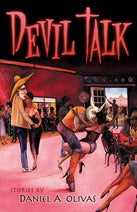
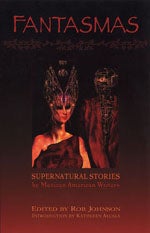
Two short story collections deserve your attention, and both have Daniel Olivas. Daniel's collection, Devil Talk (Bilingual Press, 2004), is a great mix of off-beat stories that present hard-earned lessons of life or glimpses at an alternative reality. These are the kind of stories that make you go "Oh no, he didn't do that" at the end. Daniel also is featured in Fantasmas (Bilingual Press, 2001), edited by Rob Johnson with an introduction by Kathleen Alcalá. This collection is billed as Supernatural Stories by Mexican American Writers and in addition to Daniel the authors include Carmen Tafolla, David Rice, Stephen Gutiérrez, and sixteen others.

The Festival of Bones/El Festival de las Calaveras: A Little-Bitty Book for the Day of the Dead by Luis San Vincente (Cinco Puntos Press, 1994) is described by the publisher in this way: "Mexico’s Day of the Dead fascinates kids, whether for its joyful celebration or its unusual traditions. With fantastic illustrations and a wild and fanciful poem, San Vicente captures the spirit of this most marvelous holiday. A short and fun essay, directed toward young readers, explains this important Mexican holiday, and the fun things kids can do to join in the festivities."
Cinco Puntos Press also features El Cucuy! A Bogeyman Cuento in English and Spanish (2002)by Joe Hayes, illustrated by Honorio Robledo.
All Chicana/o writers have a story in them about La Llorona. Rudolfo Anaya's contribution is his children's book, Maya's Children: The Story of La Llorona (Hyperion, 1997) illustrated by Maria Baca, a kinder, gentler tale in which the mother, Maya, does not kill her children but instead loses them to a tricky Señor Tiempo.
On the other, more serious, hand, Weeping Woman: La Llorona and Other Stories by Alma Luz Villanueva (Bilingual Press, 1994) has been described as painful and disturbing. The stories portray dark images of violence - rape, incest, abuse - but, as noted by The Library Journal, "out of the ashes of this cruelty rises a sense of hope."
My own llorona story can be found here for those of you who might be interested (originally published in 1986!)

And something unique for La Bloga, Día De Los Muertos by Kent Harrington. This is noir fiction - bleak and as gritty as they come. The book has some relevance to La Bloga since Harrington's mother was from Guatemala, but in no way is this book Latino Literature. Even so, it is a very good book for those of us who like this kind of thing.
Bits
The play September Shoes was described by the author as "a complex, lyrical piece about the desert, shoes, forgiveness and redemption. We start you in a place where you are grounded, and then we begin to take you on this lyrical and magical journey." Written by José Cruz González, it runs through December 17 at the Denver Center Theatre Company. The Denver Post observed, "September Shoes is not only the first DCTC play by a Latino playwright since 1999; it will be the first staged by any female director since the same play, Barrio Babies. Director Amy González (no relation) commented that the play is a suspenseful story that is revealed in little increments. 'It's a very personal story that has some deeper and universal resonances,' she said."
Meanwhile, I get to spend most of October 29 at the Boulder Public Library as part of the Guilty Pleasures - Mystery Writers Day. I join seven other writers for talks, lunch, a panel, book signings, and general positive reinforcement about the "writer's life." Come by if you get a chance.
Later.
Tuesday, October 25, 2005
ROSA PARKS: 1913-2005

I realize that I've already done my post for the week, but I felt compelled to take note of Rosa Parks' passing. Here is one of many articles published today. -- Daniel Olivas
ROSA PARKS: 1913-2005
Revered icon of civil rights
Rosa Parks' refusal to give up seat to a white man set off Montgomery bus boycott in '50s
By E.R. Shipp, New York Times
Tuesday, October 25, 2005
Rosa Parks, a black seamstress whose refusal to relinquish her seat to a white man on a city bus in Montgomery, Ala., almost 50 years ago grew into a mythic event that helped touch off the civil rights movement of the 1950s and 1960s, died Monday. She was 92 years old.
Her death was confirmed by former Detroit Mayor Dennis Archer, who served as Parks' guardian.
For her act of defiance, Parks was arrested, convicted of violating segregation laws and fined. In response, blacks in Montgomery boycotted the buses for nearly 13 months while mounting a successful Supreme Court challenge to the Jim Crow law that enforced their second-class status on the public bus system.
The events that began on that bus in the winter of 1955 captivated the nation and transformed a 26-year-old preacher named Martin Luther King Jr. into a major civil rights leader.
"Mrs. Parks' arrest was the precipitating factor rather than the cause of the protest," King wrote in his 1958 book, "Stride Toward Freedom." "The cause lay deep in the record of similar injustices."
Her act of civil disobedience, what seems a simple gesture of defiance so many years later, was in fact a dangerous, even reckless move in 1950s Alabama. In refusing to move, she risked legal sanction and perhaps even physical harm, but she also set into motion something far beyond the control of the city authorities. Parks clarified for public consumption far beyond Montgomery the cruelty and humiliation inherent in the laws and customs of segregation.
That moment on the Cleveland Avenue bus also turned a very private woman into a reluctant symbol and torchbearer in the quest for racial equality and of a movement that became increasingly organized and sophisticated in making demands and getting results.
Over the years, myth tended to obscure the truth about Parks. One legend had it that she was a cleaning woman with bad feet who was too tired to drag herself to the rear of the bus. The truth, as she later explained, was that she was tired of being humiliated, of having to adapt to the byzantine rules, some codified as law and others passed on as tradition, that reinforced the position of blacks as something less than full human beings.
"She was fed up," said Elaine Steele, a longtime friend and executive director of the Rosa and Raymond Parks Institute for Self Development. "She was in her 40s. She was not a child. There comes a point where you say, 'No, I'm a full citizen, too. This is not the way I should be treated.' "
Parks was active in the Montgomery chapter of the NAACP. She and her husband, Raymond, a barber, had taken part in voter registration drives.
At the urging of an employer, Virginia Durr, Parks had attended an interracial leadership conference at the Highlander Folk School in Monteagle, Tenn., in the summer of 1955. There, she later said, she "gained strength to persevere in my work for freedom, not just for blacks but for all oppressed people."
But as she rushed home from her job as a seamstress at a department store Dec. 1, 1955, the last thing on her mind was becoming "the mother of the civil rights movement," as many would later describe her. She had to send out notices of the NAACP's coming election of officers. And she had to prepare for the leadership workshop where she would be the host for teenagers that weekend.
"So it was not a time for me to be planning to get arrested," she said in 1988.
On Montgomery buses, the first four rows were reserved for whites. The rear was for blacks, who made up more than 75 percent of the bus system's riders. Blacks could sit in the middle rows until those seats were needed by whites. Then the blacks had to move to seats in the rear, stand, or, if there was no room, leave the bus. Even getting on the bus presented hurdles: If whites were already sitting in the front, blacks could board to pay the fare but then had to disembark and re-enter through the rear door.
For years blacks had complained, and Parks was no exception. "My resisting being mistreated on the bus did not begin with that particular arrest," she said. "I did a lot of walking in Montgomery."
Her arrest was the answer to the prayers of the Women's Political Council, which was set up in 1946 in response to the mistreatment of black bus riders, and for E.D. Nixon, a leading advocate of equality for blacks in Montgomery.
Blacks had been arrested, and even killed, for disobeying bus drivers. They had begun to build a case around a 15-year-old girl's arrest in March 1955 for refusing to give up her seat, and Parks had been among those raising money for the girl's defense. But when they learned that the teenager was pregnant, they decided that she was an unsuitable symbol for their cause.
While Nixon met with lawyers and preachers to plan an assault on the Jim Crow laws, the women's council distributed 35,000 copies of a handbill that urged blacks to boycott the buses on Monday, Dec. 5, the day of Parks' trial.
On Sunday, Dec. 4, the announcement was made from many black pulpits, and a front-page article in the Montgomery Advertiser further spread the word. Some blacks rode in carpools that Monday. Most black commuters -- 40,000 people -- walked, some more than 20 miles, to and from their jobs.
At a church rally that night, blacks agreed to continue the boycott.
The boycott lasted 381 days, and in that period many blacks were harassed and arrested on flimsy excuses. Churches and houses, including those of King and Nixon, were dynamited.
Finally, on Nov. 13, 1956, in the case of Browder vs. Gayle, the Supreme Court outlawed segregation on the city's buses. The court order arrived in Montgomery on Dec. 20; the boycott ended the next day. But the violence escalated: Snipers fired into buses as well as King's home; bombs were tossed into churches and into the homes of ministers, including the Rev. Ralph David Abernathy; some blacks were beaten by roving bands of whites.
Early the next year, the Parkses left Montgomery for Hampton, Va., largely because Parks had been unable to find work but also because of disagreements with King and other leaders of the city's struggling civil rights movement. In Virginia, Parks worked as hostess in the faculty dining hall at the Hampton Institute, a black college.
Later that year, Parks, her husband and her mother, Leona McCauley, moved to Detroit. Parks worked as a seamstress until 1965, when Rep. John Conyers Jr. hired her as an aide for his office in Detroit. She retired in 1988.
Rosa Louise McCauley was born in Tuskegee, Ala., Feb. 4, 1913, the elder of Leona and James McCauley's two children. Although the McCauleys were farmers, James McCauley also worked as a carpenter and Leona McCauley as a teacher.
Rosa McCauley attended rural schools until she was 11 years old, then Miss White's School for Girls in Montgomery. She attended high school at the Alabama State Teachers College, but dropped out to care for her ailing grandmother. It was not until she was 21, and had been married for two years, that she earned a high school diploma.
Parks' husband, Raymond, died in 1977. There are no immediate survivors.
The Opposite of Chicana Chicano Literature?
Michael Sedano
Can there be such a thing as the opposite of Chicano literature?
(1) The question arises, in part, in considering Manuel Ramos’ report on the business-as-usual exclusion of Chicana Chicano writers from Time magazine’s list of the 100 best English-language novels published since 1923.
Who can argue against Vonnegut, Nabokov, Atwood? I would thump the lectern for alternatives to certain writers’ work. Giles Goat-Boy for Barth, A Cool Million for West, Robber Bride for Atwood. As my eyes swept the list, though, I saw numerous titles and writers whose work has been surpassed by Chicana and Chicano writers. Not that I'd read all 100 of Time's list, but the majority. So here’s what I told Time:
The panel needs to read more. A lot more. Chicana and Chicano writers have produced notable fiction that merits consideration. Sadly, when a reader's literary compass excludes an entire culture's production, there's little wonder a "top 100" list will illustrate a conscious, or unconscious bias.
Here are five titles to get you started:
Graciela Limon. Memories of Ana Calderon.
Benjamin Saenz. Carry Me Like Water.
Alfredo Vea. Gods Go Begging.
Alicia Gaspar de Alba. Sor Juana's Second Dream.
Ana Castillo. Peel My Love Like an Onion.
(2) The question hit me again, this time in the funny bone, at the Mark Taper Forum Saturday afternoon, where I sat astonished by David Mamet’s farce, “Romance.
Mamet’s “Glengarry Glen Ross,” had heretofore defined my relationship with the playwright. The telemarketing boiler room drama explodes in deadly intensity, profanity, and just plain human meanness. “Romance,” similarly, is laced with personal animosity and profanity, but unlike “Glengarry,” Mamet’s new play is a courtroom / bedroom farce that takes ethnic and sexual prejudice to outrageously absurd extremes. In one exchange, lawyer and client launch a hate speech assault on one another that builds for five minutes. The Episcopalian defense attorney hurls slurs like “hook nose shimie” and “baby eater,” and lots of exotic stuff I’ve never heard, at his Jewish client. The client gives as good as he gets, denigrating the sect and taunting the lawyer about his son’s pederastic priest in a truly ugly retort that drew gasps from the people sitting near me. When the two men run out of words, they go into several minutes of “f*ck you” repartee that had the audience howling in pain.
Remarkably acted with precision timing and effectively staged by director Neil Pepe, “Romance,” is so far removed from anything ever staged by a Chicano troupe that it seems absurd even to raise the issue. Except “Romance,” through November 13, launches the Taper’s 39th season, which concludes with the July 27th run of “Water and Power,” written by Richard Montoya with Culture Clash. Obviously the comparison not only is not far-fetched, it’s now a matter of time and Los Angeles audiences will have to deal with it.
Interesante, que no?
Read! Raza.
mvs
Monday, October 24, 2005
SPOTLIGHT ON DEMETRÍA MARTÍNEZ
 Monday’s post from Daniel Olivas…
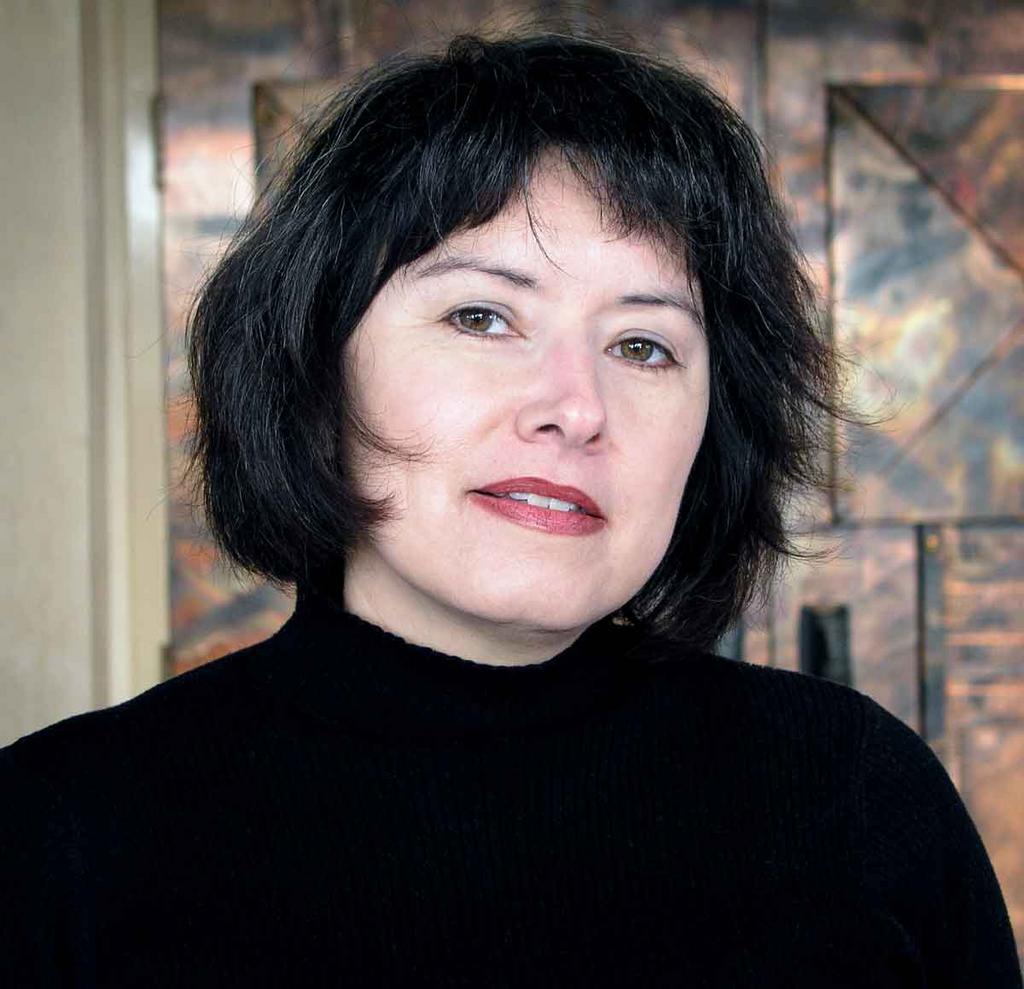
Demetría Martínez is an author, activist, lecturer and columnist. Her collected essays, Confessions of a Berlitz-Tape Chicana (Chicana & Chicano Visions of the Americas) (University of Oklahoma Press) is forthcoming in November 2005. Her books include the widely translated novel, Mother Tongue (Ballantine), winner of a Western States Book Award for Fiction, and two books of poetry, Breathing Between the Lines: Poems and The Devil's Workshop both published by the University of Arizona Press. She writes a column for the National Catholic Reporter, an independent progressive newsweekly.
CLASSIC REISSUE: The Elegant Variation recently published my review of HarperCollins/Rayo’s 35th anniversary reissue of the classic novel Chicano by the late journalist Richard Vasquez.
PRESS RELEASE: Con Tinta is a coalition of cultural activists (Chicano/Latino poets and writers) who believe in affirming a positive and pro-active presence in American literature. We come together in the spirit of intellectual exchange, of creating dialogue with our communities and beyond, of recognizing our literary and social histories, and of establishing alliances with other cultural and political organizations. Our mission is to create awareness through the cultivation of emerging talent, through the promotion and presentation of artistic expression, and through the collective voice of support to our members, our communities, and our allies.
In March 8-11 of 2006, Con Tinta members will participate at the Association of Writers and Writing Programs Annual Conference in Austin to engage in a series of necessary discussions about politics, culture, activism and art. As part of its community outreach efforts, Con Tinta will host a celebration through an event outside of the conference grounds. Programming at a local venue will include a dedication to two beloved veteranos of Chicano letters, Rolando Hinojosa-Smith and raulsalinas; a reading by renowned authors and emerging talent; a communal meal; and a baile.
Con Tinta Advisory Circle:
Kathleen Alcalá, Brenda Cárdenas, Lisa Chávez, Rigoberto González, Lorraine López, Daniel A. Olivas and Richard Yañez
Con Tinta contact person: Rigoberto González, Department of English, University of Illinois, Urbana-Champaign, 608 S. Wright Street, English Building, MC-208 Urbana, IL 61801. Email: noanoa@uiuc.edu. Phone: (217) 333-2926
CRISOL PRODUCTIONS IS PROUD TO ANNOUNCE THE RELEASE OF LOTERIA DE LA MUJER: Renowned San Diego artist, Nuvia Crisol Guerra, has fused her vibrant artwork with the traditional Mexican game “Loteria.” Crisol’s striking depictions celebrate 20 universal stages of a woman’s life. These colorful portraits speak to men and women of all cultures and generations. In addition to the game, these images are also available as packets of greeting cards and individual post cards. Visit her website for more information.
CONFERENCE: El Clamor Público - 150 Years of Latino Newspapers in Southern California.
The Huntington Library, San Marino, CA
October 28, 2005
8:30 a.m.-4:00 p.m.
Sponsored by the Huntington-USC Institute on California and the West, USC Annenberg School for Communication, California State University, Northridge Graduate Studies Program Distinguished Speakers Series, and the John Randolph Haynes and Dora Haynes Foundation.Founded in Los Angeles in 1855, the newspaper El Clamor Público staunchly defended equal rights in California. Though labeled treacherous, incendiary, and anti-American, eighteen-year-old journalist Francisco P. Ramírez‘s newspaper courageously reported lynchings, land frauds, vigilante terror, racial profiling, and legal injustices targeting Spanish-language communities. Ramírez’s faith in the U.S. Constitution guided him as he urged readers to elect trustworthy representatives and to learn English so they could defend their rights. He printed the Declaration of Independence in Spanish and encouraged Californios and Anglos to “work together in the same spirit.” During its four and a half years, the newspaper published political opinion, international news, literary expressions, and social commentaries.This conference will examine the history and legacy of El Clamor Público through and exploration of Latino newspapers in Southern California’s past, present, and future. The conference is free and open to the public; registration is required by October 24. Luncheon will be provided for a prepaid fee. For registration information, go here. For more information on the conference contact conference coordinator Joseph Legaspi at his e-mail.
RAIN OF GOLD LIVE ON STAGE: Don't miss Victor Villaseñor’s Rain of Gold live! The most recent version of The Western Stage’s sweeping adaptation is a must see, and will only be in Salinas, October 22nd through November 5th, 2005. For information and tickets visit here.
UP CLOSE AND PERSONAL: Sunday, October 30, 6:30PM to 8:00PM - Tongue & Groove: A monthly offering of short fiction, poetry and music. The featured writers include: Glen David Gold ("Carter Beats the Devil"), Salvador Plascencia ("The People of Paper"), Daniel Olivas ("Devil Talk"), Carmen Esquer and Maria Cristina Jimenez. Musical guest: Carmella Rappazzo. Hosted by Conrad Romo.
Venue: The Hotel Café. Address: 1623 1/2 N. Cahuenga Blvd., Hollywood, 90028. Admission: Free! For more information call: 323-937-0136. Or visit: http://www.hotelcafe.com.
All done. So, until next Monday, enjoy the intervening posts from my compadres y comadre at La Bloga. ¡Lea un libro
Friday, October 21, 2005
Time's Best
Manuel Ramos
Time Magazine listed it's choices for the 100 best English-language novels from 1923 to the present. As with many such lists, it had some obvious picks and some real surprises. How can anyone argue with books like All the King's Men by Robert Penn Warren, one of my favorite novels of all-time, or The Grapes of Wrath by John Steinbeck, or Paul Bowles' The Sheltering Sky? Surprises that clicked with me include The Big Sleep by Raymond Chandler, Blood Meridian by Cormac McCarthy, and Red Harvest by Dashiell Hammett, although we could quibble about whether these are Chandler's or Hammett's best.
But, and this isn't a surprise, I guess, no Latino books on the list. No Anaya, Cisneros, Hijuelos, Allende, Véa, Alvarez, Rivera, etc. Not one. Please correct me if I am wrong.
However, let's not dwell on the negative.
Time also listed the all-time graphic novels. I'm partial to graphic novels - always wanted to write one, enjoy reading them, even did an interview with Brian Azzarello, writer of the 100 Bullets graphic novels (among many others) for an upcoming issue of Crime Spree magazine. According to Time, a graphic novel "is a vague moniker that gets applied to any extended form of comics, including non-fiction and short story collections." This is a much more exclusive list than the best novels, only ten titles are "all-time" according to Time. And guess what? Chicanos made the list. Here's the quote from Time:

"Palomar: The Heartbreak Soup Stories by Gilbert Hernandez (Fantagraphics Books; 2003)
A kind of über graphic novel that collects a series of smaller graphic novels all situated in a small town 'somewhere south of the U.S. border,' this giant tome by a seminal comic artist will likely be the author's magnum opus. Part of the creative team behind the deeply influential Love and Rockets comic book series (along with his equally talented brother Jaime) Gilbert has created a pan-American epic that spans multiple generations of a family run almost exclusively by w omen. Hernandez' Palomar combines the look of Archie comics with Faulkner's richness of character and place into the melodramatic sweep of a sexy soap opera to create one of the most remarkable works of any narrative art."
Way to go, bro.
Later.
Time Magazine listed it's choices for the 100 best English-language novels from 1923 to the present. As with many such lists, it had some obvious picks and some real surprises. How can anyone argue with books like All the King's Men by Robert Penn Warren, one of my favorite novels of all-time, or The Grapes of Wrath by John Steinbeck, or Paul Bowles' The Sheltering Sky? Surprises that clicked with me include The Big Sleep by Raymond Chandler, Blood Meridian by Cormac McCarthy, and Red Harvest by Dashiell Hammett, although we could quibble about whether these are Chandler's or Hammett's best.
But, and this isn't a surprise, I guess, no Latino books on the list. No Anaya, Cisneros, Hijuelos, Allende, Véa, Alvarez, Rivera, etc. Not one. Please correct me if I am wrong.
However, let's not dwell on the negative.
Time also listed the all-time graphic novels. I'm partial to graphic novels - always wanted to write one, enjoy reading them, even did an interview with Brian Azzarello, writer of the 100 Bullets graphic novels (among many others) for an upcoming issue of Crime Spree magazine. According to Time, a graphic novel "is a vague moniker that gets applied to any extended form of comics, including non-fiction and short story collections." This is a much more exclusive list than the best novels, only ten titles are "all-time" according to Time. And guess what? Chicanos made the list. Here's the quote from Time:

"Palomar: The Heartbreak Soup Stories by Gilbert Hernandez (Fantagraphics Books; 2003)
A kind of über graphic novel that collects a series of smaller graphic novels all situated in a small town 'somewhere south of the U.S. border,' this giant tome by a seminal comic artist will likely be the author's magnum opus. Part of the creative team behind the deeply influential Love and Rockets comic book series (along with his equally talented brother Jaime) Gilbert has created a pan-American epic that spans multiple generations of a family run almost exclusively by w
 omen. Hernandez' Palomar combines the look of Archie comics with Faulkner's richness of character and place into the melodramatic sweep of a sexy soap opera to create one of the most remarkable works of any narrative art."
Way to go, bro.
Later.
Tuesday, October 18, 2005
CPT and Novels Needed Now, More Than Ever
Michael Sedano
 There's a cruel jest that has a small wring of truth in it, the "CPT" stereotype, "Chicano / Colored People Time," that holds we cannot start events at an appointed hour, but linger and delay.
What fun I've had the past couple months, proving the invalidity of CPT.
In association with a group of veteran Chicana Chicano artists--as well as a few newcomers to the chicanarte scene--I've helped put together a 2006 calendar featuring Chicana Chicano art. I started as a naysayer, that we should take a year and dar luz for 2007. The editor and artists would have none of it. "Let's go now!" they said, so we carpéd the diem and here comes the calendar! A la brava or not, it's been a great experience.
The publisher, Floricanto Press of Mt. View, Califas, recently added the piece to its catalog, not CPT, but just in time for the holidays. I wrote the introduction, edited most of the artist biographies, as well as drafting P.R. materials and tending to some of the administrivia attendant in bringing the piece to market. Being a Southern California endeavor, there will be November / December signing events in Eagle Rock, Pasadena, and Los Angeles' Placita--Olvera Street. The artists will do the autographs; the writer is merely window dressing, as it were. I hope the intro's message will be heeded: buy Chicano art.
There's a cruel jest that has a small wring of truth in it, the "CPT" stereotype, "Chicano / Colored People Time," that holds we cannot start events at an appointed hour, but linger and delay. What fun I've had the past couple months, proving the invalidity of CPT.
In association with a group of veteran Chicana Chicano artists--as well as a few newcomers to the chicanarte scene--I've helped put together a 2006 calendar featuring Chicana Chicano art. I started as a naysayer, that we should take a year and dar luz for 2007. The editor and artists would have none of it. "Let's go now!" they said, so we carpéd the diem and here comes the calendar! A la brava or not, it's been a great experience.
The publisher, Floricanto Press of Mt. View, Califas, recently added the piece to its catalog, not CPT, but just in time for the holidays. I wrote the introduction, edited most of the artist biographies, as well as drafting P.R. materials and tending to some of the administrivia attendant in bringing the piece to market. Being a Southern California endeavor, there will be November / December signing events in Eagle Rock, Pasadena, and Los Angeles' Placita--Olvera Street. The artists will do the autographs; the writer is merely window dressing, as it were. I hope the intro's message will be heeded: buy Chicano art.
Meanwhile, CPT (Chicago Publisher's LATimes) has an interesting lit op-ed piece, Literature, more than ever that raises a number of useful topics about fiction, nonfiction, relationships of writer to reader, readers to events outside one's immediate world. Times staff writer David L. Ulin begins provocatively, "There's a moment in the life of every writer when he or she questions the relevance of literature." Ulin relates the writer's block Jane Smiley suffers in the aftermath of terrorist attacks in the U.S. Smiley tells Ulin, from her home in lovely Carmel, "'I expected to get back to work. And then, the stuff that came afterward — anthrax, Afghanistan, Iraq — just compounded the feeling of intrusion. It was impossible to get away.'"
Ulin ends the piece with another Smiley remark, "'We don't connect with literature in the intellect,' Smiley says. 'We connect to it where we attach to dogs or boyfriends — at the deeper level of the self. The desire we have for long narrative forms is intrinsic; it's a natural human thing. A lot of people worry about the future of the novel, but I don't. It's a part of who we are.'"
I found one paragraph troubling for its futility. Ulin writes, "In her (Jane Smiley's) view, there's a political component here, since the more empathy we develop, the more likely we are to understand opposing attitudes. 'If you have leaders who don't read novels,' Smiley says sharply, 'look what big trouble you get into. They can't imagine other points of view.'
Futility, I say, because the sentiment is wasted on gente who do not read.
Ulin's article may have provoked me because I'm in the middle of reading Salvador Plasencia's The People of Paper, wondering where in the world this writer gets his ideas--parental divorce? a broken romance? fighting through writer's block? a history of enuresis? Now, if you're wondering where that last sentence comes from, you'll have to sink your eyes into Plasencia's novel, and make the conecta for yourself. Like a dog?
Read! Raza. Hasta mañana, which is good enough for some of us.
mvs
Subscribe to:
Posts (Atom)