Wednesday, September 20, 2006

Family Traditions


September 16, 2006

Just before dawn on September 16, 1810 Miguel Hildalgo y Costilla (better known as Padre Hidalgo) rang the church bell in village of Dolores and called the indigenous community to war against the Spanish. His historic cry of "Mexicanos, Viva México!" signaled the beginning of the war for independance and is known as El Grito de Dolores. Every year on September 15th, the President of Mexico gives the Grito but this year, with the furor over the election it was a very near thing. They actually considered not doing it. But I'm not here to talk about the elections. I only bring it up because it's a beautiful and important tradition. (For more on that, see Luis J. Rodriguez' excellent blog at Xispas.com).

Tradition is important to me. In my family when my grandparents were alive, we followed our traditions with great anticipation. We were proud of them. Care was taken. Everything had deep meaning and there was a reverence about it. When they died the family fell apart and the traditions that I grew up with died too. I became the only one left that clung to the old traditions.

To me they became more sacred, my personal Holy Grail. I resurrected them, added to them, researched them and made a new family made up of friends, neighbors and co-workers to share them with. In doing this, my old family traditions became new again and glowed with a new light.

The September 16th El Grito party is one of the traditions that I’ve kept alive and saved for my children. It used to be a big deal for my grandparents. We’d spend days making paper flowers, confetti in green, white and red, a homemade piñata and cooking all the special, traditional foods. My grandmother’s sisters and cousins would come over and we’d all cook and tell stories as we worked together cooking, baking and singing. I remember baking my first bandera cake made with Duncan Hines yellow cake mix, canned frosting dyed red, white and green with food coloring and an eagle made of broken lifesavers. I was eight and I’ll never forget my grandfather’s face and how proud he was when he saw it. I remember he would get teary-eyed over the bandera. It meant that much to him.

Well things have changed. I haven’t used a box cake mix since I was ten. My recipes have gotten more traditional, more elaborate and I go out of my way to find old recipes that are almost forgotten. I get a kick out of bringing the old into the light. I’d like to take my post time this week to invite you, my La Bloga family to this year’s celebration of El Grito, held in a little pink house in Eagle Rock, Califas. You’re Mexicanos for the day y nuestro casa es tu casa. Bienvenidos!


On this year's menu: Mole con pollo, rajas con queso y crema, chiles en nogada, nopale salad, chips, salsa, guacamole, taquitos, stewed apples with goat milk cajeta and guayaba, arroz con leche, melon, margaritas de orchata de melon, tequila, cervecita, sangria, arroz bandera (white, red and green rice), frijoles borrachos, enchiladas Sarita (made with squash flowers, tomato, onions, cheese and cream) y una piña rellenado.


Too many Margaritas, Chris?


What would I do without my best amiga y comadre Elodia? Aren't mother and daughter beautiful?


Mara Price, illustrator; Mary Wynton, our Eagle Rock librarian (hey authors, Mary's trying to get a Chicano author series going for Eagle Rock library so swing by and help her out. The library can't pay but they sure can publicize. Be down for the community and the public library!) and Rene Colato, author of children's books like Loteria! (he devoted his September 16th to teach the kids at Eagle Rock Public Library how to play loteria. How cool is that?).


PEDRO INFANTE!!! Yeah, baby we watch Pedro Infante movies on September 16th. What's a Mexican party without Pedro Infante? Who can tell me what movie this is? I bet Denise Chavez can.

And speaking of Pedro Infante....


Sol y Victor acting silly as we hang the lights

Read: 1) my La Bloga review of Loving Pedro Infante and 2) Loving Pedro Infante

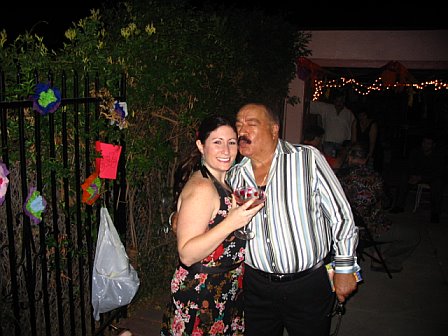
He's a papi chulo though, nice and a hell of a lot of fun.


And then there's my roommate Rachel with Jerry from Jerry's Mexican Grill. Jerry and Kiko kicked us down with everything from chafing dishes and chiles to guacamole and taquitos. The taquitos there are damned good! Feel like some good cooking and can't get to Sol's house? Head on down to Jerry and tell him Rachel and Gina sent you. They have two locations now because they're so good. Nice people too.


Eagle Rock Location
4923 Eagle Rock Blvd.
(2 blocks south of Colorado Blvd in the CVS Shopping Center)
323-257-8815Santee Food Court716 F South Los Angeles Street(7th and Los Angeles)213-624-TACO

Kiko is a sweetheart! Y caramba!!! El vato can sing!!! When you're down at Jerry's ask Kiko to sing you El Rey. Oh yeah and he was one of the very few at the party that knew all the words to the Mexican National Anthem!!!

Do you?


Mexicanos, al grito de guerra

El acero aprestad y el bridón;

y retiemble en sus centros la tierra Al sonoro rugir del cañón.
Ciña oh patria!

tus sienes de oliva

De la Paz el arcángel divino,

Que en el cielo tu eterno destino

Por el dedo de Dios se escribió.


Más si osare un extraño enemigo

Profanar con su planta tu suelo,
Piensa, oh patria querida, que el cielo
Un soldado en cada hijo te dio.

Guerra, guerra sin tregua al que intente

De la patria manchar los blasones!
Guerra, guerra! Los patrios pendones. En las olas de sangre empapad.
Guerra, guerra! En el monte, en el valle Los cañones horrísonos truenen
Y los ecos sonoros resuenen Con las voces de Unión!Libertad!
Antes, patria,que inermes tus hijos
Bajo el yugo su cuello dobleguen,

Tus campiñas con sangre se rieguen, Sobre sangre se estampe su pie.
Y tus templos, palacios y torres Se derrumben con hórrido estruendo,

Y sus ruinas existan diciendo:De mil héroesla patria aquí fuePatria! patria!

Tus hijos te juran

Exhalar en tus aras su aliento,

Si el clarín con su bélico acento

Los convocaa lidiar con valor.

Para ti las guirnaldas de oliva!
Un recuerdo para ellos de gloria!

Un laurel para ti de victoria!
Un sepulcro para ellos de honor!
heroes.


Sedano is off the hook on that one, he left before the mariachi came over. There he is hanging with his lovely wife Barbara and Rachel's friend Johanna.


Isn't it cool to have a mariachi next door? He took requests too and sang a lovely duet with Rachel.

His name is Gus and he and Kiko seriously kicked some musical butt!

El Rey, Volver y Volver, Tu Solo Tu, Las Mananitas for Johanna who's birthday is this week and a few other amazing ballads to finish off the night.

Check out Sarah in the background listening. Sarah is editor in chief of AWN.com, an online publication dedicated to serving the animation community. The guy with wings belongs to her.


All nights should end in baladas, laughter and the scent of night earth and flowers.


Rene won the hula hoop competition!


We hope you enjoyed the party. As always, I invite your comments. What traditions do you treasure? Which ones have fallen by the wayside and how can we resurrect them? How did you spend your September 16th? A comment might get you an invitation to the next party.

Hasta la proxima,

Gina MarySol Ruiz y amigos

Tuesday, September 19, 2006

A Piece & A Bit: Chicken soup for anxious bar examinants. Prettiest Girl in Arvin

Michael Sedano

I was talking recently to a woman who took the grueling California Bar examination. Waiting is the worst part. Dread mixes equally with anxiety even for the most confident law students. I’m sure Manuel and Daniel can attest to the emotional churning a person goes through in that awful interim between the bar exam and getting your results. Here's a glimpse into the future of this woman, and of all such former law students sweating out the bar.


It was time.

The woman pressed the enter key and sat down. Her computer screen woke from black into the familiar blue desktop. A single icon occupied center screen. CABAR, she had named it.

Pulsing the link would fill her screen with the white oval against a striped blue field. The California Bar Exam. The woman would type in her examinee’s serial number and press enter. One of two messages would populate the oval text hole. Every bar exam, more than half the applicants got the dreaded message: “Your name not found.” You failed. All those years. All that studying. All the money. Shot to Hell.

On the other hand, the taste of joyous exultation when the screen filled with the reader’s name. I passed. It’s all been worth it!

Last May, the woman had rented the robe and walked with her class. Juris Doctor she was now. “No, I’m not a lawyer yet, Ma,” she explained for the hundredth time. “I still have to pass the bar.”

The day after graduation she started studying for the bar exam. Every available hour, day in, day out. She read. She outlined. She briefed and practiced essays. Somewhere out there, people had paid thousands of dollars for bar prep classes. Money narrowed the odds but there are no guarantees. Answer the questions. Write the essays. Hold your breath. The best preparation was to review everything twice. In three years of law school she’d mastered the art of drudgery, so the work was effortless, second nature. It was what she did. And then she studied some more.

The week of the Bar Exam, the woman rose at 4:00 a.m. to meditate on the day’s challenges. The bus ride to the exam center gave her a chance to glance through the daily paper, sit among her fellow riders, eavesdrop on the chisme, but mostly stare out the window for the hour long ride to the convention center. A hotel room would have been a ridiculous extravagance. Day after day she rode that bus, wrote the exam, then rode that bus home.

She would have no results for months. Months and months of waiting, job hunting, and more waiting until the hour when the results would be available on the internet.

It was time.

The processor talked to the modem which talked to the internet which found the state bar’s website, navigated to the file the woman’s icon had linked. The colored ball spun for two seconds. In the first second, the woman felt the pangs of buyer’s remorse. The Macintosh had cost twenty five hundred dollars. She added the cost into her student loan and held her breath against tonight’s moment. In the last second, reason took over. With a JD and a bar number, she knew, she’d have the Mac paid off within about five years. Maybe more, but five years against a lawyer’s salary would be just about right. And if she could stomach it, a position in a firm, with a six figure salary, pay it off in one month. Unthinkable. But still, the bar number would be, could be, should be a . . . magic key?

The signal passed through the modem into the waiting processor. Text flowed across the liquid crystal luminosity, line by agonizingly slow line. Damn this modem! The woman’s eyes scanned the text for something that made sense. Bla bla bla… there! She saw her name. She pronounced it out loud. My Name. “Hey,” she said to the empty room, to no one in particular, to the world at large, “I see my name. I passed. I passed the bar!”


New Title from Chusma House Publications

I received the following announcement of something that sounds worthwhile. It’s good to see Chusma sustaining its efforts.

Title: Provocaciones, Letters from the Prettiest Girl in Arvin

Author: Rafaela G. Castro

Publisher: Chusma House Publications
P.O. Box 467
San Jose, CA 95103
408-947-0958
Available: November, 2006

Brief Summary
A collection of sensitive essays that depict the lives of a close knit Mexican family living first in Arvin, in the San Joaquin Valley, and later in the San Francisco Bay Area. These insightful, loving, guilt ridden, and at times very sad narratives, reveal the religious, moral, cultural, and ethical values of a young girl raised in the 1950s and 1960s in a Mexican Catholic working class home. We are told stories about a special Mexican mother-daughter relationship; about loving one’s family but needing to leave it; about living in another country and loving it; and about the role of the Peace Corps in the lives of young Americans of the 1960s. The essays cover the years from the late 1930s, when the author’s parents married and came to California from New Mexico, to the 1990s when their lives ended. In between those years their special marriage experienced intense love and intense tragedy.

Short Bio
Rafaela Castro was born in Bakersfield, California, but has lived most of her life in the San Francisco Bay Area. She spent two years in Brazil with the Peace Corps before receiving degrees in English Literature, Library Science, and Folklore from the University of California, Berkeley. She has lectured in Ethnic Bibliography and Chicano Studies at UC Berkeley, and recently retired from the Humanities/Social Sciences department of Shields Library at the University of California, Davis. She is the author of Dictionary of Chicano Folklore.


For all you law students out there, your time will come. Keep your chin up! See you next week!

mvs

Monday, September 18, 2006

BEAR STAR PRESS PUBLISHES DOROTHY BRUNSMAN POETRY PRIZE WINNER

Monday's post from Daniel Olivas...

Each year Bear Star Press awards the Dorothy Brunsman Poetry Prize ($1,000 and publication) to a writer living west of the central time zone. (Dorothy Brunsman pictured.) The prize for 2006 has gone to Manuel Paul López for his debut collection, Death of a Mexican and Other Poems, which is now available. My review of this powerful, playful and insightful collection will come out shortly in the El Paso Times. You can read a sample and order the book online from Bear Star Press.

The founder of Bear Star Press is Beth Spencer who was recently profiled in Chico Statements, a magazine from California State University, Chico. Spencer is an alumna of Chico State (B.A. and M.A. in English) and teaches in the literary editing and publishing program. Spencer's mother, Dorothy Brunsman, funds this annual poetry prize. Brunsman, now 84, lives in Placitas, New Mexico, with her husband Donald, a playwright. Politically active, especially in pro-choice matters, Brunsman is also an accomplished photographer.

Competition Information & Guidelines from Bear Star Press:

Manuscripts will be read in September, October, and November 2006. Postmark deadline is November 30, 2006.

Manuscripts should be between 50 and 65 pages in length.

All work must be original and accompanied by a $20 reading fee. Previously published poems can be included in your manuscript if you retain the copyright (this is standard).

Writer must currently reside in the Western States (those within Mountain or Pacific time zones, plus Alaska & Hawaii). Previously unpublished writers are welcome to submit!

Any form or subject is acceptable. Use a plain 10-12 font.

Rights revert to author upon publication.

Simultaneous submissions absolutely fine so long as we are apprised of changes in manuscript status.

Please do not send your manuscript by registered mail (doing so necessitates a 40-mile roundtrip drive to the P.O., very inconvenient for us). If you want to know whether we have received your work, simply enclose a stamped, self-addressed postcard.

Winner notified on or before February 2007. Check web site for winner information or send a SASE marked “results.”

Publication by Fall 2007 (with luck, in Summer 2007).

Name, address, and phone number should appear on a separate cover sheet only.

No manuscripts will be returned. They will be recycled. Please do not send your only copy. Please DO send SASE for contest results.

Mail submissions to:

Bear Star Press
185 Hollow Oak Dr.
Cohasset, CA 95973

◙ LATIN@ VOICES: Tongue and Groove is a monthly offering of short fiction, personal essays, poetry and music. Up next: An evening of Latin@ writers featuring Taylor Negron (Murder in La Quinta), Milcha Sanchez-Scott (Roosters), Suzanne Chávez Silverman (Killer Crónicas), Danette Rivera and a musical guest. It's hosted by the incomparable Conrad Romo.

DATE: Sunday, September 24
TIME: 6:15 to 7:45 p.m.
PLACE: The Hotel Café (website: http://www.hotelcafe.com/)
1623 1/2 N. Cahuenga Blvd.
Hollywood, Ca 90028
COST: $5.00

For more information call 323-937-0136

◙ MORE LATIN@ VOICES: I just received my copy of a special “Latina & Latino Writers” issue of the Indiana Review. It’s filled with fine writing from dozens of authors including Gary Soto, Judith Ortiz Cofer, David Hernandez, Angie Cruz, Jimmy Santiago Baca, Ray Gonzalez, and many, many others. To order a copy, visit IR’s website.

◙ NEW EDITION: The latest offering from Somos Primos is now available. Somos Primos is “dedicated to Hispanic Heritage and Diversity Issues.”

◙ EVEN MORE LATIN@ VOICES: The fall issue of Literal: Latin American Voices is now available. It’s a handsomely produced magazine that “provides a medium for the critique and diffusion of the Latin American literature and art, recognizing its potential strength as a point of departure for understanding that the broad cultural universe is not overshadowed by any single language, but is bathed in the light of a unified spirit.”

◙ BOOK REVIEW: In yesterday’s El Paso Times, Rigoberto González reviewed Jessica Abel’s graphic novel, La Perdida (Pantheon, $19.95 hardcover), which is set mostly in Mexico City, “where the landscape slips into sensory overload, disorienting and seducing the visitor.” He also observes: “As a contribution to Chicano literature, La Perdida is a welcome and unique addition. It explores biculturalism and a biracial ethnicity, but without resorting to clichéd representations.”

◙ OTRO BOOK REVIEW: In the Los Angeles Times’ Sunday Book Review, Susan Salter Reynolds sings the praises of A Taco Testimony: Meditations on Family, Food and Culture (Rio Nuevo) by Denise Chávez. My review of this fine memoir appeared in the El Paso Times last month and was reprinted here on La Bloga.

◙ MOVIN' ON UP: MARGIN, an online journal dedicated to magical realism, has a new home: http://marginnews.blogspot.com/.

All done. So, until next Monday, enjoy the intervening posts from my compadres y comadre at La Bloga. ¡Lea un libro!

Friday, September 15, 2006

Chicks and Pugs

Manuel Ramos


LYNDA SANDOVAL, LATINA SAFEHOUSE INITIATIVE AND DENVER BOOK MALL
The Latina Safehouse Initiative will host a literary event on Friday, September 22, 2006, at the Denver Book Mall, 32 Broadway, 303-733-3808. This event, which is open to all, is to help raise funds to establish a battered women shelter to meet the special needs of Latino families.

Local author Lynda Sandoval will discuss and sign her several books, the latest of which is Chicks Ahoy. There is no admission fee for the signing, which will begin at 7:30 p.m. There will also be a light buffet at 6:30; admission for the buffet is $10. Reservations for the buffet are encouraged, but not required. Please contact Diana at 303-935-6634 for reservations or with any questions.

The food is being donated, the author herself is donating the books, and the Denver Book Mall is covering administrative costs, so ALL PROCEEDS will go toward the Latina Safehouse Initiative.

Mail orders and advance orders for the books are welcome. If you have any questions, please call Nina Else or Pat Grego at 303-733-3808.


BREAKING THROUGH PICKED FOR NAPA READS
Francisco Jiménez's Breaking Through has been selected as the featured book for Napa County Reads, a community-wide reading program. This critically acclaimed book has won numerous awards. It continues the author's fictionalized memoir of his youth spent in the migrant stream and then at various jobs when his family finally settled in one place. As noted in the Napa Valley Register:

"Francisco Jiménez's life journey has taken him from a poor village in Mexico to a professor's chair; from a child searching through trash to help feed his family to an acclaimed author and educator as well as a father, grandfather and husband -- enjoying the prosperity he's earned.

He sums it up with a characteristic simplicity: 'My experience is part of the whole American experience.' " Jiménez will visit the Napa Valley Oct. 11 to 13 as part of the program.

GUEST ARTICLE: GREGG BARRIOS REVIEWS POUND FOR POUND

Pound for Pound By F.X. Toole (Ecco)
F.X. Toole is bigger in death than he was in life.

When Toole died at age 72 of complications from open-heart surgery in 2002, his passing was barely noted. After all, Toole only had a lone book of short stories, Rope Burns: Stories From the Corner (2000), to his credit.

Despite the literary accolades Ropes drew (novelist James Ellroy called the work "the best boxing short fiction ever written"), few could augur that four years later one of Toole's stories would become the Oscar-winning blockbuster Million Dollar Baby. Or, that his unfinished novel Pound for Pound— edited from an unwieldy 900-page manuscript — would be published posthumously as a lost masterwork.

What distinguished Toole from other boxing writers was his insider status in the fight world. He had been a boxing trainer and later a cutman, the guy who stops the bleeding between rounds. The white-haired Irishman Jerry Boyd — his real name — worked out of the Broadway Boxing Gym in the California coast town of Hermosa Beach — where he kept his day job separate from his literary aspirations.

This newspaper [San Antonio Express-News] assigned me to write a profile on Toole while he was in town to research Pound for Pound — a tale as familiar as Million Dollar Baby, but with a young Tex-Mex boxing contender as protagonist.

After sitting for the interview, Toole moved on to an impromptu demonstration of his training savvy at a South Side gym where a professional woman boxer volunteered to work out under his instruction.
Unlike the trainer in his original story Million Dollar Baby, Toole appeared to enjoy training the young woman, but still doubt lingered: What was his gut feeling about women in the ring?

If Toole had lived to share in the fame and glory of the Clint Eastwood film, he might have rehearsed an official answer. But on that day, it was the unrehearsed Boyd who answered.

"I've trained women who are good fighters," he said. "They only fight two minutes and wear chest protectors so it doesn't hurt them up there like it does a man. That's the reason they throw a lot of headshots. My point is the bar has been lowered.

"That is not to say there aren't any good women fighters. As much as women may be competitive, I don't like to see women fight and get hurt. We best serve ourselves, our family and culture to whatever gender we're born."

A year later as a book editor, I assigned Toole to review a Dagoberto Gilb collection of short fiction. Later, when I had to inform him that several explicit words in his review wouldn't make the final cut in a family newspaper, Toole wasn't fazed. "I want people to read Gilb, and if my review helps accomplish that — then cut away."

We spoke regularly on the phone and by mail — checking on his novel's progress, his health or talking boxing from A-Z. From time to time, he'd send a chapter from the novel asking for a second opinion on the accuracy of his use of Chicano slang, style and family history.

Toole's Irish gift of gab and strong convictions often made for hard-hitting verbal sparring lessons from the square ring. Since he didn't have cable TV and worked most fight nights, it fell upon me to send videotapes of championship fights. The payoff came with his phone wrap-up of that month's tape.

Two weeks before his death, Toole called to chide me. I had been remiss in sending new fight tapes. When I asked about his health, he recounted instead an incident after his latest medical emergency.

He had asked a nurse for ice cream. "She wouldn't do it. So I told her exactly what she could do with her applesauce and chicken noodle crap."
Later, he unplugged his monitoring device, dressed and left the hospital.
"I drove straight to a 7-11 store and headed straight for the ice-cream freezer for Ben & Jerry's Cherry Garcia. As I shut the freezer, I caught a glimpse of myself in the glass door haze. 'What are you looking at, you crazy S.O.B.?'"

Whether my friend was actually embellishing a true story or whether Toole was floating a new narrative twist remains a mystery. Nevertheless, for the rest of our conversation, he avoided his albatross and my question: Was the novel finished?

Posthumous novels, whether written by Hemingway or Melville, can be a bane or a blessing. Pound for Pound hit bookstores in August to both critical cheers and jeers. In addition, Hollywood announced with great fanfare that a film version was in the works. Meanwhile, book publishers and film producers were vying for rights to a trunk of unpublished work that Toole left behind.

Still, some argue that Toole got a raw deal — that he could have been a contender — that cruel fate denied him one more round, one more edit.

I disagree. The 72-year-old writer and boxing cutman I knew beat the odds when, four years before his death, he sold his first short story after 40 years of toiling at his craft.

"All of a sudden I got lucky. I caught a break because open-heart surgery kept me alive and because I kept punching. I had no guarantee. But you know what? I didn't want a guarantee — that would have taken the fun out. Going against the odds was part of the fun. I want to take that chance and roll the dice — put my life on the line. It's stupid, it's insane, it's unreasonable, but that's what my heart tells me to do.

"You're going to tell me I can't follow my heart?"

Gregg Barrios is a playwright and a former Express-News book editor. As part of Gemini Ink's fall semester, Barrios will teach the one-day seminar Real Life Characters: Biography as Play on Sept. 30.
San Antonio Express-News publish date Sept. 10, 2006

Later.

Thursday, September 14, 2006

¡POETRY ALERT!

David Hernandez and Charles Harper Webb

will read from their latest poetry collections

September 15, 2006 at 8:00 p.m.

Barnes & Noble
1201 3rd Street Promenade (at Wilshire Blvd..)
Santa Monica, CA 90401

DAVID HERNANDEZ's poetry collections include Always Danger (SIU Press, 2006), winner of the Crab Orchard Series in Poetry, and A House Waiting for Music (Tupelo Press, 2003). In January 2008, HarperCollins will publish his first novel, Suckerpunch. His poems have appeared in The Missouri Review, Ploughshares, Field, and The Southern Review.

CHARLES HARPER WEBB was a rock guitarist for fifteen years and is now a licensed psychotherapist and professor at Cal State University, Long Beach. He has written five books of poetry, including Liver, which won the 1999 Felix Pollak Prize, and Reading the Water, which won the S.F. Morse Poetry Prize and Kate Tufts Discovery Award.

-- DAO

Wednesday, September 13, 2006

Brother Trini, 2006: D.E.P.

by Ralph Garcia, Houston

It was that time before the computer age when I would encounter Trinidad Sanchez, or as I came to call him, Brother Trini. Given his association with the Catholic Church and as a fellow Jesuit, our meeting was more of a divine inevitability--I as the assistant to the pastor at Our Lady of Guadalupe Church; he, advocating on behalf of the less fortunate.

There was a plan in motion to create a Chicano cultural facility, the end product the Guadalupe Cultural Arts Center. Enter Trini. Sanchez joined our board of directors and served as its chair. There were countless planning sessions and debates conducted in San Antonio’s bars and cantinas, chief amongst them the Esquire and Tacoland.

One thing Trini taught me was never to admit being wrong in these negotiations. “Say: I regret this happened or that was done. But never apologize.” In the midst of all this, one day Trini up and left, to Chicago I believe.

Three decades later, out of curiosity and with the knowledge I obtained on the use of computers, I googled myself. Amongst the listing appears Trini’s web site. I am hesitant to contact him after so many years. A few weeks pass, and I finally E-mail him; he quickly responds about how long it has been. I often joked with him about how much poetry San Antonio had, telling him about the poetry groups organized around every subculture that existed. We spoke about him coming to Houston and the possibility of teaching at the local college, a real job.

Somewhere here my oldest sister Marie passes away from cancer. I write a piece dedicated to her. It’s about our younger days when we danced as a ballet folklorico team. I send a copy to Trini. He writes back about how it reminds him of going to the school sock hops, describing the polarity of boys on one side of the gym and girls on the other. He continues with the point of how the girls have the power to crush a young man’s heart, by simply saying no to a dance request.

Program monies are available and we ask if he will come to Houston to do a reading. We arrange a reception with local political dignitaries, including three city council members, two U.S. Congressmen, the county treasurer, and others. Scheduling an elite group like this becomes difficult in a town like Houston. The death of one elected official and other logistical problems delay the event. The elections pass and some of the hosts are no longer in office. We agree to bring Trini in anyway, as a presenter in the Latino Book Fair.


[Postcard of the proposed Sept. event, showing the sponsors]

The Book Fair itself is struggling to happen because Hurricane Katrina makes the convention center facility unavailable. Throughout this time Trini is hesitant about coming. Finally at the last minute he calls to let me know he’s coming and driving alone.

Trini arrives, and I offer to house him for the nights he will be here. Cinco de Mayo festivities are in full swing. About 7:00 p.m. I tell him we are going to eat and get some culture. We drive to Houston’s north side, one of the city’s oldest and most stable Mexican communities. I take him to Moody Park, site of the historic Moody Park riots in the late 70’s. We stop and view the original “Vaquero” statue of Luis Jimenez. Then we head to Doneriki’s Mexican Food Restaurant further down Fulton Street. Here the owner always provides entertainment during Cinco de Mayo.

As tradition, the restaurant is full and a line of people wait to be seated. Each year the owner removes tables from the center of the restaurant and sets up a temporary stage. One of the managers spots us and immediately waves to the waiters to place a small table directly in front of the stage area. As we make out way to the table we are greeted by waiters and others in the audience who are looking and pointing, wondering who we are to deserve this attention. I want to describe it as something you see in the movies, but it’s not. This is as real as life gets and something the movies try to replicate. We are so close to the stage, when the girls' skirts brush our faces when they swirl. After a plate of nachos and three rounds of beer we exit.

Outside, I introduce Trini to the manager and others. We offer our thanks and next go to Ray Ray’s (swear: the place has two Rays in it) Ice House. Here again there is a crowd listening and dancing to Tejano music. The owner Ray is introduced to Trini, and we consume two or three more rounds.

It’s getting late, ten or so, and on our way home we stop at the Harrisburg Country Club. It’s more of your neighborhood dive, owned and operated by two Vietnamese brothers. On tonight’s menu is a DJ with loud Tejano music. It is necessary to strategically seat yourself contingent on how much conversation you want to carry on. Again, I introduce Trini to the owners, and we have a couple more drinks.

Since Trini has to read the next day, we leave the Harrisburg, five minutes from my residence. At home I have no alcohol because I believe if one drinks alone that means you're an alcoholic. Trini gets out his backpack. We have this long discussion about recent passings of our friends and fellow artists, including Dr. Ricardo Sanchez, Jose Montalvo, and Rudy “Diamond” Garcia.

I tell him I had conversations with Montalvo, about death. I share with him some of the exchanges we had that I’ve never divulged to anyone else. I tell him I spent two days with Montalvo. He reminds me that when Montalvo rented off of Fredrickburg Road, how the doorbell to the apartment didn't work. Someone had penciled, “Neither does the tenant”. Montalvo had his trademarks: that black hat, his “A mí que?” bumper sticker. I told him Montalvo after many years of being an artist had met a woman, bought a house and life was going fine. His illness came and she left and once again he was alone. Trini said in the end Montalvo was nothing but anger.

I ask Trini what was really going on in his life and he tells me. He then to read from his book of poems--me, the private audience. Again it’s one of those things the movies can't replicate.

Next day Trini is off to the Book Fair and tells me he’s gonna stay at the home of another poet, Later that day I went to the Book Fair and find Trini in the company of Victor Vega and Lorenzo Cano, two other seldom recognized do-gooders. I realize how we as a collective, off and on have helped to change the world.


[A doodle done while on the phone with Trini. He was always at poetry group meetings--Fathers without Children Poets, The Sleeping Giant, Enchilada Vendor Poets, the list seemed endless. San Antonio must be the Mecca for Latino poets.]

I am beginning to understand his poetry. It’s about self and worth. I was just beginning to understand him. After this I hear no more from Trini. In a couple of days, I call and find him in San Antonio. He thanked me for everything. He also tells me how he saw so many people, writers he had not seen in a long time. He tells me, “Write, just write."

Our conversations continue mostly via e-mail. Trini seems to have gotten back to his beeline schedule, seldom home. He talks about pool parties at his residence, about his woman returning from Denver. We talk about another engagement in September.

Then comes the devastating news, the stroke, his death. I received many e-mails and articles. I was asked to write a piece in his memory, but I said no, because I say there are so many others that are much better at writing. Maybe someday Hollywood will replicate him in a movie. I remain doubtful.

Hermano Trini: descanse en paz.

Tuesday, September 12, 2006

Chicano: Pronouncing Diversity. Mental Menudo Artists Exhibit New Work in Landmark Show.

Michael Sedano

To see the photos of the exhibit, visit http://readraza.com/diversity.htm

It’s almost incredible that chicano art shows keep getting better and better. An excited crowd is its own reward; energized by ambience, conversations flow among strangers sharing delighted moments of inspiration. In such moments, crowd and art fuse into the same thing, culture. Every show brings new talents to the walls, but for me, seeing the maturation of talent in new work by familiar artists offers the greater pleasure.

So it was at the opening reception for Chicano: Pronouncing Diversity, in Los Angeles’ Eagle Rock Cultural Arts Center. An encouraging display by a new generation of artists and a core of veteranas and veteranos from the old days. Holding it all together the familiar materials and attitudes of chicanismo.

At one point during the exhibit, I was leaning against a pillar taking candid shots of Vibiana Aparacio-Chamberlin speaking animatedly with Serge Hernandez about Pola Lopez’ irreverent piece combining loteria cards and la Virgen. Out of the blue, I remembered Salvador Plasencia saying he’s glad to be published outside the chicano mainstream.” And here’s Pola placing her work squarely in the heart of that mainstream.

I asked Magu, who curated the exhibit, what qualifies a piece for the show? Not what makes the work “good,” but what makes it “chicano.” I got the answer the question deserves: go inside and have a look.

The excitement of the moment begins at the door with Raoul De La Sota’s painting of cactus pencas. Hugely magnified and rendered in fanciful warm colors, the canvas evokes Rousseau’s “Magical Kingdom”. Turing left into the main gallery, the visitor will be welcomed by the curator, who will nudge the visitor to take in the vendor’s cart, and photographer Oscar Castillo’s tribute to Frida.

Joe Bravo and Serge Hernandez hung out near the door, looking for old friends as Magu invites the new arrivals to grab a plate for the buffet. Later, Oscar will tell Diane Hernandez she is the subject of the first multiple image Oscar printed, back at Cal State Northridge in the 70s.

A perennial chicana chicano theme, la Virgen de Guadalupe’s familiar cloak covers the muscled black of a Pacoima loyalist. The orthography is a high level script echoing grafitti art.

Pola Lopez' large canvas offers a delight of color. Eight virgins and one diosa decorate a luciously red-orange huipil. A phallic cactus thrusts out of the collar. It’s interesting to compare Lopez’ manifestations of the virgin with Sculptor Robert Graham’s bronze door to Los Angeles’ new cathedral using a multitude of virgins in much the same manner.

Conjunto Los Pochos had the crowd tapping their toes. Left of the stage, Joe Bravo tortilla art featuring a sabana-sized tortilla de harina. Behind the conjunto, holding center focus of everyone’s eyes, a brilliant mural by Martin Charlot featuring a young Arnold Schwartzeneggar lower right, Magu, lower left. Right of the stage is an exaggerated portrait by Neri Lemus of a boy in a striped t-shirt and ear-flapped hunter’s cap.

A little boy gets so caught up in the joyous music that the accordion player hangs the precious instrument on the tyke, who pulls the bellows and sounds his first note!

Sculptor Armando Baeza is a WWII veteran. His small and medium sized bronzes attract admirers wherever Baeza shows his work. The show features a handful of medium sized work. The free-standing bases are themselves beautiful sculpture. A photograph is not enough when an admirer falls in love with Apache Dancer, or Emerging Power.

Mario Triillo 's usual medium is polaroid photo transfer. Taking up the Diversity theme, Trillo builds a shrine to upward mobility. The bottom rung of the ladder features a beat up old huarache. The second rung a clean white Nike sneaker. The top rung sports a spit-shined black lace-up shoe. At the top of the ladder the U.S. flag. The umbrella protecting the ladder sports corporate logos of Pepi, McDonalds, Union Oil Co.

As Magu says, you really have to be there, see the art, feel the energy. Just enjoy. Don't ask, "What makes this 'Chicano' art?" Instead, share your views on what you see in the work that qualifies your assessment. Please leave your comments.

Until next week, that's Tuesday, Nine One Two.

mvs