Wednesday, September 24, 2008

2008 Alfredo Cisneros Del Moral Foundation Award Winners

San Antonio, TX -- September 19, 2008 -- The Alfredo Cisneros Del Moral Foundation is pleased to announce winners of the 2008 Foundation Award: poet Sheryl Luna (El Paso, TX) and writer Kristin vanNamen (Plano, TX) were each awarded $5,498.

Poet: Sheryl Luna was born and raised in El Paso, Texas. She currently lives in Lafayette, CO where she teaches at The University of Colorado at Boulder. A graduate of Texas Tech University, she earned a doctorate in contemporary literature from the University of North Texas and a M.F.A. from the University of Texas at El Paso. She also holds a M.A. in English from Texas Women's University. Her collection of poetry Pity the Drowned Horses won the first Andrés Montoya Poetry Prize at the University of Notre Dame. The collection was profiled in "18 Debut Poets Who Made their Mark in 2005" by Poets and Writers Magazine. Ms. Luna was a semi-finalist for the Nation's "Discovery Prize," a finalist for the National Poetry Series, the Perugia Press Prize and the 2006 Colorado Book awards.

Writer: Kristin S. vanNamen is currently earning her doctorate in Humanities at the University of Texas at Dallas. She earned her MA in Humanities, Aesthetic Studies at the University of Texas at Dallas and her BA in Women's Studies at the University of Kansas. She is the author of Glorie in a Small Town, and her short story collection, Sorrow Causes Crazy, explore ritualistic traditions and rites of passage through humorous narrators who are distinctly Southern and oftentimes proud of their status as small-town outcasts. Ms. vanNamen has taught Creative Writing at the University of Texas at Dallas. She is a Pushcart Prize nominee and was recently short-listed for a Glimmer Train prize.


The Alfredo Cisneros Del Moral Foundation was created in 2000 to honor the memory of Sandra Cisneros' father, an upholsterer. "My father lived his life as an example of generosity and honest labor," Cisneros has written; "Even as he warned us to save our centavitos, he was always giving away his own. A meticulous craftsman, he would sooner rip the seams of a cushion apart and do it over than put his name on an item that wasn't up to his high standards. I especially wanted to honor his memory by an award showcasing writers who are equally proud of their own craft."

The Alfredo Cisneros Del Moral Foundation invites a panel of nominators to recommend writers from across the writing disciplines who were born in Texas or who currently reside in Texas. Recipients are selected for exhibiting both exceptional talent and a profound commitment to their chosen form of expression.

The 2008 judges were poet Wanda Coleman, writer Lois-Ann Yamanaka, and San Antonio Library Director, Ramiro Salazar. Past judges have been journalists, memoirists, anthropologists, poets, historians, essayists, and novelists--including Edwidge Danticat, Linda Hogan, Dr. Antonia Castaneda, John Phillip Santos, Dagoberto Gilb, Dr. Arturo Madrid, Dr. Norma Elia Cantú, Dr. Carmen Tafolla, and Rubén Martínez.

[The Foundation does not accept individual solicitations, nominations, or funding requests.]


For more information contact:
Irma Carolina Rubio, Coordinator
Alfredo Cisneros Del Moral Foundation (ACDMF)
735 E. Guenther Street
San Antonio, TX
Phone- 210.534.0517
Email- acdmfoundation@yahoo.com
www.sandracisneros.com/foundation.php


Victor Villaseñor's Book Tour


Best-selling author goes on tour to promote his memoir, Crazy Loco Love


Crazy Loco Love marks Villaseñor's return to Arte Público, the independent press that published the best-selling Rain of Gold, which established the author as a literary force.

Villaseñor launched his latest work at the Barnes & Noble Arboretum in Austin, TX on September 21, 2008, and then set course on a national tour to promote Crazy Loco Love.

See below for a list of cities where Victor will appear.


Fall 2008 Tour Schedule:

California

Coronado
Thursday, Sept. 25, 7:00 p.m.
Bay Books

Encinitas
Saturday, Sept. 27, 1:00 p.m.
Barnes & Noble (Encinitas Town Center)

West Hollywood
Sunday, Sept. 28, 1:00 p.m.
West Hollywood Book Festival

Santa Ana
Thursday, Oct. 2, 7:00 p.m.
Martinez Books

Chula Vista
Saturday, Oct. 4, 3:00 p.m.
Barnes & Noble (Otay Ranch Town Center)

Lynwood
Sunday, Oct. 5, 3:00 p.m.
Martinez Books

Carson
Monday, Oct. 6, Time TBA
California State University Dominguez Hills

San Diego
Sunday, Oct. 19, 3:00 p.m.
The Grove at Juniper & 30th

Wednesday, Oct. 29, 7:00 p.m.
San Diego LGBT Center
Women's Resource Center - Library

Carlsbad
Thursday, Oct. 23, 7:00 p.m.
Carlsbad City Library Learning Center

Riverside
Friday, Oct. 24, 6:00 p.m.
Barnes & Noble (Galleria at Tyler)

Palm Springs
Saturday, Oct. 25, 2:00 p.m.
Latino Books y Más

Pasadena
Sunday, Oct. 26, 4:00 p.m.
Vroman's Bookstore

Sacramento
Saturday, Nov. 8, 7:00 p.m.
La Raza Galeria

Sunday, Nov. 9, 1:00 p.m.
Barnes & Noble (Arden Faire)

Los Angeles
Wednesday, Dec. 3, 6:30 p.m.
East Los Angeles Library

Long Beach
Thursday, Dec. 4, 7:00 p.m.
Cultura Latina Bookstore

Imperial Beach
Wednesday, Dec. 17, 6:30 p.m.
Imperial Beach Branch Library

New Mexico

Albuquerque
Wednesday, Oct. 12, 1:00 p.m.
Barnes & Noble (Coronado Mall)

"Readers will find Crazy Loco Love a departure in a new direction, for now the author, revisiting his late-adolescent self, becomes exceedingly interested in matters of the flesh."
-Kirkus Reviews

"Crazy Loco Love solidifies Villaseñor's status as an enchanting Mexican American storyteller. What makes this memoir so intriguing is that he isn't afraid to bear his soul and serve up every aspect of his life under the powerful, grueling lens of self-examination. Though readers may feel they know Villaseñor through his earlier works, this book gives us young Victor- defiant, rebellious and sexually charged- and the results are simply fascinating." -San Antonio Express-News

Tuesday, September 23, 2008

Review: Havana Gold, Leonardo Padura | Alltop | 8 Free Books

London: Bitter Lemon Press, 2008.
ISBN: 9781904738282

Michael Sedano

Publisher Bitter Lemon Press' temperamental webpage calls its offerings, "The best crime and romans noirs from faraway places." That's no idle boast. Mexico and Cuba, while not so far away from a United States-based reader, the publisher's London headquarters introduces a distinctively alien flavour to the pages of such novels as Rolo Diez' Tequila Blue and Leonardo Padura's Havana Gold.

Havana Gold is the fourth in a series called The Havana Quartet (Havana Black, Red, Blue), all published by Bitter Lemon. Leonardo Padura published several titles, including his Adios Hemingway with Canongate of Edinburgh, first reviewed at La Bloga by Manuel Ramos.

Padura is a superb writer and story teller.

Despite the relentless Britishisms of translator Peter Bush (or John King for Adíos Hemingway), readers who enjoy good detective tales will enjoy the story, the characters, and the small insights into today's Cuba. Unlike Padura's Hemingway mystery--also featuring Conde--and other Cuba-set mysteries, there is more story and less privation. For example, Skinny's mother always has a great meal featuring meat. As a side benefit, Padura describes the recipe with sufficient detail that an adventurous cook might lift the meal off the pages and onto a dinner plate.

The grim story casts Cuba in a no punches pulled framework. A high school honors teacher is murdered. A marijuana roach provides a clue to more far-reaching crime. The young teacher, it turns out, enjoys an active sex life with her students, petty street criminals, the headmaster, and uncounted others. Corruption doesn't creep in so much as it is taken for granted; the school's only half painted owing to someone stealing half the paint for personal gain, ho hum. Color lines remain in high relief, characters identified by skin color, or weaving it within the fabric of everyday conversation. Absence of consumer goods defines shopping--the teacher exchanges sex for a new pair of sneakers. These are the type of feature that make a work distinctively Cubano.

Padura's Conde character is a gem. Straight-arrow but driven to distraction by horniness. Conde's a writer who doesn't, and feels pangs of guilt and frustration about not writing. As a literate man, he sees his world through the lens of Shakespeare and other writers. Padura takes full advantage of his character to use allusion and literature-derived metaphor to describe the world while adding to the reader's enjoyment. Here a quick allusion to Prospero's revels speech, there something from Cervantes.

Although Havana Gold is not a travelogue like Martin Cruz Smith's Havana Bay, there's a rich sense of place infusing the novel with a sentimentality echoed by Conde's own sense of loss, his failure with women, writer's block, devotion to friends, both those still in Cuba and the ones who are "off". Still, I worry that too much might have been lost in translation.

Anglophone Americans laugh with the old saying about themselves and Britons being separated by a common tongue. Havana Gold strikingly reaffirms the truth of that, in some unpleasing reminders that this is a work in translation from Spanish into British.

Most readers have no difficulty looking past -our spelling where US English calls for simple -or. But how alien indeed to hear old friends--one a cop, one a doctor, one a paralyzed war veteran--remembering back when, as boys, they played baseball: the fresh air, a prized leather glove, striding out to take their position on the pitch. No, not the fastball, the field, the pitch.

The most strident idiomatic conflict develops out of the novel's key romantic interlude, the cute meet when Conde fixes a flat tyre for a beautiful woman. He makes a pass, she takes it for a quick six. She's just playing him along but he's head-over-heels in love. When she dumps him, his bittersweet farewell loses its tender reminder of their meeting, when our separate tongues get in the way:

He held her shoulders, stroked her thick, damp hair and kissed her gently on the lips. "Tell me when you need a tyre changing. It's my speciality."

That variant spelling leads me to hear the broken-hearted Conde pronounce four syllables, "spe-shee-all-i-tea," and the charm evaporates. Sadly, this comes amidst a magical moment where Padura's writing approaches his most masterful. The author sets up a beautiful parallel of Conde and Karina with Bogart and Bergman in Casablanca. Bogie/Rick laments about all the gin joints in the world she walks into his and plays that song:

"Don't think ill of me, Mario," she replied, also standing up.

"Does it matter to you what I think?"

"Yes, it does. I think you're right, we should meet up in another life."


"Pity about the mistake. But don't worry, I'm always getting it wrong," he said opening the door. The sun was disappearing behind the old Marian Brothers school in La Víbora and the Count felt like crying. Recently he'd wanted to cry a lot. He looked at Karina and wondered: why? He held her shoulders, stroked her thick, damp hair and kissed her gently on the lips. "Tell me when you need a tyre changing. It's my speciality."


And he walked down the porch towards the garden.


He was sure she'd call out, tell him to hell with everything, she'd stay with him, she adored sad policemen, she'd always play her sax for him, he only had to say "play it again", they'd be birds of the night, hungry for love and lust, he heard her run towards him, arms outstretched and sweet music in the background, but each step he took in the direction of the street stuck the knife in a little deeper, quickly bled dry his last hope. When he reached the pavement he was a man alone. What a load of shit, he thought. There wasn't even any music.


Conde's tough luck is the reader's gain. An inspired character from a masterful creator, even when read through the fog of the mother tongue. This definitely is a quartet well worth following for the full spectrum.

Internet Search News - Alltop, Chicano, La Bloga

Futurists in the 1970s predicted that (print) media would become so diverse and far flung that people would need to hire the services of media sifters who would consume voluminous amounts of information, filter it through the sieve of topicality, and pass digests along to consumers hungry for specialized knowledge. Fast forward to the 21st century and the world of RSS feeds and the Google.

La Bloga friend and compañera Sol Ruiz, alerted me to Alltop. This service is something like the filtering service those futurists were describing. Navigate to Alltop, type in a few key words, like chicano, and click: a page of chicana chicano blogs, including above-the-fold, La Bloga.

Alltop has a few kinks to work through; type "chicanas" and get no result, "mexican american" to produce "all the top Mexican news." Still, the chicana chicano page contains a wealth of fun, so happy browsing!


Hachette Give-Away for Fiestas Patrias Month

Here's how to enter La Bloga's give-away of this exquisite list of highly thought-of titles, and some great discoveries:

Dream in Color By Linda Sánchez , Loretta Sánchez ISBN: 0446508047
Gunmetal Black By Daniel Serrano ISBN: 0446194131
The Gifted Gabaldón Sisters By Lorraine López ISBN: 0446699217
Bless Me, Ultima By Rudolfo Anaya ISBN: 0446675369
Brownsville By Oscar Casares ISBN: 9780316146807
The Hummingbird's Daughter By Luis Urrea ISBN: 0316154520
The General and the Jaguar By Eileen Welsome ISBN: 0316715999
Tomorrow They Will Kiss By Eduardo Santiago ISBN: 0316014125

Each Saturday at noon Pacific time, La Bloga will post a set of questions related to the week's / month's La Bloga columns. Attentive readers will know the answers, capable researchers will quickly teclar a few key words in the blogger search field to produce the answers. Click the entry button, fill in your name and mailing address, and the first entry with all the right answers will receive in the mail the set of 8 titles. Note, the noon Pacific time gives coast-to-coast readers the same chance to win.

Sample question: What Leonardo Padura novels have been reviewed at La Bloga? Click here for your answer.

That's September's penultimate Tuesday. Fall has fell, Californians will dine al fresco one last time then we move inside. Time to chop down a few orange trees and eucalyptus, get that cozy fire going.

La Bloga welcomes your comments on this or any column. Simply click the comments counter below. Remember, too, La Bloga welcomes guest columnists. To inquire about topics, or to submit a fully developed review, announcement, other idea, click here.

See you next Saturday for our first quiz. We're giving away 5 sets.

mvs

Monday, September 22, 2008

Historian tells Los Angeles' story through its plaza

The Los Angeles Plaza: Sacred and Contested Space (University of Texas Press) by William David Estrada

Book review by Daniel Olivas

Historian William David Estrada brings us a fascinating and well-researched historical examination of his city's cultural and political heart in The Los Angeles Plaza: Sacred and Contested Space (University of Texas Press, $24.95 paperback).

As with many other cities and towns in the Southwest that had once been under Spanish and then Mexican rule, Los Angeles had a plaza around which the city's social and economic life revolved. Estrada informs us that such a configuration was far from random and that it had profound theoretical and philosophical underpinnings:

"The founding of El Pueblo de La Reina de Los Angeles in 1781 as envisioned by Governor Felipe de Neve was part of a complex historical process that was reflected in the development of the grid-plan plaza throughout the Americas." This central plaza concept "had its origins in European and pre-Columbian town planning models."

Of course, political and social forces changed the function, purpose and importance of the Los Angeles Plaza over the years. Estrada discusses this evolution beginning with the city's indigenous, pre-colonial inhabitants and moving to today's multicultural megalopolis by relying on a broad array of sources such as diaries, newspaper accounts, letters and the memories of those who lived near the Plaza.

The result is a historically intricate portrait that brings to life the great diversity of Los Angeles.

Estrada is the curator of California and American History and chairman of the history department for the Natural History Museum of Los Angeles County. He is also a native Angeleno with deep roots in the city going back to the early part of the last century.

He divides his book into nine sections with such titles as "Cultural and Historical Origins," "From Ciudad to City," "Revolution and Public Space" and "Parades, Murals, and Bulldozers." By focusing each chapter on a particular theme of the Plaza's development, Estrada allows the reader to be immersed in specific facets of city life.

He also includes a generous number of photographs as well as maps and drawings which add greatly to the text. Some of the photographs are truly remarkable -- for example, the oldest known photograph of the Plaza, taken in 1862. Others depict the faces of Los Angeles, such as a 1913 photograph of Mexican and Italian railroad workers, and one taken in 1895 of Chinese immigrants celebrating their New Year in the old Chinatown near the Plaza.

Los Angeles has suffered violent racial strife almost since its founding, and the Plaza provides a microcosm of these social rifts. While Estrada carefully documents these brutal clashes -- including the 1871 Chinese Massacre and the Zoot Suit Riots of 1943 --he also recounts the great cultural vibrancy symbolized by the Plaza and those who have lived near it throughout the centuries.

Despite hundreds of footnotes, a 17-page bibliography, and a highly detailed index, Estrada does not offer a dry history. Rather, he has written an enthralling, intricate and much-needed ethno-history of Los Angeles and its cultural heart, the Plaza.

[This review first appeared in the El Paso Times.]

◙ Well, I hope to see all of you at Seventh Annual West Hollywood Book Fair this Sunday!

WHEN: Sunday, September 28, 10 a.m. to 6 p.m.
WHERE: West Hollywood Park, 647 N. San Vicente Blvd.
COST: Free!

Not only will you enjoy 400+ authors and artists, by you can meet literary legends, celebrity guests, poets, storytellers and Los Angeles authors. There will be book signings, panel discussions, a children’s area (with crafts, games and performances), readings, and over 125 exhibitors of independent book stores, small press, authors and literary groups.

AND…I will be moderating a panel of authors featured in the anthology I edited, Latinos in Lotusland: An Anthology of Contemporary Southern California Literature (Bilingual Press, 2008). The panel includes three of the thirty-four authors featured in the anthology: Lisa Alvarez, Reyna Grande and S. Ramos O’Briant. There will be a book signing afterwards at the IMIX Books booth.

The day before, on Saturday, September 27, Melinda Palacio will be moderating a Latinos in Lotusland panel at the Santa Barbara Book and Author Fair on the grounds of the Santa Barbara Public Library, 11:00 a.m. at the Book Lover's Tent. Her panelists will be Reyna Grande, Sandra Ramos O'Briant and Alex Espinoza.

Many more Latinos in Lotusland events are planned. For a complete (but ever-growing) list, go here and scroll down until you find the schedule.

◙ All done. So, until next Monday, enjoy the intervening posts from my compadres y comadres at La Bloga. And remember: ¡Lea un libro!

Sunday, September 21, 2008

Raymation: An Interview with Artist/Director Ray Prado


You just don’t find men like Ray Prado in Vermont. I mean, motion picture director, storyboard artist, animator, music video producer, college football player, wine connoisseur and retailer, and that’s just for starters. Did I mention guapo? Well he is. Actually, you don’t find men like Ray Prado anywhere, so how did he come to co-own a small patisserie in Vermont you ask? Well, I’ll tell you.

Ray grew up in Denver Colorado, of Chicano/Native-American/Japanese heritage. He attended Dartmouth College and majored in visual studies, art history and anthropology. In his early 20s he made his way west again, and “lied” himself onto a game show and won enough money to last until he got his first job drawing storyboards (seriously, I couldn’t make this stuff up).

He was then hired by Marvel Productions to storyboard/direct a rap-oriented cartoon called "Kid N Play" based on the rap duo of the same name. “I think I was hired because I was young and cheap and understood the music.” He eventually went on to draw storyboards for major Hollywood motion pictures including Devil's Advocate and X-Men which, he says, nearly sent him into an early retirement. He is also a second unit director and has worked on such disparate movies as Dodgeball and Ray, for which director Taylor Hackford was nominated for best director by the DGA and by the Academy of Motion Picture Arts and Sciences.

But he and his wife Gesine eventually tired of the Hollywood lifestyle and they moved back east ostensibly for her to go to culinary school, but with the unexpected success of her macaroons they opened up a—as he refers to it--not-so-profit bakery called Gesine Confectionary in Montpelier, Vermont.

All this is dazzling enough (can you say hombre de Renaissance?) but what really impresses me about Ray is his versatility. This week he launched a music video that he directed and animated that is one of the most sophisticated and haunting pieces of animation I’ve ever seen. I spoke to Ray between lattes this afternoon:

Congratulations on your music video for Wasted. What a spectacular and complex piece of animation. How long did it take to complete?

Thank you. Well, I started it about a year ago in August of 2007. I had to stop altogether in December when I had to direct 2nd unit on Love Ranch in New Mexico and couldn't get back to it until after another movie I did in the spring in Boston called The Proposal. In all, I probably completed it in about six months elapsed time.

How did you get involved in the project?


I am a big fan of Matthew Bryan. We met here in Vermont and I thought, WOW, this guy is a unique raw talent that people need to know about. When he decided to move to Austin and pursue his career there, I offered to make him a video so he would have a kind of "calling card". As a painter, I would hire Matthew as a model and thought it would be great to combine the two mediums.

Is the process similar to what you do as a storyboard artist?

Similar in the way that in order to get it done I have to draw like a madman without even thinking about going back and making adjustments and changes to what I had already drawn. Very different in that it was much more of a creative endeavor with no restraints and I approached it as if I were just animating my doodles and free-form sketches that would reflect whatever was in my mind when I sat down that day to draw. The only constant was sticking to the mood of what I felt when I first heard his song and keeping Matthew well-rendered so that we could actually see him singing. He is amazing to watch.

When did you start drawing?

I always liked to draw, but somehow I was convinced that it wasn't a legit profession for an ivy leaguer to do for a living. I was a little ashamed of my talent, actually. I felt a bit like a living stereotype, in a way. The Latino artist making his way out of the barrio with a paint brush. Only there was no barrio. I was a football player and I couldn't speak Spanish.

I wised up eventually. Embraced my talents and have lived an incredible life.

There is so much in the video that is stylized like a graphic novel, are you influenced by that art form?

Of course I am. As I was drawing one day, I decided to turn Matt into one of my favorite comic book characters that Neal Adams used to draw for DC called Deadman. I also turned him, for a few seconds, into one of the Baseball Furies from the Walter Hill movie, The Warriors. I gotta say that the seminal 80's A-Ha video, Take on Me has been one of my biggest influences for drawing for film.

Do you see yourself working on more music videos?

I've directed other music videos, but they bore me if my only duty is to point a camera at a band lip-synching to one of their songs. I am lucky enough to do a video if I want to, or work on a movie here and there. So if the perfect scenario presents itself I'll do anything.

How is the Matthew Bryan going to use the video?

Hopefully he can use it to help get his name out there. Unfortunately, the days of MTV playing videos all day are over. Maybe he can reach a wide audience online. There are already thousands of people who have seen this video who otherwise wouldn't have heard of him. The video is posted on youtube and vimeo. He has it on his personal sites as well.

Tell us something that isn't on the official bio.

I want to make the Lawrence Welk biopic.

Friday, September 19, 2008

The economic times, they are a-weirdin'

I didn't think it was weird when the Internet bubble burst because I knew it would happen. It wasn't my prediction; I was just repeating conclusions others had come up with.

It wasn't weird to me when the housing boom turned into a fragile bubble, because I expected it for the same reason--again, from others' ideas, not my own.

Same goes for gas nearing five dollars a gallon and the present chaos in financial sectors. Some of what's yet to come is too weird to repeat here, even though again they're suggested from other's work, not mine.

So what do I think would be good to share today? What's appropriate for these times? What might help you make sense of the depths into which we plunge?

Actually, I don't think this is the best time to share anything constructive. Weird times sometimes call for something weirder to take you out of reality's stiffling madness, if only for a short breath.

Consequently, below I reprint something which does happen to be my own original thoughts. It won a British spec-fiction website (AlternateSpecies.com) contest a few years ago.

While this piece of fiction won't convince you to put your money into energy, gold, foreign markets, euros and yuans, it might help you forget that the devalued dollar in your wallet soon won't buy much more than fish guts. Even if it doesn't accomplish that, at least it might make you feel luckier than Weird Ronnie's neighbor.

RudyG

Weird Ronnie's fish guts

I saw Weird Ronnie yesterday, the third-grader who lives down the street and around the block from me. As his obvious, roly-poly shape comes closer, I see he's up to his usual--kicking through a fence at a pit bull, catching wasps and pulling their wings off, and chasing first-graders and threatening to pull their legs off. I take a break from weeding discarded whiskey bottles from my cactus garden and ask him what he's doing 'cause he looks kind of sad.

"Nuttin."

He says that a lot. Like that time I saw him in an empty lot burying some red shoes and pink socks and asked him what he was doing, he said, "Nuttin." I take it to mean he's thinking of things to keep himself busy. Idle hands, you know.

Anyway, as I crouch there, pulling prickly pear needles out of my forearm, I ask him if he knows anything about the boy up the street who was reported missing.

"Nope."

"You know the boy," I say, "the one that use to call you loco. What'd you do, kill him?" I say jokingly, before I can catch myself.

I remember too late that the last time I made a remark like that my car wouldn't start for days. Whatever I worked on--the battery, plugs, wiring--when I tried starting it, nothing happened, except, Weird Ronnie'd be standing nearby, smirking his ghoulish little grimace. Finally I told him I was sorry if I'd hurt his feelings, and his beamy little eyes lit up and my car started--all by itself.

So I'm wondering now if I'm in trouble for joking with him about the missing kid, when he says, "Nope, he's okay. I made sure he had enough air and water for a couple of days."

Since that kid's already been missing for four days, I get distracted, my hand slips off a rock, and I get a cheek full of cactus. While I'm yanking those out, I decide to change the subject.

I'd also noticed Weird Ronnie looked a little thinner than usual. If you've never seen him, well, he's definitely plump, though he wasn't always that way. When he was real young he was pretty skinny, up until the time those kidnappers left that scrawled ransom note about getting his little sister back. His parents never could read the note to figure out where to send the ransom, so they never got her back. But Weird Ronnie did plump up. Go figure.

Anyway, I say, "You're looking trimmer. You been working out?" I can't help letting out a nervous chuckle.

"Nope."

"What you been eating?"

"Nuttin."

"Nuttin? Haven't your parents been feeding you?"

"Nope."

"Why not?"

"Ain't been home since Tuesday."

I'm worried again. The first time this happened, it took the cops a week, a subpoena and two court orders to get them to come back. I hoped this wasn't going to last as long because the neighborhood lost a lot of cats during that episode.

So, I have to ask, "Want something to eat?"

"Yup." (He also says that a lot.)

"What would you like? How 'bout some tamales?"

"Nope. Got any fish guts, or chicken lips?"

I laugh and say I don't think I have either one, but I take him in and fix him a peanut butter sandwich, with a little tuna laid on, and tell him it's close to fish guts. He gives me a big smile that shows his cracked, black teeth. While I'm looking for something for him to drink, I ask how school is.

"Okay."

"How the sixth-graders treating you?" I always hear they tease him something awful, for his weight, teeth, and all the rest.

"Fine."

We don't talk much while he finishes the tun-- ... uh ... fish guts sandwich.

Then he tells me, "You're always building things. You got any extra wood?"

"Yup." (Sometimes I say that.)

"You know how to build a cross, like a big crucifix?"

"Sure, that's easy. What size you need it?"

"Big enough for a sixth-grader."

I manage to think up a quick lie and tell him I don't have the right kind of wood for something like that. I'm not sure about the stare he gives me, but I can tell he's thinking.

As we head out onto the front deck, Weird Ronnie grabs my hand, jerking me so I have to look into his eyes. "You know, I know that wasn't at all like fish guts, right? It was tuna, huh? My uncle Mario used to give me tuna."

I don't know if it's his clammy hand or his tone of voice that bothers me more. Like the feeling your skin gets during a nightmare about swimming, when something underwater grabs your leg and you can't get away no matter how much you try to shake and shake it off.

The tone of his words bothers me 'cause I remember his uncle Mario was never the same after he babysat Weird Ronnie one week. Last I heard, the uncle had been transferred to a federal institution 'cause the state hospital decided they couldn't help him.

"I'll try to do better than tuna next time," is all I can think of saying. With that he lets go of my hand and strolls away down the sidewalk. He seems to have given my wrist a rash, but I'm glad he at least leaves with a half-smile on his face. I always try what I can to get along with him.

As I watch him turn the corner of the block, I remember the nice house that used to be on that vacant lot, before all the arsons. But since most of the adults do pretty much whatever Weird Ronnie wants now, luckily the fires don't happen as often anymore.

Just before I go in for the evening, I'm thinking how much could real fish guts cost. And what could it hurt to make him one measly cross?

© Rudy Ch. Garcia

Manuel Ramos, Friday's regular contributor, returns next week.

Wednesday, September 17, 2008

New Graphic Novel From Cinco Puntos Press

A graphic novel, a true story—a life lived underneath the New York City subway system.
Product Details
10-digit ISBN 1-933693-06-1
13-digit ISBN 978-1-933693-06-4
Format Hardback
Language English
Page Count 64
Product Dimensions 11" x 6"
Publication Date October 1, 2008


How do you tell the story of a life that starts something like this?


I was born to people who didn’t want me and so they gave me away. But I guess the people they gave me to didn’t want me either. No one wanted me. That’s why I ended up on the streets alone and uneducated. I couldn’t read or write. I didn’t know anything and the whole world knew it.


This is the voice of Anthony Horton. Born in 1968, Anthony is a homeless artist who lived underneath New York City. If you want to see his work, you’ll have to walk along the tunnel walls in the darkest parts of the transit system. In 2005, he met Youme Landowne, another artist, there at one of the subway stops and they began to talk. They rode downtown and uptown and downtown again, discussing art and life, and they decided to begin working together. They decided to write a book which would tell Tony’s story.

But here was the issue—how do you tell the story of a life that seems so bleak? Or, as Tony might say it, how do you turn your life into art? How do you bring light out of pitch black darkness?

Well, first the whole story had to be told, had to be heard, and that’s where Youme comes in. Youme considers part of her art to be her ears—she listens, often long and hard. Her listening ears have taken her all over the world to hear the stories of people who have been marginalized and ignored—Haiti, Laos. SELAVI, Youme’s acclaimed picture book, proves that Youme knows how to listen.

And the second part of her art is collaboration. She thrives in the context of public collaborative art.

The graphic novel was the form these two artists chose—rich, beautiful black and white drawings, gritty but tender, dark, with a minimum amount of text, allowing the reader to fill in all the places for which there aren’t any words. With art and words from both of them, they map out Anthony’s world—a tough one from many perspectives, startling and undoing from others, but from Anthony’s point of view, a life lived as art, light infusing the darkness.


Lifetime Achievement Award
For Alma Flor Ada


CABE 2008 Annual Gala Benefit Dinner
Honoring Alma Flor Ada with a
Lifetime Achievement Award

Join CABE on Saturday, October 4, 2008, 5:30pm
Hyatt Regency, 200 South Pine Avenue, Long Beach, CA, 90802
Reception and Silent Auction, Seaview Rotunda, 5:30pm
Dinner and Program, Seaview Ballroom, 7:30pm
RSVP ASAP to aida@bilingualeducation.org or 626-814-4441
Gala Flyer Gala Letter Gala Pledge


A noted author and a visionary leader dedicated to advocacy for language minority students, their families and teachers, Alma Flor Ada obtained a Ph.D. in Peru and did post doctoral work as a scholar of the Radcliffe Institute at Harvard. Author of over 200 children's books as well as educational books and adult novels, her books have received multiple awards and international recognition. As a professor at the University of San Francisco Alma Flor has mentored numerous educators who now continue her vision of education for social justice, equality and peace.

Tuesday, September 16, 2008

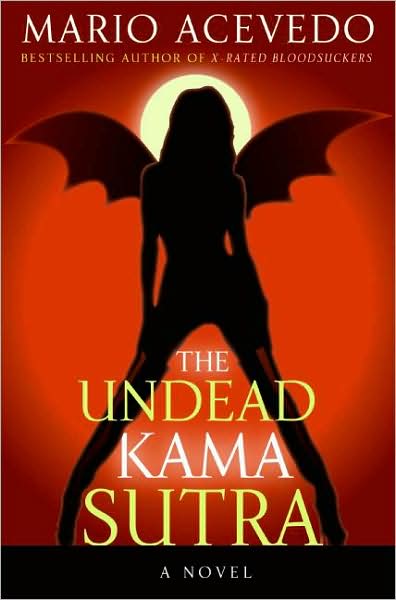
South Florida Alien Invasion. Win 8 Novels.

Mario Acevedo. The Undead Kama Sutra. NY: Harper Collins Publishers, 2008
ISBN-13: 9780060833282

Michael Sedano

Mario Acevedo has a great thing going for him with his Felix Gomez, vampire detective, series. Not only do the vampire characters possess a creepy allure, they get tangled up in wild adventures making such diverting intrigue, that fun-seeking readers will want to read each novel in the series.

In this third adventure, the detective travels to south Florida to mix it up with space aliens intent on corrupting the U.S. government while addicting the earth's men to virility-boosting pills, and women to breast-enhancement drugs that also increase libido. No problems with your HMO, either.

There's a nefarious motive behind this alien science that Felix uncovers with a little help from his undead friends.

The Kama Sutra of the title makes for a bit of silliness without getting too graphic. Carmen, with her friends and chalices (a human who willingly allows vampires to feed on their blood) helping, is discovering methods to use colorful sexual practices to attain transcendent levels of powerful spiritual energy. She wants to practice with a reluctant Felix and has to con him into bed.

Acevedo has a lot more confidence in his characters now. He devotes minimal space to Gomez' backstory--how he was turned into a vampire while fighting in Iraq--and the vampire world government, the Araneum, and its telecommunication system reliant upon carrier crows and arcane messages written on cured vampire skin that self-destructs on exposure to sunlight. The vampires enjoy an occasional nap in a coffin, and draughts of fresh blood that may cause momentary discomfort to queasy readers, even those who enjoy a nice boudin noir or morcilla nosh.

Gomez' friend, the luscious Carmen, has discovered a Caribbean secret: a spider whose venom tans the otherwise pale-skinned vampires. Being free to walk in daylight without heavy sunscreen makeup removes a key vulnerability. But there's a catch, for Felix: he loses his sure-fire vampire human chick magnetism. In fact, poor Felix grows depressed when a casual pick-up kicks him out of her apartment after testing his sexual athleticism. Felix, by the way, is one prideful vampire who prefers to conquer women without using his vampire hypnotic powers, so the loss of his magnetic allure is a source of shame as well as a looming ethical crisis.

Outside of seduction and feeding, Felix remains otherwise reliant upon vampire powers. Machine-gunned to shreds, he heals rapidly. When he infiltrates the high security military compound protecting the evil alien, Felix and pals float, climb walls, see in the dark, and zap human guards merely by making eye contact.

With all their undead power, however, Felix' vampire comrades are no match for the alien spy and his human hench seducers. Only an alien-ex-machina ending saves the day, sort of. Clever Acevedo, he disappears Carmen, leaving Felix frustrated at his inability to help her, but keeping the door wide open to what should be number four in the series, the quest to rescue Carmen and save her from her unimaginable fate.

Fiestas Patrias in America - Mes de la Herencia Hispana - Mes de Free Books

Hace unos años, in fact, since 1968, that the EUA has set aside a period of time to recognize and cerebrate things Latina Latino, Chicana Chicano, et al. The 90th Congress passed public law 90-498 authorizing and requesting the US President to declare an Hispanic Week. Gerald Ford did that. By the time the 100th Congress came about, in 1988, Public Law 100-402 declared a month would be enough, commencing the next year. So, ever since 1989, the United States has held its National Hispanic Heritage Month.

Little as I enjoy seeing "the 'H' word" associated with chicano literature, I feel the battle of the name is becoming passé as increasingly gente become inured to--or never felt the dagger of--accepting the government's imposition of its catch-all term in place of a preferred and more descriptive identity term. Like chicana chicano. Oh well, "so it goes," as the famous chicano writer Vonnegut used to say.

There's a point and here it is, from publisher Hachette:

In honor of Hispanic Heritage Month (Sept. 15-Oct 15) Hachette Book Group USA has rounded up a collection of our best books that celebrate Hispanic Americans to offer exclusively online as a free Hispanic Heritage Book Giveaway.


This exquisite list includes a number of highly thought-of titles, and some great discoveries:

Dream in Color By Linda Sánchez , Loretta Sánchez ISBN: 0446508047
Gunmetal Black By Daniel Serrano ISBN: 0446194131
The Gifted Gabaldón Sisters By Lorraine López ISBN: 0446699217
Bless Me, Ultima By Rudolfo Anaya ISBN: 0446675369
Brownsville By Oscar Casares ISBN: 9780316146807
The Hummingbird's Daughter By Luis Urrea ISBN: 0316154520
The General and the Jaguar By Eileen Welsome ISBN: 0316715999
Tomorrow They Will Kiss By Eduardo Santiago ISBN: 0316014125

Next week, look for details on how five La Bloga visitors can each win a set of all eight titles, mailed to the winner's home address by the publisher, in cooperation with las blogüeras los blogüeros here at La Bloga.


And that's the happenings from September's third Tuesday, a day like any other day, except we are here.

La Bloga welcomes your comments and questions. To participate, simply click on the Comments counter below. If you'd like to be a La Bloga Guest Columnist, you're welcome to click here to describe the book or arts review, issue, or other material you'd enjoy sharing.

See you next week.

mvs
c/s