Wednesday, September 21, 2011

Talleres de Poesía- New Fundraising Events

For more information visit www.talleresdepoesia.org

Event in Los Angeles

Talleres de Poesía and Un Solo Sol Kitchen invite you to this fundraising event for the 2nd Annual Children's Poetry Festival in El Salvador.

You will enjoy delicious food while you listen to poets and children’s book authors. 

Date: Sunday, September 25th
Time: 2 to 5 pm.
Place: Un Solo Sol Kitchen
1818 E 1st St, Los Angeles, CA 90033
(323) 269-8680

talleres.jpg

Event in San Francisco

Friday, October 7, 7pm 
Piñata Art Gallery 
4268 Mission St. San Francisco, CA

Talleres de Poesía and CARECEN present the 2nd Annual Art Auction Benefit for the 2nd Children's Poetry Festival in El Salvador.

poster+auction.jpg

‘40K in 40 days’ 
campaign to open La Casa Azul Bookstore in East Harlem! 

Tuesday, September 20, 2011

Doppelgängers. Melinda Palacio Reads. News & Notes. On-Line Floricanto.

Los Doppelgängers Fun, Frolic, Convergence

Michael Sedano


Richard Montoya and Guillermo Gómez-Peña, Los Doppelgängers. What a bill for an evening's entertainment. Two geniuses, one certified one not. Ni modo, it is a dream bill.

A Mexicano and a Chicano, the two performers don't look alike; each is a spitting image of himself. Ricardo is not William nor is Guillermo Richard, so they're not tocayos. The one adheres to unscripted spontaneity the other a playwright, by nature dedicated to structure and plot. So what is the doppel part of this gang, and what are the two of them doing sharing the same stage at UCLA's Fowler Museum?

Richard Montoya, Guillermo Gómez-Peña

To believe the program, the collaboration offers "mana a mana" performance around border issues. The pair will perform reworked excerpts from older work. The promised result both a ‘profane’ border ritual and a ‘living archive’ that explores the rampant violence taking place in Mexico and the concurrent anti-immigration hysteria in the United States.

Guillermo Gómez-Peña, for one, explains some of the above, offering his willingness to see what would happen. Take it Montoya. Richard Montoya puts down his chain saw to flash the pages of a script for the evening then admits he has little idea what will actually take place in this space. Montoya apologizes for the placement of the massive stone fountain smack aplastada in the center of the room. It’s on loan to be returned to the Getty Villa tomorrow. He lied; I learned the fountain is permanently installed there.

The performance consumes the four corners of the enclosed courtyard. Gómez-Peña diagonal from Montoya. Musicos--Chicano Son--play kitty-corner from a dazzling spotlight. The ornate fountain holding center stage requires the audience--limited by the Fowler to an elect handful—to bunch up around the periphery or, until the last act, fountain perch and swivel to the active corner then pivot 180 degrees to watch the counterpart act. 

Alternating time in the pink light, the actors let flow streams focused on  language, communication, identity, politics. Gómez-Peña elects to go a la brava, extemporizing when he holds the stage. Montoya orates and spiels, reads his father’s gem,  El Louie, accompanied by bluesy horn, also reads from Ricardo Flores-Magon’s “Tierra y Libertad."

The doppels work simultaneously in the evening's final segment. Montoya narrates a wild romp in the water by a diaphanous-gowned woman while Gómez-Peña circles through the audience, mic in hand, echoing key phrases or words plucked from Montoya's stream. The world's oldest cholo makes an appearance, dances with the angel. She splashes water with hands and hair on as many onlookers as possible all the while following Montoya's sometimes risqué stage direction. Click below for “Los Doppelgängers” samples.


The link above mixes still frames with video snippets. Taken with an iPod Touch camera in puro available light, the results are a colorist impression of a challenging and entertaining event. I'd asked about photography and was told the event was to be an intimate setting and no cameras. Glowing screens floated out of the deep shadow like giant fireflies, so I whipped out my iPod and voilà.

With the house lights dimmed to max, much of the white light illumination comes from the underwater lights and the surrounding hallways. The spotlight operator mounts a pink gel. The light burns away the performer's face. The operator sweeps the light across heads and faces to spot the performer in the opposite corner.

Conejos Raul Baltazar and Company Bunnies wear pink bunny outfits, circulating through the crowd taking videos. With the evening billed as be a “living archive” exploring US culture, I hope the conejo video will surface one day soon.

In the warm-up, Abby Ghraib aka Allison Wyper holds up a sign asking about cameras. She selects an unwitting volunteer, walks him to the podium where a noose awaits. Posing the hapless fellow, Ghraib invites gente to create their own home-made torture foto. At $25 a head instead of $1.2 trillion, that’s a bargain souvenir. I am too far to get a foto.

I catch one foto, center below, of Guillermo Gómez-Peña as he flashes past me and through the pink beam. He's moving and I pan with him. The high contrast and absence of detail cry out for color experiments, hence the triptych here:

Guillermo Gómez-Peña

After LA Times writer Reed Johnson so enthusiastically wrote up the performance in advance, the program reprints the piece and thanks Johnson for his work: both Artists wish to thank: Josefina Ramirez of the Irvine Foundation Rene Yañez, their artistic Godfather Reed Johnson EI Gringo Simpatico Del Los LA TIMES! Everybody who bought a ticket! Gente wishing they’d been there could have been part of that elect group, with a subscription to the Fowler Museum’s e-news.

Gente attending the current ASCO tribute at the LA County Museum of Art understand the bottom line of “Los Doppelgängers.” LACMA’s walls do little to express ASCO’s identity nor add to appreciation of their actual work, which is not a bunch of fotos. Performance art constrains itself to time, place, attention. If you’re not in place when the thing runs, you’ve missed it and it’s gone forever. In other words, you shoulda been there. Los Doppelgängers proved itself a highly worthwhile “mana a mana.” Tighten up the structural threads, make something of those bunnies--or add gorilla suits and other critters, quien sabe--make the piece more coherent, and it's ready for the road.

El Louie is a genuine masterpiece that deserves a better reading. It's not that Montoya père's reading is the final word on that monument of carnalismo because son's blue atmospheric reading simmers with potential. The gruff voice limits what can be expressed. Now Montoya and Gómez-Peña have to bring back Los Doppelgängersat least one more time, to do El Louie justice. Y si no, san pinche or los doppelgängers are in for it.


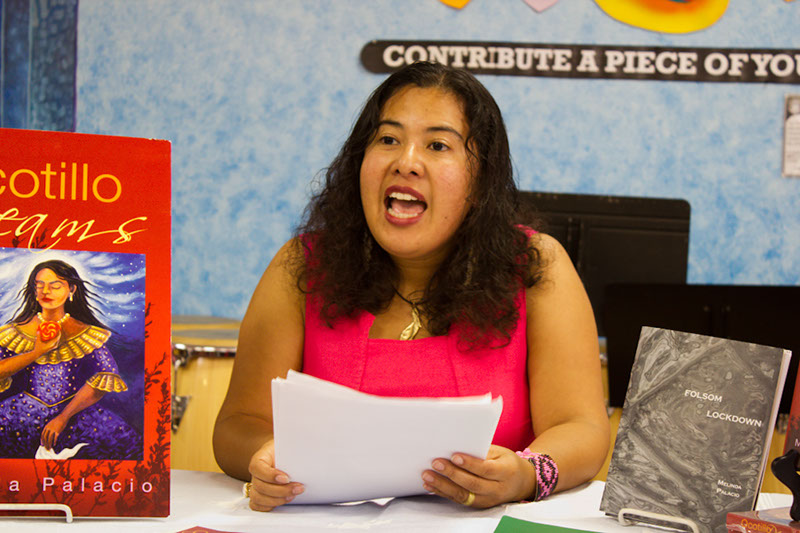
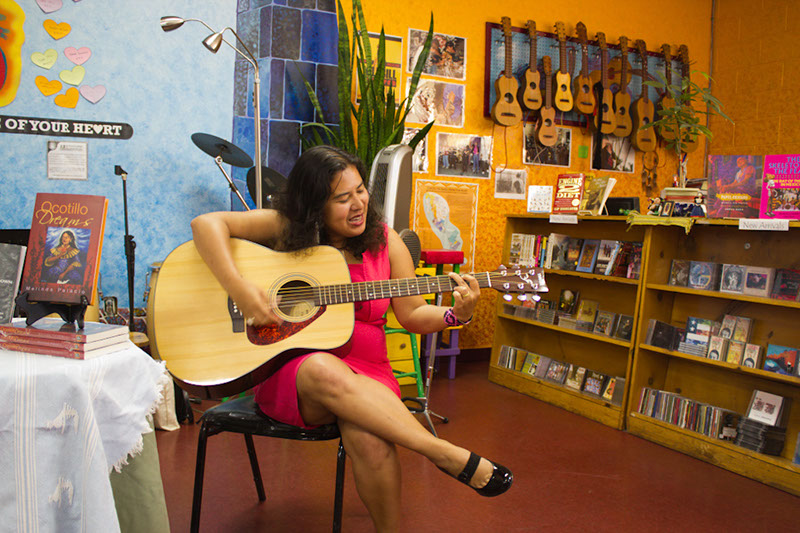
Melinda Palacio Brings Ocotillo Dreams to Tia Chucha's

Saturday was the annual Lascano Pelada, and I was glad Tia Chucha's Centro Cultural scheduled Melinda Palacio's Ocotillo Dreams reading for an early start. Sadly, the hour proved too early for readers so a big crowd did not get to enjoy the repartée, reading, and fun.


This is the second reading I've attended at Tia Chucha's that had a small house. Indie booksellers provide  an important community service by opening business hours to itinerant writers like La Bloga's Melinda Palacio. Every signed book indicates a sale, and perhaps new business to the enterprise. Cash flow and growth, two magic words for the bottom line.

The centro sits on the road to LA Mission College, at the fringes of densely populated neighborhoods. I hope some advanced student considering a communications or marketing career makes a project of drumming up colas en sillas. For instance, there's a large apartment building across the street, an ideal target for shoe leather intensive advertising, i.e. door-to-door pamphleting. At the college, identify twenty students and five teachers. Deliver personalized messages with time & place. Get commitments, not definite maybes. Bring a few opinion leader tipas tipos in the door and word of mouth will soon have gente competing for a chair at crowded readings.

Building audiences remains a constant struggle for the artist and entrepreneur. I suppose if they knew there would be an audience sing-along to "Cama de Piedra" they'd be knocking down the doors.


News & Notes
One Hundred Thousand Poets For Change Berkeley Schedule

La Bloga friend, poet Vibiana Aparacio-Chamberlin, advises she is reading in Berkeley as part of the event broadsided below. Vibiana's venue, Subterranean ARTHOUSE, is at 2179 Bancroft Way. 100,000 Poets for Change stages a global event September 24. Click here for details.


News & Notes
New Short Fiction Series Spotlights 1973 Festival de Flor y Canto Writers

Mark your calendars for October 29 for a wonderful reading listening experience. Vibiana, along with Alejandro Murguia and Ron Arias, are the featured writers in the October 29 staged reading, Diga Me/Pacific Standard Time at The Fowler Museum, UCLA. I am moderating the post-performance discussion.

The reading is produced as part of the fifteenth anniversary season of The New Short Fiction Series produced by Sally Shore. It is the longest-running spoken word series in the region.

La Bloga will share details as they emerge. The spoken word series is an every second Sunday of the month event in Santa Monica. The series moves to UCLA's Fowler for this event.

News & Notes
Call for Papers on Carlos Fuentes • Due date January 31, 2012

Carlos Fuentes

La Bloga friend Roberto Cantú from California State University Los Angeles has organized what promises to be another spectacular event in May 2012. As with any academic conference, the focus is up in the air other than having to do with Fuentes. For example, here are some suggested paper topics:


13.  The Gothic literary tradition in the novels of Carlos Fuentes.
14.  The Avant-Garde, Latin American literature, and Carlos Fuentes.
15.  Carlos Fuentes and European Realism, from Cervantes to Balzac.
16. Carlos Fuentes and Mexico's post-Boom generation of novelists: continuity and change.
17.  Archaeology at the Templo Mayor, 1976-present:  revisions in Mesoamerican history, and impact on Mexican art and literature.

That last one has a good ring to it. And trece would be a good session, too. Visit the conference website for the exquisite details.

The keynote talk, too, sounds like a good draw. CSULA's food services does a great job on banquet cooking and serving, so guests will sit back well satisfied when Dr. Georgina García Gutiérrez Vélez, Centro de Estudios Literarios del Instituto de Investigaciones Filológicas,  Universidad Nacional Autónoma de México gives her talk on “Carlos Fuentes and Diego Rivera: Leading Creators of ‘Renaissances’ in Mexico”.

CSULA is on the eastside of town, in El Sereno. UCLA, a co-sponsor, is westside, near the edge of the continent.

News & Notes
Siquieros Mural Subject of Upcoming Sunday Lecture


The dazzlingly modern entertainment that Montoya and Gómez-Peña mounted stands as an encouraging sign that artistic liberty--or license, go for it--lives vibrantly in the halls of the Academy.

Across town on Calle Olvera, in 1938--hopefully a far different era--censors elected to whitewash a dramatic 18' x 82' mural depicting the crucifixion of a  campesino. Painted by David Alfaro Siquieros, it is one of three murals the Grande painted in this city.


Today, the mural is almost restored. Shortly, the mural will be unveiled to the public. (A copy created recently adorns the west wall of the old Self Help Graphics building on Gage and Cesar Chavez in East Los.)

The Getty's conservation scientists, numerous public officials--many self-recruited--and the gente in the background like Carol Jacques and Amigos de Siquieros, must savor the moment. What satisfaction knowing the job approaches completion.

The lecture, conducted in association with the new La Plaza de Cultura y Artes, advances los Amigos de Siquieros' public education efforts about the mural, the next phase of the mural project. No rest for the weary, but nothing reinvigorates volunteer energy than seeing one's work come to fruition. Next.

Anyone who enjoys a cobbled street, a sidewalk table to people watch, and acceptable cooking, enjoys Calle Olvera. With the addition of Plaza de Cultura on one side and the Obregón Medal of Honor Memorial on the Union Station side now joining the ongoing program of the Mexican Cultural Institute, the area, officially named El Pueblo Historical Monument, is being reinvigorated as an important cultural site.


La Bloga On-Line Floricanto • Penultimate Tuesday in September 2011

This week, the moderators of the Facebook group, Poets Responding to SB 1070, submit work by five poets: Doroteo García, Devreaux Baker, John Martinez, Susan Deer Cloud, Monica King.


1. "Los Janitors Soñamos Despiertos" por Doroteo García
2. "Oiling the Immigrant's Bowl" by Devreaux Baker
3. "The Line" by John Martinez
4. "Reading The Names, 9/11/2011" by Susan Deer Cloud
5. "Learn English" by Monica King


"Los Janitors Soñamos Despiertos" por Doroteo García

Alguien camina por las noches
Hasta muy tarde, en la Universidad
De Stanford
No es un estudiante
No es un profesor.
A veces lo encuentras, dentro
De un salón de clases,
Dentro de un auditorio,
Otras veces lo puedes ver
Dentro de un taller o
Dentro de un laboratorio
Pero no es doctor
También lo podras ver
Adentro de algunas oficinas
Pero no es administrador

No lleva libros ni cuadernos
Usa un trapeador y un sacudidor
En vez de una computadora
Trabaja con una aspiradora
Mantiene limpia la universidad
Mientras todos duermen.

Mañana durante el día, en este lugar,
Se hablará de economía, de historia
De polítíca. Tal vez se invente una nueva
Formula física, o tal vez, se descubra
Una nueva galaxia.
Pero ahora a la una de la mañana
Un janitor sueña despierto
Añorando un mejor futuro
Para sus hijos.


Oiling the Immigrant's Bowl

by Devreaux Baker


I stuck my hands in my mother’s apron
pulled up pictures of her holding long dead babies
in her arms

I stuck my hands in her apron
felt the sting of asophedite on my tongue, a cure for cursing,
a cure for flu, a cure for stormy relations

I stuck my hands in my mother’s apron
smelled her cedar chest opening, found moth balls
like globes of sugar sprinkled across my uncle’s navy uniform

I pulled up pictures of the dead, resurrected color into their faces
jumped off   jumping off places,
stuck my hands in past the wrists, up to the elbows, shoulders,
this is my collar bone ringing my neck

I pulled her apron over my head,
tied it in a bow across my belly, her pockets next to my pelvis
I stuck my hands in, pulled out blackjack nights I had forgotten
pulled out river smells in her hair, cypress sap on her fingers

I dusted my hands with flour, measured in salt, rolled out the dough
flattened out days, lifted up her first dates in Austin,
farm boys waiting on the porch, live crawfish in a bowl
on her table

I stuck my hands in her apron, pulled out the Queen of Wands,
determined, strong, oiled the immigrant's bowl,
covered the bread


THE LINE

by John Martinez


Between two trees a line is drawn
But high in the sky
The diving birds
Witness their branches
Piercing clouds
To meet
And embrace

Soon their roots will tangle
Deep in the soil and fuse
So that eventually
Each tree has a bit
Of the other one’s bark

The rain falls at an angle
The sun moves in precise time
Spreading rays on each tree

Between two trees a line is drawn
But this line is weak
Drawn with a pen
This line is temporary
As the wind
The rain
The scurrying leaves
The raising root
Will turn it back
Into the earth it was
And then
It will be gone

John Martinez © 2011


READING THE NAMES, 9/11/2011

by Susan Deer Cloud


                              Reading the Names   9.11.2011

Today I stood under sky,
violet at dawn then graying
to rain by noon.

I started reading
the names of the dead …

every Indian who died
in terrorist attacks,
beginning with Columbus.

Thunder cracked nearby
and made me think of the guns.

I remembered the ghosts
beaded with bullet holes,
the ones in canoes

who wave to me
from the Susquehanna.

I prayed they fared okay
in this week’s flood and will eat
pancakes once more at Manny’s Diner.

I read until twilight mists
silvered in.  Raindrops wet

my lips like multiple delicate kisses.
I wondered if ghosts kiss …
maybe more delicate than this.

When the rain stopped
I watched a star shine out.

The terrorists stole my language
so the names shone out mute.
My heart knew

the dark city was still
in a state of emergency.


                           © Susan Deer Cloud   9.11.2011
First published in Counterpunch, September 17-18, 2011.


Editor's Note: Normally I prefer to let a poem speak for itself and include no graphics. Susan Deer Cloud's poem put me in mind of Lalo Alcaraz' pure genius  9/11 drawing. Lest we.
Lalo Alcaráz. Collection of msedano.


Learn English

by Monica King


Learn English

When a little girl,
she was told learn English.
Other moms did not want her
to play with their children.

"Go back to where you came from"
were the words spoken each day.
But a little girl,
she learned English.

She did not care to play with the children
whose moms did not like her.
She found the words,
"I am from here".

A confused teenager,
trying to find a place
not just in the world
but in herself.

Going to a school where
she was too "brown" to be white,
and too "white" to be brown.

Living where girls did not want to talk,
torment was their passion.
A confused teenager,
who pushed her way and made a place to stand.

She ignored the poison
and was no longer a threat.
A teacher now,
who was told she had an accent.

Parents say she should not be teaching their children.
Children love her and want her to stay.


Every day she goes for them,
not for the ones who create laws
to make her feel less than human.

She continues to believe,
and becomes a great successful teacher.

~Monica King


BIOS

1. "Los Janitors Soñamos Despiertos" por Doroteo García
2. "Oiling the Immigrant's Bowl" by Devreaux Baker
3. "The Line" by John Martinez
4. "Reading The Names, 9/11/2011" by Susan Deer Cloud
5. "Learn English" by Monica King


Devreaux Baker has published three books of poetry; Light at the Edge, Beyond the Circumstance of Sight and Red Willow People. She has current poetry in ZYZZYVA, Borderlands: A Texas Review of Poetry, New Millenium Writings, Crab Orchard Review: The American South Issue, and Poecology. She was a co-editor of Wood, Water, Air and Fire:Poetry of Mendocino County Women and the producer of the Public Radio Program; Voyagers: Original Student Writing for Public Radio for KZYX . She directs the Mendocino Coast Poets and Writers Reading Series.

Susan Deer Cloud is a Métis Catskill Indian of Mohawk/Seneca/Blackfoot lineage.  She has a B.A. & M.A. Literature & Creative Writing from Binghamton University and an MFA in Creative Writing from Goddard College.  She has received various awards and fellowships, including a National Endowment for the Arts Literature Fellowship, two New York State Foundation for the Arts Poetry Fellowships (most recent one a 2011 Fellowship), a Chenango County Council for the Arts Literature Grant, First Prize in Allen Ginsberg Poetry Competition (twice), Prairie Schooner’s Readers’ Choice Award, and Native American Wordcraft Circle Editor’s Award for her multicultural anthology Confluence.  


Deer Cloud’s poems and stories have been published in numerous journals and anthologies (Sister Nations: an Anthology of Native Women Writers on Community, Unsettling America & Identity Lessons multicultural anthologies, American Indian Culture & Research Journal, Yellow Medicine Review, To Topos (Poetry International), Florida Review, Mid-American Review, Ms. Magazine, Prairie Schooner, Many Mountains Moving, North Dakota Quarterly, Poet Lore, Quarterly West, Earth’s Daughters, Shenandoah, Blood Lotus, Exquisite Corpse, Pembroke Magazine, Stone Canoe, Paterson Literary Review, Helicon Nine, etc.). Her most recent books are The Last Ceremony and Car Stealer (FootHills Publishing) and Braiding Starlight (Split Oak Press).

Deer Cloud has edited two anthologies ~ multicultural Confluence and Native anthology I Was Indian (Before Being Indian Was Cool) ~ plus the 2008 Spring Issue of Yellow Medicine Review, a Journal of Indigenous Literature, Art & Thought.  She is now an adviser to Yellow Medicine.  Currently she is editing the Re-Matriation Chapbook Series of Indigenous Poetry for FootHills Publishing, as well as an all Native issue for on-line journal Big Bridge (to be published in January 2012).  Her panel on the re-matriation of Indian people through writing poetry was a part of February’s 2011 Associated Writers Conference in D.C., where she also took part in three readings and a book signing.  In March 2011 she read, served on a panel, and spoke to a Native Literature class at the three day International Writers Conference at University of North Dakota in Grand Forks.


Monica Renee King (Morales) was born and raised in Mesa Arizona where she attended Mesa Public Schools.  After graduating from Westwood High School, Monica pursued a degree in Early Childhood.  In spring of 2009 Monica graduated from Arizona State University with honors and was hired by Maricopa County as a teacher in their Head Start Program.  Monica is going on her third year teaching for Head Start and is now a Site Supervisor.  Her goal is to go back to school and get a Master’s Degree in Early Childhood Education.  Monica enjoys hobbies such as:  photography, dancing, traveling, cooking, and writing. Currently Monica lives in Mesa Arizona with her husband and their two dogs.

Monday, September 19, 2011

Fernando D. Castro reads from his new poetry collection


[Click on the above poster to enlarge it. Note that this event will feature an open mic session. To read a review of Redeemable Air Mileage, visit this prior La Bloga post.]

Sunday, September 18, 2011

Ire'ne Lara Silva on diabetes poetry: An interview by Amelia Montes


Writing, reading, researching diabetes has brought me many surprises. One continual surprise is when friends I have known for many years contact me to let me know they too have the chronic disease. Here is information never relayed, never shared until this moment because I have been writing about diabetes. This is the power of the word: to speak diabetes through words, song, painting, dance.

And so it goes with ire'ne lara silva. I have known ire'ne for many years but until this year, we had not shared our experiences and struggles with this chronic disease. I'm very pleased to bring ire'ne lara silva to this Sunday's Bloga. ire'ne is a fierce poet from Austin, Tejas, whose words instruct me. She has also taught me how to "hechar el grito" and now she is gritando diabetes in her poetry. When ire'ne's first collection of poetry, furia, was published October 2010, it was featured right here on La Bloga. furia received an Honorable Mention from the 2011 International Latino Book Award in poetry.

Now she wants to follow furia with a collection that focuses on diabetes. she has titled it, blood/sugar/canto.

Here is one of the poems from the collection:


"diabetic love song"

understand there are things I will never do with you I will never go to the beach with you in the summer I will never share a stack of pancakes with you I will never stay up all night I will never toss back tequila shots with you or have a beer or a glass of wine I need naps and I need rest and when I get too tired I stop functioning my brain begins its meltdown at 90 degrees I will cancel plans it will all be more than I can bear

and now there are pills in the morning and pills at night and more than one syringe a day there may be three there may be four and everywhere everywhere there are alcohol pads in the house in the restroom on the floor in my purse in my pocket and spent lancets and testing strips with one miniscule drop of blood and I will be pricking my fingers and pricking my fingers and pricking pricking pricking

I can never skip meals I will always need more water I will always have doctors’ appointments looming and sometimes I will rail against all of it and I will howl and gnash my teeth and throw things about and I will despair and there will be nothing you can do and sometimes when I am tired and hungry I will become a screaming monster felled only by exhaustion

given that time is short given that the number of my days are unpredictable I have no patience now for people who put off all their dreams people without dreams people dedicated to accumulation and consumption people who fill their lives with drama and noise because they can think of nothing better to do given that time is short I will cut corners everywhere and preserve energy for what is essential: creating and passion and love and beauty and quiet I will never make beds or iron or clean baseboards I will never go to a mall or a baby shower or any event for the sake of appearances I will never again try to make my family love me

I will always be working on letting go of things that hurt me I will always be intent on healing on becoming stronger and sometimes that will make me flint-faced and harsh and sometimes it will make me the compassionate being I want to live my life as and sometimes I won’t know the difference

but if you stay if you stay I will love you always love you fiercely love you as if you were the only one I ever loved love you like my last hope my only hope sing you the moon and the night wind I will give you the light of my eyes and the touch of my lips and the hot of my hands I will be your road going and your road returning and most of all most of all I promise I will never give up

Q&A

Amelia: Tell us about blood/sugar/canto and how you have decided to shape the collection with diabetes in mind.

ire'ne: Not every poem will be about diabetes, but that is the central theme. I want to look at diabetes from many different angles--not just from my own experience but the experiences of my family/ancestors, historically, culturally . . . addressing issues like nutrition and food activism, how socioeconomics are tied to diabetes rates and treatment. And I want to write about fear and despair and doubt and hope. Mostly, I want to talk about healing, self-acceptance, and growing into a new appreciation for our bodies.

Other than Sherman Alexie's pieces, I haven't seen a lot of poetry on diabetes. As with other experiences--some beautiful, some painful, I need to make art out of this. I need to own it. I need to share it. And I hope those future readers will find this collection to be a springboard for discussions. I hope it will help those who feel isolated in their illness feel less so. And I hope it will open a window for non-diabetic people into the lives of others.

Amelia: When were you diagnosed?

ire'ne: April 23, 2008. My doctor put me on insulin the same day.

Amelia: On that day, did the doctor also refer you to education classes?

ire'ne: I was referred to a Diabetes Education class, but not to a series of classes or to a support group. The class I went to covered the basics. Mostly it was oriented for people who 1)had no knowledge whatsoever about diabetes, or 2) who had made no adjustments at all to their diet or lifestyle. I also went to an orientation class when I started taking [the drug] Byetta. I couldn't believe how insensitive the doctor was--she told us she had nightmares about being diabetic and how she wouldn't want to live if she was diagnosed with it. I also couldn't believe how many of my classmates were unwilling to reconsider their current levels of alcohol consumption.

Amelia: How did you get through those first days/weeks after the diagnosis?

ire'ne: I was incredibly depressed. It isn't an exaggeration to say that I wanted to die. It's not that I thought it was an automatic death sentence--after all, my father was diabetic for 24 years before he passed away in 2010. I think it was more that I didn't have the capacity at the time to handle the news or process what it meant for me. When the diagnosis came, I was working two jobs, taking care of my brother who is also dealing with diabetes, and was experiencing a lot of pain on a daily basis--I was overwhelmed. Since then, I've had time to come to terms with being diabetic--at turns fighting it, denying it, accepting it, working around it . . . now trying to work with it.

Amelia: What has been most helpful to you since your diagnosis?

ire'ne: In my case, not "a what" but a "who"--my brother has been the most helpful person. He was diagnosed years before I was. I may be his caregiver, but he's been my teacher and my support group. He was the one who pushed me to see a doctor, the one who got me on track with scheduling meals and snacks, the one who makes me take naps when I'd be inclined to push one, and he's been the one with helpful advice as I've dealt with adapting to my medications.

Amelia: What needs to change in our society--regarding Diabetes?

ire'ne: So many things that I barely know where to start. We need more eduction everywhere, especially about food. So much of what we, as a society, are eating is toxic to our health. It's not just fast-food culture, it's all the processed foods and all the additives. Sadly, the least expensive choices are usually also the worst possible choices. I've heard so many people tell me they can't afford to shop at Whole Foods--but I know it's possible to seek out farmer's markets or grocers that sell local produce. We can value the food we eat above a new car or a big screen TV.

We have to change our attitudes about food--educate and love ourselves enough to choose to eat food that can increase our health instead of diminish it--seeking out organic/unprocessed/natural foods wherever we can. It's possible to take some time every day to plan meals, substituting healthier options in our recipes (olive oil for butter or any other oil, fresh or frozen veggies for canned veggies, brown rice and whole grains instead of white rice/white bread/white flour, and skipping altogether on sugar, cream, etc.)

I think Latinos have a huge advantage when it comes to adapting our diets. People blame tortillas and Tex-Mex food all the time, but if we actually took a closer look at what our home-cooked meals consist of and at the dishes that came from our indigenous ancestors (who didn't have white flour or cow's milk or Micky D's), we'd find so many healthy possibilities. Look at dishes like pollo guisado con calabaza or caldo de repollo. It's all in how you make it, especially the quality of ingredients you use.

Amelia: What would you like to tell La Bloga readers and those who have been newly diagnosed about diabetes?

ire'ne: There are just two really important things I want to say to people with diabetes, especially those who are newly diagnosed. One: you have to forgive yourself. You may have done everything in your power for the last twenty years to avoid diabetes or you may have lived in denial or you may not have had a clue. It doesn't matter. What's important is to work on your health from this point on.

And two: in my experience, doctors treat diabetes by making their patients afraid. You can't live your life afraid all the time of everything you eat, everything you do, every medication you take. Only you know what the right pace and the right balance are for you. Talk to other people. Listen to your body. You don't have to be afraid.

Amelia: Thank you ire'ne for your palabras de poesia and your courage.

ire'ne also has her own website and blog. You can find ire'ne at:
website: http://www.irenelarasilva.webs.com
blog: www.irenelarasilva.wordpress.com
e-mail: irenelarasilva@yahoo.com
In addition to ire'ne's work on blood/sugar/canto, ire'ne is currently seeking a publisher for her collection of short stories, The Ocean's Tongue and she is quite busy writing a novel entitled Naci. ire'ne is also the co-coordinator for the Flor de Nopal Literary Festival coming to Austin December 1-3--very soon. If you're in Austin, don't miss the Flor de Nopal Literary Festival!

Friday, September 16, 2011

Keeper of the Chicana Codex or Low-Tech Writer Hits the Road


Melinda Palacio

August marked the beginning of the Ocotillo Dreams book tour. I don’t have an agent or a big publishing house to send me on a 30-city book tour, but I’m a determined person of the world with a story to share. My novel is a work of fiction, set during the 1997 INS Sweeps in Chandler, Arizona. The story is made up, but the work reveals its own kind of truth. I’m blogging, traveling, and reading my work to live audiences, radio audiences, poetry audiences and prose audiences. I arrive ready to perform, meaning I’ve undertaken weeks and months ahead of publicity prep work; I’ve told as many people in the are about my reading, informing news and social media outlets, in some cases I am expected to provide my own refreshments and books. I’ve never expected special treatment, but it sure is nice when an organization sends you a kind note and invites you to be there guest, at their expense.

Sure, at times I feel silly wasting gas and money for what seems like a dying technology, the book and the dinosaur fueling it all: the paperback writer. The fact that I do not own a Kindle or e-reader and that I’ve published my novel with a small university press who has little interest in publishing their beautiful books in e-format makes me feel old fashioned. Call me keeper of the Chicana Codex, a person who has yet to buy an e-reader, who schleps around an extra bag for my shoes and books over a long weekend trip. I recently read in the NY Times that the codex (aka book) is more efficient than the even more ancient scroll (aka digital e-reader). If this is so, then maybe I’m not pushing a boulder up a hill.

I press on with my self-made book tour stay the mostly straight course of the stretch of the 10 hwy between Santa Barbara and New Orleans. I do this because of the pleasure of meeting with readers and new friends, of hearing an audience laugh at all the right places when I read a scene aloud.

On August 31, I had a reading and book signing at Changing Hands Books in Tempe, Arizona. Before the reading, I checked to make sure all of my facebook friends in Arizona knew about the reading. I contacted local newspapers to make sure they were announcing my event. I wanted to share my novel with locals who were familiar with the book’s setting and immigration policies. What I wasn’t prepared for were the hate-filled comments elicited by the newspaper announcement of my book signing. I was scared of the people spewing negative dogma about immigrants from Mexico and immigration issues in general. Luis J. Rodriguez told me if any of the hate-filled people show up, you stay focused. Michael Sedano told me to read the heck out of my book. I started telling more friends and they sent wishes of support. Pretty soon, the strangers supporting me outnumbered the negative commentators. I found strength in numbers. As more people sent me their positive energy, I felt more protected. The reading at Changing Hands Book store was wonderful and filled with a crowd of about 60 people who listened to what I had to say and who were eager to read their recently purchased copies of Ocotillo Dreams.


Stella Pope Duarte came with all her friends and fans. She is the recipient of the Alberto Rios Teaching award. I met an entire Chicano Studies class, taught by Professor Hernández. I was especially touched by a man named Alvaro who bought my book even though he cannot read the paperback because he is blind. Alvaro says he will have to wait for a pdf, audio or e-version of the book. He said he enjoyed hearing the excerpt I read and was hooked. I met future writers and a journalism student who hopes to publish her first novel soon. A pleasant visit with Arizonans I hope to meet again. October 6 takes me back to Arizona for the National Hispanic Women’s Conference in Phoenix. One of the organizers, Anna, was in the audience. Arizona, nos vemos.

If you are reading this post this Friday morning, listen to my radio interview on the Julio Martinez show KPFK 90.7 FM Los Angeles and 98.7 FM Santa Barbara. I have two appearances, Saturday September 17. The first will be a book signing at Tia Chucha’s Centro Cultural and Bookstore, 13197- A Gladstone Ave at 12:30 pm and the second will be a book talk at the Autry National Center at 3:30 pm at Griffith Park.

Submit with me… First, offer your grito. !Viva! Next, submit your poems to Hinchas de Poesia.

One of my Panama Poems, “Sin Vergüenza Swagger, was accepted for Hinchas de Poesia’s November issue. You won't know if the editors will accept your work if you don't submit.

* * *
GUIDELINES:

Please provide a cover letter telling us the title(s) of submitted work, current contact information (full name, mailing address, telephone number(s), e-mail address), and previous places where you’ve placed your work.

Please read the complete guidelines here.

Hinchas will only be accepting submissions through the Submishmash online submission manager.

Thursday, September 15, 2011

Chicanonautica: The Xuanito Syndrome

by Ernest Hogan


Not satisfied with the turmoil caused by his publication of “Doctora Xilbabla’s Datura Enema,” Rudy Rucker has chosen to include another story of mine in Issue #12, Fall-Winter, 2011 of Flurb: A Webzine of Astonishing Tales.


That’s right, it’s a webzine, available online, for free, to any unsuspecting soul with net access. With one click, you could find yourself reading a new collaboration between Rudy and Paul Di Filippo, and new stories by Bruce Sterling, John Shirley, and other talented folks. There’s also an assault on civilized sensibilities by me, called, “Xuanito.”


Just a name for a title, in the tradition of Frankenstein, Dracula, and Godzilla.


“Xuanito” is a tribute to a major influence on my work (and my personality) -- the monster movie. I grew up watching them on shows like L.A.'s KHJ-TV, Channel 9’s Strange Tales of Science Fiction. They weren’t just products out of Hollywood. Monster movies came from Japan, Mexico, the Philippines, Denmark, Italy, even England. Monsters shaped my world.


At first I has horrified by the genre, but I found it irresistible. I went from having nightmares about monsters coming after me to fantasizing about being one of the heroic guys who killed the monsters. Then, things took a weird turn -- at some point I started to identify with the monsters.


I’m not sure when this happened. It may have had something to do with hormones kicking in. It was also the Sixties . . .


Rudy noticed what he calls transreal stuff about the way young Latinos get treated in “Xuanito.” That was what I intended. I have noticed that often, when I’m minding my own business, pursuing my interests and curiosities, the prevailing society reacts as if I was one of the rubber-suit creatures from my favorite movies. Fair-skinned, English-speakers have reacted with terror and looked like they were about to call for uniformed back-up when I just was out looking for a job or something. Luckily, I developed an attitude and a sense of humor that defuses the situation before excessive force is authorized.


This has caused me to realize that the Chicano Taking On The World is a recurring theme with me. Cortez on Jupiter is a portrait of an artist as a young monster. High Aztech reanimated Aztec culture and turned it loose on an unsuspecting world. Smoking Mirror Blues has a barrio mad scientist making himself into Tezcatlipoca. And here, in my last Chicanonautica, I refered to myself as a Frankenstein monster.


Yeah, I’m working on those ebooks . . .


And I’m thinking about the Chicano as a Menace to Society and an Information Age Monster. There are probably more stories lurking in that syndrome.


Ernest Hogan’s story “Guerrilla Mural of a Siren’s Song,” can now be pre-ordered in the anthology Alien Contact by Marty Halpern.

Wednesday, September 14, 2011

Marisol McDonald Doesn't Match Celebrates The Multiracial Experience


From Children's Book Press


Marisol McDonald Doesn't Match /
Marisol McDonald no combina

Marisol cover_PR.jpg
San Francisco, CA—What do President Barack Obama, actor Keanu Reeves, and reporter Soledad O’Brien have in common with the spunky heroine of our new children’s book, Marisol McDonald Doesn’t Match / Marisol McDonald no combina? Like nine million other Americans, they are mixed-race. While the multiracial population in the country has grown rapidly in the last ten years (especially among children), very few children’s books actually deal with the experience of being mixed-race. Marisol McDonald Doesn’t Match is a funny and lively story about a biracial soccer-playing pirate artist who doesn’t match—and doesn’t want to.


Marisol McDonald has bright red hair and golden brown skin. She loves to mix up her outfits with polka dots and stripes. For lunch, she packs a peanut butter and jelly burrito in her lunch box. To Marisol, these seemingly mismatched things make perfect sense together.

Some people don’t know what to make of Marisol—can’t she just be one or the other? Try as she might, in a world where everyone tries to put this biracial, Peruvian-Scottish-American girl into a box, Marisol McDonald doesn’t match. And that’s just fine with her.

A mestiza Peruvian American of European, Jewish, and Amerindian heritage, renowned author Monica Brown wrote this lively story to bring her own experience of being mismatched to life. Her buoyant prose is perfectly matched by Sara Palacios’ mixed media illustrations.

  • Marisol McDonald follows in the footsteps of children’s book characters like Clarice Bean, Junie B. Jones, and Fancy Nancy, but focuses on the experience of being biracial.
  • According to the 2010 US Census, the number of mixed-race children in the US increased almost 50% in the last decade, to 4.2 million, making it the fastest growing youth group in the country.
  • Between 2008-2009, one in seven new marriages were between spouses of different ethnicities (Pew Research Center).
  • Monica Brown has written nearly a dozen children's books, many of them bilingual. Her books have received many awards and honors, including the Américas Award for Children's Literature, the Pura Belpré Honor Award, and an NAACP Image Award nomination.
Marisol’s varied, distinctive lifestyle and multiracial family affirms our increasingly blended society and clearly celebrates independent thinking. Bravo!
—Kirkus STARRED Review

ABOUT THE AUTHOR & ILLUSTRATOR
Monica Brown is the author of many award-winning bilingual books for children, many of which are inspired by her Peruvian American heritage. Monica is a Professor of English at Northern Arizona University, specializing in U.S. Latino Literature and Multicultural Literature. She lives in Flagstaff, Arizona.


Sara Palacios was born in Mexico City. She holds degrees in Graphic Design, Illustration, and Digital Graphic Techniques, and is pursuing her MFA in Illustration at the Academy of Art University in San Francisco. She divides her time between Mexico City and San Francisco, California.

ABOUT CHILDREN’S BOOK PRESS

Founded in 1975, Children’s Book Press is a nonprofit publishing house with a mission to promote cooperation and understanding through multicultural and bilingual literature, offering children a sense of their culture, history, and importance.

Visit our Press Room to download a PDF of this press release.