Monday, May 24, 2010

Come celebrate the release of the Homeboy Review!

Come celebrate the publication of the Homeboy Review (Vol. #2) featuring readings by authors Melinda Palacio, Daniel Olivas, Fred Mills, A.K. Tony and the brilliant Homeboy Poets. The Homeboy Review is edited by novelist Leslie Schwartz. Light fare from the Homegirl Cafe.

This reading is free and open to the public. However, please help Homeboy Industries in its current time of need. If you donate $5, you will receive five chances to win an amazing Homeboy gift including signed copies of Tattoos on the Heart (Free Press) by Father Greg Boyle, Homeboy Review's debut issue, a Homeboy T-shirt, coffee mug and lunch for two at the Homegirl Cafe, and more!

WHEN: Tuesday, May 25
TIME: 7:00 p.m.
WHERE: Homeboy Industries, 130 West Bruno Street, Los Angeles, CA 90012

For more information, e-mail Leslie Schwartz, editor-in-chief of the Homeboy Review. You may also check out the event listings on the Homeboy website, or follow on Facebook Fanpages (Homboy Review Literary Magazine and Homeboy Industries) for up-to-the-minute event information.

◙ THE RAMONA GARDEN SLUGGERS

A children’s story by Álvaro Huerta

"Hey! Who's that dude?" yells Fat Ritchie.

"I think he's selling Tupperware?" Lucky cracks a joke, making the rest of the Chicano kids from the Ramona Gardens housing project burst into laughter.

I sigh, wondering, "What have I gotten myself into?" I know these kids, since I used to be one of them. I remember playing a great game of baseball and ignoring my homework. Then one day a coach made all the difference. He encouraged me to get into organized sports and made sure I went to college.

Finally I get the nerve to approach these kids. We are at Murchison Elementary's baseball diamond on a hot Saturday afternoon. "Hi," I say. "Would you guys like to play in a baseball league?"

"My mom says not to talk to strangers," says Mayto.

"Wait, I know this guy," Beto responds. "He's cool, but I think he's trying to get in good with us so he can date my sister, Antonia."

"I want to see if you guys want to be part of the East Los Angeles Little League. I'll be your coach," I say.

"Why should we listen to you? You probably don't even know how to play."

"Who's your best pitcher?" I ask.

Nene steps up to the plate.

"OK, if I hit a home run, will you listen to me?"

All the kids, Nene, Lucky, Mayo, Fat Ritchie, Peanut Butter, Beto, Chato, Buddy, Herbie and Kiki hoot and holler, and roll on the ground, and point at me. I guess they don't think I can do it. But, and I can hardly believe this, I hit the ball out of the park. There is absolute and total silence. Then Nene saunters over and holds out his hand. As we shake hands he asks, "What do we have to lose?" We become the Ramona Gardens Sluggers.

We are officially part of the league!

Eager to begin, the kids bring their equipment: old gloves, broken bats and baseballs ripped at the seams. So my older brother, Salo, the artist, draws numbers and last names on our uniforms with black makers. From a distance, the jerseys look professional.

Peanut Butter pronounces them "professional looking." "From a distance," he adds.

"OK, guys," I say, "if we win this first game, we'll go to McDonald's, and if someone hits a home-run, he'll get a Big Mac instead of a Happy Meal."

Every one of the Ramona Gardens Sluggers cheers with all his might. We are on our way!

Our first game is against the Montebello Bombers. They think that they're better than we are because they have new uniforms.

Nene gives up only one run, and the Sluggers lead, 3-1, by the end of the seventh inning. Suddenly, the umpire calls time out.

"It's time to switch pitchers," the umpire says.

"Why?" I ask.

"Didn't you read the rule book?" the umpire responds. "A pitcher can't throw more than seven innings."

Nene moves behind the plate to catch. Needing to score twice to tie, the Bombers load the bases with two outs in the last inning.

Nene's reliever, Lucky, takes the next batter to a full count. The batter hits the next pitch to left field. The player on third tears down the base path and crosses the plate, making the score 3-2. The runner on second rounds third and heads for home, trying to tie the score.

The Sluggers' left fielder heaves the ball home, trying to nail the runner. Nene catches the ball and the runner slides into Nene's glove.

"You're out!" the referee yells.

"We won! We won!" the Sluggers scream, making their way to the dugout. We're all hot, sweaty and tired. And happy. And I'm just as happy as they are.

"You guys did it," I say, proudly. "Who knows? If we go all the way, maybe next time we can go to Chuck E. Cheese."

The cheers get louder.

[“The Ramona Garden Sluggers” first appeared in the Los Angeles Times. Illustration by Andrew Huerta.]

◙ BOOK REVIEW: Rigoberto González, an award-winning writer living in New York City, reviews for the El Paso Times Stella Pope Duarte’s latest book, Women Who Live in Coffee Shops and Other Stories (Arte Público Press, $15.95 paperback). He observes, in part:

"Women Who Live in Coffee Shops" taps into the most pressing issues of contemporary urban living, a war zone with many wounds. And Duarte refuses to simply romanticize or indict the working class. Instead, she challenges the negative stereotypes with characters who reach toward tough solutions, and she demonstrates how Latinos sometimes surrender to the easy but damaging answers.

You may read the entire review here.

◙ THAT’S ALL FOR THIS MONDAY. In the meantime, enjoy the intervening posts from mis compadres y comadres here on La Bloga. And remember: ¡Lea un libro!

Final Dispatch from Alburque National Latino Writers Conference

Here is the final update from La Bloga Guest Columnist Margaret Y. Luévano. Outstanding work, Margaret. Thank you for keeping La Bloga updated on the fabulous ongoing efforts of the gente at the National Hispanic Cultural Center.


The 8th Annual National Latino Writers conference is over. Writers are back at home with the treasures gathered at the conference – business cards, writing tools, ideas, and budding friendships. They sit at their desks knowing that now the real work begins. Now is the time to put into practice not only everything that was learned but the call to action that Rigoberto Gonzales gave to all at the beginning of the conference. We are artists in a time of crisis. It is our responsibility to document the world around us, to write it as it is and how we wish, how we know it can be. It is up to us to continue building our community so that we have strength in numbers and out of that strength, courage can be gained to follow our paths.

The National Hispanic Cultural Center, Carlos Vásquez, and his staff can now rest knowing that their genuine New Mexican hospitality was appreciated and their work successful. They provided a safe atmosphere where ideas could be exchanged and confidence built. The fruits of their labor now grow beyond Albuquerque; writers now take the seeds and plant them throughout the country where they live, write, struggle, and dream.


Earlier Updates:

http://labloga.blogspot.com/2010/05/nlwc-day-2-photolog.html

http://labloga.blogspot.com/2010/05/dispatch-from-national-latino-writers_21.html

http://labloga.blogspot.com/2010/05/dispatch-from-national-latino-writers.html

Sunday, May 23, 2010

Gloria Enedina Alvarez: Offerings from a Poetic Rock Star

Olga García Echeverría

Foto by Jose Lozano
We're at Liliana's tamales in East Los Angeles, grubbing on cocido and gorditas de nopal. Snoop Dogg is rapping on two large LCD screens that hang at opposite ends of the restaurant, but no one seems to be watching the almost muted TVs.

Instead, people unwrap hot corn husks with their dedos and dig into steaming tamales. They chatter at their mesas, a veces en Español, a veces in English, and sometimes in both. Estamos en Spanglish land. Language is fluid. It rises into the air like music and melds with the sweet, spicy aromas of chile, masa, menudo. Dishes clank. A mesera laughs. A baby cries. The urban soundtrack of passing cars afuera enters every time someone opens the front door. Yeah, I guess you could say it's a little noisy for an interview, but Los Angeles-based poet Gloria Enedina Alvarez doesn't seem to mind. She's sitting across from me toda tranquila, looking bien cool in her long curly tresses. Parece rock star.

Actually, it's not just the hair: Gloria Alvarez is a rock star. She's been poeting for decades, crossing linguistic borders a su manera, pissing off purists in both English and Spanish-speaking worlds. When publishers have wanted English only or no translated work or Spanish only, she's kept moving through other creative mediums, collaborating with other artists, delving into visual arts, theater, radio, creating her own artist books and chapbooks. Gloria Alvarez' work and long-standing presence in the literary scene have been instrumental in carving out a space for inter-generational Latina poets/writers in Los Angeles. She's a daughter of the Civil Rights Movement. A community-based artist. A Literary translator. A Curator. Mujer de Consiencia. Mother. Maestra. Mentor to generations of Latina artists. Master of La Metáfora. Born in Guadalajara and raised all over the place in Southern California--San Bernardino, San Pedro, the Mar Vista Projects, Pico-Union, East Los Angeles, South Central--she's a real LA homegirl, home grown with sunglasses and all, but her poetry sprouts thick raíces that branch in and out of the United States, cross over time and space to constantly tap into memory and identity.

Guadalajara

Es olor de barro rising
In the morning
Its crevices hiding
Lupita’s secret wishes
It’s watching movies with our
Heads hung upside down
Through a peephole in an ancient wooden shutter
Los vecínos rociando
Sus palabras con el agua
En la acera
Es el ropero
Red mahogany mirror
Stained letters unsent
En cajones que bailan al abrirse
It’s my Tio Jose’s dairy
Hot milk
Recien ordeñada
Froth on my tongue
It’s the nopales y el mole
Made from our pet chicken killed on my birthday
It’s what remains but never returns


Gloria can transport us not only to her childhood in Mexico, but also to mystical places where female lenguas dance...

Teyolía
Tongue of fire,
The energy centered around the heart,
Moon myths halo de las regiones místicas de mujer,
Sacred depths of aguamiel, the sweet water dance,
The Origin
Her tongue awaits
bleeds
Ofrenda aguadulce
Multiplies expressions

Her woman-centered work, full of alluring images, conjures both the past and the present...

For the fractured girl child
Skin broken
Bent torso
Purple illusions
Asoman ‘tras del castillo
De marfil
The ivory castle of broken dreams
Shards of daylight
Bliss contained
Por el cancel
De las memorias de papel
At paper memories’ gate
Then ribbons swirl and rise
Tower to iridescent heights
Glazed gaze freed as cotton candy

A female tale of the phoenix rising
Mujer lifting from the ashes
Woman ablaze ascends
Takes flight
Born from her own fire

The maize maiden
The color of hot summers
Roja mujer
Woman red
The color of the warrior path
El color de esa tierra

El olor de barro húmedo
Rojo sobre la tarde
Como el saber que corre por sus venas
The land is the insight that washes her veins
En el camino
Dressing the morning star with hope


The spirit continues its flight
Landing to render courage
Like the quetzal
Return the green to the mountain
Burned and stained with yesterday
Vestir la mañana with color with corn
Extensions
A cry of conscience
A call to action
The length of a landbridge
Desde el Anahuac
Blood drawn
To the separation
Of hands
Veins flow
Each in
Its direction
Towards the heart


Photo by Lluvia Higuera
And when it comes to heart, this poet has a lot of it. Here is Gloria Enedina Alvarez compartiendo a bit about herself, language, the role of poetry in our lives.

When did you first fall in love with language?

I think I knew from a very young age that I had some kind of special relationship with language, some kind of gift. I loved it so much, even before I could even read or write. And language was very visual for me. I always saw things in poetic terms. I remember when we were first going to come to the United States, I'd hear family members say, "Vamos a ir a los Estados Unidos." But I would hear "Vamos a ir a los Estados Hundidos." I imagined a land full of giant holes, craters, and I would ask, "Is it like the moon?" I remember when we crossed the border I was actually looking for craters. I kept asking, "¿Dónde estan los hoyos?"


That's a great description of the United States, Los Estados Hundidos, especially when it comes to the issue of immigration.

It's very interesting this issue of immigration. My father's family was part of the generation that was repatriated in the 1930's. Although they were US Citizens, they were forced to leave the country because of the racism and anti-Mexican climate of the time. My grandfather came to the US to work for the railroads and then ironically his family was sent back on the train to Mexico. My grandfather lost everything he had worked for here—his job, property. He ended up in Zacatecas and then eventually in Jalisco, where he met my mother. I’ve been thinking a lot about the parallels between what was going on before I was born and the present in regards to immigration and in particular in Arizona. It’s incredible that we are at this point again.

What was it like for you, arriving in a new country, having to learn a new language?

When I started school here in the US, I only spoke Spanish. My mother at the time had me practice two sentences that she felt were very important--“My name is Gloria Alvarez” and “I have to go to the bathroom.” How she learned to say those things I don't know, but I remember practicing for like two weeks. I could never say Gloria Alvarez. Gloria yes, but Alvarez was absolutely abstract to me. Foreign. When I heard my mother say my name I would always hear Gloria Arboles. Arboles! I was so proud of my name. Wow, I would think. Gloria Arboles. Gloria con hojas and ramas.

Gloria Arboles. That's beautiful. I love it.

Yeah, but then when I get there--to school--they never call me by my name. They call me Glow-Re-Ah Al-Vah-Rez, so of course when they called on me I never responded. That wasn't my name. I only raised my hand to tell my teacher the second thing I had learned. "I have to go to the bathroom." She wouldn't let me go, so I ran out of the classroom and all the way home. I barely made it to the restroom.

Was there a separation between your English and Spanish-speaking worlds when you were growing up?

I’m thankful that my father was very strict in making sure we maintained our language and our traditions and that we knew something about our history as Mexicans. He was very nationalist. He didn’t let us speak English in the house. English was reserved for school and other formal activities, but otherwise eramos Mexicanos and proud of it. It gave me that sense of identity, that pride. Although I didn’t learn Spanish formally. Because when I started school you couldn’t speak Spanish. You couldn’t even take Mexican food to school. If you did you'd get in trouble. If they heard you speak Spanish on the playground, you got punished back then.

When did you start writing creatively?

I began writing creatively in high school. It’s interesting because I was really into fiction, stories and story telling. I hated poetry. But then one of my high school teachers introduced me to the writers of the Harlem Renaissance and I got so turned on to poetry.

Were you able to get encouragement for your writing?

I grew up in a crazy negiborhood and the library was my sanctuary. I always knew I wanted to be a writer, so I went to the librarian one day and told her my secret. She looked at me and said, "That’s not something for you people, that’s something for the rich." In college it happened too. I mentioned to one of my professors that I had been writing and that I wanted to be a writer and mas o menos this teacher said the same thing as the librarian. "Forget about it. Because of you speaking Spanish your diction is off. You can’t be a writer." I think it gave me more resolve. My high school counselor told me once “College? That’s not for you. The most you can aspire to be is a secretary." I wanted to slap her, but instead I thought "Okay lady I’ll show you." I gratuated early, went to college, majored in Social Science and Education, and got my degree. I had a baby while I was at it too.

What were some of your early creative influences?

As a kid, before I could read or write, I remember asking my older sister to make photo-novellas. She would draw monitos and leave blank bubbles for dialogue. Then I would tell her what to write in each of the bubbles. That was fun. We also put on these variedades, these shows that I would direct. It was the bomb. I was 4 years old and I was directing skits. I remember dressing up my guy cousins in flamenco dresses. My father had planted milpa outside of our house, so we even had fresh popcorn from our own milpa.

Are either of your parents artists?

No, they had a hard time with me being an artist. But they did influence me in terms of my love of language. My father, he only had a fourth-grade education because from a young age he had to work to help the family. Yet, he was a voracious reader. He was always reading and always drilling us. I remember him sacrificing so that he could buy encyclopedias for us. He bought us this great dictionary too that I couldn’t even pick up because it was so heavy, and an atlas. He made sure we had basic reference materials to work with. He was also always really playful with language and all the albures mexicanos, which I love. And my mother was always telling stories. I'm the shy one, but my mother can talk.

How does poetry come to you?

A lot of times its visual for me. I see it. There have been times when I make little drawings. I can’t draw, that’s why I write. The goal is to try to transfer, translate the visual, the experience into words. There’s this heightened sensitivity when you're a poet. All my senses are working on this heightened level. As poets we are listening to the details and we may hear things differently. Sometimes I see more than what’s actually there.

What is poetry to you?

Poetry is a gift that has been given to me that I have to give back. When I teach and when I write, I always say that this, my poetry, is my ofrenda because I see poetry that way. As a shrine to ourselves. As a shrine to everything around us. A shrine to the future. A link to all of our relations. Our relatedness. It’s tied to the essence, to the origins to the self, and to others.

I see poetry as healing. As medicine. It's absolutely necessary for us to have poetry. Es el espejo, In Lak Ech. Tu eres mi otro yo. We are all extensions of each other, mirrors. Mirrors not as pieces of glass nor inanimate objects, but as moving bodies of water that you can put your hand into and feel the depth. Dimension. Movement. Language as this living thing that is always changing.

Poetry is the need to dialogue with our own hearts and with the hearts of others. The poet takes the feeling, el querer de la gente, everything around us, and then synthesizes it and gives it back.
________________________________________________________________
If you're in Los Angeles, you can listen to Gloria Alvarez today at Chimmaya Gallery in East Los Angeles at 4:00 PM. The gallery is honoring women's history month with a special exhibit: Goddess: Nuestra Alma Espiritual. Colombian writer and bloggera tatiana de la tierra and myself with be reading with Gloria, and singer, songwriter, actress and performer Cui Cui will be performing her unique blend of traditional and contemporary music.

Chimmaya Gallery
5283 E Beverly Blvd
Los Angeles CA 90022

Saturday, May 22, 2010

Denver author signings missed

The hot Chicano comic

From Chicano vampiristico (sic?) Mario Acevedo, comes this note:
"To read about the new Felix Gomez Comic Killing the Cobra, in a special edition newsletter, click this link."
Happy fanging,
Mario"

There's two covers to this issue and I have to disagree with Mario's pocho tastes and say this one ain't the winner. Reminds me of Charlie's Angels, the vata vampira edition.

Here's the Cover B version. I'll take votes from all readers, whether you're registered, a resident or even don't look like your legal.

Anyway, I missed Mario's debut signing in Denver--pinche! I also missed Manuel Ramos's Denver debut Tattered Cover Bookstore signing of King of the Chicanos. Still down about being job-less and had hundreds of computer entries to make on grades, tests, etcetera. (At least my wife went and got me four copies I can Ebay to subsidize my unemployment checks.)

Anyway, I'm sure you'll find something about Mario's event on his website soon
and he will have another signing for the comic book, 3pm, June 6, at the Broadway Book Mall, 200 So. Broadway, Denver. He'll do a PowerPoint of how the comic came together, with more pictures than what he presented my first grade class that had them totally fixated on doing their own comic.

And Ramos posted
a piece yesterday about what my wife told me was a huge, great event. Tattered sold out of all the copies they had, which probably means King will make Denver's bestseller list for awhile. I'm just finishing the novel and suggest you get one before all that's available is the 2nd, 3rd or 4th editions.

Borrowing from the master, Lalo

Inspired by and patterned after the classic poem "Stupid America" (1969) by the late Abelardo "Lalo" Delgado (QDEP), an old friend and academico Donaldo Urioste sent us this piece about Arizona and its recent anti-immigrant/anti-Mexican mania.

Stupid Arizona
See that Mexican
Walking the streets of your cities
and the barren lands of your countryside.
He doesn't want to harm you,
he just wants to work
and earn a decent wage
but you won't let him.

Stupid Arizona,
hear that Latina
Speaking Spanish and broken English
throughout your callous communities.
She is a future scholar
of Ethnic Studies, Chicano history, Chicano literature
whose potential will perish
Because of your draconian policies.

Stupid Arizona,
remember that Chicano
detained and vilified
by ICE and your local police agents.
HE is the rising Phoenix
of the Great Southwest,
But in Arizona
His ashes will expire
never again to glimmer in the horizon.

donaldo urioste, 5/10
Professor of Spanish & Chicano Literature
School of World Languages & Cultures
California State University, Monterey Bay, Seaside, CA
durioste aT csumb.edu

Funds to research your book

From Marcela Landress's
Latinidad website comes this info:

"Working on a book that requires travel and/or research you simply can't afford? Apply for a writing grant. An excellent source is the NALAC Fund for the Arts; past recipients include Angie Cruz, Nelly Rosario, and Sandra Rodriguez Barron. Application forms will soon be available on the NALAC website. Read this month's Q&A with NALAC Executive Director Maria Lopez De Leon to learn more.


Getting ganas from estudiantes

On an upnote about my last week as an employed 1st-grade bilingual teacher, 35 of my present and former students gave a chingón presentation at the school talent show. Here's the content of the chant/dance they did, something we use year-round:

¿Por qué estás aquí?

¡Para aprender!

¿Por qué quieres aprender?

Para subir, de nivel,

y ser, más inteligente.

¿Más inteligente?

¡Sí! para ir,

a la universidad.

¿Para ser?

Para ser doctora! Para ser astronauta!
etc. . .


You had to be there to appreciate the chanting cadence, the hand-clapping, finger-snapping, foot-stomping, strong-voiced spirit that comes from estudiantes con ganas.
Especially when their Para Sers
at the start of the year consisted of mesera, carpintero, mamá, but now end with several,
¡Para ser maestro!


Es todo, hoy
RudyG

NLWC- Day 2 Photolog

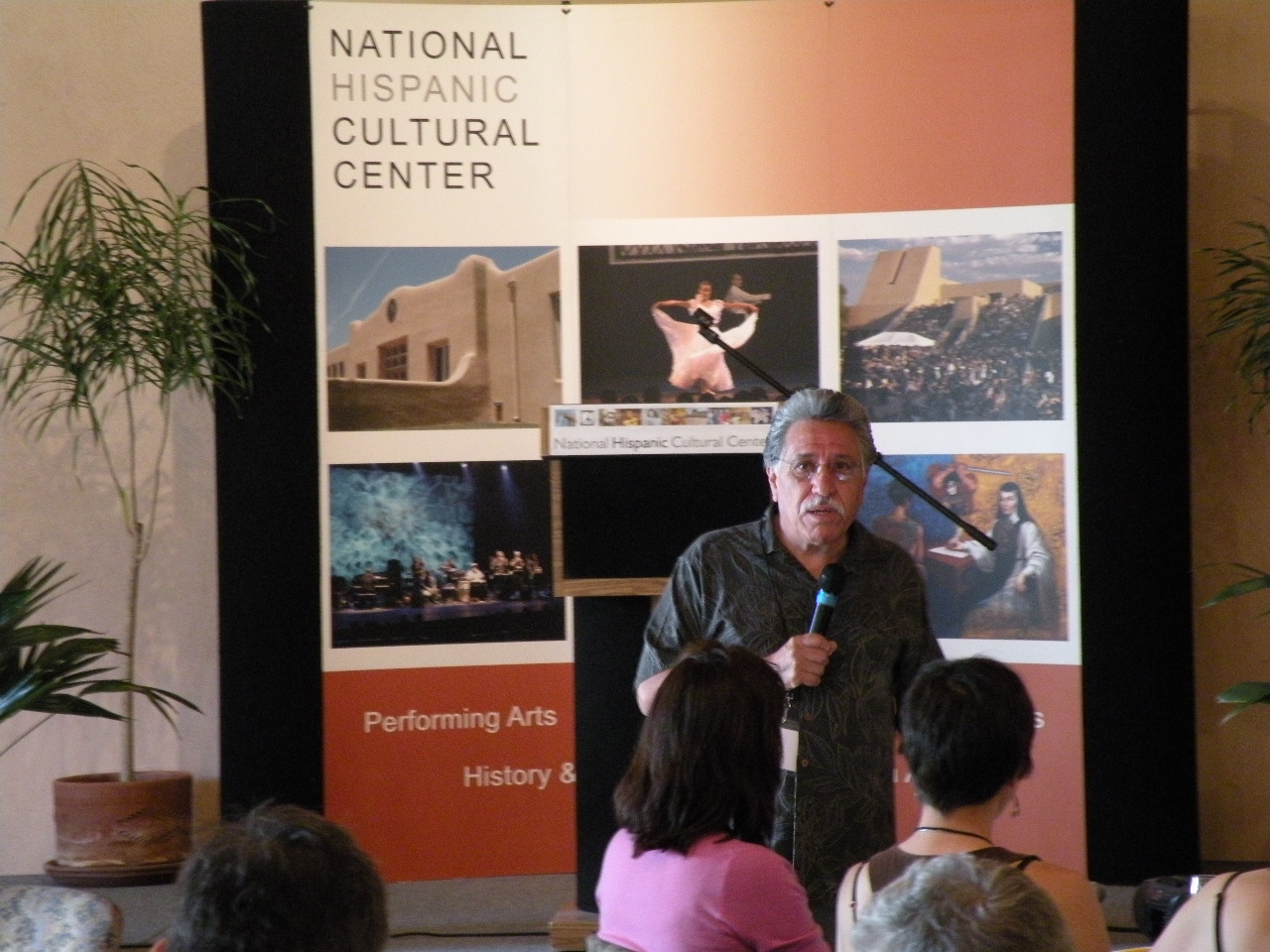
Opening day:This year's conference is all about mentoring and supporting each other's work. Rigoberto Gonzalez sets the tone in his wonderful keynote address. He fills the room with hard truths and inspiration. He tells us we all play a role in building a community of writers and readers, and that we need to support each other's work, by reading, reviewing, promoting each other's work. And yes, by buying each other's work too! We feel we've just listened to a manifesto. It was about time!
Demetria Martínez discusses the archeology of memory. Our stories are all around us, in photographs, letters, refrigerator postings, newspaper clippings, horoscopes... Those are all the artifacts of memories. Learn to recover them and use them to tell your story. And tell it in a beautiful way.
The organizers decided to double the open mic time this year. So instead of a band, there was poetry. And short stories and memoir. Fitting music for a writer's conference.


Fotos: Fabián Armijo (NHCC)


Friday, May 21, 2010

The Launch

Forgive my tardiness this fine May day, but the launch of King of the Chicanos at the Tattered Cover turned out to be a great night, and cause for a late morning. We sold out of books; old friends connected; the audience got cookies from the Capuchin Poor Clares at Our Lady of Light Monastery; and it felt good to finally publicly talk about Ramón Hidalgo, Tino García, Soledad Cortez Arango, and a few other characters from the story. I won't take up too much of La Bloga's space this morning except to let you know that in the weeks ahead I intend to feature a review of Tim Z. Hernandez's wonderful book, Breathing, In Dust; a few author interviews; and, of course, some surprises for you and me.


Photos from last night:


waiting for a signed copy


the author tries to come up with something clever


Denver authors Wick Downing and Mario Acevedo along with arts supporter Dr. Patty Baca

Thank you to everyone who showed up last night.

Later.

Dispatch from the National Latino Writers Conference. Day 2.


Fotos: Fabián Armijo (NHCC)

This week, La Bloga is happy to share late-breaking news and views from the National Hispanic Cultural Center in Alburquerque NM, site of the NLWC. Our correspondent is Margaret Y. Luévano. Click on Margaret's name for her first day column.


The spirit of camaraderie and support that Rigoberto Gonzales instilled in us yesterday carries over into day two of the conference. Ideas bounce around from table to table. The knowledge flows freely and generously among participants and presenters alike. People run off to chat with the muse in the corner while others have lights go on in their eyes when they get a fresh insight into their work.

With such a variety of genres represented in the group, the open mic sessions are a joy to witness and a certain highlight of the conference. Poets and young adult writers, novelists and memoirists, read their work to a generous and cheering audience.

Most impressive is the experience and talent level present here. The participants are serious writers searching for tools to improve their craft while the presenters' arsenal of expertise serve as a testament that yes, we are a strong community of writers with a firm foundation.

Coming tonight is the banquet and presentations of Premio Aztlan to Gloria Zamora and the NHCC Literary Award to Luis Alberto Urrea.