Tuesday, August 28, 2018

An August La Palabra. The Gluten-free Chicano Cooks. Actors Read Ramos-O'Briant. 50/73.

La Palabra at Avenue 50 Studio Features Four & Open Mic
Michael Sedano


Advice to first-time visitors to Northeast Los Angeles' cultural treasure, Avenue 50 Studio:


There's ample parking behind the gallery. I overheard a couple of first-timers remarking on how far they'd walked from their cars. The Gold Line parallels the gallery building; the driveway separates the railroad from the gallery.


Advice to Los Angeles' poetry readers and Open Mic seekers: No matter where you park or how far you get to walk, Avenue 50 Studio's La Palabra Poetry Series (link) runs on the fourth Sunday of the month from 2 to 4 p.m.

Now in its 17th year of continuous growth, La Palabra arrives with a few innovations as Host Angelina Sáenz settles into her element. 

Amplification has become a standard option. If someone has a lavaliere RF mic to donate that would markedly improve the utility of the boom box.

A videographer documented the featured readers, and perhaps the Open Mic readers. I look for Avenue 50 Studio one day to have an archive of La Palabra and the gallery's other reading series, Bluebird. RF mic'ing would serve that video soundtrack wonderfully. Anyone have a splitter to contribute?

Sáenz introduced a 'Zine complement on Sunday. The 'Zine included one poem from each of the features. That's a great idea, easily worth the $5.00, some of which is shared with the poets. 

More advice: bring money. I didn't have the cash today. Next reading, I'll get my 'Zine before the reading to follow along with the text when the reader gets there. Bring your credit card because the art is for sale, and affordable.


Featured Poets
Ron Baca, Angelina Sáenz, Melinda Palacio, Matt Sedillo, Irene Monica Sánchez

Four featured poets took center stage at Sunday's iteration of the ongoing poetry tradition. 

In addition to an afternoon of engaging political discourse and Palacio's lyrical gems, the reading offered a clinic to beginning readers on using the microphone and occupying their speaking space.
Irene Monica Sánchez
Sánchez read from her phone screen and paper manuscript.  She lowered the lectern to minimize the visual barrier between her audience and her poems. She knows her material well enough to allow her generous eye contact and directness, a benefit with cerebral works like those Sánchez chooses for La Palabra.


Matt Sedillo
Matt Sedillo is a veteran of spoken word performance competitions. His accomplished style uses memorization, which could eliminate the lectern if he chose. Sedillo's technique today is to plant himself at "home base" and require listeners focus on the aural flow of ideas and delight in Sedillo's lexical cleverness. 

Ron Baca
Ron Baca and I go back to the  mid-1970s when I was Director of Teatro A La Brava in El Sereno and Cal State LA, and Ron was a student-actor in el teatro. It's great seeing him regularly at Avenue 50 and now in the spotlight.

Ron's work reflects his career teaching at Roosevelt High School in Boyle Heights, his home town.


Melinda Palacio
La Bloga Friday Columnist, with Manuel Ramos, novelist-poet Melinda Palacio, lands in Highland Park today, a stop on her cross-country book tour for Bird Forgiveness (link). Palacio has read Bird Forgiveness in New Orleans, Santa Barbara, and now El Lay. 

There's always excitement when a poet introduces a new collection, particularly a poet with Palacio's reputation for producing thoughtfully delightful work. Birds--caged, freed, wild--are among peoples' favorite animals. Now Palacio's poetry adds dimension to one's delight. Vuela, vuela pajarillo...


Melinda Palacio checks her phone before the reading begins.
Readings at Avenue 50 Gallery share space with reliably stunning paintings and drawing.

Open Mic Portraits
These unidentified, for the most part, artists, have up to three minutes to share one or two works. Open Mic gives opportunities to try out new stuff, work on a delivery issue, share a favored piece with a new audience, or just give in to a message that demands to be let free.


Mary Torregrossa reads in the upper left hand foto. A few years ago I wrote something that offended the heck out of the poet. I said something thoughtlessly boorish about her delivery. 

Torregrossa's delivery, as her portrait illustrates, is a superb example of using the speaking space. She's shoved the lectern over to the side to allow herself the full technology of her body. It's a risk for some speakers but a wondrous method to grow comfortable in front of audiences, as well as enhance effectiveness. 

Electing to hold the manuscript at comfortable reading level enables good eye contact. She gets good audio from the mic, which keeps her in one spot. The mic at a lower level works just as well.

She gestures off to the side, or high enough to make the emphasis contribute something to the line. Often readers gesture at waist level, or under the lectern and the audience misses the point.

The reader holding the mic, Tongo, does it out of necessity, but it's an excellent strategy for a poet who works from memory.

The mic stand didn't stay elevated so Tongo was able to walk around the speaking space for visual variety. Movement was useful to add interest to Tongo's lengthy non-stop eloquence. If someone's got a functioning mic stand, that donation is tax-deductible.

A lavaliere microphone pins to a collar and transmits wirelessly to a receiver that plugs into the boombox. That would allow all the speakers the freedom, and benefit, of movement. Movement not only enriches the gestural vocabulary, moving releases nervous energy and tension that builds when standing in one place.


Lower left, La Palabra Host Angelina Sáenz


The Gluten-free Chicano Cooks
A gluten-free crustless quiche makes a company-quality main dish in an hour. With hatch and other New Mexico chiles coming to market right now, make the version called "Chile relleno casserole" quiche. When ready for the horno, it looks like this:


Preheat oven to 350º
Prep a baking dish with non-stick spray or oil

In a mixing bowl or deep saucepan:

Whip to frothy 6 eggs
Mix in:
¼ cup heavy cream
2 Tbs sour cream
½ cup (lactose-free) milk
pinch sea salt, pepper, ground cayenne, big pinch garlic powder

Slice ¼ lb or more burrata or fresh mozzarella

Slice or grate ¼ lb or so sharp cheddar cheese


Chop two cups peeled chiles. 

I buy the "mild" and trust to the label. 


Often, the sack has a mix of too damn hot and ok, so chop and taste.


Put the chopped chiles and the cheddar cheese into the bottom of the casserole dish. (If some people get asco from eating chile, layer half the bottom with chile. That way some get the flavor without the vegetable.)


Cover with the egg and cream mixture.


Dot the surface with burrata, or float slices of fresh mozzarella.


Distribute tomato slices attractively. If you made a half/half, put halved tomatoes on the not-chile'd half.


Sprinkle with coarsely ground pepper and garlic powder as needed.


Bake for 45 minutes on a cookie sheet in case of boil-over, and to make handling the hot casserole easier.


How do I know the quiche is done? 

•Shake the cookie sheet. A done quiche doesn't wiggle.
•Slip a thin knife blade into the center. If the steel comes out clean, it's done. The quiche keeps cooking so if the knife is a little wet, it's done. Let it rest while you get the dishes laid out.

This recipe has a paucity of carbohydrates. Lots of gente watch carbs, so serve this to the watchful.


¡Provecho!


New Short Fiction Series September 16


There's a load of fun in store for visitors to North Hollywood's The Federal Bar at 5303 Lankershim Blvd on September 16 when a set of actors turns La Bloga friend Sandra Ramos O'Briant's fiction into stage readings.

For the writer, the experience is a reminder that once those words leave her keyboard they belong to the reader. Ramos relates that she'll be invited to a single rehearsal, to observe.

Blogueros Daniel Olivas and Michael Sedano have engaged the New Short Fiction Series. Olivas' work took the spotlight at a Beverly Hills reading, and Sedano hosted a reading (link) at UCLA's Fowler museum.

The Federal Bar serves food and drink. Reservations for the 7 p.m. show, 818-980-2555, can provide parking details and menu datos.

Fifty Years, Seventy-Three Suns

By the time I see you next Tuesday, if everything goes according to plan and global warming doesn't get me, I will have passed my seventy-third year avoiding the Sphinx' riddle. I'm still on my feet.

Far more importantly, on my birthday my first wife and I celebrate our Fiftieth Wedding Anniversary.

What a trip it's been. We got married in a fever hotter than a pepper sprout but it was in Isla Vista we met. I proposed, she said "yes," he mother said "no," I said "ni modo" the Monsignor said "Marriage is like a barbeque" and it was the hottest day of the year. The coals grow hotter and then the groom gets Drafted.

We were married on August 31. On October 15 I got the notice from Selective Service. Report and eat Thanksgiving Dinner in the Army. I managed to postpone induction until January 1969. 

I spent my first wedding anniversary sitting atop the world's highest anti-aircraft missile site. Adventurous, but not what I'd envisioned the year before. Darn sight far from what she imagined. But it was what it was.


That foto is newlywed Barbara just after I opened the brown envelope that read, "Greeting: From the President of the United States." We were going to the Santa Barbara arboretum and she said, "Don't get the mail, let's get it when we get back."

Love, honor, and cherish, in sickness, in health, all the days of our lives. 

Saturday, August 25, 2018

The Rivas Boys, Cultural Emissaries, by Antonio SolisGomez


Hollowwood Stars playing in shorts circa 1950
My family arrived in Los Angeles in September of 1950, when i was nine. We lived on Bunker Hill for a couple of months, then a family friend of a friend, rented us two rooms in back of her home by the University of Southern California. A few months later in the summer of 1951, my stepfather did some carpentry work for an Italian man that collected and sold junk for a living. Tom, the Italian, always looking for opportunities, had stumbled on an inexpensive duplex and had it moved to his lot. It needed a lot of carpentry work and he hired my stepfather, compensating him with eight months free rent in one half of the duplex. Tom and his wife Helen and their 6 year old son Gary, occupied the other half.

Tom owned an old battered stake truck that he used to cruise the streets in the early mornings on trash days collecting whatever he found of value. His truck had plywood sides allowing him to pile it high and it was always full as he never sold everything that he found. When he returned from his morning hunt, he parked it in front of the duplex and the rest of the day he would spend at Lincoln Park, playing cards with his drinking buddies, much to the annoyance of Helen who was resentful because she was working eight hours in a glass factory. Often we would hear her cussing him out like a sailor once he returned home, soused as usual. This was astonishing, as we had never known a woman to cuss like that, especially at her husband.

The duplex sat on a hilly lot on Lincoln Park Avenue and was reached on a steep dirt driveway. We didn’t think much of the fact that unlike other neighboring houses, it had no stairs to the sidewalk but that winter when it started raining, there was no way to get from the house to the street without slipping and sliding. Many a fall later, my stepfather laid some long wide boards in order to walk over to a neighbor’s house and use their stairs.

Four SquareArchitectural Style
The neighbor’s lived in a large two story house that at one time must have been quite beautiful, attesting to the fact that Lincoln Heights at the turn of the century had been a neighborhood of the upper class. It was a square structure with several rooflines, a feature resulting from dormers at each of the sides, and it had architectural wood trim adorning the windows and the large front porch. But now it was in ill repair, needing paint and TLC. It was rented by the Rivas family, a large clan that became cultural emissaries for my older brother and me, teaching us the ropes of living in an English speaking community that for us, coming from El Paso, was a totally different world.

The Rivas home sat even higher from the street than the duplex that we occupied, the large terraced lot ending above the sidewalk on a four foot tall concrete wall. The concrete stairs meandered down from the house to the sidewalk, passing not far from where we could reach it from our yard.

Getting use of their stairs was easy as all summer we had become close friends with the Rivas boys, who introduced us to baseball with a real ball, unlike the old socks that my mother would roll up and stitch for our games in El Paso. Rudy was the eldest at thirteen, Max his younger brother was eleven. And there was Ray, who had been taken in by the family. He was fourteen.

Several of the homes on Lincoln Park Avenue, including ours and the Rivas', sat on the lower part of a hill that continued up for several hundred feet. Directly behind the duplex at the top of the hill, someone had removed dirt from a large section of the hill, leaving it flat, possibly intending to use it as a home site. But it was abandoned and only an old long open trailer on its side remained, it’s tires worn and deteriorating.
typical hill in Los Angeles

That area, measuring roughly hundred feet by fifty, became our baseball field, playing regular baseball games as well a the game called over the line. We would play from early morning until the ball could no longer be seen in the fading light of day.

The neighbor boys all took names of minor league baseball players currently playing for the Hollywood Stars or the Los Angeles Angels that played in Wrigley Field in South Central Los Angeles. My brother Ruly and I didn’t know those players so they helped us select a name.

Earlier, I called the Rivas’ a clan because it was indeed a large family. In addition to the three boys, Mr. Rivas, a widower, accommodated three teenage daughters, Frances, Belen and Olga, two granddaughters, Genevieve and Gloria, a friend Eustolia, her daughters Renie and Evelyn and two sons Frankie and Bobby, Eustolia’s 2nd husband Louie and their four young children.

It was a very busy household and yet on many occasions when we weren’t playing baseball we would be inside the home, playing a version of war. Our weapons were thin pieces of rubber from old tire tubes folded in half with a series of spaced knots. With our index finger inside the loop made by the last knot and stretching the opposite end of the rubber with our opposing hand, we aimed and shot at an opponent.

Frances, whom everyone called Pancha, often joined the game as did Genevieve and Gloria. We used the entire two floors of the house to hide and ambush the opposing team, often resorting to subterfuge to get an advantage. Pancha once made the telephone ring, answered it and said it was for me. Coming out of my hiding place, she shot me in the chest and laughed.

If the Rivas boys were cultural interpreters from my brother Ruly and me, for my mother it was Eustolia, a heavy woman with a robust voice and a hearty laugh. She was divorced from her first husband, who was a drug addict and father of her four older children, when she met and married Louie, a quiet, small slender man who adored her and their four young children. One day Eustolia convinced my mother to accompany her to apply for work at a costume jewelry factory in Santa Monica. They had to take the streetcar to downtown and transfer to the Red Line that took them to Santa Monica. As it turned out, they both found work and my mother never again was a stay at home wife/mother.

We continued playing baseball the rest of the year, the hill changing color as the rains turned the yellow grass of summer to a bright green where we often had to wade to find a ball hit for a homerun.

On weekends, the Rivas boys and we would walk to the local Starland Theater to watch whatever was playing. Max, a natural comic, was passionate about Jerry Lewis and often would imitate his voice and gestures. I was more of a music man and my idol was Donald O’Connor. Weeks later, we would sit around and try to recall what film we had seen on a particular weekend, which often, we couldn’t remember.

The tallest roof belongs to the Starland Theater now a retail shop
Sometime before the following summer, the boys cousins, Genevieve and Gloria moved to Boyle Heights. My brother, who was head over heels over Genevieve, was heartbroken and when 1952 summer vacation started, he was excited by Rudy’s suggestion that we visit them on our bicycles. We took off early one morning and to me it seemed that our destination was really far away. The visit was a highlight of that summer, visiting two pretty girls and listening to music, we were definitely being Americanized.

Sometime in early 1953, my family moved from the duplex to a single family home that we rented on Workman near Main Street. Leaving the Rivas circle was wrenching at the time, as we had spent so much time together and I couldn’t imagine having different friends. I was a 6th grader at Gates Street School at the time of our move and Max had already moved to Lincoln which was a 7th to 12th grade school. My brother was also at Lincoln, as was Rudy, but Rudy was older than my brother and Max younger and although they saw one another they had a different circle of friends. The break with the Rivas boys for me was a total separation.
Red Line

Although Max and I were closer in age, he was a year older, it was Rudy that I most admired. He was slender, of medium height, moreno with black tight curly hair. He was Mr. Cool, somewhat stoic and he wore the customary barrio attire for the time, Khaki pants and a brown leather jacket. He was an average student, pursuing an industrial arts program. When I started the 7th grade at Lincoln in January of 1954, I saw him in a car cruising down Lincoln Park Avenue. We greeted one another and it was the last time I saw him as a few months later he died unexpectedly from a brain aneurism.

Rudy’s death shocked everyone. We went to his memorial service at the local mortuary and said our goodbyes. What was equal in sadness to his death, was how quickly we had grown apart from the Rivas family after such intimacy during those two years that we were neighbors. It was a sadness that I would always carry.

Friday, August 24, 2018

One Photo, Two Words: La Palabra

Melinda Palacio


Not to be missed


The Bird Forgiveness tour joins La Palabra at Avenue 50 Studio. I'm excited for this very special homecoming for me. I have featured and participated in many poetry series at Avenue 50 Studio from the Bluebird Series to La Palabra to a special panel with Luis J. Rodriguez, who informed me that he was accepting my first poetry manuscript, How Fire Is a Story, Waiting for publication by Tia Chucha Press, to hosts from Rafael Alvarado to Luivette Resto to Karineh Mahdessian to Jessica Ceballos. Avenue 50 Studio is a gorgeous space for Chicano and Latino arts. Director and Founder Kathy Gallegos has been on board since 2000 and her commitment to the arts is simply beautiful. Each iteration of Avenue 50 Studio is a guaranteed explosion of important poetry and I'm honored to be part of this community. I look forward to reading with Ron Baca, Irene Monica Sanchez, and Matt Sedillo. Our host, Angelina Sáenz has a special surprise in store for attendees; you will have to show up to find out what it is. An open mic will follow the featured readers on Sunday, August 26, 2-4 pm at Avenue 50 Studio, 131 North Avenue 50 Studio, Highland Park, CA 90042. 


P.S.
Today is the birthday of my sister Emily. Happy August 24 everyone. 

Thursday, August 23, 2018

Betraying A Sacred Trust

Daniel Cano
                                                                       
WLA VA, one showcase bldg. to serve vets in need
     I drive through the south gate, the original entrance, of the West Los Angeles Veterans Administration and hospital, circa 1870, its first patients Civil War veterans struggling with psychosis from combat, PTSD, today. The words on the columns “National Soldiers Home” are welcoming. Golden twin eagles, the national symbol, stand as reminders our sacrifice in defense of this country is not forgotten. Though, we all know it is.
     One LA Times reporter, when once asked to write an article exposing VA incompetence, said, “Veterans’ issues are boring.” Less than 2% of the American public fight this county’s wars. Most Americans prefer to avoid such an inconvenience. They feel they’ve done their duty by cheering the military honor guard at professional sporting events, becoming righteously indignant at professional athletes who “take a knee,” or they spout the mindless but ubiquitous “Thank you for you service,” which I take to mean, “Better you than me.”
     When I first came to the Soldiers Home for treatment in 1969, rolling hills, trees, shrubs and dirt walkways greeted me, a sacred place for physically and emotionally damaged veterans to heal. Today, that has changed as the government and high-level V.A. administrators consider profit over sacrifice, real estate deals over rehabilitation.
                                                                                 
1800s architectural gem crumbling
     
     The WLA Veterans Administration, or the National Soldiers Home for those who remember the original name, is situated between Brentwood and Westwood, just west of Bel-Air, some of the most expensive property in the United States. Since the 1970s, developers have eyed these 366 acres, more than once, trying to quietly evict veterans in favor of a new cinema complex, condos, stores, and restaurants. Both veterans and neighborhood groups fought the intrusion. Some VA administrators, past and present, supported by both Democratic and Republican administrations in Washington, have tried bowing to the gods of commerce by decreasing veterans' services, allowing outside organizations to move onto the land, watching as buildings fell into disrepair, and secretly leasing land and buildings to non-veteran entities, like an elite private school, UCLA, and various Hollywood businesses and transportation companies. The long-term plan: to carve up the land, ignoring the original deed, which called for the government to use the donated land solely for the rehabilitation of U.S. military veterans. 
                                                                               
Veterans locked out of athletic field taken over by elite private high school
      Just like so many broken treaties with American native people, the government sees no betrayal in ignoring legal treaties, or what veterans refer to as a sacred trust. Under euphemisms, such as Master Plan and CARES, some in Washington push for the dismantling of Veterans Administrations across the country, starting with the largest west of the Mississippi, the WLA Veterans Administration. The current administration is floating the idea of giving vets healthcare cards to be redeemed by participating healthcare programs, kind of like medical welfare.
     When the VA administration began leasing parcels of land designated for veterans’ recuperation and rehabilitation, it found an effective way to begin shattering the system. Under the eye of Veterans Service Organizations and the public, the VA, using legislators and wealthy supporters as muscle, allowed the coyotes in. One might argue: isn't raising money a good thing? Yet, when asked for an accounting, VA administrators, at the time, remained mum. No one knew the answer.
     It’s rumored the elite private high school adjacent to the veterans land originally paid $1 a year to build an athletic complex, evicting veterans who used the open fields for physical therapy, like playing soccer, football, softball, in addition to holding concerts and weekend cookouts. Who approved these sweetheart deals? It could not have been authorized without the approval of local congressional leaders, VA administrators, and the Department of Veterans Affairs in Washington. In which rabbit hole did the money disappear? Who knows? If a trillion dollars can disappear from the Department of Defense's budget, without questions from legislators or the public, how much easier to lose veterans' money?
     The government and the VA claim veterans' care too expensive, yet nobody will answer anything about the leases or the funds generated.
                                                                                   
VA administration allows history to waste away
     To the west, a forest of eucalyptus trees once formed a perimeter, separating the busy world outside the Soldiers Home from the sedate world within. Who gave the order to fell those trees? No
bureaucrat ever admitted to signing the work order.
     Just past the entrance, where long grassy knolls once filled the landscape, I pass the Red Cross complex, an important organization but having no connection to the military whatsoever or to veterans or their rehabilitation. Across the street is a large parking lot where local car dealership and bus companies once parked their vehicles. Only after veterans complained, walked along Wilshire and San Vicente boulevards in protest, and filed a legal suit with the help of the ACLU, did the VA evict the usurpers. Who thought it was a good idea to lease veterans’ land to a commercial bus company, and how much money was raised? Veterans who have asked VA administrators questions about leases and money earned were usually ignored, or considered disgruntled, thankless vets.
     I first sought help at the Soldiers Home for a wound I received during a night of chaos, as howitzers fired shells into the darkness, flares attached to small parachutes lit up the sky, slowly descending, my friends firing M-16s and throwing grenades wildly into shadows. Shrapnel from a grenade found its way into my arm, pierced the flesh, and came to rest near the bone, where a doctor at the Plieku Field Hospital advised against operating, fearing he might permanently damage my arm by accidentally severing nerves and muscles to get at the wayward intruder.
                                                                                 
1980s, Outpatient Treatment Center for vets afflicted by PTSD; today, all weeds, no patients
     "A lot of people live with injuries like yours. When You get home,” the doctor told me, “just get to a V.A. hospital and have them check up on it every so often. It could have been worse. A few inches higher and they might’ve gotten you in the head.”
     I was in no position to complain. The kid in the bed next to me had both legs amputated below the knees. Across from me, a North Vietnamese soldier lay in bed, his chest exposed, a long, thick incision ran from his neck to his belly. We exchanged glances throughout the day. He didn’t look angry, just hurt like the rest of us. I didn’t know our doctors treated enemy soldiers and let them recuperate beside us. I didn’t hold any animosity towards him. He was just another guy.
                                                                                                                                                               
Waterfall, a natural place for reflection and rehabilitation
     A sense of calm comes over me as I drive farther into the VA complex, land many veterans hold sacred. I nod to the veterans I pass or meet in the hospital’s waiting room. Conversation flows easily; after all, we share a bond few other people experience, especially those who served in a combat zone.
     It’s strange. I look beyond the gray hair, wrinkles, missing limbs, walkers, and I see youngsters, strong, vibrant, and healthy, again, dressed in olive drab, spit shined boots, carrying ruck sacks, and weapons, or sitting around in groups telling our life stories. It’s like we were all 19 again.
     So, now, when I hear rumors the government is planning to shut the place down, even with all its reported inefficiencies, long waits, and poor service, I see the other side, dedicated men and women, doctors, administrators, and staff working diligently to repair a reputation destroyed by years of administrative neglect, malfeasance, and corruption. Over the past ten years, many improvements have been made. VA doctors and researchers continue to make breakthroughs in both mental and physical health, the field of prosthetics, nutrition, and alternative medicines. If it weren't for injured veterans and the VA researchers, little would be known about PTSD today.
                                                                               
Where Spirit Dwell; the Road to Recovery
     I walk the grounds, especially the north campus, where vets sit and reflect, or contemplate beside a waterfall and pond, seeking solace, solitude, and maybe even redemption.
     It’s clear to see why native Tongva people considered this sacred land. Vets feel the same way. With warts and all, the Soldiers Home is a place veterans can call Home, even though many are still trying to force them out, betraying a sacred trust.

Wednesday, August 22, 2018

Lucia the Luchadora


Written by by Cynthia Leonor Garza
Illustrated by Alyssa Bermudez


  •             Age Range: 3 - 7 years
  •             Grade Level: Preschool - 2
  •             Hardcover: 32 pages
  •             Publisher: POW! (March 7, 2017)
  •             Language: English
  •             ISBN-10: 1576878279
  •             ISBN-13: 978-1576878279


Lucía zips through the playground in her cape just like the boys, but when they tell her "girls can't be superheroes," suddenly she doesn't feel so mighty. That's when her beloved abuela reveals a dazzling secret: Lucía comes from a family of luchadoras, the bold and valiant women of the Mexican lucha libre tradition. Cloaked in a flashy new disguise, Lucía returns as a recess sensation! But when she's confronted with a case of injustice, Lucía must decide if she can stay true to the ways of the luchadora and fight for what is right, even if it means breaking the sacred rule of never revealing the identity behind her mask. A story about courage and cultural legacy, Lucía the Luchadora is full of pluck, daring, and heart.


NPR Best Books of 2017
Kirkus Best Books of 2017
Chicago Public Library Best Picture Books of 2017
Evanston Public Library List of 101 Best Books for Kids 2017
ALA's 2018 Amelia Bloomer List for best feminist books for children


"A shining debut outing for author and illustrator, this endearing and humorous title is sure to put a bit of KA-POW into storytimes! A must-have." -School Library Journal (starred review)


"Garza shines in her children's debut. The text bursts with infectious energy and Lucía's endearing personality...Likewise, Bermudez's colorful, buoyant illustrations radiate pure joy. Nifty text placement, variations in type color, and use of sound effects add to this delightful package, making it a joy for readers to root for this plucky young girl. A KA-POW kind of wonderful." -Kirkus (starred review)


Tuesday, August 21, 2018

Brick that built Pasadena.

Classics Revisited:
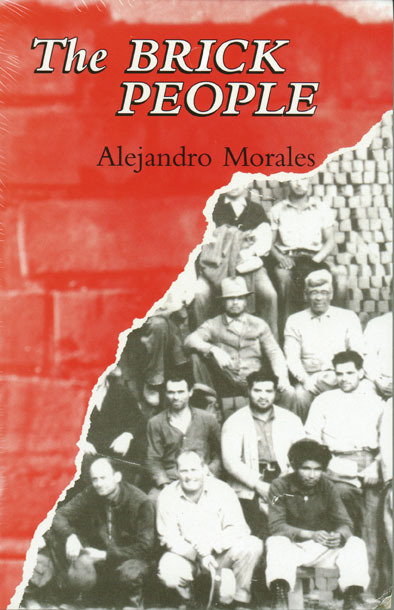
Review: Alejandro Morales. The Brick People. Houston: Arte Publico Press, 1988.
ISBN: 978-0-934770-91-0

Michael Sedano

The Brick People possesses remarkable currency, thirty years after its 1988 publication. A sweeping historical novel in the family saga genre, Alejandro Morales’ Southern California novel stands alongside a Gore Vidal historical novel for arresting detail and exciting plotting.

Unlike Vidal’s founding fathers characters, Morales’ gente are the anonymous Mexicanos whose skill and labor made the Simons family rich from a world-leading brick empire in the early 20th century. At the same time, issues of immigration, labor justice, equality, identification persist continuously making the novel a signpost in U.S. literary history, a critical metric for how far or little the civilization has advanced-.

The Simons plant is a plantation. In the guise of taking care of their Mexicans the company builds houses, stocks a company store, gives credit, brings in a Priest, a teacher, a doctor, a symphony orchestra for the kids, electricity. Trucks take over from horses, construction demand increases, the plant ramps up capacity. More workers come, those winning the mayordomo’s favor get work.

Two camps of Mexicanos staff the brick factory, Simons’ hand-picked assistants versus the working families. The bosses hold onto their authority through the generations. Among the workers, first generation characters become elders as a vigorous middle generation takes the novel’s center stage. The third generation comes into its young adulthood as the novel closes. The Simons generations are dying off, losing interest.

Material success comes to all three camps, the anglos, the administrative raza, the workers, each less than the other.

The ugly-faced boss has such wealth he starts a familia on the side. His wife lives with the bitter duality. The mayordomo can afford two homes as a highly compensated employee whose brick-making skill matches his loyalty to his employer. A worker, Octavio, supplements his brick labor as a successful gambler. Working swing shift then gambling until morning tortures his wife, Nana.

Morales assembles a collection of critical events to advance his narrative of raza against the odds and getting their asses kicked. This is not a happy story because that's not how the history took place. The author holds reality at arms length and injects imaginative recreations that advance various themes. In the early chatper Simons paterfamilias tours Mexico where he watches a mayordomo casually rape a fourteen-year-old then apologize for not offering. Simons empathizes and resolves to be a kind owner of these industrious docile people.

Making millions of bricks to build Pasadena reflects highly coordinated labor and resource management. The Simons company gets contracts, expands, adds gente and the Simons community grows, an isolated encampment of Mexicans safely removed from anglo Montebello at the northern boundary of the plant.

The Brick People go to World War II. In this respect, there’s no red-lining, a GI is a GI. Except raza soldiers fight harder than other Unitedstatesians. Morales’ narratives here include some of the writer’s most powerful expressions. The power of the history drives the narrative:

Terrible news came to Simons when Amalia was told by an Army captain that both her boys were lost at sea. Pascuala and Gonzalo Pedroza never said a word when they were told that the Wally was missing in action in Sicily.

On June 2, 1943, Wally Pedroza, after witnessing his company commander and nine enlisted men die and realizing that his company was helplessly pinned by German machine gun fire, picked up a BAR and became a one-man destruction squad. Firing from his hip, he moved on the enemy and put out two machine gun emplacements. Wally took two shots to the stomach but still kept advancing forward. ¡Ya estuvo cabrones! ¡Ya me agüitaron! ... Wally headed towards a third machine gun. Grenades exploded around him as he moved forward. Wally threw a grenade and wiped out the machine gun nest. He advanced and killed seven more of the enemy. After one hundred yards he confronted a fourth and a fifth machine gun. Wally was instantly hit by what seemed to him a ton of fiery pins penetrating his body. He squeezed the trigger of the BAR for one long eternal burst. Silence and blackness fell on him forever in a small innocent Italian town.
Wally Pedroza was proud of the Aztec blood that flowed through his veins. And once pushed against a corner, pinned down and used to the life of the underdog, used to fighting unimaginable odds and uphill struggles, and having a lot of huevos, Wally could on reason one way and that was to throw chingadazos. He was not going to wait to get his butt kicked. ... El Wally Pedroza no se va rajar . .. He would kick ass. He would do it for the United States of America, for his raza, for his barrio Simons, for his homeboys and homegirls, for his sisters and brothers, for his father and mother. Wally was not going to wait around for someone else to do the job because before he went he saw that every man around him was frozen with fear.
"jYo no me rajo!" Wally Pedroza ran forward into millions of butterflies. 252

Perhaps owing to Luis Valdez’s play Zoot Suit, Alejandro Morales’ narrative of the zoot suit riots rings with familiarity. Both accounts are, of course, based in actuality. Morales employs both narrative and reportage to flavor his recreation of the historical milieu.

The historical narrative of the 1940s mirrors today’s newspaper front pages:

Time and history would later write about the days after June 7, 1943, when the movie theaters were invaded and every zoot suiter the military boys could find was dragged out to the street and beaten senseless; when cripples were attacked; when children were viciously taken from their parents and stripped of their clothing and battered with sadistic frenzy and joy; when the Mexican barrios were in constant turmoil; when thousands of Mexican mothers searched frantically to locate their missing sons and daughters; when the Anglo– American population, the government representative and the press applauded the Neo – Nazi actions. 256

The researcher’s reportage captures today’s equally adamant resistance:

“A mí nadie me va a decir lo que puedo vestir. Tengo el derecho de llevar lo que da la gana,” a Simons youth declared.
“My three carnales are fighting in Europe, ese, and nobody is going to tell me what to wear,” a fourteen-year-old girl said.
“A mi no me importa si me echan en la cárcel pero no me quito el zoot suit y no les hablo ingles,” a thirteen-ear-old boy said. 257

Today’s readers deserve to visit, or revisit, this historical fiction, to meet the families who buy into management, or struggle to unite in a Union. Morales doesn’t offer a rosy picture when company defeats the strike and the Simons workers run off the outside organizers when the strike fund evaporates. Later, corruption destroys a cooperative store and the gente just can’t catch a break.

Renting a home or apartment in East LA or Montebello today means high rents and being accused of gentrification, at some addresses. Union organizer Octavio is blackballed and evicted from Simons company-owned housing and can’t find an address. No Mexicans allowed, that’s why there’s a Simons.

Wait! The Brick People is no ordinary family saga historical novel. Morales has fun dipping his pen into his surreal inkpot. Characters whose evil gives them power and success get their due. Thick infestations of crawling brown insects eat their way out of the carcass of one of the Simons brothers. The same plague lurks in the bowels of a wino’s home, mourning twins killed by the drunken driver. The mayordomo decays from the heights of power through petty corruption to the lowest position on the boss hierarchy. Gonzalo’s face melts into a hideous mask.

Wait again. The Brick People is a richly detailed work. The section on the Chinese massacre, for example, deserves study for its high drama but also the ugly history told. Homeless camps and survival during the Depression offer vivid tableaux. A funny baseball vignette makes the asshole Gonzalo a good guy for at least this scene.

Thirty years doesn’t make The Brick People a classic. Superb storytelling, imaginative use of familiar history, incisive insight into a specific group of raza workers while illustrating enduring elements of cultura and gente, these elements make The Brick People a classic novel of U.S. literature.


Mail Bag
Early September Reading in Riverside

The Inlandia Institute wasn't around when I lived in the Inland Empire. Too bad, because the programming of the cultural institution is a fresh breeze in an historically stodgy, stagnant landscape.

Nowadays, Inlandia isn't alone. Mention Riverside and The Cheech Marin art museum has to come up, too. But Inlandia is an active, going concern. The Cheech is still fund-raising.

La Bloga friend Ron Arias reads from a novel-in-progress in the upcoming afternoon "Conversations at the Culver" near the historic Mission Inn. For details view the September menu after you click this link.