Monday, September 18, 2023

SOME SEEMINGLY RANDOM EVENTS


By guest essayist Jennifer Silva Redmond

My mom was born in 1940, to a Mexican mother and an Anglo father, in that far-flung part of Mexico now known as East LA. Her parents divorced when she was young, and my mom split from my own Anglo dad in 1968, when I was seven. We all spent a few years in the hippie beach town of Venice, which I still consider my hometown, then Mom took us kids traveling around Europe, since my dad worked for Pan Am. That sojourn was followed by two years in Northern California and Oregon. We moved to San Diego when I was eleven and soon settled in the barrio of East San Diego.

I got into reading and writing very early, which lead me to reading scripts and doing theater as a preteen. At 14, I did the first of two plays at the Old Globe Theater, then went to a local performing arts college on scholarship, after testing out of high school at 16. I enjoyed studying acting, especially the summer school quarter at a campus just outside of London, but was sick of school by then, so I moved back to LA at 19 and started auditioning. I lived in Venice, waited tables in Santa Monica, and got (very) small parts in Hollywood.

My dream was to be a Broadway actress so I accepted a nanny job that took me to New York City. Once there, I became a “Californian,” which of course I’d never thought of myself as before. Once they heard where I was from, people would ask, “Then why are you here?” I could see their point—the extreme hot/cold that is NY’s weather, the indifferent concrete jungle of Manhattan, the cold, crowded beaches and lakes of the rest of the state. I got cast in an eight-month touring show in Florida, which felt more like home, with its acres of orange orchards and long white-sand beaches.

By 1989, I was a 28-year-old aspiring actress, back waiting tables and doing way-off Broadway shows. On a short trip home to San Diego for the holidays I met my old boyfriend Russel Redmond. The timing was right and he proposed and, even more important to me, he followed me to NYC with his grandmother’s ring. But one snowy day in March, we came up with the idea of kicking off our marriage with a three-month honeymoon sailing to and around Baja California’s Sea of Cortez. We got married in San Diego and soon set sail on his 26-foot sailboat across the ocean border, bound for Cabo.

My experience in Baja to that point was limited to day trips to Tijuana and weekends in Ensenada. Sailing was a new world, too; I had spent only a few weeks on the boat in a marina when we set off on that first 1000 mile journey south. The life-changing voyage was full of firsts, like my first time on solo watch enroute to the Islas San Benito during which my mindset went from wary paranoia to a kind of cosmic acceptance in four hours; my inner and outer awareness grew with every nautical mile.

We stopped in Cabo, beat our way up to La Paz, then continued north into the Sea of Cortez. I traded auditions and lunch shifts for wandering empty beaches, exploring cactus-covered canyons, and snorkeling with curious dolphins and colorful reef fish. After three months, we had not begun to see all Baja had to offer, so we cinched our belts, ate lots of rice and beans and fresh-caught seafood, and spent nine more months sailing turquoise waters and making friends in the plazas, markets, marinas and fish camps of that desert peninsula.

I quickly fell in love with Baja and its people, in small towns and fish camps, and in the capital city of La Paz. Along the way, I discovered, or rediscovered, my own Mexican-ness. My Spanish improved in the supermercados of Loreto and La Paz, at stops at the tiny tiendas of scattered fish camps, and the frequent trips to immigration offices. My daily journal writing evolved into stories, poems, and essays. To my amazement, I found that doing theater was not the only way for me to be creative and share my emotional inner life with the world. By the end of 1990, I’d chosen a pen name that included my grandmother’s maiden name, Silva, and started to become the Latina writer I am now.

I began editing for other writers in 1996, and in 2000, started working for Sunbelt Publications, a San Diego publisher that specializes in Baja and Mexico. In 2011, knowing editing was my calling, I gave up my days in an office cubicle writing budgets and grant proposals, and went back to working directly with authors. Me going freelance also allowed us—since Russel was teaching at San Diego City College by then—to continue exploring the West Coast on our sailboat during summers. By 2017, we both were working 100% online. I’m still Sunbelt’s Editor at Large, so I have the best of both worlds.

Over the years, I sold some short nonfiction pieces to magazines like Science of Mind, Sail, and Cruising World, plus anthologies that included A Year in Ink, and Dime Stories, which kept me believing that I had a future as a writer. I was especially thrilled to place a piece of short fiction in the anthology Latinos in Lotusland: An Anthology of Contemporary Southern California Literature. There I met Daniel Olivas and Melinda Palacio, who both wrote for La Bloga. My husband and I wrote three screenplays together, set in Arizona, Mexico, and California, which kept us traveling to locations to get the feeling of the places just right. We rewrote one of them, El Camino Real, as a short film which got made and even played at a couple of film festivals.

These seemingly random events all led me to start rewriting many of the pieces that began as journal entries so long ago. Soon, I had a rough draft of a memoir of my first year at sea. Being an editor, I kept revising and rearranging the manuscript as we sailed north to San Francisco in 2020, and on to Washington’s Puget Sound in 2022. Luckily, I found the perfect publisher who found me the perfect editor; eventually they said it was time to stop rewriting and publish the book. That memoir, Honeymoon at Sea: How I Found Myself Living on a Small Boat, is published by Re:books of Toronto, Canada. I couldn’t be happier that circumstance made me an “international author,” since I have led such an international life.

If you want to follow us on our ongoing sailing adventures—yes, the honeymoon continues!—here is the link to my Substack, Honeymoon at Sea. To buy/pick up my book at an indie bookstore, or order online and support an indie bookstore, click the link on bookshop.org. You can also order the book at Sunbelt, and see their other cool books and maps and everything else under the sun, at Sunbelt Publications which is a great way to support a small publisher and a regional book distributor.

*         *         *

Jennifer Silva Redmond is a writer and freelance editor from California, whose memoir Honeymoon at Sea is coming out from re:books of Toronto. Her essays, articles, and fiction have been published in numerous anthologies and magazines, and on sites such as Brevity. She is on the staff of the Southern California Writers Conference and San Diego Writers, Ink, was prose editor for A Year in Ink volume 3, and co-founder of the critically acclaimed Sea of Cortez Review. Formerly editor-in-chief of Sunbelt Publications, Jennifer is now its editor-at-large. She lives with her husband Russel, an artist and teacher, aboard their sailboat Watchfire, somewhere on the West Coast of North America.


Friday, September 15, 2023

How to Answer an Age-Old Question on Poetry

 Melinda Palacio

Previously published in the Santa Barbara Independent 


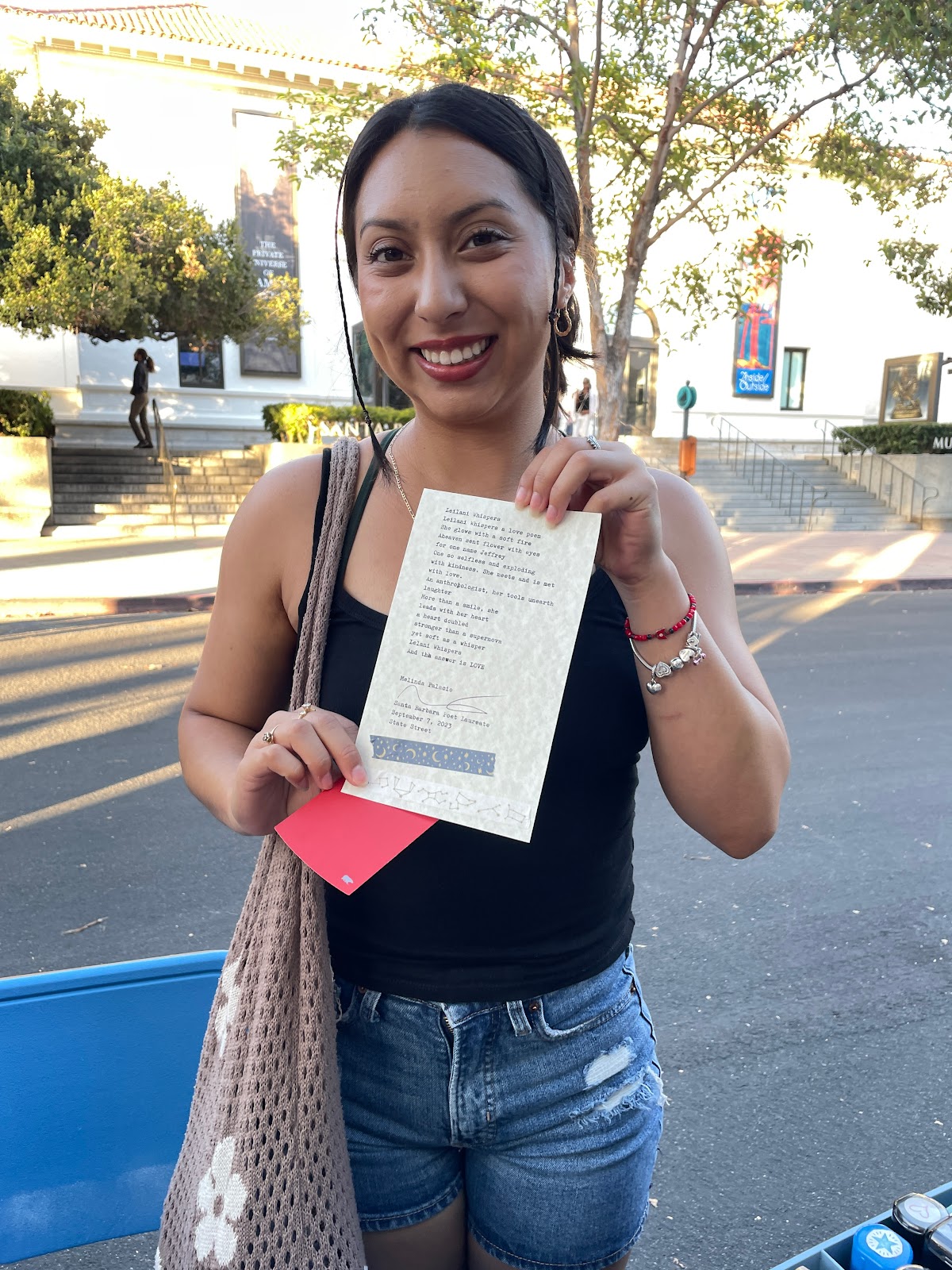
happy customers


typewriter poets

freshly typed poem lover

a love poem for her


One question that I’m often asked is Why Poetry or What Does Poetry Contribute? Last week’s typewriter poetry event helped me offer an answer. Simply put poetry is the best friend you didn’t know you needed or have had all your life. Poetry allows you to look at the same road, flower, person or thing with new eyes in a unique way that’s all your own. Poetry offers a celebration of the everyday world, sometimes comfort for situations that seem difficult, such as a bittersweet final send off for a loved one or ways to heal from an injustice. 


Thursday’s typewriter poetry presented five poets typing up free poems with music provided by the local duo, The Gruntled, Mark Zolezzi and Jesse Felix. Poets included two poets laureate, myself and Emma Trelles, as well as Steve Beisner, Diana Raab, and Simon Keiffer of the Typewriter Lending Library. We wrote love poems, tribute pomes, haikus, and several poems for grandchildren. I had the pleasure of writing a poem for recently born granddaughter. The young grandma was so proud about her daughter’s daughter that I have no doubt the folklore of the child’s first poem will be a story the girl will hear for the rest of her youthful life. 


All of the poets agreed that the event exuded a therapeutic aspect. In fact, when I proposed the idea to the downtown organization in charge of First Thursday, I almost titled the event: Poetry Therapy. I changed the titled because I didn’t want to scare anyone away or have them feel as if they needed to lie on a therapist’s couch. Yet, many people received a nurturing, poetic hug that helped reveal what was, at the moment, most important to them. 


Sharing space with a fellow human and offering them a free typed poem was a magical experience. I’m still in search of a good title for this event as there was much demand for a repeat of the evening. 


A true connection happens when you have the opportunity to have a face-to-face conversation about the birth of a poem. The poets found the spontaneous demand for a poem, an intellectual exercise. Also, I can say I’ve been spoiled by the composing on a computer. The keys are butter to the touch and while they don’t make the special clack of a typewriter, a keyboard is much easier on the wrists and mistakes are easy to fix. However, there’s something thrilling in knowing that you need to think ahead of your fingers when you press down on a typewriter. 


Although I brought a reem of scratch paper, due to time constraints, I didn’t write a rough draft by hand. In my everyday writing life, I write a draft by hand and then go to computer to rewrite the handwritten draft and this process is repeated after I print out what I have. At the same time, the time constraints meant there was more of a freedom to the writing than I would allow myself had I more time, a typewriter conundrum and mystery. With typewritten poems on demand, you must accept your mistakes and typos and offer yourself a bit of kindness. 


While it’s not every day you can find a poet on State Street to write you a poem, the marvelous thing is you can perform a similar act of kindness by typing yourself a letter or writing down your feelings or observations on pen and paper. If you think you need a bit more guidance, I have a free workshop coming up at the Santa Barbara Museum of Art. You’ll have a chance to respond to the Inside/Outside exhibit. No previous writing experience is needed, but you need to sign up as space is limited. 

Thursday, September 14, 2023

The FBI, Chicanos, and the Band Redbone


The Dream Catcher

      I was recently thinking about the time a kid named David bellowed, “No way, man! An FBI agent can’t be a Chicano.”

     I was in my 30s, working at UCLA, coordinating an early outreach program for “minority” students throughout L.A. high schools. I’d trained a team of UCLA undergrads, interns, mostly Chicanos and African American juniors and seniors who offered workshops to high school kids during a weekend program we called, Saturday Scholars. In 1980, the interns had a keen sense of ethnic awareness and were proponents of affirmative action programs, which led to many engaging discussions.

     It had been in one training session when I told them I was reading a book, a memoir, by a Chicano FBI agent. That was what led to David’s outburst, that an FBI agent couldn’t be Chicano. I countered that Chicano/Chicana was not only an ethnicity but a state of mind. David said it was so much more than that. It meant, to him, a Chicano or Chicana had to be politically aware and act against injustices done to the Mexican community.

     David was born and raised Mexican American in Chicago, He was a senior and had travelled west to attend UCLA. A political science major, and astute, as were most of the interns, unless his emotions got the better of him, he argued the FBI was antithetical to everything Chicano. “Man, J. Edgar Hoover was a racist. He was out to destroy the Chicano and black movements. The FBI’s job was to stop civil rights, like sabotaging striking farmworkers or infiltrating student clubs. A cop can’t be a Chicano.”

     I got David’s point, but I’d never heard identifying as a Chicano or Chicana meant one had to hold a certain political position. David and many university activists were arguing Chicanismo was more than ethnicity and culture. It was a movement whose members ascribed to a particular socio-political belief, but the specifics of the belief, no one could answer, unless he meant the Plan de Santa Barbara, which was somewhat out of date by this time. Many Mexican university students knew nothing about it and had moved on, except for the more politically minded student, like David.

     My father, born in 1923 and raised in Los Angeles, was a registered Democrat, voted in elections, and belonged to a labor union, but he wasn’t politically active in any way. He’d refer to his friends, sometimes, as Chicanos, even some who claimed to be Spanish or Indian. "Ah, Pete's a Chicano like the rest of us," he'd say. My mother didn't call herself Chicana but, as part of the WWII zoot suit generation, identified with the term. Like my dad, she wasn't active in Chicano politically issues; though, she supported the farmworkers movement and was sympathetic to new immigrants. 

     Were my parents wrong? Whose job was it to tell them, that according to David, they were "Chicanos and Chicanas falsas” (writer Michele Serros’ term). They couldn’t pass as Chicanos and Chicanas?

     By early 1980s, because of immigration from Mexico and Central America, the U.S. media, especially in Los Angeles, began limiting its use of the words "Mexican American" or "Chicano" and began pelting readers with the terms "Hispanic" and "Latino," which added confusion to the debate. No one knew, exactly, what those words meant, except, maybe, a fancy word for "Mexican." 

     So, what were we? Some Chicanos began mining their roots for a better understanding, even turning to their indigenous roots, which were, mostly, south of the border, and vague. We couldn't all be Aztecs.

     The direct English translation of “Latino” is Latin, which to me indicates a descendent of the Romans, as in Italians. That doesn’t really fit the Spanish-speaking people of America Latina. Still, it’s a term some Latinos use, maybe for linguistic convenience, like Colombian American John Leguizamo, who seems to prefer “Latin” to other ethnic terms. He uses it quite often.

     So, is the concept of "identity" fact, fiction, or myth? If it’s fact, I suppose the definition can be found in a dictionary or a history book. If it’s fiction or myth, you can say it’s a “state of being,” open to interpretation. Can we be whatever we choose? In the dictionary, “Latin means: of or relating to Latium, its people or its culture, or relating to ancient Rome, or relating to places and peoples using Romance languages.” Are we wayward Romans?

     Hmm, French is a romance language. I don’t recall anyone calling a French person Latin or Latino. In the dictionary, “Latino” is defined as, “A person of Latin American origin, male.” I have heard rumors my paternal grandfather had some French in him, probably going back to Napoleon's invasion of Mexico. Or figure it this way, if a Chicano has green or hazel eyes, he's got to have French in him, another illusion.

     "Latin" is different from, say, “Hispanic,” which means, according to Webster's: “of or relating to the language, culture, and people of Spain, or Spanish speaking countries, especially Latin America.” Some argue the word “Hispanic,” is a literary term, which refers to a language and not to a people. Wasn’t Cuba once called Hispanola, and it was settled by the Taino people, first, then by Africans and Spaniards? I think "Hispanic" was adopted by the media for no other reason than it was easier on the monolingual Yankee tongue.

     Ethnic studies professors might argue a Latino is a person of Spanish descent, a Latin American mestizo, both Spanish and Indian, but what if one is from Mexico or Latin America and has no hint of indigenous blood, like Carlos Fuentes, Octavio Paz, Fidel Castro, or even Che. Are they Latinos? Afterall, some New Mexican Chicanos still claim themselves to be, “puro hispano.”

     All this got me to thinking about music and my favorite bands, who used their ethnicity to take on various identities to advance their careers. Take Texan Domingo Zamudio, with his turban and trademark Egyptian wear, the lead Pharaoh in Sam the Sham and the Pharaohs, or Rudy Martinez, the "Question Mark" for the band out of Saginaw, Michigan Question Mark and the Mysterians, who created an illusion of themselves on stage. Nobody knew Vickie Carr was Mexican until she began cutting records in Spanish. Freddie Fender couldn't hide behind that last name. He was pretty upfront about his Tex-Mex identity.

     Recently, there has been a lot of posting about Candido Abelardo Vasquez and his brother Patrick Vasquez, two Chicanos from farmworker families in Fresno and Salinas, California. The brothers, superb musicians in high school, left the cotton fields and peach orchards of the San Joaquin Valley and hit the Sunset Strip in the early 1960s. 

     Quickly becoming a hot musical commodity, they were in demand at all the major clubs on the Strip, as well as studio musicians working with some of the biggest names in music, but to advance their careers, it was recommended they lose the name Vasquez. So, like Ritchie Valens who dropped his real name Valenzuela, the Vasquez brothers became Pat and Lolly Vegas, a suave rock infused blues-jazz band, their ethnicity ambiguous. 

     That's why I was confused in 1970, when they resurrected as Redbone, a long-hair, bare-chested native American rock band, complete with loin clothes, head dresses, feathers and skins, no sign of Mexican, Hispanic or Latino. Yet, it was interesting they chose Redbone as a name. In U.S. lore, especially in Cajun country, "redbone" means "a multi-racial individual or culture."

     It turned out the Vasquez brother carried hints of Shoshone and Yaqui blood on their father’s side. How much, nobody knew for sure. One woman, Beatrice Bonilla and her son, in a Youtube video, who appeared to have known the Pat and Lolly back in Fresno, proudly pointed at the interior of a Redbone album, an 1800s photo of plains Indians on horseback, and her son said, "Those are real Indians," laughter, then Beatrice answered, "No, they weren't....  Well, the dad had a little Indian."  

     Years later, in an interview, Redbone drummer, Cheyenne, Peter Depoe, cousin of Leonard Peltier, who is still in jail, and unjustly convicted, for killing two FBI agents on the Pine Ridge Reservation, said he was the only Indian in the band, the other three were Mexican American, with traces of Yaqui blood. From what I knew, only plains Indians wore war bonnets and colorfully beaded chest decorations, not Yaqui. 

     Depoe also said Redbone brought much needed pride to native American people, who accepted them as Indians, especially during the turbulent 1970s, when the government used the FBI to infiltrate reservations and cause havoc within Indian groups, as documented in Peter Matthiessen's book, In the Spirit of Crazy Horse. It was dangerous time to be Indian, even if only a rock and roll band.

     However, back in the day, when they were still Pat and Lolly Vegas, East L.A. claimed them as Mexican American musicians. I had two older friends who played at Gazzarri's and other clubs on the Sunset Strip in the 1960s. They told me they only knew of one other Mexican act playing the Strip, Pat and Lolly Vegas. So, I always considered the Vasquez-Vegas brothers Chicanos. They always claimed their Mexican-ness, but it was their indigenous side, no matter how slight, they embraced. Redbone blew up the music world with their monster hit, “Come and Get Your Love,” which young people are still singing today.

     Does this mean that ethnic identity is more complex than wrapping up one’s identity in a single word? Can we decide who or whom we want to be? My guess is that, even though they were raised Mexican, among many other Mexicans in San Joaquin’s central valley where the picked cotton and peaches, Pat and Abelardo Vasquez decided to explore a part of their indigenous heritage through their music, giving rise to a more complex identity.

    As I researched their lives, I found little evidence that they ever lived on a reservation or among indigenous people. Lolly graduated from Salinas High School, where he and his brother were already gathering fame for their music and their musicianship, performing with other Mexican kids in the region. It seems they were more intent on honing their musical skills than on worrying about their identity, as it should be. Had it not been for their superb musicianship and advice from the great Jimi Hendrix, who, it is rumored, told them to embrace their indigenous roots, they might not have succeeded in the cut-throat world of entertainment. Tapping their native American roots, at just the time when many of us were tapping into our own roots, gave them the vehicle necessary to carry them to stardom. To my ear, Redbone always sounded more like the traditional rhythm and blues band of Pat and Lolly Vegas than, say, the deeply spiritually inspired indigenous music of John Trudell.

     Ironically, it was this same identification, which some say, was Redbone's downfall. Their song about Wounded Knee was banned in the U.S. It was during the time two FBI agents had been killed on the Pine Ridge Lakota reservation, and neither the U.S. nor law enforcement, including the FBI, took kindly to an Indian rock band influencing millions of fans around the world. Ethnic pride might just have caused them their musical careers. 

     So, maybe David had a point and an FBI agent identifying as Chicano, was "suspect."

Wednesday, September 13, 2023

Plátanos Go with Everything/Los plátanos van con todo


Written by Lissette Norman 

Illustrated by Sara Palacios


Publisher: ‎HarperCollins; Bilingual edition

Language: ‎English

Hardcover: ‎32 pages

ISBN-10‏: ‎006324778X

ISBN-13: ‎978-0063247789


With the English and Spanish text side by side on the page, this bilingual edition of the vibrant picture book celebrating the strength of community and the versatility of plátanos is ideal for bilingual readers as well as Spanish speakers learning English and vice versa.


Paletero Man meets Fry Bread in this vibrant and cheerful ode to plátanos, the star of Dominican cuisine, written by award-winning poet Lissette Norman, illustrated by Sara Palacios, and translated by Kianny N. Antigua.


Platanos are Yesenia’s favorite food. They can be sweet and sugary, or salty and savory. And they’re a part of almost every meal her Dominican family makes. 


Stop by her apartment and find out why platanos go with everything—especially love!


Perfect for reading aloud and shared story time!


Review


"Yesenia takes readers on a sensory and culinary journey. Bright, inviting illustrations welcome readers into the warm embrace of family and food." — Kirkus Reviews


Prompted by a family’s love of plátanos, this simile-laden embrace of Dominican culture twines food and story. Norman works this ode into a well-rooted family story that expands upon the food’s power as a “magical cure,” a “superpower,” and a “fiesta.” Palacios’s green and gold plátanos-colored digital illustrations capture the dance of life mid-spin. — Publishers Weekly


Lissette Norman is a poet and author of the picture books My Feet Are Laughing and Plátanos Go with Everything. She is also co-author of the picture books, Until Someone Listens (w/ Estela Juarez) and On the Line: My Story of Becoming the First African-American Rockette (w/ Jennifer Jones). Lissette received her BA in English at SUNY-Binghamton and currently lives in New York City. Visit her at www.lissettenorman.com.


Sara Palacios is the recipient of the 2012 Pura Belpré Illustrator Honor for her work on Marisol McDonald Doesn't Match/Marisol McDonald no combina. A native of Mexico, Sara graduated from the National Institute of Fine Arts in Mexico City with a degree in digital graphic techniques and went on to earn BFA and MFA degrees in illustration from the Academy of Art University in San Francisco. She works with a variety of media such as collage, ink, and digital artwork.


Tuesday, September 12, 2023

Workshops and Work Outs

Poetry Writing Workshops 

Next Week: Wednesday at 6:00 

 Saturday, Two Weeks Away: 


Son's Boxing Biography A Knock-Out

Michael Sedano


Canto "TNT" Robledo ruled the Olympic Auditorium bantamweight ring in 1930s Los Angeles. Robledo was blinded while training for his big shot, a title fight that never happened. That accident was no "career-ending blow." Devastated by blindness, Canto Robledo rebuilds his life in the fight business. He becomes a mentor and coach to generations of young fighters and future champs. Robledo is the only blind person in history to be licensed to train professional fighters.

Joseph Robledo wrote a book about his Dad, Blood on the Canvas. Robledo, fils, may be the only Golden Gloves boxing champion to write a book about the sport. For certain, Joe Robledo was the only memoirist selling books at Los Angeles Plaza de Cultura y Artes' splashy celebration honoring 18TH & Grand: The Olympic Auditorium. The two-floor exhibition runs through May 2024.

Golden Foothills Press Publisher Thelma Reyna and Joseph C. Robledo pose for LAPCA photog

Blood on the Canvas documents the era of the rise of Mexican-American fighters. Little guys with big hearts and hard fists. Within a few generations, Chicano fighters have the local limelight. Indian Red Lopez, Schoolboy Bobby Chacon, Carlos Palomino, Joey Orbillo, Danny Little Red Lopez, Mando Ramos headline fight nights at the Olympic promoted by Eileen Eaton. As much as the fighters, Eaton is the heart of the LA fight scene.

Joe and Josie (She's the Cut-man in Joe's corner) 
Bronze: Canto Robledo coaching a fighter by touch. (foto: LAPCA)

Monumental fotos from those generations of boxers fill the walls of LAPCA. Enter a different gallery and more huge b&w fotos of Roller Derby confrontations. Two rollers skaters pass between the legs of surprised Jammers. A woman on her back is about to take a punch from her angry opponent.


Turn into another spacious gallery to view assemblages of mascaras and sequined capes, wrestlers, luchadores. Freddy Blassie has a wall to himself. I don't see Mr. Moto nor Crybaby Corbett up on those walls, Gorgeous George and Little Chief are missing too. I grew up on this stuff and did so many visitors tonight.

I learn a lot about the Olympic and the various blood sport practitioners whose "sweet science" fills special niche in raza cultura. 18th & Grand Curator Stephen DeBro, Latino boxing historian and author Gene Aguilera with LA Plaza curators Karen Crews Hendon, Esperanza Sanchez, and the LA Plaza curatorial team put together an exhibition that merits its extended run through May 2024.

It's unlikely future visitors will get a chance for a foto with Joe Robledo, but the bookstore has a good supply of the book. 

foto: Thelma Reyna

You can order Blood On the Canvas directly from Golden Foothills Press (link), or ask your local Indie Bookseller to bring in a good supply for you and your friends.


Monday, September 11, 2023

_Somos Xicanas Anthology_ Submission Deadline Extended


_Somos Xicanas Anthology_ Submission Deadline Extended

 Xanath Caraza


Para nuestra gente de La Bloga, Somos en Escrito will publish Somos Xicanas Anthlogy. The submission deadline has been extended to October 1, 2023. Send your poems and/or prose. For more information visit somosenescrito.com or read the following information aquí en La Bloga.


Friday, September 08, 2023

Sense of Place?


Occasionally I get asked writer questions. How to create opening paragraphs? What is a sense of place? How to move the plot forward? Legitimate questions -- that I don't do a very good job of answering. Today I present three short excerpts from three different books I've written. Do the excerpts answer any of the questions? I doubt it, but it's what I got today.


__________________

THE BALLAD OF ROCKY RUIZ
(1993)
Opening lines of Part One

Ojitos bonitos
Que me estan acabando
Ojitos bonitos
Que me estan matando
                        Ay Ojitos

I don't recall all the subtleties and particulars and some of the events are screwed up in my head -- out of sequence, out of synch.  Hell, there were too many late nights and fuzzy mornings, and even back then I had a hard time keeping it straight.  Life had this rough texture, like Velcro on a screen door.  But there is one detail that stands out in my mind as clearly as if I was staring at her this minute, across the room, waiting for her to finish taking off her clothes.  Those eyes -- the round, moist, glowing brown eyes that will haunt me as sure as la llorona prowls dark alleys looking for bad children; eyes tht will stay with me until Chicanos reclaim their lost land of Aztlán -- forever.  There are days when I look over my shoulder and I catch them watching me, driving me up the wall, chilling my skin, making me forget every other woman I knew or met or loved.  I know those eyes.

And the blood.  I remember the blood....

__________________________


BLUES FOR THE BUFFALO (1997)
Opening lines of Chapter 1

“What an ugly scar.”

I opened my eyes into the brilliant Mexican sun. The details of her face were masked in a numbing combination of light and more light created by the sun and the white beach that curved against the turquoise lagoon.

“It must have hurt.”

I shielded my eyes with the flat of my hand. Her skin recalled the café con leche I had nursed at breakfast. She wore a white two-piece swimsuit that was less than a bikini and she looked hot and sweaty.

“It hurt like hell. I was in the hospital for weeks. I still limp.”

I raised a beer to my lips. My empty hand slipped from the handle of the cooler and grazed the hot sand and recoiled automatically. Her feet were naked, exposed to the sand.

“Is the bullet still in your knee?”

I did not ask how she knew it was a bullet wound. Maybe it was obvious.

________________________


DESPERADO: A MILE HIGH NOIR (2012)
Second part of the Prologue

Summer in the city.  For a few, living came easy.  For others, living ended.

I moved to familiar rhythms embedded in memories of days that stretched forever and nights filled with promise.  I executed rituals meant to define my existence.  I hoped for one more grand time, one more forever.  But the sun drove parasites and pests from the shadows and exposed the limits of my hope.

Dry winds rolled in from the mountains and whipped up dust devils on the horizon.  Urban grasses and flowers yellowed in the heat.  Aged elms and oaks bowed to thirst.  When the dog days arrived, monsoon rains filled gutters and drains but failed to clean the city, or me.  I struggled like a fish trapped in a net.  I searched for a way out, an escape....

Later.

_________________________________________


Manuel Ramos writes crime fiction. Read his latest story, Northside Nocturne, in the award-winning anthology Denver Noir, edited by Cynthia Swanson, published by Akashic Books.