Showing posts with label Chicano Crime Fiction. Show all posts

Tuesday, November 08, 2016

Ramos' My Bad His Good. Veterans Day.

Review: Manuel Ramos. My Bad: A Mile High Noir. Houston: Arte Publico Press, 2016.
               ISBN: 978-1-55885-833-6

Michael Sedano

They may not know it--not Gus, not Luis--but they are. Broken men. Gus, he’s broken from being locked up and now at the mercy of bullies. Luis, he’s gotten old, he knows it, but he hasn’t given in, yet. He will. Manuel Ramos, who wrote the characters, calls upon his long time companionship with Luis to put the Denver lawyer into dangerous territory Luis alone can’t handle. Ramos brings back Gus from an earlier novel, to tell half the story, to provide the vigor that escapes the aging hero. Together they heal.

My Bad: A Mile High Noir may have one shortcoming, but it’s one easily remedied. Only recently released by Arte Publico Press, this detective gem from Manuel Ramos might not be in stock at your local independent bookseller.

Not having a copy is the only reason a reader wouldn’t immediately devour this instant noir classic from razanoir master Manuel Ramos. My Bad: A Mile High Noir has everything readers seek in a novel: connections, action, irony, danger, wonderfully drawn characters.

Ramos has been following the adventures of Luis Montez since 1993’s The Ballad of Rocky Ruiz introduced the Denver Chicano lawyer as only the second Chicano detective in U.S. fiction. Not only is it entertaining to follow Montez’ career, there’s an extra reward for readers seeing the effect of age on the character’s energy and spirit. For an older reader, Montez is one of us. And as the reader ages, she or he may find themselves sharing Montez’ reflection of engaging “reminiscence that had no where to go but regret.”

Age doesn’t stop Montez from jumping in with both feet. Unlike a younger vato, the lawyer is less likely to put himself in harm’s way. For that, there’s Gus Corral. Action may as well be Gus Corral’s middle name. Gus can’t be a todo dar owing to the constraints of being a pinto on parole--a consequence out of Ramos' 2013 novel, Desperado: A Mile High Noir.

Readers who are meeting Gus for the first time owe it to themselves to go back and read Gus’ action-packed thriller of a debut, Desperado. Prison slows him but Gus is Gus, and nothing—not a horny cop, not a spiteful parole agent, not a pack of very bad hombres—will stop Gus from doing the right thing.

Irony defines the relationship between Luis Montez and Gus Corral. The pair identify with one another, the unintended consequences of an affinity between lawyer and client. Under different circumstances, Luis might have grown up puro street, Gus might have used his smarts to become an Esquire. Incipient humor lurks in the niches of barrios, as in the smile-inducing names of vatos like Shoe and Ice, the Mexican cop named Fulgenico Batista. A back story involving Gus’ parole agent,  Dirty Harry, and an unsavory bossman, rounds out Gus' independence. Then there’s the hard-ass Denver cop who invites Gus to her pad to discuss the case after hours.

Danger and action always form the center of attraction in a Manuel Ramos plot. A request from a client quickly elevates from quotidian lawyer stuff to murder, arson, police harassment, drug cartel assassins, and that ultimate show-down at the lake. In a wonderful bit of authorial elegance, Ramos starts My Bad with a prologue set at the moment of greatest lethality, shuts it down, then lets the story build to that opening narrative. It’s a lot of fun.

As the plot glides to that climax, Shoe, Ice, Gus, and Batista are four rubes ice fishing on a wind-swept lake, where they draw attention from a game warden who stops them in their tracks. It’s the pause that endangers. The bad guy with the gun from the prologue is up there on shore, with Luis in the thick of the action.

As with all of Manuel Ramos’ gems, the Montez series and the superb Moony’s Road to Hell, the  characters scintillate with interest with a depth unexpected when having so much fun. The dynamic between old and young undergirds this story to add a wonderful dimension to the novel, a kind of Sailing to Byzantium sense of hope, futility, and regret.

The bit players have a way of working their way to the spotlight, but they’ll inevitably take a back seat to Gus and Luis. These two are honest, good men, principled and notable for their positive ethos, while not being goody two-shoes about it. Age takes its toll with merciless inevitability, but broken men don't have to remain that way, what is passing or to come is in their own hands.

Aristotle might have pointed out had he been around today, all other things being only slightly unequal, good guys and their wits will always win out over bad guys with pistolas and malice in their hearts.

In a radio interview, Ramos summarizes what it means to be a “Chicano noir,” and in the phrase, captures the interest, and attraction, readers will find in My Bad: A Mile High Noir. This novel, the genre overall, Ramos tells the interviewer, brims with fatalistic cynicism in an angst-driven atmospheric tale. “The way chicanos are in general.”

Ask your independent bookseller to order it, or buy copies publisher-direct from Arte Publico Press. My Bad: A Mile High Noir is a perfect companion before the fireplace on a cold winter night, and a great holiday gift. Don't miss the soundtrack of 35 tracks listed in the afterword. Light the fire, spin the discs, treat yourself.


Veterans Day 2016
And Then I Became A Veteran

It was the kind of dream you don’t want to have, and when you’re in it, you want to wake up. But you can’t wake up, and there’s a reason for that.

My fiancé sits on the couch, eyeing the television set. Flag-draped coffins arriving at Andrews Air Force Base as they do every grim day. She turns to watch me on the rug, in the front leaning rest position, counting. One, two, three, four, five…

“What are you doing?”

“six, seven, push-ups, eight, nine… push-ups.”

“What are you doing that for?”

“nineteen, twenty, twenty-one, twenty-two, twenty-three, twenty-four, twenty-five. Because I need to get in shape for when I’m drafted.”

I’ve been doing 25 twice a day since we moved in together. The first time she hears the answer she gets angry and stomps outside into the beautiful Santa Barbara summer. Today, she asks, just to see if I’ll change my answer. I don't and she doesn't get mad. She sits there and says with emphasis, “you’re not getting drafted.”

I roll over onto my bare back. The thick-pile white wool carpet feels soft as I stare up at the water-stained ceiling. I close my eyes and take a deep breath. In the distance, tambourines, shouting, and singing filter in from The Powerhouse Church of God in Christ across the empty lot behind the house.

I open my eyes, disoriented, as if from a dream, this July of 1968. In early September, a few days after our wedding, I will be drafted. Ordered to report before Thanksgiving, I manage to postpone induction until mid-January 1969.

At Ft. Ord, much to my chagrin, I learn the Army does four-count push-ups. One, two, three, ONE, Drill Sergeant! One, two, three, TWO, Drill Sergeant. One, two three…

Put on a happy face, Ft. Ord, February 1969

Friday, March 30, 2007

The Postman and the Mex - Part Two

Manuel Ramos

I continue with an article originally published in Hopscotch, Volume 2, Number 4 (2001).

THE POSTMAN AND THE MEX: FROM HARD-BOILED TO HUEVOS RANCHEROS IN DETECTIVE FICTION (PART TWO)

By Manuel Ramos, all rights reserved.

Or, and this he didn't like to admit even to himself, perhaps he had become a private investigator because in his daydreams he saw himself as a hero. -- Rudolfo Anaya, Zia Summer

Lucha Corpi’s poetry and an early novel are much admired for their Chicana perspective and their critical role in the definition of Mexican American literature. A teacher of English to adults in the Oakland, California, public schools, Corpi had written consistently in Spanish until she embarked on longer fiction pieces. In 1992 she turned to crime and published the award-winning Eulogy For A Brown Angel. Cactus Blood followed in 1995, Black Widow’s Wardrobe in 1999, and Crimson Moon in 2004. All of her books have been published by Arte Público Press.

These are truly Chicana mystery stories. Corpi’s heroine, Gloria Damasco, is a veteran of the Chicano civil rights movement, educated, smart, ambitious and possessed of a mysterious ability to "see," to use strange visions that appear incomplete and oblique even to her. In another type of story Damasco might by called a curandera, perhaps a bruja. In Corpi’s novels she is a Latina private detective, one of only two in the San Francisco Bay area (she teams up with the second one, Dora Saldaña, in Black Widow’s Wardrobe.) Corpi’s plots flow from cultural, historical and political events in the Chicano community. Eulogy For A Brown Angel opens with the disturbing discovery of a murdered child amid the violence of the riot that erupted in Los Angeles during the August 29, 1970 National Chicano Moratorium, the largest antiwar demonstration ever organized by Chicanos. Cactus Blood centers on Damasco’s investigation into the murders of three former activists from the seventies who were integrally involved in the struggle of migrant farm workers. Black Widow’s Wardrobe is nothing less than a retelling of the legend and myth of La Malinche, Cortez’s mistress, branded forever a traitor. In Crimson Moon, Saldaña assumes the major role in the story as she and her partner, Justin Escobar, investigate two cases that eventually involve the F.B.I., the Crusade for Justice, the Zapatista movement in Chiapas, a discarded manuscript, and even Luis Móntez, the Denver lawyer.

The use of La Malinche as the plot's fulcrum signals a deepening of the trend of the past several years to rewrite La Malinche’s story in order to overcome its inherent sexism and racism. Although Black Widow’s Wardrobe takes place in modern Northern California and in the Valley of Tepoztlán, Mexico, a complete understanding of the book must come from knowledge of historical events and people outside the limits of the book. La Malinche, or Malintzin Tenepal – her "true" name according to Damasco -- is the target of betrayal, not its purveyor, and she definitely is not her husband’s victim. Corpi also flips the myth of La Llorona on its head. The ancient tale of the woman who murdered her children and was forced to cry forever along riverbanks, a tale used for centuries by madres and abuelitas to instill good behavior in unruly children, is completely reworked in Corpi’s novel: the children are the possible murderers of their mother, and it is they who must suffer the consequences.

Corpi’s novel has only the obvious in common with the hard-boiled stories of Cain, Raymond Chandler, or Dashiell Hammett. In Black Widow’s Wardrobe gunplay and ambushes do light up the night sky, but the murder, if there is one, takes place years before the story starts and is entirely offstage. The heroine is a tough biscochito, but she’s no Sam Spade, not even a V.I. Warshawski. Black Widow’s Wardrobe is not a detective story like many have come to expect from the overflow churned out by authors of mystery or detective fiction. It is a Chicana tale of discovery and reaffirmation, a cultural reclamation project whose protagonist just happens to be a detective.

The book opens with the Día de los Muertos procession in San Francisco, during which a mysterious woman in white is attacked. Damasco witnesses the attack and “sees” a duo of armor-clad conquistadors involved in the incident. Her natural inquisitiveness and the nature of her profession eventually lead her to Licia Lecuona, the Black Widow, a woman recently released from prison after serving a sentence of several years for killing her abusive husband. Before the story is finished, Damasco has traveled to Mexico in search of details about La Malinche, of whom the Black Widow claims to be a reincarnation. Damasco becomes involved in a plot that includes stolen Mexican artifacts, a wild chase and a shoot-out in a labyrinthine cavern, and at least two domineering husbands. By the end she is recovering from a serious bullet wound, the victims of domestic violence have had their revenge, and the artifacts are safe. However, the true identity of the Black Widow has not been resolved.

The Case of the Genre Within a Genre

Fans and critics of and publishing house publicists for the mystery novel, an already pigeonholed literature, have delighted in classifying the genre even further: cozy, noir, police procedural, legal thriller, medical thriller, gay, historical, hard-boiled, ethnic ... . Then there are the subcategories: locked room, soft-boiled, redneck noir, African-American, Native American, and so on. Obviously, these are convenient marketing terms, signals to the reading public, but they also are reflections of the rich, deep promise of crime fiction, of the notion that as beautiful and ugly as humanity can be, as uplifting or downgrading our existence eventually turns out, there are writers who can use the format of the mystery novel to tell a gripping story. The abundant variety of crime itself, from the intricate plotting of Conan Doyle's Moriarty to the spontaneous, greedy and lust-driven spree of Frank and Cora in The Postman Always Rings Twice, requires writing that reflects the diversity of crimes and criminals that have plagued this planet since Cain mumbled his excuses and feigned ignorance of his brother's whereabouts. There is no mine as rich for writers to dig into as the psyche of the murderer, and because murderers and their victims come from all classes and in all colors, writing about crime has to be diverse and multicultural.


This is where Chicano and Chicana writers come in, a few years tardy but now cruising the same literary landscape as Raymond Chandler and Agatha Christie. Just as Philip Marlowe could never solve a crime without tasting the bitter fruit of his jaded, lonely life, a Chicana or Chicano detective cannot finish an investigation until the Chicano culture somehow has been upheld or even enriched. The duality of the Chicano experience, the hyphenated existence of Mexican Americans, has been at the core of several Chicano and Chicana novels and now has made its way into crime fiction. The search for roots, for history, for identity motivates, some would say plagues, the Chicano and Chicana detectives. Sam Spade’s angst-driven loyalty to his murdered partner makes him turn over to the police the woman who has offered him love in Hammett’s classic The Maltese Falcon. Although loyalty to the community, rather than an individual, is a recurring theme in Chicano crime fiction, there also is the idea that Chicano and Chicana detectives carry the weight of history on their backs. The end is not merely the showdown, the last shoot-out, the ironic denouement with the killer cleverly unmasked. These tried-and-true devices must be tinged with Chicanismo.

Although Chicano crime fiction attempts to re-create an acutely defined genre, it can and does fall prey to many of the criticisms leveled at crime fiction in general. This literature can be formulaic and clichéd. Obvious endings are a disaster in this type of story. The author has to generate suspense and fear in readers and keep them guessing about the outcome. Conversely, the ending has to make sense in the context of the story, or the readers will feel cheated. Mystery readers prefer solutions based on good old-fashioned detective work, as opposed to dreams, serendipitous visions, or miraculous coincidences. Some mysteries contain too much action, at the expense of character development; others lose the plot in the maze of a character’s self-analysis and emotional havoc. The cozy mysteries can be too cute, too sterile in their portrayals of death and violence, and, with a subtle touch of irony, therefore, heartless, while the hard-boiled authors are too violent, too graphic, too visceral for many readers.

These and other criticisms have been made against all of the Chicano and Chicana authors who are writing in yet another subgenre. But the special nature of Chicano crime fiction also makes it susceptible to criticisms not usually associated with the broad category of crime fiction. The stories can be accused of paying too much attention to Chicano politics, culture, or history. In other words, the author’s Chicano agenda can get in the way of a good story. The folklore and spirituality of the Chicano community can be misinterpreted, and an author has to be careful to not patch plot holes with timely curses from a bruja or unexpected appearances of El Koko. Chicano and Chicana authors also have been criticized because their writing is not “Chicano enough,” that is, does not contain enough political or cultural references to be called a Chicano novel.

Chicano and Chicana literature reflects the continuous changes and development undergone by a people that claims an ancient history but that, politically, is fairly new to the world. Chicano crime fiction, too, is growing, finding itself, and its authors so far have only touched the edge of what is possible in it. Whether this fiction will continue to develop and whether its authors will firmly establish themselves in the crime fiction genre are questions that time must answer.


Many of these writers have been praised for their talent, their creativity and for injecting new life into a format that may have grown tired. Anaya’s Alburquerque won the PEN Center West Award for Fiction, while Corpi’s Eulogy For A Brown Angel was awarded the PEN Oakland Josephine Miles Award. The Ballad Of Rocky Ruiz won the Chicano/Latino Literary Award and the Colorado Book Award and was nominated for an Edgar Award by the Mystery Writers of America. Limón’s Jade Lady Burning was a New York Times "Notable Book of the Year." Several of Nava’s books have received the Lambda Literary Award for Best Mystery. After all is said and done, of course, good writing is still the essential requirement. Authors have to be serious about their craft, willing to guarantee that good stories are written, and that the communities in them are honestly, not stereotypically, depicted.

What Chicana and Chicano crime writers have done should be regarded as an evolutionary leap for the mystery genre. From police procedurals to character studies, from cozies to hard-boiled, these writers have spiced up the mystery story, added a bit of chile to the recipe, and created huevos rancheros.

I want to thank the knowledgeable denizens of Rara-Avis, the Internet hard-boiled discussion group, for their many leads concerning some of the authors mentioned in this piece. -- MR

__________________________________________________________
Well, that's it for me for awhile. Beginning next week my Friday space here on La Bloga will be taken by guest contributors, each one offering a unique perspective about literature, culture, the writing life, and a few surprises. Check out my friends Mario Acevedo, Linda Arroyo-Holmstrom, Jesse Tijerina, and Lucha Corpi. Let them know you appreciate their efforts. Don't be shy with the comments. See you again around Cinco de Mayo.

Later.

Friday, March 23, 2007

The Postman and the Mex - Part One

Manuel Ramos

The following is Part One of an article that was published originally in Hopscotch, Volume 2, Number 4 (2001). I have updated it a bit but obviously I need to expand the article to encompass changes and developments in the six years since it first appeared. I will post Part Two next week. I welcome suggestions for Part Three, which I may get to one of these days. In the meantime, here is what I have so far and, as usual, all rights reserved by me.

THE POSTMAN AND THE MEX: FROM HARD-BOILED TO HUEVOS RANCHEROS IN DETECTIVE FICTION

Girl meets boy. Girl and boy murder girl’s husband. Girl and boy destroy each other.

If James M. Cain’s The Postman Always Rings Twice did not create this essential formula it certainly planted it in the collective consciousness of hundreds of writers who have followed him down the mean streets of crime fiction. This classic noir novel--indeed, some call it a classic American novel--was published in 1934 at the height of the Great Depression and turbulent social unrest. Its bleak, fatalistic point of view and laconic style reflected the tragic world of the main characters and a prevalent cynicism about the American dream. Cain’s use of sex as the canvas for a violent picture of twisted morals and deadly greed was enough to have the book banned in Boston. No surprise, then, that it became an instant hit and established the reputation of Cain, who went on to write other intriguing novels such as Mildred Pierce (1941) and Double Indemnity (1943).

At its heart, The Postman Always Rings Twice is a novela negra, a crime novel, with criminals as the main protagonists and no real heroes in sight. But it has come to stand for much more. Albert Camus acknowledged it as the inspiration for his own book, The Stranger (1942). At least two major movies and one Broadway play have been based on the book, and more than seventy years after its first publication it is still in print. The Library of America recently included Postman in its two volume Crime Novels anthology published in 1997.

Set in southern California, the story races to its climax, never pausing for literary niceties or random observations other than those critical to our understanding of the characters and their motivations. Thus the fact that Mexicans are even mentioned in this book is especially telling about the times, the characters, the author, and, of course, the country. The first private conversation of the doomed lovers, Frank and Cora, begins with a bold statement from Cora:

“You think I’m Mex.”

“Nothing like it.”

“Yes, you do. You’re not the first one. Well, get this. I’m just as white as you are, see? I may have dark hair and look a little that way, but I’m just as white as you are. You want to get along good around here, you won’t forget that.”

“Why, you don’t look Mex.”

“I’m telling you. I’m just as white as you are.”

“No, you don’t look even a little bit Mex. Those Mexican women, they all got big hips and bum legs and breasts up under their chin and yellow skin and hair that looks like it had bacon fat on it. You don’t look like that. You’re small, and got nice white skin, and your hair is soft and curly, even if it is black. Only thing you’ve got that’s Mex is your teeth. They all got white teeth, you’ve got to hand that to them.”

At least Frank adds good dental hygiene to his smear of an entire nation. Frank and Cora’s attitude was not unusual for white persons during the dust bowl era of the United States. The reader is left to ponder, however, whether Cora isn’t in denial, expressing an early form of Mexican American self-hatred. All in all, Mex is a much softer term than Cain might have used, given the racially charged atmosphere of the Depression era.

Mexicans, Mexicans Everywhere, But Where Are the Mexicans?

From bit players to detectives to killers, Mexicans and Mexican Americans have added a realistic touch to what can be an unrealistic genre. As the body count climbs higher and the sleuth unwittingly stumbles into harm’s way, a Mexican here or there injects verisimilitude, sets a tone of truth. But Mexican characters also been included for their exotic or “colorful” natures, a technique that has been criticized as yet another facet of racism.

James Crumley, James Ellroy, William Campbell Gault, Dorothy Hughes, Whit Masterson, and Jim Thompson are only a few of the many pulp, hard-boiled, or mystery authors who have used Mexican characters or settings in their work. These characterizations rum the gamut from crass caricatures of individuals, whose only Mexican distinctiveness is their Spanish surnames, to sincere attempts to portray the culture authentically.

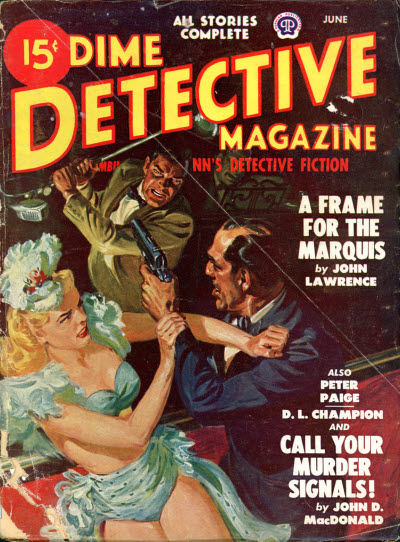
Non-Mexican writers have had Mexicans or Mexican Americans at the center of their books, and some have built an entire series of stories or books around these characters. Between 1944 and 1948, in the pulp magazine Dime Detective, D.L. Champion published eight novelettes based on his detective hero Mariano Mercado. Mercado was atypical of the 1940s private eye. First, he was a Mexican and operated out of Mexico City. He referred to himself as a “detectivo particular.” Second, although brave and smart, he had quirks, such as raging hypochondria and an unnatural fear of germs. He also had wild taste in clothing. In one story he is described as wearing a “bright, jealous green suit,” shoes as “yellow as the proverbial dog,” and a shirt as “pink as an embarrassed salmon’s underbelly.” When he had to, though, he was quite capable of acting tough and getting physical with the bad guys. Champion was born in Australia and educated in New York.

Robert Somerlott’s short stories about Detective Sergeant Vincente López of the Jalisco State Police appeared in Ellery Queen’s Mystery Magazine in the 1960s. Somerlott could claim some legitimacy for his characterizations: he lived for a time in San Miguel de Allende. Rex Burns writes a series of police procedurals using Gabriel Wager as his detective. Wager is half Mexican, half Anglo. Burns won an Edgar Award for the first book in this series, The Alvarez Journal, in 1976. Marcia Muller created Elena Oliverez, the first fictional Chicana detective, in The Tree of Death in 1983. Other non-Mexican authors in this genre include Del Shannon (Lieutenant Luis Mendoza, head of the Los Angeles Police Department’s homicide unit), Richard Wormser (Sheriff Ken Craigie, half Mexican, half Anglo), Bruce Cook (Antonio "Chico" Cervantes, Mexican American private eye), Nancy Herndon (Elena Jarvis, Chicana cop from Los Santos, Texas), Earlene Fowler (Gabriel Ortiz, police chief of San Celena, California), Fredric Brown (Tucson homicide detective Frank Ramos).

At this point, the question becomes obvious: Where are the Mexican American authors of crime fiction who use Mexicans or Mexican Americans in their stories? And the follow-up question seems just as obvious: Does ethnicity make a difference?

A Brief History of the Detectivo Particular

The detective Hector Belascorán Shayne deserves special mention. He is at least the second Mexico City private eye whose exploits have made it to the North American reading audience. Champion’s Mercado predates Shayne by several decades. The one-eyed Shayne is the creation of Paco Ignacio Taibo, II, born in Spain in 1949 but a resident of Mexico since childhood and now a naturalized citizen of that country. Taibo has had several novels published in Spanish and English, and he is a major organizer of the International Crime Writers Association’s “Semana Negra” conference, held every summer in Gijón, Spain. Taibo has been writing private-eye novels in Spanish since 1977, but he was not translated into English until 1990. His detective, Shayne, is deeply into leftist politics and is quite philosophical. A typical Shayne story twists and turns through several permutations until, at the end, it has the feel of a Fellini movie. In one novel Shayne is killed off, only to return in the next, with a reluctant “explanation” (certainly not an apology) from Taibo for having upset his readers. Taibo, writing about a Mexican private eye, has found an audience not only in Mexico but in the United States.

Rudy S. Apodaca’s book The Waxen Image, published in 1977, is important because it was, Apodaca claims, the “first mystery-suspense novel by a Chicano.” However, its focus is not on Mexican or Mexican American characters.

The handful of practitioners of Chicano crime fiction engage in almost all of the major forms of the genre, from police procedural to cozy, and use characters from the prototypical private eye to the isolated loser. For example, Rolando Hinojosa is well-known for his ongoing project about life in fictional Belken County, Texas, just a stone’s throw from the border. Two books in the Klail City Death Trip Series are police procedurals featuring Rafe Buenrostro, one of the first Mexican American police characters created by a Chicano author. Hinojosa’s crime fiction resonates with the tempo of the border where corridos and rancheras mingle with the pop of bullets in the sultry night air. His Partners In Crime was published in 1985; Ask A Policeman came out thirteen years later.

On the other hand, Michael Nava’s hero is Henry Ríos, a gay, alcoholic Chicano lawyer whose cases often have elements from the gay underworld, the tragedy of AIDS and the bittersweet life of a man defining his values in an uncaring world. Ríos first appeared in 1986 in The Little Death. Nava has published seven Rios novels. The final installment in the series is Rag and Bone (2001).

Rudolfo Anaya, the author of the immensely popular novel Bless Me, Ultima (1972), took up mysteries late in his writing career but so far has published four novels that can be classified as mysteries: Zia Summer (1995), Rio Grande Fall (1996), Shaman Winter (1999), Jemez Spring (2005). Anaya’s contribution to the list of Chicano private eyes is Sonny Baca, introduced in a novel usually not classified as a crime novel, Alburquerque (1992). Baca, the grandson of legendary New Mexican lawman Elfego Baca, operates a private-eye business in Albuquerque. Baca’s arch-nemesis is Raven, brujo extraordinaire.

Martin Limón takes his readers to Korea where his Chicano military policeman, George Sueño, has to bend rules to solve exotic and violent crimes. Sueño debuted in Jade Lady Burning in 1992, the same year Anaya’s detective first appeared, and has shown up in three other novels, Slicky Boys (1997), Buddha’s Money (1998), and The Door to Bitterness (2005).

I first published a novel featuring burned-out lawyer and nostalgic Chicano activist Luis Móntez in 1993 in The Ballad of Rocky Ruiz. Móntez’s crime solving comes about because of the self-destructive antics of his law clients or the shady nature of many of his old friends. Five novels featuring Luis Móntez have so far appeared. I also have one stand-alone novel, Moony's Road to Hell, that tells the story of Denver private eye Danny "Moony" Mora.


Max Martínez’s stories are as hard-boiled as anything penned by the better-known Elmore Leonard. Martínez explores the dusty, heat-soaked Texas badlands with abundant helpings of gritty violence and feverish sex. Martínez’s sardonic hero, deputy sheriff Joe Blue, has been in White Leg (1996) and Layover (1997).

And Lucha Corpi has given us Gloria Damasco and Dora Saldaña, private investigators who are not quite cozy or hard-boiled -- maybe medium-boiled?

Brown Angels and Black Widows

Contrast Frank’s description of a Mexican woman in The Postman Always Rings Twice, with Damasco’s in Corpi’s Black Widow’s Wardrobe:

At least five-feet-six, and of medium build, she seemed self-possessed to the point of aloofness. Her eyes, framed by arched brows and prominent cheekbones, were large and observant, and they animated an otherwise doleful countenance. I tried inconclusively to guess her age.

"She was in the procession," Tania said. "She looks so sad."

"Sad but lovely," Art commented. "She is ... regal in her sadness. Like a tragic Greek heroine."

"More like a tragic Aztec princess," Francisco remarked.

"More like a brown murderess," Myra said.


Part Two next week.

Later.