Showing posts with label Poetry Connection Column. Show all posts

Friday, March 13, 2026

A Week of Civic Engagement in Santa Barbara


 Melinda Palacio  

Kristen Sneddon 


When my neighbor, Kristen Sneddon, invited me to read poetry at her Mayoral Campaign Kick-off, I did not hesitate to say Yes. I remember when she was canvassing the neighborhood during her campaign for City Council in 2017. At the time, I didn’t know that she lived next door to my dog’s favorite persimmon tree. Since then, I’ve been impressed by her compassion and leadership. As a geophysicist and city council member, Kristen is a profound listener who cares about our city and the global environment. When she realized she needed a bigger venue for all who had rsvp’d for her kick-off party, she was happy Laura Capps offered her beautiful home.


Two weeks ago, one of my biggest concerns was the continued bombardment of ICE raids on our town and country. Today, thoughts of war occupy my waking hours, as well as ICE and how this is impacting our community and country. As a friend and representative of our city, Kristen has expressed how much she appreciates my poems on immigration and ICE. I brought four poems, but read three. ICE Detention Tornillo, Texas was a poem I wrote in 2017 during Trump’s first term. Friday Morning Before Work in Carpinteria is from last year and Canopy over Milpas and Alphonse is a poem written this year in response to the Fair Trade Exhibit and Patricia Clarke’s photograph of La Super Rica. Even in this ekphrastic poem, I had ICE on my mind. You can read the poem in last month’s column. As I waited to read my poems and took in the diverse crowd in support of Sneddon for Mayor of Santa Barbara, I was impressed by the strong feeling of community. Another highlight of the event was hearing Kristen’s family band entertain the crowd before the speakers. Although they are not usually a band, her daughter, Elsie Sneddon on drums, and son, Harry Sneddon on bass, joined their friend Lucien Dempsey on keys, and formed a very impressive and impromptu house band.


Hannah-Beth Jackson offered the closing remarks and reminded everyone of Santa Barbara’s strong history of electing female mayors. It’s always an honor for me to contribute poetry at important community events. Last Sunday, I read some poems honoring my mother and grandmother at Carpinteria’s International Women’s Day Festival, held at the Carpinteria Children’s Project. Geri Ann Carty who was recognized as Carpinterian of the Year in 2022 was one of the festival’s organizers. The day included a variety of women-owned and women-centered organizations, as well as performances by local singers and dancers, a fun start to Women’s History Month. 


*an earlier version of this article appears in the Santa Barbara Independent 

Thursday, December 19, 2024

Poetry Connection: Connecting with Local Poets in Goleta, CA

Melinda Palacio, Santa Barbara Poet Laureate 

David Starkey, Cie Gumucio
Anna Mathews, Daniel Thomas, Shirley Geok-lin Lim, and Dylan Farrell


In a case of IYKYK, then you know that the Goleta Valley Poetry Series is one of the best kept secrets in our local poetry scene. Poet Laureate Emeritus, David Starkey, runs the series twice a year. He pairs seasoned and youth poets, with the help of Cie Gumucio who is the Santa Barbara County Coordinator and Poet Teacher with Cal Poets in the Schools. Starkey says he adopted the idea from a New England poetry series, The Liar’s Bench. This month’s Goleta Valley edition was outstanding. Perhaps knowing that the series might be put on hold due to the library’s upcoming renovation made each reader stand out for me. There was something special l about each of the poets. The librarian’s are committed to the poetry series and just might come up with a creative way to keep it going throughout the renovation. Let’s hope they come up with a solution to keep the biannual series going. Meanwhile, if you want to write more poetry in the new year, sign up for David Starkey’s Ekphrastic Poetry Workshop at the Central Library next month on Sunday, January 12. 


The line-up included Dos Pueblos High School student and 2023 Poetry Out Loud Regional winner, Anna Mathews (you may recall Anna Mathews from previous columns), 6th Grader at Mountain View Elementary, Dylan Farrell, Daniel Thomas, and Professor Emerita Shirley Geok-lin Lim, who merits her own write-up, look for more in a future poetry connection column. A proud Goleta resident, the UCSB Professor Emeritus said she was happy to be presenting at her local branch.


Anna Mathews is a poet to watch. As a Poetry Out Loud Regional winner, she knows how to deliver a poem, even offers some hand choreography. Her powerful poems linger in the ear and heart. Dylan Farrell, age 12, opened the reading series. He said it was his first poetry reading. However, he seemed so at ease at the podium, you would think he was a much older, seasoned poet. 


Nightmare 

written by Dylan Farrell

6th Grade , Mountain View Elementary


Nightmare 

Tonight in the darkness, an image struck me

a land where love is a dream and hate is a dark reality where you find

strength in pain and beauty in death

when I arose from my slumber I vowed not to let this dark illusion become

a reality

yet my wounded heart fell

so I looked out the window, a portal and I threw my heart out

I projected my thoughts in to the infant void

I screamed my mind to are beautiful country trying in vain to rid my life of

this nightmare

And the void answered back showing me a land of dreams a land where

you can unshackle your chains and set down your burdens

where love is your guide and hate is only a dark thought in the back of

your mind

As I looked through my portal my wounds hurt less and my scars

healed

yet my nightmare remanded It haunted me endlessly so I spoke

“‘I have tried fighting you and I have tried pushing you away so all that's

left to do is to embrace you” and so I did

And I have never stopped

I hold it still to this day and for some strange reason I see things differently

when I see things hurt and tinged with despair

I look back to where we started

I look at a nightmare and I see a dream


Dylan wrote the poem after a presentation and lesson to his 6th-grade class on how poets and politics have intersected over the years by Cie Gumucio. The class discussed Martin Luther King’s I have a Dream speech, Maya Angelou’s poem, Still, I Rise, and they watched and listened to Amanda Gorman’s The Hill We Climb. Cie asked the students to reflect on the inspiring words of each poet and write their own poems about their hopes for the future. 


This week’s poetry connection features a poem by Dylan Farrell and two by Daniel Thomas who is equally at home writing about music and stillness. There’s a spiritual, yin and yang quality to his work. His collection of poems include, Leaving the Base Camp at Dawn (2022) and Deep Pockets (2018). He has an MFA in poetry from Seattle Pacific University, as well as an MA in film and a BA in literature. 


THE FADO SINGER

Daniel Thomas


The word itself contains shadows,

as if the singer stands poised

between the saddened past

and the always fickle future, in a now

lit only by a glaring spotlight

that shines the sequins of her silver

dress and deepens the night sky

hidden in her eyes of black onyx.

Her long arms gesture to the balcony

and her voice trembles through

a languid melody in a minor key,

while three guitars pluck percussive

notes that frame her liquid arcs

like the simple setting of a fine

carnelian stone. Her Portuguese words

grant me liberty to hear only

rhythm and melody and the mouthed and trilled

consonants and vowels that might speak

of lost love, or death beside us

in the dim hall, or the deep sorrow

in these things we live beside. And so

I am transfixed by the origin of drama,

before plot or theme, just

the one life that shines through

her face, stares into darkness, sings

the pure song of her dangling fate.


GREEN PEARLS

Daniel Thomas


When illness stills you, and worry weights

your limbs—when you rub your eyes to wake up

and the rose light of evening slants

across the dusty table—you take a walk,

but the neighborhood is empty—even the birds

have flown, taking with them the furnishings

of sound that make the world inhabitable.

You remember Midwest autumns—how herds

of maple leaves skittered across the blacktop.

Nestled among tree trunks and leafless shrubs,

they found their place of winter rest.

You, too, hurry down the driveway, brittle

as the dried husk of a seed pod. But within you—

green pearls in a frail shell.


*an earlier version of this column appears in the Santa Barbara Independent

Thursday, February 29, 2024

Featuring Lynne Thompson, Los Angeles Poet Laureate Emerita (2021-2022)

Melinda Palacio, City of Santa Barbara Poet Laureate

 (an earlier version of this column was published in the Santa Barbara Independent)


A poetry connection I’ve made over the years is with Lynne Thompson, the 2021-2022 Poet Laureate for Los Angeles. I have had the pleasure of reading with Lynne over the past fifteen years. Lynne is the daughter of Caribbean immigrants. To close Black History Month and with permission from the poet, I’d like to share some of Lynne Thompson’s poems here. Her lush poems are playful, sexy, and thought provoking. Of her poetry, Natasha Trethewey says, “Thompson is a poet who revels in language.” Do you have a favorite Lynne Thompson poem? 


START WITH A SMALL GUITAR

Lynne Thompson

(previously published in Start with a Small Guitar, What Books Press 2013)


although you already know:  this was never a real guitar.

What you hear is the melody once resident inside you

and you know this too:  it’s only my silhouette you see

dancing, dancing.  Step into this splendid suggestion or

flotsam.  Then are those my eyes, filling, or yours?


or        start again with a small guitar


Of course, you already know:  this was never a real guitar.

But here are all of my fingers longing to coax its duende.

What you hear is the melody once resident inside you as it escapes, suddenly, and I am there just in time to pluck it


From the innocent air & slip it around my wrist like a cuff.

You must know this too:  it’s only my silhouette you see

Dancing, dancing.  Step into it:  this splendid suggestion,

this flotsam.  Then, are those my eyes, filling?    Yours?


I ASK THE MALAGASY

Lynne Thompson

(from Beg No Pardon, Perugia Press 2007)


Where are my ancestors buried?

    In the feathers of a yellow bird.


How do you remember me?

    As seven wishes.


Where will I find the shape-changers’ magic?

    In fields of hydrangea.


Who teaches your tantara?

    A fox behind closed doors.


Where are your elephant birds?

    In ruby and absinthe afternoons.


And where is the sawfish beak?

    In the dayshine of trees.


How deep is your river Betsiboka?

    Twelve earthquakes deep.


What time did your soil turn red?

    When calves bent their knees . . . . .


ELEGY FOR THE RED DRESS

Lynne Thompson

(from Beg No Pardon, Perugia Press 2007)


Good morning, Red Dress,

double strand of pearls, faded rose

perfume clinging to the bodice,

the slip, the silk of the sleeve;

molten to my hips, my breasts, 

the drum of my heart, hem

softly pleated to a permanent party. 


Hello and hey there, Red Dress—

heavy with seat

of Love Wants to Dance.  Scented

with hopes of Shy Man, Bold Man,

Begged-to-take-you-home Man.

Still crumply down the back

From the hanker in their hands.


BALLAD FOR YESTERDAYS

Lynne Thompson

(from Beg No Pardon, Perugia Press 2007)


Buzzing like a hawk over high

cotton—in a trance—I saw you


where human lust is electrical, all 

gyration and heartbreak, a July’d


moon and sun. Drowsy with beauty,

we spooned in sweet, fallow fields so


which of us is more mad?    (Or is this

melancholy just a corn cob dipped 


in red roux?)  Still, we were lovebirds.

Perhaps we invented our own jazz;


Sweets, we were mornings’ glitter.

And yes, there were afternoons of scat,


of bee-bop.  But there is no loving that

won’t splinter from itself and we know


time is just a honey dripper. Yet, I’m all 

dreams and hunger all these years later.


Friday, February 16, 2024

Poetry Passages Puts Poetry on Santa Barbara Buses

Melinda Palacio  


* A version of this Poetry Connection Column originally appeared in the Santa Barbara Independent


One of the notable connections I’ve made as Poet Laureate is with Lea (pronounced Lee) Williams. Lea is a wanderer, traveler, writer who specializes in letter writing, and graphic designer. I met her early in May, during one of my first events at the Santa Barbara Historical Museum, where I had the honor of sharing the spotlight with our Youth Poet Laureate Madeleine Miller at the Women’s Literary Festival’s Poetry Pairing. After the event, Lea contacted me and asked if I would be interested in collaborating with her to bring poetry on our city’s buses. I was certainly thrilled with the idea because it aligned with my mission as Poet Laureate: to bring more poetry to public spaces and create more awareness to poetry in our community. 


Since April, I have participated in over 30 events, most recently at Bishop Diego High School. It always surprises me how little awareness there is for the position of Santa Barbara Poet Laureate. I’m happy to help local bus riders become aware of our current and past poets laureate through Poetry Passages, the project that will put poetry on our buses. 


I also remember how thrilling it was when I went to New York and rode the subway and sat next to a poster of one of my favorite poems by Aracelis Girmay. Lea had a similar experience of riding the bus in Los Angeles and seeing poetry during National Poetry Month on the buses. She described seeing poetry on buses as a thrilling gift:


            “When I lived in Los Angeles, one April there were “Poetry in Motion” panels of classic poetry up on the buses. It was a thrilling gift. And I noticed how many riders, of every economic state, were entranced by those panels. That stayed with me—the pleasure and inspiration of poetry being presented for everyone. And the extraordinary engagement I saw over and over again. So grateful to The Poetry Society of America for launching this idea. We just chose to do it a little differently.”


Lea and I have been meeting since May to figure out how to make this idea into a reality for the Santa Barbara Municipal Transit District (SBMTD). There are several moving parts to this project, from getting approval of the SBMTD, to choosing poets and poems, to figuring out how to pay for the project. 


Luckily, several of the pieces fell into place from having access to a wonderful translator in visiting poet Alexandra Regalado to wrangling eight poets laureate to contribute some verses to the project. If you’ve been following poetry in Santa Barbara, you know that we lost one of our own, Sojourner Kincaid Rolle. While she was not able to finish her bus poem, she had chosen a coastal route and we were able to find an appropriate verse for her chosen bus line. 


One of the most important parts was the opportunity to apply for a city grant to cover the cost of funding the project. The grant will allow us to pay the SBMTD, the poets, our translator, and fiscal sponsor. In addition to the task of choosing excerpts of each poem, there was also the issue of naming the entire project. Since we couldn’t use Poetry in Motion, we came up Poetry Passages. Lea designed the poetry panels and a flyer to let people know about the project. Download the QR in the flyer and view the routes where you’ll find Poetry Passages during National Poetry Month in April. I’ll include my entire poem. Can you guess which couplet will be excerpted for bus route 11?


Bus Stop

Melinda Palacio, 10th Poet Laureate of Santa Barbara 


It’s the waiting that hurts,

Makes the day feel longer.


Smiles and relief when the bus arrives,

a satisfying thrill, seeing a long, lost friend.


She speaks in a woman’s voice, announces the stop

For Goleta Valley Cottage Hospital.


Outside, Lowriders on parade turn heads.

Too tired. I’m glad I’m not driving. 


So many rattling parts. The bus hums, squeals, exhales,

screeches to a false stop as it crouches to receive passengers.


As it gurgles forward, 

I wonder if the bus is more tired than I. 


Friday, July 07, 2023

Boost Your Creativity with Collaboration

Melinda Palacio

Artist Colleen M Kelly


*This Column originally appeared in the Santa Barbara Independent


Last month, I wrote about my twenty-year journey at the Santa Barbara Writers Conference. What I didn’t talk about was the team-teaching I do with mystery writer Lida Sideris. A few years before the pandemic, Lida and I started offering a workshop titled, ‘Writing through the Fear.’ This year, we did a workshop on how to be your own best publicist. In our workshop, we talked about how to promote your writing and books without hiring an expensive publicist. Our styles are very different, but we work well together and have great energy as a team. 


When a friend and local artist, Colleen M. Kelly asked me to write a poem for her solo exhibition, “The Dichotomy of Laundry,” I was reluctant because I’ve been so busy and the request meant having to write a poem within two weeks, but I am happy I agreed.


This wasn’t the first time I had written a poem in response to Colleen’s work. Her artistry is often playful while addressing serious and important issues, especially in regards to feminism and the environment. 


For me, ekphrastic poetry is fun because it gets me out of my head. “The Dichotomy of Laundry” is Colleen’s initial response to the Supreme Court’s reversal of Roe v. Wade. However, there’s so much more to the exhibition that covers a myriad of women’s issues from coming of age to violence against women to abortion to missing women. While the exhibit recalls childhood, hung laundry and women’s work, It’s about the times a woman has fought for her life or needed to tap out some form of S.O.S. In a way, the exhibit is her own cry for help during a time when the women’s rights that her generation helped achieve are being walked back before her eyes. 


With a lit stick of incense, Colleen burned morse code on Japanese Gampi paper. The second part of the exhibit features red dresses on wire hangers, some of the dresses are riddled with the letters S.O.S. The presence of wire hangers reminds us of the horror of the history of illegal abortions. 


Kelly’s mantra is “Art is healing.” She thought it was a good idea to do something that was calming. The volume of “laundry” she produced is a testament to the calming nature of producing the work. 


When I agreed to write a poem for Colleen, I had no idea that her work would have such a profound effect on me. I contemplated her images from a previous installation in Los Angeles as well as those on her Instagram account @drapedinwonder. I sat down to write and was so moved and inspired that I wrote a series of five poems, enough for a small chapbook, instead of the one poem she had asked for. 


In regards to collaborating, Kelly says she does not like to micromanage other artists: “When I collaborate with people, I want them to do what they do best.” She brought in a dancer and improv artist for her exhibition in Los Angeles. At her opening in Santa Barbara on Friday, July 7 at Silo in the Funk Zone, I will read my ekphrastic poems for the exhibit. 


My collaboration with Colleen elicited the kind of creative outpouring I hadn’t experienced since writing my first chapbook, Folsom Lockdown, poems that I wrote after visiting my father in Folsom prison. In a similar experience, I sat down to write a single poem and could not stop. 


View Colleen M. Kelly’s solo exhibition, The Dichotomy of Laundry at Silo in the Funk Zone 118 Gray Avenue, Santa Barbara, Friday, July 7, 5 pm to 7pm. 


Woman

The first poem in “The Dichotomy of Laundry” Series. 

Melinda Palacio


Her gear appeared soft without instructions.

On her bed, a belt to hold the pads of cloth

in the nameless space she hadn’t thought about.


If it weren’t for the trail of blood,

she could continue the game:

Cowboys and Indians, her older brother’s favorite.


She would even play with dippy plastic baby

dolls that neighbor Esther forced on her.


Why would she want to play at babies

when she had a baby brother to care for?


The gear on her pink pillow confirmed 

What she suspected: at ten years old,

She was done with little girl stuff.

She was a woman.


Does it have to hurt so much?

Does there have to be so much blood?


She tugged on the clothesline between

Her apartment and the next building.

If Vilma, Esther’s older sister was home,

She would have all the answers.


Vilma at 12 knew everything.

S.O.S.


She wrote the letters on a blank piece of paper,

Hung it on the clothesline, but 

Vilma was gone. 


S.O.S. 

Friday, May 26, 2023

Poetry Connection: A Lesson in Resilience and the teachings of Poetry


Melinda Palacio, Santa Barbara Poet Laureate


Woww Writers Lori Anaya, Mona Frazier, Melinda Palacio and 23rd US Poet Laureate, Joy Harjo


*This post was previously published in the Santa Barbara Independent 


National Poetry Month May be over but Santa Barbara continues to bring the best of the laureates to our town. United States Poet Laureate Ada Limón closed out poetry month. Last Thursday, UCSB hosted Joy Harjo, 23rd Poet Laureate of the United States. Joy Harjo was the perfect choice for Multicultural Center’s Resilient Love series. To read her poetry, songs, memoirs and plays is to understand how she navigates obstacles and rises above them. 


If you are not familiar with our previous United States Poet Laureate, a good place to acquaint yourself with her twelve books of poetry is to start with Weaving Sundown in a Scarlet Light 50 Poems for 50 Years with a foreword by Sandra Cisneros, a rare insight into the friendship of two once-struggling poets turned literary giants. The notes section of the book is fascinating and tells the backstory and sometimes to whom the poem was written. The Life of Beauty, a New York Times assignment, is also on her music album, I Pray for My Enemies. I’ve spent the past couple of days listening to her songs on Apple music. Sandra Cisneros describes being startled when she first heard Joy Harjo’s singing voice: 


“It was a voice as soft as the wings of sparrows, as sweet and transparent as rain, so unlike her deeper speaking voice, a wonder to me. Where had she hidden that voice all those years? More important, why?”


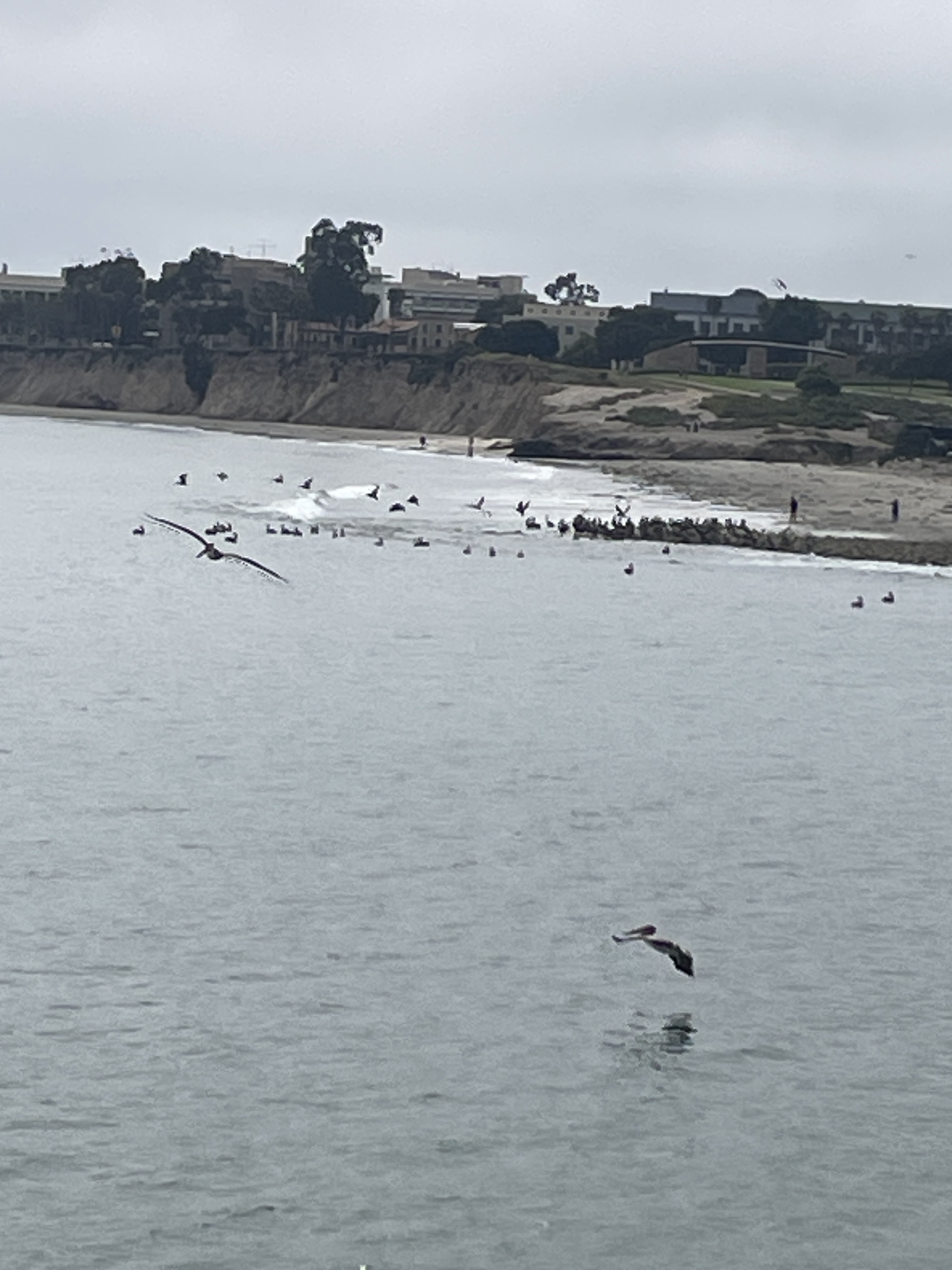
I spent the day with Joy Harjo, first at a lunch with students at the multicultural center and later driving around town. The luncheon was a highlight for Joy because the students shared their stories about who they are, who they aspire to be and how they came to appreciate stories and poetry. During the break before her reading, I took Joy and her husband, Owen, to the pier at Goleta Beach. We witnessed a rehabilitated pelican being released on the beach. There must have been at least 50 pelicans at a nearby sandbar. Joy mused about the stories the bird would share once it reached its squadron of pelicans.

Joy Harjo


Goleta Beach


At the I.V. Theatre, Joy began with a song on her flute to acknowledge those who keep the land. 

So much of her work has to do with facing obstacles and poems as tools for healing and transformation. She conveyed how poetry can allow you to speak the unspeakable. There’s so much to unpack in her words, a lifetime of books and music. She also revealed her latest picture book, Remember. Judging by the profound questions from the audience, many appreciated how she’s never shied away from the difficult work that is writing. 


For Joy Harjo writing is about going into that troubling space and listening. “Poetry can give the mind something constructive to do in the face of grief or obstacles,” she said. Joy spoke about the hard work that must be done before writing: listening. Acknowledging and listening may be painful tools but ‘once you acknowledge the monster’s story, you can choose to release it,’ she said. She read from her poem, I Give You Back, which begins: ‘I release you, my beautiful and terrible fear.’ For Joy, the power of poetry is walking a little lighter, having released burdens.


There’s so much more to find out about the new direction Joy Harjo’s work will take. I asked about her role as the Artist-in-Residence at the Bob Dylan Center. She is the first to take on this position and said she was making it up as she goes. As a fan of Bob Dylan’s music, I hope I get to see some of her projects there. 


Upcoming Poetry Events in Santa Barbara:


Next week, for First Thursday, June 1, I will be introducing our State Poet Laureate, Lee Herrick. We will also be joined by our Youth Poet Laureate Madeline C. Miller at the Museum of Contemporary Arts in Paseo Nuevo at 6pm. We will also have music at this event. 

First Thursday Laureates at the Museum of Contemporary Arts, Paseo Nuevo, June 1 at 6pm.


This Saturday, The Mission Poetry Series features award-winning authors from Gunpowder Press. Catherin Eposito Presscott whose collection Accidental Garden won Gunpowder Press’s 2022 Barry Spacks Poetry Prize, selected by Danusha Laméris and the co-winners of Gunpowder’s Alta California Chapbook Prize, Gabriel Ibarra and Florencia Milito, both selected by Francisco Aragón.