
Olga García Echeverría
I came to know the Los Angeles Chicano/a literary scene back in the 1990's when it was bustling with some pretty incredible artists. I still have a clear image of seeing Luis Alfaro on stage for the first time. He was roller skating in a circle while reciting poems about his father and about growing up in Pico Union. I was mesmerized by Alfaro and his work, as I was by other local artists. Marisela Norte and Gloria Alvarez were two of the first poetas I ever saw read live in LA. Seeing these strong, brown mujeres at a mic, soltando sus poemas was (and still is) empowering, and it fueled my own desire to delve into and develop my own poetic voice. Another significant artistic influence of that time was a literary group called ¿Y Qué Más? This group was my first exposure to a Chicana/Latina women's literary collective, and it was the first time I ever heard la liz gonzalez read her poetry.
What I have always appreciated about liz' work is that it does not fit neatly into boxes. As a fourth generation Chicana who was born and raised in San Bernardino County, she brings into her poetry and prose the complexities of her identity, challenging assumptions of what it means to be Chicana. For example, in her poem, "The Four Food Groups in Grandma's Summer lunches," gonzalez describes some of the meals made by her maternal abuelita. gonzalez' words paint immediate pictures--thick slabs of spam fried in lard, canned spinach, and powered leche mixed with good old tap water.
My assumption upon first hearing and later reading this humorous poem was that perhaps la poor liz didn't grow up eating a lot of traditional Mexican food. However, this was just me jumping to quick conclusions, putting la liz into a box. Those quick lunches (that her grandmother made to avoid cooking in the summer heat) are only a glimpse of liz' cultural/culinary history. liz shares that actually she was raised eating tamales from scratch, "not the masa, but everything else was made from scratch. And I was also raised eating mole and drinking chocolate de la olla...My maternal grandmother cooked Mexican food for us on a regular basis when I was growing up." liz has another poem where she describes that same spam-frying abuelita getting down making buñuelos.
Even the label "fourth generation" has layers. Liz' maternal great-grandmother was born in or came to San Bernardino as an infant and grew up there. Her other maternal great-grandparents were all born in Mexico and came to the US as young adults. Liz' father, however, was a more recent immigrant who was raised on the Texas/Mexico border. "At seven, he picked cotton. At fourteen, he lived and worked with his family on a strawberry ranch in New Mexico. From what I understand, he did not go to school past ninth grade. When he died, he was a laborer at Kaiser Steel. I was three."
Language is another stratum. On the surface, liz hablar poco Espanish. Her attitude about this is complex. "If someone says I'm a coconut or not Chicana or not Mexi enough because I don't speak Spanish, I have an ¿y qué? attitude, but for the most part, I'm sorry I'm not fluent." Like many Mexicanos/Chicanos of their generation, liz' grandparents witnessed and experienced the discrimination that came with speaking Spanish in the U.S. "My grandparents advised my mother not to teach us Spanish because of segregation. It had recently been stopped, but they were still concerned. And when I tried to practice Spanish with Grandma, she told me she wanted to learn 'educated English'--the way I was being taught to speak in school--because she had to quit school so young, and having to leave school had broken her heart."
 |
| liz gonzalez con sus perritos |
I came to know the Los Angeles Chicano/a literary scene back in the 1990's when it was bustling with some pretty incredible artists. I still have a clear image of seeing Luis Alfaro on stage for the first time. He was roller skating in a circle while reciting poems about his father and about growing up in Pico Union. I was mesmerized by Alfaro and his work, as I was by other local artists. Marisela Norte and Gloria Alvarez were two of the first poetas I ever saw read live in LA. Seeing these strong, brown mujeres at a mic, soltando sus poemas was (and still is) empowering, and it fueled my own desire to delve into and develop my own poetic voice. Another significant artistic influence of that time was a literary group called ¿Y Qué Más? This group was my first exposure to a Chicana/Latina women's literary collective, and it was the first time I ever heard la liz gonzalez read her poetry.
What I have always appreciated about liz' work is that it does not fit neatly into boxes. As a fourth generation Chicana who was born and raised in San Bernardino County, she brings into her poetry and prose the complexities of her identity, challenging assumptions of what it means to be Chicana. For example, in her poem, "The Four Food Groups in Grandma's Summer lunches," gonzalez describes some of the meals made by her maternal abuelita. gonzalez' words paint immediate pictures--thick slabs of spam fried in lard, canned spinach, and powered leche mixed with good old tap water.
My assumption upon first hearing and later reading this humorous poem was that perhaps la poor liz didn't grow up eating a lot of traditional Mexican food. However, this was just me jumping to quick conclusions, putting la liz into a box. Those quick lunches (that her grandmother made to avoid cooking in the summer heat) are only a glimpse of liz' cultural/culinary history. liz shares that actually she was raised eating tamales from scratch, "not the masa, but everything else was made from scratch. And I was also raised eating mole and drinking chocolate de la olla...My maternal grandmother cooked Mexican food for us on a regular basis when I was growing up." liz has another poem where she describes that same spam-frying abuelita getting down making buñuelos.
Even the label "fourth generation" has layers. Liz' maternal great-grandmother was born in or came to San Bernardino as an infant and grew up there. Her other maternal great-grandparents were all born in Mexico and came to the US as young adults. Liz' father, however, was a more recent immigrant who was raised on the Texas/Mexico border. "At seven, he picked cotton. At fourteen, he lived and worked with his family on a strawberry ranch in New Mexico. From what I understand, he did not go to school past ninth grade. When he died, he was a laborer at Kaiser Steel. I was three."
Language is another stratum. On the surface, liz hablar poco Espanish. Her attitude about this is complex. "If someone says I'm a coconut or not Chicana or not Mexi enough because I don't speak Spanish, I have an ¿y qué? attitude, but for the most part, I'm sorry I'm not fluent." Like many Mexicanos/Chicanos of their generation, liz' grandparents witnessed and experienced the discrimination that came with speaking Spanish in the U.S. "My grandparents advised my mother not to teach us Spanish because of segregation. It had recently been stopped, but they were still concerned. And when I tried to practice Spanish with Grandma, she told me she wanted to learn 'educated English'--the way I was being taught to speak in school--because she had to quit school so young, and having to leave school had broken her heart."
For the past 20 years, liz gonzalez has been sharing her poems and stories with audiences in California (and beyond). Last week I had the opportunity to interview liz about her writing, her teaching, her perceptions of Chican@ lit, and her current novel in progress. Here is a transcript of our online conversation and an excerpt from her novel at the end.
Welcome to La Boga, liz. I never tire of asking writers this same question: when did you first start writing and why?
In 1991, I was a theater arts major at California State University, Los Angeles. Bluepalm, the dance-theater duo Jackie Planeix and Tom Crocker, were scheduled to teach a collaborative workshop at my school. The workshop was to culminate in a weekend of performances. My roommate at the time encouraged me to audition. Fortunately, I was one of the 15 students accepted. Soon after the course began, three or four of us students were each assigned to write and perform a monologue. I was mad, frightened, and honored all at the same time. I had never considered writing creatively. However, I knew it was a great opportunity to work with Bluepalm, so after much frustration and many false starts, I wrote the monologue and found my voice and the seed of creative writing was planted in me. I am eternally grateful to Bluepalm, specifically to Jackie Planeix who was my director, for giving me that life-transforming assignment.
I recall first hearing your work back in the 1990's via the female poetry collective ¿Y Qué Más? How did you get involved with this group and how did it influence or shape you creatively?
Shortly after I graduated from CSULA with a BA in 1993, I found myself longing for a Chicana/Latina arts community, a community I automatically had when I was a student. I contacted fellow alum Martin Hernandez and asked him if he knew of any Chicana or Latina art groups that were looking for members. Within a few months, Martin called and told me that some Chicanas he knew were starting a poetry collective. I had never written poetry, but I tore a couple of entries that looked like poems out of my journal and took them to the first meeting. Maria Cabildo, Adela Carrasco, Frankie Hernandez, Cathy Loya, Evangeline Ordaz, Michele Serros, and I became the Chicana poetry collective ¿Y Qué Más? That’s when the writing seed inside me sprouted. We workshopped and performed our poems, and the group introduced me to Lorna Dee Cervantes’s and Sandra Cisneros’s poetry. Before that, I hadn’t read any literature written by Chicanas or Latinas; it was powerful to learn that these Chicanas were expressing truths and validating their and our—Chicanas, women’s, Latinos…--voice, existence, and experiences. Michele Serros and Maria Cabildo told us they were participating in Michelle T. Clinton’s Multicultural Feminist Workshop at Beyond Baroque Literary / Arts Center in Venice, near my studio apartment in Mar Vista. I started attending the workshop, and Beyond Baroque became my creative writing home.
You shared with me that you have been teaching writing for most of the years that you've been writing. How do you balance teaching writing and actually writing? Do these two things feed off each other or is there a burn-out effect?
Balancing teaching and writing hasn’t been easy for me. Before I went to grad school, when I was a receptionist at a 9-6, Monday through Friday job and mainly wrote poetry, I didn’t face any challenges with writing. For many of my teaching years, though, I suffered from frequent migraines, and would be woken by a severe headache most every morning. In addition, I’m a slow reader and writer. I love the composition students, but the energy it takes to teach in front of a classroom, grade papers, and lesson plan were taxing. I rarely had a day without schoolwork. After looking at text all day, I longed to go outside, take in some art or music, and not bury my face in more text, even though it was my own writing.
You shared with me that you have been teaching writing for most of the years that you've been writing. How do you balance teaching writing and actually writing? Do these two things feed off each other or is there a burn-out effect?
Balancing teaching and writing hasn’t been easy for me. Before I went to grad school, when I was a receptionist at a 9-6, Monday through Friday job and mainly wrote poetry, I didn’t face any challenges with writing. For many of my teaching years, though, I suffered from frequent migraines, and would be woken by a severe headache most every morning. In addition, I’m a slow reader and writer. I love the composition students, but the energy it takes to teach in front of a classroom, grade papers, and lesson plan were taxing. I rarely had a day without schoolwork. After looking at text all day, I longed to go outside, take in some art or music, and not bury my face in more text, even though it was my own writing.
What are some of your strategies to deal with these challenges and how have you kept the writing momentum going?
In recent years, I have lightened my teaching load, teaching only at two schools: composition at a community college and creative writing online through UCLA Extension Writers’ Program.
In recent years, I have lightened my teaching load, teaching only at two schools: composition at a community college and creative writing online through UCLA Extension Writers’ Program.
I also came up with strategies for managing schoolwork to benefit my students and me. For example, my partner usually drives when we go out, so I sit in the back seat and read and grade students’ papers and manuscripts. I also read my own writing and write notes for revision in the car. Thank goodness that he prefers to drive and that I don’t get carsick. Another example is that I stopped pressuring myself to read and write feedback on all my online creative writing students’ work within two days, each week. Every Friday, I’d end up in bed with a migraine. I allowed myself to take a week to give them feedback, the same for my comp. students. The quality of my feedback improved, and I rarely get migraines.
I really appreciated the posting you shared on FB by Daniel Peña, "Is Chicana/o Literature Dead? (A: No, not really): A Teacher's Ramblings" where the author discusses the complexities of defining Chicana/o literature today. Peña states, "Contemporary Chicana/o literature is simply the act of the Mexican diaspora writing ourselves into dignity. Not only in literary fiction or non-fiction but in Science Fiction too and Slam poetry and screenplays made for television--pretty much any genre or medium you can think of. Contemporary Chicana/o literature is not so much crystalized in a set canon as an ongoing vision under constant revision." Your thoughts in response to this as it pertains to you, the way you identify yourself, and your work?
Peña states that he asked his “academic and writer buddies” questions about what is Contemporary Chicano/a literature and that, “their responses were radically different, but if anything tied all of their answers together, it would be that definition.”
I agree with the conclusion Peña came to and am not surprised that his “buddies’” responses were so different because our experiences and tastes are so varied. While some will think a specific piece of Contemporary Chicano/a literature achieves “writing ourselves into dignity,” others might think that same piece degrades or stereotypes us. Because we are so diverse, some contemporary Chicano/a literature isn’t going to represent us or speak to us as individuals, and I think that’s okay as long as the work is well-intended and well crafted. Not all the work that’s out there speaks to me, but what’s important to me is that our wide range of voices and stories are read and seen.
I really appreciated the posting you shared on FB by Daniel Peña, "Is Chicana/o Literature Dead? (A: No, not really): A Teacher's Ramblings" where the author discusses the complexities of defining Chicana/o literature today. Peña states, "Contemporary Chicana/o literature is simply the act of the Mexican diaspora writing ourselves into dignity. Not only in literary fiction or non-fiction but in Science Fiction too and Slam poetry and screenplays made for television--pretty much any genre or medium you can think of. Contemporary Chicana/o literature is not so much crystalized in a set canon as an ongoing vision under constant revision." Your thoughts in response to this as it pertains to you, the way you identify yourself, and your work?
Peña states that he asked his “academic and writer buddies” questions about what is Contemporary Chicano/a literature and that, “their responses were radically different, but if anything tied all of their answers together, it would be that definition.”
I agree with the conclusion Peña came to and am not surprised that his “buddies’” responses were so different because our experiences and tastes are so varied. While some will think a specific piece of Contemporary Chicano/a literature achieves “writing ourselves into dignity,” others might think that same piece degrades or stereotypes us. Because we are so diverse, some contemporary Chicano/a literature isn’t going to represent us or speak to us as individuals, and I think that’s okay as long as the work is well-intended and well crafted. Not all the work that’s out there speaks to me, but what’s important to me is that our wide range of voices and stories are read and seen.
That said, I would add that Contemporary Chicano/a literature shares our many different experiences and voices. One of the reasons I am writing my two novels-in-progress is that I want to write stories I haven’t seen and want to read.
Although I self-identify as a Chicana, I do not identify my writing as Chicano/a poetry or fiction, for some misinterpret the term or get false expectations of the work. However, I do not mind if booksellers, academics, librarians, etc. categorize my writing as Contemporary Chicano/a literature as long as the bookshelves carrying these books are not off in back corner. A few years ago, I couldn’t find an anthology of Latino fiction at a major bookstore because it was in the small Chicano/Latino literature section behind the children’s books. If I hadn’t asked someone to help me, I wouldn’t have found it.
In our email exchanges, the issue of language arose. I made a comment about you taking an ¿y qué? attitude about not speaking fluent Spanish. It was an attempt to describe you as someone who owned her linguistic space--regardless of the language(s) used. However, in retrospect I think the issue is more complex. Can you speak briefly to your feelings about and use of Spanish in your work?
I studied Spanish in college and can speak some, but I don't have anybody to speak it with, so I am sorely out of practice. I understand more than I can speak. Palabras bubble up from time to time, especially when I'm writing, and I'm always happy that they're still part of my fabric. There are Spanish words that we grew up with, like chonies and diablita, that I still use.
I feel a loss that I don't speak Spanish fluently and can't speak when I meet people who speak only Spanish. And one of my dreams is to attend an immersion program in Mexico. It's also a missing connection to my father--a long cuento I'll spare you. I feel that if he had lived, I would have a connection to my first generation side and would probably speak Spanish.
You are currently working on a novel. How did you begin to make that transition from poetry to novel writing? How does one type of writing inform the other for you?
I began writing short creative prose before going to grad school, maybe around 1995. When my maternal grandfather died in 1990, I based my eulogy that I presented at his funeral mass on his memoir, which he had shared only with me. My maternal grandmother loved my eulogy so much that she asked me to give her eulogy when she died. Since she didn’t have a memoir, I started tape-recording her telling me her stories about growing up in the Westside of San Bernardino, California, in the 1920’s. She was born in the Westside in 1911. Over about ten years, we spent many fun and intense afternoons together in her kitchen, reliving her childhood, taking breaks to dance, eat lunch, and drink a beer. I didn’t know about oral histories back then. She just talked, and I asked any questions that came up. (Grandma passed almost five years ago, and I gave her eulogy at her funeral mass.)
While I was in grad school, I realized that Grandma’s stories would make a great book. From research I conducted, there isn’t much information and there aren’t any creative writings about female Mexican-Americans or Mexicans in San Bernardino in the 1920’s, and Grandma’s life and her character are compelling. Grandma gave me permission to turn her stories into a book as long it was presented as fiction, “because,” she said, “nobody will know what’s true and what’s not.” Writing the book as a novel also gives me leeway to add details about San Bernardino and Mexicans and Mexican Americans in the 1920s that she didn’t know. Mama offered to transcribe the hours of tape recordings for me, which was a huge help.
My initial vision of the novel was to have short vignette chapters, a la Sandra Cisneros’ House on Mango Street. As a poet whose poems were rarely longer than one page, vignettes seemed doable. However, when my good friend, novelist Renee Swindle read the few vignettes I’d written, she told me they weren’t working; I needed to write chapters at least ten pages long. It was hard to generate enough content to fill three pages and beyond, and I’m a slow writer. I thought I couldn’t do it. Eventually, my vignettes grew into bona fide chapters. However, the benefit of having written poetry before writing fiction is that it’s easier to vivify and tighten my prose.
So is that your novel in progress, the one about your grandmother?
I put down what I call “Grandma’s novel” in 2007 because I didn’t have the energy to conduct and digest the research I wanted to incorporate into the book and to weave a well-crafted work that does Grandma’s stories and the history justice. At the time, I was teaching composition, literature, and creative writing courses at three schools and suffering from frequent migraines. I decided to write another novel as my first novel, one that would be easier to write and that would help me hone my craft. Fate happened again during my writing residency at Macondo Foundation’s Casa Azul in San Antonio the same year. Every night before I went to bed, I reviewed a file filled with drafts of poems and short stories that I brought with me to inspire a novel idea. After reviewing the file, I put a wish out in the universe: “Tell me what to write when I wake up tomorrow morning.” The third or fourth morning, a bad-baby-poet-poem I had written when I was in ¿Y Qué Más? started developing itself into a story. I had to jump out of bed and onto the laptop to catch what was being dictated to me. My new novel was born.
I love that a "bad-baby-poet-poem" was the seed to your current novel. Can you give us a synopsis?
It’s 1974 in San Bernardino, California. Fifteen-year-old Rachel Quintero’s father disappeared with his pregnant girlfriend, leaving Mama, Rachel’s mother, with all the bills and no child support for Rachel and her younger sister Natalie. Mama has to sell Rachel’s beloved childhood home in San Bernardino and move the family to a cramped townhouse in nearby Muscat (a fictional town). Natalie finds comfort and stability with her Grandmother and best friend; both live in the old neighborhood. Rachel and Mama are like loose helium filled balloons caught in a breeze, flying aimlessly. Rachel struggles to find her grounding as she starts high school where she doesn’t know anyone, and she longs to be close to Mama again. Adjusting to being an abandoned wife and newly single mother, Mama reacts by drinking and going to happy hour after work and a nightclub on Friday nights. Rachel is the protagonist, but the novel follows Rachel and Mama on their journey. For me, it’s a like a Fast Times at Ridgemont High, Dazed and Confused, and Thirteen with people of color and funk and R&B added to the rock soundtrack.
la liz was cool enough to share a short excerpt from that working novel with us at La Bloga. Many thanks liz gonzalez for taking the time to share some of your insights on writing with our readers. Best wishes to you estimada escritora, and we look forward to seeing and reading both of your upcoming novels.
This excerpt is from the first chapter, which takes places on Rachel, the protagonist's, first day at high school in a new town.
All the picnic tables are full except one beneath a shady tree where a tall Mexican Janis Joplin sits by herself. She takes a shark bite out of a sandwich so thick it barely fits in her mouth, and her cheeks puff out like a blowfish. The bright blue and yellow wooden bead necklaces around Mexi JJ’s neck, her tie-dye spaghetti strap tank top, and rust-colored hip hugger bell-bottoms are straight out of Woodstock. She’s a stoner for sure. Chris asks if we can sit with her. Mexi JJ peers at us through her blue-black tumbleweed hair hanging in her face and nods. Not shy at all, Chris introduces us, explaining that she just moved from Mississippi and I just moved from “some city” nearby, as we climb onto the bench across from her.
“I’m Minerva,” Mexi JJ mumbles, giving a show of her chewed up food. She must have the munchies. Yep, super-stoner stuck in the 60s.
Chris pulls the lid off her blue Tupperware bowl and holds the container out to me. “My Mama makes the best black eyed peas. Would you like some?”
A strong whiff of dirt and lard hits my nose. “Not today. I packed a big lunch.”
Chris holds it out to Minerva.
“Does it have meat in it?” Minerva mumbles again, food falling out of her mouth.
“Of course. Black eyed peas don’t taste right without bacon.”
“No thanks. I’m a vegetarian.”
“Vegetarian?” Chris turns her head sideways, studying Minerva’s sandwich like it’s on display in a science class. “Is that why your bread looks like cardboard?”
I take a closer look at Minerva’s sandwich. The bread is brown, and there’s no meat, just avocado, lettuce, a slice of white cheese, and some green roots that look like pubic hair sticking out of the sides.
“It’s squaw bread, man. Made it myself. Want a bite?”
“No thanks. I prefer white bread,” Chris says in her sweet Southern belle voice.
“You mean wonder-why-it-doesn’t-kill-you bread?” Minerva holds her sandwich up in the air. “This bread will save your life. Nutrients, man. Nutrients.”
“You mean wonder-why-it-doesn’t-kill-you bread?” Minerva holds her sandwich up in the air. “This bread will save your life. Nutrients, man. Nutrients.”
“Pardon me, but I’ll stick to my Southern slop.” Chris shovels a spoonful of her stinky peas into her mouth.
I hide my peanut butter and jelly sandwich made with white bread behind my paper bag so Minerva won’t lecture me.
“I’m trying out for the school’s tennis team tomorrow,” Chris announces. “Do either of you know about tennis?”
“Oh, brother.” I roll my eyes.
“Well, I don’t know y’all’s sports. My daddy says that Mex’cans play soccer, except y’all call it football, which I find hilarious.”
“Pancho Gonzales is one of the best tennis players of all time,” Minerva says. “And he’s from Los Angeles.”
Mexi JJ’s got brains.
Minerva talks about other famous Mexican-Americans we never heard of. She calls them Chicanos. “You must know about Cesar Chavez. The grape strikes?”
We both shrug.
“Robert Kennedy went to visit him in Delano. It was all over the news.”
Chris and I look at each and her, shaking our heads no. Minerva gasps as though we haven’t heard of electricity.
“How do you know so much?” Chris asks.
“My dad and his books. He’s gone to protest rallies since I can remember.” Minerva pulls her hair up, out of her face and off her neck, like she’s going to put it in a ponytail. Even without make-up and with that wild hair sticking out everywhere and those small-as-dimes onyx eyes, she’s pretty enough to be on the cover of a rock album. A natural pretty.
“My dad always says.” Minerva makes her voice deep: “You can’t depend on the, the…” she glances at Chris, “the man to tell you what you need to know.” I think she left out “white” for Chris’s sake. Minerva lets her hair drop in her face again and goes back to eating.
I stay quiet, embarrassed that I don’t know more about my own people. Nobody in my family talks about Cesar Chavez or Pancho Gonzales. For all of my father’s bragging about being a proud Mexican, he never mentioned the important things Mexican-Americans are doing, let alone read books about them.
liz gonzález, a fourth generation Southern Californian, was born and raised in San Bernardino County. Her poetry, fiction, and memoirs have appeared in numerous literary journals, periodicals, and anthologies. She is the author of the limited edition chapbook Beneath Bone, published by Manifest Press (2000). Three of her poems are forthcoming in Wide Awake: The Poets of Los Angeles and Beyond. She recently received an Irvine Fellowship at the Lucas Artists Residency Program, Montalvo Arts Center, Saratoga, California. Currently, liz lives in Long Beach, California, with her dog Chacho and her partner, sound artist Jorge Martin. She works as a writing coach and consultant, working one-on-one online and in-person with writers at all stages of their process and teaches creative writing through the UCLA Extension Writers' Program. For more info. www.lizgonzalez.com
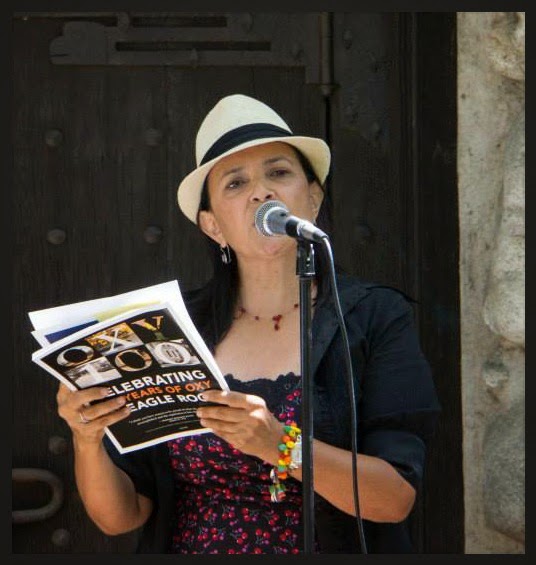 |
| Photo by Eliot Sekular, Lummis Day 2014 |


