Showing posts with label images of women. Show all posts

Tuesday, October 15, 2024

Women Achievers Celebrated in Southern California

35 Years Celebrating Women Achievers

Michael Sedano


Print magazines have become an endangered species in today’s media ecology. Magazine advertising sales declined since 2012 from an estimated 20 billion dollars to $5.5 billion this year, according to GroupM, a media-buying agency. One Southern California print magazine, Business Life, seeks to be an exception to the extinction model with a hyper-local print strategy with longevity. 


Serving California’s San Fernando and San Gabriel Valleys, Business Life has published since 1989. Compiling articles and writing original content, the magazine makes a major splash in its regional market with its annual celebration of Woman Achievers. It’s an inspired and worthwhile endeavor singling out small-business owners and executives of larger enterprises. 


The magazine’s not exclusively print. It has a Facebook page along with its web presence. (link) https://www.businesslife.com Those attending the gala luncheon took home back issues along with the current issue, Vol 35 No 2. The print magazine’s ideal spot is waiting rooms where people can hold the news in their hand as opposed to using a phone that might suffer from low battery and weak signal strength, or irritate neighbors with grudges against electronics in public. Subscribers get mailed at least six issues a year. 


La Bloga is honored to have attended the magazine’s luncheon for the 2024 roster of Women Achievers recently, the 35th anniversary of the award. We were invited by honoree Thelma T. Reyna. Reyna, a poet, this year is honored as publisher of Golden Foothills Press (link) and principal of The Writing Pros (link), an editing nservice offering one-on-one consultations.    

Excitement reigns as families and friends capture their own memories


The gala luncheon features a ballroom filled with ten-person tables that quickly fill as guests wait for the program. Energy electrifies the atmosphere, happy conversations create a din that raises voices and leads some guests to lean into one another to be heard.

Grand Entrance, Greg Krikorian slaps hands with Thelma Reyna


The program begins with the grand entrance of honorees similar to the entrance of the Chancellors of the Academy of American Poets at that organization’s annual celebration. A heavy rock beat announces the procession. Publisher Gregory S. Krikorian greets the entering women who navigate to their respective tables. 


The magazine singles out four women as a “Woman of Distinction,” “Exemplary Leadership,” and two “Lifetime Achievement” honorees. Twenty-seven women complete the 2024 roster as “Women Achievers.” The four deliver extended remarks before the other Achievers approach the stage to receive ornately calligraphed certificates from the magazine, the State Assembly, and Los Angeles County government.


Business Life is largely a family endeavor. Krikorian’s father founded the magazine and the masthead lists numerous Krikorians at various levels of responsibility. It’s encouraging seeing the diversity of honorees, which include Armenian, Black, Raza, Pinay, Anglo achievers.


Gerda Govine-Ituarte composed a poem for the occasion

The awardees represent a rich cross-section of businesses, insurance, health, education, government. Family stands out as a shared value among all the speakers, who acknowledge husbands and kids with the unspoken idea that behind a successful woman is a family who has her back.

Thelma T. Reyna advises
"with every fiber of your being, determine to make a difference."


With the US about to elect its first woman president, that’s still not enough recognition. Business Life’s motivation is to correct the neglect of the influence and effectiveness of professional women and business leaders. The magazine states, “So many women were doing so many good things, but not enough people knew about their stories. The Krikorians were acquainted with many worthy women in various fields, excelling professionally and contributing to civic and philanthropic efforts. These were the women who did not receive sufficient acknowl- edgement as corporate or civic leaders, and not enough were in the board rooms where decisions were being made...but they were out getting the work done - supporting causes, being active entrepreneurs, achieving professional success, and contributing significantly to the quality of life enjoyed in the San Fernando and San Gabriel Valleys.”


La Bloga happily shares news of this year’s event, invites readers to explore the magazine’s website for the history of the award along with meeting past achievers. Nominations for 2025 Women Achievers open in Spring. Past awardees and other leaders participate in the nomination process.

2024 Women Achievers Honorees


Tuesday, September 29, 2015

Gluten-free Delight. Leading Ladies at Forest Lawn. News&Notes.

Michael Sedano

For the Autumnal Equinox, the Gluten-free Chicano traveled to his favorite part of the country, the Coachella Valley desert. Not that the Palm Springs area has as much desert these days as when he was a kid in the 1950s.

Development has ravaged the once-open fields teeming with creosote and chia bush, dotted regularly with jumping cholla, fish hook and golden barrel cacti, horizons highlighted by stands of gorgeous blue-grey smoke trees, the even-then rare sight of ironwood trees.

A constant flow of freight trains rumble slowly up the grade
carrying full containers from Asia to market in the midwest and East Coast,
or dead-head empties downhill toward the Ports of LA and Long Beach.

Today, the horizon in San Gorgonio Pass has sprouted windmills, and more recently, solar farms, changing the ambiente of that entry to the valley.

Over time, miles-long stretches of citrus groves replaced that desert from Indio to the Salton Sea. The Gluten-free Chicano’s grandfather, Victor, grafted fruit on a citrus ranch bordering the Salton Sea. One visit, grampa handed us a wondrously sweet and easily-peeled Tangelo variety he’d developed. It’s in all the markets now, credited to someone else. As grampa would say, pos si.

Now an isolated oasis surrounded by development, a visit to Shields Date Garden
rewards with rare varieties of dates, assorted dried fruit, local honey,
and for barley-malt eaters, delicious date milkshakes. 

Today, many of those citrus ranches have been leveled. The drive from Palm Springs to Shields Date Garden on the outskirts of Indio once coursed through miles of naranja and toronja. The highway now runs past shopping centers, more shopping centers, and condo projects. And restaurants galore, from the fast-food usual suspects to fine dining.

Passing Las Casuelas Nuevas restaurant in Rancho Mirage always sets off a twinge of shoulda woulda coulda.

“Delgado started a food stand in Colton,” my Dad announced in his "I'll be darned" voice. In the 1950s, Dad and Delgado were aircraft sheetmetal workers at Norton Air Force Base. One weekend my Dad drove us over to a tiny hut near the railroad tracks on Mt. Vernon, one of those tiny burger shacks some entrepreneur had failed in.

Delgado welcomed us with open arms and a meal, a ravishingly delicious carne guisado on a paper plate with frijoles, arroz, and hand-made tortillas de harina. My gosh that food was a wonder. How I wish I could recreate that sabor. I remember licking the wax paper and the tin foil Delgado covered the plates with.

We never went back, though, because Delgado wouldn’t let my dad pay for the food, and that wasn’t our way, to take anything free.

Free. Delgado wanted my dad to partner with him in that restaurant. That also wasn’t our way—business. So Dad passed on what has become a Mexican dining institution in the Palm Springs area. Shoulda woulda coulda.

Clearly, The Gluten-free Chicano is no spring chicken and has lots of stories about that desert and the Inland Empire. Nowadays, when meal time approaches, he hangs his head in anticipated  disappointment, knowing even Delgado’s food will have wheat. The enchiladas suizas at Las Casuelas Terraza were the only safe entrée.


Then, wonder of wonders, The Gluten-free Chicano discovered Giuseppe’s.

Normally, a pizza and pasta joint is out of the question, pero sabes que? Giuseppe’s makes its own gluten-free pizza crust and take it from a man who misses pizza almost more than any other food but won’t eat most gf pizzas because the crust sucks, Giuseppe’s gluten-free pizza is the eighth wonder of the modern world.

A "small" gluten-free pizza is dinner and tomorrow's breakfast and lunch.

Thin, crunchy on the edges, not soggy where it’s covered with fresh tomatoes, rich cheeses, generous servings of pepperoni, sausage, and onions. Más mejor, the crust lacks the grainy texture of rice or potato flour that ruins most pizza bread, nor is there the slimy feel on the tongue, and sickening aftertaste of guar gum. Ay, Giuseppe’s, you make my heart sing!

Next visit, gluten-free pasta carbonara because that was Mrs. The Gluten-free Chicano’s order, on wheat pasta. For the wheat-eaters, Mrs. GfC says the hot, freshly-baked bread served to accompany our salad (beets, garbanzos, baby lettuce) is delightfully light and fluffy.

Giuseppe's is a small house but hugely satisfying. The waitstaff are warmly welcoming.

Giuseppe's Pizza and Pasta
1775 E Palm Canyon Dr, Palm Springs, CA 92264
(760) 537-1890


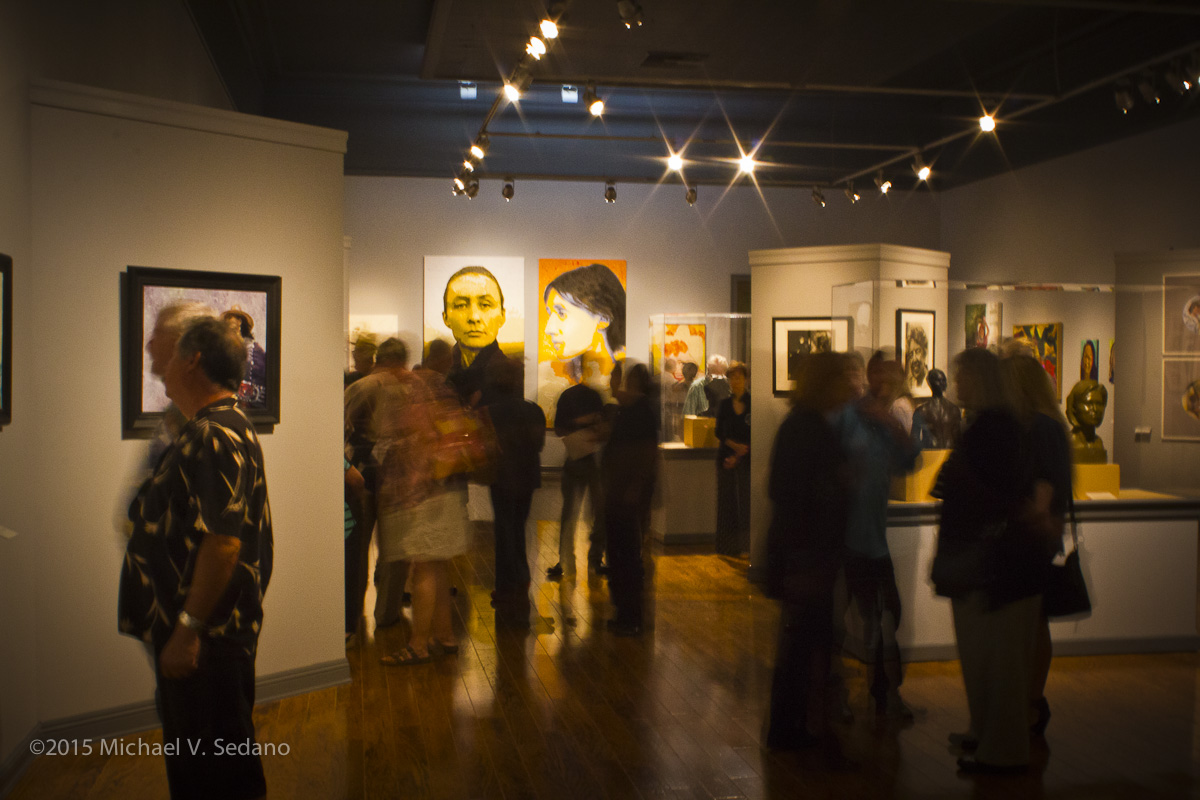
Leading Ladies at Glendale Forest Lawn Museum


La Bloga friend Margaret Garcia invited me to attend the opening of a spectacular exhibition chronicling an array of prominent women—from heroines of legend to real-world leaders, influential authors, and courageous trailblazers, Leading Ladies—from Fantasy to Reality.


The museum, at the crest of Glendale CA’s Forest Lawn, showcases more than 75 works including paintings, bronzes, photographs, and maquettes of luminary women like Frida Kahlo, Eleanor Roosevelt, Hilary Clinton, Michele Obama, Mulan, Georgia O’Keefe, Maria Guardado, Beverly Sills, Marian Anderson.


The exhibition marks the culmination of curator Joan Adan’s tenure at the museum. Adan’s shows have been spectacular gifts to the community. La Bloga sends best wishes to Ms. Adan for a glorious retirement!

Adan’s final exhibition runs through March 2016 so there’s plenty of time to take in the arte. Admission and parking are free.

Sandra Cornejo and Margaret Garcia strike a pose in front of their work.
The Forest Lawn Museum
Tuesday – Sunday, 10am – 5pm (closed Mondays)
1712 S Glendale Ave, Glendale, CA 91205

News&Notes
UC Merced Reading Thursday 10/1

UCM's Merritt Writing Program and Write! Look! Listen! present a reading by La Bloga friends and  poets Meg Withers and Odilia Galván Rodríguez.

This event is supported by Poets & Writers through a grant it has received from the James Irvine foundation.

Thursday, October 1st, 2015, 7:00 PM
University of California, Merced
Kolligian Library 355 (Green Room)

Pay for parking in yellow permit dispensers.


From Philadelphia's Al Dia
Poet Laureate Juan Felipe Herrera Casa de Colores Project
foto:msedano

http://aldianews.com/articles/culture/literature/juan-felipe-herrera-wants-write-epic-american-poem-you/40457

Every poet laureate commits to undertake a public project during the year he or she is designated poet laureate. "La Familia" is only one part of Herrera's project which was outlined in full at the Library of Congress National Book Festival, Sept. 5. The full project "La Casa de Colores" (the house of colors) will focus on the resources of the Library of Congress in a monthly feature; "El Jardín" (the garden) will have Herrera interacting with items at the library through videos, poems and blog posts.

"The House of Colors is a house for all voices," Herrera said. "In this house we will feed the hearth and heart of our communities with creativity and imagination ... if it is a 'casa,' a grand house for all of us, we must be a 'familia,' a family. A family cannot flourish without a 'jardín,' a garden to care for, to create. Our garden is our luminous Library of Congress with inspirations nestled inside for more than 200 years."

More information at the Library of Congress, here.


Tuesday, March 09, 2010

Review: Waking Up in the Land of Glitter. Art News: Circle of Women Stamp Project

Monday, March 8 observed "International Women's Day. Tuesday's La Bloga extends that observation one additional day with a pair of women-related columns. This way we can have two days for women, and only 363 days not for.


Kathy Cano-Murillo. Waking Up in the Land of Glitter. NY: Grand Central Publishing, 2010.
ISBN: 9780446509244

Circle of Women Stamp Project

Michael Sedano

Kathy Cano-Murillo stands as one of the prime expositors of what I want to term Situation Comedy Literature, though some might say "Chica Lit". The term comes out of my memories of television's "My Little Margie," "Our Miss Brooks," and "I Love Lucy." A woman puts herself in a sticky predicament and by dint of clever machination and blind luck makes everything work out in the end, always leaving its audience with a heart-warming chuckle and a half hour or hour of mindless entertainment.

Covering Waking Up in the Land of Glitter's 302 pages (336 including appendices), requires a little more than an hour, but with the passage of a couple days or a long airplane ride, the reader is sure to be left with the pleasure of largely mindless entertainment. That's a good thing, despite--or because of--the formulaic, almost stereotypic characters and abbreviated plotting.

Three women share a common interest in crafts and crafting. Estrella--Star to everyone but her parents--and Chloe are whitewashed twenty-something Mexican Americans who meet and strike up a mutual animosity. Ofie, Star's best friend, is young thirties basket case who takes refuge in crummy craft projects. Star calls herself an artist but doesn't make art; she books talent into her family's restaurant-cum-gallery and is in love with an accomplished artist. Chloe--Crafty Chloe--is a local television celebrity on the arts beat, "a role model for artistic Latinas". She does a regular crafts spot but secretly hates crafts. Chloe's assistant does all the crafting and seethes in the background as Chloe shines in the klieg lights taking all the credit.

Things fall apart between Star and Theo after she spraypaints happy faces across his masterpiece mosaic mural. Cute as she is, Theo cannot bear the string of vast projects undertaken with half vast ideas that is Star's modus operandi in life. On and off camera, Chloe lives a lie. Sexually manipulated by a sleazy station manager, shacked up with a passionless loser, as well as stealing the assistant's craft creations, to her mind Chloe's ambition justifies her sins. Poor Ofie. Obese, frumpy, a dismal housekeeper, she spends more money on craft supplies than running her suegra-dominated household. Ofie's craft work sounds disastrously pathetic.

The "waking up" part of the title reflects how Star, Chloe, and Ofie come to realizations of the emptiness of their lives and learn to see value in others. Poor Ofie. Her friends laugh about her creations behind her back even as they reinforce her behavior to her face. Learning this truth, she breaks down and cuts herself off from her new-found friends.

Star's irresponsibility comes of being la consentida of hippie new age parents who indulge their only child's every whim, until the grafitti vandalism incident. They fire her from the family business and demand she pay rent to live in their home. Forced to stand on her own two feet she makes small to giant steps, becoming more self-assured by learning to work in mutual respect with peers, especially her chola prima Star had blamed for Star's own misbehavior.

Chloe's awakening comes of realizing that Star and Ofie have a freedom and happiness that Chloe has walled off from her own life, just to be a big teevee personality. Hers is a public humiliation, broadcast all over Phoenix when her assistant and loutish lover conspire to unmask Chloe's false face and screw-the-boss-to-get-ahead antics.

A child shall lead them. Ofie emerges healthy and prosperous, the lowest of the low to the highest of the three, after an outcast boy teaches Ofie to crochet. Ofie becomes the Craft Olympics speed crochet champion, garnering teevee spots and books. After being the butt of cruelty, readers will long for a more elaborated description of the contest here.

Star and Chloe get their respective men, and thus, happiness. Ofie's already got a loyal man supporting her through every rough spot she brings upon herself. Star gets Theo back, Chloe has a one-night stand but it sure looks like authentic love. And they probably live happily ever.

Waking Up in the Land of Glitter isn't going to land on anyone's list of canonical Latina literature, and you're sure to spot glaring Spanish deficiencies here and there (Los cuatro milpas?) but that's not the point. The book is for a certain reader and serves her him well. Cano-Murillo provides a woman's eye view of some young women's thought patterns, despite the oddball behaviors, that is sure to entertain a reader looking for a couple hours of mindless entertainment. Planning on a cross-country airplane ride? I have just the book to make that boring journey pass quickly and leave you with a smile on your face.


Circle of Women Stamp Project Launches First Gallery Show

I am happy that noted artist Margaret Garcia invited me to participate in the Circle of Women Stamp Project. My piece is the second from left in the announcement below. Margaret has already arranged two gallery exhibitions, the second coming in July at Avenue 50 Studio in Northeast Los Angeles, the initial exhibition in East Los Angeles' premiere art space, ChimMaya Gallery. Following the announcement are Margaret Garcia's thoughts on bringing this still-evolving show and project to fruition. You can view more of the work, and new additions as they come in, at Ms. Garcia's Facebook Page. The individual prints are priced extremely affordable, allowing gente to buy several for themselves as well as treasured gifts. Organizers of local events may wish to bring the exhibit locally. Contact Margaret for details.


Our Federal Government’s STIMULUS PACKAGE does not in any way acknowledge or support what truly does need to be stimulated, cultivated and encouraged in our society and in the world.

I am inviting visual artists, poets, musicians, print-makers, or just people of culture to create a STAMP IMAGE. Each stamp will bring to life an affirmation which we desire to be STIMULATED OR CULTIVATED amongst us—for example, health, wealth, love, creativity, generosity, intuition, humility, faith, illumination, spirituality, forgiveness, intelligence, wisdom, courage, growth, tolerance, hope, vision, abundance, talent, music, kindness, fellowship, prosperity, etc.—whatever you are IN FAVOR OF…NOT AGAINST.

My hope is that the creation of these stamps will bring attention to what is truly important.

This project was conceived by Margaret Garcia as part of the Circle of Women. The red postmark of the Circle of Women will be placed on each print.

The final serigraph print size is 7" x 9-1/2".

PRINTER: The Master Printer is Ramon da La Rosa, who has worked with Artists, Ignacio Gomez, Shepard Fairey, Banksy, Ron English and Margaret Garcia

STAMP VALUE: My intent is to establish a market value of $20 per piece. The prints will belong fully to the artist.

STAMP EXHIBITIONS: There will be an exhibit of stamp art and opportunities for print exchanges. Venues in Los Angeles, Texas, Oxnard and San Francisco have expressed interest. To help support this worthwhile project, each artist will tithe 5 of their prints to the Circle of Women.


That's March's second Tuesday, a Tuesday like any other Tuesday, except You Are Here. Thank you for visiting La Bloga. See you next week.

ate,
mvs

La Bloga welcomes your comments on this and all columns. Click the comments counter below to add your observations. La Bloga welcomes guest columnists. If you have a book review, an extended commentary on something you've read here at La Bloga, a literary, arts or cultural event to report, or something from your writer's notebook, click here to discuss being our guest.

Sunday, August 23, 2009

Who's that Woman in the Zoot Suit?

Olga Garcia Echeverria


The Woman in The Zoot Suit.
Catherine Ramirez.
Duke University Press

This past week, I was smitten by The Woman in the Zoot Suit. I carried her around in my plastic book bag like a secret treasure. She rode shotgun in my car, spoke to me in Calo. We shared Vietnamese coffee and sandwiches over lunch. And of course, she was my bed buddy in the early mornings, late nights, or whenever time allowed.

When I wasn't highlighting passages in Catherine Ramirez' book, I found myself staring at the cover. The featured picture, printed in the Los Angeles Times in 1942, is both intriguing and haunting. It captures three young Chicana women being taken into police custody for allegedly being members of a pachuca gang, the Black Widows. One woman is gazing directly into the camera. I can't look at her without wondering who she is and what she's thinking. In fact, she inspires a litany of questions...

Who are these young women in baggy pants and huaraches entering a police car? What are their stories? Why have they and other women like them of the World War II era been so largely ignored by scholars and historians? And how is it that el pachuco (once demonized as a social menace, effeminate dresser and clueless pocho) got re-envisioned into history as an icon of masculinity, resistance, and cultural pride, whereas his female counterpart, la pachuca, dwindled into erasure?

These are some of the questions that Ramirez tackles in The Woman in the Zoot Suit. Her book, which focuses on Mexican Americans in Los Angeles, re-examines the Zoot Suit Riots, the Sleepy Lagoon incident, World War II, and parts of the Chicano Movement. Drawing from a variety of sources, such as literature, film, interviews, pictures, trial transcripts, and newspaper articles, Ramirez locates la pachuca and reinserts her into the historical and cultural narrative.

There are many engaging elements in Ramirez' work. One of her most interesting arguments is that the zoot suit and those who wore them (both female and male) destablized race, class, and gender categories. Whereas men in zoot suits were orginally thought of as excessive and feminine, pachucas were seen as transgressing into the domain of men and masculinity. In this way, Ramirez argues that pachucas and pachucos queered American and Mexican American culture.

This, however, changed for el pachuco during the Chicano movement. Chicano cultural nationalists, such as Luis Valdez and Alurista, "unqueered" el pachucho and redefined him and zoot suit subculture as primarily masculine. In addition, they elevated el pachuco to the status of rebel and cultural icon. Meanwhile, the pachuca continued to be overlooked.

Pachuca Sketch by Sergio Magallanes

We're reinserting her here in a sketch to honor her a bit and to summarize her attire and look, which Ramirez discusses in detail. This particular pachuca is very cool in her huarache sandals, although more feminine pachucas might have worn short skirts and heels. Her hair is styled into a pompadour. This was also known as a razor blade hairdo, as la pachuca's big hair was supposed to serve as a perfect hiding place for razor blades. Myth or reality? Perhaps in la pachuca's world you never knew when you were going to have to throw down. Also emblematic were her thinly plucked eyebrows and her dark lips, traits later visible in cholas and cha cha girls. Some pachucas donned the zoot suit jacket with a skirt that fell above the knees, scandolous attire at the time. Others, like the sketch here, wore the entire tacuche or zoot suit, taking on a masculine or butch persona, and therefore signaling gender and sexual transgression. According to Ramirez, it was this transgression that challenged heteronormative views of nationalism, like La Familia, and that ultimately relegated la pachuca to status of "other" and "outcast."

Ramirez points out that la pachuca was shafted and othered within American nationalism as well. She did not, for example, meet the racial or gender norms of mainstream WW II figures, such as Rosie the Riveter, the housewife, mother, and servicewoman, all of which were featured in wartime American propoganda and were exalted as legitimate citizens and women.


So much more can be said about The Woman in the Zoot Suit, but I will stop here and encourage you all to pick up a copy of Ramirez' book and read for yourself. This is definitely an important body of work that sheds light on la pachuca and how the history of erasure impacts cultural movements and thought. Here is la pachuca academic, Catherine Ramirez, answering a few questions about her work.

What drew you to the pachuca or the woman in the suit zoot?

The pachuca attracted me because, quite frankly, I thought she was cool. In the late 1990s, when I began doing research for my dissertation (the seed for my book), I found her mysterious and transgressive. Like many other students of Chicana and Chicano history, I didn’t know much about pachucas, in great part because they had received so little attention from scholars. I perceived them as transgressive because they appeared to challenge rigid, particularly middle-class and heteronormative, definitions of feminine comportment and beauty. And I liked their clothes, hair, and makeup.

When I was a teenager in the 1980s, my friends and I wore our hair big and high. We also favored black liquid eyeliner and dark lipstick. When my father told me that we looked like pachucas, the girls he used to fear when he was growing up in East L.A. in the 1930s and ‘40s, he piqued my curiosity. Yet, as the project unfolded, I was surprised to see how unenigmatic and ordinary many female zooters were. All of my interviewees, for example, were students, workers, mothers, daughters, and/or wives. Despite the generation gap, they weren’t very different from many of my friends and me. Once I saw their mundaneness, I was struck by the discrepancy between la pachuca as icon and the real, flesh-and-blood zooterinas who have shaped and been shaped by history. I decided to probe this inconsistency further in The Woman in the Zoot Suit.

Can you speak briefly to the void that your book fills in Chican@ and American history?

The Woman in the Zoot Suit is a response to previous stories about the Mexican-American zoot subculture, many of which have focused on men and masculinity and have privileged race as a category of analysis over those of gender and sexuality. While I do not dismiss the roles of race, ethnicity, or class in our understandings of this subculture or the events associated with it, such as the Sleepy Lagoon incident of 1942 and the Zoot Suit Riots of 1943, I believe that there’s more to learn from other social identities and relationships. In short, the story and its meanings change when gender and sexuality are brought to the fore.

What initial challenges did you face in researching la pachuca?

When one of the professors with whom I worked as a graduate student warned me that there was insufficient material for a dissertation on pachucas, he didn’t discourage me from pursuing this project. Rather, he motivated me (although this was probably not his intention). My initial reaction to his comment was, Whatever, dude. I will prove you wrong. Then I asked myself, Why the denial? Why the dearth of material? What counts as “material” anyway? Those questions ended up driving my project.

How did you proceed with your project after that initial interaction with your professor?

Because of my professor’s warning, I believed that I needed to create material, so I launched into my research by interviewing Mexican-American women who came of age in Los Angeles during the 1930s and ‘40s, the peak of the zoot suit’s popularity. In other words, my dissertation started off as an ethnography. I began by interviewing family members, mostly aunts. Then I posted flyers in and around East L.A. at places that attracted elderly Mexican Americans, like senior citizen centers. If I recall correctly, the flyer read, “Do you remember the zoot suit? Did you wear one or did you know anyone who did? Were you living in L.A. in the 1930s and 1940s? Do you remember the Sleepy Lagoon incident or Zoot Suit Riots?” Dee Chávez, one of my most interesting interviewees, contacted me after she saw a flyer at a recreation center in Monterey Park. At first, she claimed that she didn’t remember much and she was concerned that she wouldn’t be very helpful to me. She turned out to be a trove of information.

What were you expecting to discover about the women you interviewed and what did you find?

I wasn’t sure what I would learn from the women I interviewed, but I can say that I was hoping they’d simply shed light on the zoot subculture in L.A. in the 1930s and ‘40s. I wanted to know what they did for fun when they were young, where they hung out, how they wore their clothes, hair, and makeup, how and where they acquired their zoot suits, and why they wore them in the first place.

I wasn’t expecting so many of my interviewees to reject the label pachuca, or to show discomfort or disapproval when I used it. When this happened, I feared that I might have to abandon this project. However, rather than ignore their resistance or give up altogether, I decided to explore it. Why was the pachuca so scary to some of my interviewees? What did this figure signify to them and to a later generation of Chicana and Chicano cultural workers?

So, why was la pachuca so scary to some of these women you interviewed?

I believe many of my interviewees had a vexed relationship to the pachuca because she embodies a dissident, highly racialized femininity. While my interviewees wore or borrowed from the zoot look and considered themselves respectable, they told me stories about pachucas who continued to speak Spanish in school even when they were forbidden to do so, who talked back to teachers (and were disciplined as a consequence), who smoked cigarettes in public, who showed more leg and cleavage and wore more makeup than any of their peers, who cut up the dance floor, who refused to step aside when someone attempted to walk past them on a sidewalk, and who weren’t afraid to throw down.

In regards to Chicano history and cultural production, why has the pachuca been so threatening and so greatly ignored?

I found that the pachuca was threatening precisely because she was simultaneously too feminine and not feminine enough—too masculine, in other words. She frightened her contemporaries (e.g., many of my interviewees) and a later generation of Chicano cultural workers, particularly those with an investment in patriarchy and heteronormativity. For this reason, many writers, artists, scholars, and activists have ignored her. However, movement-era Chicana feminist writers and artists, such as Judith Baca, Inés Hernández, Carmen Lomas Garza, and Cherríe Moraga, recognized the pachuca’s dissident femininity and ran with it. Indeed, Moraga’s character, La Pachuca, in her 1984 play Giving Up the Ghost is a butch lesbian.

You use a variety of sources in your book. Can you comment on this?

The Woman in the Zoot Suit is a recovery project. That is, it seeks to bring to light that which has been buried or ignored. Based on its methods (e.g., oral history, textual analysis) and questions, it’s a combination of history and literary criticism. I drew on an eclectic array of sources out of necessity. Narrating a story about la pachuca is a bit like doing a puzzle: each source—for example, an interview, a photograph, a poem, or a newspaper story—represents a piece of that puzzle. I don’t think this puzzle can ever be completed, but scholars who are resourceful and flexible can help to clarify the picture.

Was there resistance within academia to the diverse types of sources you used?

In many ways, sources define academic disciplines. Literary critics often study “texts,” which are generally understood as poems, stories, or novels—fiction, in other words. Historians, in contrast, are supposed to work with non-fiction “documents,” like letters or court records. Irrespective of discipline, these sources are supposed to reveal something about truth and knowledge. To scholars with very conservative ideas about disciplinary boundaries, sources from multiple disciplines should not be mixed. However, I wanted and needed to see what sort of story they would tell when put together.

What have the responses to your book been thus far?

By and large, the responses to The Woman in the Zoot Suit both within and beyond academia have been very positive so far. My parents and old friends have told me that they’re very proud of me. Likewise, colleagues at universities and colleges across the U.S. have let me know that they like the book. Now all I need is for some of them to publish their praise in a book review or two.

What current or future projects are you working on?

My new project, on democracy and difference in the United States and Western Europe, was inspired by the late political scientist Samuel Huntington’s 1996 assertion that Muslims and Mexicans pose a “problem” to Europe and the United States respectively. Huntington argues that both groups are unassimilable and that, ultimately, we threaten the democratic societies we inhabit. I’ve been studying immigration and assimilation in the U.S., France, and Spain. I’ve also been brushing up on my French for the past couple of years. Although I’m still unsure how this project will develop, I’m interested in learning more about Europe and am excited to move into new disciplines and fields of inquiry, like sociology and political theory.

Thursday, July 23, 2009

Sandra Posadas, Vida Bella y La Voz Puertorriquena


Gente: I met Sandra many years ago, when we were both doing very different things....While our paths diverged, it looks like we both found our way to making art. Here's at look at a local women in the arts and an up and coming Latino theater group in Chicago.

Sandra Posadas is a second generation Puerto Rican woman born and bred in Humboldt Park, Chicago, Illinois. She is a teacher, published artist/illustrator, actress; cast member of the Vida Bella Ensemble, artisan; creator of Coqueta Creations by PiXie- a jewelry line for women. Sandra has been a Bilingual educator within the Chicago Public Schools for 12 years and was recently nominated for the Illinois Golden Apple Award. She's also an educator of teachers, and has presented her progressive early childhood approach to curriculum development and implementation at a variety of teacher conferences throughout Chicago. Sandra successfully co-wrote her first production, "Brown Girls Singing" which was successfully staged at University of Chicago and Jane Addams' Hull House.

Sandra performs her poetry at various Chicago venues and has presented her art work at various local venues including the University of Illinois @ Chicago Symposium for Women of Color in 2008. She holds a B.A. from Roosevelt University and is currently a working on her M.A. in Bilingual/ Bicultural Education at DePaul University. Sandra believes strongly in that art can educate. Through her poetry, canvasses, and performances. She believes in using art as knowledge and transformation so that all participants and spectators examine themselves in relation to their place in society. Through different modalities that she uses, whether visual, interactive, or the performing arts, the audience can explore, reflect, analyze and transform the reality in which they are living.


The Brown Girls’ Chronicles: Puerto Rican Women and Resilience
Written & directed by Yolanda Nieves, executive producer Mike Oquendo


Vida Bella Ensemble is thrilled to announce its upcoming performance of The Brown Girls' Chronicles: Puerto Rican Women and Resilience was SOLD OUT. Written and directed by author/playwright Yolanda Nieves, “The Brown Girls' Chronicles” are the stories of second generation Chicago Puerto Rican women who in their daily lives embody the struggle for independence of mind, soul, heart and body. The three-night run of “The Brown Girls’ Chronicles” will took place at the Chicago Center for the Performing Arts. The production will be mounted again, in Fall 2009. Check the group's myspace page for more info.

Following audience acclaim and a previous sold-out run in March, the May performances mark the second sold-out run of The Brown Girls’ Chronicles: Puerto Rican Women and Resilience. “I stand in awe of the support…” shares director Yolanda Nieves, “This play is a testament to the intelligence, beauty and resilience of who Latinas are.” The May performances took place May 28-30, 2009 at 8:00 p.m. in the 140-seat West Town Studio Theater at the Chicago Center for the Performing Arts, 777 N. Green Street in Chicago.

# # #

About Vida Bella Ensemble: Vida Bella Ensemble is an all Latin, all-female Chicago-based collective of inter-generational artists committed to communicating the stories of the trials and triumphs of the urban woman. In collaborative partnership the stories of such experiences are told through the performance of poetry, dialogue, monologue, song and movement. For more information about Vida Bella Ensemble visit www.myspace.com/browngirlschronicles or email browngirlschronicles@gmail.com.

About Director Yolanda Nieves: Award winning Chicago poet, author and playwright Yolanda Nieves uses the power of verse and the written word to teach and inspire. An accomplished writer, her work has been extensively published by college/university and independent presses and journals around the country. Her newest book, “Dove Over Clouds” (Plainview Press, 2007) has again garnered her acclaim for the themes revolving around the issues of race, gender, class and colonialism as it relates to the Puerto Rican/Afro-Puerto Rican Diaspora. Her work captures the spirit of hope, shaped by her Puerto Rican heritage, growing up in Chicago’s Humboldt Park and by the direct impact of women impressed upon her. Performing her poetry and plays in Chicago and all over the world, her performances have received great acclaim in England, Puerto Rico and Mexico.

She’s the founder and artistic creator of Vida Bella Ensemble performance troupe. Her collection of artistic work gives audiences the clarity of the experiences of women, mothers and immigrants. Full of passion and candor, she inspires audiences to expand their understanding of their own lives and the inspiration for them to tell their own stories. Yolanda resides in Chicago’s Humboldt Park and teaches at Wilbur Wright Community College.


About Executive Producer Mike Oquendo: Mike Oquendo combines his love of live arts and his production experience to produce over 70 shows a year in both the Chicagoland area and throughout the country. Creator of the "Mikey O Comedy Show,” Mike is a prominent force in independent productions. His shows and events have been featured on local TV, radio and print media including coverage by Telemundo, WGN-TV, People en Español, TimeOut Chicago, Chicago Reader and Metromix.

Two notable accomplishments include sitting on the Board of Governors for the National Academy of Recording Arts and Sciences which produced the first Latin Grammy's in 2001, and being a concept contributor on three HBO Latino specials in 2006. Mike was a production consultant for the Adler Planetarium’s "Luna Cabana Series" and the International Latino Film Festival, positions he held for 6 years respectively. Mike is particularly proud of continually raising funds for non-profit organizations that provide services and programs to Latino and non-Latino communities.


Lisa Alvarado

Tuesday, June 30, 2009

Review: The World In Half.

Cristina Henríquez. The World In Half. NY: Riverhead Books, 2009.
ISBN 9781594488559


Michael Sedano

Cristina Henríquez’ The World In Half is a deceptively complex, deeply romantic novel that should be next on your summer reading list, and an ideal choice for book groups who enjoy a rich discussion that balances decisions looked back on from middle age against possibilities open only to youth.

Deceptive because on its surface it recounts a naïve young woman’s search for an absent father whose identity has been a closely guarded secret by a steely, abrasive mother. Complex because the still-young mother’s mind has begun to fail under the merciless attack of Alzheimer’s Disease. As mother’s memory fades, the daughter fears what her own future health may bring, the total loss of her mother, and along with that, all connection to the mystery of her father.

Miraflores Reid, “Mira,” a University of Chicago scholarship student majoring in Geology, knows only that her mother lived in Panama with her husband, a Marine stationed in the Zone, where she conceived the child with an unnamed local. The pregnant woman returned to New York to live with her family near West Point, where Catherine Reid’s father taught. Mira wonders how difficult the pregnancy and birth must have been in that small-minded military town. Catherine is white. Was Gatún black? Danilo has “brown” skin, and Mira may “look” Puerto Rican, or like a local of whom Panameño travelers ask directions.

Escaping that life, Catherine takes her child to Chicago where she works a series of survival jobs as waitress, pizza delivery, receptionist. Mother keeps a wall between herself and the social world, treating others abruptly and welcoming little humor or flirtation into her privacy. Mira carries herself similarly, but this may simply reflect her nerdly scientific bent.

Much of the mother’s personality emerges over the course of the story. Early in the novel, as Mira is organizing her mother’s property, she comes across a box of letters her father mailed to the woman who abandoned him. Mira’s mother led the daughter to believe the man had no interest in either of them. The letters open Mira to a poetic and broken heart whose longing for a daughter and fugitive lover cries off the pages.

The letters provide two vital clues to help Mira unravel the mystery. A name, Gatún Gallardo, and an address in Panama. With these, the desperate young woman launches herself on an ill-planned, desperate quest to recover the facts of her own birth and reconnect with the heart-broken man. Fortunately for Miraflores, her mother has enrolled the child in Spanish language classes and, as a Spanish minor, she has superb bilingual skills.

Arriving in Panamá--note the diacritic, an authorial denotation that the English-language narrative is taking place in the local idiom—Mira makes friends with Hernán, a hotel bellman, and his nephew Danilo, an ambulante flower seller. Hernán invites Mira to move into their home while Danilo helps Mira track down the clues leading to her father. Danilo warms to the task of tour guide and intercultural informant.

Mira is a guileless virgin and would be easy prey for a womanizing school dropout like Danilo. But he wants to be her friend. In fact, the most serious crisis in their relationship occurs when, nearing the end of her stay, a drunk Mira caresses her host in a late-night conversation. He bolts and she spends the next day tracking him down instead of tracking down clues to her still-unreachable father.

Danilo looks into Mira’s heart and fears, and draws them out in conversation. On the surface, they talk of her fears that Alzheimer’s will strike Mira young, as it has her mother. On a different level is the parallel of Catherine coming to Panama to find a man, and here is the daughter, come to Panama and finding a man. The mother, nineteen years earlier, had returned home pregnant. Now here is the fruitless frustration Mira experiences of not finding any trace of her mother’s lover, even as Danilo unwittingly draws Mira’s affection toward himself.

The canal across the isthmus cut the world in half. That is what the laborers who dug the waterway used to say. Alzheimer’s is cutting Catherine and Mira’s world in half, as their personalities do in their social world. Mira stands astride both halves, her parental history on the one side, her own future on the other. How much will history repeat itself, will Mira make the same errors her mother has, abandoning love in Panama to a bitter life of denial in Chicago? Adding complexity to themes of choice and circumstance, Danilo’s story echoes Mira’s. He’s been abandoned by his parents, a difference being he has their address and phone number but they never call. That story lurks in the background as we work through Mira’s story.

Henríquez draws a parallel between mother and daughter when Mira meets her father’s sister in a rich part of town. A box of letters Gatún Gallardo never mailed to Catherine fills in blanks missing from the letters Catherine closeted. Mira gets unreasonably angry that Hernán and Danilo knew and didn’t help until her stay was near its end. Unlike her mother, however, Mira lets it out, confronting Danilo angrily. He convinces her that friendship and love were the motive for what Hernán and Danilo suspected, only suspected. They believed it would be preferable to keep hope alive in Mira’s heart, rather than break it with a hard truth.

The World in Half tells a complex story that a casual summary can only hint at. Cristina Henríquez rewards her readers with compelling narrative and touching personal portraits of the city and residents. Much of the enjoyment of the romantic nature of the novel comes as the story unfolds, and to disclose details will spoil the pleasure of seeing it firsthand with your own eyes. One indication of this comes in the names. Both Miraflores and Gatún are names of locks on the canal. It’s not just that a lock allows the uniting of both halves of the world, but that Catherine, despite closing off her daughter’s life from her father’s, gave her daughter a name like her father's, one that foretells her quest to bring both worlds together.

As the novel ends, Catherine’s illness grows increasingly severe and dictates much of what must come next. But beyond a daughter’s responsibilities lie the choices Miraflores can make, but that Henríquez leaves open to delicious speculation. Your book group will enjoy discussing and accounting for what happened in Catherine’s life, more so the undefined what ifs that lie ahead for a young woman like Mira and a young man like Danilo.

There's the final Tuesday of June 2009. A Tuesday like any other Tuesday, except you are here. Thank you for visiting La Bloga. And a quick question, with Independence Day hard upon us. How many other countries have a fourth of July?

mvs

La Bloga welcomes your comments on this and all columns. Click the comments counter below to add your observations. La Bloga welcomes guest columnists. If you have a book review, an extended commentary on something you've read here at La Bloga, a literary, arts or cultural event to report, or something from your writer's notebook, click here to discuss being our guest.

Tuesday, June 23, 2009

Review: Down to the Bone.

Mayra Lazara Dole. Down to the Bone. NY: Harper Teen, 2008.
ISBN: 9780060843106

Michael Sedano

Down to the bone is among the more challenging YA novels I’ve had the pleasure to read.The challenge is less to the reader than to the author, Mayra Lazara Dole. Not only must Dole work her coming of age plot to a happy ending, the author tasks herself to address gay sexuality in an ambiente of Miami’s Cubano cultura. The specific geography provides background for a work that should have widespread appeal for kids everywhere.

Dole, or her editor, recognizes the language gap between Spanish-literate readers and those less endowed. There’s a Spanish-English glossary that clarifies the majority of italicized expressions, even to obvious cognates like música and gringo, and the conjunction y. I looked for a description of a tortilla de platano, but it was omitted. As a certified senior citizen who digs YA and chica lit and is hip to a certain amount of patois, I would have appreciated glossaried help with such English expressions as “hooking up” and the title. Given the popularity of the phrase—a movie and a band share the name--“down to the bone,” I suspect that means something beyond the novel’s final line, “This is where I belong, loved and understood right down to the bone.” In my vocabulary, “hooking up” seems a clearly metaphorical allusion to forming a social alliance, but in Laura’s world, the phrase seems restricted to sexual union.

Scrunchy, née Laura Sofia, has already hooked up with Marlena, or maybe tonight's the night. For sure, they've shared passionate kisses. Laura and Marlena are eleventh graders and deeply in love. Back in the day, this might have been called “puppy love” by adults who remember the first time is not necessarily lasting. But that’s not Laura’s world view. Por vida, that’s what Laura feels. And that’s what Marlena says, too, in a love note Laura’s reading on the last day of school as the novel opens. Daydreaming, the vivacious teen doesn’t hear Fart Face, Sister Asunción, ask a question. That daydream leads to a world of hurt.

Adults in Laura’s world fit one of two types. There are the horrorshow assholes, like the nun and Laura’s mother, or there are the totally cool, like Viva, the mother of Laura’s best friend, Soli. Mostly it’s a world of the former, until Laura discovers Miami’s gay society. Laura’s classmates fit into the former tipos, too. “Muff diver!” they shout, after Sister seizes and reads Marlena’s note to the entire classroom.

Being kicked out of Catholic school is not punishment enough. Laura’s mother demands to know the identity of Laura’s degenerate friend, and, failing that, kicks Laura out of her home until Laura identifies the lover and accepts heterosexuality. Find a man, get married.

Viva and Soli love Laura unconditionally, mirror images of the horrid mother whose love is conditioned on the teenaged girl complying with the mother’s every demand. As much love as Laura feels in her cramped temporary abode, still the daughter wants to go back home to her mother’s love, and to remain in her little brother’s life. I worry about that kid, given that mother.

Laura meets a boi—another term some readers will learn—who befriends the emotionally devasted Laura. Tazer, a rich woman virtually abandoned by her father to a luxurious pad, prefers to present himself as a male. Tazer wants to start a love affair with Laura, but he is not what Laura wants. It’s an interesting view of gay choices. Dole makes the point that gay gente don’t hook up with promiscuous abandon. Like all people, Laura and the gay world she enters are concerned with choices and motivated by emotional attraction. The one who flits from lover to lover is la Soli, a confirmed heterosexual. (Who will come around in the end to a decent but spurned lover).

The worst choice a person can make is to conform to outside pressures, especially when these are inimical to one's self. Laura denies her desires and starts dating a hot-to-trot man. Hoping she’ll fall in love with him, she falls into his arms and into his bed, but doesn’t “hook up” with the conquest-minded hottie. Marlena, on the other hand, is whisked away by her family to Puerto Rico, to be brainwashed by a fundamentalist church. Laura finally gets a “dear Jill” letter from the about-to-be married Marlena, who washes her hands of their love, wishing for Laura to reject herself and become a betrayer like Marlena.

I’ve summarized only a few key plot lines in this engaging novel. Dole’s depiction of Laura’s peers takes the novel into a similar direction as the adultcentric line. There are STD, clubbing, dancing, blind hatred, krypto personae; all adding rich texture to the teenage scene. Sadly, Dole doesn’t dwell on the tragedy of Laura quitting school to work full time to support herself, nor look forward to what happens in three or five years. Will Laura graduate? Get her landscape architect degree? A contractor’s license? Such unexplored possibilities are sorely lacking in an otherwise edifying story that likely mirrors what’s happening for countless teens facing amor prohibido, whether parents like it or not.

Irrespective of sexual identity or activity, teenagers and adults will take serious thought from the novel. Laura and Soli are healthy, happy children. As such—children—they control only some elements of their environment, and expose themselves too much to risky behaviors, e.g. a speeding cab runs down Laura on her bicycle in a late-night accident. Adults might find difficulty allowing a child the kind of freedom Laura takes, but only because her awful mother is such a narrow-minded person. Viva, perhaps, allows her daughter and live-in friend too much liberty, but because the girls make good choices, little harm comes of going overboard in this direction. Obviously the restrictive nuns and birth mother’s rules produce dysfunctional results. Dole’s lesson is a good one: trust the kids to make good decisions. Despite the poor raising Laura got from her mother, she makes those decisions because that’s the right thing to do. Trust the kid to know her heart and take the proper course.

Still, there’s nothing like reasoned adult upbringing to help a kid grow into the kind of adult I hope Laura, Soli, Tazer and the rest will. Adults would profit from YA work like this, if only to know what, or whom, is influencing the next generation's views of their inheritance. As my dad liked to say, pa'lla va la sombra. Let's see what kids can do that we didn't. In Dole's world, there's a montón of intractable caca that won't take care of itself.


That's June's penultimate Tuesday. A Tuesday like any other Tuesday, except you are here. Thank you for visiting La Bloga. Please invite your friends to stop by, read, leave comments--las huellas de sus pasos.

ate,
mvs

La Bloga welcomes your comments on this, or any, daily column. Click the Comments counter below to share your thoughts. La Bloga welcomes guest columnists. If you have a book, arts, or cultural review you'd like to share, or something about writing from your writer's notebook, click here to discuss being our guest.

Tuesday, June 09, 2009

Review: Marie Arana. Lima Nights.

NY: Random House, 2009.
ISBN: 978-0-385-34258-2 (0-385-34258-6)

Michael Sedano

Maria walks into the central city crowd, homeless, destitute, the rest of her life in front of her. And that’s that. Bluhm chases her, losing ground until suddenly she is not there.
After twenty years with Maria, before that life with a wife, his mother, two kids, a maid, Carlos Bluhm stares into the brownness of the city numb with pain, oblivious to the crowd’s resentment of his gringoness on their streets. In the distance, Bluhm’s German-Peruvian pals call his name to bring him back into their protective embrace. So ends Marie Arana’s Lima Nights. It’s a novel whose pages you keep turning not because the characters are endearing—quite the opposite—but to see if there’s a point to Carlos Bluhm’s loser of a life.

Maria has never been there throughout the novel, despite her pivotal role in the mess that is Bluhm’s life. He first spots her at a taxi dance bar, Lima Nights, where women keep men buying liquor, then after hours making whatever deals they can turn. An experienced woman counsels Maria to capture a man’s attention by slipping her datos into the guy’s coat pocket. Make a good choice and a woman earns long-term security and a taste of the good life that comes of being a man’s mistress.

Maria chooses Carlos, a forty-something man out on the town with his three pals. Not that Maria’s been on the job all that long, or other work for that matter. She’s fifteen years old, a couple weeks from turning legal. Maria desperately wants out of a life in Lima’s worst slum, her mother an alcoholic who takes in men and laundry to support Maria and her two brothers. Talk about highly motivated to do whatever it takes to shake free of that futureless history, that’s Maria. If something good has come of Maria’s years with Carlos it’s the slim chance that her future will not be to return to that slum and her mother’s footsteps.

But Lima Nights is not Maria’s story. And it’s not Carlos Bluhm’s, despite his central role. Lima Nights is a political novel. Marriage politics looms above all, defining the tragedy that comes to familia Bluhm. Arana casts a cold, subjective eye on men’s philandering and women’s tolerance. Except for Oscar the shrink, the cohort are scions of rich families down on their luck. With their grandfathers’ economic empires dismantled, the men live in Lima’s elegant houses but work regular jobs like camera salesman, appliance store entrepreneur, hotel manager. Bluhm struggles to make ends meet; to pay for his pleasures he begins dismantling his heritage, selling family silver and pre-hispanic artifacts.

Maria never gives a conscious thought to what she’s done to Bluhm’s family, other than one uncomfortable moment staring into the eyes of Bluhm’s younger son, who is older than Maria and who finds Maria beautiful. The women’s attitudes range from bitter resentment of the men covering for each other to zero tolerance only when confronted by hard proof. That’s Bluhm’s wife. Only when confronted with firm evidence of Bluhm’s tryst with the Indian girl, does the wife move out, taking Bluhm’s mother with her, and the maid. Maria moves into the empty house the first night. It is an empty dream but she takes full advantage of it, investing the next twenty years of escape in making the nest a comfortable home.

Bluhm’s friends cannot understand his actions. Not that the girl is not alluring, nor that she’s only fifteen. Only the psychiatrist is troubled by the child’s age. For his part, Bluhm anxiously waits until her birthday to make his first physical move on her. Maria’s main fault is being a chola--brown-skinned India. Indians like her, according to Bluhm’s buddies, are good for a one-night stand but not someone to settle down with. It’s an attitude Maria feels too, thinking herself disposable to men like Bluhm.

This vicious prejudice permeates Bluhm’s light-skinned society. It is the immovable force against the irresistible force of Peru’s indigenous and mestizo masses. This ugly undercurrent of hatred converts Lima Nights from a sadness-infused battle of the sexes fable to a frustrating metaphor for Peru’s decaying colonialism. The intractable divide between cholas like Maria and white-skinned Europeans like the Bluhm’s German-Peruvian social circle offers no escape to either side. There is hope. Bluhm’s sons wash their hands of their father’s past—neither of them wants nor needs the old place, they’ve carved out their own fortunes by dint of their own labor. Just as there’s hope that Maria’s future will not be like her past, if she can parlay into a job what she’s learned as a chola living a middle-class gringo life. If not, there’s always the slum, or the Shining Path, or something less.

A ver, Maria. Suerte. Carlos, you did it to yourself and whatever happens next, you have it coming. Readers have it coming to them to enjoy Arana's Lima Nights.

There's the second Tuesday of June 2009. A Tuesday like any other Tuesday, except you are here. And thank you for visiting La Bloga.

mvs

La Bloga welcomes your comments. Click the Comments counter below to share your thoughts on today's or any column. La Bloga welcomes guest columnists, as last week when Lydia Gil reported on Luis Urrea's reading at Denver's Tattered Cover. If you have a book review, or an arts or cultural event to report, click here and tell us about your guest column.

Tuesday, May 19, 2009

Review: Hungry Woman in Paris is Code

Josefina López. NY: Grand Central Publishing, 2009.
ISBN: 9780446699419


Michael Sedano


From its opening paragraphs, Hungry Woman in Paris reads with the same hyperbolic first person breathlessness of a Young Adult chiclit novel. But mothers, don't let your girls read Canela's story until they're engaged--at least--if not married. And if that adventurous daughter of yours reads Hungry Woman in Paris despite your censorship, then tells you she wants to go to Paris on vacation, alone, tell her you know about the swinger sex club scene, so don't get any cochina ideas about doing a ménage a quatre right there on the dance floor. Wouldn't she prefer a nice trip to Disneylandia, instead?

Your teenage boys will keep the novel under the mattress, and share the "best parts" with all their friends.

All of which means Josefina López achieves her purposes to, in turn, amuse, shock, tempt, and taunt sundry readers lacking the good sense to recognize Hungry Woman in Paris as a deliberately outrageous pastiche of the chiclit genre, with a generous helping of Henry Miller and Anaïs Nin. Hemingway? Canela is the movable feast, which is part of the joke, and López' affront to prudes everywhere.

The novel is an almost complete success. I say "almost" because López' first person voice leads me to wonder if there's more than a soupçon of autobiography in this ribald tale of a failed journalist on the lam from a prima's tragic suicide and the bizarre velorio, a failed engagement, an irate mother, and her own depression. Naturally, she enrolls in cooking school.

This is not your mother's Como Agua Para Chocolate, despite the recipes and cookery. Canela stumbles her way through class, affronting classmates, seducing chefs and translators, earning a few measly Euros posing nude or helping Japanese tourists buy Louis Vuitton merchandise, and, with her typically impulsive thoughtlessness, help a Turkish woman escape her husband's vengeance. Más, she then inserts herself into the notorious riots of Arab youth contra French racism, and plays cougar to a Arabic rapper from the projects. Then...other stuff happens. This is the kind of novel that readers are advised to just sit back and let unfold.

Hungry Woman in Paris boldly takes Chicana literature into places where, like a literary Star Trek, no woman has gone before. Not that there aren't a few perplexities.

Canela comes out of Boyle Heights, a semi-successful writer but a failure to meet her Mexican-American family's standards to be a good Mexican daughter. Conflicting cultural norms play havoc with Canela's and her family's expectations. Canela's spent a lifetime fleeing them with no particular direction, and this has been further complicated by US immigration strictures. France, Canela discovers, is a lot like the US, except in many ways, worse, for immigrants.

That's right, "Mexican-American," a curious choice, given Canela's upbringing among the Mexicanas and Chicanas of Boyle Heights, her allusions to protests she's been involved in, and her kick-ass attitude to rules and external controls. Canela is conscious of the distinction, electing the binational term because "Chicana" would be too difficult to explain, with her limited French. But that's the public Canela. Yet, even the private Canela prefers the hyphenated identity term, but chafes under the oxymoron.

"No, I'm North American...Mexican-American," she tells a cabbie. "I clarified for him in Spanish. I wanted to tell him I was a Chicana, but then I would have to give him a cultural and historical lesson". The incident with the cab driver offers one of the novel's more insightful moments. Canela taunts the nationalistic driver that he can call himself Spanish if he likes, but his children, and for sure his grandchildren, will call themselves French. "It won't be up to you to determine their identity, it's up to them."

Given the extremes López takes her character, her editorial conventionality comes as a disappointment. She translates all Spanish language phrases into English, if not as an apposition in a follow-up periphrasis. The only saving grace of this irritating editorial strategy is the absence of italics. "'Hmmm,' her mother says, 'donde el va, yo ya vine.' Where he is going I've already been was my mother's way of saying she had already planned for betrayal."

When all is said and done, Canela and López want to make this one point clear: men everywhere are shits, most of them. A woman has a right to live her life in whatever fashion meets her needs, wants, desires, curiosities. Keep tasting life's treats and eventually, like the runaway Turkish bride, or Canela herself, a woman will find the man who deserves her. Or is that vice versa? Could a chiclit novel have a different ending? Probably not. López' Epilogue wraps the novel into a tidy package:

"Frenchwomen don't get fat and Japanese women don't grow old or get fat...but Latina women do. We get fat and we wrinkle, but our wrinkles come from laughing and crying. We know how to feel and eat; we know how to love and to come; we know how to live ourselves to death." In the end, readers will fulfill López' wish. It was delicious. And yes, "hungry" means horny.


Hit List Hits East Harlem

Sergio Troncoso writes about the reading experience at his blog,
"Chico Lingo..."

MONDAY, MAY 18, 2009
East Harlem Cafe and Hit List Reading
Last Thursday I read at a place I am still entranced by, the East Harlem Café owned by Michelle Cruz, at 104th and Lexington in El Barrio. Two other authors from Hit List: The Best of Latino Mystery, read with me, Carlos Hernandez and Richie Narvaez. A few hours before, Richie and I appeared on the Victor Cruz Show, a radio talkfest from Brooklyn. Man, did I have a good time. This is the thing about getting out there, reading and talking to people about your work. You meet new people who wow you, you get to discover what they have created, and you feel lucky. Let me count the ways.


Pancho Rodriguez and Tennessee Williams A Love Story Almost Lost to Time


Gregg Barrios sends the following news about his upcoming release. Felicidades, Gregg.

Just a heads up on the June 1st release of the trade edition of Rancho Pancho. It is the first play to be published in The Hansen Drama Series. It has a forward by David Kaplan, curator, Provincetown Tennessee Wiliams Theatre Festival. Blurbs from playwrights Nancy Cassaro (Tony n' Tina's Wedding ) and Luis Valdez (Zoot Suit ) as well as a gaggle of newspaper and magazine critics from the cities where the play has been performed.

The schedule of my first signing tour forthcoming with dates. Cities and bookstores lined up include:

Now Voyager Bookstore, Provincetown, Ma
The Drama Book Shop, New York City, NY
Borders - Garden District, New Orleans, LA

Hope my publisher can add your city or town to the tour. Meanwhile, there will be a special event in San Antonio to launch the book in June.

Be well,

Gregg


PS While the book purchase price is less expensive at B&N.com, you have to pay sales tax and shipping. At Amazon, it is at list price and you don't pay tax or shipping. But I hope you support your local independent bookstore and purchase your copy there.

http://www.amazon.com/Rancho-Pancho-Gregg-Barrios/dp/1601823312/ref=sr_1_3?ie=UTF8&s=books&qid=1242611061&sr=8-3


"Rancho Pancho is a delightfully decadent love story. Through Barrios' beautiful work, we are given a bird's-eye view into the brilliant, prolific
and complex life of our greatest American playwright Tennessee Williams." – Nancy Cassaro, actress and playwright, Tony n' Tina's Wedding.

"A wonderful piece of theater... a delicious slice of history." – Luis Valdez, playwright, Zoot Suit.


Will the swallow come back to Barbara Renaud González?

Rigoberto Gonzáles sends word that his El Paso Times Review of GOLONDRINA, WHY DID YOU LEAVE ME? is posted now at http://www.elpasotimes.com/living/ci_12386618

Sounds like a good read. Per Rigoberto's review, "The narrator's name is Lucero, and like the star in her name, she proceeds to guide the reader through a border-crossing odyssey as sad and familiar as a corrido, as hopeful as the song referenced in the title, though the golondrina in question, that determined swallow, is none other than her own mother, Amada."


National Latino Writers Conference This Week in Alburquerque

This week, I'll be posting photos and updates from the conference that starts Wednesday at New Mexico's beautiful National Hispanic Cultural Center. I'll be there to conduct the workshop "Oracy: Presenting Your Work Effectively." Look for a link to my video illustrations and notes in a future La Bloga Tuesday.


That's the penultimate Tuesday of the fifth month of the year. A Tuesday like any other Tuesday, except you are here. Thank you for visiting La Bloga.

La Bloga welcomes comments and guest columnists. To share your comment, simply click the Comments counter below. If you want to share your own review of a book, an art or cultural event, click here to discuss being our guest.

Ate,
mvs