Friday, November 14, 2008

Soul-Stirring Words

In this edition of La Bloga:

Words To Stir The Soul

Adiós, La Mano Press

Remembering 1968

A Dozen On Denver


WORDS TO STIR THE SOUL
Earlier this week I had the pleasure of participating in Words To Stir The Soul, an annual event (for twelve years now) sponsored by the Center of the American West. This is quite a literary happening. The idea is to bring together a diverse group of people (professors, writers, artists, community leaders, etc.) to read from their favorite literature, usually around a common theme. Each reader gets five minutes only (and a very short amount of time for an introduction and to provide some context), but the reading selections are up to the individual readers. Words To Stir The Soul has always been a multi-hued, multi-layered celebration of literature.

Here's the introduction from the printed program:

Words To Stir The Soul spotlights some of the region's best writing by providing a unique opportunity for both readers and attendees to deepen their appreciation of the region in which we live. In this process, the Center of the American West strives to create dialogue and establish non-partisan relationships that can lift us above the rhetoric that frequently governs public dialogue about the complex issues we face as westerners. When we conceived this event, we did so with the faith that the better angels of our nature would prevail. We hope you enjoy tonight's reading.

This year's event focused on immigration and the intent was to present works that discussed the topic in a creative, artistic fashion, and not necessarily as part of a political debate or polemic.

Patty Limerick, the Faculty Director of the Center, is an enthusiastic host for this event; she's enthusiastic about everything she does and if you ever get a chance to see her you should jump at the opportunity. Read one of her thought-provoking opinion pieces in periodicals such as the Rocky Mountain News, New York Times and the Wall Street Journal. She introduced this year's program and the readers by reminding the audience that immigration issues, questions, and concerns are not new topics in the West and that many Western writers have tackled the subject.
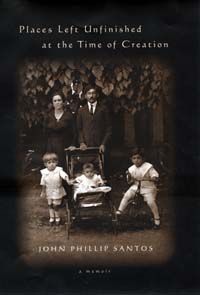
I chose for my reading the first few pages of John Phillip Santos' incredible memoir, Places Left Unfinished at the Time of Creation (Viking, 1999). This book was a finalist for the National Book Award and in 2006 was the One Book, One City selection for San Antonio. I chose it because it faithfully, and beautifully, conveys the duality of the Mexican-American experience - roots in this country that go deep, for hundreds of years, and yet often we are newcomers, fresh from the border, in our own heads and in the eyes of our fellow residents of this contradictory, confusing country.


I'll list here some of the other readers (a complete list is here - heavy on professors this year) and their selections, many of which should be familiar to La Bloga readers:

Steve Burkholder, former Mayor of Lakewood, Colorado, read from Luis Alberto Urrea's The Devil's Highway (Back Bay Books, 2005), one of La Bloga's all-time favorites;

Daryl Maeda, Professor in the Department of Ethnic Studies at the University of Colorado, Boulder, chose No-No Boy by John Okada (University of Washington Press, 1978); this reading made me want to read Okada's classic; it's now on my list;

José Mercado, Asst. Professor in the Department of Theater, Film & Video Production, University of Colorado, Denver, read Federico Peña's speech, We Are America, originally presented by the former Mayor of Denver at the massive Cinco de Mayo immigration rally in Denver in 2006;

John-Michael Rivera, Assoc. Professor in the Department of English, University of Colorado, Boulder, and Director of El Laboratorio, read from The People of Paper, Salvador Plascencia (Harvest Books, 2006); remember the controversy we discussed here about this book and its author?

MaryAnn Villarreal, Asst. Professor in the Department of History, University of Colorado, Boulder, presented selections from Crossing by Manuel Luis Martínez (Bilingual Review Press, 1998); another book added to my list because of this event; a photo of Villarreal from the event is to the right.

William Wei, Professor in the Department of History, University of Colorado, Boulder, read from America is in the Heart: A Personal History by Carlos Bulosan (University of Washington Press, 1974); this book should be on every one's list.

The nature of the event does not leave time for discussion after the readings, but that is certainly something that could be added. I have been thinking that I might try to put together my own version of Words to Stir the Soul. I would invite Latino/a writers, artists, musicians, teachers, entrepreneurs, etc., to read from their favorite book by a Latino/a writer - no set theme. Talk about encouraging literacy. Hook-up with a school, get the students to attend, and it could well be a night to remember, and a night with lasting impact. Don't you think we'd hear everything from Bless Me, Ultima to The Undead Kama Sutra, with a bit of Juan Felipe Herrera and the Hernandez Bros in-between? Now that's literature.

Muchisimas gracias to the Center of the American West for the invitation to participate.


ADIÓS, LA MANO PRESS
I pass on this message:

"After five great years at La Mano Press we have decided to say goodbye to LA. For me it has been about 14 years of learning experiences, accomplishments, many good moments and many great friends. We, Silvia, myself and all the friends who
have collaborated with us, have done all our best to try to promote the arts in our communities. I hope we have at least left some mark along our way. We can no longer afford the expense of having La Mano Press open while we live and work in Mexico. I am already working on a nice project down there: EL HUERTO, a center for ecology and arts, a botanical garden with an adobe building
dedicated to the arts. To see it: http://www.lamanopress.com/huerto.html

"This Saturday November 15, join us for the GRAFICOMOVIL party, a traveling mural, mobile cinema, gallery and print studio.

http://www.lamanopress.com/grafico.htm


"After two years of a lot of hard work, Oscar Duardo and myself, have transformed the old and rusty 1947 delivery truck into this great piece of art. Now we want to take it to the streets and hopefully travel across country with it. In this
event we will be asking for your cooperation, to make this a reality. Almost forgot, we have designed and produced 2 new skate decks. In this event you will also get a chance to see them, as they are hot off the press.

"Our last event will be our Christmas sale on Dec. 5,6,7. As usual many artists
will be here to share their wonderful work. I hope to see you here so we can toast together for La Mano Press's past history and the hope of a great future for all of us. Invite friends.

"Saludos,
Artemio Rodriguez"
La Mano Press - 1749 N. Main Street, Los Angeles, CA 90031

REMEMBERING 1968
From forty years later, the events of 1968 appear as fantastic images caught in a strobe light, pulsing to the beat of countryfied rock music. Unreal, sometimes unbelievable, the people and passions of 1968 shine directly on what we have experienced in the very political year of 2008.

I've been thinking a lot about 1968. I recently wrote about that year in a novel I'm working on, and only a few weeks ago I watched the excellent animated documentary Chicago 10, which details the notorious trial of the men accused of inciting riots at the 1968 Democratic National Convention. I remember the big events of that year, of course - all around the world, revolution was on the agenda, revolution was in the air, as the poet said. From Mexico City to Paris, from Czechoslovakia to Northern Ireland. South Africa to Vietnam. Here in this country, student takeovers of university buildings ; the San Francisco State College student strike. Riots in the cities, antiwar marches and civil rights demonstrations. The hippie counter-culture, psychedelic music and drugs, free love and free form jazz. Chávez fasted for the farm workers. Chicano teachers and students in Los Angeles walked out of the classrooms for eight days. The assassinations: Martin Luther King, Jr. and Robert Kennedy. The murders of progressive leaders, Black Panthers, Chicano activists, and many others. A year of conflict and climax; the year I grew up.

And I remember the not-so big events.

I worked in construction that summer, with my father, trying to earn enough to stay in school and save for a student life style that I hoped would be more than cheese and crackers, condensed soup and cheap wine. My Dad worked me to death but that made it easy for me to understand why I had to stay in school. I would come home totally exhausted, not able to do more than collapse on the living room floor and watch the news. I saw the city of Chicago hunt its own children, I heard the politicians call for the blood of the peace-mongers, and I knew which side I had to be on. It's been forty years since a group of very young Chicano students came back to the Colorado State University campus radicalized and "incited" by events that happened that summer, including the brutal attacks on the antiwar protesters in Grant Park, the same site where Barack Obama would acknowledge his election as President of the U.S. In 1968 that group of very young students created one of the first Chicano student organizations in the state - the Mexican American Committee for Equality (MACE). They made demands on the CSU administration for more students and teachers of color; for more relevant classes and degrees; for less of a university involvement in the U.S. war machine. MACE eventually formed a coalition with the Black Student Alliance; they protested, marched, disrupted, and worried through candlelight vigils. They were gassed, arrested, threatened with expulsion and violent injury. They lived what we now trivialize with the throw-away tag of "the Sixties."

Bottom line - MACE and the BSA created a recruitment, scholarship and mentoring program at CSU that has changed over the years, but it still functions and has provided assistance for thousands of students.

You got stuff from 1968?

A DOZEN ON DENVER
This November, the city of Denver celebrates its 150th anniversary. In April, the Rocky Mountain News follows with its own 150th. To commemorate both, the News is running a special series titled A Dozen on Denver: Stories to Celebrate the City at 150. For the series, the News commissioned 11 Colorado authors to write original fiction. The authors were asked to choose a different decade of Denver's history, to mention Larimer Street at least once in their stories and to keep it all to 2,500 words.

The News has featured a new story each Tuesday since the beginning of the se
ries. Coming Friday (November 14 - today), look for a special section in print compiling all the stories, plus one additional piece: the winner of the News' story contest.

Also Friday, stop by the Denver Newspaper Agency lobby at 5 p.m. to meet some of the featured authors and help kick off the Rocky's 150th anniversary.
The public is invited to mix and mingle with many of the 12 Dozen on Denver authors, plus enjoy a beverage and light appetizers from 5 to 7 pm.

The party will be in the Denver Newspaper Agency lobby, 101 W. Colfax Ave., in downtown Denver. Rocky Publisher John Temple, Denver author Sandra Dallas and Rocky Books Editor Patti Thorn will share comments about the series and attendees are welcome to bring items for authors to autograph.

I'll see you there.

Later.


Wednesday, November 12, 2008

Tomas Rivera Award 2008

Congratulations to Marisa Montes and Yuyi Morales!
Los Gatos Black on Halloween has been honored with the Tomás Rivera Mexican American Children's Book Award for books published in 2006-2008. Watch the video and celebrate with Marisa and Yuyi.

The Tomás Rivera Award is given annually to the author/illustrator of “the most distinguished book for children and young adults that authentically reflects the lives and experiences of Mexican Americans in the United States.” The book can be fiction or nonfiction. Children nominate books which are then narrowed by a regional committee. A national committee picks the winners.


New Book by Yuyi Morales

Just in Case


Reading level: Ages 4-8
Hardcover: 40 pages
Publisher: Roaring Brook Press
Language: English
ISBN-10: 1596433299
ISBN-13: 978-1596433298

Yuyi Morales takes us on a new journey with Señor Calvera, the skeleton from Day of the Dead celebrations. Señor Calvera is worried. He can’t figure out what to give Grandma Beetle for her birthday. Misunderstanding the advice of Zelmiro the Ghost, Señor Calvera decides not to get her one gift, but instead one gift for every letter of the alphabet, just in case. Una Acordéon: An accordion for her to dance to. Bigotes: A mustache because she has none. Cosquillas: Tickles to make her laugh…only to find out at the end of the alphabet that the best gift of all is seeing her friends. Morales’s art glows in this heart-warming original tale with folklore themes, a companion book to her Pura Belpré-winning Just A Minute.

Tuesday, November 11, 2008

Veterans Day 2008. The Pit from Pole to Pole.

Michael Sedano
US Army, 1969-70
B 7/5 & Hq 7/5 HAWK (Korea)

One of my earliest memories of war veterans takes me back to my father and mother loading up the Plymouth with water and food for the long drive from Redlands to the Long Beach or Los Angeles Veterans Hospitals. Our next door neighbor, Mr. Gardner, survived mustard gas attacks in WWI, only to spend his days next door to us a nearly blind invalid, sitting in his living room as Mrs. Gardner did all the yard work, household chores.

My Dad, a WWII veteran, explained our treks as an obligation he had to a fellow veteran with no way of getting to the hospital. If we didn’t take Mr. Gardner to the Veterans Hospital, and if Mr. Gardner didn’t get his treatments, he’d die. So we’d drive him. Mr. Gardner sat wheezing next to me. Now and again he would tell me in his whisper voice about the battlefield and his inability thirty years later to fill his lungs with a deep breath of clean (in the 1950s) Redlands air. One day we drove Mr. Gardner to the hospital, and drove back home to Redlands without him. I never saw “old Mr. Gardner” again.

Looking back, I understand Mrs. Gardner, too. She had a good heart. She once told me a chilling story of an apparition that followed her home one night, back when she was a girl in Arkansas. Years later, when I first heard Der Erklönig, Mrs. Gardner’s tale provided the frame of reference. But back then, I thought she was a crazy old woman, remonstrating loudly her dog Rito. “Now see here, Rito, I told you not to do that, do you hear me?” She wasn’t crazy, just defeated. Mrs. Gardner, too, was a victim of the attack that mutilated Mr. Gardner’s eyes and lungs.

This is not my story alone, nor is it unique. The current administration is creating thousands of Mr. and Mrs. Gardners.

As of October 4, 2008, icasualties.org counts thirty-four thousand four hundred twentysix war casualties. 34,426. Include “non hostile” injured, the total reaches 69,390 Mr. and Mrs. Gardners.

This is not to ignore the almost four thousand two hundred killed—QEPD—but they won’t require VA medical services, these veterans already have all the land they need.

I was thinking about Mr. and Mrs. Gardner at a menudo breakfast the other morning with some of my fellow veterans. One ex-Marine recounted his frustration that political machinations are stealing land from veterans, placing it in private hands. The Department of Veterans Affairs West Los Angeles Healthcare Center sits on 388 acres deeded "in perpetuity" for Veterans health care. Abutting the exclusive Brentwood barrio of West Los Angeles, the land has been coveted by private interests for years—already a commercial laundry, theatre complex, and private school athletic facilities occupy veteran land.

The veteran sadly explained how his Congressman, Henry Waxman, helped a non-Veteran group, the hubris-overloaded, mis-named "Veterans Park Conservancy,” seize 16 beautiful acres of canyon and oak forest, converting this from land that would have served injured, PTSD, and disabled Vets, into a cozy park for locals. Compare the scandal that erupted at Walter Reed last year that was laid, rightfully, at the feet of the Republican administration. This gift of Veterans land constitutes an ugly acknowledgment of the failure of the Democratic Party to defend the nation's war injured. Here’s a website that goes into all the sadly disgusting details of this land grab.

There’s little hope that veterans will regain control of that stolen land, but ample hope the new administration genuinely cares for its soldiers and veterans. But you gotta keep 'em honest. As a result, the Marine has begun to expand his horizon from the stolen land to finding ways to bring veterans issues into the public eye. After all, Waxman and his land-grabbing subversives pulled off their movida because no one is keeping an eye on veterans health.

Taking a cue from the 1960s, the ex-Marine is looking to organize returning veterans by means of teach-ins, and today's technology, like Facebook and a blog. Back in the 60s, anti-war activists mobilized on college and high school campuses across the nation by reading and sharing knowledge with like-minded peers. There was no single leader nor traveling pitchmen and women. They taught themselves. What today’s veterans and supporters will need is a curriculum. How to hold and follow-up meetings, agenda boilerplate, informative handouts and lecture materials, recommended reading, websites.

La Bloga’s friends read and understand the power of books. What should modern-day activists read and share with others that will help energize publics about veterans, that could have created an upsurge of public outrage to stop Henry Waxman in his tracks? Certainly practical work like Saul Alinsky’s Rules for Radicals. Patriotic work like Howard Zinn’s People’s History of the United States. Straightforward insight like Charles Beard’s History of the United States.

Beyond such focused, pragmatic work, I recommend reading the literature of Vietnam. Charlie Trujillo’s novel, Dogs From Illusion, and his oral history, Soldados, offer compelling stories of war. Trujillo frames Dogs in puro irony. A couple of boys from the central valley tire of picking melons and bosses cheating them on wages, so they join up, go to war, and convert into cold-blooded killers. Then they come home to pick the same melons, where the boss welcomes them back by cheating them on their wages. And they have to take it because that’s what they fought for. Equally compelling is Alfredo Vea’s Gods Go Begging. The war episodes raise a sweat for their graphic power. The character’s PTSD lingers thirty years after Vietnam, reducing his social relationships to declivitous, constant struggle. Daniel Cano’s superb collection of stories, Shifting Loyalties, covers the interpersonal pain and aimlessness that plague combat veterans long after their time in country. See also Stella Pope Duarte's Let Their Spirits Dance, with its controversial roll call of Chicano Vietnam war dead, to the exclusion of all the others. Readers not familiar with the impressive library of Chicana and Chicano war literature will find a survey here.

Social disintegration, or failure to re-integrate, is not a theme of fiction but a disastrous consequence of military service. As of early October, US Iraq invasion casualties already number over 69,000. A significant number of these veterans will require ongoing medical rehabilitative care. This is not a guess. Look at the conclusions of the National Academy of Sciences in their publication, Gulf War and Health: Volume 6. Physiologic, Psychologic, and Psychosocial Effects of Deployment- Related Stress. The findings point to growing severity of problems with a proportionate growth in need for services like West LA is supposed to provide.

In cold, scientific phrasing, the report notes, “there is a causal relationship between deployment to a war zone and a specific health effect in humans”. The scientists divide the injuries into those with clear causation between war and later health effects--psychiatric disorders, including PTSD, other anxiety disorders, and depressive disorders, alcohol abuse, accidental death in the early years after deployment, suicide in the early years after deployment, marital and family conflict—and injuries likely caused by exposure to war-- drug abuse, chronic fatigue syndrome, gastrointestinal symptoms, skin disorders, fibromyalgia and chronic widespread pain, increased symptom reporting, unexplained illness, incarceration.

Read the fiction then read the science and find the congruencies. As usual, the artist has it right, depicting all along what society wants to deny, or hide.

David tangled with Walter Reed's image machine when he wanted to attend a ceremony for a fellow amputee, a Mexican national who was being granted U.S. citizenship by President Bush. A case worker quizzed him about what he would wear. It was summer, so David said shorts. The case manager said the media would be there and shorts were not advisable because the amputees would be seated in the front row. " 'Are you telling me that I can't go to the ceremony 'cause I'm an amputee?' " David recalled asking. "She said, 'No, I'm saying you need to wear pants.' " David told the case worker, "I'm not ashamed of what I did, and y'all shouldn't be neither." When the guest list came out for the ceremony, his name was not on it.

It’s Veterans Day, raza; you know who you are. Celebrate. Be glad you are alive. If you’re a veteran, this is for you:
Attention!
Present, Arms.

Ready, two.

Taps.

At ease.


Fotos: Top. Michael Sedano posing next to a Korean home near Bravo Battery 7/5. Middle, Jane Fonda, Ron Kovic at USC's Tommy Trojan. Bottom: Bob Handy standing up for Veterans land. See link.

La Bloga welcomes your comment on this column. Please click the Comment counter below to share your views and recommended reading. La Bloga welcomes guest columnists. When you have a book or arts review, a cultural observation, or an extended response to something you've read here at La Bloga, click here to talk about your invitation to be our guest.

Monday, November 10, 2008

Libros, libros, libros...

So many wonderful books come my way but I often cannot dedicate as much time discussing them as I’d like. To try to make up for this, let me tell you about several that deserve some attention. This is the drill: below each title is the press’s description of the book followed by a short excerpt. Enjoy!

Some of My Best Friends and Other Fictions (Lewis-Clark Press) by Joe Benevento: Joe Benevento's first collection of short stories is a compelling and diverse exploration of American and Latin American cultures. Benevento's readers may recall his prolific work in poetry and novels, which include the volumes "Holding On," "Willing to Believe," "Plumbing in Harlem," and "The Odd Squad." Some of My Best Friends and Other Fictions is a significant addition to Benevento's fresh portrayals of the urban lives of New York City and of the Midwest. Benevento is a full professor at Truman State University in Missouri where he has served as Director of Freshman Writing and Director of Graduate Studies, and teaches courses in American and Latin American Literature, Creative Writing, and Spanish. He is co-editor of the Green Hills Literary Lantern.

Excerpt: Last night I saw my husband, dead now these twenty years. I asked him if he missed me as much as I missed him, and if he were waiting for me anxiously in heaven. He told me he had come to warn me not to expect to be reunited. I was his second wife; his first had died young. In heaven they had been reunited, as was proper. If there was a place for me, it could not be with him.

One Night in America: Robert Kennedy, César Chávez, and the Dream of Dignity (Paradigm) by Steven W. Bender: Robert Kennedy and César Chávez came from opposite sides of the tracks of race and class that still divide Americans. Both optimists, Kennedy and Chávez shared a common vision of equality. They united in the 1960s to crusade for the rights of migrant farm workers. Farm workers faded from public consciousness following Kennedy's assassination and Chávez's early passing. Yet the work of Kennedy and Chávez continues to reverberate in America today. Bender chronicles their warm friendship and embraces their bold political vision for making the American dream a reality for all. Bender examines their shared legacy and its continuing influence on political issues including immigration, education, war, poverty, and religion. Mapping a new political path for Mexican Americans and the poor of all backgrounds, this book argues that there is still time to prove Kennedy and Chávez right.

Excerpt: Chávez was overcome with sadness after Robert Kennedy’s death. Nixon’s presidency aggravated the loss when his administration targeted the farm workers union for hostile federal action and reversed any influence the union had enjoyed in prior years within the executive branch.

The Last Supper of Chicano Heroes: Selected Works of Jose Antonio Burciaga (University of Arizona Press) edited by Mimi R. Gladstein and Daniel Chacón: Widely considered one of the most important voices in the Chicano literary canon, José Antonio Burciaga was a pioneer who exposed inequities and cultural difficulties through humor, art, and deceptively simple prose. In this anthology and tribute, Mimi Gladstein and Daniel Chacón bring together dozens of remarkable examples of Burciaga's work. His work never demonstrates machismo or sexism, as he believed strongly that all Chicano voices are equally valuable. A joy to read, this rich compendium is an important contribution not only to Chicano literature but also to the preservation of the creative, spiritual, and political voice of a talented and passionate man.

Excerpt: Most popular Mexican cuss words begin with a p. Why words such as pinchi, puto, politico, and pendejo carry such a harsh negative sound, I don’t know. I’m not a linguist.

Esperanza: A Latina Story (Floricanto Press) by Sandra C. López: In this young adult novel, fourteen-year old Esperanza Ignacio could only think of a few words to sum up her life: crap, crap, crap! She was born into a poor Latino family living in a small crummy apartment in the barrio side of town, where the graffiti chiseled more the souls and character of the residents than it impacted the exterior looks of the buildings. Her father was a drunken gambler, and wife-beater who, one cold night, got arrested after a violent intrusion. Her entire circle of relatives consisted of nothing but formers-former drug-addicts, former gangsters and gang-bangers, former alcoholics, former everything. Esperanza illustrates what persistent Latino youth can achieve when they get back up after a fall and keep on walking straight into college.

Excerpt: Another year was gone, and a brand new one had just begun. Nothing had really changed. I was following the same routine from the previous year.

L.A. Bitch: The Last Word (LuLu Press) by Jim Marquez: This is the latest in a series of passionate, in-your-face slices of life about Los Angeles after dark. Wicked. Foul. Funny. Sexy. Sad. Boozy. This is the long awaited best-of collection: a little from each of the first three in the series mixed in with new material. Come on, join the madness.

Excerpt: I should’ve been happy after the reading and signing of my latest book: big crowd, standing room only, college girls sitting on the floor and gazing up at me like I was the Mexican-Charles-fucking-Bukowski himself, but something was off…

◙ Rigoberto González, an award-winning writer living in New York City, reviews La Bloga’s very own Lisa Alvarado's debut book of poems, Raw Silk Suture (Floricanto Press). He says, in part:

"Raw Silk Suture" lives up to its name. This book is the marriage between that which aggravates and that which soothes the body and soul. There's no picking and choosing; there's only the dealing with all things beautiful and all things hurtful. It's called life, it's called survival: "Yes, / I am here, / even now."

Read the entire review here. You may also order the book from your favorite bookstore or online.

◙ Last week, Ramón Rentería, book editor for the El Paso Times, wrote about the newly-released The Last Supper of Chicano Heroes : Selected Works of Jose Antonio Burciaga (University of Arizona Press), edited by Mimi Gladstein and Daniel Chacón. He says that the editors “must have felt like they had cracked a literary piñata when they searched 41 boxes of Burciaga's papers in California and found unpublished work.” He adds:

The editors are optimistic that the new book will generate fresh interest in Burciaga's work, especially among young people and teachers. "We hope this book will revitalize his spirit," Chacón said. "We're trying to present the complexities of a great artist and to have him referred to as a great artist and not just a funny humorist or essayist."

Let me add my own opinion about this book: Without question, any personal collection (particularly one that focuses on Chicano literature) should have this volume; the editors have done a remarkable job in capturing the heart, soul and talent of the late, great Burciaga. In any event, read the entire El Paso Times piece here.

◙ And yes…there’s more literary news from the El Paso Times with my piece on Orange County: A Personal History (I’ve Been Taking Notes) (Scrbner) by Gustavo Arellano. More on Arellano’s book later.

◙ “Bold Caballeros y Noble Bandidas” Explores Borderland’s Identity

An excerpt of an article by Yadhira De Leon

Captivating exhibition explores Mexican popular culture inspired by the Mexican Revolution of 1910.

An exhibit opening at the Autry National Center of the American West will explore the development of Mexican popular culture and United States, and take a look at U.S.-Mexico relations through the works of some of the country’s foremost artists.

“Bold Caballeros y Noble Bandidas,” organized by the Autry National Center in association with Arizona State University’s Hispanic Research Center, uses art, rare historical footage, feature film, music, and popular culture to experience and understand the monumental changes in the Americas that were inspired by the Mexican Revolution of 1910.

Creating a mythology that endures to this day in Mexico and the United States, towering figures such as Emiliano Zapata and Francisco “Pancho” Villa inspired a vast output of film, art, folklore, music, song, and literature that continues to shape the identity of the U.S.-Mexico borderlands, according to the exhibit’s curators.

* * *

The exhibition runs from Saturday, Nov 1 to Sunday, May 10, 2009. Admission is $9 for adults, $5 for students and seniors 60+, $3 for children 3-12, and free for Autry members, veterans and children 2 and under. For more information call (323) 667-2000 or visit Autry’s website. You may read the entire article about the exhibit here.

◙ lizz huerta has published a new chapbook of poetry, Half Life of Memory. You may learn more about it here or here. Here is a sample:

“I want to rope, I want to rope you in”

thunder honey, your mouth is the same as your mama’s sweet pot and
you’ve got me tasting, recalling every ground we have kissed over

the rules I habitually remove from your body; encouraging distance, water, spirit
the memory of your hand on my face the first morning I knew you

I’ll stay your super sexy if you keep me believing that everything
up until now, every concentric circle of doubt I have haloed myself into

every slab mortared around my heart, every nettle planted
have been so that when you came riding through, slaying my ugly ducklings

I would recognize the new hero scent of your breath, your come-love-me forearms

and would gratefully celebrate the day you were conceived.

◙ Last week, I had the pleasure of giving a lecture at Santa Monica College about the making of Latinos in Lotusland: An Anthology of Contemporary Southern California Literature (Bilingual Press). The faculty, staff and the students were wonderful and I hope to visit again.

◙ That’s all for this week. So, in the meantime, enjoy the intervening posts from mis compadres y comadres here on La Bloga. And remember: ¡Lea un libro!

Friday, November 07, 2008

La Bloga predicted, La Nación decided.


Manuel Ramos will be back at his regular Friday spot next week, November 14.

La Bloga welcomes your comments on our política series, or anything you read here. We encourage and invite your guest columns. When you have a book or arts review, an extended event announcement, a response to something you read here that needs its own space, alert las blogueras los blogueros, either by clicking on the Comment counter below, or by sending email by clicking here.

Thursday, November 06, 2008

Memento Mori


Studs Terkel, prize-winning author and radio broadcast personality was born Louis Terkel in New York on May 16, 1912. His father, Samuel, was a tailor and his mother, Anna (Finkel) was a seamstress. He had three brothers. The family moved to Chicago in 1922 and opened a rooming house at Ashland and Flournoy on the near West side {LISTEN}. From 1926 to 1936 they ran another rooming house, the Wells-Grand Hotel at Wells Street and Grand Avenue. Terkel credits his knowledge of the world to the tenants who gathered in the lobby of the hotel and the people who congregated in nearby Bughouse Square, a meeting place for workers, labor organizers, dissidents, the unemployed, and religious fanatics of many persuasions. In 1939 he married Ida Goldberg and had one son.

Terkel attended University of Chicago and received a law degree in 1934. He chose not to pursue a career in law. After a brief stint with the civil service in Washington D.C., he returned to Chicago and worked with the WPA Writers Project in the radio division. One day he was asked to read a script and soon found himself in radio soap operas, in other stage performances, and on a WAIT news show. After a year in the Air Force, he returned to writing radio shows and ads. He was on a sports show on WBBM and then, in 1944, he landed his own show on WENR. This was called the Wax Museum show that allowed him to express his own personality and play recordings he liked from folk music, opera, jazz, or blues. A year later he had his own television show called Stud's Place and started asking people the kind of questions that marked his later work as an interviewer.

In 1952 Terkel began working for WFMT, first with the "Studs Terkel Almanac" and the "Studs Terkel Show," primarily to play music. The interviewing came along by accident. This later became the award-winning, "The Studs Terkel Program." His first book, Giants of Jazz, was published in 1956. Ten years later his first book of oral history interviews, Division Street : America, came out. It was followed by a succession of oral history books on the 1930s Depression, World War Two, race relations, working, the American dream, and aging. His latest book, Will the Circle Be Unbroken : Reflections on Death, Rebirth, and Hunger for a Faith, was published in 2001. Terkel continued to interview people, work on his books, and made public appearances until his death. He was Distinguished Scholar-in-Residence at the Chicago Historical Society.

(Courtesy: http://studsturkel.org)

xxxxxxxxxxxxxxxxxxxxxxxx

Tony Hillerman was born in 1925, in Sacred Heart, Oklahoma. Although he was raised among the Pottawatomie and Seminole Indians and studied at an Indian boarding school, Tony Hillerman is not Native American. He attended Oklahoma State University (1943), the University of Oklahoma (B.A. 1946), and the University of New Mexico (M.A. 1966). He worked as a journalist in Texas, Oklahoma, and New Mexico (1948-63), lived in Albuquerque, and taught journalism at the University of New Mexico (1976-85).


He has written numerous mystery novels drawing on Native American culture, the most successful featuring Jim Chee and Joe Leaphorn of the Navajo Tribal Police. His many bestselling novels include Sacred Clowns, Coyote Waits, and A Thief of Time. Hillerman is a past president of the Mystery Writers of America and has received their Edgar and Grand Master awards. His other honors include the Center for the American Indian's Ambassador Award, the Silver Spur Award for best novel set in the West, and the Navajo Tribe's Special Friend Award. He lived with his wife, Marie, in Albuquerque, New Mexico.

(Courtesy: http://mysterynet.com)

Lisa Alvarado

Wednesday, November 05, 2008

¡Obamos a leer!

Almost every political figure has a picture book and our new president and presidential candidates are not the exception.

¡Obamonos a leerlos!

Barack Obama: Son of Promise, Child of Hope by Nikki Grimes. Illustrated by Bryan Collier.

Reading level: Ages 9-12
Hardcover: 48 pages
Publisher: Simon & Schuster Children's Publishing (August 26, 2008)
Language: English
ISBN-10: 1416971440
ISBN-13: 978-1416971443

Product Description
Ever since Barack Obama was young, Hope has lived inside him. From the beaches of Hawaii to the streets of Chicago, from the jungles of Indonesia to the plains of Kenya, he has held on to Hope. Even as a boy, Barack knew he wasn't quite like anybody else, but through his journeys he found the ability to listen to Hope and become what he was meant to be: a bridge to bring people together.

This is the moving story of an exceptional man, as told by Nikki Grimes and illustrated by Bryan Collier, both winners of the Coretta Scott King Award. Barack Obama has motivated Americans to believe with him, to believe that every one of us has the power to change ourselves and change our world.


My Dad, John McCain by Meghan McCain. Illustrated by Dan Andreasen.

Reading level: Ages 4-8
Hardcover: 32 pages
Publisher: Aladdin (September 2, 2008)
Language: English
ISBN-10: 1416975284
ISBN-13: 978-1416975281

Product Description
Born the son and grandson of military men, Senator John McCain from Arizona was destined for a life serving his country in the armed forces. Like many great men, he occasionally struggled with authority, but once he found his true calling -- flying naval aircraft -- his ideals and commitment to his country took him far.

From the low point of five years as a prisoner of war to the high points of raising a large, happy family and being chosen as the Republican nominee in the 2008 presidential election, Senator McCain has lived an incredible life driven by a love of his country and a desire to serve it to the best of his ability.

This picture book biography, written with great love and insight by his oldest daughter, writer Meghan McCain, shows us the public John McCain and the personal John McCain in a way we've never seen before -- making this American hero come to life before young eyes.

About the Author
Meghan McCain is a blogger who documents life on the campaign trail with her father and muses about fashion, music, and pop culture. Check out her blog at McCainBlogette.com.

Meghan is the oldest daughter of John McCain, U.S. senator from Arizona and the 2008 Republican presidential nominee, and Cindy Hensley McCain. She was raised in Phoenix, Arizona, and graduated from Columbia University, where she majored in art history. McCain interned at Newsweek magazine and Saturday Night Live.

Dan Andreasen is the illustrator of numerous picture books, including By the Dawn's Early Light: The Story of the Star-Spangled Banner by Steven Kroll, which was named an ABA Kids' Pick of the Lists and a Notable Children's Trade Book in the Field of Social Studies; A Quiet Place by Douglas Wood; and Sailor Boy Jig by Margaret Wise Brown. He has also authored several picture books, including With a Little Help from Daddy and A Special Day for Mommy. Dan lives with his family in Orlando, Florida.


Hillary Rodham Clinton: Dreams Taking Flight by Kathleen Krull. Illustrated by Amy June Bates.

Reading level: Ages 9-12
Hardcover: 40 pages
Publisher: Simon & Schuster Children's Publishing (August 26, 2008)
Language: English
ISBN-10: 1416971297
ISBN-13: 978-1416971290

Product Description
When Hillary was young, she wanted to be an astronaut, to soar as high as the stars above. She kept reaching up and up as she grew. There were people who told her no. But she didn't listen to them. There were people who didn't think she could do it. But she believed in herself. And Hillary has been making history ever since. This is the inspiring story of a girl with dreams as big as the open sky.

About the Author
Kathleen Krull is the author of A Woman for President: The Story of Victoria Woodhull, illustrated by Jane Dyer, and Lives of Extraordinary Women: Rulers, Rebels (and What the Neighbors Thought), illustrated by Kathryn Hewitt, as well as a number of other acclaimed biographies for young readers. She lives in San Diego, California.

Amy June Bates has illustrated many books for children, including The Dog Who Belonged to No One by Amy Hest and You Can Do It! by Tony Dungy. She graduated from Brigham Young University and now lives in Carlisle, Pennsylvania, with her husband and three children. Illustrating books has always been her dream.
Product Details