Showing posts with label veterans. Show all posts

Tuesday, January 26, 2021

Getting Ahead of the Con Game


Confession in Plague-time: The Article 15
Michael Sedano

Note Found On the Internet:
In the last week I’ve received two emails from background check companies threatening to release reputation-damaging info if I don’t subscribe to their services. They’ve mentioned things that are true about me. 


It is the last Monday of ten weeks of Radio School at the Army’s Ft. Ord in 1969. Just a mile west, Barbara and I have breakfast at Cypress Knolls, then drive through Gate 3 in time for me to climb upstairs to my troop bay, put hospital corners on the bed I’d mussed up the night before, then join the platoon for the march to school--just like every day since Barbara surprised me by moving up here from Isla Vista.

We work a Plan to live a normal life together, like the Army is my day job. I go AWOL overnight, show up the next day nonchalantly falling in after chow, do the Army all day. At evening chow, I hastily rumple my bed then head downstairs where Barbara picks me up.

I go AWOL overnight. We will have these moments to remember.

When I boarded the bus for the Induction Center on January 15, I considered that the end of normal life, including "being married." I anticipated doing Basic Training, AIT, then getting shipped out to Vietnam.  Barbara and I would not have a life together until my two year hitch was up. I was sure I'd live.

I didn't anticipate my wife's determination to make us a future right now, the Army be damned.

When I start Advanced Individual Training--Radio School AIT--Barbara packs up in Isla Vista and finds us a shack in a converted farmworker colonia rented by Permanent Party at Ft. Ord, a dream job.  

We launch Plan A. She gets a part-time jale at May Co. With the Commissary and PX, we find ourselves living a good life, working the Plan.

Today, there’s a kink in the Plan, a First Lieutenant with a Lifer mentality. His shiny Opel sports car noses out of the Company Street just as I've parked. I lean over and grab Barbara in a passionate embrace like those scenes from a “B” movie where the villain ignores the beast with two backs. His quick thinking and subterfuge saves our good guy, and he gets to kiss the ingenue.

I feel the Lieutenant’s eyes boring into my windshield.

I hold the kiss. 

The 1LT holds his stare. 

I outwait him and the 1LT drives away in his fancy new Opel. It's safe to show my face on the Company Street. Barbara drives away and I begin my routine.

That evening, the class marches back from school to a halt between the chow hall and the company commander’s office. We turn to salute the flag, somewhere a bugle recording sounds Retreat, Dismissed. 

The company clerk calls me over. I’m in deep shit.

The Captain expresses hard-nosed sympathy that yes, I could get my ass blown up in Vietnam as early as next month. How long have I been going AWOL?

I’m tempted to play it up with the standard Radio School horror story, “Sir, if I’m in a magnesium radio van that gets hit with a tracer round and burns to the ground in seconds, all she’ll get is ashes and ten thousand dollars.” She deserves this time, it could be her only time with her husband in her entire life. The commander nods affirmation. Everyone loves that magnesium van story. Bam, flash!, fried commo guy.

The Captain and I banter back and forth. I won’t admit I’ve been AWOL every night for almost 10 weeks, and he doesn’t press the issue. The Hawaiian sergeant who does night guard duty tells me don’t think I’m pulling one off on him. He could get court-martialed, but he’s cool about that. FTA. 


We’re all co-conspirators and good friends, me and these teenagers in radio school. Next week, many will head to Ft. Benning for Special Forces school--Green Berets. Ave Atque Vale, my friends. 

Article 15 of the UCMJ is non-judicial punishment. The sympathetic Captain doesn't take my stripe, hits me with a $20 fine, and locks me down with extra duty. 

The company clerk tells me I lucked out with CQ runner duty. He hands me an envelope with stencils he’s typed out, the Captain’s signed.  As far as the Army is concerned, my Article 15 is fait acompli with the signature. A technicality leaves it to higher headquarters to promulgate the Order when Battalion runs off the stencils and sends copies to payroll and personnel.

“Take your Article 15 to Battalion H.Q.” the clerk instructs me in his broad Boston drawl. He briefs me on how the Army works and suggests I lose the envelope on the way to Battalion. A week later, I am on my way overseas. 
 

••••

La Bloga Way-Back Machine

Snowy Ride Up the Mountain

(This 500-word memoir originally appeared on Tuesday, June 21, 2011. Revised.)


Costillas finds his grip on the truck’s canopy, and with his left boot on the rear bumper swings himself up into the rear of the deuce and a half.


“Anahash,” he greets the two Korean KPs hauling chow up the mountain. “Ne,” one says. The other looks away from the snowy landscape and pointing to the bench across from him, looks at Costillas and says something. “Mu-la me,” Costillas answers palms up, “No ara, mee un hum,” he apologizes for not understanding.


Specialist Fourth Class Miguel de las Costillas shivers in the penetrating cold despite his long johns, wool OGs, and fur-lined parka. He walks to the plywood box bolted to the floor against the cab. The foam rubber cushion would absorb a little of the violent jostling that punishes his kidneys and ass during the rough bounce up the mountain. No luck. Next to the chow cans, the cushion holds a green printed circuit board, and there is nothing Costillas can do. Missile repair parts have priority on any truck going up the mountain.


The California Chicano snuggles into the corner where heavy green canvas curves against the back of the cab. He imagines catching a hint of warmth off the exhaust pipe. “Yoboseyo!” the older KP calls. “Yoboseyo! Joe. Yogi. You yogi.” He points again to the empty bench across from the older Korean.


“Ne ne,” Costillas shakes his head that he understands the invitation. "Kamsamnida chingo, I stay here.” 


Costillas doesn't intend to sit at the open end of the deuce, where the cold wind and blowing snow suck into the truck. Worse, if that were possible, when the deuce and a half bounces off the primitive roadbed, gravity sends the shocks to concentrate there at the far end where the old KP pointed. Costillas’ back was a constant ache from the trip up mountain. 


Ski guns it and the truck speeds out of the Admin Area, a seven mile ride to the mile-high mountaintop missile site.


Wham! The truck bounces Costillas into momentary free flight that ends when his back crashes against the punishing steel canopy strut of the lurching truck. He bounces off sideways but manages to keep himself on the bench as gravity and inertia heap punishment and pain on him.


They are in the storm now. The two Koreans are sharp silhouettes against the blinding whiteness outlined by the canopy. Ski guns the motor at the third switchback. Something feels wrong. The truck slides sideways, Costillas feels weightless for a split second's panic. To furious spinning of wheels and grinding gears the truck slides backward toward infinite whiteness. The two Koreans coil their bodies in readiness to leap out. Costillas’ eyes bulge in sheer bloodcurdling terror. “Oh fuck, I’m not gonna make it. Damn it, menso. Damn it damnit.”


He should have been with his wife back in warm California, teaching class, going about his quotidian duties taking roll, ogling hippie chicks…not plunging off a mountain in a picturesque arc in the middle-of-nowhere.


Wham! The truck crashes into the side of the mountain and stops. The tires find traction, the chow truck lurches forward, Ski has them back on track. The three men explode in wild, genuinely happy laughter. They have beaten the mountain. They are invincible.


Tuesday, November 24, 2020

Memory: Thanksgivings In Plague-times

Michael Sedano 

In 1968, my bride and I planned our first Thanksgiving Day feast with dampened spirit. Married on August 31, I got the letter in October. Not the plague, but the draft felt like a terminal disease.

At first, Selective Service told me to report on November 15, 1968. I managed a postponement, and would report on January 15, 1969. Thanksgiving and Christmas, then New Year, then I'd disappear. Disappear maybe forever, Barbara feared, had I gone to Vietnam and been killed. A lot of draftees got killed in those days, so we were feeling rotten.

There has been a single thanksgiving day meal we haven't shared together, otherwise for the past fifty-two years, Barbara and I have enjoyed the national eating holiday feasting on cocono.

Guajolote, other gente call them, I learned cocono. My grandmother raised gallinas and a few coconos. My elementary school teachers requested the bags of turkey feathers my gramma saved for them. Emilia Macias was the best poultry dresser in California. Customers drove from Pomona to DeYoung's Poultry on Highway 99 outside Redlands, to buy a thanksgiving turkey dressed by "Emily." 

Emilia's great-granddaughter, Amelia, raises gallinas and a few coconos. This year, Christmas heritage turkeys will be on several holiday tables, fresh from McDonald's Urban Farm, dressed by Emily's great-grand-daughter. Thank you, Time, for coming around and going around.


Tamales For Thanksgiving

Miss McCartney begins her fourth grade class with the annual holiday poll, "What did you have for Thanksgiving?"

The weeks leading to the holiday weekend we chattered about the upcoming holiday. We were taught to know our place--at Thanksgiving it was noble Puritans feeding sluggard indios. We were set up to beg for turkey because it was American.

Kids already knew the score. The northside was the wrong side of the tracks, where the poor people live. But there's poor, and then there's dirt poor. Playground talk sorts it out. A few families went for cocono, for most, it was pollo. The dirt poor Sepulvedas had a really festive meal, the twins reported. Tamales. 

"Felix, what did you have for Thanksgiving?" Felix had turkey, and stuffing, and everything. "Irma, what did you have?" Turkey. Freddie, Foodo, Zeferino, Michael. Turkey, Turkey, Chicken, Turkey.

Inevitably the teacher turns her attention to the Sepulveda twins. Painfully quiet and normally uncommunicative, their faces show the tension of the upcoming inquisition. "Carmen, and what did you have for Thanksgiving?" Carmen bows her head in silence. "Oh, come now, Herlinda, what did you have for Thanksgiving?" Both girls hunch their shoulders and hang their heads lower. 

"Now, speak up, girls, what did you have?" the teacher cajoles and wheedles. 

We sit in  uncomfortable silence until one of the one of the Weeks twins whispers loudly, "they had tamales."

"Oh, no," cries Miss McCartney, "no one has tomallies for Thanksgiving. You're supposed to have turkey, and cranberries, and . . ." The young teacher lists an exquisite menu while the twins do their amazing shrinking Mexicans act. Pulling their shoulders to their ears, the sisters' heads slide lower and lower in their desks until the two girls disappear before our eyes, only four trenzas hang over the ladder back seats.

The First Thanksgiving, 1968

Barbara keeping a stiff upper lip. I have just opened the envelope drafting me.
    
Thanksgiving made us sick. She feared I was going to get killed in Vietnam and this would be her only Thanksgiving of the idyll she envisioned for the happily ever after. I scoffed at getting killed, but teevee pictures infected my self-confidence with flag-draped aluminum tubes of doubt. This might be our only Thanksgiving. Not that I would know it, if I did get killed in the Army. I had to leave in January.

We determined we’d make a great big Thanksgiving Day dinner that couldn’t be beat and share it with Karen and Mike, who’d been in our wedding August 31st. 

The Salvation Army stove cost me twenty-five bucks back in July, and the appliance fried and boiled our food all summer, making me confident the oven would roast the turkey. I struck a match and got the oven going. Barbara studied her Rombauer & Becker and got the bird prepped.

Flames squeezed out from around the oven door. Black smoke poured out the top under the burners. Barbara was not calm.

I pulled down the hinged door to see turkey grease and butter splatter pooled on the oven floor boiling and burning angrily, fed into spatters and growth by the infusion of air I’d introduced. The turkey carcass had acquired a black coating of soot from the grease fire.

I grabbed the orange cardboard box of Arm & Hammer out of the refrigerator and ripped off the top. Turning to the smoking fire box I nodded at Barbara who pulled down the door. 

The turkey was covered in baking soda, coagulating spatter, and black grime. Barbara washed it off in the sink while I called our guests over in Isla Vista. Karen and Mike had a cliffside apartment, a functioning oven, and Alice's Restaurant. 

That’s where we finished roasting that turkey and had us a great big Thanksgiving Day dinner that couldn’t be beat. We laughed every time the theme came round on the guitar again, and we had the record on replay for nine hours and that was our first Thanksgiving, 52 years ago.


Thanksgiving Dinner With All the Trimmings. Class "A" Bummer.

Army chow has a deservedly bad reputation. Holiday chow usually makes an exception, and a year after our burning turkey, I looked forward to the Army's promise of an "old-fashioned turkey dinner" in the mess hall here at Bravo Battery. I would not pull duty up on the mountain, where the dinner would arrive after an hour ride tucked inside aluminum cans, not for this upcoming feast!

The site buzzed with excitement at the posted menu of real food. Up in the crew hootches on the mountain, guys passed the hours reminiscing about family  favorites, trading stories, getting lost in memories of the taste and smell of grandma's stuffing, playing football in the yard, getting stuffed, and then having pie. 

Warm thoughts of home help men ignore the routine hardship of the world's "highest and ruggedest HAWK site." Bravo Battery and Site Seven-five lie six thousand miles from home, and two hours from the nearest PX. Men live in close quarters, with the same five or six men, 24/7, North Korea fifteen miles a constant presence in every breath. 

Forget that crap, in a few days, we'll be eating like Thanksgiving  back home. The Army says so.

Turkey, roasted by our own cook, and all the trimmings: stuffing, cranberry sauce, yams, green beans, peas and carrots, mashed potatoes, gravy, rolls. And pies. Among all the other food we didn't get at Bravo Battery, we never get dessert. And now, not only can we look forward to a great big thanksgiving day dinner that couldn't be beat, there will be pie. Alice's restaurant didn't have pie.

The cook laments the all-nighter he's going to pull, so I tell him I'll make the pies. Tyner agrees. Tyner could get an Article 15 for letting me into the kitchen, a remote risk.  I wait for the mess sergeant to disappear into the ville. I watch Tyner work with impressive efficiency. I am proud of my friend's skill at his work. The chow sucks but it's not the cook's fault.

I had never seen a refrigerated pie crust. Tyner rips open white waxy boxes and dumps the things on the stainless steel workspace next to a stack of pie tins. I make apple and cherry pies, I don't remember how many pies, enough to feed 75 soldiers. 

I was a bit disappointed there was no magic, anticipating mixing dough, rolling crusts, trimming and pinching edges. I simply filled the crusts with canned pie fillings and Tyner did the rest. That disappointment was nothing compared to the next morning's news and the outrage it produces.

Top ruins everyone's day at morning formation. The uniform of the day for chow will be the Class "A" uniform. Incongruity slathered with absurdity tempered with last-minute notice is a slap in the face. Wear coat and tie, all your brass, formal wear out here where locals don't have electricity and running water.

Had we been ordered to wear pink tutus, the outrage wouldn't have been matched. Thoughts of home smolder behind spit-shined dress shoes in the middle of nowhere. The Lifers, of course, love it. They keep their brass polished and dress greens pressed. We enlisted men dig Class A traje out of the bottom of our duffel bags and wear them wrinkled and looking like shit. 

The BC knows it, Top knows it, we know it. Out here, GIs wear a dress uniform when they land, then roll it up and stuff it in the bottom of their duffel. A week before we leave, the houseboy presses it and the soldier wears the Class A home.

We make the best of it, looking like shit. We eat seconds, laugh a lot and darned if we don't look good all dressed up military. And, of course, we eat the best pie in the United States Army. I have cherry.

The Second Thanksgiving

The two happy people in the foto are eating a perfectly-baked turkey. This is the second turkey the woman roasted, and the first that did not catch fire. They remember how grim their first thanksgiving day had been, this is their next. Today, they talk about that time in their lives, they listen to "Alice's Restaurant" on repeat, like they played during that awful day, and they begin again. 

That terror never completely extinguished itself, until recently, for Barbara. That flaming bird never happened again. Barbara became a skilled cook, happily ever after. Every Thanksgiving Day, the couple puts "Alice's Restaurant" on the turntable, play the song on repeat all day, recalling how scared they were at what might have been, and how that absurd scenario gave them nightmares. 

And the people in that foto, they laugh, because things turn out good, and the couple sits there and they know it.


Tuesday, February 05, 2019

GF Company's Coming. Dominic's Dialect Dispensation. Mexican Schools Baroque. Tet

The GF Chicano Cooks
Gluten-free Chile Relleno Casserole-Company Style Because We Have Good Eggs
Michael Sedano

Farm-to-table eggs taste better, they really do.
Crustless vegetable custards, aka Quiche, get put together licketysplit and make an elegant setting after suitable baking in a hot oven. Fast, easy, elegant--just what the cook with other things to do looks for in nutrition. The Gluten-free Chicano is no exception, especially when his daughter's McDonald's Urban Farm (link) this season features uniquely colored hen fruit. These beautiful eggs deserve special treatment, so company wasn't coming but the Gluten-free Chicano made the just-layed eggs fancy-style by beating them to a hard fluff and baking a faux cheese souffle con chiles.


There's no requirement to beat the egg to a hard fluff then diluting with cream. Fast, fast, fast, use a fork to break up four to six whole eggs, proceed.

For company-style, I used extra egg whites because i kept three yolks for Hollandaise sauce the next morning.

Get the oven to 375º or 400º.


You can use canned whole chiles; I had a bag of Hatch mild from Alfredo Lascano's La Pelada (link)

Grease a presentation-quality shallow dish. Lay the stemless chiles whole on the bottom. Chop if you must, or use canned and chopped chile.


Grated cheese makes a flavor difference. Tillamook sharp yellow cheddar is the Gluten-free Chicano's preference, though adding some Vermont or Irish cheese makes good sense, if there's on-hand inventory.

Those beaten egg whites get mixed in with the yolks, a cup of half and half or a combination of whole milk and whipping cream. Melt ¼ stick butter and stir it in.

Add pinches of salt, black pepper, ground cayenne.

Pour the eggs onto the chiles and cheese. Dust the top with Paprika.


The Gluten-free Chicano cooks for two. Increase the volume of milk and eggs and fill that pie pan to the top to feed four. 

Put the assembly on a pie pan and slide into the oven. Neglect it for 45 minutes.

Test then allow to sit for five minutes or more. Servings will be steaming hot.

The custard is ready when the jiggling stops and a blade in the middle comes out shiny and uncoated. Don't open the door. Leaving the casserole to cook in there without spilling heat out an open door ensures the eggs fully cook. The biggest trouble people have with custard dishes is a soggy middle. (Microwave that to fix it.)

Ingredients (carb counter):
¼ lb or 2" off a chub or 1 loose-pack cup grated good cheddar cheese.
4-6 farm-fresh eggs from McDonald's Urban Farm or a local farm-to-table producer.
1 cup milk or half-half or cream plus milk. Add milk if you need more volume to feed more people. (carb advisory-check)
¼ stick butter.
Options:
Chopped spinach, sliced onions, minced or slivered garlic, bacon crumbles, diced good ham. Bake a sliced tomato on top.

400º
40-45 minutes.

Note
Mastering the basic savory custard with cheese is a gateway to fine, fast, easy elegance. Next you'll be making Spanish Tortilla and wowing your dining guests and finicky eaters. 

Reheat leftovers for a few seconds in the microwave, covered.


Review: Veteran, Poet, Collects Disconnected Memories.
Michael Sedano

Dominic Albanese. Disconnected Memories, poems by Dominic Albanese. Port St. Lucie, FL. Leaky Boot Press, 2019.
 ISBN: 978-1-909849-69-3


“Sure, ay bin comin’ to touwn…” I said in my best Norwegian bumpkin dialect. Mrs. B’s eyes grew wide as she rose from her desk. As nonplussed as possible she suggested I find something closer to home for the monologue contest. I selected Barnaby Conrad’s The Death of Manolete, did it in SAE. I got the point. Don’t do dialect that ain’t your’n. Especially if you don't know the lingo.

My oral interpretation must have been funny peculiar, not funny ha-ha. Printed language and oral representations are langue et parole apart. Print cannot make the sounds of someone saying the words. Countless writers have done dialect text, a few successfully in English, magnificently successfully by raza poets. But I speak the language, I'm not held back by the text itself.

For some readers, text written as dialect distracts even as it calls attention to the bridge between speech and language, writing and talking, them and me. Others will see the line and hear the sounds back on the block and in the word savor their own compressed moments. Dialect does that, too.


Dialect writing possesses a distinct aesthetic that touches innate gregariousness for those who speak the dialect, that creates interest in exogenous readers looking for the "smell of the crowd." 

For some poets, not writing dialect, i.e. "straight" composition, could muck up their connection to their muse, that's the way they learned to write English. That's not the case for the writer of Disconnected Memories. Read the poet's biography in "straight" prose and note he's capable of clarity, spelling, coherence, all that shit.

This Critic reminds not just Albanese, because he's not alone in electing the dialect style. Alurista's most recent collection (link) offers a glaring example of dysfunctional spelling that can dilute the poetry in the syllable. Meaning resides in the reader despite the poet’s intent. Orthography represents a writer’s best chance to get their own meaning across. 

Dominic Albanese does dialect poetry the right way. Recently, he's brought forth a collection that earns respect for the poet qua poet and makes it worth the effort to decipher, overlook, or forgive his printed representations of oral communication. For all I know, this is how the vato talks and he's not writing, he's quoting.

I think I got his language OK, but I’m not going to endeavor some explanation of stuff like this one time I was writing an explicacion du texte on a line from e.e.cummings, “my jaws all gone”. I reasoned the persona must have been punched-out or had gum disease, pobrecito. My professor gently corrected my misunderstanding. Cummings is broke, his “jack’s all gone." Anglos say "jack" for "lana."

if only
I had not been
so ready to go mad
be bad
n have wild adventure
(still pissed off over Vietnam)
I would have got that shop
n been
a grumpy ole guy like he was
looking back… no telling

Albanese closes the 131-page collection with those lines. Spelling doesn’t distract, much, although the poet could go to extremes to catch the sound of that voice. Aurally, one spelling could go “be badnhave wild” more closely copying elisions natural to speech, but “badnhave” or “nbeena” would stop a reader in her his tracks like an arroba in a line of Chicano literature. The spelling conventions Albanese pursues with grammatical consistency fashion an “eye dialect” that shapes the page, bringing a visual coherency to a page on its white space.

Eye dialect aside, Dominic Albanese writes vitally important words. The young guy went through the Vietnam war and writes poetry about it. This poet has done something few people did and it’s time for Unitedstatesians to read about it. Some a ya will cry yr eyes out.

Albanese probably speaks the English of Brooklyn and Coney Island. It’s the sound of where the kid grew up among unmeltable ethnics; Italiano settlements, internal colony cultura with bilinguals living with monolingual immigrants. Albanese’s youthful recollections tell of wise guys, blueberries, ethnic expressiveness. Mother. Father.

never had a company
or a Enterprise
for me to
inherit… no wage slave… day by
week paycheck
survival
truthfully I was
ashamed of his
honesty… acceptance
was way more attracted to
wise guys… steal it… fuck it…
what they gonna do
put ya in da Army n send ya to Vietnam
bet yr ass they would
then some years of rebellion

Vietnam. Novelists have the luxury of developing the intense terror and landscapes of combat—the helicopter scene in Mexican Flyboy (link) leaps out of memory—Poetry's economy is the perfect language for the unspeakable.

That war he fought inhabits this soldier’s mind, it hits him even retroactively, he remembers the past against what happened later.

When the poet was a kid not knowing it, Vietnam was already digging into his psyche, moments distilled and stored away until he needed their succor. In “Sleepwalk,” an old man relives fondly a boy's record hops, slow dancing to Santo and Johnny in adolescent heat. The poet's innocence is offered as an antidote to Vietnam and its ravaging aftermath. 

“don’t dance, float… I will show you”
that and Anny had a baby
uhuu uhuu
kept me alive
in Vietnam
I met her again we were both in
our twenties… she remembered tole
me “you were so sweet”
SLEEPWALK BACK TO BROOKLYN
50+timeless years ago

The note of chagrin at the end illustrates the humor that offers another good reason to read Disconnected Memories. "Sweet" is just what a horny guy doesn't want to hear, it's like saying let's be friends. Irony's many faces permeates Albanese's poetry, adding a dimension most readers yearn for and get in ample measure.

When the poet gets back from the war, in 1966, he sees loveliness on the San Francisco streets of the summer of love. He connects with a hippie chick and he’s ready to whatever, head over heels horny GI still struck out of his wits by the tours in the jungle. She looks into his eyes:

pain blood tears… a fear that she
said scared her… then she kissed
me before I could kiss her
we spoke of future… she said to me
I recall tone intent vibrations of words
“you will need a lot of time. more time than I
am willing to spend, but only love can let those colors
come out”
I never saw her again

Regret weaves in and out of Albanese’s life, things that never happened or almost, as well as what that 18 year old kid got put through. Every Veteran knows this—everyone who put on the uniform and absented themselves from home will never get back those 13 or 18 or 24 months. But only 7% of United States Americans have ever served in uniform and know what it feels like to step off that transport and admit you made it back, you're home.

ok I was 18 in Vietnam
let me see if I can just run
this waka noddle down
in 56 a bit longer en that ago
under duress… from Dulles
Ike sent Iron Mike n 600 troopers to
that swamp… for to defend economic policy
nothing more nothing less
as a “workers paradise” drank em self dead
Never forget 911 (I know I jump around)
Nixon killed 30.000 people a week
in Cambodia… (who cares?) right
be glad for Jerry Ford… he only hurt ya
with golf balls
then comes Ronny Ray gun
at about nine times a number a week

This soldier recognizes he was part of an unending war, nothing to regret, that’s how it is, fifty years on after his war, United States wars have never stopped. Vonnegut’s tag line, after living through the Dresden fire-bombing in World War II, completely encompasses the Veteran's lot: “so it goes.” 

For poet Albanese, there’s no regret, the old soldier has hope.

an old Ford Falcon drives by
with
better days written in blood on the side

Dominic Albanese lied in his title, Disconnected Memories. These poems are connected to the hearts and minds of the Vietnam generation. Us old people, the Love Children of the sixties. All of us.

But not solely. You few who pulled shock & awe against those hapless Iraqi conscripts, you Reservists who got extended time and again, read Disconnected Memories, you'll connect your time with your comrades across time. Kosovo. Ethiopia. Not South America, please.

Too bad those freaked out PTSD homeless guys can’t read these poems. They, too, have stories to connect, but this isn’t about them, it never is. 

Old Soldiers aren’t going to be alone getting hooked on Disconnected Memories. People who read poetry, who seek commanding expression and arresting ideas, will tell their friends to order the collection from Leaky Boot Press. Everyone knows poetry doesn't sell, so prove everyone wrong and buy Disconnected Memories.

Distribution is the bugaboo of all modern publishers, bookstores stock only limited publishers. Fortunately, mail and UPS narrow the distance with the flick of a virtual plastic card. Ordering from Leaky Boot is Poetic Justice:

Kris Haggblom
Poetic Justice Books & Arts
1774 Port St. Lucie Blvd.
Port St. Lucie, FL 34952
772.249.5678

Website ordering: www.poeticjusticebooks.com

Email order/inquiries:
poeticjusticebna@gmail.com

Dominic Albanese Bio from Publisher Website
On the whole I would rather be in Philadelphia - W. C. Fields on his tombstone - I have been writing poetry since I was twelve years old, and within sight of where I am sitting at the moment are more than seventy-five notebooks full of poems. When I returned to the United States from Vietnam in March of 1966 I spent at least fifteen years--in the words of Bryon--being "mad and bad and dangerous to know." I suffered from post-traumatic stress disorder, a malady that could not then be named--for a few years I had an almost terminal case of it. Crime, drugs, chopped reality, fast motorcycles, women, rum and cocaine, all of these just about killed me. I went to prison for a while. Through all of that I never stopped writing poetry, even if some of my poems from those times are as dreadful as the years themselves were. - I live a life now I could once only dream of, I got and stayed sober, I stopped being a thug and a lout. I have been mentored and taught what it is to be a man--and to be a good man at that. I have long known that it's not what we say we are that makes us who who are, but what we do. - Each poem in Disconnected Memories is a response to something that happened in my life, so you could say, in a way, that they are autobiographical. Some of the poems are quite old, some are quite new, but that's unimportant. What matters to me is what you, the one reading my words, makes of these fragments of a life. - Dominic Albanese is an American poet, mechanic and Vietnam War veteran. He has published five previous books of poetry: Notebook Poems (Finishing Line Press, 2014), Bastards Had the Whole Hill Mined (Les Éditions du Zaporogue, 2015), Iconic Whispers (Les Éditions du Zaporogue, 2015), Then n Now (Les Éditions du Zaporogue, 2016), Only the River Knows (Les Éditions du Zaporogue, 2018). Dominic lives in Florida


Beyond Baroque Site of Four Mexican Schools Literary Events • 2/10/19  4 to 6 p.m.


Beyond Baroque
681 Venice Blvd, Venice, California 90291

First of four in Narratives of the Southwest Series at Beyond Baroque: 
Mexican Schools: An Evening of Resistance Featuring Poetry by 
Angelina Sáenz, Fernando Salinas, 
Irene Sanchez, & Matt Sedillo
With narration by Sean Arce 
February 10, 2019
4-6pm


The fight for tomorrow has always started with the struggle for education. History past and present comes to meet in an explosive evening of poetry, prose, and narration grounded in historical research and educator/parent/student testimonios. The fight for tomorrow will be won in the struggle for the past. We are not just teaching history, we are making it.


Year of the Pig

Tuesday, November 11, 2014

Veterans Day 2014 • Review: Take This Man • On-line Floricanto Eleven Eleven

Veteranspeak, or 5 Questions To Ask a Veteran

Michael Sedano

MiG Alley below, Homing All the Way Killers above

I’ve been a Veteran since August 1970, forty-four years since I walked away from Ft. Lewis Washington, discharge in hand but still in my Class A uniform. In a curious parallel, that was early in the predawn darkness, just like that January day in 1969 when my busload of inductees stood in the predawn fog of Ft. Ord.

Ever wonder what to say when you learn someone was once boots on the ground? Veterans of my era will spin you some memories to one or more of these conversation ice-breakers. I was Army, other services have similar answers. Kids from Bush and Obama’s Iraq and Afghan wars are likely to understand the questions--the answers are the cement that links a majority of Veterans with one another.

What was your MOS?
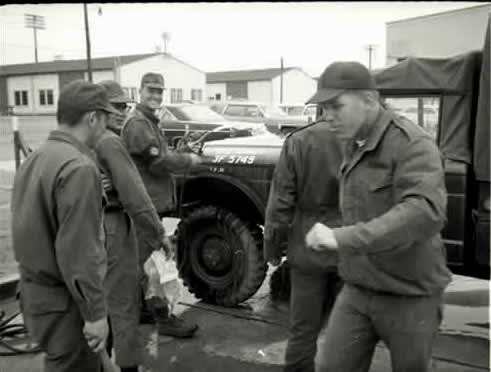
Military jobs have code numbers, the Military Occupational Specialty, M.O.S. The best known is eleven-bravo, 11B, Infantry. Me, I was trained as an oh five bravo intermediate speed morse code radio operator, a defunct trade in military communications, even then. Assigned to a rugged anti-aircraft missile site guarding MiG Alley at the Korean DMZ, I worked an oh five charlie field wireman's job. Mid-tour I lucked out and took a job in the Colonel’s office, writing military propaganda as an acting 71Quebec Information Specialist.

Short and Shorter. Sedano 3d from right, with shades.
When did you DEROS?
Short, short-timer. We counted the days until we would “get back to the world.” Upon arrival overseas, clerks calculate your Date Estimated Return from Overseas. If all goes as planned, you’ll be heading for the airport on your "dee-rhos" date. Not every Veteran served overseas. A stateside post meant serving the full two year hitch. Draftees doing one of the hardship tours—Vietnam and Korea—often put in a thirteenth month in order to earn discharge upon DEROS. I put in thirteen months, two weeks, three days, seventeen hours seven minutes and thirteen seconds in Korea, but who’s counting, que no?

RA or US?
Did you sign up, or were you Drafted? Draftees were assigned US serial numbers, volunteer tipos were Regular Army. On the sidelines were ER and NG, Enlisted Reserve and National Guard. The latter pair did Basic Training then went home. Everyone in today’s military are RA, or in barracks vernacular, Lifers. For a long time I knew my serial number by reflex. It was stamped on the dog tags to identify our bodies. I've forgotten the number now, and that's a good thing.

Would you want to see your grandchildren in uniform?
Not involuntarily.

Would you do it again?
Gente I know, to a man and woman say, Yes. I told an Army recruiter friend that I would go if I could take the place of one of the kids he was signing up. No way in Hell would I volunteer for the Draft, but if they called me again, I'd go.

Veterans and active duty wearing a uniform get free chow at  a number of chain restaurants today. A DD214 gets you fed, too. So there's that.

Veterans get to understand important yet amorphous concepts like Duty and Honor. I remember telling a friend about my cannon fodder post had the north invaded. The friend asked why I would hold my ground instead of running before it was too late? I told him it was my Duty. His eyes told me I was a fool. Así es.

Not short.

Take This Man Grossly Captivating Memoir

Review: Brando Skyhorse. Take This Man. NY: Simon & Schuster, 2014.
ISBN 9781439170878

Michael Sedano


Take This Man, along with its author Brando Skyhorse, occupy a unique spot along the continuum of U.S. ethnic literatures. These people, Brando and his mother, aren’t chicanos, but could have been. And they aren’t Indians, but they’re passing. His mother prefers fantasy history and invented Indianness, she becomes Running Deer Skyhorse, her son Brando Skyhorse, son of a chief. This is Identity run awry.

Take This Man revolves around Maria Skyhorse’s story, but at the memoir’s core lives a boy looking for a father in the men his mother regularly brings home. They all leave. Then she finds a replacement. Herein lies a challenge for readers: don't judge.

Maria’s acts gouge with such ferocity they steal the spotlight from Skyhorse’s more intimate explorations, overwhelming the author’s memories in his struggle to sort out identity and family and fatherness from his mishmash of an upbringing.

Skyhorse engrosses his reader with sordid details that make it tough to like that woman, Brando’s mother. While disgusted readers will grow furious at events, the author denies them an ally in their feelings. Skyhorse's tone is nearly emotionless, he refuses the reader's escape valve for the horror. The only release is turn the page, there's more.

It’s hard not to judge the people Skyhorse had in his life, not to want to spread chisme about those lowlife fathers, so consistently awful the child’s memory of fathering is a guy ferreting out hiding places, robbing piggy banks to buy a night’s drinking and gambling. Mother's not dumb but the easy way out is her route, such as her work-at-home telephone sex worker job. It brought in good cash and she didn't have to give up her food stamps. Marie laughed, ate well, and grew fat.

The little boy’s life is so gutwrenching I find myself wondering that people like this live among us, asking myself, he can’t be making up this stuff, can he? Skyhorse pulls off a tour de force voicing  disarming neutrality. Animated wit and punch-line paragraphs add depth to the mostly fast-moving account. It’s a challenge separating the creative from the nonfiction. Just turn the page.

The crud just piles up for this boy. Five husbands, lots of boyfriends, flings on the road, Vegas, Reno, Tahoe, ritualized humiliations. One example suffices to illustrate the savagery of Brando’s mother, her insanity, and Skyhorse’s own neutrality as he recounts a time he couldn’t produce some coupons to pay for a bus.

The mother shouts, I’ll just leave you here! You’ve taken enough of my life from me! Mother’s fury and hatred for men finds at-hand Brando easy pickings, normally with her mouth. In this instance, however, Maria gets lethally physical.

My mother grabbed my throat. Then she pulled me across the trailer the way a girl would drag a lifeless doll up a flight of stairs. She threw me shivering onto the bathroom floor and then snatched one of Nakome’s leather knife holsters and stabbed at my neck with it…. My mother wrapped her hands around my neck again and pushed my face in the toilet water while I flailed my short arms trying to reach the flush handle.

After Maria locates the boxtops she explains to the son how his carelessness led to the bathroom incident. Skyhorse matter-of-factly clarifies her logic for the reader, Not being given the box tops wasn’t an excuse; I should have asked for them.

The slight bitter aftertaste here is among the few instances where the memoirist’s otherwise controlled voice deviates from its straightforward, low-affect style. This son does not judge his mother. The author, ever a good son, won’t have readers criticize her, either. That’s just the way she was, this is what is available to remember.

Which, of course, is not what happens. Brando Skyhorse, the writer, isn’t disingenuous in what he’s chosen to recall and detail. That mother so burdens his life it takes over the book. The son-writer runs out of room for his main goal, and only skims the surface of the boy’s understanding of fathering and his relations with his biological father and daughters. Then again, the author notes, he hasn’t got this worked out yet.

With Take This Man, Brando Skyhorse should have exorcised the demons of his mother and fathers. He said good things about most of the men. He was kind to his mother and in that way gets back at her. Now the author can rekindle the spark seen in Madonnas of Echo Park, and hinted at in the Bukowski homage of this memoir, to drop the "creative non-"and get on with it.


On-line Floricanto for November 11, 2014
Elizabeth Cazessús, Henry Howard, Ashley, Jackie Lopez, Iris De Anda

Los Rehenes, Elizabeth Cazessús
Guilty of Being Brown (Showdown in Arizona), Henry Howard
Illegal, Ashley
Blessing for James' Place, Jackie Lopez
#bringbackourgirls, Iris De Anda


Los Rehenes
Por Elizabeth Cazessús

…el viento del crimen a la altura del delirio.
Rodolfo Hasler

es la hora de escribir un poema acerca del mundo
de diagnosticar las formas en que amedrenta
con su odio y deslava el rostro de la sinrazón
para justificar mil malabares políticos

es hora de escribir que estamos al acecho
de ladrones, de gangsters, de la avaricia
de la falta de libertad y la zozobra
de la mezquina relación de las entelequias

es hora de callar lo escrito
aquello que no tiene razón en la sobremesa
congestionadas las entropías mediáticas
ante verdades telúricas y tan llanas

es hora de nombrar en lo oscuro
la íntima ejecución de los días
la denuncia, el porvenir y la esperanza
con un silencio atroz que no deje dudas

es hora de contar metrallas, muertos, a los que corren,
de ver la película en las calles y al desnudo
dilucidar acaso en la espesura
de ciertas e inexplicables densidades

es hora de escribir un poema acerca del mundo
de éste y no del otro repleto de metáforas
ya no podemos escapar, no hay letras de salva
Somos rehenes de la impunidad que nos cohabita.

(del libro Hijas de la Ira)


Guilty of Being Brown (Showdown in Arizona)
By Henry Howard

I had a nightmare the other night.
I dreamed I went to buy the morning paper,
And the headline screamed
For all the world to see,
“SB1070 Declared Fully Legal!”
And I cried, because I knew
I was now legally unwelcome here.

My mother took the paper and milk from me
With trembling hands,
And told me in her soft Mexican voice
That Papa had been arrested on his way to work.
For the crime of driving without a Green Card,
He was found Guilty of Being Brown.

We did not have time to kiss him goodbye,
Or even make him a sandwich
On his way back to a country he had not seen
In twenty years.

I woke with my heart pounding,
And my eyes full of tears.
I slowly relaxed,
Realizing it was just a dream.

Then I drove to the store in my first car,
And the morning paper screamed
For all the world to read,
“SB1070 Declared Fully Legal!”

It was my 16th birthday,
and now I, too,
Had been found Guilty of Being Brown.


I am a Los Angeles activist and Peace Poet, whose literary focus has been on human rights since 2001. Published most notably as a featured writer on Quill and Parchment.com, and the legendary Sam Hamill's global anti-war poetry protest, Poets Against the War (beginning in February, 2002), my most recent work was published as a full-length compilation of peace and justice poetry called "Sing to Me of My Rights: Poems of Oppression and Resistance" (editor/publisher Mark Lipman, Vagabond Books 2014). Immigrant rights have been a focus of my street-level activism since 1980, when I learned in college of the murder of El Salvador Archbishop Oscar Romero--followed, of course, by the rape/murder of the four U.S. churchwomen that December. I was active in the Sanctuary Movement from 1984-98, and a member since 1986 of Refuse and Resist! and La Resistencia. I have never been to our Southern border, but it looms large in my consciousness. The horror of our country's involvement in the collective Central American slaughter, and the residual xenophobic policies towards immigrants, both documented and undocumented, reflected in legislation such as SB1070, haunts me to this day, and inspires me to take to the streets. I have one philosophy that sums up all my activism, including my writing: NO HUMAN BEING IS  ILLEGAL!

Contact me about the poem or order my book. I am also available for readings at public and private events, and will travel to Arizona, Northern California or Nevada to share my work at open-mic events. EL PUEBLO UNIDO! JAMAS SERA VENCIDO!


Illegal
By Ashley

You say I am illegal because of my flesh,
Racism-pigmentocracy,
Separation-marginalization,
Apartheid, a race apart.
Even after the laws change,
Discrimination still exists
Cradling fear and fight of flesh-hood
Same flesh, different color.
Illegal,
So is it my flesh, my body, or my being?

You say I am illegal because of the land I stand on.
I do not belong here.
The land sits underneath the sky,
Shall we fight over clouds?
However, this is no different than the land I was born from.
Migration to illegal immigration,
I am, me, the im- in immigration,
The prefixed knot in the rope,
The prescribed not of ‘im’ and ‘il’
Illegal,
So is it the land, my body, or my being?

You say I am illegal because of love,
An endearing criminal at best,
Same heart, different passion,
Love is not a crime.
What matters is within:
not the shape of our skin
377: I went sleep in 2013 and woke up in 1860,
Illegal,
So is it my heart, my body, or my being?

You say the I of me, the me of I is- Illegal.
The law versus: Land, love, and life,
No! No being is illegal,
Neither my body, flesh, nor heart,
Not even my soul,
It is time,
To set my soul afire and let it free.

This poem was first published on Orinam on Dec 20, 2014 at http://orinam.net/illegal/ and is being republished with permission of the author


Ashley was born and raised in Southern California. Her parents are from Mexico. Ashley has been published both online and in-print. A poet, aspiring writer, and is currently learning classical dance. This poem "Illegal" was first published on Orinam on Dec 20, 2014 at http://orinam.net/illegal/ and is being republished with permission of the author


Blessing for James' Place
By Jackie Lopez

James, I bless you from the tip of my hat to the bottom of your feet.
James, never covet another’s house because your place is blessed for having feasted.
I do believe you are entitled to a blessing.
I do believe you become disjointed at the ends when I don’t come around.
Don’t worry.
I will come around every Thursday night at 7 in between meals.
I happen to have happiness around.
I happen to have a misnomer claiming that I am “mad,” but that is how it should be
because I am quite the crazy little pajama party girl.
The mockingbird is singing outside of your studio.
The melancholy moon is twisting in her bed.
She heard you have blasted fun.
The pavement to your studio has been watered by daffodils.
The encouragement of the nonchalant is ever present.
There’s an artistic renaissance running around naked in your studio.
There’s a show girl at your doorstep.
There’s a criminal lurking around, but you know better, there is never a love that can be considered a crime.
If you watch your watch words, you will find me misbehaving.

When I was lost and had no matrimony to offer,
you took me in.
When the painters, poets, musicians, prophets, dancers, and one-night-stands came by,
you gave them an apple dessert to eat.
It so happens that I have come a long way from my home,
and I am able to salute you on a happening basis.
When the ticket to the train I was going on fell through,
I took to hiding in between the sheets.
Now I have you to call friend.
If ever you need a helping hand, if ever you are lonely and blue, call me telepathically.
I shall send the angels to rescue you because you deserve it, James Watts-and you, too, Juan Pazos.
Thursday night dinner is for dancing and being ludicrously in love.
It is for harnessing a misbehavior and going about town.
It is for the young at heart and for the philanthropists.
I summon all the powers of the Universe Complete to bless your studio now
and forevermore or for as long you endeavor to stay home.
When I saw your rocket scientist artwork, I became a lucid woman.
Simple things mean so much more when they are shared with friends.
So, keep on trucking.
I shall meet you on the other end of a transcendence.


Jackie Lopez is a poet and writer from San Diego. She was founding member of the Taco Shop Poets and has always pursued a study of history of which has influenced her writing. She has taught in San Diego City Schools and has been published in several literary journals. She has just finished her Magnum Opus titled “Telepathic Goodbye” described as a long poem of 25, 333 words. She is now looking for a publisher for this. You can catch her work on facebook under “Jackie Lopez Lopez” where she shares her work with a daily poem. She has a radio interview that will come out later this year. Her email: peacemarisolbeautiful@yahoo.com


#bringbackourgirls
By Iris De Anda

ruby rage shouts escape
as our young girls disappear
there is no sleep
when night falls without them near
days and days and days have passed
can you remember their bright eyed brilliance
forsaken flowers with petals that wither
under boots of beatings and men with guns
they are killing them softly
raping them daily
silencing their spirit
every time one of them dies
can you feel it in your body
walk around so heavy
carry unseen sadness
on the bridge of our backs
they are our future failing
mountains crumbling
deserts flooding
stars extinguished after lightyears of shining
blood moon tainting the night sky
mothers wailing to the goddess
bring back our schoolgirls
bring back our daughters
they are the martyrs of this modern plague
where men get away with murdering women
while the world looks away
closed eyes to our girls plight
makes the whole world blind
you do not want to see
what you would rather neglect
because it’s not your daughter, sister, or niece
you pretend to respect
can you protect morning dew from the blazing sun
the young woman from the older man
a system that teaches a girls life is worth less than his pen
there is no gentle here where our daughters cry
only rivers of pain
flowing back to the Niger
years of disdain
growing darker by the hour
bring back our sisters
bring back our feminine
bring them back
backdrop of africa
blackout of femicide
backbone of generations
backyard of transgressions
giveback our girls
payback our pain
paperback our stories
comeback our angels
we are waiting
arms wide open
feet tired from running with you and for you
tongues chanting
all the ways we could pray for you
hearts broken
night and days we wait for you
bring back our girls


Iris De Anda is a writer, activist, and practitioner of the healing arts. A womyn of color of Mexican and Salvadorean descent. A native of Los Angeles she believes in the power of spoken word, poetry, storytelling, and dreams. She has been published in Mujeres de Maiz Zine, Loudmouth Zine: Cal State LA, OCCUPY SF poems from the movement, Seeds of Resistance, In the Words of Women, Twenty: In Memoriam, Revolutionary Poets Brigade Los Angeles Anthology, and online at La Bloga. She is an active contributor to Poets Responding to SB 1070. She performs at community venues and events throughout the Los Angeles area & Southern California. She hosted The Writers Underground Open Mic 2012 at Mazatlan Theatre and 100,000 Poets for Change 2012, 2013, and 2014 at the Eastside Cafe. She currently hosts The Writers Underground Open Mic every Third Thursday of the month at Eastside Cafe. Author of CODESWITCH: Fires From Mi Corazon. www.irisdeanda.com

Tuesday, May 20, 2014

Recuerdo de Leipzig. Review: Dismantle from VONA. On-line Floricanto. Military May.

War Souvenir
Michael Sedano
The 69th Infantry Division fights its way across Germany toward Leipzig, killing soldiers, children, and old men sacrificed to slow Patton's advance while Hitler’s surviving troops fall back to defend Leipzig, the empire’s final bastion. For the rest of his life, killing those people haunts the machine gunner on the Sherman tank named C’est La Guerre.

Two hours before dawn the troops saddle up. Infantry soldiers check their ammo, armored cavalry take their seats in their Sherman tanks. The 777th Tank Battalion will lead the battle. The radio crackles inside C’est La Guerre. “Prepare to move out.” The driver starts the engine, holds the brakes and gooses the pedal. The tank rocks and shakes. “Move out!”

Initial resistance hits them a within a mile from their bivouac. These aren’t kids. C’est La Guerre booms cannon rounds into fortified positions while the machine gunner fires toward the smoke, raising thick clouds of dust and blood. Infantrymen move in to mop up, but by then C’est La Guerre is downrange, advancing on new targets.

Fifteen hours later, C’est La Guerre roars up to the front steps of Leipzig City Hall. The war in Germany is won.

Generals and politicians plan a meet-up between the Russians and the U.S., later deciding to give back with signatures what C’est La Guerre has taken with blood. The tankers of C’est La Guerre don’t know that yet. They’ve been ordered to the rear and park next to a surprisingly undamaged estate.

It seemed years that C’est La Guerre had rumbled past the mansion, but it has been only a few hours. The machine gunner remembers targeting his .30 calibre on the house but not firing a round at the empty home. He is relieved he hasn’t killed children, women, and old men who might have thought themselves concealed and safe behind the easily perforated walls. The machine gunner knows how easily.

The machine gunner walks inside. Rear echelon troops have stripped the home bare. The place stinks from its use as a latrine by soldiers seeking a private place to shit. Some jerk has savaged the household china that now lies shattered across the floor. Shards crackle under his boots, kicking pieces of crystal that tinkle across the rubble glinting like jewels. He shakes his head at the destruction and turns to leave when his eye catches a dim golden glow on a dark shelf. He squats to find two small gold filigree vases, untouched by the pendejo’s mindless destruction. The machine gunner cradles the delicate pieces and carries them to C’est La Guerre.

In 1962, one of the vases hit the floor in Redlands, California. My dad—the machine gunner on C’est La Guerre—shattered, too. I know the outlines of the story, but that day he tells me the story of the vases again, this time in chilling detail, of killing, the final battle, and the dead. He picks up a piece of bronze glass, and looking through it toward the sky, his voice shakes from memory of moonlight shining through bodies machine-gunned on a ridgeline. Niños héroes.

Thoughts of that conversation echo as I packed up my parents’ house. I wrap the surviving vase in soft cloth and place it in a box with mom’s china and crystal. I lose track of that box and dream frequently of the vase, pained by its absence. Yesterday, my daughter finds the bundle of cloth nestled among shattered crystal. She unwraps it and brings the Dresden glass vase into the light again. She sends me a foto, which is all I need; her grandfather wants her to have the vase.

I stare into the bronzeness of its color and hear my dad’s words, “When you get drafted, I hope you don’t go to war.”


Review: Dismantle. An Anthology of Writing from the VONA/Voices Writing Workshop. 
Ed. Marissa Johnson-Valenzuela. Philadelphia, Thread Makes Blanket Press, 2014.
ISBN 978-0-9897474-1-7

Michael Sedano


Unless you are a voracious reader with infinite subscriptions to chapbooks, literary journals and independent publisher lists, there’s likelihood many of the authors anthologized in Dismantle: An Anthology of Writing from the VONA/Voices Writing Workshop, will be unknown. It’s not a pity, because now, owing to this book, readers enjoy in a single cover, access to dozens of new writers who have been waiting up to fourteen years for you to find them.

In other words, Dismantle is a cornucopia of lost or hidden talent brought to light in this outstanding collection of compilations from VONA’s fourteen years of workshopping dedicated to developing writers-of-color. But The New makes the reviewer’s task all the more challenging. The book’s plethora of sparkling new voices and undiscovered poems and stories draw blood in a struggle to highlight one or two over all the others.

Then again, it’s the nature of anthologies that everything in one has already been chosen, in the process of winnowing submissions to the published few. For Dismantle, those choices fall to Poetry Editor Andrea Walls, Nonfiction Editor Adriana Ramirez, and Fiction Editors Camille Acker and Marco Fernando Navarro.

There is one name, and chapter, that, it seems, everyone knows. Junot Díaz’ introductory essay, on the whiteness of MFA programs, raised a social media ruckus when it went viral. One pendejo went to Díaz-the-MIT-Professor’s assigned readings and trumpeted the lack of writers of color Díaz assigns, implying hypocrisy because the list overwhelmingly includes anglo writers. Other gente picked up the unbearable whiteness theme sympathetically, chiming in from all corners of the MFA globe, “mine is/was too white!” and "that's why I quit the program."

Most agree with Díaz' thesis, that VONA offers welcome change and opportunity.

Other than Díaz, many of the 47 published writers may be names you see in print for the first time. Eighteen of the writers are reprinted, including three from big publishers, Norton (Maaza Mengiste), and Houghton Mifflin (Minal Hajratwala and Justin Torres).  And, upon reading the contributor bios, it’s a safe assumption Dismantle won’t be accused of being “too white.” Like the Spanish-surnamed, most writers carry what appear to be WOC names (writers of color), viz., Vanessa Mártir, teri elam, Vibiana Aparicio-Chamberlin, Kimberly Alidio, Jennifer De Leon, Ky-Phong Tran, David Mura, David Maduli, Kenji Liu.

There’s a familiar principle in panels of public speakers and anthologies, Primacy and Recency. Primacy, the first person to speak or the first piece in a collection, sets the standard for those who follow. An editor would want as the lead piece something that draws readers to turn the page. The last piece will be a capstone, the final impression one takes away from the event or the book. Those are the best two spots for performers, and could be effective as a strategy for anthologies.

The principles aren’t effectively employed. Editor Marissa Johnson-Valenzuela runs her Preface after Díaz’ Introduction. Fortunately, Johnson-Valenzuela limits herself to a pair of pages, but coming hard upon Junot Díaz’ nine page diatribe, the anthology gets off to a clunky start. I’d forego the Preface in favor of an Afterword, thus allowing the selections to speak for themselves, then closing the collection with the editor’s validation of her work.

Dismantle kicks off with poetry, a stinging piece of subdued anger from Torrie Valentine, “To the white woman on the plane who doesn’t understand my discomfort when she asks if she can touch my hair”. It's a fabulous kick-off.

Valentine explores the titular white woman’s motive, seeing her not as a curious bigot but as a person of possibilities, not phenotypes.

What will you do now
your hands in the dark thick of my hair
tracing the spine of a curl.
Your sleeve brushing my face.
If I were your lover I would begin
to undress you, unbutton your blouse
the warmth of you suddenly there.
And you surprised at how easily we give in,
search my eyes for something
more than your face
something more than you
fingering a coil near my ear.

The final literary piece—there are bios, credits, an afterword, too--is likewise a poem, “To My Future Son” by Kenji Liu. A father’s wish for a son’s manhood describes the desperate struggle a first-generation immigrant sees, a scion trapped between two worlds, lured by the glitz and ubiquity of the new world that devalues the father’s in favor of a reductio ad anglo.

inside concrete, men spin and flex
like WWF wrestlers, hollow and fearsome
and always performing. son, you do not have
to empty yourself like them, fists squeezed
so tightly your tenderness becomes
a sickness, constricted and hard
in your liver. this is the price
of manhood, to be a stone quivering
inside an egg. you will be told
to choose from a stir fried lineup
of kung fu gangsters, dumb-asses and
anti-sexy uncle tongs. these are men
made from the politics of other men
who only worship themselves.
if you choose manhood, many
will reward you, but really, who wants
to be a plastic action figure, muscular
yet with only one move: a head slam?

The poem fittingly closes the anthology with reminders its subject matter is not your standard Unitedstatesian literary array, but products of thoughtful writers who have assessed the consequences of multiculturalism and see them clearly, in writing. Liu might as well be addressing his fellow writers in advocating a person remain constant in their self-reliance, therein finding personal resources to become a man of his gente, or a writer for diversity. It's the core principle of VONA workshops.

Writers and readers can learn more about VONA workshops and the organization’s goals at www.voicesatvona.org. “VONA/Voices, the only multi-genre workshop for writers of color in the nation, brings writers of color from the margins to a community where their work is centralized and honored. Join us at the University of California, Berkeley for a week of writing workshops.”


On-line Floricanto

In the four years La Bloga has run the popular On-line Floricanto series, this is my favorite poem.


Appreciate Your Military Month

May is "National Military Appreciation Month," capped off with Memorial Day to remember the killing and the dead.

Remember? My Dad could never forget them. And his wish came true, I was drafted and did not go to Vietnam.

Who the heck wants to see their children go to war?

From this Veteran's perspective, if politicians genuinely want to appreciate the military, Bring the troops home now, every one from everywhere. Provide good jobs for Veterans, and reform the Veterans Administration to care for our wounded children and parents.

The machine gunner's wish: his son did not go to war when he was drafted.