Showing posts with label Floricanto Movement. Show all posts

Tuesday, July 01, 2025

Review of Blues for the Buffalo, Backyard Floricanto Returns to Casa Reyna, Jorge Martin qepd

 An Old Friend Through New Eyes

Review: Manuel Ramos. Blues for the Buffalo. Houston: Arte Público Press, 2025. ISBN: 979-8-89375-008-9

Michael Sedano

If you were reading detective fiction in 1994, you were excited by publication of a new Manuel Ramos novel, Blues for the Buffalo, featuring a Denver Chicano lawyer-detective malgre lui, Luis Montez. 

That was forty years ago, so it’s likely many readers are meeting Luis Montez for the first time, and today’s readers are excited by publication of the fourth in the Luis Montez series from Houston’s Arte Público Press. (link), Blues for the Buffalo

For gente who get a summer vacation, the four-volume Luis Montez series is perfect for summer binge reading. The series offers not simply four brown noir mysteries but more arrestingly, Ramos crafts a distinctive character in Luis Montez whose ethos occupies a central focus of Blues for the Buffalo.

Not that the novel lacks action and murder and clues and supporting characters. Ramos always fills his books with rich portions of all the above. Blues for the Buffalo, for all its insights into what makes Luis tick, has a fire-bombing murder, a gruesome hit-and-run, a shot in the dark, a bad guy getting it from Luis’ father.

Blues for the Buffalo introduces a California private detective character, Rad Valdez. Rad’s an ass-kicker and no Chicano but he’s got a semi-open mind about raza identity. Valdez is like a proxy for the modern reader who doesn’t “get” the title allusion to Oscar Zeta Acosta, the Brown Buffalo, and gives Ramos a platform to teach some history. This isn't dry stuff; it's like listening to oldies on remastered vinyl.

Oscar Acosta reads from his
Autobiography of a 
Brown Buffalo, 1973

There's no disclaimer like,“Any similarity to actual poets and Yo Soy Joaquin are strictly co-incidental,” but there could be. And there’s a sly smile behind that in the novel’s allusion to Denver poet and movimiento activist Rodolfo Corky Gonzales, who authored the movimiento anthemic ballad, Yo Soy Joaquin. That part’s not in the novel but what’s an allusion for if you have to spell out everything, que no?

Ramos isn’t raising pedo for its own sake. The book's fictive authorship is possibly a motive for murder and just desserts. The poetry subplot lets author Ramos riff on the literary life, flamboyant writers, and signing tables.

Manuel Ramos dedicates Blues for the Buffalo to Zeta, “For Zeta c/s”. Ramos is careful not to embellish or lionize the Los Angeles lawyer and writer in the novel's lengthy expositions about Chicano history and the place Oscar Acosta holds. 

The Brown Buffalo’s a kind of red herring--the book isn't really about Zeta, and the legendary activist is used as a fraud perpetrated upon a fragile woman by an evil half-brother. Evil is a word that dare not speak its name, in the story behind why the woman goes missing and the search leads to a Molotov cocktail and death of a good woman.

Readers who’ve seen Montez take too many risks and make dumb decisions that get him shot in the leg and have his legal practice come crashing down on him will find Buffalo’s Montez a breath of fresh air. Luis is earning a meagre living as a reinstated lawyer again. Slowed down by the leg, he’s introspective and sensitive. Ramos gives the character numerous ethos-fashioning soliloquies on urban change, the movimiento, conscientiousness, being a good son.

Like all the Luis Montez novels, Ramos juggles several plot threads whose characters pop in and out of chapters. As a favor to readers, halfway through Blues for the Buffalo, the author offers a thumbnail summary, “now it appeared that Rad’s presence in town had something to do with the fire that had claimed the life of Charlotte Garcia. And somewhere in all that, I had to sort out the killing of my client, Wilson López, and the unlikely linkage between the poet, Bobby Baca, and the small-time hood Chick Montero.”

All that gets sorted, raveled, and unraveled in good time, along with an untied loose thread about the missing woman and the ugly motive behind the woman’s disappearance and the chain of tragedies leading out of the search for a missing daughter, sister, family secret.

Summer is icumin in and that’s when gente who get vacation time like to kick back and read. Arte Publico’s making binge-reading the Luis Montez series an ideal way to do just that, kick back and read. You’ll enjoy the noir sensibility Manuel Ramos infuses into his novels, clever writing, plot twists you don’t see until they hit you in the gut, entertaining characters and despicable bad guys.

If you’re a working stiff who doesn’t get time off and have to sneak in a book only now and again, there’s nothing like a good mystery novel to distract from the crap and daily drudge. A Luis Montez mystery novel like Blues for the Buffalo brings just what you need to chase away your own blues and if you’re up on your movimiento history, it’ll bring smiles to your face. Y si no, here's a free lesson that anti-DEI tipos don't want you to have.


Backyard Floricanto Returns to Casa Reyna Poetry Garden

La Bloga has long championed the home-grown floricanto, a literary uprising in a living room or backyard. Festivales de Flor y Canto take place on big stages attracting whomever gets the word. Back in 2010, Michael Sedano organized a reunion floricanto of the first major floricanto at USC in 1973. Both festivals were three-day celebrations of Chicano Literature.

These were big deals but floricantos don’t have to be, and should not be, restricted to the big stage. Everyday gente can put together a guest list of poets, send out invitations, and get together in the living room or back yard to eat, drink, and share an open mic with fellow writers and invitadas invitados.

Poets and writers in the Altadena-Pasadena and neighboring communities enjoy the generosity and hospitality of Thelma Reyna, laureate emerita of Altadena, whose poetry garden makes a personal setting for an afternoon floricanto. This was the case last year, when Richard Vargas featured at Casa Reyna Poetry Garden. Link. 

This year, Reyna, with co-host Michael Sedano, welcomed the year’s first floricanto featuring Roy Kuchel and Karineh Mahdessian. 

A floricanto can be fully experienced only in public. This foto essay, however, captures moments of sublime joy wrought from sharing by the afternoon’s features and open mic readers. Iphone fotos by Michael Sedano, art directed/curated by Thelma T. Reyna.

Host, Thelma T. Reyna
It's not all poetry. Margaret García canta.
Alicia Viguer-Espert
Toti O'Brien reads then later sings a song.
John Martinez
Donald Berry
Jimmy Recinos
Mary Anee Berry moves the audience with a fire poem.
Casa Reyna is two blocks south of the Eaton Fire's reach.
G.T. Foster reads from his Vietnam-era memoir 
One of the day's feature poets, Karineh Mahdessian
Karineh Mahdessian makes her return to a poetry stage
in today's Floricanto
Leading the spotlighted readers, Roy Kuchel
Roy Kuchel made his poetry debut at one of last year's
Backyard Floricantos at Casa Reyna Poetry Garden


Remembering Jorge Martin

In 2018, Casa Sedano hosted author liz gonzalez in a book release Living Room Floricanto for her Dancing in the Santa Ana Winds (link). It was a joyous celebration with friends and familia for the San Bernardino native. Last week, liz gonzalez celebrated the life of her husband, scientist, musician, cancer patient Jorge Martin.

liz is surrounded by writer friends in the foto below. The display behind them tells Jorge's life story in a series of tee shirts. There is joy in sorrow, and the Jorge Martin Celebration of Life brought both in equal measure. Jorge's spirit lives on in memories of him held close to the hearts of Jorge's and liz' friends and familia. 

liz begins life after caregiving stops. La Bloga wishes liz the joy of finding the new life awaiting discovery.

Tuesday, August 09, 2022

Floricanto In GOPlague-time: Doing It Right

Renascimiento Floricanto: Floricanto Renaissance
Michael Sedano

We did it and it worked for years. Then it couldn't, doing it was dangerous. Still might be, but with considerations, so we've done it again. And we'll be doing it again later this month 

Oh, do not ask, “What is it?"
 Let us go and make our visit. 
In the room the women come and go 
Talking of Michelangelo. 

Floricanto, that's what it, is. It is the United States National LivingRoom/BackYard Floricanto Movement, and it's your turn to host them at your chante. Join the Movement! 

A few years ago, my wife and I frequented galleries and poetry readings like it was going out of style. We were the ones going out of style. Early signs of dementia began slowing us down and then, eventually, inevitably, we could no longer do the arte circuit. So it goes.

CasaSedano, already the scene of Barbara's magnificent seasonal parties, and where many a Mental Menudo with Magu went down, saw few hurdles to launching the LivingRoom/BackYard Floricanto Movement. 

Join the LivingRoom/BackYard Floricanto Movement! The easiest element, the Plan, makes hosting Floricanto events a breeze.

The LivingRoom/BackYard Floricanto Plan: invite good people, have a reading and discussion, and have fun. You don't even have to feed people, but come on. Clean up the yard and house. Make sure you have seating. Invite to your seating capacity.

We had a good run of readings. Authors making LA stops on book tours accepted CasaSedano's invitation to the informal gathering. At times, the Stanford Chicana Chicano Book Club met with the author, other times, the junta was a just for itself. 

Then the GOPlague hit and our living room shut down. 


Two years ago, Sergio Troncoso closed our unbroken string of annual+ LivingRoom/BackYard Floricantos. Sergio will the second guest at the 2022 resumption of CasaSedano floricantos.

Daunted, but not done, we waited out the GOPlague's worst years, isolating ourselves and looking at the world pass by the front window. No more of that. The world has begun opening up and we opened up CasaSedano to Richard Vargas's touring How A Civilization Begins (link, click please).

Richard has a special place in my memories and not-memories. 

In 2012, Jesus Treviño and I joined the book smuggling Librotraficantes on a journey (link) from El Paso to Alburque to Tucson. When we arrived at the National Hispanic Cultural Center, local artists had filled the main auditorium and Richard Vargas emceed a fabulous floricanto! I photographed the readings from the back of the house with a long lens.

Richard Vargas at the Librotraficante reading NHCC Alburquerque March 2012

Comes 2014, I'd put Jessica Ceballos in contact with Richard Vargas, and Jessica scheduled a Sunday Palabra reading, or was it a Blue Bird?, at Avenue50 Studio, featuring Richard. I planned to get some portraits up close.

I got myself hospitalized just in time for the reading. I hear Richard dedicated a reading to me. Having enjoyed an NDE (science calls dying and coming back a "near death experience") so recently, hearing some poet dedicated one to me made a big difference to my attitude.

Launching the CasaSedano LivingRoom/BackYard 2022 Edition with Richard Vargas is perfection. All those connections coming together gave the event a special feeling for me. 


Latinopia Word Richard Vargas How a Civilization Begins.mp4 from Latinopia.com on Vimeo.


Scenes from a BackYard Floricanto: Round Robin featuring Richard Vargas and John Martinez


Richard Vargas
John Martinez


Tuesday, May 11, 2021

O.G. & Hail! Originals Gone Forever

Michael Sedano 

In 1973, USC's El Centro Chicano hosted three days of raza artists performing their poetry and prose in El Festival de Flor y Canto. Several floricantos followed that year to put Chicano Literature on the U.S. literary map. The USC festival is the only one that was professionally videotaped. And then the tapes were lost until 2009.

That year, I tracked down the only two extant sets of videos from the first floricanto--outdated U-Matic ¾" videocassettes. 

One set was in Kingsville, Texas, where librarians were uninterested in helping me physically locate cataloged tapes. Another set resided in a storeroom of the Tomás Rivera Memorial Library at UC Riverside. After numerous conversations with people at USC's Doheny Library, and ultimately the legal department, I got permission from a USC lawyer to digitize UCR's copies and make copies for distribution. 

Juan Felipe Herrera was UCR faculty, a key conecta. Juan Felipe found the only U-Matic cassette player on campus. A few plugs and cables, two weeks in the storeroom, and the job was done (link). I returned the Festival de Flor y Canto 1973 to its USC home in 2010.

But the job was incomplete. Two performances had gone missing. I found exceedingly poor quality audiocassettes (link) of Roberto Vargas and José Montoya's readings, but the videotapes went out on interlibrary loan and got eaten by time. 

I had such a beautiful goal of returning the floricanto to USC, but dissatisfaction burned in me at the absent videos. More important, I wondered what happened to the original source tapes? 

Back in 1973, on my way to photograph a performance, I stuck my head into the production van and stared longingly at the 2" Ampex reel-to-reel video recorders I'd read about in my Annenberg coursework. The tape on those machines is what I wanted to get my hands on. Digitizing from 1st-generation tape would vastly improve the 3d-generation signals I'd worked. Plus, I would finally finish my goal of returning the floricanto--all the performers and all the stuff that landed on the cutting room floor--to USC. I was really interested in stuff seeming desultory then, that would have incredible value today.

The January 28, 2014 La Bloga-Tuesday announced my goal to find those original tapes. After all, I'd found almost all of the performances. If those originals existed, I would track them down. Three months ago, I got a phone call.

"Michael, this is Sy. I have the original tapes."

I always reasoned that the videotapes in Texas and UCR were produced by someone connected to El Centro, and marketed by them. The money wouldn't have been a lot, but it would have supported a lot of tardeadas at el centro, or personal fund-raising goals. I didn't ask, they wouldn't tell. UCR didn't have the invoices in their files--I checked.

That was all a ni modo under the bridge. Here is a lead to The Tapes! 

I phone the man Sy got the tapes from. This fellow was always at the top of my list as the mysterious marketer. I was one step removed from being accurate. A fellow whose name I remembered, an insider I did not know back in 1973, had the tapes in his garage. He was dumping them and offered them to this other quondam insider.

Purportedly original tapes--the O.G.s of floricanto in the entire United States--were now in three locations. Sy had a reel. The middle fellow had a reel. The third fellow had two reels. Or so I heard.

Are they 2" tapes? Yes, 2" tapes. That's the only fact I thought I knew for sure.

Then the crucial question: Can you make copies?

Like the ¾" U-Matic media I worked with, I figured finding a machine to play 2" Ampex tape would be an expensive proposition. I'd have to go out glad-handing media people to ask for money to pay to digitize the originals. Or if I could collect the entire set, I'd see if Barbara Robinson at Doheny Library had a budget for the project?

Sy's son works in media. He'll do it. Problem casí solved, que no? Those tapes, that have been missing since 1973, have to make their way from a garage in wherever, to a garage in another town, to Sy's pad, to el hijo's studio.

I waited two months then called Sy last week to see if he'd collected all the tapes from both guys' garages. Yes. Not good news.

Sy reports these are not the original uncut material. Tom Reddin Productions, likely, ran off the original performances onto these tapes. Someone copies this second-generation material onto those U-Matics I digitized, then put the "original" tape into storage. 

Roberto Vargas and José Montoya's performances? That's in Sy's hands now. 

This is something good to understand: I'll never know. I'm as done with that project as I'll ever be, and I'm satisfied leaving it unfinished. It is what it is.

Tuesday, April 20, 2021

Plague-time Casualty Rebound: Backyard Floricanto

Michael Sedano

Note:
In past years, Casa Sedano has hosted numerous authors in our Living Room Floricanto and Backyard Floricanto. We had to cease celebrating with the pandemic. We're shut-ins, so that cessation had an extra sting.

Pandemic recovery appears on track to allow a resumption of non-family gatherings of people who follow mask and distance safeguards. What a relief. Zoom offered a telecommunication-transportation trade-off that was cool--todo el mundo had living room floricantos on the phone. 

Nothing supplants the immediacy, la cultura, of readers and audiences sharing a poem or story. And this Summer, they're back. 

Here's a column from 2016 when Casa Sedano hosted Jesus Salvador Treviño's launch party for his short fiction collection, Return to Arroyo Grande. A great time we had, and the joy multiplied later when Treviño's book went on to win an American Book Award that year.


The spate of heavy rain exhausted itself and overnight the weather turned Southern California gorgeous. And since it looked like Spring had sprung early and was here to stay, people planned outdoor events, like the publication party for Jésus Salvador Treviño’s Return to Arroyo Grande.

As the day for the gathering of friends and readers approached, Pasadena skies clouded and rain threatened to wash out the reading and move it indoors. The hosts, Barbara and Michael Sedano, were bummed because Plan B, moving indoors, would challenge space and seating plans.


Treviño appreciated Sedano’s La Bloga review of Return to Arroyo Grande, the most recent in the author’s trilogy of speculative and fantasy stories. Treviño shared the column at Latinopia, where Treviño publishes excerpts from his exhaustive video and film archives, while advancing Chicana Chicano arts and literature through essay, interview, and review.

In the process of sharing the file we agreed that Treviño would do a reading at Casa Sedano. Treviño would record it and share it at Latinopia. Pick a date. That was in November.

Time, weather, hour, planning, calendars, all came together just right. The slight overcast that day offered perfect illumination for photography; clean clear light with no hard shadows.


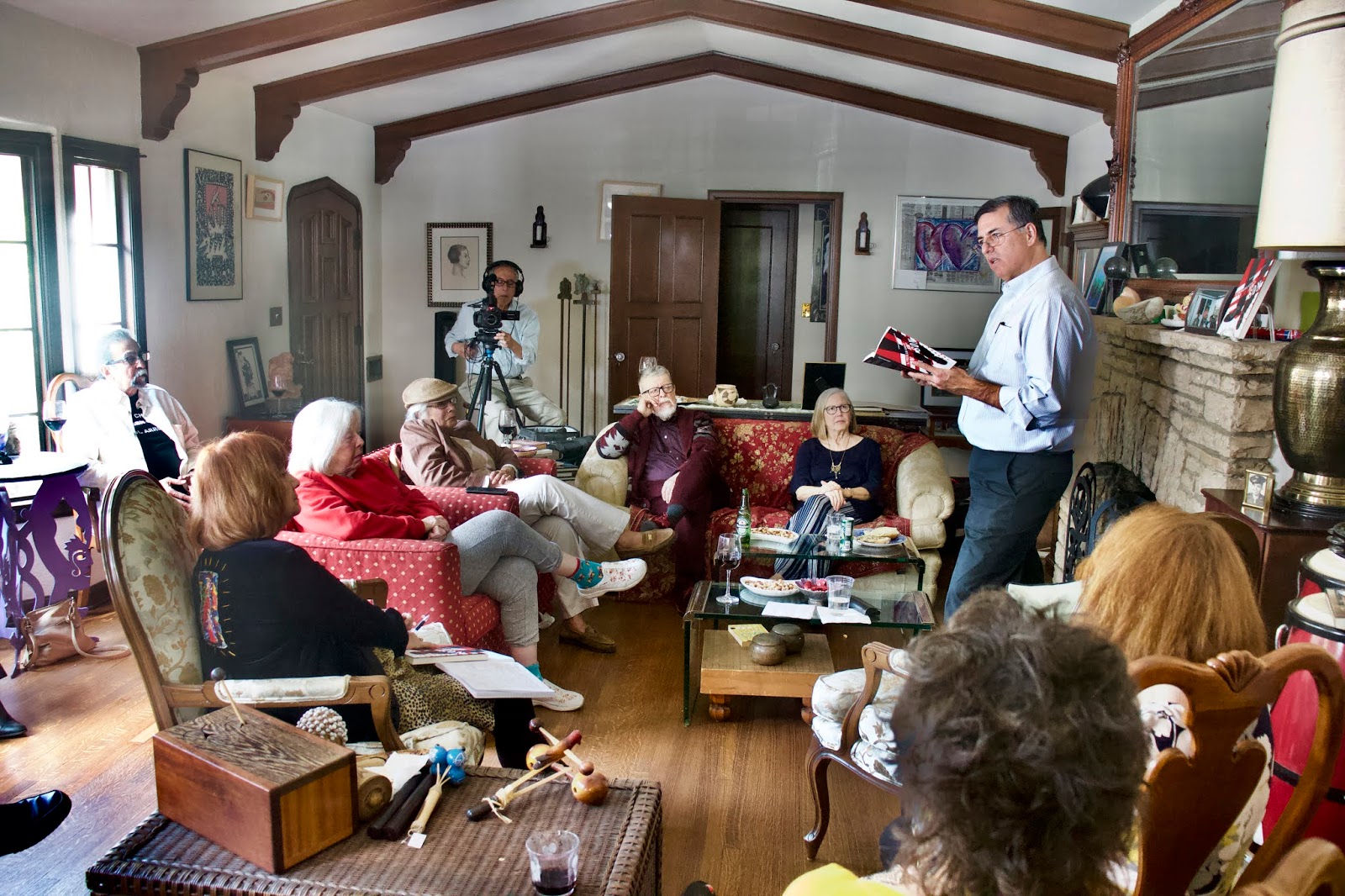
This was a party of friends, most of them writers and storytellers.  Guests had come intending to  relax, hear a reading, and celebrate the writer's achievement.

Nonetheless, the afternoon calls to mind the importance in a book’s life of marketing. Hitting the hustings doing readings and signing books gets the book in front of its readers and launches good word-of-mouth. All manner of salutary effects on writer, reader, and book result from a relaxed event and a good reading.


Treviño put a lot of work into the reading, crafting his presentation with a flair. He selects a gruesome outer limits-style story and does characters. He growls with practiced vocalics in an author’s endeavor to extract every ounce of drama from the scene. One imagines Treviño wrestling with that text when he was writing it, now he's wrapping it around his tongue for rapt listeners, he ponders has he muted the horror enough but given it possibility?

The story and the author’s interpretive reading draw appropriate shivers and “Uyy” responses from the attentive guests. They talk about it afterward.  Another day, when they read the story, they will hear the author's voice again, re-experience this moment of delight.


Jesus Salvador Treviño's Return to Arroyo Grande should already be on the shelf of any reputatbly stocked independent bookseller. The bookseller, or you, can get your copies directly from Arte Publico Press.


Tuesday, December 29, 2020

Book of the Peculiar Year. Your Picks For 2021. Bonus: Mural Update

This is the final La Bloga-Tuesday column for 2020. Talk about a tumultuous year! 

2020 arrived with annual bonhommie in every quarter of our lives, a new year, a re-start, begin at the beginning. 

La Bloga, along with readers everywhere, looked forward to a Spring and Summer of new book releases and Casa Sedano looked forward to working with Latinopia to produce Living Room Floricanto programs of authors and good literature. That was the outlook in La Bloga-Tuesday's final 2019 column, reviewing Sergio Troncoso's soon to be award-winning collection of stories, A Peculiar Kind of Immigrant's Son. 

In February, when Troncoso took his book on the road, he accepted Casa Sedano's invitation to read for a living room floricanto and Latinopia's camera. The virus had begun killing people but we weren't on edge yet.

As the plague spread, social distancing spread. That put a stop to 2020's Living Room Floricanto plans. Summer arrived, we cancelled Back yard Floricanto. We were ready for a great set of readings and pachangas.

Rudy Anaya, QEPD, kept his downstairs bedroom as a traveling writer's guest bedroom. Inspired by that hospitality, Casa Sedano installed its own traveling writer's guest bedroom, then uninstalled it when the virus came calling. The ropa de cama is in the Lane chest and I keep the cat out of that room. We are ready at the poke of a million needles.

Winding up 2020, La Bloga-Tuesday reprints those two Troncoso columns, in part as a sentimental farewell to a year that only got started before it slammed closed, in part as a token, mejor, a talisman, of what may be, in 2021, if those needles get poked. A ver. 

Wrapping this year-wrapper, La Bloga Co-founder Rudy Ch. Garcia raises timeless questions that La Bloga's readers may wish to answer. Please do so when you leave a Comment below. Be sure to click the box to receive notices when others Comment, too. 


La Bloga December 31, 2019 
A dozen characters in search of a peculiar son 

 Review: Sergio Troncoso. A Peculiar Kind of Immigrant's Son. El Paso: Cinco Puntos Press, 2019. ISBN: 9781947627338 

Michael Sedano 

13 stories make up the two-hundred pages of Sergio Troncoso’s A Peculiar Kind of Immigrant’s Son. (link) It’s a book so compelling it easily consumes an afternoon in a single reading, then days re-reading, provoked into thoughts on material success, identification, sex, quotidian life, and story-telling. 

Troncoso gives characters their own names and spaces, linking their stories to offer readers points of view the characters won’t know. There’s added enjoyment for readers when characters don’t recognize significant overlaps. Troncoso plays with that in one story, bringing strangers together with one degree of separation from a third, leaving readers on the edge of their seat, like running into your first lover in a random airport. 

Despite different names, I read them all as the same character who left Ysleta, only they played out their lives in alternative futures. Each story is the imagined “what-if” yearnings of a fifty-something man surrounded by links to his past. I am David. I am Carlos. I am Galilea. I am Vendo Claridad. Reading these stories as if they all are the same person on parallel courses comes from a conversation Carlos has with his suegro.

Who knows what changes the human heart. Who knows if it changes at all. Maybe the objects around it simply change too, so the heart – in– the – world is only an older heart lost in a different world. The question then becomes: are we the same person as our younger selves, or a collection of different selves in new worlds, or something disquietly suspended between the past and the present? 

Why shouldn’t raza hold Harvard degrees and work on Wall Street? Marry Jewish girls and seek out bad Mexican food in Manhattan? Follow your heart, if that’s what you want. The Peculiar Immigrant gives permission for that. In this sense, it’s a perpetual coming-of-age story because fitting into the establishmentarian world of Columbia professorial chairs or investment banking cubicles, exercise competencies that begin developing early in a lifetime. 

It sets you apart. The dead father had told his son how loved the boy was but held him at a distance, “you are not like any of us.” He is “Joe, the different Mexican” of the poem “22 Miles,” but instead of high school rings their fingers have MBA class rings and if the work they do is stoop labor, it pays six figures and buys condos near the park. 

Troncoso’s raza in monied or prestigious milieus hold their own with matter-of-fact social and professional competence, and save a repentant racist suegra, being a Chicano doesn’t overtly trouble these characters. Troncoso excavates that dreadful sense that lurks around the edges of social mobility, and saves it for the last story. Some call it “imposter syndrome” but for Troncoso’s character it’s a sense of being pursued by a wild beast in a trackless wilderness, or have no space of one's own. 

 The wild beast story closes the collection, introducing a new character after readers have come to terms with Paul, Galilea, Carlos, David, Sarah, Arturo, Melissa, Lori. Vendo Claridad, the final version of the peculiar son, waits until the end to raise the big issue of belonging. Given the dystopic setting of the closing two stories, the beast leaves readers with an uneasy gloom that remains unspoken, one's feelings for the collection not clear at all. In fact, the ambiguity of “Vendo” and its nearness to “vendido,” add to a reader’s unease in accounting the book’s closing words. Peculiarly provocative. 

A Peculiar Kind of Immigrant’s Son reverberates with literary significance as Chicano Literature, and for a bunch of academic reasons, but it doesn’t have to. Readers don’t have to catch all this, instead just enjoy the way Troncoso tells a story or uses characters to flesh out peculiarities of the Harvard Chicano. 

Carlos acts a total asshole blithering on about how put out he is while between-the-lines his wife is busting her back to make a good life for this jerk. 

Another fellow, Julio, is a cameo at the velorio, then gets righteously murdered in a later tale. 

Galilea will catch every reader’s interest, just for her and the cat’s name, but more so for her eroticism. She’s not particularly likeable as her story opens, especially when she has casual sex with that pendejo Carlos. Then, Gali’s husband Ben dies from a second bout of prostate cancer, leaving Galilea a million dollars. 

Empathy takes a roller-coaster ride in Galilea's and several stories, sometimes accompanied by humor. A character crashes and readers fear we’ve lost her. Nope, just the leg. Look for it, you’ll laugh out loud at the understatement.

Erotic writing calls attention to itself. Sex and lust occupy significant parts of youth, and old people remember passion with yearning, so these scenes are essential, though some obnoxious, others spicy. 

Troncoso delves into adultery from both a man’s and woman’s perspective, making his story devoid of moral dudgeon. Galilea likes to have fun and fulfills her own expectations. Mostly his characters betray out of pendejismo, but that’s neither here nor there. They just do it. 

I don’t want to ignore Troncoso’s instructions on how to read and think about his book, any book. Troncoso offers this, what seems reasoned and valuable, it’s an element of torture and assimilation into a dystopic republic of reading, the antepenultimate story, "Library Island": 

They asked for a nuanced view of each book, a viewpoint based on details about characters or scenes or writing style, or better questions and possibilities posed by the book to the reader, and in reality, all of the above.  

If anyone tells you Troncoso's "Library Island" resembles less a dystopia than a bad grad school experience, they’re right.


La Bloga February 20, 2020 
Living Room Floricanto at Casa Sedano Welcomes Sergio Troncoso
Michael Sedano

Living Room Floricanto is a social movement instigated by gente who love literacy as much as they love reading Chicana Chicano writers. Join the movement in your own pad.

In Spring and Summer, Casa Sedano hosts a Backyard Floricanto. In fact, the homegrown floricanto started out as an a la brava get-together after the Pasadena Book Fair hosted its first-ever panel featuring raza writers. Before then, Casa Sedano hosted Mental Menudos with our late compañero, Magu.


Cold or inclement weather relocates the now-regular floricanto gatherings indoors, as February’s California chill promised when Latinopia’s Jesus Treviño first proposed the gathering. Would I be interested in hosting Sergio Troncoso during his Southern California tour for his short story collection, A Peculiar Kind of Immigrant's Son? As it turns out, Saturday, February 8 was a picture-postcard perfect day of sunshine. It was still more comfortable indoors.


Casa Sedano is a spacious place that encourages small crowd events. We had a dozen friends, mostly writers and significant others, join us for a mid-day event. We broke up around 7, such a great time was had by all wish you’d been here. But sabes que? You can, you should, you oughta have your own living room floricanto.

Invite an author who’s going to be on tour in your region. Generous people, authors. They’ll work with your schedule and theirs. Sergio Troncoso, for example, chatted with Alex Espinoza and read at Los Angeles’ La Plaza de Arte y Cultura on Thursday night. This week, Troncoso is featured at the University of California, Riverside literary week. Saturday, at Casa Sedano in Pasadena, filled the calendar and put his work in front of a welcoming audience.


For authors on a book tour, a Living Room Floricanto offers a chance for a unique sharing of one’s work. It’s an enlarged conversation with abrazos. The guest of honor was on hand to greet the gente as they arrived. For the purposes of the video, I did a stand-up intro long enough for Chuy to get “B-roll” shots. I went for light-hearted in my remarks and Sergio read some serious stuff. Let’s see what editing can put together next week at Latinopia.com.

Ordinarily, Casa Sedano has the traveling writer’s guest bedroom available, but la casa is in a bit of transition right now. Authors on book tours travel on their own dime, so a spare bed or a warm spot on the floor saves out-of-pocket expense.

A public one-to-many event might feature introductions, announcements, then the author chats before reading fifteen minutes of good stuff. If you’re lucky, you get Alex to put you through your paces. Then, as time allows, a half hour of Q&A that range from desultory to good questions usually too much for this event. Living Room Floricanto provides warmly beautiful contrast. Sergio has listeners sitting next to him or just across the room leaning against a wall.


He reads the first few pages in a standup then signs copies. The author runs out of books but retrieves a new supply from the rental car. Everyone takes home an autographed copy they’ll treasure for the good writing but especially this experience. Not to be mercenary or nothing sabes, but word of mouth is the best marketing there is. We talked about raza hurting sales by sharing their books with five or six people who should buy their own copy. Autographed copies tend to stay at home, heeding Polonius’ advice.

Living room Q&A quickly wears out literary discussion in favor of getting down raza to raza and heart-to-heart with these Chicanas Chicanos. Hours pass exchanging regional histories and family conectas, this group readily switching English to Spanish or mixing, as the subject matter demands. La palomilla is in town and they're in the front room.

In California it seems everyone is from someplace else, and in this group, half of them have Texas roots. Several guests hail from Juarez or El Paso. Ysleta, Troncoso’s wicked patch of dust, is a suburb, so lots of insider chismeando and exchanges fill the conversation. Topics range from writerly discussion among the writers, laments on development messing up the old home town. That book came in for some discussion, the guests familiar with Myriam Gurba’s important work with David Bowles in the nascent #DignidadLiteraria movement.

Treviño and Latinopia provided amazingly delectable Italian sandwiches and lots of soft drinks and some notable wines. Recently-retired multi-talented Mario Guerrero brought Gruet champagne. This superb New Mexico wine has found distribution in Southern California. A small winery like this offers a model for small publishers, that is, gotta find ways to break out of the local mold and get into distribution channels.

Independent publisher Cinco Puntos titles likely have spots on independent booksellers shelves, though the direct link works for gente who buy over the internet.

Clickable Links
La Bloga-Tuesday's review of A Peculiar Kind of Immigrant's Son.
Publisher's website to order your copies of Sergio Troncoso's works.


Looking Back With Delight
How Soon? Sooner Than Too Late.

History happens right before your eyes along Los Angeles' Marmion Way. It's the resurrection of a living spirit--make that 169 feet of living spirit, in the restoration of Daniel Cervantes' 169-foot long mural depicting indigenous gente in native settings. 

I'm going to use "resurrection" interchangeably with "restoration," the artist's description of her labor. The wall had been put to death by tagging and city maintenance crews. The committee and the artist have brought this work back to life. That's a resurrection in the light. But that word, it has holy connotations! Yes, yes it does.

The location, on the alternative to busy Figueroa Street, makes a perfect display site given the towering original Southwest Museum Mt. Washington Campus, the original location of the Gene Autry-founded Southwest Museum of the American Indian.


La Bloga has followed the restoration since summer of 2019, when Lopez began working for the arts activist funding committee that pulled together funding from the local politician, the Los Angeles city arts commission, California's Arts grants, and other donors. Sadly, once Lopez had the project well underway, support evaporated like the blue tarp covers protecting the site disappeared within a few days of mounting.

The artist labored under open sun, no shade had been provided by the owners of the worksite. Worse, the ground provided treacherous footing from terrain displacement and trash. One night and weekend, a person who loves what Pola Lopez is doing raked the surface and leveled the worst spots. Only community support made the ground safe for a worker.

Lopez has enjoyed consistent support from Angel Guerrero, who's dedicated weeks of days to painting as directed, apprentice to the maestra. Angel, and a small number of other artists, have the skill to lend a brush. It's not a job, it's arte.


Community support has brought spiritual enrichment beyond a few dollars more, though money is really useful. Passersby honk and throw thumbs-up signals. A mother walks her babies past the site regularly, enjoying the progress. During my recent visit, Marco, a Salvadoreño, drove up and parked for a chance to talk to the artist. His son attends a local elementary school art program and Marco the dad was talking about an enrichment field trip for the kids. Imagine the insurance liability had that volunteer not been civic-minded, and some kid tripped on a dirt clod and broke a limb?

The site attracts attention from tourists and locals alike. The richly colored design and subjects create a landmark along an otherwise nondescript stretch of road. The mural fills a need no one realized was there, now it's an indispensable contribution to community unity. Taggers respect this wall.

The mural will be fully restored perhaps this week. Then Lopez has a crew spraying a protecting bonding coat, the semi-final stage of restoration. A final graffiti coat completes the entire project.


Lopez faces a funding crisis. Lopez has stocked the graffiti coating material now needs a professional installation crew to spray this vital protective coating. Here's a link to the artist's funding site. There's a spectacular photograph of the sorry state of the surface prior to Lopez' skilled recovery of this historic mural. 

It's anyone's guess why the Cervantes Mural has become an orphan. The Autry's coordinator offered to share insight into the museum's abandoned role, but nothing further came from that direction. I wrote councilman Gil Cedillo an open letter (link) recently, about having a grand unveiling. Silence is golden so someone's getting rich but it's not Pola Lopez nor local cultura.

There's the pity. Here's a major cultural landmark nearing resurrection and the community's leaders turn blind eyes and deaf ears. Ask Lopez when the gran unveiling is and she stares back with a rueful smile. None she's heard of, and I figure if she hasn't heard, there is nothing planned.

I'll gather with some friends, burn sage, walk the mural, hear their stories, invite the artist to a good restaurant and toast her health. I hope the people at the next table won't shush us for raising a ruckus. We'll be the only people in LA celebrating the mural.


The business of art subscribes to the force of a contract, arte and cultura and culture be damned. The letter of the law says no more money. The law is an ass that never had to resurrect a cultural wonder and ran into cost over-runs and comes up short. 

The value of what is happening on that wall is immeasurable, not zero, but zero is what funders and cultural giants have added to their earlier generosity. 

The Autry museum, owner of the Marmion Way site, recently "undertook its major multiyear, multi-million-dollar effort" to preserve its collection. That's P.R. Its mural, its most highly visible cultural treasure and one not hidden in the museum's vaults, gets not one red cent nor indian penny more. "Take our word for it," Autry fundraisers say about their vaults filled with unrestored artifacts, "we care."

The business of art demands a piece of the action. So it goes. Fundraising costs money, sending a portion of all the gifts donated to restore the mural to the operating budget of the fundraising committee. There's no millions there, but who knows what the commission is, 30% 15%? One or five percent of that would finish the job. Not that the artist is asking. I asked Lopez about the final coat and she says that's an open issue. Now, the graffiti coating is the most critical step to protecting the mural, and it's an open issue.

It's not the business of art but the art of art at stake here. The entire raison d'etre of resurrecting this spirit is that people see its images, read the story, enjoy the color, identify the land they stand upon and its people. Ars gratia don't waste all this by not having professionals apply the graffiti coat.

The artist's funding site directly supports the restoration with no institutional overhead. Use this link to give directly to hiring professional graffiti coating experts.


Books In Review: 2021
A column from 2010 by La Bloga Co-founder emeritus Rudy Ch. Garcia:

La Bloga reviews – pensamientos


In the years that La Bloga has been in existence in one way or another we've reviewed thousands of books, not all of them by or about Chicanos. We've covered classics, new releases, children's books and even vampironovels.

While the ranks of our reviewers have varied over those years, the core of Blogueros continues weekly with this labor of love. At the same time we have had delightful variation coming from guest Blogueros or those who have followed our path for a time. It's made for a huge body of work that we hope not only has entertained and informed but in some way has contributed to the literary body and history of Chicano lit.

Some questions come to mind that readers may be able to help us with:

Is there a type of posting that we've neglected to cover or that we need to expand?

What are the outer limits of Chicano lit and have we excluded books and stories that in fact should be covered?

What about Chica lit?--the pulpier version of cozy works being written for and read by Chicanas? Should we consider that a higher priority or just leave it to other websites already doing so?


Where's the reviews of Diana Gabaldon novels? Despite not calling herself anything ethnic and insisting that her name should not be pronounced as a Spanish word, Gabaldon is at least highly successful as a big-name writer to mainstream U.S. audiences.

Does La Bloga have the cómo-se-llama to do critical reviews of some of the most successful Chicana authors out there, or do we limit ourselves to publisher blurbs?

Do La Bloga reviews suffer from undercurrents of that old Chicano Movimiento envidia that limits us in doing frank reviews of books that should not be recommended?

Are all the books being published by Chicanos worth reading?

Should La Bloga's literary responsibilities be raised to higher standards?

Would there be a purpose in becoming "more professional" and less tolerant or would we end up cutting off our own noses?

Should we worry how the Anglo world of literary critics views our present perspective?

Are any Chicanos out there reading Sci-Fi, westerns and dragon-fantasy genres from Anglo writers and wish there were Chicano authors doing such works?

Don’t' get me wrong. La Bloga reviewers have done incredible and significant volunteer work through the years. In many instances they have pointed out the weaknesses to reviewed books, and I'll note that Michael Sedano is one of the most accurately critical in this. And the reviews and opinions will continue.

Also, I ask these questions not only in general, but also of myself. Things to ponder about how my own Chicano mind works. And it's also possible other La Bloga contributors, particularly those who've produced chingosmore reviews que yo, might have additional questions.

In any event, I thought it might be a good time to put out these thoughts about how we've approached Chicano literature and welcome readers' comments on them, as well.

Dan Olivas asked me to cover his spot today for personal reasons, but will return next week. Although, after reading this, he may decide not to leave Monday open again.

Es todo, hoy
RudyG