Showing posts with label floricanto. Show all posts

Tuesday, September 01, 2026

La Bloga Spotlights Poets Laureate

Keeping Poetry Alive: Poets Laureate Across the Nation

Michael Sedano

La Bloga launches a series spotlighting Poets Laureate and their work to foster literacy and poetry in their community or state. Inspired by the Laureate program in Altadena, California, La Bloga encourages other communities to establish a Laureateship.

Who Are Laureates?

The United States Congress supports a Poet Laureate Consultant in Poetry to the Library of Congress, more readily known as the US Poet Laureate. The Consultancy, dating to 1947 (link  https://www.writersdigest.com/write-better-poetry/who-are-the-united-states-poet-laureate-consultants-in-poetry) features a roster of esteemed poets. The US Laureateship has bestowed its honor recently on leading voices such as Juan Felipe Herrera, Ada Limon, Joy Harjo. 

Fifty US states and the Navajo nation appoint Poets Laureate. Numerous communities recognize local writers as their Poet Laureate. There’s a widespread poetry community in our culture, as this roster of state Laureates illustrates (link  https://poets.org/text/current-us-and-state-poets-laureate )

Spotlight on:

Today, La Bloga-Tuesday is happy to feature José B. González, Poet Laureate of Connecticut. The state has a State Troubador and a Laureate. According to the state’s website, 

Connecticut’s State Troubadour and Poets Laureate are ambassadors of the arts. These inspiring artists are nominated by Connecticut residents and evaluated by a peer panel and the Connecticut Office of the Arts (COA) for their distinction within their fields, portfolios of work, and contributions to the arts community. The COA is committed to building a community that is respectful and responsive to the diverse talents, skills, and abilities of all people.


González’ recognition is well-earned. A Macondo alumnus, José founded the notable Latina Latino  literary resource, Latino Stories (link https://latinostories.com ), which has been sharing literary news and insights for twenty years. La Bloga reached out to Laureate González and he shares the following:

When I first got the news about being a state poet laureate, I heard the ancestors rejoicing in their native tongues. I hope to remind those who need reminding that "immigrant" is not a dirty word, but that it is a word full of honor, sacrifice and dignity. I am proud of running LatinoStories.Com and celebrating La Raza authors for over 20 years. La Bloga is the only site that has done it for longer. And the way I see it, when I get an honor like this one, it's because someone took the time to say let's take a moment to read and listen to him. This is all a round-about way of saying, thank you to La Bloga for all you do.


Meet the Laureate

Connecticut’s Poet Laureate, José B. González is one of the most sought after speakers in the U.S today. He was born in San Salvador, El Salvador and immigrated to New London, Connecticut at the age of eight.  He knew no English and now holds a Ph.D. in English. A nationally known speaker, Dr. González has presented at various colleges such as Harvard, Rutgers, and Cornell University; countries including Mexico, Spain, and El Salvador; and institutions including the Smithsonian Latino Center and the Smithsonian Museum of the American Indian. He has been a featured Moth storyteller, a contributor to National Public Radio and has published poetry in such journals as Boston Review, Quercus Review, Callaloo, and Acentos Review, and anthologies including the Norton Introduction to Literature,  Theatre Under My Skin: Contemporary Salvadoran Poetry, Wandering Song: Central American Writing in the United States, and Latino Boom: An Anthology of U.S. Latino Literature, which he also co-edited. His poetry was a part of the first ever Latino exhibit at the Smithsonian American History Museum.

A Fulbright Scholar, he has received national and regional awards for his teaching, for his efforts to improve the conditions of Latinos pursuing a college degree or a career in higher education, and for his poetry. One of the major Salvadoran-American poets in the U.S., he is the author of the poetry collections, Toys Made of Rock (Bilingual Press), and When Love Was Reels (Arte Publico), and is the founder and editor of LatinoStories.Com.

Dr. González infuses his presentations with a mix of poetry, humor and social commentary. He holds a Master’s in Teaching English from Brown University and a Ph.D. in English from the University of Rhode Island and is an alumnus of Sandra Cisneros’ Macondo Writers Workshop.


Connecticut Poet Laureate Online Floricanto

English Words from https://www.splitthisrock.org/poetry-database/poem/english-words

By José B. González

my mouth agape           for these english words          made of stone
their sharpness              could split my tongue,            but one by one
i’ll use them                     to build a wall,                           one by one
i’ll stack them                 on top of each other                smooth them
and scrape way              the sounds that                         silence me.


Breaking away to the u.s. from https://poets.org/poem/breaking-away-us

José B. González

finally,
a day so perfect that
this morning’s awakening bombs
are overtaken by a woman’s wind chimes
of “tamales, tamales.”

on the way to the airport
iguanas hang upside down,
even they smile.

along farms and fields
rotten bullet seeds
are overtaken by flowering weeds.

on the side of the highway
a tall Maquilishuat tree gives
birth to premature pink petals
&
inside a plane headed north,
yani & i fly so high
that we can’t tell
cornfields from fences;
it’s such a perfect
final day.

From Toys Made of Rock (Bilingual Press/Editorial Bilingüe, 2015). Copyright © 2015 by José B. González. Used with the permission of Bilingual Press/Editorial Bilingüe.


Read more of José B. González work at this page (link).https://josebgonzalez.com/sample-publications/


Tuesday, July 29, 2025

On-line Floricanto features Angel Guerrero

La Bloga-Tuesday proudly shares poetry from a recently-debuted poet, Angel Guerrero. Guerrero’s work has taken an upward trajectory ever since the poet made her initial public reading at the Eagle Rock branch of the Los Angeles Public Library in  May 2024. 

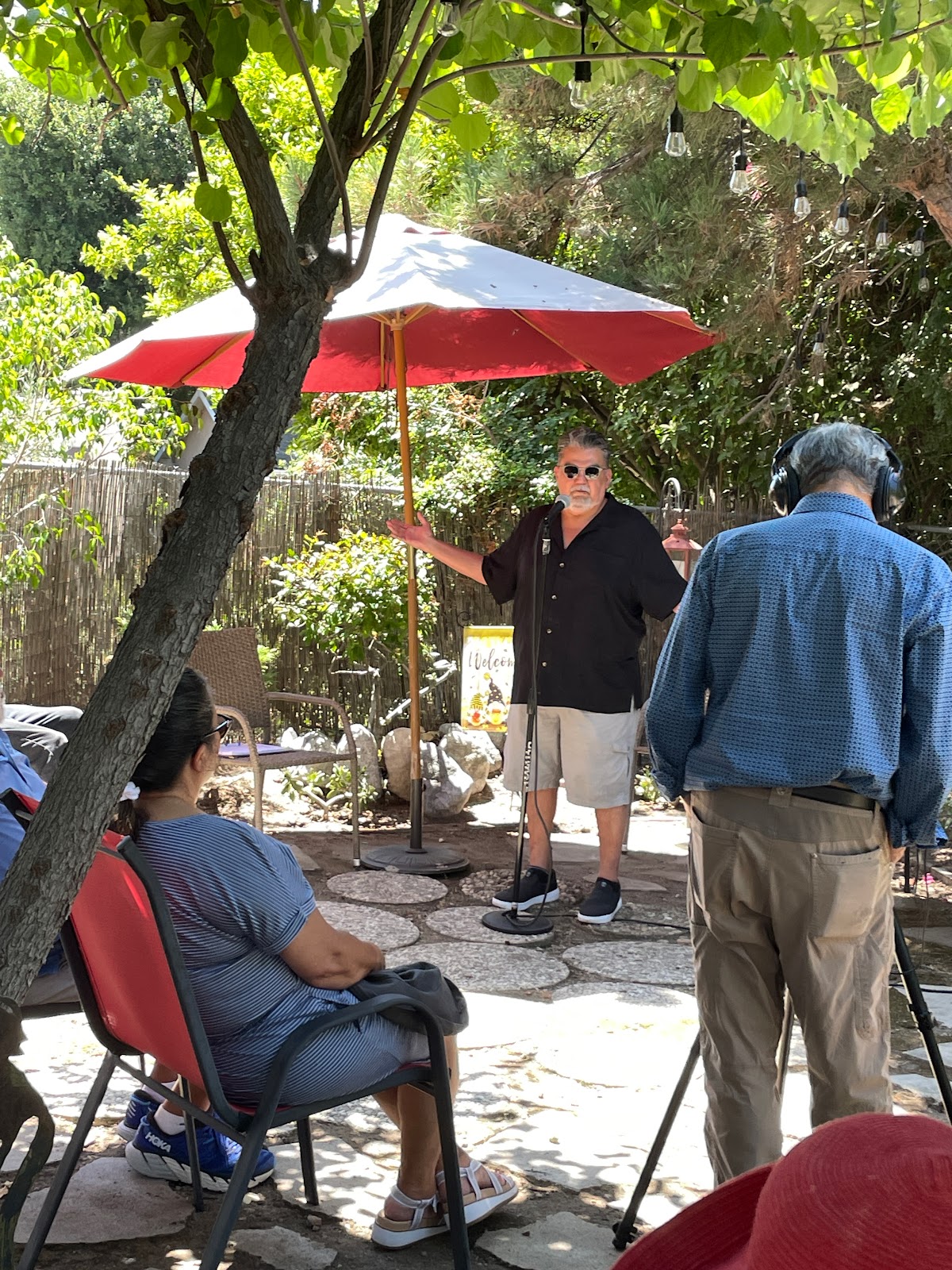
Since the reading, Angel Guerrero’s been published in Don Campbell’s So Cal Steps and the upcoming on-line Altadena Poetry Review. Guerrero has shared her work at Casa Reyna's Poetry Garden in a backyard floricanto. This is Angel's first On-line Floricanto appearance.

Guerrero enjoys a diverse artistic life. She’s a noted collector of Chicana Chicano artists, she studied sculpture and painting with Magu, Angel Guerrero was assistant to Pola López for the restoration of the Daniel Cervantes indigenous faces mural at the foot of Los Angeles’ endangered Southwest Museum.

Editor's Note: La Bloga's On-line Floricanto series started in 2010 in collaboration with Francisco X. Alarcón qepd, in anticipation of that year's three-day Festival de Flor y Canto: Yesterday • Today • Tomorrow, organized by Michael Sedano. Francisco and Michael reasoned that that Fall's reunion of poets from the first Flor y Canto in 1973 shouldn't be limited by geography, hence we took the opportunity to share established and emerging work, particularly work submitted to the Face group, Poets Responding to SB1070, via La Bloga-Tuesday.

Angel Guerrero, left, Pola López, right, restoring a heritage mural in northeast Los Angeles 

On-Line Floricanto Featuring Angel Guerrero


KEEP CLIMBING
by Angel Guerrero

I’ve been climbing these stairs, 
For what seems like forever. 
I’ve climbed Seventy-One, 
Each one has my name engraved on it. 
This is my path, and it is well-worn. 
I step carefully nowadays, 
gone are the days of 
Skipping and jumping 
and daring myself to fly, 
Slipping and falling to the bottom, 
only to start again. 
That energy has faded, 
and caution has taken its place. 
I dare not look down 
a dense fog threatens to overtake me. 
So, I look upward 
and refuse to lament the past.
I climb slowly, 
I am unsteady, 
but some days I get excited 
to see what awaits on the other side. 
But every step has its own lessons and wonder, 
One day soon I’ll reach my destination 
So, for now, 
I will continue climbing.


THINGS LEFT BEHIND
by Angel Guerrero

I run around my bedroom frightened by the familiar voice on my cell phone, 
The voice sends out warnings of 
Amber Alerts, Flashfloods, and Earthquakes. 
And now that voice insists, 
we must leave, leave our home, 
Our art, sculptures, books, our love letters,
Small and large items, mean something only to me. 
Everything is precious,
 our photographs, the kind you can hold in your hand, 
The images of life together, our youth, 
And family members we will never kiss or hold again, 
We must get out now, “it’s only stuff.” 
So instead, we gather necessary items, 
our survival kit is small, 
And our time is short. 
I search out my husband's eyes, 
His still-strong arms envelop my quivering body and still my fears. 
As we turn to leave, he whispers in my ear 
“It’s only stuff.” 
I realize that the things we leave behind are no longer 
more important 
Than our fingers holding on tightly to each other. 
He leads me down the staircase 
just in time to hear 
That the warning was not meant for us, 
But for another community of people.
We stand frozen. 
Our hearts are pained for them, in shock, for them. 
For the many who will now have to deal 
with this horrific loss 
we pray that your families survived 
And that it is only their things that were left behind.

*to be published in 2025 Altadena Poetry Review


CHARRED STAIRS
by Angel Guerrero

 I went to search for you, 
but could not find you. 
Everything was gone, 
Charred rubble, 
which was once precious memories, 
Was all that was left. 
Gone was the beauty that had once existed, 
All was scorched beyond recognition. 
So, on and on I walked, 
So sure, I would find the path that led to you. 
Finally, I looked up and there was your street. 
I followed the now-broken road 
Once edged by everything that was lush and green. 
I walked until I saw the stairway that led to your home,
 It was stark and blackened by the ravenous flames. 
My heart was filled with dread, 
but I climbed on. 
Once at the top, I fell to my knees in tears, 
As if it had been my home, 
As if it had been, my loss, my pain. 
Finally, I turned and slowly walked down those stairs, 
Which no longer led, 
to anyone or anything, 
I once knew. 


Friday, August 18, 2023

Backyard Floricantos Are for Summer


Melinda Palacio, Santa Barbara Poet Laureate


 *this post is originally published in the Santa Barbara Independent 


In Thelma Reyna's backyard


Over the past fifteen years, I’ve attended several floricanto’s at Casa Sedano, the home of Michael Sedano of La Bloga.com and Barbara (Michael’s late wife who recently lost her battle with dementia). Sedano has staked his claim as blogger and photographer to poets. He travels to poetry readings, near and far, and aims his camera in hopes of the perfect poetic pose. He photographed the first floricanto festival at USC, celebrating Chicano and Chicana poets in 1973, an event originally hosted by El Centro Chicano. USC’s Digital Library holds original films by the readings thanks to the efforts of Producer-Director Jesus Treviño and Photographer Michael Sedano.    


In 2010, Sedano organized a reunion of the original festival poets and invited several newer poets to participate. The floricanto festival of 2010 included poets who identify as Chicano, Chicana, Latino, Latina. I was lucky to be among the participants in an amazing lineup that included Juan Felipe Herrera, Alurista, Ron Arias, Vibiana Aparicio-Chamberlin, Tony Marez, and Mary Ann Pacheco, and Veronica Cunningham. 


Since then, Sedano has hosted several floricantos in his backyard with Jesus Treviño is there to film and feature the poets on Latinopia.com. Last Sunday, the tradition returned after a long, covid-hiatus. It was wonderful to gather with poet friends. There was even an appearance by famed artist Margaret Garcia, who last year was honored with a one-woman art show, Arte Para La Gente, at the Ventura County Art Museum. It was a big surprise when Margaret Garcia signed up for the open mic and sang a few verses of “Gracias a La Vida,” the Mercedes Sosa song made famous by Joan Baez. Garcia’s voice is rich with dark chocolate tones, a surprise for someone with a high speaking voice. 

Richard Vargas 

David Roth and Richard Vargas


Sunday’s gathering was in honor of Richard Vargas and his latest poetry book, leaving a tip at the Blue Moon Motel, Casa Urraca Press 2023. A seasoned poet, Vargas is on top of his game and at his strongest when writing about everyday life, his various jobs and occupations that inform his poetry, love and family. At the floricanto, Vargas is surprised by his high school friend, David Roth. Vargas says it’s a joy to be invited to read at one of Michael’s floricantos. “I feel as if I’m contributing in a small way to our culture’s traditions ad evolving art,” he said. “The camaraderie and friendship between poets and the audience makes it a very special event. 

John Martinez


For this gathering, a little flexibility is in order. Casa Sedano has been sold (his wife Barbara did not survive Covid or her battle with dementia. Michael is still in the process of moving so the reading takes a place nearby at Thelma Reyna’s beautiful backyard. Thelma Reyna is an award-winning author and publisher of Golden Foothills Press and was Poet Laureate of Altadena from 2014-2016. Thelma and I are set to open for Richard and there’s a signup sheet for an open mic. However, the order becomes jumbled because Jesus Treviño must leave early, so the show begins with the featured reader, followed by the open mic and Thelma, our hostess and featured reader. I closed us out with three poems and their companion songs. 


I’m looking forward to my set at Shoreline Park, August 17 at noon. If you come, look for the Library’s On the Go Van and the playground. 


Events:


Thursday, August 17, noon to 1pm, Poetry in the Park, 1237 Shoreline Dr., Santa Barbara. A set of poems and songs by the Poet Laureate.


Saturday, August 19, 10 am, SB Community Archives Showcase, East Side Library, Santa Barbara. Listen to a poem and hear stories, see archived photos of Santa Barbara’s East Side neighborhood. 


August 25, 6:30-8 pm, Writers Symposium, Fine Line Gallery, La Cumbre Mall. A discussion on ‘inviting the Muse’ with Dan Diamond, Janet Lucy, and Melinda Palacio, moderated by Mike Cregan, founder of La Cumbre Center for Creative Arts and award-winning author Tracy Shawn. 


Two poems by Richard Vargas:


menudo


i remember the morning

car ride to the Compton

neighborhood market

just the two of us

my dad would walk in 

carrying the empty pot and lid

set it on the counter and ask

for it to be filled with our

sunday morning breakfast

while he picked up a package

of warm corn tortillas

i checked out the colorful

piñatas and sweet-smelling 

pan dulce still warm from the oven


he would notice and buy a few 

conchas and fruit-filled empanadas

watch the smile light up my face

the drive home was slow and gentle

making sure we didn’t spill 

any of our orange-red bounty


i never cared for the oregano

but a squeeze of lemon

a spoonful of chopped onion

and a warm tortilla rolled up

in my small fist 


planted the seed 

for this poem to bloom


************************************


leaving a tip at the Blue Moon Motel 


i always take it for granted

the dusted chest of drawers and nightstands

the well-made bed with the crisp sheets

folded and tucked at each corner

sure to bring a smile to the grumpiest

of drill sergeants


the snow-white towels, the clean tub and toilet

a commendable attempt to add a little class

with that peculiar folding of the first

square of toilet paper hanging 

from the roll


rarely giving a thought to the women

who roam the hallways in the morning

knocking on doors looking for the empty

rooms ready for them to do their magic


no thought given to

the kids they raise

the bills paid late

the men who leave

and don’t come back


they pick up after all of us

oblivious strangers passing 

through on our way to a better

place than this


i leave a five-dollar bill and loose change

on the table as i check out

my small token of appreciation

for these hard scrubbing angels

doing their best to provide

a place to rest on the long

way home


Tuesday, August 10, 2021

Augusto al Gusto: Reading Your Stuff Aloud, Oracy Month


One In A Hundred-Thousand: Your Best 2 Minutes

Michael Sedano

Every year for eleven years now, poetry has been the motive of 100,000 people focused on themes like peace, justice, sustainability. La Bloga invites your participation with a video recording of you reading your own work for two minutes. Our On-line 100K Floricanto happens on September 21. Due date: September 14.


When you write, you make it right. Now read it and make it sound right. Give each word what it earns and deserves. Honor your Arte with a thoughtful reading.


Announcement details are at this link. Rules there offer guidelines--variance happens--except two minutes is the limit.


Your video reading will be your writing. Not necessarily the best two minutes you’ve ever written, the best two minutes—or shorter—you’ve ever read. 


Today, La Bloga adds six Ekphrastic prompts in search of a poem or a paragraph.


Back in May 2018 (link), La Bloga teamed with Oscar Castillo to share ekphrastic poetry created from Oscar’s Smithsonian photographs by Professor Margarita López' students at Cal State Channel Islands, and published in El Canto de los Delfines.
Oscar enjoyed the experience and I hope to share something like that, with this month's ekphrastic poetry or prose prompt. I took the suite of six photographs of an Esperanza flower feeding an Allen’s Hummingbird at the Los Angeles County Arboretum, a week ago. 
Capturing the bird and the flower that day, that moment, was my challenge. Your challenge is What do you see in the photograph? If Google is working well, click on an image and scroll a slide show.


Email for details on buying prints, note cards, playeras. Note: La Bloga maintains a “no selling” policy so, like  stockbrokers say, the actual offer is in the email (link).


Guest Writer: Raymundo Jacquez, Jr.


What voice do you hear when you read Raymundo Jacquez’ account? Do you hear a fifty-years older man taking a sentimental journey? A vigorous headstrong vato who hasn’t learned his lesson yet? A Veteran with his head on his shoulders?


Read "The Kitchen Exile," aloud to someone and videotape yourself. When rehearsing a reading, give the important words and phrases appropriate emphasis. Do it cold and let the words come at you. Then listen to yourself while you follow along with the text. Identify words and phrases that you feel more than others, that have information that needs to stand out, where do you have fluency issues?


Evaluate your oral performance with four goals in mind:


•Saying the words written on the page. Incidental changes happen, but is it you, or the writer?

•Are you using micro-pauses or full stops for emphasis and clarity?

•How often did your eyes get off the page? Did the eyes make contact with camera? When you create eye contact you’re creating emphatic space, it’s a form of pausing to catch your breath and to make a point.

•Are you cranking up the playback volume? Speak as if people across the room were in the conversation. Be sure you enlarge the conversational space to include the gente in back, make them pay attention.


Reading someone else’s words is wonderful preparation for reading your own. When you rehearse a personal reading, limit yourself to three practices once you have all the elements together. More than three, you predict yourself and lose effectiveness. 


THE KITCHEN EXILE
Raymundo Jacquez Jr.  

Except for Joy, things were going from bad to worse in my life. I didn’t like Cal-State. I felt totally out of place. I didn’t belong. I was a fraud. I stopped going to classes and just dropped out. I didn’t care if I lost my student deferment. I was tired of playing the game. What the hell anyway, if I wanted to be a writer I had to experience everything life had to offer. Hemingway was Hemingway because he lived what he wrote about. People could read his books and know he had walked the walk before he had ever talked the talk. 

War had its own value. Wasn’t war one of the most predominant chapters in human history? The more I thought about Vietnamrite the more I convinced myself that I didn’t want to miss out on my generation’s war. Every American generation went to war. Why should my generation be any different? It was an American rite of passage. I just wished my war had been a little more black and white as to who were the good guys and bad guys. I didn’t like the idea that there was a real big maybe that we were the bad guys. I had almost decided to go, when my Dad made the decision for me….well maybe I helped a little bit. 

Dad and I had gotten into another argument about the war at the dinner table again. Mom had made chicken flautas, which was spiced chicken, rolled up tight in a corn tortilla. They looked like gun barrels. I had forgotten the point I was trying to make, or if I even had an objective beyond just pissing my Dad off.

I picked one of the flautas off my plate and instead of eating it I started pointing it at everybody like it was a gun barrel. 


“Ratataatatatta…..” “You are all dead, you dirty commie bastards. I’m gonna kill you to save you! Long live Amerika. Seig Heil, mein Papa.”


Dad blew up. He got up and he called me outside. We went to the backyard together. I thought we were going to go to blows. I was scared. I had never hit my father and I didn’t want to. But he looked like he was going to hit me. I was relieved when he started just talking.

“Look Ray, if you’re a coward and don’t want to go let me know. I’ll join and go in your place right now!” 

I was infuriated. Blood rushed into my head. He had challenged my manhood. No one called me a coward, not even Dad. I had taken his macho jingoist bullshit for too long. “That’s a joke, you’re too old to go, and you know it!” My voice was getting louder. I didn’t care. If he wanted a fight he had one!

“Ya, easy for you to say it’s a good war, go die. It’s not your dick on the line!” 


I nearly screamed it. I thought he was going to slap me. I was shaking. I had never talked to my father like this before. I knew there was no turning back. We were both laying everything out on the table, nothing held back. 

“You’re a coward” 


He said it simply, and without emotion as he pulled away from me. 


He was sullenly resigned to the fact that his oldest son was some sort of commie pinko coward or worse. I saw the look of disdain on his face mixed with a deep hurt in his eyes. He was my Dad, and what he thought of me was more important to me that what everybody else in the whole world thought of me. I did not care what my country, God, Congress, Tricky Dick, or all the saints in heaven thought, but I did care about what my Dad thought of me. I tried lowering my voice, and placed my hand on his shoulder. 


“Dad, I could go to Vietnam, but it won’t change me, I’d be the same person, with the same ideas against the war as when I left. They can have my body, but they’ll never get my mind. The real war is here against the oppression of the gringo ruling class. We’re their latter day niggers, and I don’t want to die with a sombrero in my hand. I’d rather die with a rifle in my fist.” 


I was quoting Emiliano Zapata, and sounding like a revolutionary. I knew these were the right buttons to drive my Dad crazy. I was right. We locked horns. Neither of us was going to give an inch.


“No, you’re wrong; you couldn’t go into the military and come out the same…” He was somewhere else when he said it, another place, and another time. Maybe he was thinking about his own generation’s war. I didn’t care. 

Dad moved away from me, shrugging my hand off his shoulder. He walked back into the house. I could hear Mom in the kitchen reciting the Rosary with the Spanish radio station that played the rosary every night. She would recite the Rosary as she cooked the night’s dinner. She told us that we must all pray the Rosary because the Blessed Virgin had commanded it at Fatima for world peace. She didn’t know it, but world peace was about to get really personal. “I’ll show him” I thought.

The next morning I went to the Hayward recruiting center on “A” street. All the armed Forces were represented there - the Army, Navy, Air Force, and the Marines. I checked out each of them. I saved the Marines for last. Everyone had offered me the moon if I’d sign up for a three or four year hitch. Only the Marine Corps made no promises. The Marines had a two-year, no frill enlistment contracts. Besides, my Dad had been in the Navy. What better way to rub salt in our father/son feud, and continue the rivalry, than to join the United States Marine Corps?

I signed the papers. I was theirs. I was to learn later that U.S.M.C. was an abbreviation for “You signed the Mother Fucking Contract.” I was also going to learn that nobody goes into the Marine Corps and comes out unchanged.  “Once a Marine, always a Marine,” is a lot more than just a catchy slogan. I asked to go in as soon as possible. I didn’t want time to think about what I had done. I might want to change my mind.  The Marines kept their promises; they always did. Within two weeks I would be gone. 

I went home from the Recruiting Station. Dad was still upset about the night before. He was sitting at the head of the table in the dining room eating his evening meal. I couldn’t wait to let him have it with my “good news”. Instead of starting an argument with him about the war I changed tactics. I sat down at the opposite end of the table for a sneak attack. The wary look on his face said he was expecting a frontal assault. For a Navy guy he had good instincts.

“You know Dad, I’ll bet Vietnam ain’t so bad. It’s probably got friendly villagers and beautiful beaches. A guy could get a good suntan over there.” 


Dad looked over his plate at me. I had confirmed his suspicions. He had stopped scooping a piece of meat up with his tortilla and was now moving rice around on his plate. He was wondering where the hell this was all going. He knew I was up to something. 

Mom was busy taking fresh flour tortillas off of the comal and bringing them to the table. She had made a second pitcher of iced tea with lemon. She put the pitcher down without saying anything, but the look on her face said she knew we were at it again about the war. 


My little brothers were too busy eating to notice the subtleties of life’s little drama as it was unfolding. They were part of the backdrop on the stage instead of the actors or being part of the audience. Vietnam to them was something on television, a nightly ritual when the news would give the carnage as crisp clean numbers in the body count. As Americans we were born competitors. We followed the numbers to make sure we were winning. Lately the numbers didn’t look too good.  But the score was starting to be kept in the barrios, suburbs, towns, and cities in America. Only the blind thought we were still in the lead.

Dad had just scooped up a piece of meat and chili with his tortilla when I let him have it between the ears. “I joined the Marine Corps today!” 


I spoke with a smug smile, without any comprehension what “I joined the Marine Corps” really meant. Dad’s food stopped then slowly made its way into his mouth. He looked at me in stunned bewilderment.” There would be no more fights. I would be going to war just as he wanted. After all, wasn’t it his generation’s slogan “Better Dead than Red” that I had just fulfilled?” Maybe he would be getting his wish after all, and I’d come home in an aluminum tube. I watched the expression on his face change to a hurt bewilderment. I had scored a direct hit.

Mom had heard me from the kitchen. She had heard the straight delivery of my self-prescribed death sentence. I might have as well said I was going to jump off the Golden Gate Bridge. There was only one place that came to mind when you said “Marine Corps” and that was Vietnam. Vietnam was now synonymous with death and war. At Cal State, hardly anyone could locate Vietnam on a map or globe. Now Vietnam was a generational destination spot.

“Aye Dios mio!” came the soft gasp from my Mom’s quivering lip as she burst out into tears and came running to me, grasping me roughly by the shoulders. “No mio, please tell me you didn’t. You’re going to school. You’re going to be a lawyer or a doctor. No mio you’re joking, Si?” 


Poor Mom, she seemed so small, and vulnerable at that moment. She was shaking, and her voice was trembling. She was fighting to gain control of the flood of tears that rolled down her checks in torrents. 


I felt bad. I wasn’t even dead yet, and besides I had no intention of dying. Dying only happened to the other guys in the movies. Didn’t it?

“You got what you wanted now Ray”, she said to my father. I had rarely seen her stand up to him. “His blood is on you, and if anything happens to my son I’ll never forgive you”. 


Mom turned off the stove, and walked into her bedroom slamming the door behind her. There would be no more fresh homemade flour tortillas for him that night. In fact, I figured he’d be in dry dock for a long time. Dad and I just looked at each other. For once, neither of us had something to say. Mom had said it all.

After a few minutes I could hear Mom saying the Rosary. I could see the flickering of the candles she had lit before the statue of the Blessed Virgin of Guadalupe in front of her small bedroom altar. I could also smell the incense as it made its’ way from her bedroom, down the hall, and into the living room. Mom was in one of her very serious prayer modes. 


I knew the candle was probably for me. I found out later it was. It always was.


I was born Raymundo Jacquez Jr.  in Oakland, CA in May 1950. My Dad was from Anthony, New Mexico and my Mom was from Texas. I was raised in the rough Oakland housing projects along the estuary until I was five. Then we moved to suburbia. 


I now claim Hayward as home.  I attended James Logan high school in the middle of the Decoto Barrio. In the Sixties I was both a self- proclaimed Chicano student revolutionary and a weekend hippy in Haight Asbury before joining the Corps.  
I received a degree in Socio-Cultural Anthropology; and I eventually retired after a thirty year career with the United States Treasury. 
 

I was not drafted to Vietnam. I enlisted in the Marine Corps. My enlisting was result of an ugly confrontation with my pro-war Navy World War II dad. This excerpt is from Farewell to the World and it documents that fight and the story of how and why I joined the Marine Corps to fight in a war I didn't believe in.


Tuesday, December 29, 2020

Book of the Peculiar Year. Your Picks For 2021. Bonus: Mural Update

This is the final La Bloga-Tuesday column for 2020. Talk about a tumultuous year! 

2020 arrived with annual bonhommie in every quarter of our lives, a new year, a re-start, begin at the beginning. 

La Bloga, along with readers everywhere, looked forward to a Spring and Summer of new book releases and Casa Sedano looked forward to working with Latinopia to produce Living Room Floricanto programs of authors and good literature. That was the outlook in La Bloga-Tuesday's final 2019 column, reviewing Sergio Troncoso's soon to be award-winning collection of stories, A Peculiar Kind of Immigrant's Son. 

In February, when Troncoso took his book on the road, he accepted Casa Sedano's invitation to read for a living room floricanto and Latinopia's camera. The virus had begun killing people but we weren't on edge yet.

As the plague spread, social distancing spread. That put a stop to 2020's Living Room Floricanto plans. Summer arrived, we cancelled Back yard Floricanto. We were ready for a great set of readings and pachangas.

Rudy Anaya, QEPD, kept his downstairs bedroom as a traveling writer's guest bedroom. Inspired by that hospitality, Casa Sedano installed its own traveling writer's guest bedroom, then uninstalled it when the virus came calling. The ropa de cama is in the Lane chest and I keep the cat out of that room. We are ready at the poke of a million needles.

Winding up 2020, La Bloga-Tuesday reprints those two Troncoso columns, in part as a sentimental farewell to a year that only got started before it slammed closed, in part as a token, mejor, a talisman, of what may be, in 2021, if those needles get poked. A ver. 

Wrapping this year-wrapper, La Bloga Co-founder Rudy Ch. Garcia raises timeless questions that La Bloga's readers may wish to answer. Please do so when you leave a Comment below. Be sure to click the box to receive notices when others Comment, too. 


La Bloga December 31, 2019 
A dozen characters in search of a peculiar son 

 Review: Sergio Troncoso. A Peculiar Kind of Immigrant's Son. El Paso: Cinco Puntos Press, 2019. ISBN: 9781947627338 

Michael Sedano 

13 stories make up the two-hundred pages of Sergio Troncoso’s A Peculiar Kind of Immigrant’s Son. (link) It’s a book so compelling it easily consumes an afternoon in a single reading, then days re-reading, provoked into thoughts on material success, identification, sex, quotidian life, and story-telling. 

Troncoso gives characters their own names and spaces, linking their stories to offer readers points of view the characters won’t know. There’s added enjoyment for readers when characters don’t recognize significant overlaps. Troncoso plays with that in one story, bringing strangers together with one degree of separation from a third, leaving readers on the edge of their seat, like running into your first lover in a random airport. 

Despite different names, I read them all as the same character who left Ysleta, only they played out their lives in alternative futures. Each story is the imagined “what-if” yearnings of a fifty-something man surrounded by links to his past. I am David. I am Carlos. I am Galilea. I am Vendo Claridad. Reading these stories as if they all are the same person on parallel courses comes from a conversation Carlos has with his suegro.

Who knows what changes the human heart. Who knows if it changes at all. Maybe the objects around it simply change too, so the heart – in– the – world is only an older heart lost in a different world. The question then becomes: are we the same person as our younger selves, or a collection of different selves in new worlds, or something disquietly suspended between the past and the present? 

Why shouldn’t raza hold Harvard degrees and work on Wall Street? Marry Jewish girls and seek out bad Mexican food in Manhattan? Follow your heart, if that’s what you want. The Peculiar Immigrant gives permission for that. In this sense, it’s a perpetual coming-of-age story because fitting into the establishmentarian world of Columbia professorial chairs or investment banking cubicles, exercise competencies that begin developing early in a lifetime. 

It sets you apart. The dead father had told his son how loved the boy was but held him at a distance, “you are not like any of us.” He is “Joe, the different Mexican” of the poem “22 Miles,” but instead of high school rings their fingers have MBA class rings and if the work they do is stoop labor, it pays six figures and buys condos near the park. 

Troncoso’s raza in monied or prestigious milieus hold their own with matter-of-fact social and professional competence, and save a repentant racist suegra, being a Chicano doesn’t overtly trouble these characters. Troncoso excavates that dreadful sense that lurks around the edges of social mobility, and saves it for the last story. Some call it “imposter syndrome” but for Troncoso’s character it’s a sense of being pursued by a wild beast in a trackless wilderness, or have no space of one's own. 

 The wild beast story closes the collection, introducing a new character after readers have come to terms with Paul, Galilea, Carlos, David, Sarah, Arturo, Melissa, Lori. Vendo Claridad, the final version of the peculiar son, waits until the end to raise the big issue of belonging. Given the dystopic setting of the closing two stories, the beast leaves readers with an uneasy gloom that remains unspoken, one's feelings for the collection not clear at all. In fact, the ambiguity of “Vendo” and its nearness to “vendido,” add to a reader’s unease in accounting the book’s closing words. Peculiarly provocative. 

A Peculiar Kind of Immigrant’s Son reverberates with literary significance as Chicano Literature, and for a bunch of academic reasons, but it doesn’t have to. Readers don’t have to catch all this, instead just enjoy the way Troncoso tells a story or uses characters to flesh out peculiarities of the Harvard Chicano. 

Carlos acts a total asshole blithering on about how put out he is while between-the-lines his wife is busting her back to make a good life for this jerk. 

Another fellow, Julio, is a cameo at the velorio, then gets righteously murdered in a later tale. 

Galilea will catch every reader’s interest, just for her and the cat’s name, but more so for her eroticism. She’s not particularly likeable as her story opens, especially when she has casual sex with that pendejo Carlos. Then, Gali’s husband Ben dies from a second bout of prostate cancer, leaving Galilea a million dollars. 

Empathy takes a roller-coaster ride in Galilea's and several stories, sometimes accompanied by humor. A character crashes and readers fear we’ve lost her. Nope, just the leg. Look for it, you’ll laugh out loud at the understatement.

Erotic writing calls attention to itself. Sex and lust occupy significant parts of youth, and old people remember passion with yearning, so these scenes are essential, though some obnoxious, others spicy. 

Troncoso delves into adultery from both a man’s and woman’s perspective, making his story devoid of moral dudgeon. Galilea likes to have fun and fulfills her own expectations. Mostly his characters betray out of pendejismo, but that’s neither here nor there. They just do it. 

I don’t want to ignore Troncoso’s instructions on how to read and think about his book, any book. Troncoso offers this, what seems reasoned and valuable, it’s an element of torture and assimilation into a dystopic republic of reading, the antepenultimate story, "Library Island": 

They asked for a nuanced view of each book, a viewpoint based on details about characters or scenes or writing style, or better questions and possibilities posed by the book to the reader, and in reality, all of the above.  

If anyone tells you Troncoso's "Library Island" resembles less a dystopia than a bad grad school experience, they’re right.


La Bloga February 20, 2020 
Living Room Floricanto at Casa Sedano Welcomes Sergio Troncoso
Michael Sedano

Living Room Floricanto is a social movement instigated by gente who love literacy as much as they love reading Chicana Chicano writers. Join the movement in your own pad.

In Spring and Summer, Casa Sedano hosts a Backyard Floricanto. In fact, the homegrown floricanto started out as an a la brava get-together after the Pasadena Book Fair hosted its first-ever panel featuring raza writers. Before then, Casa Sedano hosted Mental Menudos with our late compañero, Magu.


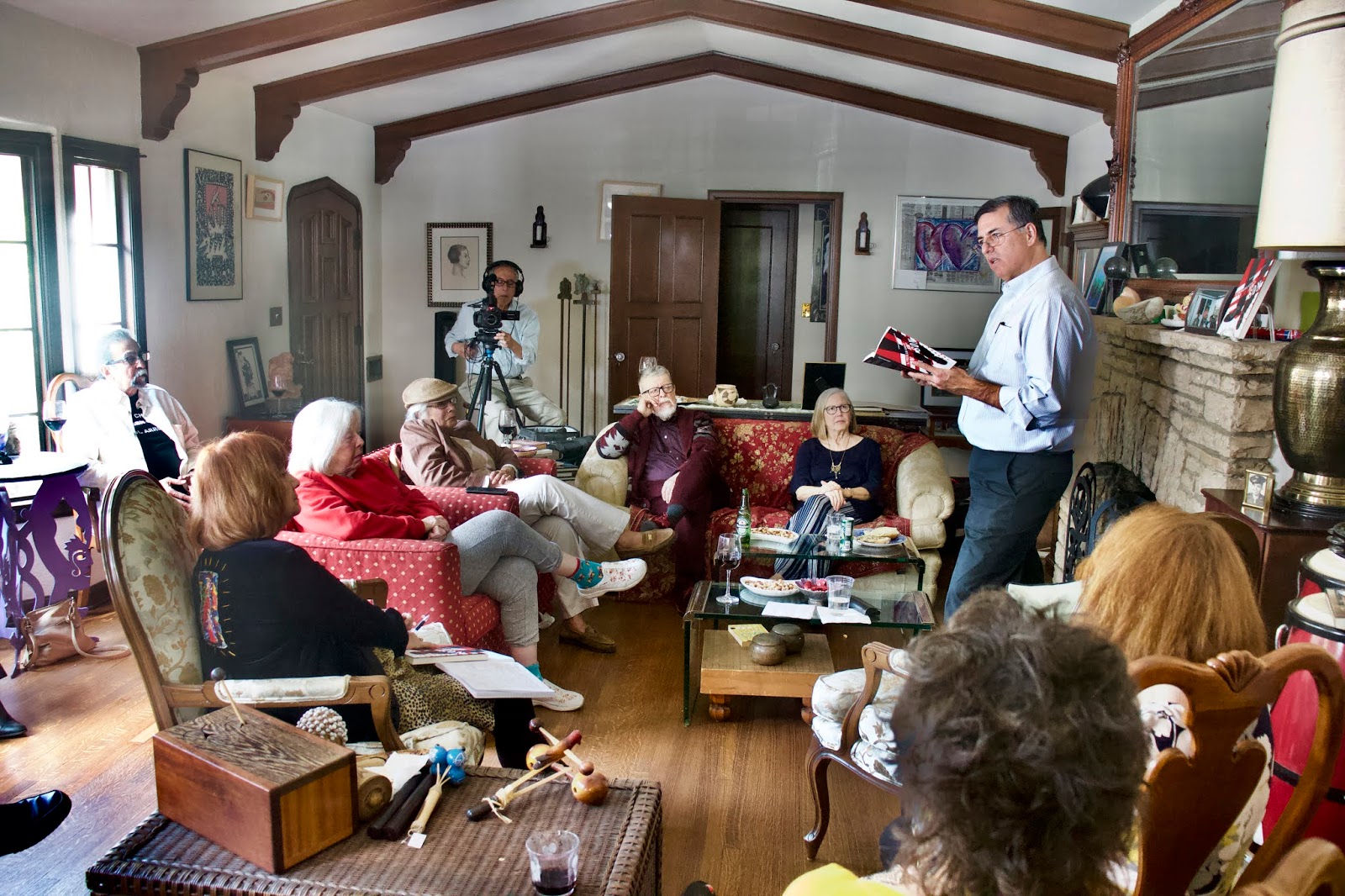
Cold or inclement weather relocates the now-regular floricanto gatherings indoors, as February’s California chill promised when Latinopia’s Jesus Treviño first proposed the gathering. Would I be interested in hosting Sergio Troncoso during his Southern California tour for his short story collection, A Peculiar Kind of Immigrant's Son? As it turns out, Saturday, February 8 was a picture-postcard perfect day of sunshine. It was still more comfortable indoors.


Casa Sedano is a spacious place that encourages small crowd events. We had a dozen friends, mostly writers and significant others, join us for a mid-day event. We broke up around 7, such a great time was had by all wish you’d been here. But sabes que? You can, you should, you oughta have your own living room floricanto.

Invite an author who’s going to be on tour in your region. Generous people, authors. They’ll work with your schedule and theirs. Sergio Troncoso, for example, chatted with Alex Espinoza and read at Los Angeles’ La Plaza de Arte y Cultura on Thursday night. This week, Troncoso is featured at the University of California, Riverside literary week. Saturday, at Casa Sedano in Pasadena, filled the calendar and put his work in front of a welcoming audience.


For authors on a book tour, a Living Room Floricanto offers a chance for a unique sharing of one’s work. It’s an enlarged conversation with abrazos. The guest of honor was on hand to greet the gente as they arrived. For the purposes of the video, I did a stand-up intro long enough for Chuy to get “B-roll” shots. I went for light-hearted in my remarks and Sergio read some serious stuff. Let’s see what editing can put together next week at Latinopia.com.

Ordinarily, Casa Sedano has the traveling writer’s guest bedroom available, but la casa is in a bit of transition right now. Authors on book tours travel on their own dime, so a spare bed or a warm spot on the floor saves out-of-pocket expense.

A public one-to-many event might feature introductions, announcements, then the author chats before reading fifteen minutes of good stuff. If you’re lucky, you get Alex to put you through your paces. Then, as time allows, a half hour of Q&A that range from desultory to good questions usually too much for this event. Living Room Floricanto provides warmly beautiful contrast. Sergio has listeners sitting next to him or just across the room leaning against a wall.


He reads the first few pages in a standup then signs copies. The author runs out of books but retrieves a new supply from the rental car. Everyone takes home an autographed copy they’ll treasure for the good writing but especially this experience. Not to be mercenary or nothing sabes, but word of mouth is the best marketing there is. We talked about raza hurting sales by sharing their books with five or six people who should buy their own copy. Autographed copies tend to stay at home, heeding Polonius’ advice.

Living room Q&A quickly wears out literary discussion in favor of getting down raza to raza and heart-to-heart with these Chicanas Chicanos. Hours pass exchanging regional histories and family conectas, this group readily switching English to Spanish or mixing, as the subject matter demands. La palomilla is in town and they're in the front room.

In California it seems everyone is from someplace else, and in this group, half of them have Texas roots. Several guests hail from Juarez or El Paso. Ysleta, Troncoso’s wicked patch of dust, is a suburb, so lots of insider chismeando and exchanges fill the conversation. Topics range from writerly discussion among the writers, laments on development messing up the old home town. That book came in for some discussion, the guests familiar with Myriam Gurba’s important work with David Bowles in the nascent #DignidadLiteraria movement.

Treviño and Latinopia provided amazingly delectable Italian sandwiches and lots of soft drinks and some notable wines. Recently-retired multi-talented Mario Guerrero brought Gruet champagne. This superb New Mexico wine has found distribution in Southern California. A small winery like this offers a model for small publishers, that is, gotta find ways to break out of the local mold and get into distribution channels.

Independent publisher Cinco Puntos titles likely have spots on independent booksellers shelves, though the direct link works for gente who buy over the internet.

Clickable Links
La Bloga-Tuesday's review of A Peculiar Kind of Immigrant's Son.
Publisher's website to order your copies of Sergio Troncoso's works.


Looking Back With Delight
How Soon? Sooner Than Too Late.

History happens right before your eyes along Los Angeles' Marmion Way. It's the resurrection of a living spirit--make that 169 feet of living spirit, in the restoration of Daniel Cervantes' 169-foot long mural depicting indigenous gente in native settings. 

I'm going to use "resurrection" interchangeably with "restoration," the artist's description of her labor. The wall had been put to death by tagging and city maintenance crews. The committee and the artist have brought this work back to life. That's a resurrection in the light. But that word, it has holy connotations! Yes, yes it does.

The location, on the alternative to busy Figueroa Street, makes a perfect display site given the towering original Southwest Museum Mt. Washington Campus, the original location of the Gene Autry-founded Southwest Museum of the American Indian.


La Bloga has followed the restoration since summer of 2019, when Lopez began working for the arts activist funding committee that pulled together funding from the local politician, the Los Angeles city arts commission, California's Arts grants, and other donors. Sadly, once Lopez had the project well underway, support evaporated like the blue tarp covers protecting the site disappeared within a few days of mounting.

The artist labored under open sun, no shade had been provided by the owners of the worksite. Worse, the ground provided treacherous footing from terrain displacement and trash. One night and weekend, a person who loves what Pola Lopez is doing raked the surface and leveled the worst spots. Only community support made the ground safe for a worker.

Lopez has enjoyed consistent support from Angel Guerrero, who's dedicated weeks of days to painting as directed, apprentice to the maestra. Angel, and a small number of other artists, have the skill to lend a brush. It's not a job, it's arte.


Community support has brought spiritual enrichment beyond a few dollars more, though money is really useful. Passersby honk and throw thumbs-up signals. A mother walks her babies past the site regularly, enjoying the progress. During my recent visit, Marco, a Salvadoreño, drove up and parked for a chance to talk to the artist. His son attends a local elementary school art program and Marco the dad was talking about an enrichment field trip for the kids. Imagine the insurance liability had that volunteer not been civic-minded, and some kid tripped on a dirt clod and broke a limb?

The site attracts attention from tourists and locals alike. The richly colored design and subjects create a landmark along an otherwise nondescript stretch of road. The mural fills a need no one realized was there, now it's an indispensable contribution to community unity. Taggers respect this wall.

The mural will be fully restored perhaps this week. Then Lopez has a crew spraying a protecting bonding coat, the semi-final stage of restoration. A final graffiti coat completes the entire project.


Lopez faces a funding crisis. Lopez has stocked the graffiti coating material now needs a professional installation crew to spray this vital protective coating. Here's a link to the artist's funding site. There's a spectacular photograph of the sorry state of the surface prior to Lopez' skilled recovery of this historic mural. 

It's anyone's guess why the Cervantes Mural has become an orphan. The Autry's coordinator offered to share insight into the museum's abandoned role, but nothing further came from that direction. I wrote councilman Gil Cedillo an open letter (link) recently, about having a grand unveiling. Silence is golden so someone's getting rich but it's not Pola Lopez nor local cultura.

There's the pity. Here's a major cultural landmark nearing resurrection and the community's leaders turn blind eyes and deaf ears. Ask Lopez when the gran unveiling is and she stares back with a rueful smile. None she's heard of, and I figure if she hasn't heard, there is nothing planned.

I'll gather with some friends, burn sage, walk the mural, hear their stories, invite the artist to a good restaurant and toast her health. I hope the people at the next table won't shush us for raising a ruckus. We'll be the only people in LA celebrating the mural.


The business of art subscribes to the force of a contract, arte and cultura and culture be damned. The letter of the law says no more money. The law is an ass that never had to resurrect a cultural wonder and ran into cost over-runs and comes up short. 

The value of what is happening on that wall is immeasurable, not zero, but zero is what funders and cultural giants have added to their earlier generosity. 

The Autry museum, owner of the Marmion Way site, recently "undertook its major multiyear, multi-million-dollar effort" to preserve its collection. That's P.R. Its mural, its most highly visible cultural treasure and one not hidden in the museum's vaults, gets not one red cent nor indian penny more. "Take our word for it," Autry fundraisers say about their vaults filled with unrestored artifacts, "we care."

The business of art demands a piece of the action. So it goes. Fundraising costs money, sending a portion of all the gifts donated to restore the mural to the operating budget of the fundraising committee. There's no millions there, but who knows what the commission is, 30% 15%? One or five percent of that would finish the job. Not that the artist is asking. I asked Lopez about the final coat and she says that's an open issue. Now, the graffiti coating is the most critical step to protecting the mural, and it's an open issue.

It's not the business of art but the art of art at stake here. The entire raison d'etre of resurrecting this spirit is that people see its images, read the story, enjoy the color, identify the land they stand upon and its people. Ars gratia don't waste all this by not having professionals apply the graffiti coat.

The artist's funding site directly supports the restoration with no institutional overhead. Use this link to give directly to hiring professional graffiti coating experts.


Books In Review: 2021
A column from 2010 by La Bloga Co-founder emeritus Rudy Ch. Garcia:

La Bloga reviews – pensamientos


In the years that La Bloga has been in existence in one way or another we've reviewed thousands of books, not all of them by or about Chicanos. We've covered classics, new releases, children's books and even vampironovels.

While the ranks of our reviewers have varied over those years, the core of Blogueros continues weekly with this labor of love. At the same time we have had delightful variation coming from guest Blogueros or those who have followed our path for a time. It's made for a huge body of work that we hope not only has entertained and informed but in some way has contributed to the literary body and history of Chicano lit.

Some questions come to mind that readers may be able to help us with:

Is there a type of posting that we've neglected to cover or that we need to expand?

What are the outer limits of Chicano lit and have we excluded books and stories that in fact should be covered?

What about Chica lit?--the pulpier version of cozy works being written for and read by Chicanas? Should we consider that a higher priority or just leave it to other websites already doing so?


Where's the reviews of Diana Gabaldon novels? Despite not calling herself anything ethnic and insisting that her name should not be pronounced as a Spanish word, Gabaldon is at least highly successful as a big-name writer to mainstream U.S. audiences.

Does La Bloga have the cómo-se-llama to do critical reviews of some of the most successful Chicana authors out there, or do we limit ourselves to publisher blurbs?

Do La Bloga reviews suffer from undercurrents of that old Chicano Movimiento envidia that limits us in doing frank reviews of books that should not be recommended?

Are all the books being published by Chicanos worth reading?

Should La Bloga's literary responsibilities be raised to higher standards?

Would there be a purpose in becoming "more professional" and less tolerant or would we end up cutting off our own noses?

Should we worry how the Anglo world of literary critics views our present perspective?

Are any Chicanos out there reading Sci-Fi, westerns and dragon-fantasy genres from Anglo writers and wish there were Chicano authors doing such works?

Don’t' get me wrong. La Bloga reviewers have done incredible and significant volunteer work through the years. In many instances they have pointed out the weaknesses to reviewed books, and I'll note that Michael Sedano is one of the most accurately critical in this. And the reviews and opinions will continue.

Also, I ask these questions not only in general, but also of myself. Things to ponder about how my own Chicano mind works. And it's also possible other La Bloga contributors, particularly those who've produced chingosmore reviews que yo, might have additional questions.

In any event, I thought it might be a good time to put out these thoughts about how we've approached Chicano literature and welcome readers' comments on them, as well.

Dan Olivas asked me to cover his spot today for personal reasons, but will return next week. Although, after reading this, he may decide not to leave Monday open again.

Es todo, hoy
RudyG