Showing posts with label festival de flor y canto. Show all posts

Tuesday, August 29, 2023

First Of Its Kind: Biography of a Raza Laureate y Más

Review: Francisco A. Lomelí, Osiris Aníbal Gómez, Eds. Juan Felipe Herrera. Migrant, Activist, Poet Laureate. Tucson: UofA Press, 2023

Michael Sedano

Someone has to be first. Someone, or someones, have to be the first editors to compile the first critical collection of scholarship centered around Juan Felipe Herrera. 

Editors Francisco Lomelí and Osiris Gómez became those someones with the June 2023 publication of the first critical survey of the extensive works scholars have produced about the first raza U.S. Poet Laureate, and before that honor, the first raza California Poet Laureate, Juan Felipe Herrera.

I say, "Raza," not "Chicano"owing to a point JFH makes in the closing interview, "How Do I Identify Myself."

Recently, we are Latinx. I am more inclined toward a 'humanity' identity. It embraces all 7.9 billion human beings.--there are no divisions, separations, and sectors.

I'm not here to reopen the "battle of the name", nor is this collection of thirteen articles, a biography, an interview, and a bibliography. I will declare, however, that Juan Felipe Herrera is a Chicano Poet no matter the lexical divides we impose upon ourselves. And "Chicano Poet" is the ethos assigned the subject by the various scholars collected herein.

Part I offers "Critical Perspectives on JFH's Poetics." Only one writer outright accuses Herrera of Chicanismo, Marzia Milazzo's "'To Go into American as I Go into Myself'"Chicana/o Indigeneity, the Indigenous Other, and the Ethnographic Gaze in JFH's _Mayan Drifter_".

1973: Juan Felipe Herrera and Lyn Romero (qepd)

Another Part I writer, María Herrera-Sobek shares a fascinating investigation of neologisms and caló, offering finely-detailed catalogs of Herrera's language and linguistic maneuverings.

2014: JFH leads "the Unity poem" on his last day as California Poet Laureate

Part II, "On Camaraderie and Poetics: Other Authors Reflect on JFH's Impact on Chicano Literature," there's that "Chicano" word again. This section includes a delightful personal essay by Tom Lutz recounting a two-family trip across Iowa where Herrera breaks the monotony creating a conceptual quest for the title "Gravy Donuts, 24/7: A Personal Reading of JFH."

2010: the Reunion Floricanto at USC. Herrera opens his reading
with the same piece he opened with in 1973

Part III, "The Child-Poet Within Me: Toward an Analysis of JFH's Children and Young Adult Literary Production focuses not only upon the books but the central role food plays in the Herrera oeuvre, with papers like Manuel Martín-Rodriguez' "JFH's Illustrated Books for Young Readers: Chicano Children's Literature con Cilantro."

2012: speaking as one of the Chancellors of the Academy of American Poets

Part IV offers a potpourri of reading, "Mapping the Sojourn of a Maverick." The "day in the life of" section includes an extensive interview with the Laureate by the Editors. If you want to learn how to be Juan Felipe Herrera, devour this interview. The section includes a worthwhile and adequately detailed biography by Renato Rosaldo. Scholars, and term paper writers perhaps, will deeply appreciate Donaldo W. Urioste's "Bibliography by and on JFH 2022."
2010: the Reunion Floricanto at USC

The Editors express contentment with the books illustration program. There are a few color plates and a smattering of photographs. I have been photographing JFH since he made his debut as a public poet at the 1973 Festival de Flor y Canto at the University of Southern California.

California Poet Laureate and volunteer readers. Sedano in red beret.


UCLA Profe Dr. Concepción Valadez happy to have her book signed by the author.

1973: The future Laureate reads "Let Us Gather In A Flourishing Way"
In the Video below from the 2010 Festival de Flor y Canto: Yesterday • Today • Tomorrow
JFH reads 
"Let Us Gather In A Flourishing Way"


Video © Barrio Dog Productions courtesy of Jesus Treviño 

Friday, August 18, 2023

Backyard Floricantos Are for Summer


Melinda Palacio, Santa Barbara Poet Laureate


 *this post is originally published in the Santa Barbara Independent 


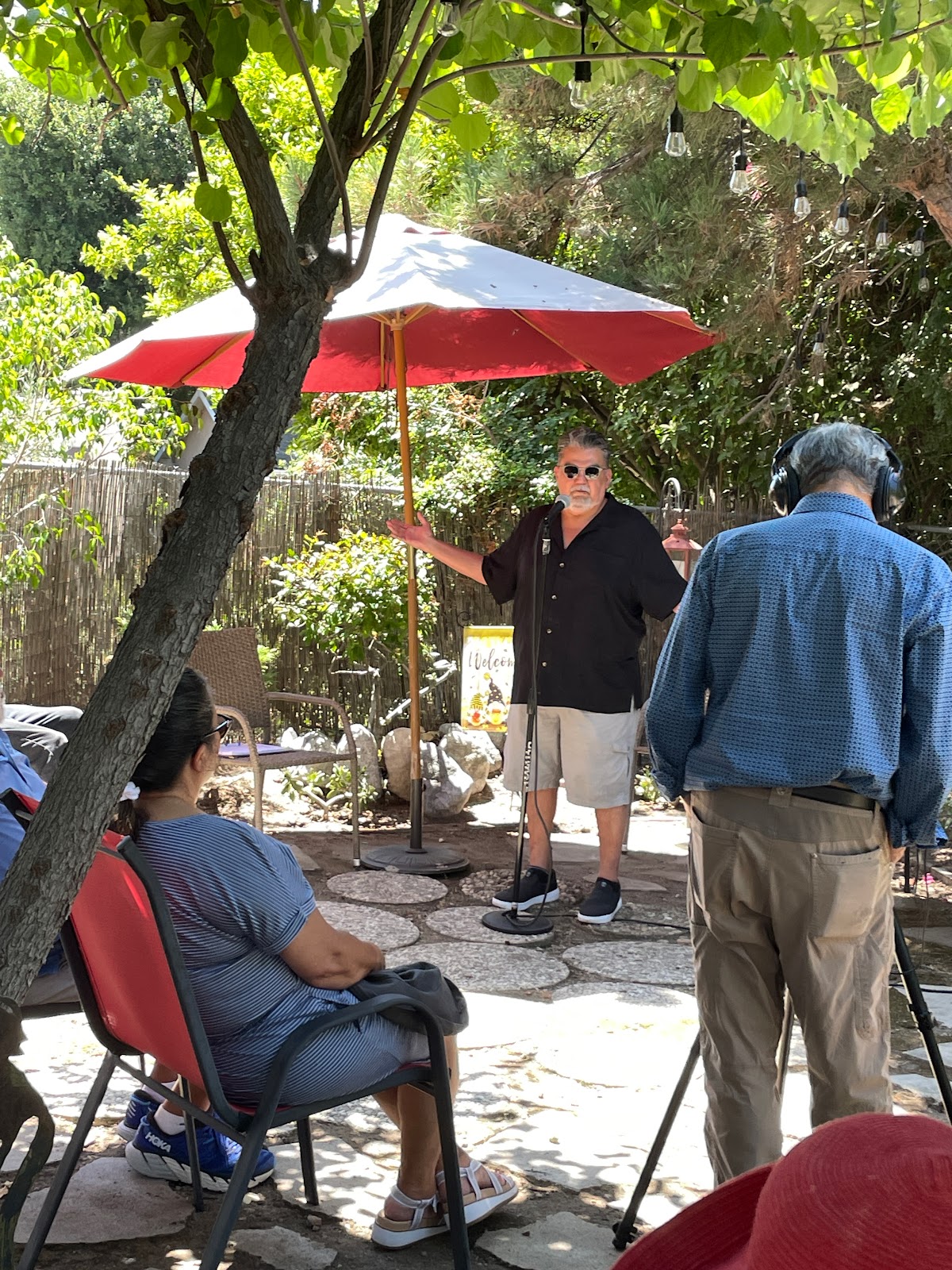
In Thelma Reyna's backyard


Over the past fifteen years, I’ve attended several floricanto’s at Casa Sedano, the home of Michael Sedano of La Bloga.com and Barbara (Michael’s late wife who recently lost her battle with dementia). Sedano has staked his claim as blogger and photographer to poets. He travels to poetry readings, near and far, and aims his camera in hopes of the perfect poetic pose. He photographed the first floricanto festival at USC, celebrating Chicano and Chicana poets in 1973, an event originally hosted by El Centro Chicano. USC’s Digital Library holds original films by the readings thanks to the efforts of Producer-Director Jesus Treviño and Photographer Michael Sedano.    


In 2010, Sedano organized a reunion of the original festival poets and invited several newer poets to participate. The floricanto festival of 2010 included poets who identify as Chicano, Chicana, Latino, Latina. I was lucky to be among the participants in an amazing lineup that included Juan Felipe Herrera, Alurista, Ron Arias, Vibiana Aparicio-Chamberlin, Tony Marez, and Mary Ann Pacheco, and Veronica Cunningham. 


Since then, Sedano has hosted several floricantos in his backyard with Jesus Treviño is there to film and feature the poets on Latinopia.com. Last Sunday, the tradition returned after a long, covid-hiatus. It was wonderful to gather with poet friends. There was even an appearance by famed artist Margaret Garcia, who last year was honored with a one-woman art show, Arte Para La Gente, at the Ventura County Art Museum. It was a big surprise when Margaret Garcia signed up for the open mic and sang a few verses of “Gracias a La Vida,” the Mercedes Sosa song made famous by Joan Baez. Garcia’s voice is rich with dark chocolate tones, a surprise for someone with a high speaking voice. 

Richard Vargas 

David Roth and Richard Vargas


Sunday’s gathering was in honor of Richard Vargas and his latest poetry book, leaving a tip at the Blue Moon Motel, Casa Urraca Press 2023. A seasoned poet, Vargas is on top of his game and at his strongest when writing about everyday life, his various jobs and occupations that inform his poetry, love and family. At the floricanto, Vargas is surprised by his high school friend, David Roth. Vargas says it’s a joy to be invited to read at one of Michael’s floricantos. “I feel as if I’m contributing in a small way to our culture’s traditions ad evolving art,” he said. “The camaraderie and friendship between poets and the audience makes it a very special event. 

John Martinez


For this gathering, a little flexibility is in order. Casa Sedano has been sold (his wife Barbara did not survive Covid or her battle with dementia. Michael is still in the process of moving so the reading takes a place nearby at Thelma Reyna’s beautiful backyard. Thelma Reyna is an award-winning author and publisher of Golden Foothills Press and was Poet Laureate of Altadena from 2014-2016. Thelma and I are set to open for Richard and there’s a signup sheet for an open mic. However, the order becomes jumbled because Jesus Treviño must leave early, so the show begins with the featured reader, followed by the open mic and Thelma, our hostess and featured reader. I closed us out with three poems and their companion songs. 


I’m looking forward to my set at Shoreline Park, August 17 at noon. If you come, look for the Library’s On the Go Van and the playground. 


Events:


Thursday, August 17, noon to 1pm, Poetry in the Park, 1237 Shoreline Dr., Santa Barbara. A set of poems and songs by the Poet Laureate.


Saturday, August 19, 10 am, SB Community Archives Showcase, East Side Library, Santa Barbara. Listen to a poem and hear stories, see archived photos of Santa Barbara’s East Side neighborhood. 


August 25, 6:30-8 pm, Writers Symposium, Fine Line Gallery, La Cumbre Mall. A discussion on ‘inviting the Muse’ with Dan Diamond, Janet Lucy, and Melinda Palacio, moderated by Mike Cregan, founder of La Cumbre Center for Creative Arts and award-winning author Tracy Shawn. 


Two poems by Richard Vargas:


menudo


i remember the morning

car ride to the Compton

neighborhood market

just the two of us

my dad would walk in 

carrying the empty pot and lid

set it on the counter and ask

for it to be filled with our

sunday morning breakfast

while he picked up a package

of warm corn tortillas

i checked out the colorful

piñatas and sweet-smelling 

pan dulce still warm from the oven


he would notice and buy a few 

conchas and fruit-filled empanadas

watch the smile light up my face

the drive home was slow and gentle

making sure we didn’t spill 

any of our orange-red bounty


i never cared for the oregano

but a squeeze of lemon

a spoonful of chopped onion

and a warm tortilla rolled up

in my small fist 


planted the seed 

for this poem to bloom


************************************


leaving a tip at the Blue Moon Motel 


i always take it for granted

the dusted chest of drawers and nightstands

the well-made bed with the crisp sheets

folded and tucked at each corner

sure to bring a smile to the grumpiest

of drill sergeants


the snow-white towels, the clean tub and toilet

a commendable attempt to add a little class

with that peculiar folding of the first

square of toilet paper hanging 

from the roll


rarely giving a thought to the women

who roam the hallways in the morning

knocking on doors looking for the empty

rooms ready for them to do their magic


no thought given to

the kids they raise

the bills paid late

the men who leave

and don’t come back


they pick up after all of us

oblivious strangers passing 

through on our way to a better

place than this


i leave a five-dollar bill and loose change

on the table as i check out

my small token of appreciation

for these hard scrubbing angels

doing their best to provide

a place to rest on the long

way home


Wednesday, September 12, 2012

1er Festival Flor y Canto para Nuestros Niños y Niñas


Bring your children of all ages to attend this FREE fun-filled Bi-lingual Poetry Festival with Children's Book authors, Illustrators and Musicians! Poetry, Art and Music workshops plus a fun fiesta with arts & crafts, face painting, roaming mascots and more!

Saturday September 15, 2012


The Brava Theater 

2781 24th Street 
San Francisco
(415) 642-7657)

Poetry: 9:00 a.m. – 12:00 p.m.
Reception: 5:00 p.m.
Event: 7:00 p.m.


Workshops with Francisco X. Alarcon, Maya Christina Gonzales, Rene Colato Lainez, Harriet Rhomer, Jorge Argueta, Lucha Corpi and Francisco Herrera Brambilia.

And in the evening...the the Festival continues with over 30 wonderful Poets and Musicians!

When the doors close at the Brava, we'll head on to Casa Sanchez for open mic!

***A community event in support of the 3rd Annual Children's Poetry Festival in El Salvador - November 2012***


If you are unable to attend this event but would like to make a donation to the Third Children's Poetry Festival in El Salvador, please go to  www.active.com/donate/poetryfestival


We sincerely thank you for your encouragement and contribution.

Tuesday, September 21, 2010

Floricanto Returns to USC. On-Line Floricanto Continues.

Michael Sedano

Festival de Flor y Canto. Yesterday • Today • Tomorrow concluded its three-day run Friday evening with a reception for the exhibition Sueños by the Sea: Celebrating Los Festivales de Flor y Canto at USC.

The festival's first day reunited veteranas veteranos videotaped at the 1973 floricanto; that was Yesterday, a misnomer given the energy and ongoing power of these artists. Now I'm thinking we should bill the next festival--there will be another--as "From Yesterday to Today leading into Tomorrow," for clearly that is the status of Chicana Chicano, Latina Latino literature at this moment in history, a living, growing, vitally alive literary tradition.

The Today and Tomorrow themes spread across the second and third days that blended presentations of important contemporary poets and writers with several poets making their debut at an important event, as well as readings by a graduate student and three undergraduate poets, sponsored by El Centro Chicano, the original host back in 1973.

Great news for those unable to attend, and those wishing to relive the festival. In coming weeks, USC's Digital Library will be posting video of Festival de Flor y Canto Yesterday • Today • Tomorrow, filmed gavel-to-gavel by Jesus Treviño. In addition, I donated my archive of 1973 photographs to USC and these, too, will soon be publicly available on the digital library.

Available right now are the extant videos from 1973's first Festival de Flor y Canto at this link. For the most part, these videos have not been viewed since their distribution in the mid-1970s, and as I've reported in earlier La Bloga columns, nearly were lost. To view a collection of photographs from 1973, click here.


Foto: Francisco Alarcón / Source: Facebook.

All three days, the emotion that filled Friends Lecture Hall in Doheny Library was palpable. I could smell it, taste it in the air; felt it in the hugs and kisses of well-wishers; saw it in the abrazos and smiles shared in small and big groups; heard it in laughter and excited chatter coming from every corner and aisle in the room, in the hallway, at the reception.

Great news arrived at the exhibition reception, when USC Libraries Dean Catherine Quinlan expressed a view that USC needs another floricanto next year. ¡Ajua! Dean Quinlan, the audience nodded in joyous agreement. I believe the statement was not an offhand phatic remark. Given USC's long-standing commitment to Chicana Chicano, Latina Latino literature, a festival de flor y canto could become the signature event annually reaffirming that commitment. I volunteer to help. Anyone else?

Here is a slideshow of portraits of every presenter in the three-day event. As the emcee, I had a front row seat and was able to capture numerous effective images. For a larger size view--one that plays well in full screen mode, view the slide show at Read! Raza (do allow time to load).


On-Line Floricanto

Among the more engaged performers at both Tuesday's Un Floricanto Adelanto and Festival de Flor y Canto Yesterday • Today • Tomorrow, was Francisco Alarcón. He helped Abel Salas organize the Tuesday event at Corazón del Pueblo, and conducted a four directions ritual at USC, in addition to bringing his mother and brothers to Doheny Library to share the love.

Francisco's energy extends to the virtual world (does anybody still use that phrase, other than me?). Francisco responded to Arizona's hate legislation by forming the Facebook group Poets Responding to SB1070. Francisco, and his moderator team, weekly select poems to share with La Bloga. This On-Line Floricanto has become one of La Bloga's most popular features.

1. "The Remembered" by Genny Lim
2. "Defiance of Flowers" by Alma Luz Villanueva
3.“A Chicana Chant For Roots Up High On The Mountain” by Diana Joe
4. "Slaughters and Shifts and Migrations" by Virginia Barrett
5. "The Great Wall of America" by James Michael
6. "Sestina for Illegal Widows" by Lori A. Williams.
7. "Walls (A Stream)" by Yasmeen Najmi
8. "Letter to the boy that made me cry" by Edgar Gonzalez


"The Remembered" by Genny Lim

The Remembered

by Genny Lim


Remembering Our Immigrant Ancestors


We dream of the forgotten
When daylight breaks
we return to the shell of the living
We dream of the forgotten
whose yearnings spill into sunlight
We dream of the forgotten
whose faces are withered petals
whose names brush our lips
like blown candles
We dream of those we loved
of those we didn’t, of those who
we only knew in brief or in passing
through their footprints dogging our trail
through their songs trapped in our cells
through history’s suffocating noose
through the jungle of paper bloodlines
to the altar of broken hearts

We dream of the forgotten because they
follow us through the skin of our memories
through the tracks of our journeys
through the unmarked graves of ancestors
through wars and exile
through births and deaths
through joy and sorrow
We dream of the forgotten because
they remember us
They inhabit us
They are us
They are the surf pounding rock
the battering sea shattered
into infinitesimal drops
Arching, wave after wave
against currents of migrating geese
We dream of the forgotten
as dispossessed lovers
who lived, who loved
like us

Copyright by Genny Lim
Sept. 3, 2010


"Defiance of Flowers" by Alma Luz Villanueva

DEFIANCE OF FLOWERS

by Alma Luz Villanueva


I sit here, centuries past, eating
breakfast, a tired, hungry looking
young man, making his errand, carrying
an immense spray of rainbow

flowers, a peacock of
flowers, an altar of
flowers, a defiance of
flowers in his arms, his

stunning child for these stone
lined blocks, the few pesos
they will give him for the
gathered beauty, defiant

in his thin, hungry arms-
if Zapata could see him, a
century later, he would weep,
grab his rifle, start a new revolution,

yet they killed him for his defiance of
flowers, his altar of
flowers, his rainbow of
flowers, and so the poor

still carry burdens and
beauty for the rich,
the masters of this
time, this day as

I eat my omelette
smothered in salsa,
listening as the well to
do older man orders the

waiter, the weight of his
class fills his voice,
master to peon, I glance
at him, it's all he has,

no peacock of flowers,
no altar of flowers,
no defiance of flowers,
no beauty. Of flowers.

His red-blotched angry face holds
these words, though he would deny
it: "I would rather die on my feet than
live on my knees." Emiliano Zapata


One hundred years after the revolution-
San Miguel de Allende, Mexico-
To the seventy-two human beings, migrants
murdered at the Mexico/USA border-
by Mexican drug cartels, shame on
us all, the Americas, this Turtle Island.

Alma Luz Villanueva

“A Chicana Chant For Roots Up High On The Mountain” by Diana Joe


A CHICANA CHANT FOR ROOTS UP HIGH ON THE MOUNTAIN

by Diana Joe


I BEGIN WITH A HUM
HUM
A HUM THAT ENTERS
THE CREEK ROLLING
ROCKS TAPPING TAPPING

SING SING
A HUM HIGH UP ON THE
MOUNTAIN
A MOUNTAIN
HUGGED BY THE FOOT HILLS
FILLED
WITH SPIRIT SPIRIT
I BEGIN WITH A HUM
A HUM
HUITZILI FORCE
WINGS SING
LEAVES OF THE ASPEN
BEATING
BEATING THE WIND
WIND WIND
BREEZE IN HAIR
CURLED TO CAPTURE
THE ALTITUDE IN THE AIR
HAIR HAIR THE COLOR
OF NIGHT NIGHT

AND NEATH' MY FOOT
MOSS MOSS MOSSS
SOFT LAYING THERE
WAITING FOR THE
REST OF MY SISTERS

A NEST HOLDS THE
KEY TO FAMILY FAMILY
COME AWAY STEP
STEP STEP ON
GENTLE FERNS
MEDICINE OAK TREE
NO POLICE HERE
NO POLICE HERE

HUM HUM HUM
WHISTLING CACTUS
NEEDLES THAT PIERCE
TIME
TIME
TIME FOR THE FAMILY
THE CLOUDS COVER ME
THE CLOUDS COVER ME

A BLANKET ON THE MEADOW
NEXT TO THE CREEK
WHERE I WAIT PATIENTLY
FOR A DAY DREAM

WHERE THE MOUNTAIN ROAD
OPENS AND NEVER CLOSES
WHERE CHILDREN CAN CLIMB
AND ROLL AND HUM
HUM HUM

THIS IS A CHICANA CHANTING
IN THE MOUNTAIN
NO LAWS OF MAN CAN HOLD
ME

NO MAN MADE LAWS WILL
SCOLD ME

I HAVE A SPEAR
NEARBY

WHITTLED BY THE
SISTER THAT LIVES WITH THE
OAK TREE
THE OAK TREE
SHE WEARS A SKIRT THAT
THE ELK GIFTED TO HER

HER SHIRT SEWN BY HAND
BY HER AUNTIE
THIS IS A CHICANA CHANT
NOT A TUNE BUT A GOOD WORD
COMBINED WITH THE MIST
SPIRIT
SPIRIT FOG THAT CAME TO
BE WITH ME THROUGH THE NIGHT
UP HERE IN THE MOUNTAIN

AND MY FIRED TALKED TO ME
IT TALKED TO TO MY FOG SPIRIT
FRIEND
IT LIT UP
EVERYTHING FOR EVERYBODY
AND ALL THE RACCOONS
JOINED US
THEY JOINED US
THE FIRE
THE RACCOON RELATIVES
THEY JOINED US

THE FOG
THE FAMILY OF MIST SPIRIT
HUMMING ALL
COMBINED TO DELIVER
MESSAGE FOR DREAMING
STAY IN DREAMING
STAY DREAMING
YOU DONT HAVE TO CLOSE YOUR EYES
IN THIS DREAM THERE ARE NO
LIES NO LIES NO CHASER OF FAMILY
IN THIS DREAM YOU ARE FREE.

A CHICANA CHANT FOR ROOTS UP HIGH ON THE MOUNTAIN
FAMILY

A PRAYER BETWEEN HER CREATOR
A PRAYER FOR THE NEARNESS OF THE SKY
A PRAYER THAT WILL REACH THE DESERT
A CHICANA CHANT FOR ROOTS

TO BE WATERED IN THE DESERT
BRING WATER TO THE DESERT
A MEDICINE POUCH DANGLES IN DE LIGHT
IN DE LIGHT IN DE LIGHT

CHANTING CHICANAS WORKING WORKING
HUM MM HUMM A MOUNTAIN IS WAITING
TO POUR WATER FOR YOU
COME DREAM YOUR DREAM WITH OPEN EYES
LAY HERE NEXT TO THE OTHERS STARE AT
THE NOTES IN THE SKY

STARE
STARE
BRING A LITTLE BIT OF THE DESERT HERE
NO POLICE
JUST THE DESERT
DRESS IN SAHUARO CLOTHING
STYLISH SANDLES OF OCOTILLO
OUTSTANDING
THEY CAN NOT HARM US HERE
UP HERE
WAY UP CHANTING
HIGH ON THE MOUNTAIN
A CHICANA CHANT FOR ROOTS
A CIRCLE REACHES THE HEAVENS
HUMMING HUMMING


"Slaughters and Shifts and Migrations" by Virginia Barrett


SLAUGHTERS and SHIFTS and MIGRATIONS—ARIZONA


I spent the day skirting the Mojave

in nearly 100 degrees, no air conditioning

in the car, wondering how people can make it

in such heat, crossing the Sonoran Desert by foot

to get to this side.


NO EXPONGAS TU VIDA A LOS ELEMENTOS! NO VALE LA PENA!


Past nightfall I catch 66 through Slegman

wrecked and in need of a bed.

How do they sleep with pillows of cactus and scorpions under their heads?


I pull in after a neon motel sign: SUPAI.

I receive the last available room from the affable owner.

She inquires about my profession and her face brightens at my reply.

"When we first moved to America from India,” she tells me,

"my son he made the Taj Mahal from clay in school. He painted it, too.

Teaching art to children,” she assures me, “this is very, very important.”

She hands me my key with a sudden melancholy gesture.

“But in this small town,” she shakes her head and glances outside,

“they have no art.” She sighs, “so my children, they do sports

and computers instead.”


My room, recently remodeled is uninspiring but clean.

What can you expect for 40 bucks?

But why am I complaining—an entire family could live in here

if they managed to make it over the border safely.

Los coyotes ahora cobran $4,000.


Supai—from Havasupai, the indigenous language

of this land.

Slaughters and shifts and migrations;

greed and dreams and people searching to survive.


__________


This morning, on the road again and already hot,

grasshoppers perish on my windshield

as a bolt of lightning over the mountain I’m driving toward

momentarily steals my eye.

The news says: “some support the installation of a minefield

to keep illegal immigrants out.”

Arizona—how many need to die?


Moving over the land can push us

into the heart of our existence,

beating and aching and keeping us alive.


What agony over killing these insects!

What exhilaration driving toward the rain!


Only Earth holds the right to tell any of us where we belong.


by Virginia Barrett


"The Great Wall of America" by James Michael

The Great Wall of America

by James Michael


We built a wall around this country…
a good five stories high.
If any hoser wants to climb it,
I’d like to see ‘im try.

After we walled off Canada,
we built another wall down south,
from the California beaches
to the Rio Grandy’s mouth.

All along our coastal shores,
we built enormous dikes,
anchored in the ocean floor
and topped with barbs and spikes.

We all gathered to admire our work.
The cash and effort that it took
to build this monstrous concrete wall
called for another look.

A little girl, aged 5 or 6
asked with a puzzled grin,
“When you lock those people out,
don’t you lock these people in?”

I must admit that girl was right.
I let out a mournful wail.
America’s Great Wall had turned
our country into a jail.


© Jim Michael
April 8, 2006

"Sestina for Illegal Widows" by Lori A. Williams.


Sestina for Illegal Widows

by Lori A. Williams


Luz tries to get some papers together.
The blonde lady at the Red Cross promises to help,
get her some sort of aid, with proof that her Pedro
worked for Fine & Shapiro in the Trade Towers;
delivered breakfast and lunch to the women and men
whose families grieve and rage, but always eat

enough. Her three young children miss eating
the food papa once brought home -- burgers and ice cream; together
at a big basement table full of cousins, uncles, aunts -- women and men
with golden smiles for their American dream. The help
was what they were called, cleaning the restrooms in the Towers,
washing dishes in deli's, delivering corned beef and salad, like Pedro

did, six days a week. His tips were big. You are my best worker, Pedro,
his boss Miguel said and Luz was so proud. Now come eat
at my table, let's talk! I see you moving on to waiter. These towers,
they make men like us rich! We must stick together
in this free and prosperous land. With this money, we help
our families back home, prove we are able men.

Luz and her friends have lost many good, strong men
to this free, safe, rich country. Manuel and Pedro
were brothers, six kids between them. The women help
each other with rice and beans and plantains to eat,
cheap, plentiful, but never enough. They cry and fret together
for their loves and tomorrow. After the fall of the towers,

family back home kept asking long distance, where did the towers
go? Luz tried to explain what she didn't understand. Our men
are gone, mama. There is nothing to send you! Hands together
in prayer, the parents spoke to God -- where is our Manuel? Our Pedro?
Candles were lit, town square filled with fear. How will we live, eat
without them? How can we bury not even a bone? God, help!

Luz finds no proof. Only clucks of regret, no help
from blondes or any other saviours. Money in the tower's
fund is not for her kind -- those who came to America to eat
three meals a day with kids and anxious limbs. Hard working men
who toiled in kitchens and bathrooms and carried lunch sacks, like Pedro,
to offer their families a dream; to succeed as a people, together

in New York, where there is no help for families without papers. Men
employed in the Towers, who died with our own, like Pedro,
leave wives like Luz, scrounging to eat, to live, to be acknowledged--
together.
I wrote this one after reading about the plight of the families of all the undocumented immigrant workers at the WTC.
Most of them were delivery men, working at the restaurants on the concourse level. There are no
numbers as to how many of them died....because most of them were not citizens, yet...they worked hard
supported their families here, and in Mexico. I remember reading an article about their wives
and children, and how they were lost....no income, nowhere to turn. This is for them.


"Walls (A Stream)" by Yasmeen Najmi


Walls (a stream)

Broken glass
sardine cans
broken bones
memorias in sand
broken landscapes
broken land
broken rivers
broken dreams
broken Dream Act
broken schemes
broken families
broken tribes
broken language
broken lives
broken houses
broken homes
broken screams
composed of stones

broken mother
non-stop tears
for her son deported
just before graduation
to a foreign land
thirst-broken
prayers to La Virgen
an altar
to the Saguaro's
slender reservoir and
broken shade

Oh Virgencita
pray for our
broken minds
broken hearts
the circle
love
us
broken.


Yasmeen Najmi


"Letter to the boy that made me cry" by Edgar Gonzalez


Letter to the boy that made me cry

by Edgar Gonzalez


I look at the ring you gave back to me, and remember.
I remember the Banda playing and us dancing.
Dancing the dance that has flowed through our blood and has been passed down from our padres.
The cumbia and banda steps that shake the earth with the sounds of joy and delight
The same delight that our ancestors felt before the colonization and the despair.

I remember that boy.
That boy that made me cry.
The boy that gave back the ring that signified our love for each other.
I remember.
I remember, the ceremony that would follow proving that we too, follow the social norms of the west.
That love
the love we were proud of in the open and struggled with in the bedroom
That love that proves that weren't as down as we thought.

I remember that boy.
That boy that taught me about my past
The boy that reminded me that the scorching blood in my veins represents the fire of sun.
The fire that no one can take away from me.
That fire that has been reproduced by my mestizo brothers and sisters and passed down to me.
He reminded me that the soil underneath my feet is brown and that without it we cannot live.
That the brown under my feet that is spread across the world is brown because it is mixed with bloodshed from our brothers and sisters that have fought the injustices that I will continue to fight tomorrow.
He reminded me

I remember that boy that made me cry.
The boy that despite my stubbornness, made me enroll into school and learn that life has more to offer a faggot colored boy than the capitalist structure pretends to.
The boy that stuck by me even when I chose to be the oppressor and throw the past in his face like sand in the eyes for stupid reasons that only I, understood.
He would watch me buck like a wild horse throwing tantrums for issues that were tear drops in size but not in depth.
I remember

I remember him, That boy.
That boy that wanted to share his life with me.
The one that was OK with the tomato in the garden that was not quite ripe yet.
The boy that saw the steel beyond the wood.
I remember him.
The boy that taught me that I cannot make the same mistake twice and that if I do, there will be another boy that I will cry over.


BIOS

1. "The Remembered" by Genny LimGenny Lim is a native San Franciscan poet, performer and playwright. An internationally known poet, she has toured festivals in Naples, Italy, Sarajevo, Bosnia-Hercegovina and Caracas,Venezuela. She has two collections of poetry, Winter Place and Child of War. Her play, Paper Angels, about anti-Chinese immigration set in 1915 returns to San Francisco after its premiere in 1980, for a free three-day run, Sept. 15-17th in Chinatown's Portsmouth Square as part of the SF Fringe Festival.

2. "Defiance of Flowers" by Alma Luz VillanuevaAlma Luz Villanueva was raised in the Mission District, San Francisco, by her Yaqui grandmother, Jesus Villanueva- she was a curandera/healer from Sonora, Mexico. Without Jesus no poetry, no stories, no memory...
Author of eight books of poetry, most recently, 'Soft Chaos' (2009). A few poetry anthologies: 'The Best American Poetry, 1996,' 'Unsettling America,' 'A Century of Women's Poetry,' 'Prayers For A Thousand Years, Inspiration from Leaders & Visionaries Around The World.' Three novels: 'The Ultraviolet Sky,' 'Naked Ladies,' 'Luna's California Poppies,' and the short story collection, 'Weeping Woman, La Llorona and Other Stories.' Some fiction anthologies: '500 Great Books by Women, From The Thirteenth Century,' 'Caliente, The Best Erotic Writing From Latin America,' 'Coming of Age in The 21st Century,' 'Sudden Fiction Latino.' The poetry and fiction has been published in textbooks from grammar to university, and is used in the US and abroad as textbooks. Has taught in the MFA in creative writing program at Antioch University, Los Angeles, for the past eleven years. And is the mother of four, wonderful, grown human beings.
Alma Luz Villanueva now lives in San Miguel de Allende, Mexico, for the past five years, traveling the ancient trade routes to return to teach, and visit family and friends, QUE VIVA!! And taking trips throughout Mexico, working on a novel in progress, always the poetry, memory.
www.almaluzvillanueva.com

3.“A Chicana Chant For Roots Up High On The Mountain” by Diana Joe
4. "Slaughters and Shifts and Migrations" by Virginia BarrettBorn in New York City, raised in Vermont, Virginia Barrett is a poet, writer, and visual artist. Her travel memoir Mbira Maker Blues—a healing journey to Zimbabwe, was released in 2010 (www.studiosaraswati.com/jambu.htm). Her most recent book of poems is Infinite Love—poems from a course in meditation and she is the translator of At 24th & Mission—poesía local con esencia global by Miguel Robles. Virginia teaches poetry, creative writing, and visual art to both children and adults. She has lived and traveled in Mexico, South America, Zimbabwe, Europe, Thailand, and other parts of the world. She now lives in San Francisco. www.virginiabarrett.com


5. "The Great Wall of America" by James Michael
6. "Sestina for Illegal Widows" by Lori A. Williams.
7. "Walls (A Stream)" by Yasmeen NajmiYasmeen self-published a poetry chapbook in 2004 titled Ankh, the Hindi word for "Eye," and is working on a second. Her poems appear in the Kolkata, India-based Graffiti Kolkata Broadside, La Bloga, El Tecolote’s 40th Anniversary Literary Edition, Poets for Living Waters and the poetry anthologies The Stark Electric Space and Adobe Walls. An environmental planner and public servant, her poetry often reflects her deep connection to the ecology and cultures of the Rio Grande. She can’t wait to experience the poetry of visiting her father’s homeland (India) for the first time this year!

8. "Letter to the boy that made me cry" by Edgar Gonzalez

Tuesday, September 14, 2010

Festival de Flor y Canto. Yesterday • Today • Tomorrow This Week. On-Line Floricanto

Festival de Flor y Canto. Yesterday • Today • Tomorrow. Tomorrow (Wednesday September 15, Day One!) and Tomorrow's Tomorrow, and Then Friday's Final Festday.
Michael Sedano

Here are Frequently Asked Questions pertaining to this week's Flor y Canto. Yesterday • Today • Tomorrow events.

I am driving into LA. How do I get to USC?
The University Park campus of the University of Southern California is immediately west of the 110 Harbor Freeway, north of the Los Angeles Memorial Coliseum and Exposition Park. Here is a link that will get you to campus. The address of Doheny Memorial Library is 3550 Trousdale Parkway, Los Angeles CA 90089.

Where do I park?
Park on campus and pay $8.00. Do not park at University Village at Hoover and Jefferson Blvd. Street parking can be a lucky find. Entrance 5, on W Jefferson Blvd and Entrance 4 on W Jefferson may have public spaces. The friendly parking kiosk attendants at any of the 8 entry points will direct you to available parking structures.

How about public transit?
The downtown DASH F line runs every 10 minutes until 6:30 p.m. and is most convenient. Thereafter, regular bus routes serve the area. Cash only. LA is not a taxi city. The kindness of strangers option should work at the end of the day to catch a ride to a nearby drop-off point.

Where is Doheny Library?
Students and parking kiosk attendants are friendly and happy to point you in the right
direction. You'll see several tall buildings. Head toward those and the Library will be a few steps southeast.

Where is Friends of the USC Libraries Lecture Hall?
2d floor, north side of Doheny. There will be signage. Follow the signs. Library Staff at the main entrance and at the stacks desk will be happy to point out the elevator and stairwells.

What if I'm late?
The literary festival model means the only people who have time certain schedules are writers who will appear at their appointed time. The public is welcome to come and go (quietly, please) throughout the day. Overflow seating will be nearby.

I love Magu's floricanto graphic. Can I get a t-shirt with that?
Magu licensed his copyrighted work to the festival for publicity purposes. There is no provision for t-shirts. If you want one nonetheless, La Bloga will put you in touch with the artist who will make arrangements. The original is in Michael Sedano's collection and is not for sale.

Can I buy books of my favorite poets?
The festival has set aside time for writers to meet and greet you, autograph copies of their work. Copies are limited at the festival, but you can easily order from the publisher or your local independent bookstore.

What is Un Floricanto Adelanto?
Corazón del Pueblo in Boyle Heights is independently hosting a night of poetry and festivities on the eve of Festival de Flor y Canto. Yesterday • Today • Tomorrow. Numerous festival poets will be reading, together with a host of independent artists. It's sure to be a superb event. Click here, for a larger reading.

Is the festival really free?
Yes. There is no admission charge to attend. There is the parking fee of $8.00, but no other fee.

I want to see the full schedule.
Your wish is my command: click here.

I want to know more about some of these poets and writers.
Click here for portraits and biographies of readers.

I am disabled and need accommodation.
Doheny Memorial Library has accessible entries on the east side. You will see signs directing you to accessible portals. Click here for a PDF map.

Parking for disabled drivers is less felicitous. Show the parking kiosk attendant your placard and she or he will direct you to the blue spaces, which may be parked up. Parking structures and parking lots are distant from Doheny Memorial Library. The campus features wheelchair ramps and sits on level ground.

I want to hear the writers but won't be in LA for the festival.
Producer-Director Jesus Treviño is videographing the entire program. The USC Digital Library will post the videos in a short time for worldwide viewing. Treviño is preparing a broadcast documentary of selected artists. Be a regular La Bloga reader and when the production hits the screen, La Bloga will publicize it.

Are the original, 1973 floricanto videos on sale?
The Dean of the USC Libraries will announce at the close of Festival de Flor y Canto. Yesterday • Today • Tomorrow the release of the nearly lost 1973 performances to the USC Digital Library, along with the complete archive of Michael Sedano's photographs from that historic first Festival de Flor y Canto.

You can buy museum quality, limited edition prints, of Michael Sedano's portraits of 1973 artists. Information on these is here.

You did not answer my question.
My apologies. Please email your question for a personal response.


On-Line Floricanto. Poets Respond to Arizona's Hate Laws

The Facebook group, Poets Responding to SB 1070 offers thriving proof that some good comes of even the worst events. The ugly developments in Arizona, whose lawmakers fashioned hate laws to punish gente whom law enfarcement agents think "look illegal," provoked poet Francisco Alarcón to use the internet to organize poets to voice their disappointment.

As this week's selections by Francisco and the moderators show, there's good coming out of Arizona ugliness. The weekly on-line floricanto has become one of La Bloga's most popular features.

1. "The New West" by Antoinette Nora Claypoole
2. "Una Receta" by Ramon Pinero
3. "The Ghost of Gregory" by Guillermo Gee
4. "The Dream that Sleeps with Power: A Sonnet for the Dream Act" by Edith Morris-Vasquez
5. "The Moving Train" by Gerardo Pacheco
6. "Huey Tlahtocan" by Victor Olguin
7. "The Proletariat's Plot" by Manuel Lozano


1. "The New West" by Antoinette Nora Claypoole


THE NEW WEST

by Antoinette Nora Claypoole


"dreams are how the heart can see the vision. vision is how the dream is remembered. dream is what happens when we listen. vision is the always listening." --Wayne George, Anishanabe


one
an ancient trade route tells of toads
in the autumn desert sonora scaling
skies. toads leap defying time. a legend.
like billy the kid and his perplexing pardon.
pat garrett and his murder of the west. kiva
maps kiva secrets kiva stone people ladder
inward like that diamond in a heart old poets
define a remedy a random act of majestic.
amulet. purple saged toad seekers sleep deep
sweet baby the police will take all you dare dream.


two.
he drives down the old highway like Morrison in American Prayer.

seeking autumn toad lore snazzy miami vice DEA agents
surround sound the desert. dark. orwellian vehicles
clandestine seizures. old power blue. mercedes. searched. puppy
eyes desperado no habla espanol. toads, officer.
drug road kid. drug cartels use this highway
kid. seriously? hunting toads? not a tom robbins
frog legs in pajamas piece. more tasered space more DEA
more unmarked cars. two hours crimson King twilight. no drugs
no connections all alone with Spartacus orthea the huntress
the pie eyed pooch from Washington State who chews willow.
smiling through the rhetoric of philosophy the young man muse recites.

three.
the u.s. government hunts brown skinned young men
on sonoran desert highways like Garret and Geronimo
a post colonial cactused war two-lane road Marshalls are
like sideways 1950’s Jesuit monks, exotic butterfly collectors.
pinning wings to placards. they are. bored. and twisted spectators.
captured in the capture fossilized in the kill, stainless stolen pins
sealing freedom under glass. sassing back into winged extinction.

soon the fires soon the scorch of torch that lights a yesterday.

and a generation of toads search sci fi helicopter overflights
looking for a rare, human sighting to tell them kiva stories to the Sky


2. "Una Receta" by Ramón Piñero


The uncensored version of "Una Receta" on Seis Poetas\Six poets on KQED\ written in 1973

UNA RECETA

by Ramón Piñero


take one people
add five hundred years
of oppression
add countless murders
mix well with a
heaping spoonful of
capitalism
add two or three cups
of EOP
or some other
self-help ingredients
add five helpings
of Vietnam
add Chile to taste
and stir feverishly
open two cans of
dehydrated anger
and add water

Pre heat oven
to
3000 degrees
fahrenheit

place an airtight
lid on the
entire situation
and let cook
for five hundred
years or till
rifles start poppin’
out.

Then move out
the fuckin’ way
cause it ain’t
gonna be
no birthday cake!!


3. "The Ghost of Gregory" by Guillermo Gee


THE GHOST OF GREGORY

by Guillermo Gee

A man ripped into pieces
Subdued
Disenchanted with the world around him
Only trying to survive and make a living
How can we live in chains? he asked in his native Mexican tongue
He'd prayed to god asking for nothing but inner peace
instead he was imprisoned for being the wrong color
They said he shot a horse
they called him a thief
He never stole in his life
He sat waiting for a Texas style beheading
in chains like his brothers before him were
He couldn't understand why they put him in that celland took him away.
In the night time alone a man is left to his devices
thinking...trying to make sense of the senseless
but no one came but the devil
He told Gregorio that he would set him free
he offered him riches, and a wife, children and freedom
a new a better life.
He thought.. because he was alone
in pain from the beatings
and being tried and treated like second class
He was single.. a poor lonely farm boy
from my home state of Chihuahua
100 years ago.
The devil smiled as he smoked his green pipe
"I can give you the world"
the devil said
just give me your soul.
He turned away
and laughed.
"I'm in pain, but I will always have my convictions
"A day came the evil left him behind to rot
that day and angel came down from heaven
saying... "I can set you freegive you all you want if you come with me"
Gregorio..thought
then he asked
why does god care about me?
the Angel Miguel replied
"because god loves all his children."
But he nodded
"I must go through with my execution"
"I have a story to tell the children I never had"
"I have an example to set for the future
to see the wrongs that were done to me and so many others
"He thanked the Angel Miguel and then he was dragged away
by Texas Rangers
Shot like the lowest dog
not even given a burial
but his ghost still lingered
in that prison cell
where God and the devil came to him
he stayed hoping that the people he loved would never have to go
through
what he did.
A choice
a decision
something that we all make yet, never fufill our destiny with
So this is for Gregorio..
that farmer who took his death like a man
even if it wasnt't fair
or right
he just did it so that gente like us
could live free, so that we could fight for our tierra!
Arizona, there is blood on your hands
America kills those to make a point.
so Gregorio knew he had to die
so that we could see how they marginalize us and
make us feel like second class citizens
in a country we already owned.
I tip my sombrero, mis lágrimas are for heroes like you
to Gregorio
may his ghost rest in peace.
So that we may one day be free...


4. "The Dream that Sleeps with Power: A Sonnet for the Dream Act" by Edith Morris-Vasquez


The Dream that Sleeps with Power: A Sonnet for the Dream Act

by Edith Morris-Vasquez


Soñar no Cuesta, an old saying

I traveled the road of dreams and did not
know that it would come to an end but I
believed it would extend and always start
again, and by its nature never die
or be detained. Dreams are not foreclosures,
bankruptcies, they're not bad deals behind doors
when economies decline, liberties abort,
and successes judged by tallies of war.
How many of what origin are killed
in a day, how proud and patriotic
is death's banner? Dark, dry, and deserted
the dead-end of dream's sad and symbolic.
It's not just the dollar that's lost its hour
now dreams are only for those in power.


5. "The Moving Train" by Gerardo Pacheco

The Moving Train

BY Gerardo Pacheco Matus

"Humanity is lost." GPM


HuuuHuuuuHuuuuHuuuuu

wake up, wake up my girl, the train is coming,
fetch your coat and don’t forget your doll.
wake up and pay no attention to my crying.

cover your ears. open your eyes. the morning
dew is falling on top of your mother’s shawl.
wake up, wake up my girl, the train is coming.

get ready to jump as the train is moving
fast today. grip the rails tight and don’t fall.
wake up and pay no attention to my crying.

wake up to see all of your brothers bleeding,
and dying under the shadows of the metal wall.
wake up, wake up my girl, the train is coming.

you must run faster before their bleeding
limbs get cold. the sun is getting hot. if you fall…
wake up and pay no attention to my crying.

girl don’t be afraid, we must jump onto the moving
train. we’re ready to go to el norte like them all.
wake up, wake up my girl, the train is coming,
wake up and pay no attention to my crying.

HuuuHuuuuHuuuuHuuuuu


6. "Huey Tlahtocan" by Victor Olguin

HUEY TLAHTOCAN

by Victor Olguin


Be all you can be, but not for them
be all you can be, but for yourself
Don't allow them inside your mind
it's just a piece of the white lie

don't play their game, we are not like them
it's a big lie, don't give a damn
come join my clan, it's a big gang
we are a new kind of mexicans

don't get me wrong we ain't got no guns
what we do have is "huey tlahtocan"
knowledge and wisdom we are trying to get
from ancient people, from ancient men

Time to go back, back to our ways
we are new men, new men of maize
let's show the world how we can save
this, our planet, our mother earth

let's make a circle holding our hands
please play the drum so we can dance
this is our people, this is our way
we are Mexica' and that's how we pray

Tlazo tonatiuh, tlazo tonantzin
tlazo ehecatzin tlazo toatzintli
500 years is a long time
time to wake up, this is our land

listen inside, inside your heart
and look at your skin, how brown you are.


7. "The Proletariat's Plot" by Manuel Lozano

The Proletariat's Plot

by Manuel Lozano

The privileged dangle their golden medallion,
They say if you work hard you can touch the sky,
Their biggest fear is the people’s rebellion,
The paupers will want their piece of the pie.
The eviction notice is stamped on your garden,
But the soft petals go dry only toward autumn,
And they will misquote us saying there is no pardon
For the agitators that rise up from the very bottom.

The picture is unclear in every exposure,
The flashcards show fields that never sprout,
They double the razor to create an enclosure
Out of the protection that kept the indigenous out.
Marching ants have been trained to just follow orders,
The uncommon will shout as the sun goes down sinking,
And the poor will be blamed by these foaming supporters
Who appose old tradition and all rebellious thinking.

Sleeping you find out waking up can be worse,
But that’s if you’re part of the walking dead,
Others, we wake up to get lost in verse
Knowing the fight has been on since the bad fire spread.
They’ll say that chaos is one form of cleansing
The sounds in the head that reject all compliance,
Then they will portray us as mad ones dispensing
All sorts of false hope that preaches defiance.

The peasants will rise up in orderly fashion,
Screaming injustice while holding it steady,
It is the suffering ones who have compassion
When morality is re-written on bits of confetti.
The pieces are scattered in the raging storm,
The pitchfork and machete never lay dormant,
And as if nothing else mattered the war takes a new form
When the hungry masses reject the old historical torment.

The new seed is altered in its infrastructure,
Suffocating varieties that don’t hold a patent,
The fencing will rise up and the levees will rupture,
Then the little individual will become combatant.
That’s when all dreaming will become real life,
The top will be saddened by the birth of its nightmare-
All of that scheming just so bacteria can thrive,
And all of a sudden the workers will want their fair share.

© Manuel Lozano 2010


BIOS

1. "The New West" by Antoinette Nora Claypoole

2. "Una Receta" by Ramon PiñeroFirst generation Puerto Rican from La Manzana, landed in San Pancho in 1970, fell into a great group of people, among them, Avotcja, Janice Mirikitani, Ntozake Shange...read alongside Victor Hernandez Cruz
Jose Antonio Burciaga and many more

Moved to San Cheo (San Jose, for the uninitiated) in 1973, and met and worked with other poets such as, Javier Pacheco, Lorna Dee Cervantes, Naomi Quiñonez.

Was one of the founders of La Cosa Nuestra at SJSU, the first Latino\Chicano FM Radio in San Jose...was also one of the first DJ's at KKUP in Cupertino...

Recently read at Avotcja's Birthday Bash at La Peña in July of this year and co-featured with her at Poetry Express in Berkeley

I exist in Florida, but my soul has never left the Bay Area...a magical place

3. "The Ghost of Gregory" by Guillermo Gee
I was born in Las Cruces NM, Ive been writing since I was 13. I grew up working in the fields with migrant workers and was a product of a bilingual environment. I've been writing poems in english and spainish and have worked with several groups. I currently am president of a group called Soul Verse which is a group of artists dedicated to free expression. We throw monthly open mics and are involved in teaching kids in the community about the arts. I am very pro raza and believe that in this time period we the chicano people are being blamed for white america's problems and I aim to finish my book of collected works called Obras de Dios in 2011.

4. "The Dream that Sleeps with Power: A Sonnet for the Dream Act" by Edith Morris-VasquezEdith M. Vásquez, PhD. Her 2004 dissertation at the University of California, Riverside focused on Lorna Dee Cervantes and William Carlos Williams. She has two teenaged sons and lives in Southern California where she was raised after resettling there from El Paso/Ciudad Juárez. Her grandmother, Paula González, was a little girl when she and her family were deported from the Long Beach area in the 1940’s. By all indicators, it is known that Paula was a California Indian.

5. "The Moving Train" by Gerardo PachecoGerardo Pacheco Matus was born in Huhi, Yucatan, Mexico. He is Mayan. Pacheco migrated to the United States, when he was fifteen years old. He was the first in his family to graduate from high school and college. Pacheco’s writing is influenced by his Mayan and Mexican heritage. He uses their magic & history to bridge two worlds that have been in conflict not only with their language, but their culture. Also, Pacheco's writing deals with migration and its social and cultural hardships. Pacheco had published poems at Cipactli Magazine and Transfer Magazine. He has been a Smart Cookie scholar since 2006. Pacheco is a candidate for the MFA Creative Writing- Poetry at San Francisco State University.

6. "Huey Tlahtocan" by Victor OlguinIn 1993 I joined the way of the Mexica. In 2006 I joined Calpulli Tonalpilli. To all my relations, native people, brothers and sisters. This poem is for you all and for all those who haven't found their way. This is from the bottom of my heart and I would like to share it with you. I advise you all to come back to our ways, to our roots because we need to know where we came from in order to know where we are going.

7. "The Proletariat's Plot" by Manuel LozanoManuel Lozano, self-taught writer and artist, lives in El Paso, “El Chuco,” Texas, cradle of the pachuco. Manuel writes traditional verse “to the rhythm of the Matachines.” His work has appeared in Xican@ Poetry Daily and La Bloga. Visit his blog, Manuel Lozano: Xicano Writing, at www.manuellozano7.blogspot.com for more information.