Monday, January 11, 2021

“FBI Files on Mexicans and Chicanos, 1940–1980: The Eagle Is Watching” by José Angel Gutiérrez


A multi-chapter book that examines the FBI files on two well known persons of Mexican origin, Luisa Moreno and Ernesto Galarza; four Chicanos, Ambassador Raymond Telles and his wife Delfina Navarro, Francisco "Pancho" Medrano, Freddy Fender; two organizations, the Texas Farm Workers Union and the American G.I. Forum; and, one event, the Zoot Suit police riots in Los Angeles, California during the 1940s. José Angel Gutiérrez is emeritus professor of political science ate University of Texas in Arlington.

Praise for FBI Files on Mexicans and Chicanos, 1940–1980

"In this well-researched and detailed book, José Angel Gutiérrez, as a scholar and a fearless leader for decades on behalf of Chicanas and Chicanos in the U.S., does an excellent job in exposing the civil/human rights abuses of the American government in general and oppressive FBI apparatus in particular against los de abajo. As a self-described Chicano militant, the author exposes a contradiction of the FBI's racist surveillance against brown people, where the gaze of Big Brother doesn’t differentiate in spying on righteous militants, aspiring for radical/structural transformations, versus moderate Mexican Americans and groups, seeking reformist changes."
— Alvaro Huerta, California State Polytechnic University

"As technology intrudes into our virtual and ‘real’ lives more and more, it is imperative to think about to whom, and why, 'the eagle' may be listening. This work will make readers think more deeply about such matters. You may lose some sleep over this, but that might not necessarily be a bad thing."
— Jorge Iber, Texas Tech University

"Using the Freedom of Information Act to acquire and analyze files compiled by the FBI in its surveillance of several notable, as well as less well known Latino leaders, former Chicano Movement activist José Angel Gutiérrez describes how the federal government extensively documented the activities and movements of those deemed 'subversive' and 'un-American.' This volume is a useful addition to those studies that reveal how the FBI monitored and intimidated activists over many decades, including many Latinos branded as 'Communists' and 'lefties' for their efforts to advocate for labor and civil rights on behalf of their people."
— Albert M. Camarillo, Stanford University

Friday, January 08, 2021

The Plague Cancels Carnival and New Years Resolutions

 Melinda Palacio 


As if the thought of Covid-19 muscling its way into 2021 isn’t enough, there’s the shenanigans from Trump supporters looting and rioting and disrupting democracy. The week started off with dismal news about hospitals throughout California reaching capacity. A brief phone call with my sister, an emergency room nurse in Bell Flower and everything Dr. Fauci said about a surge on top of a surge on top of a surge is coming home to roost. Many people decided to have big gatherings for thanksgiving, Christmas and New Years, moving everyone back to square one, back on lockdown, only this time, doctors, nurses and paramedics must pick and choose who has the highest chance for survival. It’s a dire situation that could have been avoided had we had a real leader instead of a selfish charlatan. 

Instead of focusing our collective attention on how we are going to solve this pandemic and get vaccines in people’s areas, we were distracted by trump supporters who fancied themselves storming the Bastille and starting a revolution or civil war. What we saw on television was looters who were gently shoved away and a police force absent of the type of force it wielded during Black Life Matters protests. 

This week should have ushered in the Three Kings and the start of carnival, culminating in Marti Gras. I should have been busy setting resolutions and planning on what normal might look like beyond the plague. Marti Gras in New Orleans has been canceled and this might be my first year in over a decade without King Cake.  Instead, I was glued to the television, watching the home grown terrorist attack the nation’s capital building, all in the name of the traitor -in- chief. Can we depose him already? 

I have one feel good story to share with you. Many readers of La Bloga know I’ve been learning ukulele for the past year. If you’ve read my COVID Christmas post, you’ll know that my neighbor gave me a guitar. I offered to teach her how to play the ukulele. Last week I gave her first lesson and she did so well. She learned three songs. Music is the gift that keeps on giving. I’m so honored to be able to teach my first music student. Teaching my neighbor ukulele over zoom is something I never imagined I would do. I never thought I would learn how to play the little instrument, let alone be good enough to teach someone else.  My neighbor is an older lady who is retired and lives alone. She says she was the first woman to own a house in her corner cul de sac. She swims in the ocean enjoys birding in the neighborhood. And she’s an early bird. If I hadn’t walked my dog early in the morning, I might not have met her. Here’s to new encounters in the new year. Somehow being isolated has introduced me to a wonderful neighbor I didn’t know. I’m looking forward to more fortuitous meetings in 2021. You?


Thursday, January 07, 2021

What a Way to Start a New Year


                                                     Stoner Park, the Japanese Garden

You know people love to tell the same story, even if they know everybody heard it before, and they’ve been telling it all their lives? Well, the first time my cousin told me this story was back around 1969, a couple of years after it happened. It wasn’t really a story then, more of an incident, a situation, another dumb thing one of the family had done. He was still telling it to me in 2016, a few years before he died.  Each time he told it, he added something new. The thing was I never got tired of hearing it because it was like one of those movies you see over and over, and each time you see it, you see something you didn’t see the time before. Here’s the Reader’s Digest version. After, the events in Washington, I hoped this might bring a quick smile, a reminder that there's more to life than politics.

                                                                          Pasadena or Bust

     From the back seat, one of them, the youngest, Johnny answered, “Let’s go to the Rose Parade.” 

     He was responding to one of his cousins saying something about "nothing else to do but to go home." The streets were dead.

     Home was the last place any of them wanted to go, not after all the New Year’s Eve parties, the drinking and getting high, the girls, friends, and music. When Johnny suggested the Rose Parade, nobody put up an argument. They didn’t want to call it a night.

     Eddie, the oldest, mid-twenties, the driver, with no license and an eighth-grade education (and not a very good one) said, “Where’s that?” The two cousins in the back seat started laughing, more of a smothered cackle.

     “Come on, Primo, you never heard of the Rose Parade?”

     Eddie, alone in the front seat, said, “Yeah, I heard of it, but where’s it at?”

     “Pasadena,” came the answer from the back seat. “My dad took us there when we were kids,” said Johnny.

     Eddie said, nervously, “That’s far. I never drove that far. How do you get there?”

     Leo, a few years older than Johnny, but not as old as Eddie, said, “Just get on the freeway and drive towards downtown L.A. Then follow the signs to Pasadena.”

     It was Johnny’s car, a ’64 Impala, black, cool. He’d bought it with money he’d saved working summers with his dad.

     “I never drove the freeway,” said Eddie.

     “You hardly ever drove any place,” said Leo, chuckling. “You always ride shotgun.”

     They were parked on a dark street, to avoid the cops snooping around. After the parties, they'd gotten tired of  cruising through the L.A.'s westside towns and now were back to their own neighborhood, laying in the car, tripping. They lived with their their parents or, in Eddie's case, whatever relatives might put him up for a while, and, definitely, a long way from Pasadena.

     The freeway from Santa Monica to Los Angeles was but a year-old back then. From Los Angeles, it veered off to a tangle of other freeways and highways leading to Sacramento, Needles, and San Diego. Drivers were still getting the hang of it. One wrong turn and you could end up in Tijuana.

     Johnny, the most experienced driver, but in no condition to sit behind the steering wheel, gave Eddie the directions. “Primo, just follow the sign to Pasadena and park somewhere on Colorado boulevard.” With no traffic at 3:00 A.M., Eddie should have no problems.

     Some time later, Johnny heard Eddie say, “There’s a lot of signs, Johnny, Fairfax, La Cienega, La Brea, Normandy.”

     Johnny repeated, “Pasadena, man. When you get close to downtown L.A., you can’t get lost. Take the Arroyo Grande connection. Pasadena's the only sign.”

     More time passed. “Hey, Johnny, how do you spell Pasadena?” Eddie sounded rattled.

     Johnny eased out of his slumber, and not a good speller himself, tried to remember Sister Immaculata’s phonics lessons, “Ah, Pasadena, P-a-s…, no wait, P-o-s-i….” He grew frustrated, “I don’t know, Eddie. Just follow the damn sign that starts with a P, like out towards Highland Park, Glendale, East.”

     “All right, solid, a P-sign, East,” said Eddie, as Leo snored. "I had to go out to Highland Park one time to score." The rest of the ride was pretty quiet, the eight-track playing oldies, low and slow. 

     Johnny didn’t realize he’d slept hard until he saw the sun peeking through the windows. They were parked on a large boulevard. For a second, he forgot where he was. Then he remembered, Pasadena and the Rose Parade.

     He wiped the moisture from the window with the sleeve of his Pendleton, and his heart leaped when he saw the mountains looming close in the distance. A few people were on the street but not the crowds he expected. He woke up his cousins and told them they needed to find some spots along the parade route before they were all taken. “Come on, you guys! Or we won’t get a place to sit.”

     Leo shivered, hugging his trench coat. Eddie slept like a baby behind the wheel.

     “It’s getting late,” Johnny coaxed them, as he opened the door and stepped to the sidewalk. He figured they’d probably have to walk a little way, what with parking being hard to find and all, but, after surveying his surrounding for a minute or so, he thought there should be more people than the few on the sidewalk.

     “Eddie!” Johnny called. “Didn’t you park on Colorado boulevard?”

     “You just said Pasadena, primo. I didn't hear nothing about Colorado. That’s what I followed, the P- sign.”

     Johnny ran his fingers through his long hair, pulled his shirt close to him, the thick wool offering some warmth. He saw an old man walking towards him.  “Hey, sir,” Johnny asked. “You know which way to the Rose Parade?”

     The man looked at him. “Yeah, that way.” His wrinkled finger pointed north.

     “How far,” Johnny asked, his cousins now at his side. The man smiled, “Oh, about thirty miles.”

     “Thirty miles!” Johnny turned to Eddie.  Then he turned back to the older man, “Ain’t this Pasadena?”

     “Hell, no, son. This here’s Pomona.”

     Johnny took the keys from Eddie. All he said was, “I’m driving home.”


Wednesday, January 06, 2021

Santiago's Road Home - La travesía de Santiago


By Alexandra Diaz


Publisher : Simon & Schuster/Paula Wiseman Books

Language: : English

Hardcover : 336 pages

ISBN-10 : 1534446230

ISBN-13 : 978-1534446236

Reading age : 8 - 12 years


A young boy gets detained by ICE while crossing the border from Mexico to the United States in this timely and unflinching novel by award-winning author Alexandra Diaz.


The bed creaks under Santiago’s shivering body. They say a person’s life flashes by before dying. But it’s not his whole life. Just the events that led to this. The important ones, and the ones Santiago would rather forget.


The coins in Santiago’s hand are meant for the bus fare back to his abusive abuela’s house. Except he refuses to return; he won’t be missed. His future is uncertain until he meets the kind, maternal María Dolores and her young daughter, Alegría, who help Santiago decide what comes next: He will accompany them to el otro lado, the United States of America. 


They embark with little, just backpacks with water and a bit of food. To travel together will require trust from all parties, and Santiago is used to going it alone. None of the three travelers realizes that the journey through Mexico to the border is just the beginning of their story.


La travesía de Santiago


Cuando cruzaba la frontera de México con Estados Unidos un muchacho es detenido por ICE en esta novela actual e impávida escrita por la autora galardonada Alexandra Díaz.


La cama cruje bajo el peso del cuerpo tembloroso de Santiago. Dicen que la vida de una persona pasa por su mente antes de morir. Pero esto no es toda su vida. Son solo los acontecimientos que lo llevaron a esta situación. Los más importantes y los que Santiago quisiera olvidar.


Las monedas en la mano de Santiago son para el boleto del autobús para regresar a la casa de su abuela abusiva. Pero él rehusa regresar. No lo van a extrañar. Su futuro es incierto hasta que se encuentra con María Dolores, cariñosa y maternal y su joven hija, Alegría. Este encuentro ayuda a Santiago a decidir lo que va a hacer. Va a acompañarlas hasta el otro lado, hasta los Estados Unidos de América.


Emprenden el viaje con muy pocas cosas, solo mochilas con agua y un poquito de comida. Viajar juntos requiere que confíen unos en los otros y Santiago está acostumbrado a ir solo. Ninguno de los tres viajeros se da cuenta de que la travesía a través de México hasta la frontera es solamente el comienzo de su historia.


Review

 “Vivid details and a sympathetic protagonist make this a harrowing but deeply illuminating portrayal of the struggles faced by families at the U.S.-Mexico border.” —School Library Journal


“The author’s cleareyed, compassionate writing serves as a much-needed wake-up call to readers. . . . An urgent mirror for troubling times”. -- Kirkus Reviews, *STARRED REVIEW* 


“The characters here are fully realized, and this narrative is one that brings home the reality of what is happening at our borders. Pair with David Bowles’ They Call Me Güero for units exploring the southern U.S. border. A musthave for all middle-grade collections.” -- Booklist, STARRED Review 


“Basing Santiago’s story on well-documented experiences, Diaz’s crucial narrative shines a disconcerting light on the plight of children in U.S. detention centers along the southern border.” -- Publishers Weekly *STARRED* 


Tuesday, January 05, 2021

2021 A Year of Just Enough • Reading In Plague-time

Michael Sedano 

We've gone through four years of emotional austerity. Like the orphans in Annie, stead of kisses we got kicked, 'stead of Hilary we got hatred. Voters got ourselves a slap in the face when that election looked like the nation was in line for the first woman president. Instead we get our first despot. 

That isn't the only thing that wasn't supposed to work out like that, but it's the only one we can't do something about. Not we, Georgia. Georgia voters have the political CPR to unclog the airway of government, remove petulant obstacles from the first two years of the JoeKa administration. D&D, please.
 
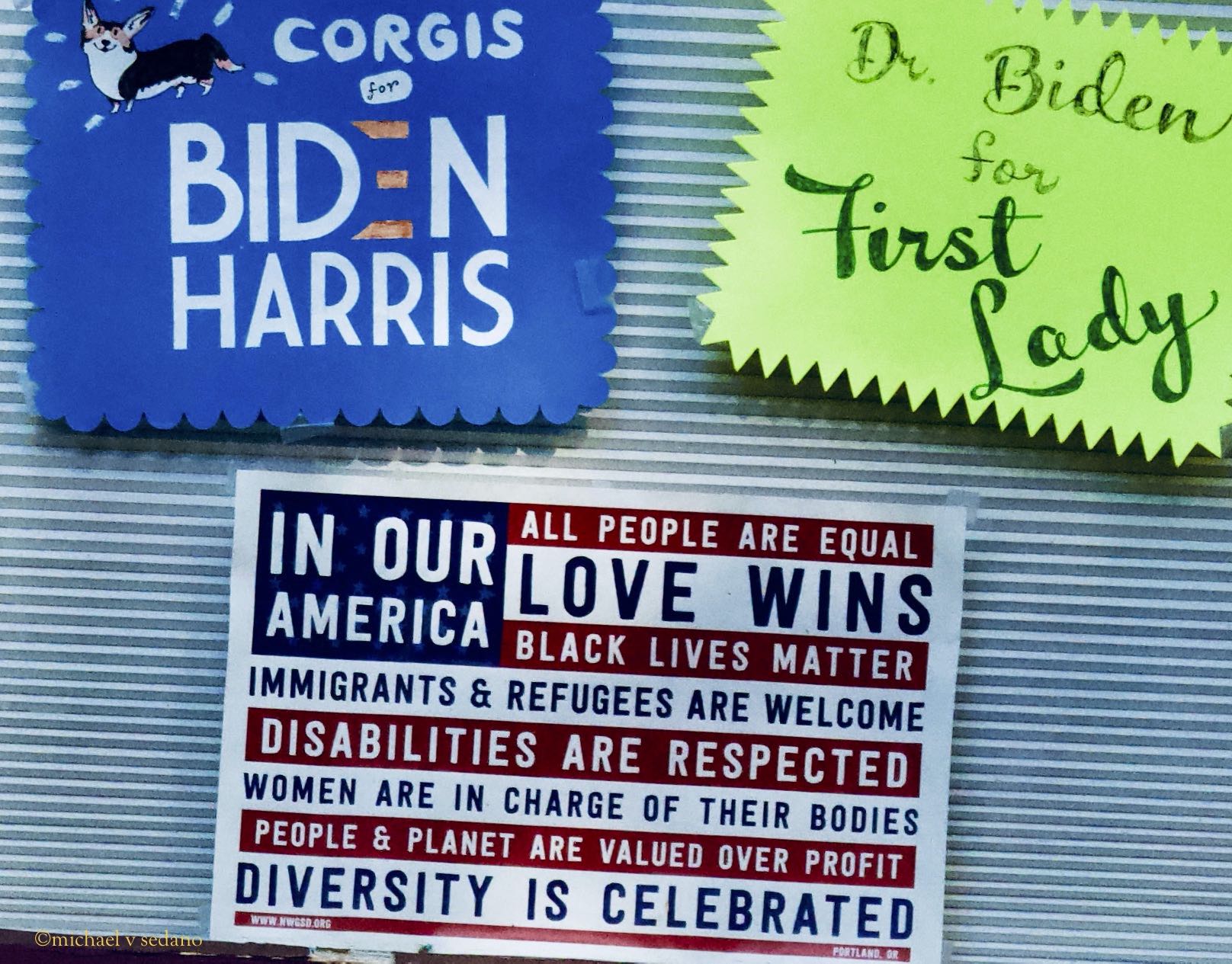
Neighborhood ephemera, in my Pasadena, California neighborhood, share affirming messages that point to what's heading our way after January 20, if Georgia voters come through and give us a delayed but incredibly happy new year. The signs read "common sense," the rarest commodity in human nature, and what they say is just enough to set matters back on track.


As the days wind down to the close of this maleficent administration, and with GOTV a Democratic U.S. Senate, I find the image out of Ozymandias compelling, angry birds fouling a wall in the middle of the Southwestern desert, almost nothing else remains. A stain, that remains.
 
People "Drank the Kool-Aid" these recent four years. Now they can seek sweeter nectars, a poet might maunder. Indeed, voices of still-restrained Hope begin to sound, as if some refined spirit gains speed, dashing to D.C. to be born with the JoeKa team in charge. The second coming of the Unitedstatesian Dream is at hand.

For my part here at La Bloga-Tuesday, I'm restraining my enthusiasm and tuning down my Hopefulness. I learned restraint the hard way, these past four years. When I thought it wouldn't get worse, it got worse. And I'm more ascetic than epicurean!

Thus, my New Year resolution looks a lot like that wondrous chuparrosa below. A hummingbird doesn't go looking for new and better but finds reliable sources of the same sweet nectar. And that's enough. Just look at this visage of Huitzilopochtli and tell me that enough isn't.

No, this isn't a self-defeating metaphor. With strength from the same old places, the bird extends its range, the plants and gardens extend theirs, and in the natural course of events, things come to be as they should, ever the same and ever greater.
Happy New Year, Raza, Feliz Año Nuevo, Everyone. 
Here's to just enough being enough for now.


Late-breaking News
Las Comadres Debut List 

From Dr. Thelma Reyna comes news her edited anthology, When the Virus Came Calling: COVID-19 Strikes America, Golden Foothills Press, joins the titles listed in LAS COMADRES AND FRIENDS NATIONAL LATINO BOOK CLUB 2020 BOOKS OF THE YEAR. 

For sure, the plague is on our minds, like the mask is on our faces. Several La Bloga columnists are included in this publication.

Here's a link to the full list of this first annual selection. Las Comadres sees marketing usefulness in the activity and generously lists numerous titles across diverse fields.
 
ANTHOLOGIES / SHORT STORIES 
And We Came Outside and Saw the Stars Again: Writers from Around the World on the COVID-19 Pandemic, Editor Ilan Stavans, Restless Books 
 
Cockfight by Maria Fernanda Ampuero, The Feminist Press @ CUNY 

Come On In: 15 Stories About Immigration and Finding Home, edited by Adi Alsaid, various authors, Inkyard Press 

LatinNEXT, The Breakbeat Poets, Vol 4, edited by Felicia Rose Chavez, Jose Olivarez and Willie Perdomo, Haymarket Books 

Lockdown: Stories of Crime, Terror, and Hope During a Pandemic by various authors, Polis Books 

Noiryorican: Short Fiction by Richie Narvaez, Down & Out Books 

The World Doesn't Work That Way, But It Could by Yxta Maya Murray, University of Nevada Press 

Tiny Nightmares: Very Short Stories of Horror, Editors Lincoln Michel & Nadxieli Nieto, Black Balloon Publishing 

Vampires Never Get Old by Zoraida Cordova & Natalie C. Parker, Imprint 

When the Virus Came Calling: COVID-19 Strikes America, edited by Thelma T. Reyna, Golden Foothills Press

Monday, January 04, 2021

‘Paws Healing the Earth’

 ‘Paws Healing the Earth’


Paws Healing the Earth will be published by River Paw Press, and it is edited by Kalpna Singh-Chitnis.  This is a book of poetry with forty contributing poets and I’m happy to share that two of my poems are part of this amazing Anthology.


My poems are "Huitzil" and "Húmeda sonrisa / Damp Smile", translated by Sandra Kingery.


The following words are from our editor, Kalpna Singh-Chitnis.


"The wait had ended, the list of "Paws Healing the Earth" contributors is ready, and we are thrilled to unveil the cover of the first poetry book by "River Paw Press" (USA) to be published soon.


This book is dedicated to an exceptional soul, who walked on earth for thirteen years, healing everyone who touched him. Troy, continues to inspire us. He is available to say hello to everyone on his Facebook page

https://www.facebook.com/Troy-Singh-Chitnis-107059324075836


The official website of "River Paw Press" is in making. Thanks to all who are with us at the beginning of a new journey. You are also invited to connect with us on the Like Page of "River Paw Press" for frequent updates. Join us by Liking the page at https://www.facebook.com/RiverPawPress


CONTRIBUTING POETS


Lee Upton

Ambika Talwar

Leslie Thomas

Minal Sarosh

Kalpna Singh-Chitnis

Kedarnath Singh

Adrian Slonaker

Donna Snyder

Megha Sood

Janaka Stagnaro

Susan Rogers

MistyRose

Yogesh Patel

Saleem Peeradina

Connie Post

William O'Daly

Kunwar Narain

John C. Mannone

Ellyn Maybe

Christopher Merrill

Jagari Mukharjee

Abhay K.

Diane Kending

Lois P. Jones

Zilka Joseph

Marian Hadad

April Garcia

Claudia Gary

Amata Natasha Goldie

Albert Gonzales

Candice Louisa Daquin

Peggy Dobreer

Jennifer Carr

Xanath Caraza

Joshua Corwin

Douglas K Currier

Betty Burton

Jonel Abellanosa

Shanta Acharya

Leticia Austria


Kalpna Singh-Chitnis”


Friday, January 01, 2021

Hindsight is 2020


There’s nothing I can say that will overcome the sadness, confusion, frustration, or anger (insert your particular emotion) that will always bubble up when 2020 is the topic of future conversations.  We won’t forget what a disaster these past twelve months have been, nor should we. Some of what we have endured was unavoidable, but there is no denying that at crucial points, when we needed courageous, visionary leaders, we got scam artists and criminals, hacks and petty sycophants, power mongers and bunglers.  The forces of fascism and racism seized the opportunity given to them by the demagogue in the White House, and far right terrorist organizations attacked the essential egalitarian and democratic foundations of the promise of the United States, apparently without consequences.  As a country, we are passing through an existential crisis, as yet unresolved, and no one knows what fate awaits, or how the crisis will end.   

 However …

The social activist movement that needed to happen, that was necessary to save the soul of the United States, erupted around the slogan Black Lives Matter, and the struggle for civil and human rights inched forward, precisely when we required the shake-up, when the disturbance of our collective conscience demanded a monumental response to hatred, lies, and apathy.  

Largely because of the Trump administration’s incompetence and criminal negligence, hundreds of thousands unnecessarily died or suffered critical illness.  But we remember the courage and sacrifice that played out every evening on the national news.  Generous individuals and small-nonprofit organizations provided food to the hungry, compassion to the suffering, a shoulder to lean on for the grieving.  Nurses, doctors, hospital staff, ambulance personnel, first responders, and many others risked their lives to care for strangers.  In the midst of the pandemic, firefighters, risking everything, fought to save homes and animals of people they would never meet. Neighbors looked out for each other.  Even with social distancing and quarantines, families and friends bonded, stronger than before, with assurances that no one was forgotten.   

Thousands of stories of heroes have been told, and thousands more are yet to be revealed.

The struggle continues.  We will accept that we must discard the idea of life returning to “normal,” and for many that’s okay.  We will adapt, endure.  People of color know that the struggle continues, it never ends.  We remember a lesson learned long ago -- without struggle there is no progress.  

But at least 2020 is over.

Later.

______________________________________

Manuel Ramos writes crime fiction. His latest book is Angels in the Wind coming from Arte Público Press, April 2021.