Monday, March 28, 2022

_La mariposa de Jackeline, Jackeline’s Butterfly_ por Xánath Caraza


La mariposa de Jackeline, Jackeline’s Butterfly por Xánath Caraza


La mariposa de Jackeline / Jackeline’s Butterfly de Xánath Caraza

Traducido al inglés por Sandra Kingery, Hanna Cherres y Aaron Willsea

Imagen de Mariana Ramirez Cano

Casa editorial: FlowerSong Press (2022)

ISBN-13: 978-1-953447-11-1


Since her first book Conjuro in 2012, Xànath Caraza continues her ambitious bilingual publications with a book-length poem, La mariposa de Jackeline / Jackeline’s Butterfly. Spanish and English link in her books, complementary, as she bridges experiences of those who wander and those who find rest, sometimes in death. This prize-winning author illuminates the tragedy of a seven-year-old Guatemalan girl who died in custody of the United States border officials. The sequence of poems, a tour-de-force, follows Jackeline Caal on her fictionalized journey from the tropics to New Mexico. Caraza’s lush language describes interplay of sky, sun, seas, and earth, as the girl journeys through beauty. At death, the poet writes, “You depart full of poetry, Mayan girl. / Your huipil embroidered with blue butterflies. / Your motionless hands loaded with golden memories.” Her soul, freed like a butterfly, finds immortality in her store of memories. This book is essential reading. It celebrates how each individual carries within the fire of eternity.”

    ~Denise Low, Kansas Poet Laureate, Red Mountain Press prize winner


“Desde su primer libro Conjuro en 2012, Xánath Caraza continúa sus ambiciosas publicaciones bilingües con un poema de la extensión de un libro, La mariposa de Jackeline / Jackline’s Butterfly. el español y el inglés se conectan en sus libros, complementándose, mientras ella enlaza experiencias de aquellos que deambulan y de los que encuentran descanso, algunas veces en la muerte. Esta autora galardonada ilumina la tragedia de una niña guatemalteca de siete años en custodia de los oficiales fronterizos de los Estados Unidos.  La secuencia de los poemas, un tour-de-force, sigue a Jackeline Caal en su viaje ficcional desde los trópicos hasta Nuevo México.  El lenguaje exuberante de Caraza describe la interacción del cielo, el sol, los mares y la tierra, mientras la niña se desplaza entre la belleza.  Al morir, la poeta escribe, “Vas llena de poesía, niña maya / Tu huipil bordado de mariposas azules. / Tus manitas quietas cargadas de dorados recuerdos.” Su alma, liberada como una mariposa, encuentra inmortalidad en su baúl de recuerdos.  Este poemario es una lectura esencial. Celebra cómo cada individuo lleva consigo el fuego de la eternidad.”

~Denise Low, Poeta Lauread de Kansas, Ganadora del Premio Red    Mountain Press


Friday, March 25, 2022

New Libros


Here we go with another list of new books coming your way soon. Better get to that TBR pile sitting on your night table.  So many books, so little time.

____________________


Louisa Luna
Doubleday - March 8

[from the publisher]
Alice Vega has made a career of finding the missing and vulnerable against a ticking clock, but she’s never had a case like that of Zeb Williams, missing for thirty years. It was 1984, and the big Cal-Stanford football game was tied with seconds left on the clock. Zeb Williams grabbed the ball and ran the wrong way, through the marching band, off the field, and out of the stadium. He disappeared into legend, replete with Elvis-like sightings and a cult following.

Zeb’s cold trail leads Vega to southern Oregon, where she discovers an anxious community living under siege by a local hate group called the Liberty Boys. As Vega starts digging into the past, the mystery around Zeb’s disappearance grows deeper, and the reach of the Liberty Boys grows more disturbing. Everyone has something to hide, and no one can cut to the truth like Alice Vega. But this time, her partner Max Caplan has his own problems at home, and the trouble Vega finds might be too much for her to handle.

Louisa Luna
understands suspense, tension, and character like only the best writers in crime fiction do—and she may well write the best interrogations in the genre. Hideout is pure adrenaline and Luna’s most intimate thriller yet, a classic cold case wrapped in a timely confrontation with a terrifyingly real network of white supremacists and homegrown terrorists.

________________________


Heather Chavez
William Morrow - April 26

[from the publisher]
Schoolteacher and single mom Frankie Barrera has always been fiercely protective of her younger sister Izzy—whether Izzy wants her to be or not. But over the years, Izzy’s risky choices have tested Frankie’s loyalty. Never so much as on a night five years ago, when a frantic phone call led Frankie to the scene of a car accident—and a drunk and disoriented Izzy who couldn’t remember a thing.

Though six friends partied on the outskirts of town that night, one girl was never seen again . . .

Now, an AMBER alert puts Frankie in the sights of the local police. Her truck has been described as the one used in the abduction of a girl from a neighboring town. And the only other person with access to Frankie’s truck is Izzy.

This time around, Frankie will have to decide what lengths she’s willing to go to in order to protect Izzy—what lies she’s willing to tell, and what secrets she’s willing to keep—because the dangerous game that six friends once played on a warm summer night isn’t over yet . . .


_____________________


Trust
Hernan Diaz
Riverhead Books - May 3

[from the publisher]
Even through the roar and effervescence of the 1920s, everyone in New York has heard of Benjamin and Helen Rask. He is a legendary Wall Street tycoon; she is the daughter of eccentric aristocrats. Together, they have risen to the very top of a world of seemingly endless wealth—all as a decade of excess and speculation draws to an end. But at what cost have they acquired their immense fortune? This is the mystery at the center of Bonds, a successful 1937 novel that all of New York seems to have read. Yet there are other versions of this tale of privilege and deceit.

Hernan Diaz’s Trust elegantly puts these competing narratives into conversation with one another—and in tension with the perspective of one woman bent on disentangling fact from fiction. The result is a novel that spans over a century and becomes more exhilarating with each new revelation.
At once an immersive story and a brilliant literary puzzle, Trust engages the reader in a quest for the truth while confronting the deceptions that often live at the heart of personal relationships, the reality-warping force of capital, and the ease with which power can manipulate facts.


Hernan Diaz is the author of two novels translated into more than twenty languages. His first novel, In the Distance, was a finalist for the Pulitzer Prize and the PEN/Faulkner Award. He has also written a book of essays, and his work has appeared in The Paris Review, Granta, Playboy, The Yale Review, McSweeney’s, and elsewhere. A recipient of a Whiting Award and the William Saroyan International Prize for Writing, he has been a fellow at the New York Public Library’s Cullman Center for Scholars and Writers.

______________________


Cleyvis Natera
May 17 - Ballantine Books

[from the publisher]
The Guerreros have lived in Nothar Park, a predominantly Dominican part of New York City, for twenty years. When demolition begins on a neighboring tenement, Eusebia, an elder of the community, takes matters into her own hands by devising an increasingly dangerous series of schemes to stop construction of the luxury condos. Meanwhile, Eusebia’s daughter, Luz, a rising associate at a top Manhattan law firm who strives to live the bougie lifestyle her parents worked hard to give her, becomes distracted by a sweltering romance with the handsome white developer at the company her mother so vehemently opposes.

As Luz’s father, Vladimir, secretly designs their retirement home in the Dominican Republic, mother and daughter collide, ramping up tensions in Nothar Park, racing toward a near-fatal climax.

A beautifully layered portrait of family, friendship, and ambition, Neruda on the Park weaves a rich and vivid tapestry of community as well as the sacrifices we make to protect what we love most, announcing Cleyvis Natera as an electrifying new voice.

Later.

______________________

Manuel Ramos writes crime fiction.  His latest is Northside Nocturne, a story in the upcoming anthology Denver Noir (Cynthia Swanson, ed.) from Akashic Books.

Thursday, March 24, 2022

Chicanonautica: Hollywood Invades Pre-California

by Ernest Hogan

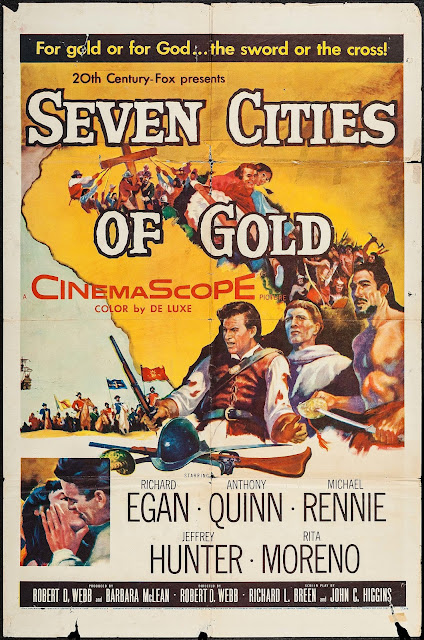
With my radar looking out for California history, the 1955 film Seven Cities of Gold caught my eye. I found it on YouTube, saw it, and needed to review it here.


It doesn’t really fill the gap left by the skimpy coverage of California Indians I learned while going to school in the state. The natives were described as peaceful, and easily converted to Catholicism, and enjoying working in the Missions, like happy slaves on plantations of the South. The film provides a rare Hollywood look at a forgotten slice of history.


It came out of an era when studios were coming up with color and widescreen spectaculars to pry the audience, and their money, from blurry, small, black and white television. Fantasy, sci-fi, and superheroes were still considered outré stuff for kids and weirdos, so these movies were usually historicals, with exotic locations.


The exotic land is California, the place that became San Diego, south of Hollywood, before the sprawling suburbs where I grew up, when it was desert. Water, like just about everything in the state, comes from somewhere else.


It was based on a 1951 novel The Nine Days of Father Serra by Isabelle Gibson Ziegler. Father Junipero Serra is played by

Michael Rennie, who was Klaatu in the science fiction classic, The Day the Earth Stood Still. Once again he was an alien ambassador trying to civilize a primitive people.


After showing sympathy for Indians, he is sent on an expedition to California in search of those elusive Seven Cities of Gold.  It is led by Captain Gaspar De Portola, played by Anthony Quinn, the versatile, Irish-Mexican-American actor who shows that he can play a white Spaniard. His second in command is José Mendoza, played by Richard Egan, who starred in another Fifties sci-fi favorite, Gog. Father Serra is sent along as a “spiritual advisor” and, oh yeah, to found a mission and spread the word of God.


Captain De Portola, and Mendoza, experienced in Indian fighting in other parts of Nueva España, want to kill several of the first ones they meet, but Father Serra convinces them to try to communicate.


At the beginning of the film, the narrator explains that the only things changed about the story, that is presented as true, is that everything has been translated into English. So when they meet the Indians, the Diegueños (a Spanishism, they called themselves the Kumeyaay, or Tipai-Ipai, according to Wikipedia; in 1990 there were 1200 of them on reservations, and 2000 off–wonder if there are any left in 2022?) they speak English, simplifying the usual confusion that happens in a first contact. It is as if they had been provided with Star Trek universal translators. 


Speaking of Star Trek, Matwir, a young warrior who becomes the chief, is played by Jeffrey Hunter, who played the original captain of the starship Enterprise. He is darkened by full body makeup and wears colorful warpaint and feathers. He and all the other Kumeyaay deliver their lines in the halting manner, stressing every word, making it almost impossible to do any real acting. At least none of them said, “Ugh!”


There are some thrilling battle scenes.


The Kumeyaay do find the Spaniard’s technology, guns, scissors, and medicine appealing, but are confused by Father Serra’s God and his desire to get them to junk their culture for his. When the mission is built, no Kumeyaay want to be baptized.

To further complicate things, and to provide some love interest, Mendoza, being frustrated by the lack of white women, falls for Matwir’s sister Ula, played by Rita Moreno years before West Side Story. He keeps it a secret, but then the expedition, having found no cities or gold, is called back to Mexico City, abandoning the mission. Ula is willing to go with Mendoza and marry him, but this was not socially acceptable in those days.


 They argue, and she “accidently” falls off a cliff, which nearly results in the Kumeyaay wiping out the expedition.


They do manage to contrive a happy ending. As they are leaving for Mexico, Father Serra, who didn’t baptize one Indian, rings the mission bell for the last time, gets a demented look on his face, and says, “I hear them coming.”


The more I think about the film, the stranger it gets.


It would also be a good way to trigger discussions of California history.


Ernest Hogan was born and raised in California, and it is a big part of what made him into the Father of Chicano Science Fiction.

Wednesday, March 23, 2022

2022 AWP Conference & Bookfair


Philadelphia, Pennsylvania

Pennsylvania Convention Center 

March 23–26, 2022


The AWP Conference & Bookfair is the annual destination for writers, teachers, students, editors, and publishers of contemporary creative writing. It includes thousands of attendees, hundreds of events and bookfair exhibitors, and four days of essential literary conversation and celebration. The AWP Conference & Bookfair has always been a place of connection, reunion, and joy, and we are excited to see the writing community come together again in Philadelphia, Pennsylvania in 2022.


In light of the tremendous success of the virtual 2021 AWP Conference & Bookfair, AWP will incorporate a virtual component to #AWP22. In addition to offering an in-person event schedule in Philadelphia from March 23-26, 2022, we will also offer an array of prerecorded virtual events.


To learn more about the conference to see the complete schedule of events visits, https://awp22.us3.pathable.com


I will be part of this panel, Documenting the Undocumented: Writing the US/Mexico Border across Genres


Time: 9:10 AM - 10:25 AM PDT on Friday, March 25


Place: 115C, Pennsylvania Convention Center, 100 Level or Online.


Moderating by Jennifer De Leon. 


Speakers: René Colato Laínez, Marcelo Hernandez Castillo, Ricardo Nuila, Aida Salazar


The border. ICE. The wall. Asylum. Human cages. How can we truthfully represent the current immigration crisis at the border in our writing? What are political and philosophical concerns, particularly when authors inherit stories they are in effect still living and when readers might expect a happy ending? Authors across categories—fiction, nonfiction, poetry, and young adult and children’s books—talk frankly about the struggles and benefits of writing la frontera.  


Tuesday, March 22, 2022

Guest Reviewer: Veronica X Valadez Reviews City On the Second Floor

Tezcatlipoca's Mirror Sees and Shows Floricanto 

Veronica X Valadez 

Matt Sedillo’s City on the Second Floor holds a mirror in front of all of us revealing not what we want to see, but what we need to see. This smoking mirror, otherwise known as “Tezcatlipoca” to Chicanas and Chicanos, is the mirror our ancestors left us with so that we may critically analyze who we are, and who we need to become. This is the mirror that Sedillo’s flor y canto gifts us. What is it that we choose to ignore? What is it that we try to cover up with illusions? What is it that we are willing to speak to, and to resist against? 


Matt Sedillo sheds light on reality as he poetically paints images of poverty, racism, classism, war, environmental destruction, greed, privilege, generational wealth, imperialism, injustice, and the selling of our very souls as we pursue a life of consumerism that dehumanizes us and pollutes our minds, bodies, spirits, and the entire world. This book of poetry delivers a sense of urgency, and wake-up call to the proletariat to see the truth for what it is and to resist! Resist against the false democracy and illusion of freedom that keeps us too busy and too blind to see what is happening right in front of us. It is a reminder that the rich and their relentless greed are leading us to the mass destruction of our humanity and of our planet. 


There are so many issues that we face as a society, and oftentimes it is difficult to face them because it can all be very overwhelming, but Sedillo’s creative way of speaking truth to power through poetry allows us to look at these injustices straight in the face, one poem at a time. It allows us to better understand how systems of oppression work seamlessly through a complex yet simple web of networks, all of which continue to feed the rich and starve the poor. Sedillo unapologetically sticks a finger in the face of government bailouts that allow the rich to “reach for the stars” even if their companies are in the red, leaving the proletariat to pay for it, making the rest of us carry the burden of dept that only gets heavier with time. A dark reminder that, if we’re not careful, we can easily end up living our lives consumed by consumerism, making the rich richer with what should be an inheritance for our own families. 


Sedillo gives the reader a clear picture of what it’s like to live in Los Angeles, from seeing “NO ICE” signs on the freeway bridges to homelessness, to braceros, to the multitude of many other laborers, to cities burning from uprisings against police brutality, to high-rises of the rich, to the cultural richness and resistance of the city. Sedillo’s poetry reminds us not to waste our lives working just to die. It reminds us to bring attention to the economic and environmental injustice we see and experience all around us. It reminds us to recognize and call out global imperialism and the false justification of wars just to make a profit. It warns us of the possibility of allowing our dreams to be eaten up by the economy if we’re not paying attention. 


As an Indigenous Xicana, I appreciate Sedillo pointing out that Brown people are native to this continent and that we have migrated throughout Anahuac for generations just as the Monarch butterflies have. He builds on our shared ancestral knowledge to bring us back home, where we can reclaim our humanity and our dignity. And in Matt Sedillo’s prolific words, I leave you with this, “May you speak with courage and conviction. May you dream of extraordinary things and may your every breath forward the revolution”. 


About the Reviewer:


Veronica X. Valadez – Xicana scholar-activist, artist, danzante, educator, Ethnic Studies advocate, Chicana/o Studies professor, and co-founder & president of Ehecatl Wind Philosophy

Monday, March 21, 2022

"How to Date a Flying Mexican" comes to Los Angeles Mission College on March 26


DANIEL A. OLIVAS in conversation with DR. JOSÉ PAEZ

In a freewheeling discussion, this live event will explore Daniel A. Olivas’s newest book, How to Date a Flying Mexican: New and Collected Stories (University of Nevada Press). This short-story collection is deeply rooted in Chicano and Mexican culture and the literary worlds of magical realism, fairy tales, fables, and dystopian futures. The characters confront—both directly and obliquely—questions of morality, justice, and self-determination.

Praise for How to Date a Flying Mexican

"This deeply textured, sensual collection more than accomplishes Olivas’s self-proclaimed task of rendering the beauty and complexity of Mexican and Mexican American culture in its fabulist, folkloric stories." —Michael Nava, Los Angeles Review of Books

"Throughout all of his stories, there are strong Chicano characters, who embody tales that range from the laugh-out-loud funny to the heartbreaking. A timely retrospective from an important voice in Latinx literature." —Wendy J. Fox, BuzzFeed

"Prompted by tragedy—the death of his father and the pandemic—Olivas revisits decades of writing to produce this collection of new and previously published stories. Olivas’s work is surreal, dystopian, critical, and introspective, ultimately moving into contemporary political rhetoric." —Alta Journal

***

This event is sponsored by

Tía Chucha’s Centro Cultural & Bookstore

and 

Los Angeles Mission College

Thursday, March 17, 2022

St. Patick's Day or Week in New Orleans

Melinda Palacio


In New Orleans, it's business as usual, laissez les bon temps rouler, and the good times roll indeed. Forget about lent, the period after mardi gras that's suppose to be a somber time and sober time for Catholics. New Orleans takes a big break from lent to celebrate St. Patrick and St. Joseph. The St. Patrick's Day parades span a whole week. I attended the first parade but will probably pass on the ones this weekend. For a short post this week, I offer some photos of the parade held the Saturday before St. Patrick's Day and a few quieter pics from Audubon Park, a favorite place to walk amongst the birds. 


At Audubon Park a goose befriends a swan.

The last of the black bellied whistling ducks. Yesterday only three were left. Wonder why they stayed?

Apparently, this group of balloon suits makes a point of watching the St. Patrick's Day Parade on the very same spot, in the same outfits year after year.

With no concern about a pandemic or Covid cooties, men offer paper flowers to women and expect a kiss in return. 

The Irish Channel in New Orleans kicks off the festivities. Downtown and neighboring communities will hold their own St. Patick's Day Parade. 

Enjoying the beautiful parade day.

Many of the floats appeared to be recycled Mardi Gras floats.

I always tend to catch the most beads. 

And now a nap