Showing posts with label Chicano history. Show all posts

Tuesday, May 05, 2026

Rudy Acuña, the Chicano Bible & the True Believers

Ed. Note: Guest Columnist Elias Serna eulogizes Rudy Acuña. By coincidence, this student-to-teacher tribute publishes on el cinco de mayo 2026. Rodofo F. Acuña. Presente!

You may share your own words about Rudy Acuña using the Post A Comment link at the bottom of the page.
--Michael Sedano


Rudy Acuña, the Chicano Bible & the True Believers

Elias Serna 


And Jose Dolores says, it is better to know where to go and not know how, than to know how to go and not know where.” -the rebel Guarina in Gio Pontecorvo’s “Burn!”
 
No we are not equals. I am a man of knowledge… and you are a pimp, doing the work of others” – Don Juan in Carlos Castaneda’s Journey to Ixtlan

When I was a kid my older brother attended Santa Monica College, where a Chicano counselor Nati Vasquez mentored him and introduced him to MEChA and Chicano Studies. My brother brought the first Chicano books to our home. In ensuing years, I tagged along with my brother and sisters to MEChA conferences, UCLA’s La Gente office, Chicano Moratoriums, Central American Solidarity gatherings and other Chicano events. I often say the Central American civil wars politicized me, but it was through Chicano Studies and the student movement that I became “awakened.” 
            
To be more clear, my world awareness and political consciousness were developed when the injustices and horrors of the near and far were “called into question” – through a Chicana/o point of view. I entered college eager to be politically active. My freshman year I enthusiastically enrolled in a Chicano History class taught by Alex Saragoza. He assigned several chapters from the freshly published 2nd edition of Occupied America: A History of Chicanos (Acuña had just discarded the internal colony theory after pressure from the Berkeley Marxists). I read the entire book.
            
At an event at Casa Joaquin Murrieta student co-op, some of my brother’s friends from Davis showed up. They were the first to tell me I was reading “the Chicano bible,” a common phrase of the 80’s and 90’s. Those of us “in the movement” were often called the “true believers,” fanatics, so having a Chicano bible was perhaps fitting. When I visited my brother at UC Davis, I learned of the RCAF, the “Royal Chicano Air Force” artist collective, veteranas/os who were said to hold certain books in high esteem: El Plan de Santa Barbara, El Plan de Aztlan and Occupied America. Perhaps because I attended Catholic School and was raised a “stone Catholic,” I was in awe that Chicanos could possess our own “holy books.” These texts, often collectively authored, had mobilized the movement, but they also held principals of liberation, tenets of our identity, which continue to guide or influence Chicanx organizers, educators, student activists and some academic departments today. 
            
Occupied America gave my life clarity, focus and direction. I reckon it was playfully but endearingly named the “Chicano bible” because in a way it is the Chicano Creation Story. Carey McWilliams had written the excellent “North from Mexico,” but here was our official history, finally documented and vigorously researched by a Chicano historian. It is Acuña’s magnum opus, a tremendous feat of scholarship  in 9 editions, a monumental research task, eloquently articulated, polemical at moments. Its versatility satisfied academic standards and was readable by students, non-students or a prisoner. It gave enormous infallible credence and a solid historical foundation to our newfound identity – as well as laying the cornerstone to the field of Chicano Studies! It highlighted major themes and motifs of Chicano and Third World liberation movements: an unapologetic counter-story to white supremacy and Mexican mediocrity, a history of consistent community militancy and resistance to colonialism and racism in the Southwest, self determination (in action and style), the significance of the marginalized to history (the indigenous, peasants, miners, farmworkers, students, etc.). It was scholarship to be proud of and to hold up as our own.
            
Quoting Franz Fanon and Paulo Freire in the first edition, the polemical third world liberation style of Occupied America was criticized by academics almost as often as it was quoted by activists. The UCSB lawyers highlighted his rhetorical style to validate their rejection of his application for a faculty position in the 1990’s, claiming his book was not “serious scholarship” but propaganda. They also claimed his version of the Mexican American War - that the U.S. invaded Mexico - was incorrect, while the majority of the world’s historians agreed with Acuña. Ultimately, he sued and won a precedent discrimination case against UC Santa Barbara. Instead of splurging the money on himself he established a legal fund to support faculty discriminated in higher education.  
            
Acuña’s text was called the Chicano Bible not just because it was an academic text. It also served as a moral compass. The misinterpretation of the polemical style was that it was attempting to rally people for a particular cause or set of causes. At closer investigation one has to recognize that interpretation is the fabric of epistemology. The writing down of Chicano history necessarily established Chicanos as a people. Critical race theory author and law professor Ian Haney Lopez explains in Racism on Trial that the Mexican American race needed to be identified, defined and invented in the courts; and the infamous Chicano lawyer Oscar Zeta Acosta performed a similar monumental task in proving for the first time that Chicanos existed as a people in a court of law. Prior to the Chicano Movement cases (the Biltmore 6, the East LA Walkout conspirators, and Catolicos Por La Raza defendants) Mexican Americans were not recognized as a protected class like African Americans or women. In 1969 and 1970, Acosta argued in court that Chicanos were a distinct people with a documented history of discrimination and racial oppression. A chapter in his novel Revolt of the CockroachPeople illustrates this history, albeit in dramatic, imagistic hyperbole beginning with the hispanic invasion of Tenochtitlan. 
            
Acuña importantly framed Chican@ history as an indigenous people’s history struggling to liberate itself from Euro-American (a term he helped popularize) occupation, colonization and racism. To label his text as polemical is to belittle his research and to overlook the deep effects on collective consciousness. As W.E.B. Dubois did with A Black Reconstruction, Acuña’s task also went against the grain of so-called objectivity; a so-called domain of the Anglo Ivory Tower. The Chicano bible gave Chicano students a mission to continue the resistance, to “return to the varrio” as professionals, and be of service to the people. It was okay to better our station and get good jobs, but without a moral compass we were doing “the work of others” - as the Castaneda and Pontecorvo epigraphs warn. 
            
In the 90’s I believe my generation impacted Rudy’s narrative and historical frame. The 1992 quincentennial of Columbus radicalized us and reminded us of our colonization and our deep and tangled indigenous roots. It awakened a quincentennial consciousness. We read about our hemispheric roots, a Mexico Profundo, re-shaped our name to Xicana/o or Xican@, set off for Aztlan, ran in the hemispheric indigenous Peace and Dignity Runs, and crawled into the sweat lodge. Acuña re-wrote the Xican@ origins, moving from 1848 to millenia, and surveyed the world systems of indigenous America – also known as Anahuac, Turtle Island or Abya Yala. A true Xican@ decolonization could not overlook our deep indigenous roots in the hemisphere and how the hispanic invasion of Taino lands, of Tenochtitlan and of the Americas impacted if not created our cultural dna. 
            
The internal colony theory came subtly back to life.  
            
The first time I met Rudy was at Berkeley on the roof conference hall in Barrows Hall. The Chicano Marxists scholars stood in the back of a packed hall. Afterward, I went to meet him on the outdoor balcony to thank him for writing the book I’d read. He asked me for a cigarette and I gave him one of my camels. Historian Jose Moreno says that’s the same way he met Rudy. I met him again at the Justice for Janitors protest, days after police beat Raza union organizers in the street; Yaotl from Aztlan Underground was his “body guard.” I would see him speak over the years sporadically. 

In the 2000’s, after being fired twice from Samohi for being a political teacher, I was hired at CSUN’s Chicana/o Studies Department where I worked for 7 years. It was one of the best and busiest times in my life. Rudy was “my colleague” and we shared many memorable interactions; he even included a joke I pulled on him in his 7th edition preface. I was teaching Occupied American for a class and looked up earlier editions in the library, where I found a very thin pamphlet, the spine titled “Occupied America.” It was a program for a conference on his book in Texas. At a department meeting, I held it up and chastised him in front of our colleagues for editing down his latest edition into a “Chicano history for Dummies.”
            
Around 2008, Rudy and a few mentors gave me the blessing to pursue a Ph.D., so off I went to UC Riverside to study English literature, rhetoric and Chican@ Studies’ epistemology. During this time, I attended the summer conferences of the Mexican American Studies Department at Tucson, an exceptional high school program that had not only “closed” the perennial academic achievement gap (the gap in grades/scores between minority and Euro-American students) but inverted it. The Tucson teachers were a dynamic group of wonderful educators and true believers, some pursuing PhDs at the U. of A. Arizona politicians attacked it, leading to widespread protests, lawsuits and full-on pleito. California and Texas educators joined the struggle with groups forming like Librotraficante, Raza Studies Now and the Xican@ Pop-Up Book. Rudy had roots in Tucson and we found ourselves shoulder to shoulder. The writings of Rudy, Roberto Dr. Cintli Rodriguez and the multi-modal A.B. Morales (Three Sonorans) were instrumental in getting the word out to Californians and the nation. 

In 2011 the Arizona governor signed MAS’s death warrant and the classes were shut down in 2012. A lawsuit by teachers over the state’s racism kept the fight going, as an Ethnic Studies movement spread nationally, and was victorious in 2017 (the year I completed my doctorate). 
The MAS department never came back to life, but Ethnic Studies campaigns and programs spread nationally and California passed Ethnic Studies requirements in state high schools and colleges – although currently governor Newsome and the pro-Israel Legislative Jewish Caucus have been blocking funding and attempting to censor our curriculum. Ethnic Studies Now rallied for a state high school requirement, and educators successfully passed a requirement in the CSU’s and community colleges around 2019; hundreds of Ethnic Studies teaching jobs sprouted. As we had proclaimed early in the movement, quoting Sandinista poet Ernesto Cardenal, “they thought they had buried us, but they didn’t know we were seeds.” 
            
Early on, at one of the first Raza Studies Conferences organized by the PYFC and held at Santa Monica College, educators convened from around LA county and the state, drawing up “El Plan de Los Angeles” which outlined principles and called for the building of Raza/Ethnic Studies programs in high schools and community colleges. Rudy came to help us inaugurate the movement. We held a panel on Chicana/o history, with 3 people who had read Occupied America; a professor, an artist and a homeboy from the neighborhood, Carlos, who had read Rudy’s book in prison. Afterwards, we introduced them to each other. Carlos explained, “you know, your book saved my life.” “I’m glad you found it useful –“ Rudy began. Carlos interrupted him “- no, you see, I was in a prison brawl, so I taped your book to my ribs for protection and it saved me.” One could say, the Chicano bible literally saves lives in more ways than one.  

 The academic job market was fierce and when Covid 19 hit in 2020 my one-year English Assistant Professor contract at University of Redlands ended and work dried up as the world came to a stand still. Capitalism was interrupted, wars ended. The Earth began healing. I was jobless. It was the best of times, it was the worst of times. Years later, I slowly began teaching again in person and online. After numerous rejections at full-time employment and personal setbacks, Rudy offered to write me a letter of recommendation and said, “before I die I want you to get a full time position.” 

His letter helped me get teaching work at Cal State Channel Island, formerly the Camarillo State Mental Hospital. A close family member of mine had been captive there during my childhood. I felt in a way as if on a pilgrimage, returning to a chapter of a past life. In the library one day, I came upon a red and black pamphlet with radical Chicano imagery on the cover. Perusing it I realized it was the Memorial to Magdalena Mora, an energetic young Chicana organizer who had died young. Numerous labor leaders, scholars and figures had paid tribute; Corky Gonzalez sent a telegram. Rudy’s eulogy was the most eloquent. When Juan Gomez Quiñonez died, Rudy told me, “Juan really had a great command of the English language.” But I thought the maistro had a special way with words. Scattering jade, as the Ancients say. We are enriched by their words, the story-telling.  
            
Between shelves in the upper story of the library, I read this passage: “When I first met Magdalena, I didn’t know how to take her. She was a student, about 18. She was criticizing things. But, I’d heard an awful lot of students who criticized things, and many times, maybe because you have the canas in your head, you see a lot of things, you start to become cynical. Then you start to listen to a person… you start to look at them in their point of struggle. And I looked at Magdalena, and I said, what a beautiful fanatic, because the fanatics make the movement. The people that have the clarity of vision make the movement. The agitators make the movement. The people that don’t compromise make the movement… She never compromised, and that’s her importance. She’s not an individual. She came out of a collective group. She came out of you. She is present in you. She’s present in me. She’s present in all of us… (criticizing artists paid by beer corporations) Magdalena never sold beer. She sold ideas. She sold a vision. She sold a way. And this is what we must do. We must learn to be fanatics.”
            
I guess reading this passage inside a former mental hospital where my relative stayed has its own kind of presence effects, but at the moment it was the Universe speaking very clearly to me, through Rudy. When I was doxed by the Canary Mission Project in 2024, Santa Monica College, after receiving over 12,000 emails claiming I was anti-Semitic, let me go. Rudy sympathized with my persecution and reached out to help. That is when he wrote me a letter and made that comment to me. Geez, I didn’t even want the job now. I wanted Rudy to live forever. But only the struggle outlives us, and the only thing that lasts forever is the Universe. A year later, I found plenty of work. Then I got the dream job. The Universe saved me, and Rudy was part of it. 

It was the best of times, it was the worst of times. Sometimes, I laugh and I cry, all at once. Like a fanatic. Blessed, enriched.

He was a Master Teacher. Rest in power Rudy Acuña.


--

Elias Serna holds a PhD in English/rhetoric from UC Riverside. 


He is a founding member of Chicano Secret Service teatro, Raza Studies Now and the Xican@ Pop-Up Book. 


Serna has taught writing and Ethnic Studies at CSU Northridge, University of Redlands, SMC, San Jose State and CSU Channel Islands. 


He is a parent and a Chican@ Studies professor. 


Tuesday, April 07, 2026

He discovers chicano literature

Before Huizache: El Grito

Michael Sedano

Between 1963 and 1967 I became a Bachelor of Arts-level expert in British Literature with a dabble of United Statesian writing, such as it was. Those qualifiers, “dabble” and “such as it was”, meant a sizeable gap in my literary education that couldn’t be filled by Random House, nor  Grove Press, nor upper-division courses in U.S. fiction. It wasn’t until my return from the US Army in 1970 that absence found its satisfaction in output from a Berkeley, California press, Quinto Sol.

For half a year, I lived part-time atop Mae Bong, the world’s highest missile site. Duty was three days and two nights on the mountain, two days and a night in base camp.

I always took the overnight turn. The troops slept through the night giving me eight hours to read, interrupted only by hourly commo checks. 

Down in base camp, the USO had installed a library featuring books I wanted to read, titles chosen right off the shelves of City Lights Bookstore. Thanks to that unknown USO librarian, I was never short on good stuff to read, from Brautigan to Vonnegut, free.

I had been back from Korea only a few weeks when my Barbara, who taught English at San Gabriel High School, told me she’d learned of a nearby bookstore selling Chicano Literature. I immediately knew what those two words meant but I’d never seen them put together like that. I whip out my Thomas Bros map book to locate this bookstore selling this unknown commodity, chicano literature.

I entered the Army in January 1969 and didn’t come up for air until August 1970 when I walked away from Ft. Lewis with an Honorable Discharge in hand and travel money to Temple City, California. Without having a name for it, chicano literature, that's what was missing from my literary experience and in a few weeks I'd hold it in my hands.

While I was overseas high atop mighty Mae Bong, Quinto Sol Publications of Berkeley, California, had published a collection of Mexican-American Literature then revised it in 1969 with a new title, El Espejo: The Mirror. Selected Chicano Literature. It was the first book in Unitedstatesian literature called “chicano literature.”


My recollection of holding Quinto Sol’s El Espejo in my hands the first time, in that tiny bookstore that sold chicano literature, sprang to mind as I received a wondrous gift from Thelma T. Reyna, who holds down alternate Fridays at La Bloga. Thelma gave me a copy of El Grito V:3 Spring 1972, subtitled Prosa Chicana Contemporánea Contemporary Chicano Prose. The collection treats readers today to work from notable writers still early in their careers.

Reyna’s short fiction, “The Grapevine”, has the antepenultimate position in the edition. Leading off the collection is Rudolfo Anaya with an excerpt from Bless Me, Ultima. Tomas Rivera, Rolando Hinojosa-Smith, Octavio Ignacio Romano-V, and Estela Portillo de Trambley, round out the opening selections. Romano is editor-publisher of Quinto Sol and El Grito.

Anaya prefaces the excerpt saying, “I have a very good feeling about where the course of Chicano Literature is headed.” El Grito V:3 offers eighty pages of contemporary chicano prose, with illustrations by Ramses Noriega, illustrating Rudolfo Anaya's confidence in where Chicanas and Chicanos are heading in 1972.

El Grito is Ur-Huizache. Huizache (link), recently located to El Paso Texas from California, offers a definitive snapshot of contemporary raza writing in journal form. While rare copies of El Grito might be obtained from internet sellers at a premium, you can buy Huizache's entire collection now (link to publisher) and wait fifty years for the collection to be sure-fire treasure.

Thursday, July 11, 2024

Chicanonautica: The Wild, Wild Border

by Ernest Hogan


There was this TV series back in my antediluvian 1960s childhood, The Wild, Wild West. There really hasn’t been anything else like it, since. Now it’s being rediscovered as early steampunk. It provides interesting material for rethinking the western genre, and different takes on history. Yeah, it ain’t so politically correct, but this was over half a century ago.


It came out of the James Bond-inspired secret agent genre. For a few years, spies armed with gadgets that bordered on sci-fi were everywhere, movies, TV shows, sleazy paperbacks, and people ate it up.


I imagine the idea had the network seeing dollar signs: James Bond in the Old West! And back then Hollywood still had western sets, props and costumes. 


The problem is, the genre was all about the Cold War. How do they come up with Bond villains in the post-Civil War Southwest? That’s where it gets Chicanonautical. It seems that back then the Border was an issue . . .


I caught the first three episodes—you can watch them for free on Pluto TV—as suggested with the cartoon James West karate-chopping a bandito in the credits sequence, and they were dead on. 


The pilot goes right to heart of the matter: A renegade Mexican general is taking land and towns and is planning on taking back the former Mexican territories. Aztlán! 


If that weren’t enough, turns out the general is being financed by an opium-smoking Chinese merchant (he offers the hero some) played by Victor Buono—King Tut from the Sixties Batman, who also was a similar yellowface villain in the Dean Martin/Matt Helm film The Silencers.


But wait! Turns out he’s actually a Mexican in disguise. A Chicano identity crisis! 


There are no Mexicans, or even Latinos in the cast! All the guys with sombreros and accents are Anglos, including Ross Martin, the master of disguise/sidekick.


We go from that to another border crisis: A French man, still in Mexico after the French occupation—Emperor Maximilian, the Battle of Puebla/Cinco de Mayo, and why lots of Mexicans have French names—wants to be the Napoleon of Norteamerica, has developed a secret weapon to destroy the railroads.  A “Latin” America, ruled by Francophones would become a reality. Lots of people in the areas nabbed in the Louisiana Purchase already spoke French—this includes some Indian tribes. Imagine a non-Anglo Midwest . . . Alternate universes keep popping up.


The third menace introduces the recurring villain, Dr. Miguelito Loveless, a mad scientist from a wealthy Spanish–Hispanic rather than Latino–family who once owned most of California. He wants it back and threatens to blow up San Francisco with his new explosive. 


For some reason, the name of the city is never spoken. Did the network think it was a bad idea to suggest such a diabolical plan with all that radical dissent going on across the bay in Berkeley? 


Another thing not mentioned is the fact that Loveless was a dwarf. Maybe this wasn’t part of the script, but the serendipitous casting was of Michael Dunn.


All these threats on the Anglo-American identity of Aztlán . . . or should I say in this case, the Southwest?


The villains are all non-Anglo. Somehow, I can relate to them better than the “white” heroes.


And now that a presidential candidate is threatening to seal off the border, defend it with the military, and round up people without the right documentation in a reboot of Eisenhower’s Operation Wetback–though for some reason avoiding that politically incorrect name–these fantasies from the past can be enlightening.


Is this the way the Anglos really see us?


Ernest Hogan was born in East L.A., Aztlán. All his life his citizenship has been questioned. His latest book is Guerrilla Mural of a Siren’s Song: 15 Gonzo Science Fiction.

Thursday, March 24, 2022

Chicanonautica: Hollywood Invades Pre-California

by Ernest Hogan

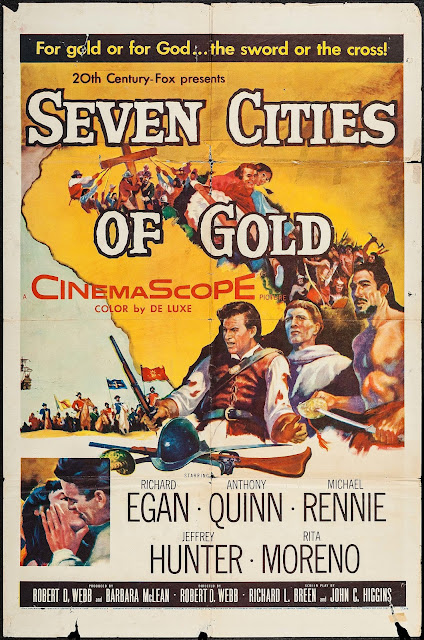
With my radar looking out for California history, the 1955 film Seven Cities of Gold caught my eye. I found it on YouTube, saw it, and needed to review it here.


It doesn’t really fill the gap left by the skimpy coverage of California Indians I learned while going to school in the state. The natives were described as peaceful, and easily converted to Catholicism, and enjoying working in the Missions, like happy slaves on plantations of the South. The film provides a rare Hollywood look at a forgotten slice of history.


It came out of an era when studios were coming up with color and widescreen spectaculars to pry the audience, and their money, from blurry, small, black and white television. Fantasy, sci-fi, and superheroes were still considered outré stuff for kids and weirdos, so these movies were usually historicals, with exotic locations.


The exotic land is California, the place that became San Diego, south of Hollywood, before the sprawling suburbs where I grew up, when it was desert. Water, like just about everything in the state, comes from somewhere else.


It was based on a 1951 novel The Nine Days of Father Serra by Isabelle Gibson Ziegler. Father Junipero Serra is played by

Michael Rennie, who was Klaatu in the science fiction classic, The Day the Earth Stood Still. Once again he was an alien ambassador trying to civilize a primitive people.


After showing sympathy for Indians, he is sent on an expedition to California in search of those elusive Seven Cities of Gold.  It is led by Captain Gaspar De Portola, played by Anthony Quinn, the versatile, Irish-Mexican-American actor who shows that he can play a white Spaniard. His second in command is José Mendoza, played by Richard Egan, who starred in another Fifties sci-fi favorite, Gog. Father Serra is sent along as a “spiritual advisor” and, oh yeah, to found a mission and spread the word of God.


Captain De Portola, and Mendoza, experienced in Indian fighting in other parts of Nueva España, want to kill several of the first ones they meet, but Father Serra convinces them to try to communicate.


At the beginning of the film, the narrator explains that the only things changed about the story, that is presented as true, is that everything has been translated into English. So when they meet the Indians, the Diegueños (a Spanishism, they called themselves the Kumeyaay, or Tipai-Ipai, according to Wikipedia; in 1990 there were 1200 of them on reservations, and 2000 off–wonder if there are any left in 2022?) they speak English, simplifying the usual confusion that happens in a first contact. It is as if they had been provided with Star Trek universal translators. 


Speaking of Star Trek, Matwir, a young warrior who becomes the chief, is played by Jeffrey Hunter, who played the original captain of the starship Enterprise. He is darkened by full body makeup and wears colorful warpaint and feathers. He and all the other Kumeyaay deliver their lines in the halting manner, stressing every word, making it almost impossible to do any real acting. At least none of them said, “Ugh!”


There are some thrilling battle scenes.


The Kumeyaay do find the Spaniard’s technology, guns, scissors, and medicine appealing, but are confused by Father Serra’s God and his desire to get them to junk their culture for his. When the mission is built, no Kumeyaay want to be baptized.

To further complicate things, and to provide some love interest, Mendoza, being frustrated by the lack of white women, falls for Matwir’s sister Ula, played by Rita Moreno years before West Side Story. He keeps it a secret, but then the expedition, having found no cities or gold, is called back to Mexico City, abandoning the mission. Ula is willing to go with Mendoza and marry him, but this was not socially acceptable in those days.


 They argue, and she “accidently” falls off a cliff, which nearly results in the Kumeyaay wiping out the expedition.


They do manage to contrive a happy ending. As they are leaving for Mexico, Father Serra, who didn’t baptize one Indian, rings the mission bell for the last time, gets a demented look on his face, and says, “I hear them coming.”


The more I think about the film, the stranger it gets.


It would also be a good way to trigger discussions of California history.


Ernest Hogan was born and raised in California, and it is a big part of what made him into the Father of Chicano Science Fiction.

Thursday, August 29, 2019

Chicanonautica: When America Invaded Mexico


I’ve always been curious about the Mexican War AKA the Mexican American War. It’s the war that created the world I live in. If it hadn’t happened, there would be no such thing as Chicanos. The American Southwest would be Northern Mexico. We’d be living in an alternate history, an alternate universe.


For some reason, going to school in California, the war was barely mentioned. Bizarre. Imagine schools in South not teaching about the Civil War.


I’m always on the lookout for materials about it, but they are hard to come by.


Even Hollywood dropped the ball on this one. Where are the movies with John Wayne leading the Marines into Mexico City? The only mention of this is in the Marine Hymn:


From the Halls of Montezuma . . .


So when I found The Mexican War Journal and Letters of Ralph W. Kirkham edited by Robert Ryal Miller, at a fantastic bargain price, I went for it.


The book consisted of a personal journal and letters that Lieutenant Kirkham, from Springfield, Massachusetts, wrote to his wife, Mrs. Catherine Mix Kirkham. They were not written for publication. What the historians call a primary source. Honest. Uncensored. You’d need a time machine to get a closer look at the war.


Which was different from wars as we know them. Low-tech Napoleonic war left cities mostly intact, so Kirkham enjoyed music, theater, circuses, and museums after conquering. He was also there for an earthquake, and climbed Popocatepetl before the end.


As for the people:


The Mexican women are very graceful, more so than ours; but as for being handsome, or even pretty, it is all a mistake. Nine tenths of the people resemble the Cherokee Indians as much as possible.
 

He considered not looking white to be ugly. Most whites felt that way back then. Many still do today.


As for Mexican morals:


No one could believe how low and depraved these people are, and instances are common of men selling their wives, and sisters, and often their mothers and daughters. The clergy, generally are very immoral and ready to stoop to the lowest acts of villainy and wickedness.


But he did note that the Mexicans were fond of flowers, birds, and paintings.


As for the availability of good help:


. . . servants are not to be had at any price, and I am sorry I did not take a good black boy with me from New Orleans.


Were American military officers allowed to buy slaves? And take them on military campaigns? I’m imagining John Wayne having a slave boy fix his breakfast before a battle . . . More research is in order here.


Bullfighting appalled him:


It is certainly the most cruel amusement that I ever witnessed.


As cruel as war? But then war is business, not amusement. At least it was back then.

And the war did take its toll:


How many more of our brave officers and soldiers shall we lose before we are conquerors of this miserable race, God only knows, but I hope and pray not many.


Ah, “this miserable race.” It does look like white supremacy, and Manifest Destiny were the justifications for the war -- that, and the land grab.


The United States of America did take Mexico City/Tenochtitlán, conquering the country. I often wonder why they (or should that be “we?”) only kept half. My theory is that it’s another race issue: A brown majority would have changed things. President Francisco Villa might have made Spanish the official language in the early 20th century.


Democracy can be a dangerous thing.


Thursday, April 12, 2018

Chicanonautica: The Brown Buffalo Rises Again


The world mostly knows Oscar Zeta Acosta as he was caricatured into a 300-pound Samoan attorney by Hunter S. Thompson. Later he was portrayed by Anglo Actor Peter Boyle in the film Where the Buffalo Roam. Puertorriqueño Benicio Del Toro played him in the film version of Fear and Loathing in Las Vegas. Now there’s a movie all about him: The Rise and Fall of the Brown Buffalo.

It begins with some words:

This film is a dramatization.

It is based on historical record - personal letters, journalistic and literary accounts.

Actors play real people and are shown along with actual footage. It straddles the bio pic and documentary genres, as well as fiction and nonfiction. That’s a Chicano thing, gonzo journalism, magic realism. Plain old realism and categories just ain’t enough, cabrones!

And it works. I sometimes lost track if I was seeing Acosta or the actor Jesse Celedon, who plays it more like the news clips than the drug-crazed maniac from the movies. 

Jeff Harms plays a surprisingly clear-headed Hunter Thompson, pouring  whisky while delivering the author’s words with a biting, cynical edge, rather than the mumbling, spaced-out mimicry of Bill Murray and Johnny Depp.

The result brings Acosta to life with the humor and brutal honesty of his books. We get glimpses of the man through that media myth, providing a good introduction for those who would like to read his books.

The film focuses on his career as an attorney and activist, but also covers his writing career, and how difficult being a Chicano writer is. He had to threaten a lawsuit to get his books published, which is of special interest to me, because I keep getting called a successor to Acosta.

He has certainly been an influence on my work. I don’t consider myself to me another Dr. Gonzo. I go easy on my cerveza, and I haven’t touched any illegal drugs in decades. Still, people read my stuff and imagine me sprinkling peyote flakes on my huevos rancheros, and prowling the streets in a lowrider, seeking virgins to sacrifice to Tezcatlipoca.

I do see how the connection is made. I have a bad attitude. I’m not an academic. My relationship with Western Civilization is antagonistic. New York treats me like the the most talented leper they ever met. I scare the sort of people publishers think buy books. I refuse to go down in flames like a good, little minority writer. So I keep that foot firmly planted in the underground, so I’ll have a place to stand when things get hairy.

Like they are now.

Sure they may change, but it’s going to be a long, hard guerrilla campaign. The Corporate Culture Machine has only just now realized that black people actually exist. It may take a while for them to see all the shades of brown, the buffaloes, the cockroaches, the high-powered mutants never considered for mass production.

Meanwhile, I recommend The Rise and Fall of the Brown Buffalo. See it. And dig in, sandwich Fear and Loathing in Las Vegas between Autobiography of a Brown Buffalo and Revolt of the Cockroach People, as a weird, disjointed, distorted--after all, isn’t all art distortion?--trilogy that lets certain truths be self-evident, and kindles some vicious laughter.

I have a feeling we’re going to need it in the near future.

Ernest Hogan has been called the Father of Chicano Science Fiction. Rumor has it that he’s an Aztec priest or a techno-shaman. His novel Smoking Mirror Blues is now available in a new edition.