Showing posts with label reviews. Show all posts

Tuesday, April 07, 2026

He discovers chicano literature

Before Huizache: El Grito

Michael Sedano

Between 1963 and 1967 I became a Bachelor of Arts-level expert in British Literature with a dabble of United Statesian writing, such as it was. Those qualifiers, “dabble” and “such as it was”, meant a sizeable gap in my literary education that couldn’t be filled by Random House, nor  Grove Press, nor upper-division courses in U.S. fiction. It wasn’t until my return from the US Army in 1970 that absence found its satisfaction in output from a Berkeley, California press, Quinto Sol.

For half a year, I lived part-time atop Mae Bong, the world’s highest missile site. Duty was three days and two nights on the mountain, two days and a night in base camp.

I always took the overnight turn. The troops slept through the night giving me eight hours to read, interrupted only by hourly commo checks. 

Down in base camp, the USO had installed a library featuring books I wanted to read, titles chosen right off the shelves of City Lights Bookstore. Thanks to that unknown USO librarian, I was never short on good stuff to read, from Brautigan to Vonnegut, free.

I had been back from Korea only a few weeks when my Barbara, who taught English at San Gabriel High School, told me she’d learned of a nearby bookstore selling Chicano Literature. I immediately knew what those two words meant but I’d never seen them put together like that. I whip out my Thomas Bros map book to locate this bookstore selling this unknown commodity, chicano literature.

I entered the Army in January 1969 and didn’t come up for air until August 1970 when I walked away from Ft. Lewis with an Honorable Discharge in hand and travel money to Temple City, California. Without having a name for it, chicano literature, that's what was missing from my literary experience and in a few weeks I'd hold it in my hands.

While I was overseas high atop mighty Mae Bong, Quinto Sol Publications of Berkeley, California, had published a collection of Mexican-American Literature then revised it in 1969 with a new title, El Espejo: The Mirror. Selected Chicano Literature. It was the first book in Unitedstatesian literature called “chicano literature.”


My recollection of holding Quinto Sol’s El Espejo in my hands the first time, in that tiny bookstore that sold chicano literature, sprang to mind as I received a wondrous gift from Thelma T. Reyna, who holds down alternate Fridays at La Bloga. Thelma gave me a copy of El Grito V:3 Spring 1972, subtitled Prosa Chicana Contemporánea Contemporary Chicano Prose. The collection treats readers today to work from notable writers still early in their careers.

Reyna’s short fiction, “The Grapevine”, has the antepenultimate position in the edition. Leading off the collection is Rudolfo Anaya with an excerpt from Bless Me, Ultima. Tomas Rivera, Rolando Hinojosa-Smith, Octavio Ignacio Romano-V, and Estela Portillo de Trambley, round out the opening selections. Romano is editor-publisher of Quinto Sol and El Grito.

Anaya prefaces the excerpt saying, “I have a very good feeling about where the course of Chicano Literature is headed.” El Grito V:3 offers eighty pages of contemporary chicano prose, with illustrations by Ramses Noriega, illustrating Rudolfo Anaya's confidence in where Chicanas and Chicanos are heading in 1972.

El Grito is Ur-Huizache. Huizache (link), recently located to El Paso Texas from California, offers a definitive snapshot of contemporary raza writing in journal form. While rare copies of El Grito might be obtained from internet sellers at a premium, you can buy Huizache's entire collection now (link to publisher) and wait fifty years for the collection to be sure-fire treasure.

Tuesday, May 13, 2025

Review: YA book of the dead

 Review: Ghost Brother by Sylvia Sánchez Garza. Piñata Books/Arte Publico, 2024.

Michael Sedano


Sylvia Sánchez Garza gives her YA readers a lot to think about in their personal lives as the reader watches Garza’s characters struggling with emotional depths familiar to numerous teenagers—an absent father—and events a kid doesn’t want to consider: the kid’s own death. There’s also young love, not to mention trouble with bullies who include a gun-toting sheriff.

The story begins with a traffic accident and what seems a kid’s out-of-body experience. It’s not. The kid, Carlos, has been killed instantly. Carlos is the dead brother of the title. Cris, the victim’s brother, was driving and has survived.

Garza uses the two brothers’ voices to spin the story of Cris falling in love with a troubled girl, Selena, and a story of children learning their father’s identity. 

None of this happens in orderly 1,2,3 fashion. For a few chapters, readers suspect the worst—that Selena and Cris are long-lost brother and sister. There’s also a hint of incipient police brutality, that big gun-toting sheriff, whose son also died in that car accident.

School is, of course, a major element in a teenager’s life. Cris is a reader but not a teacher’s pet kind of kid. Selena is a new kid in school, bringing those complications to her daily troubles, already complicated by mother-daughter strife and the presence of outsider men in the mother’s life and the daughter struggling with not knowing her father’s identity.

The author’s tactic using the dead brother narrating from the other side with the prescience of that dimension opens numerous opportunities for deeper investigations into spiritual themes. There’s a child who sees the ghost matter-of-factly. The boys’ mother responds without actually hearing her son’s wishes. Eventually, Carlos’ spirit makes itself known to this world, offering some kind of succor to the living. 

Garza chooses not to delve into the mysteries of spirits trapped in limbo, whose role is serving the concerns this world, of helping kids work through family struggles of desperate children, depressed mothers, absent fathers, and finding ways to live happily beyond the last page and a looming future. In the end, that’s enough, and if it’s not, it will have to do.

Poetry & Cookies: Altadena Laureates' Annual Spring Event

Over twenty years ago, the Altadena Library held a "poetry & cookies" (link) event sharing cookies and poets reading their stuff. That event grew into California's most active community poetry program, the Altadena Poet Laureate program that now features a pair of Co-Laureates and a two-year program of readings and publication.

Sarwar and Lennon

This Saturday, April 17, in the library's main space, the Altadena poetry community and co-Laureates Sehba Sarwar and Lester Graves Lennon, invite all to the 4 p.m. event. Rumor has it there are even gluten-free cookies to be had.


Tuesday, August 23, 2022

GOPlague-time, Galardonado In Silence, Roblest Impressions

 Michael Sedano

As if caregiving isn't enough challenge for a semi-old man (in two weeks I'll be 77), now I'm dealing with the GOPlague. Barbara has tested positive twice for the virus. She's got it, but it's not going to get her.

Me, I test negative. My claim to temporary invincibility comes as no idle boast. After all, I survived the cold war high above the frozen Korean DMZ, and back in July 2014, I died. 

The Ancestors sent me back so I wouldn't miss all those life events that flashed before my eyes as I was departing. My one regret was I wouldn't get to share my granddaughter's milestones. "Burn Sage," the ancestors told me. I do, every morning. The Ancestors are in the smoke, powerful medicine.

Provenance? I was overjoyed that Barbara had built strength and had energy to come into the grocery store and push the cart. My negligence allowed her to complete the aislesweeps unmasked. The only time she's gone into public without masking, the GOPlague gets her.

And that's the view from the coast, Tuesday, August 22, 2022. The only penultimate Tuesday of August in 2022 you're ever going to see, for the rest of your life. Make it great, gente. Read, raza, and GOTV. Never vote R.


Silence of the Latino Book Awards


The weekend of August 19-20 brought raza writers from across the continent to receive an International Latino Book Award. Almost 600 titles won a prize, if not a Medal, an honorable mention. The awards structure offers 208 categories, accounting for two full days of meetings at L.A. City College.


I searched the Google for news of "International Latino Book Awards" to disappointing results. The dearth of news about the awards fills me with frustration at lack of effort, somewhere. 


Essentially, the only news promotions the Awards get is from the organizers. Running the show is Empowering Latino Futures, renamed  from "Latino Literacy Now", whose dubious history of poorly-attended Edward James Olmos Book & Family Festivals are good cause to change identity, while pursuing the same business plan.


I don't know if the abysmal publicity about the Awards owes itself to poor promotion out of the Empowering Latino Futures' office, or deliberate erasure by newspaper culture editors. Raza literature doesn't get ink, just as raza actors don't get roles, raza directors don't get gigs, raza books don't get awards. So we have to do it ourselves.


Next year's Award campaign evidently keeps the same $90 entry fee per title. Authors, Agents, and Publishers interested in next year's awards can click this link. But do note, ELF staff have not updated the company webpage in detail.


Most Galardonadas Galardonados receive a dust jacket sticker, and authority to call oneself Prize-winning Author. Empowering Latino Futures promises some Award-winners $1000 cash and a marketing campaign. ELF places a $2500 value on the  marketing package that sends press releases and stories to 625 "Latino media outlets." 


Wouldn't it be something if ELF were to share that 625-name list with the Galardonadx? The only news I get about the Awards comes from happy Award-winning Authors on the MetaFace, so distributing proven leads to the writers genuinely has value.


It would be something if those 625 Latino media outlets ran the story big, with fotos and a local spin? A local writer's P.R. release has a better chance with a small-town editor, me parece, but the writer needs a name and number/email.

La Bloga congratulates all the participants in the International Latino Book Awards, and encourages participation in this, or similar, programs, with a caveat:

This Award is a sticker on a book. You gotta put that book and sticker onto bookshelves, you gotta send out your own press releases, don't restrict yourself to local Latino media outlets. You gotta toot your own horn. 

Learn to pronounce "Indefatigable" when people ask about your marketing campaign.


Guest Writer: Hugo Garcia

A guest at CasaSedano asked if I had read anything interesting, lately? I had just the answer for him sitting on my TBR pile, Against the Wall, in Spanish, as Contra la muralla, from Arte Publico Press.

The guest, retired newspaper editor and Spanish-language newspaper journalist, Hugo García, devoured the volume and enthusiastically sketched a few notes. The collection is available from the publisher (link).

In Alberto Roblest's Contra la Muralla's 17 short stories, reality and perception mix, even in the same sentence. The dramatic effect is not always clear to the reader.

When Roblest succeeds, like in El Dia Anterior al Anterior he skillfully describes its protagonists:
To date Grace hated her job...Sometimes she dreamt the plane was crushed by God's hand slamming it against the clouds; The Scorpions got off the limousine at the airport entrance astonished there were no fans anywhere; Pedro Martinez Ocaña aka Tigrillo was born without talent for politics or investments. To be honest he lacked talent to do anything; Cristal was worried her only support could die any moment leaving her destitute. She knew she had to hurry before his children and his two ex wives beat her to it. (García's translation) 
Roblest intrigues the reader as to how his people will intersect and how this will affect the story's end? Other times, the reader is left wondering what the stories were really about.

Throughout the stories Roblest shows a mastery  of character description and deep awareness of current political and economic corruption in the U.S., for example, in Obelisco Ennegrecido  Roblest covers the Washington Monument in cockroaches. 

Some of the Cuentos are only a couple of pages long like Laberinto in which its protagonist is chased by a fat being called la Chingada and Una Vez Abajo no se olviden de Encomendarse a Dios where the narrator is intrigued that a man in a suit and slippers stands in New York's Times Square looking up at the sky calling God.

Some stories are several pages long like El Dia anterior al Dia anterior and Lost and Found. Longer works allow the writer to present a traditional linear narrative until he gives the story a suprising end. 

In all, there is something for every one in its 17 short stories.

Tuesday, September 07, 2021

Publish Or Perish: Remembering History

Review: Homecoming Trails in Mexican American Cultural History: Biography, Nationhood, and Globalism

Michael Sedano


One might be forgiven thinking of Roberto Cantu only as the remarkable engineer who refurbishes the Antikythera maquina for The Mexican Flyboy in Alfredo Vea’s 2016 novel. I think of Roberto Cantu as the earnest UCLA grad student eloquently explaining historiography in Spanish at the 1973 Festival de Flor y Canto at USC. After I spent a career in private industry, I then learned Cantu engineers academic conferences with the same vision his literary counterpart puts together time machines.


Roberto Cantu’s 2021 collection, Homecoming Trails in Mexican American Cultural History: Biography, Nationhood, and Globalism, reflects one of Cantu’s most eclectic conference assemblages of historians and critics, including novelists writing as historians. The book results from Cantu and Cal State LA’s conference, 2018 Conference on Chicano History, Historiography, and the Historical Novel: Out of Many, One (link). 


Academic conferences fill important roles the life of a young faculty member. Having landed a tenure-track position, the burgeoning scholar will prove themselves to colleagues by attending and presenting at conferences, by publishing articles in journals, and by publishing a book. 


When a conference presentation gets converted to a chapter in a book, it’s a homecoming-to-tenure trail in a chicana chicano professor’s history. Most of Cantu’s scholars didn’t “need” the publication. One’s a Chancellor, another’s Emeritus, another’s a “Distinguished.” Beatrice Pita and Rosaura Sanchez, for example, who publish two of the collection’s seven chapters, are seasoned scholars who also published one of the first science fiction novels in Chicano Literature.


That deserves a footnote, que no?


In fact, the authors roster reads like a who’s who survey of the first fifty years of formalized C/S in universities. That’s fully intentional on Cantu’s part. The 2018 conference convened to recognize CSULA Chicano Studies Department’s 50th anniversary.


And there are lots of footnotes. And “Works Cited” appendices, what I learned were called “bibliographies,” but then, I remember when there wasn’t something called “Chicano Literature” and the MLA was the sine qua non of citation style. And the writing we learned was stilted and formulaic.


Among the worst rites of passage in a young professor’s career is sitting through two days of academic panels. In a typical session, a moderator fails to control early-program speakers and the last speakers have to rush through a twelve minute plan in three. Speaker after speaker takes the rostrum and starts reading a typed manuscript, making little to no effort to personalize the presentation nor respect their audience. And when a reader goes overtime--"only two more pages left"--that’s plain rude, as well as boring.


Thank you, Professor Cantu, for avoiding that kind of material in this collection. I didn’t attend the conference, but it sounds like these presenters actually talked to the audience. That’s what these chapters sound like, a scholar who respects the reader. Homecoming Trails in Mexican American Cultural History is an academic book—it’s meant to be studied, underlined, dog-eared, and its footnotes followed back to the primary sources. Unless it's a library book. But it’s not a bad read. These are seasoned academics who gave themselves permission to write elegantly while protecting conceptual rigor and teaching you a lot. I hope they talked their papers at the conference.


Cantu’s introduction places a frame around both the conference and the 50-year history of Cal State Los Angeles’ pioneering degree. David Montejano, an Emeritus from Cal Berkeley, is so seasoned he cites his own work as a lens to understand the movement. Pita and Sanchez’ chapter on markets, trade, colonialism, and environmental consequences reads with ease and sounds like the opening lecture in a fascinating graduate seminar.

The final chapter, Julio Puente Garcia’s Battling for the Spanish language:cultural conflicts in Rolando Hinojosa’s novel Generaciones y semblanzas, is the only purely academic essay. It reads like the work of the young scholar he is. It's Cantu's one missed opportunity to do some serious editing. But the subject, Hinojosa, should already have been awarded a Premio Cervantes, so it’s great seeing this essay wrap the collection while adding to the Post-Doc’s curriculum vitae. Chicanos do not read enough Hinojosa.


Seasoning makes a difference not only in style. I’m interested to see a plurality of raza sources in the bibliographies and footnotes. Go back 50 years and CSULA C/S had to hire high school graduates to teach C/S courses, according to Cantu. Go back 40 years and C/S publications find their footnotes devoid of raza names. One Homecoming Trails memoirist says we are in our fifth generation of Chicanx scholars, and it shows. Homecoming Trails bibliographies name a plurality of Chicana Chicano authors. 


Then there's that German guy Heribert von Feilitzsch writes about, Uprooted: The Story of Frederico Stallforth. Here's a real treat of historiography, a superbly narrated spy story from WWI. Stallforth, a Mexican, buys ammunition and weapons in NYC to stall the US war effort in Europe. The foreign agent is never punished for his work.


Footnote: Quinto Sol Press published the first book with the words “Chicano Literature” in the title, 1969’s El Espejo: The Mirror. Selected Chicano Literature. No one mentions that in Roberto Cantu's line-up of scholars, so I’ll end my review on this note: while no book can ever comprehend an entire cultural history, Homecoming Trails in Mexican American Cultural History makes an important contribution.


Homecoming Trails in Mexican American Cultural History: Biography, Nationhood, and Globalism. (link to publisher). Newcastle upon Tyne: Cambridge Scholars Publishing, 2021. 

ISBN: 1-5275-6795-8

ISBN13: 978-1-5275-6795-5


Tuesday, February 04, 2020

Sudden Death Living's Imperative


Review: Thelma T. Reyna. Dearest Papa. A Memoir in Poems. Pasadena, CA: Golden Foothills Press, 2020. (link)
Michael Sedano


Dearest Papa. A Memoir in Poems by Thelma T. Reyna starts like so many books, with an Author’s Foreward. “Poems,” the subtitle calls itself, hence, ordinarily I’d flip through the prefatory pages searching for the poetry. Why delay, get to the main point, let the poetry speak for itself. Ordinarily, I’d do that, but some power compelled me to start at page 0 and read Dearest Papa cover-to-cover and you’ll be glad you do this, too. Every word matters in a collection like this.

Dearest Papa. A Memoir in Poems isn’t about poetry. Dearest Papa is about getting ready for death. Don’t take that wrong. Dying is universal, but knowing about how to live with death comes hard, or not at all, to the living. 

Aging people, sick people, people with dementia, terminally ill people, and those around them, panic when mortality enters awareness. Dearest Papa is what critic Kenneth Burke calls “literature as equipment for living,” that is, something useful, writing as a way of sizing up situations to formulate effective responses to crisis. When my wife’s Alzheimer’s dementia got “bad,” I descended into debilitating panic for months. Reading how Reyna lived through the death of her husband would have been a balm for hundreds of reasons.

Fifty years, Victor and Thelma had. Back sometime in the late sixties, “Two young Latino college students from backgrounds of poverty, with divergent life stories and roots, made vows to live life together” and that’s what they did. Until one ordinary day Papa takes a playful bite from his cat. The wound poisons his diabetic system and after extended medical treatments and amputation, an everyday surgical procedure kills him.

Readers who come to Dearest Papa find themselves privileged to share this wife’s final words, the last thoughts she will ever get to say to her “Papa,” the grandfather, father, husband, lover. No words will ever be as intimate as these, important just to Thelma Reyna, but now part of a reader’s experience. The privilege of sharing intimacy makes a person special, not solely in those passionate moments of metaphor and narrative, but afterward, when the reader steps out of apostrophe into eulogy, then into literature as equipment for living.

Everyone knows or shall know grief. Dearest Papa accounts Thelma T. Reyna's passage through illness, death , absence. Reyna expresses her sorrow through prose poems and verse that create a stunning narrative of minor events unfolding into catastrophe. On every page, readers share the poet's grief, regret, celebration. Reyna's overwhelming gratitude for life makes Dearest Papa a book to share with caregivers, diabetics, elders, and people who love.

Reyna’s account of her sorrow, grief, suffering, and growth belongs in so many readers’ hands. The book deserves to be read along with Rudolfo Anaya’s masterful exploration of death dying and grief, The Old Man’s Love Story. Elders, caretakers, children of aging parents, these readers, especially appreciate the perspective of a widow and “getting over it.”

“It” constitutes the couple’s Beginnings and Endings, the first two sections or chapters. Then the widow’s Mourning. Her Balms and Resolutions conclude her poet-widow’s five-step method of taking a deep breath, making sense of the unaccountable, dealing with loneliness, moving on purposefully. 

People cannot sustain grief without becoming emotional cripples, at least until memory fades or something worse comes along. In its way, Dearest Papa is the old woman’s love story and a valuable addition to United States literature of grief and consolation. This book is an antidote to suffering.

The poet structures the collection to confront mourning and recovery with dramatic immediacy. In the 100-page book, Papa is gone before the book is half complete. This structure offers a pointed reminder, that life continues once the duality of beginning ending have wound their paths.

Beginning remembers a handsome young man and a quiet inconspicuous woman. They couple and court. The poet marks their vigor and commitment in erotic poetry, their sexual playfulness a demonstration of the wholeness inside that quiet girl he sees in the back of that classroom. 

Like the poet, readers remember intense days of blossoming love, this first section so open and true, so intimate and private, it’s the poet signaling her trust in her readers with a completely open ethos. Writing openly about something as elemental as sex prepares readers to think about something even more elemental, sudden death.

Caregivers have to spend time with the poems in the Endings chapter. Papa never needed to stop hoping he’d get over this. He was the star patient at the nursing home. He falls. Nonetheless, compared to those other guys, things look good. Papa’s got the good healing attitude.

Diabetics don’t heal well. This knowledge undergirds the narrative of Papa’s ending. Stepping out of the aesthetic realm into health education, families with diabetes will attend to what happens to Papa owing to his diabetes. An apparently insignificant foot injury is lethal. This section of Dearest Papa is frightening and can be a “scared straight” illustration for diabetics.

Papa is dead. The poet doesn’t challenge herself to ask “why” nor “why me?” It is what it is, and it’s all the same to the cat. Hold your breath, the poet does not blame the cat.

Opie curled in his white Sherpa-wool bed each night,
oblivious to hospitals, IVs, ICUs, and the whole alphabet.
Cats don’t worry about spelling or school.
Cats don’t care about calendars or cures.
But perhaps Opie wondered why Papa wasn’t home.

Papa disappears entirely from the work now, after Mourning he’s a pronoun or an allusion. Balms poems are for the poet. For instance, the passive voice of “Bonsai” removes from the tree Papa’s hours over years forming that tree, save for the mention of a “sturdy” limb, the poem contains not even memories of Papa. The bonsai tree exists. Nothing of Papa’s cutting and wiring and twisting and years of forming that shape is in the poem nor the branches of that bonsai:
cuts are gentle, kind
a nick from blade
snip from shears
bending of the limbs in nuanced arcs
baby branches coaxed
with copper twined
on base and slender arms

Death doesn’t matter anymore to the dead, death is for the living. The poet allows herself remonstrance in “Dear Doctor.” Papa is dead, the doctor is telling the woman consumed in grief. She ignores that fact, wildly seeking succor in everything else that’s wrong about this moment. The poet nor the poem says what the poem really wants to say to the doctor, “doctor, you killed Papa.” Don’t wonder why she doesn’t say that, nor beat the anesthesiologist over the head with bitter words. What good does it do?

The most intimate poem in the collection comes with death itself. Reyna reveals her breasts were delights in her love-making, something no one in the world knew until that poem. But something everyone experiences that cannot be shared, disclosed, nor offered is the moment a person’s life stops.

Did you hear your surgeon say, “I’ve got to tell his wife.” Did you see him pull his face mask off, and did he scurry out the door, a frightened ant? They said compressions on your
silent chest went on and on, that your heartbeat blipped back for a tiny flash, then disappeared, fading faster each time. Did you see them staring at the screen, and did anybody cry?

They say humans know the moment they expire.

But words and the world of sounds will be just out of reach to everyone, the living and the dead. There are always things that mattered, ideas that need to be gathered, words that need to be said in a eulogy so everyone left behind can hear what no longer matters but my gosh, it used to matter so much to two people.

Dearest Papa. A Memoir in Poems collects all the words Thelma Reyna has to say about her 50 years with the man her family calls Papa. Words are all that remain after fifty years and eight months. The poems, verse and prose poems, the narrative elements, these, every word, are the final expressions and memories in one woman’s life about something everyone is going to experience. Profoundly intimate, the words, in the end, don’t have to mean anything to anyone but Thelma Reyna. They don’t have to, but when you start confronting inevitability, don’t panic. Read Dearest Papa before not even words remain.

Golden Foothills Press distributes via the internet giant that’s killing the independent bookseller but makes acquiring small press titles convenient. Mail Order is a little less convenient, but back when America was great again, Mail Order was how we did it.

Mail $15.00 plus 8% sales tax and estimated shipping—USPS Media Mail costs $2.80 for a book this size--to the publisher for a paperback copy.

Golden Foothills Press
1443 E. Washington Blvd. #232
Pasadena, CA 91104

Tuesday, January 15, 2019

Don Felipe Presente! Anaya Chupacabra Billy Kid. Boatyard Gluten-free Chile. Miller in Bisbee.

QEPD Don Felipe Ortego


Don Felipe-A Remembrance from Latinopia.com on Vimeo.


Expanding Limits, Making New Rules, Setting History Straight

Review: Rudolfo Anaya. Chupacabra Meets Billy The Kid. Norman:UOklahoma Press, 2018.
ISBN 9780806160726
Michael Sedano

Rudolfo Anaya continues expanding the horizons of Chicano Literature in his newest work, Chupacabra Meets Billy The Kid in so many ways. First off, the title is sleight-of-hand. While folklorists might come looking for some Chupacabra, a sci-fi platonic romance breaks out. Beyond that, let me count the ways Anaya is busting Chicano Literature loose from conventionality and celebrating himself. And if I’m wrong, I trust I’m not alone in celebrating Rudolfo Anaya’s ongoing enrichment of literatura Chicana with this exploration of the speculative muse.
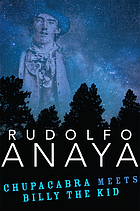
For one, Chupacabra Meets Billy the Kid is a valedictory-in-progress for Anaya’s oeuvre by the author himself. For another, the author, a descendant of the New Mexico legend, sets the record straight about his forebearer. Then there’s the novel of the title, a science fiction plot knitting together the goat-sucker with la llorona, Big Foot, space aliens, an infested office of the U.S. president. There’s a meta-novel unraveling in the process. From University of Oklahoma Press, Chupacabra Meets Billy the Kid arrives as the year’s most entertaining title. Anaya sets the bar for 2019 U.S. Spec-Fic.

In one hundred seventy-two pages, the author weaves threads drawn from the fabric of his literary output. Curandera and mystic Ultima hovers on the outskirts of the action, these settlements are her haunts, the whole llano, is her tierra. As the story draws the character Rosa home, the author reminds readers of her origins, it carries her home:

The golden carp from a story told by the man who had told Ultima’s story. She had seen the boys fishing at the river when they left Puerto de Luna. Now the carp had appeared, a miracle. 

Other tokens of the Author’s career step forth aside from that magical carp; those muchachos from young Mares’ boyhood; place names; Anaya’s familia, even Roberto Cantu makes an appearance. These allusions offer metynomic cameos concatenating all the words and characters who’ve come before in Anaya’s life, culminating for the moment, here. It's not that this title stands alone, it belongs to this long-lived familia of created truths.

Chupacabra’s science fiction angle has its origins in Anaya’s Sonny Baca series that begins with Alburquerque and follows the seasons, Zia Summer, Rio Grande Fall, Shaman Winter. The detective’s nemesis, Raven, brings mysticism and time travel to Sonny’s world in that final title, in a bit of a fictive stretch then. Time travel is the central motive of today’s plot, and it works.

Unchanging and unchangeable, time travel makes for one long bitter irony for Rosa. She knows how the stories end. The girls she hugs farewell, they’ll be dead from disease a few years after Rosa’s hugged them and wished them long lives. Billy, too, is headed for his death.

People who read history get it. Pat Garrett was a hero. People who read more history, and fiction, get it, too. People related to Billy, like Rudolfo Anaya, and country gente, think of a cowardly blast, a kid singled out by double-crossing land barons, not the only killer in town. That's the story Rosa tells here.

Don Rudy adopts a female persona for Chupacabra’s lead character. She’s a novelist frustrated because, writing yet another Billy the Kid story, she feels its absence of authentic, of things and people not known anymore. All those women of the llano, the ones Bilito romanced, the ones who endured and gave succor after drunken gunfights to men with names. Research carries one only so far. Seeing is believing and the ultimate research. It's like Rosa makes a deal with the forces of nature.

The novel itself contains no surprises. The kid lives a short, violent life and gets gunned down and buried. End of story. What was his name, this Billy the Kid? Anglin? Bonney? Henry McCarty? The characters are what give the novel its fresh life. Rosa the researcher keeps novelist’s notes that leap from date to event to person. Rosa the storyteller seeks out the women whose stories didn’t get told, who lived in between those facts.

Rosa recorded the names of the families she met in the Pecos River villages. They always welcomed her into their homes, gave her a place to sleep, shared their meals. The women were the strength of the family and community. Work was strenuous and difficult for the men outdoors, and just as hard for the women. Raising families, preparing meals, canning for winter, making soap from lard and lye, washing, sewing, gardening, sometimes riding to the range to help with shearing sheep or branding cattle, bringing in water from cisterns or the river, chopping wood, cooking three meals on a wood-burning stove, attending church, raising chickens, having babies, curing every conceivable illness that struck family or neighbors, helping their comadres: the list was endless and exhausting.

For me, what I call the meta-novel offers the best moments of Chupacabra Meets Billy The Kid. Like a Shakespearean dramatic monologue, the author steps outside the narrative to offer writerly consejos about the creative process, an historian’s gloss on a particular detail, something the author needs to tell his readers at this juncture. For example, expounding on evil, Anaya has Rosa ask “What does this have to do with me?” and the reader should take that “me” as themselves.

“For starters, we know that most Advanced technological civilizations destroy themselves in their infancy. Nations create weapons, and once each country has its nuclear arsenal, political forces keep adding to the stockpile. No one wants to disarm. When we acquired nuclear weapons, we fit the rule. You only have to look at the proliferation that’s taking place, loose nukes being sold to terrorists. A crazy president with his finger on the nuclear button.”

The voice is Marcy, a disembodied character from an earlier novel, a voice in the machine who guides Rosa’s travels through space and time. Marcy is also Anaya’s voice, the omniscient metaphysical narrator hanging--perhaps impaled-- on the point of the Arrow Of Time.

Time, travel, space, the critters, these elements make up the whole cloth of the meta-novel. Anaya devotes some explanation to how Rosa gets to nineteenth century New Mexico. It’s not clear why Billy isn’t freaked out that he understands Rosa’s presence, but he’s of his time and of the future, multidimensional, as in this scene:

Billy forced a nervous laugh. “Maybe that’s why I don’t trust the written word. Most written about me is lies. You tell ‘em the truth, Rosa.”
Billy could not look into the future. Many books had already been written about him. lies and truths. Each reader had to come to his or her own conclusion about where the truth lay.
Rosa nodded. “I’ll try, Billy.” 

After two years in Billy’s time, Rosa rides a horse upriver and into her own time. Do the people in Billy’s time think Rosa stole Mancita, the horse she rode into the sunset on? Why doesn’t Rosa’s laptop run out of juice? Is it because in her own time, she's been gone just a few hours?

Readers need to sit back and enjoy the ride. Sci-fi is supposed to make sense, but only up to a willing suspension of the rules. After all, the imagination’s the limit, and Anaya’s muse lets loose a todo dar page after page. For example, a classic scene borrowed from the stopped clock showdown scene in a movie.

Rosa’s helplessly worked up seeing a jailer bully pounding Billy’s face with the butt of a rifle. Rosa gets kicked out of the jailhouse and comes face to face with the devil, a creature named “Saytir.” This is a formidable enemy, only a hidden derringer saved Rosa the last time she was alone with the alien spawn from her own time.

Saytir wore purple bell-bottom pants with silver rosettes sewed down the sides of the legs, a bright red shirt, and a dazzling blue satin vest. His neckerchief was pink, his hat a poor excuse for a large mariachi sombrero. His boots were obviously from a Juárez Mercado. On his gun belt he sported two silver pistols, one on each hip.
“Rosa,” he whispered in his best imitation of Gary Cooper in the movie High Noon. “We meet again.”

The ridicule is Anaya's most trenchant indictment of daily events. Much as the evil is a clownish buffoon, Saytir's power can destroy the world and only Rosa has the answer, it's tied up in the inevitability of Billy's legend, in the writer's power to suspend time and write events to fit their outcome.

Filling in Billy’s story demands mas o menos straight history, or in this narrative, fashioning creative non-fiction heavy on the fiction element, as Anaya develops the facts of the Lincoln County war. For readers with an historical bent, there’s a set of research notes at the end that links plot events to history. In other words, this stuff really happened, the names have been supplied to tell the fuller story.

Ultimately, Billy’s story is satisfying because of its fantasy—the time trip, the monsters, are supposed to be fun. And they magnify the horror of the truth. Big Foot and cyborgs aren’t real but that evil is. Marcy and Rosa step away from Billy’s narrative to address, engage, a writer’s ethical responsibility to record, document, reveal, explain. Marcy talks:

Write Billy’s history. Let people know we have this self-destructive instinct in us. It’s what led to the violent times in Lincoln. But there was some good in Billy. If you can find some goodness in Billy’s life, that’s the lesson to be learned and taught to the young. Otherwise, we’re lost. Your story can save the world.”
“ I didn’t set out to save the world!”
“Few writers do, and yet that’s your mission.”

At this juncture the transmission fades and Rosa and the reader are on their own. Billy gets buried. Rosa rides home with Josefa’s blue taffeta dress. Time returns to normal. None of this happened. Evil abounds. The

Order Chupacabra Meets Billy The Kid  publisher-direct at this link. Independent booksellers can order it for you.


The Gluten-free Chicano Cooks
Kathy and Jim Build a Boat. Boatyard chile verde.

Durf marveled at his teammate, a javelin thrower who lived in the Goleta monte. A born storyteller, my roommate spun a fanciful tale of a man I knew only by sight from track meets. I sought what germ of truth must lie at the heart of Durfee’s account.

Jim Clark back to camers
“Jim Clark goes takes his javelin to hunt deer in the mountains.” The story was Jim lived for free on a remote ranch and survived mostly off the land, running down deer in the chaparral. I loved the image my roommate conjured, a wild man living at the edge of civilization because he chose to live like that, free and unencumbered. I imagined Jim Clark went hungry a lot.

Jim Clark’s girlfriend, Kathy, loved him with immense dissonance. Jim’s life was impossible to share with a woman studying to make a career teaching high school English. It was during one of their off-again separations that Kathy and I were hanging around together.

Kathy filled whatever space she occupied. Not many people chose to occupy space with her, however, because Kathy spoke her mind. A woman of wit and brains, Kathy was a formidable personality who fit perfectly into my world, especially as we both were single and not looking. An ideal end-of-college-summer partnership.

Four years have ways of changing a person’s life and attitudes. I was back from overseas and learned from the locals that Kathy and Jim lived in the boatyard along the railroad tracks. They were building a boat and needed help. I called the boatyard. I hadn’t heard Kathy’s voice in four years but I recognized her “hello?” instantly and she mine. Old friends are good friends, separations are meaningless.

I asked him about the javelin story. “I tried it one time,” Jim Clark laughed. That was the day we laid the keel for the cement boat.

Kathy looks out while Jim and friend cement the deck.
Jim had identified a pile of rotted railroad ties where some steel rails lay by the rail side. He had already picked out his keel and pulled the rail to clear ground. All he needed was someone with a truck or car to transport the rail to the boatyard.

I drove the car into the weeds where Jim directed me to stop with the rail underneath. Jim and another fellow lifted the front end and I lashed it to the front bumper. We did the same on the other end.

The nose of the rail extended a few feet from both ends of the Buick Skylark. Slowly and not spotted by cruising cops or railroad dicks, we drove the back streets to the boatyard and dropped the keel in place. In the boatyard shack’s two-burner propane stove, Kathy made her famous dumpster soup and we feasted friendship, old times, the cement boat to be.

A few months after, the boatyard shack has gained a dining table, an outdoor couch and several makeshift seats. Where we’d dropped the keel now stood a rebar and steel wire superstructure of a 40-foot boat. Jim worked on that boat with the intensity that led him to think he could chase down a deer and kill it with his javelin. The deer was certainly out of reach but Jim had built a boat. All it needed now was a skin of cement.


Months passed as Jim constructed the hull, deck, interior spaces and hidden recesses. The work took the time required. Ugency arrived with cementing. The work must be completed in one weekend so the boat dries and cures as a single mass of cement and steel that floats on the open sea. Friday after work, Barbara and I drove up from Temple City. The work was well underway by our arrival late afternoon. Jim and Kathy had lots of friends.
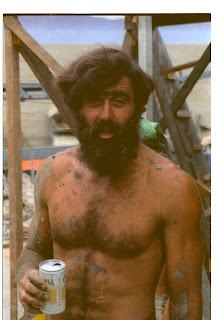
Jim Clark. qepd.

The third day the hull looked like a boat. Only a few people fit inside so workers took shifts pounding cement into the interior walls. Others touched up the exterior. By noon Sunday, the cement boat was done. Most of the crew had left, exulting in knowing they’d joined the culmination of an incredible feat. Jim had read books and talked to old salts, he and Kathy moved into the boatyard, and they built that boat by hand.

I volunteered to make the celebratory feast, a one-dish meal I call Boatyard Chile Verde. After Jim and the cement boat were taken by pirates in southeast Asia, Kathy sailed those waters in hopes of word. She cooked Boatyard Chile Verde for merchant mariners the world over, it was the crew’s favorite dish.


You can make this on a one-burner propane stove, or in a sartén over an open fire. Ingredients, improvisation, and preparation are the keys to making Boatyard Chile Verde.

INGREDIENTS
Pork. Sub beef or chicken.
Gf flour.
Tomatillos.
Green chile – hatch, California, mild new mexico, canned whole are fine.
El pato hot sauce.
comino
Onions
Garlic.
Cilantro
Cast iron frying pan and lid.
Paper or plastic bag.
Sharp knife.
Salt
Pepper
Chile powder
Olive oil

Into the bag, put a ¼ cup of gluten-free flour, a pinch of salt, pepper, and chile powder.

Wash and dry the (pork) meat.
Cut the meat into ½” cubes.
Dust the meat with seasoned flour in the bag.

Dice a large onion and six or eight garlic segments.
Chop cilantro to make 1/8 cup.
Chop 6-8 large tomatillos

Get 1/8” of olive oil hot in the pan. High flame.
Wilt the onion and garlic, stir don’t burn.
Toss the meat cubes with the wilted onions and garlic.
Season with salt, pepper, ground comino or a pinch of seed.
Brown.
Add the chopped tomatillos and chopped fresh/canned chiles, and the can or two of el pato.
Stir and cover.
Lower heat to medium and bring to a boil.
Lower heat to lowest simmer setting and cook for an hour, stirring now and again.

This is ready to serve right away. The objective to fork-tender bits of meat that look like meat, not a paste. Cook vegetable longer before adding chicken, then simmer raw chicken fifteen or twenty minutes until firm. Chicken is fast. Cook beef an hour and a quarter, maybe longer.


Bisbee Late-breaking News!


Bisbee Friday evening January 18 at 7:30 pm.
Title: "1968: From Yellow Submarine to the My Lai Massacre."
Place: Bisbee, at The Royale on Main street.
Make a Cochise County weekend of it!

Tuesday, November 27, 2018

Stock Up on Stocking Stuffers: Part I

Editor's Note: Leading up to Christmas day, La Bloga-Tuesday presents "stocking stuffer" ideas. Inexpensive gifts of great value make the best kind of stocking stuffers.
Review: Juan & Armando Tejeda. Raíz XicanX. Digital recording.
Michael Sedano

Season’s spending decisions begin to take serious measure of one’s resources. At the same time, people you love answer “nothing” when you ask. One thing most people don’t need is more things. Music is one of those you can have your cake, and eat it, too, things. Believe me, I know.

I’ve spent the past months digitizing my vinyl record collection. Cardboard cartons of albums are heavy masses of treasure and memories. I don’t need those things, the albums, but yes to the memories. So a big Yes! to the music things, especially yes to unique collections of up-tempo happy musica, like Raíz XicanX from primo hermanos Juan and Armando Tejeda.

Raiz XicanX (link) offers multiple pleasures as music and performance.

First, music you’ve never heard before but sounds like music you’ve heard all your life. Chicano music.

This is good stuff, a musicologist’s delight. That’s the Raiz part, a tour of Los Tejeda primos' artistry comprising these classic musical styles. As the website for the album describes, "a collection of 17 love songs to and from la Raza that range from original indigenous cantos and corridos to traditional Conjunto Tejano, to blues, boleros, country, cumbia, rock, and jazz."

In the middle of the playlist comes the XicanX sound that makes a listener sit up and take notice with a big grin on their face.

The album closes with more roots music, an exquisite arrangement of the classic folk tune “La Llorona,” and like a bookend, a closing canto to the composer’s other daughter.

The opening track is a chant, the perfect beginning to an album with “Raiz” in the title. Imagine you’re around a campfire and someone starts thumping a two-beat rhythm on a drum, rattles on dancers’ ankles pick up the beat, a reed flute sounds three notes signaling a change to a relentless five-beat drumming chant, “ma ya quetz zal li”.

The last embers of indigenous campfire fade and the listener sits in a barracks during WWII, following the journey of the composer, Frank Tejeda, from San Antonio to Camp Bowie to the bloody Italy invasions accompanied by Longoria in the song. A different Longoria, Felix, was denied burial in his hometown Texas cemetery—whites only, sabes? That Longoria, and the river crossing are the subject of anonymous' “To Brothers Dead.” Tejeda’s corrido, like the poem, mourns the lives left behind in a senselessly-led attack.

The acoustic sound and easy rhythm of the next songs places a listener on a Saturday night in a lonely settlement somewhere in the vast south Texas llano. Maybe you’re in the Texas chapter of Annie Proulx' Accordion Crimes, a great novel whose Texas conjunto chapter visualizes gente gathering from miles around for dance, drink, and the local musicos, some Mexican hands who own an accordion, a drum, a bajo sexto. Their music mixes up styles from the locals as well as European immigrants. The muchachos can play it all.

Tonight's dance starts with a fast one, “La Piedrera/La Barranca Polka Medley,” at a gentle kind of fast because the viejitos are out dancing to some old favorites, tunes from when they were young. Then the conjunto slows it down just a little with a schottische, "El Senderito Schotís". Slower now, “Luzita Mazurka” segues into a waltz, “Ausencia Valz,” then wham!

“Barbacoa Blues”. He coulda had menudo but he got some cabeza instead. That’s where the viejitos went, back to their tables to eat while the young people take over in the studio. Bluesy hard beat gets everyone tapping their toes, nodding, and smiling at the English lyric of Chicano food, “put some meat inside,” with a Raelettes chorus for a few measures, and heavy guitar. Vocal backgrounds are by Juan Tejeda.

Raiz XicanX is a musical treat that arrives loaded with listenability and history. Juan and Armando Tejeda offer a musicology lesson in musical foundations of conjunto music. That’s why it’s called “Raiz” que no? New roots, too, are here. Dig that delightful genre explosion of diversity in tracks 12 through 14, until the closing three tracks bring you back to las raices with a tropical tambor-heavy El Canoero, a virtuoso interpretation of “La Llorona,” and the closing chant.

Raiz XicanX is a thing that isn't a thing--download it onto your thing that plays music, at this link, where you can listen to samples, and click to download individual songs or the full CD.

Tuesday, November 15, 2016

Henry Rios Returns. Mental Cocido for Truth, Beauty, Joy.


Review: Michael Nava. Lay Your Sleeping Head. San Francisco: Kórima Press, 2016.
                                       ISBN: 978-1-945521-00-3

Michael Sedano

1986 was a long time ago, in literary time and in my memory time.

All that remains in my memory of Michael Nava’s 1986 novel, The Little Death, is knowing I sought out every subsequent Henry Rios novel, and the disappointment when I accepted that Nava had moved on from Henry and wouldn’t be presenting me with another Henry Rios novel.

A loner owing to being cast out by his brutal Mexicano father as well as Henry’s own sexuality in a restrictive straight world, Henry Rios stood out as a unique character not to mention being the first Chicano detective in mystery fiction.

Nava recounts the story of how he regained his copyright to Henry Rios in an afterword of Nava’s upcoming December publication, Lay Your Sleeping Head. A Henry Rios Mystery.

Henry Rios is back from the land of remaindered titles and wherever it is great characters go when they’re out of print. Henry Rios isn’t exactly the same vato. He's an easy mark for a pretty face, he still makes poor decisions that get him in trouble, and that aside, trouble seeks him and thrashes him.

Most distinctively, Michael Nava has liberated himself and Henry from thirty-year old constraints on graphic sex.

Lay Your Sleeping Head, Nava’s 2016 rewrite of The Little Death pulls no punches about Henry’s sex life. Some readers, in fact, will have difficulty with the opening three chapters’ account of Rios falling in love with Hugh, a man who spells trouble.

At first the attraction is puro lust, but hooking up quickly turns to heartfelt passion, then confusion, confession, and what must be love. Henry is desperate to believe Hugh loves him, and that he loves Hugh. Nava shares a powerful sense of what Henry wants to discover. A mythical foundation story tells that people were dualities, man-man, woman-woman, man-woman, but the proto-beings were torn apart and humanity became a species of individuals seeking to rejoin their rightful other half. Hugh is Henry’s other half.

At the end of chapter four, Hugh is murdered.

Nava builds the story of Henry’s search for the killers with twists, turns, duplicity, error, and frustration. Rios’ investigation has to work around a homophobic cop and institutional corruption. A law school friend—Henry’s best friend—turns betrayer. A good cop risks her career to help, then feels betrayed by Henry’s tactics. A man out of Hugh’s boarding school past enters the scene to help with the case while slipping into Henry’s arms. Their relationship is of the variety, “if only we’d met under different circumstances…”

Readers will enjoy the unfolding plot, the legalisms, the primer on estate law, the wretchedly horrid bad people who deserve a healthy dose of come-uppance and payback. The complications and just desserts grow so entangled that Nava has to resort to a gimmicky tactic where a character tells the reader-as-Rios “if this were a mystery novel, right now you’d have to find this, admit that, discover a key element.” And, that’s exactly what takes place.

Detective novels tend to come with moralistic fringes, and this one does that. Lay Your Sleeping Head provides readers with a satisfying measure of righteousness and vindication for the variety of purity Henry stands for, while leaving Henry a bit worse for the experience: he’s unemployed, betrayed, alone.

Power, money, corruption, dynasties—these are fancy words for evil, just as tarte tartin is a fancy word for apple pie. All are elements in Henry's story.

As Henry Rios unravels the skeins of evil, he comes to understand his own nature. That nature makes him a compelling character. He is a being denied his other half, after thinking he’s found that. Henry Rios is a romantic, a seeker of truth and love in a world of liars and exploiters. Readers will want more of this character.

Lay Your Sleeping Head is published by Kórima Press. Scheduled for a December release, widespread distribution and availability are problematic. That’s readily remedied by ordering publisher-direct here.


Unrequited Despair But There's A Cure

November 8's election has cleaved the nation into factions, many at each other's throats. Friendships and families are torn asunder by gloating partisanship and true-believer despair. Voices of reason are met with refusal, while people of color are met with violence akin to the winning candidate's basest impulses and speeches.

In that atmosphere, Amelia M.L. Montes sought words of advice, consolation, and positivity for her students at the University of Nebraska Lincoln. She published these in Sunday's La Bloga. La Bloga-Tuesday adopted a different tact.

Over several years, Chicano artist Gilbert Magu Lujan, brought his "Mental Menudo" tertullia to Michael Sedano's house where a core group was joined by a guest list comprised of other artists, poets, writers, critics, and activists. When Magu was absent, Sedano termed the gatherings "Mental Cocidos." Now that Magu has transitioned to the other side--QEPD, there will never be another Mental Menudo, only Mental Cocidos.

"Come to a Mental Cocido With Menudo," Michael Sedano wrote. "Bring something joyful to share, something you made, a song, a poem, good news." No politics. Puro joy. A pot of menudo and beverages awaited the guests, and the reminder from John Keats, "Beauty is truth, truth beauty,—that is all Ye know on earth, and all ye need to know."

Diane and Sergio Hernandez shared news of a new granddaughter, the recently-completed movie on Con Safos Magazine, and Serge brought copies of two issues. Angel and Mario Guerrero brought news of Mario's near-completion of a 3-D printing studio at their home. Mario brought a scale-model human heart, and news of a prosthetic Toucan bill, a bird's foot, and a human esophagus his firm has produced. Guerrero and Garcia are collaborating on design software to enhance Garcia's creations. Manuel Urrutia brought his encyclopedic knowledge of lyrics to old Mexican standards. Margaret Garcia and Rhett Beavers brought a work-in-progress fused glass painting, and Margaret brought her singing voice.

Margaret Garcia and Manuel Urrutia sing duet. Manuel knows the words, Margaret reads from a phone screen.
Guests gather to view Margaret Garcia's work-in-progress fused glass work.
Margaret Garcia explains the techniques used to create and amend the work.
Music has charms to uplift even the most depressed spirits following a travesty of an election. The gente at the Mental Cocido With Menudo illustrate the truth and beauty of the adage.


The Mental Cocido at Casa Sedano is one of numerous iterations of this variety of literary-artistic gathering. Visit the Facebook community, Mental Menudo, for news of events in your area.

Tuesday, August 25, 2015

Review: War is not cool. Call for volunteers in Austin.

Review: Hiroko Falkenstein. War is not Cool at all, Fools!: As I Remember It. Victoria BC: Friesen Press, 2015. ISBN 978-1-4602-7047-9

Michael Sedano

Hiroko Falkenstein's 108 Tanka poems distill the immensities of three periods in history. Horrors of bombardment and escape to countryside survival. Chaos, disappointments, disabilities after war's end. World-changing growth, and finally, escape to a new land and ultimate renewal. Falkenstein's 3,348 syllables expose depths no fifty-thousand word novel can ever express.

That's the blurb I contributed to the back cover of Hiroko Falkenstein's autobiographical collection of Tanka poems, War is not Cool at all, Fools! Illustrated by Johnnie Dominguez, War is Not Cool at all, Fools! in hard bound has the elegant beauty of a fine art book. For electronic readers, the publisher includes editions for most devices. I can imagine a computer screen reader magnifying Dominguez' images and spending minutes enjoying the art, magnifying and scrolling, finding relationships to Falkenstein's Tanka.

Similarly I picture readers reading particular Tanka over and over before turning the page or wiping to the next screen. A Tanka requires three readings by its nature. The first reading grasps the expression as a whole, a second reading rolls the syllables on one's tongue, a third reading puts sound and sense together with a keener sense of the poem as a whole.

Falkenstein subtitles the Tanka collection, "As I Remember It," to remind a reader the experiences of the 108 Tanka actually occurred. The poet opens wounds from 60 year old memories, some that heal slowly. It's important not that she put to rest these matters but that others acknowledge today's victims of wars while political processes struggle not to make more war.

Born during World War II, a girl flees the firebombing of Tokyo to hardscrabble village life. Father returns from the war, starts drinking and fails at numerous enterprises. Mother’s strength keeps their heads above water while the economy booms along without them. Falkenstein closes the collection aboard a trans-Pacific steamer casting off for life in the United States.

Tanka in English normally follow a 5-line, 5-7-5-7-7 structure with aesthetic expectations. In her introduction, the poet remarks about the nature of the English language Tanka,

In Japanese, one has to write in 5-7-5-7-7 letter counts, so it is extremely difficult. In the case of English, I counted syllables. For this reason, I often omit articles, predicates, and I am sometimes forced to use simpler vocabularies to fit the Tanka constraints.

Falkenstein’s adaptations of the Japanese form to the English language reader adds to the interest and uniqueness of War is not Cool at all, Fools! For more on Tanka, follow this link from the Academy of American Poets.

That thirty-one syllables can hold in their confined space a life, or a moment, a thought, a report, a feeling, is a measure of the poet's skill. Falkenstein's skill with English language Tanka connects things of history to moments of empathy with one person’s journey.

Hiroko Falkenstein has been holding back all these years and in this collection lets it out. War Is not Cool at all, Fools! seethes with an undercurrent of rage that these things happen, happened to her, and perhaps worse, that her story is all-too-familiar in today’s world of war-flattened cities and traumatized lives.

(5)
Our house, now ashes,
lifetime collections were gone,
money lost its worth.
At the end of wandering,
we found a fishing village.

Order Hardcover, paperback, and eBook through the publisher’s website for fast service and greater benefit to the author.
http://www.friesenpress.com/bookstore/title/119734000022281141

Purveyors of electronic books also distribute the collection.

Amazon Kindle store
http://www.amazon.com/dp/B0145VZKC2/?tag=friesenpressc-20

iTune e-book store
https://itunes.apple.com/us/book/war-is-not-cool-at-all-fools!/id1031383493?mt=11


Austin Centro Seeks Volunteers For Pachanga

Only a few Tuesdays past, La Bloga shared news of ongoing Flor de Nopal writing workshops at the anonymized ESB-MACC. The alphabet sopa belongs to Austin's Emma S. Barrientos Mexican American Cultural Center.

If I were in the neighborhood, I'd make it a point to take up the ESB-MACC gente helping stage their fiestas patrias pachanga.


Visit the Barrientos Centro website for details, or contact Linda Crockett, Media Marketing & Events Coordinator, 512-974-3789, for more information.