The world's longest-established Chicana Chicano, Latina Latino literary blog.
Las Blogueras Los Blogueros
Click to email a writer. Denver CO • Pasadena CA • The San Fernando Valley CA • Eagle Rock CA • Lincoln NE • Glendale AZ • Santa Barbara CA • Lincoln Heights CA • Kansas City MO • Santa Monica CA
¡Anímate! It’s not all pre-apocalyptic dystopia. Really. And I’m
not just giddy from having a new book out. For the first time in
decades, I have a favorite radio station. It’s like when I was teenager in
SoCal, cruising the FM dial (AM had gone solid bubble gum and my tastes had gotten
edgy) in search of something that would not only provide a suitable
soundtrack for my life, but expand my horizons.
Ah! Those were some days . . . “But,” to quote Frank Zappa, “ I digress.”
These peculiar days, I do such searching through radio.garden.
Radio stations from all over the planet online. Kinda utopian if you ask me.
A few months back I discovered Laboratorio 75FM, Tijuana, Mexico,
and my world exploded in a good way. It was like discovering an
interdimensional portal, worlds I never imagined were revealed to me. It blew
my mind, as we said back in the day . . .
Seems that while I was struggling to make a living, and keep my writing
career going, cultural revolutions were going on . . . not just in what I
like to call the Latinoid Continuum, but in the peculiar overlapping sections
of the planet that were affected by the Spanish Empire, but also other cultures,
because people tend to move around and ignore borders. Music and
countercultures (note the plural) that are not owned by corporations have been
developing all over. As Ishmael Reed said about the black experience, “It’s not
a ghetto, it’s a galaxy.”
Some of it’s on the Norteamericano side of the Rio Grande/Bravo,
Los Angeles, San Diego, Riverside, Chicago, others all over Mexico, with a
lively Mexico City scene. Then there’s Central and South America, with some
connections to Europe and Asia. A vast, multi/recombocultural/rasquache,
nonAnglo-centric, Global Barrio.
And it’s not the stuff that the music industry is pushing through
Latin Grammys. There’s a definite postpunk sensibility, though they did play
something by the Dead Kennedys, and it crosses and mixes genres. Oaxaca has an
underground electronic Goth scene. Mexican punk has a horn section, and shows
its mariachi roots. Argentina has an angry metal sound. Yucatan-A-Go-Go is
outrageous, rambunctious, humorous rock and roll. There’s also what sounds like mutant cool jazz,
folkloroid tunes (sometimes with indigenous lyrics), apocalyptic and dystopian
visions, and now and then, lyrics in English.
And just because the words, and even the band name, are English or
Spanish, you can’t be too sure where it's coming from. This is radio, hooked up to the internet,
and satellites. Quaint old concepts like national borders are fading away here.
The serious, anonymous female disc jockey (how different from the
sonic sexy symbols of ancient rock radio) provides background on the bands,
where they’re from and the genres and subgenres in español. Now and then she
gets excited and rrrrocks las palabras.
There’s also a website that lets you know not only what’s playing,
but what they’ve been playing for the last five days. You can click and get
videos and links to find videos, streaming, band websites, and other
sources.
Though sometimes there is no link. A lot of this stuff comes from
far flung hometown outfits like Tijuana’s own El Topo Records. I like that. The street
finding its own way to create culture.
And all this is just the tip of this rocking iceberg. New worlds
to explore. One more step toward the Intergalactic Barrio, triggering a utopian
vision of Swinging Tijuana becoming the cultural capital of the planet.
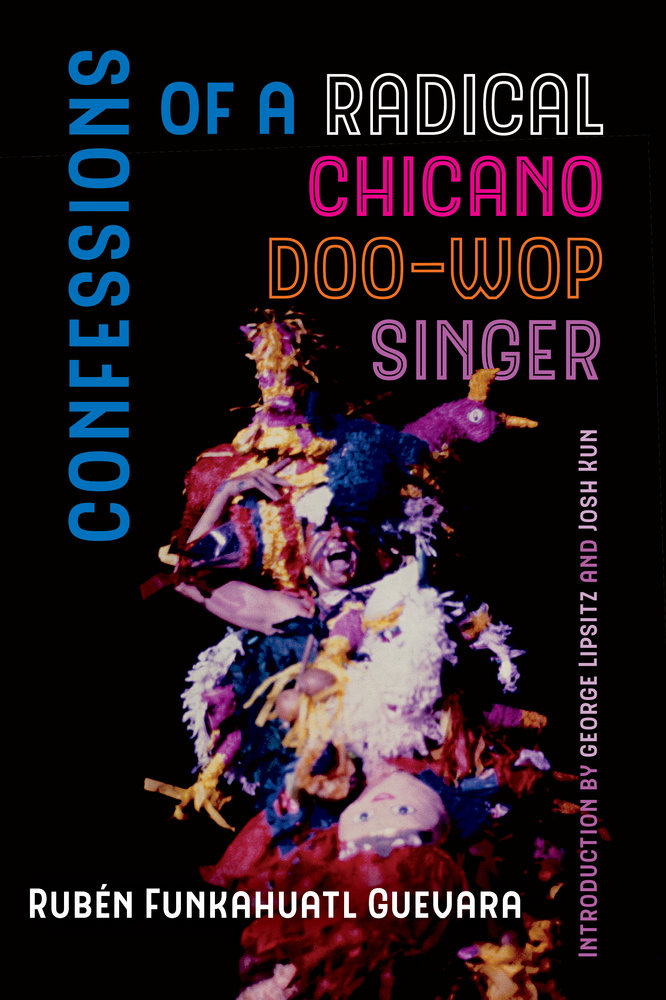
Review: Rubén Funkahuatl Guevara. Confessions of a Radical Chicano Doo-Wop Singer. Berkeley: UCPress, 2018.
Michael Sedano
It’s 1974, a Mexican American musician whose Chicano Studies classes have imbued him with an Edenic vision of his Mexicano and Amerindian raices, travels to Guadalajara thinking he’ll be embraced by his gente. A random street corner encounter shakes him to those raices: a Mexicano laughs that Chicanos have no culture.
Here is the pivotal moment in Ruben Funkahuatl Guevara’s life story. That random Mexican is right. Chicano literary production consisted in the novels Chicano and Bless Me, Ultima, and everyone in C/S classes reads Rudy Acuña’s canonical textbook, Occupied America.
In a dramatic scene—part memoir, part magical realism—the 32-year old unemployed (again) and broke (again) musician climbs a pyramid, throws out his arms, and proclaims his affirmation of all things Chicano. The namesake of the recently defunct band, Ruben and the Jets, decides he will be a Chicano culture sculptor to help fashion what had not yet emerged.
Dramatic as the scene plays, it’s one of numerous career and relationship zeniths and restarts Readers come to expect from Confessions of a Radical Chicano Doo-Wop Singer (link). Success and optimism become catchphrases, “I was on my way again,” “I was twenty-eight, and on my way again.”
Funkahuatl is the artist’s way of decolonizing his name. He likes his name, Rubén, and doesn’t want to change it like his early monikers. Funk stands for his Unitedstatesian identity blended into something Mexicano, -huatl.
Guevara calls his aesthetic “radical” for his adventurous presentations and liberation attitude.
But Guevara’s old, so old he was there at the origins, the roots, of the LA music scene. Before he was Funkahuatl—his “pre-Chicano period”—Guevara played as J.P. Moby on the television dance program, Shindig. He’s 22 years old and he’s making music with Bo Diddley on teevee. He puts a move on Tina Turner when Ike’s not on set. He’s clubbing in Hollywood and there’s a group on stage whose singer is like an intense James Dean. It’s the Doors before they were kicking down doors. Then there was some group whose guitarist plays with his teeth--Jimi Hendrix still getting experienced.
Music fans will enjoy a raft of anecdotes about pop music industry luminaries and down-and-dirty heartache of the business of music and record-making. Confessions won’t inform someone’s lust for glittery slices of fantasy, nor ample details of Guevara's rich sex life, nor details of his three, or is it four, marriages?
While there are serious personal details, these are confessions of a doo-wop singer, not a social worker. But the very best anecdote in the book comes out of left field at readers with a social work twist.
“Don’t give up your day job,” comrades will taunt performers. It’s a reminder that musicians rarely make a living from music. “I was living in my van again,” Guevara writes repeatedly. He works factotum jobs. Working in vinyl distribution, he finds it ironic to be shipping out his records to people who make money off them. He doesn’t. At one point, Guevara settles down from a national tour making music and bringing down the house. Back in LA, out of work, and he takes a job delivering Chicken Delight.
A friend points the poet toward teaching institutionalized boys. Thinking he’ll put in the 8 month contract, he works 16 years. In 1999, he takes a full-time job teaching 8-10 year olds. It’s the hardest work he’s ever done, he says. He changed some kids’ lives, like a sculptor que no?, adding to, or taking away, the shape of a kid's future.
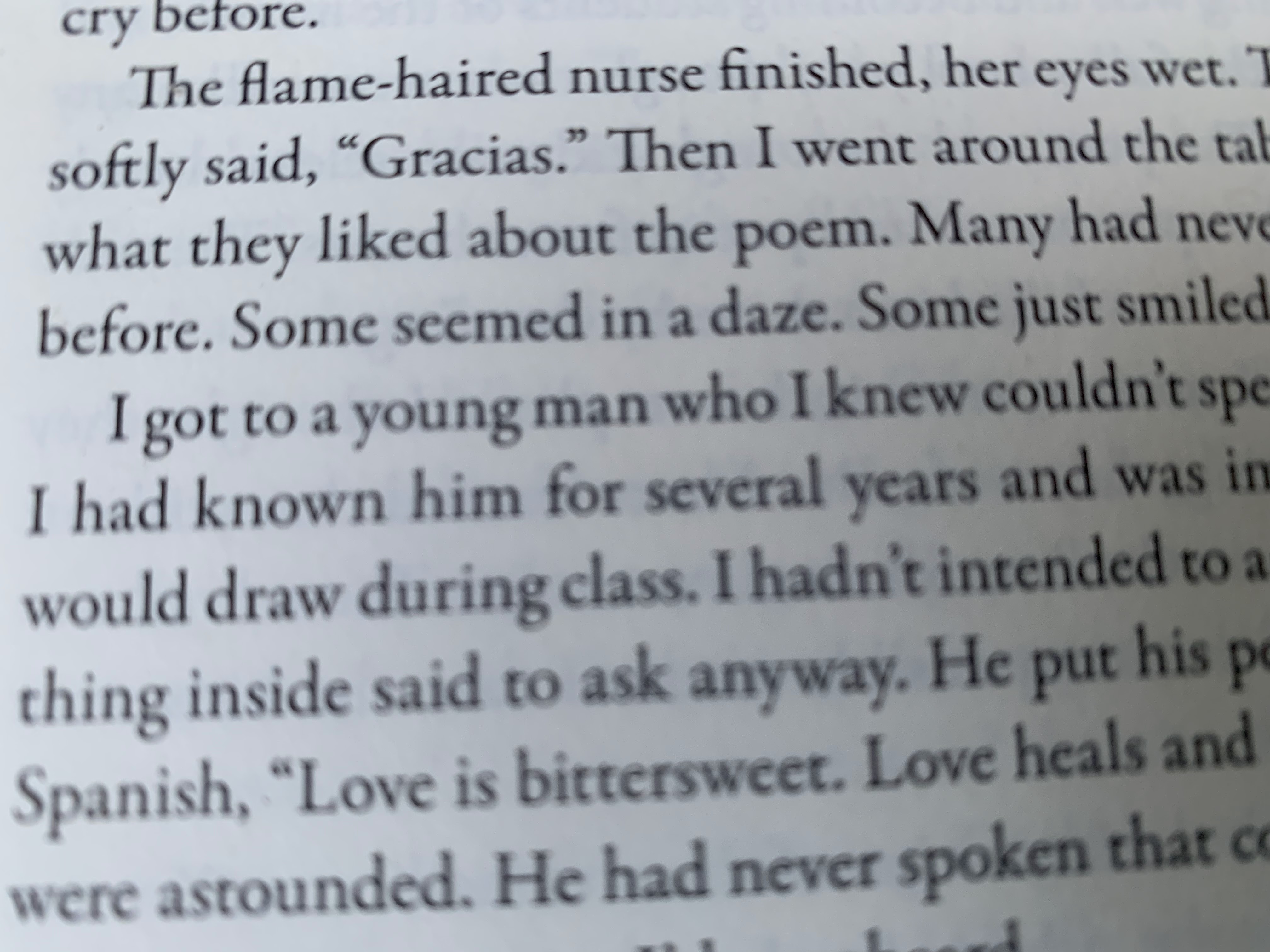
The poet was doing cultural sculpture with those damaged kids. For instance, his wonderful anecdote of reading a Neruda love poem in Spanish to students. The reader, a beautiful woman, interprets effectively and the class expresses their feelings. Some had never heard a poem read in their own language.
“I got to a young man who I knew couldn’t speak very well and rarely tried. I had known him for several years and was impressed with the images he would draw during class. I hadn’t intended to ask for his response, but something inside said to ask anyway. He put his pencil down and slowly said in Spanish, “Love is bittersweet. Love heals and scars. Love is life.” The nurses were astounded. He had never spoken that coherently before. That was one of the greatest poems I’ve ever heard.”
Readers don’t come to biography with literary expectations, but that’s a radical difference in Confessions: it’s a hybrid with poetry ending some chapters. For example, a student dies in a drive-by and the teacher writes a poem to read before the funeral. The chapter details the story. Having that poem after that narrative offers satisfying closure, no better illustration of "see what I mean?" than how a literary insertion affects each reader.
The book observes a chronological sequence (first line: “I came into the world on fire”), but with editing and organizing, each chapter holds together on its own. There are no plot threads forcing a sequential reading. A reader will enjoy cherry-picking the work. If the Punk era is of interest, start reading there. If the Shindig years bring happy tears, read there. Read the chapters with women's names. There’s an Index for topical or research-driven readers of this 300 page memoir.
One of the totally un-radical features of the radical singer’s book is the old-fashioned ultra-traditional proscription against Spanish linguistic equality. Every Spanish expression gets italicized, and almost always with appositional translation into English. For criminy sakes, UC Press, we are Chicanos. It’s simply gratuitous that you translate stuff we’re supposed to know.
Appositional translation gets insulting at times, for example “watching her make gorditas, fat little tortillas, and the way her hands would go slap, pat, slap, pat, slap to the masa cornmeal to shape them.”
Italics and translating are not only old-fashioned, it’s a publisher’s way of saying to readers, “you’re not Chicano enough to make it through elementary Español, Spanish, in our text, pendejo, so here’s a translation”
Damn, Rubén, que gacho. Otherwise, this is a damn fine autobiography, and thanks for the music, ese.
Things
have not been good for la Raza lately. I cringe whenever I check the
news. Ese, what's the body count today? I'm tempted to get mad and do
a diabolical surrealistic voodoo rant, but I think I'll save that for
later.
We’ll
probably need it . . . I've got this sickening, sinking feeling that
the pendejadas are far from over.
Meanwhile,
la Cultura marches on, looming larger and larger every day in the
dream that is los Estados Unidos de America.
I
recently ran across a book called American Sabor: Latinos and Latinas in U.S. Popular Musicby
Marisol Berrios-Miranda, Shannon Dudley, and Michelle Habell-Pallan,
translated by Angia Berrios-Miranda. It's a big, fat book. At first I
mistook it for a cookbook, the title leading me astray, but no, it
was about music. Flipping through it, I saw a lot of pictures, with
familiar faces as well as ones I hadn't seen before, plus a lot of text. English and Spanish. It’s bilingual.
Later,
I discovered that it was shelved in both the English and Spanish
nonfiction sections of the library where I work.
I
had to read and review it.
American
Sabor is based
on a traveling museum exhibit, and surveys “Latin” music in the
U.S. from the 1940s to the 2000s. That’s a lot of territory,
musically, historically, geographically, and culturally. There’s
New York/Carribbean (with the Afro influence), Texas/Tejano, and
L.A./San Francisco/California. All three coasts. And a whole lot of
identities.
There’s
a lot of provincialism is the Global Barrio. Some folks get huffy
when it ain’t the same stuff they grew up with in their barro.
“That ain’t the Spanglish my nana talked, cabrón!”
But,
we are a lot of peoples and cultures. We get around, cross borders,
and plug into the latest media. Face it, rasquache/recomboculture are us.
And it’s the crossovers that keep it fresh, while opening up new
worlds
American
Sabor shows
how each place and time creates its own Latinoid identity, keeping up
with the latest recording and communication technology.
The great things about living in the 21st century (since I’m an old
vato, it’ll always seems like the future to me) is that they
provide playlists for the songs on iTunes and Spotify. Looking them
up on on YouTube works too. No more of the frustration of reading a
book about music, writing down names and titles, and going around for
years hoping to find and hear it.
Guess
where I got the background music that I wrote this review to?
Nostalgia
is there, along with the discovery of new things. I do have to work to
be an expert on la Cultura, y’know.
What’s
really impressive is that it never all blends into a bland,
commercial sameness. The mix is too lively. New developments
still happen, and we continue to cross borders and tear down
walls.
This
celebration of la Cultura will come in handy in the impending future.
Get
them shaking their colitas, and their hearts and minds will follow.
Maybe
we can get them to put down their guns for a while.
Ernest Hogan has been hard at work in the Metro Phoenix area for months.
Soon he will be doing some vacationing in Aztlán, seeing what’s
happening and what’s still there.
Review: Melinda Palacio. Bird Forgiveness. Denver: 3: A Taos Press, 2018. ISBN 978-0-9972011-8-5
She delights surprises then kicks you in the gut.
That's my one-sentence review of compañera bloguera Melinda Palacio's tour-de-force poemario, Bird Forgiveness, from 3: A Taos Press. (link)
A single sentence is as difficult as a thousand words to comprehend the delicious array of moments, insights, vistas that fill a single title. There are forty-eight individual titles. Some don't do all that, but all are enough.
La Bloga-Tuesday rarely reviews poetry collections owing to the fundamental unfairness of collectively reporting on poems that each deserve consideration for themselves, not as an element of a mass. Case in point, Melinda Palacio's 48 potential injustices--the ones who don't get mentioned. Disculpe, poems.
Palacio proves that birds of a feather don't flock together after all. With editor Andrea Watson, the book pairs facing-page poems that contrast or extend one another, summarize an emerging theme, echo and mirror earlier titles. That's an added measure of pleasure, considering each poem for itself, then with its pareja.
Some poems don't have birds at all, not in the title, not in the lines, not suggested in diction. The poet invites the reader to address the absence of a bird in a collection about birds forgiving people. Is there no forgiveness?
"And, Then, the Dismantling of the Boudoir," a two-page poem that stands apart from the paired sensibility of other works, where there are birds. The poem opens with an old woman gasping her death's breath. A relative seizes the ownerless possessions. There's a sense of ruthlessness in the poem that encourages even greater respect for the dead than ordinarily attends a eulogy. Palacio has followed a gentle path, then in between the ominous line "And then, the dismantling of the boudoir," and the delicately genteel line "No more silky unmentionables hang on a line" the poet makes a reader gasp:
And then, the dismantling of the boudoir. An appraiser bought the bed and vanity. Blue velvet bodice with black bottom snaps, lingerie she once fucked in flung to the trash. No more silky unmentionables hang on a line.
No birds. No forgiveness, but for whom? The prudish sister, the covetous neighbors, the silenced memoir? Readers will want to take account of those no-bird poems and account the nature of their absence. "When They First Came," for example, places a couple of hippies (my word) on Santa Barbara Chumash land. The invaders don't deserve birds. Facing that poem is a Mardi Gras NOLA poem, "Carefree in New Orleans." Wonder Woman makes the scene, but no birds. There's music, however. The title pays tribute to Professor Longhair's "Mardi Gras in New Orleans," and 'Fess' disciple: Harvest music, blues guitar, and a stormy sky. She waits for Little Freddie King and the king who needs no introduction, Alain Toussaint, to take the outdoor stage on Lafayette Square.
The birdless "Carefree in New Orleans" belies its title in the closing stanza. Here the poet populates the poem with ironic surprise at what the persona finds in a bite of cake:
She devours the last bite of Doberge cake. The separation of equal parts chocolate and lemon reminds her of a bygone era when her elders used a secret language with words that tasted bittersweet.
The poem sits in the Human Forgiveness division, no birds expected. La-dee-dah when you're not looking, care manages to slip past one's idling carefree meanderings.
An involving example of pairing facing-page poems are those on page 52 and 53. "South-Central Beauty," and "Beneath the Devotion of Birds." The two distinctively of their places--the poemario is as much about place as it is about birds--a classroom and a church building. In the classroom the dark girls learn that blonde and white is the standard for beauty. The church stands in disrepair, except a white dove. For the rest, the children in the pews are learning to forgive. Both are poems of resistance trapped in frustration. The poems offer crystal clear observations that things like this are not right but right now, uneasy about it, we take it.
Skim through the book, re-read the tricky ones, savor those special lines, like the opening to the powerful "What Doves Bring," a favorite of mine just because of Palacio's opening line:
Mourning doves arrive with a bruise of dawn.
The collection's opening poem catches readers off guard for being puro funny. There'll be numerous laughing and chuckling passages mixed with heavy-duty cerebrum-intensive thoughts after"Caged Bird Cries." Kick back, laugh out loud.
The opening piece introduces the autobiographical persona centered in the collection. Her grandmother kept a talking bird who repeated "vieja cabrona". "Caged Bird Cries" wins smiles with funny names like those an uncomplicated soul might assign her parakeets, Tweety, Lola, Tweety1, Tweety2, string of Tweeties. And the talking bird.
She speaks Spanish, Spanglish, and anything dirty.
Vieja cabrona, Lola parrots the neighbor. She watches telenovelas with my grandmother and discovers the answer to all questions: Vieja cabrona.
Who drank all the milk?
And later, you get "Elvis" for funny. Did you know all blue jays are named Elvis?
The collection comes in four sensibilities: I Bird Forgiveness, II Mating Calls, III Human Forgiveness, IV Flying Away. The Epilogue and closing matter add interest to the collection. The striking cover, a part human part Pelican figure, inspires the last poem, "Pelecano Pardo 29º N, 90º W."
Pelecano Pardo answers the frustration left hanging in the classroom and broken-down church. Change, mutability; not of the "this too, shall pass" variety. That's effortless. Palacio knows change comes with energy and difficulty:
From male to female, he is now a she. Wings unfurl from long matted hair. Awake in awkward mutated state, the landing and take off prove hardest.
Human. Avian. Which way does change lead? One direction, to more of the same. Only one direction offers substantial change, doesn't it?
She prefers brown and white wings to hands.
Readers will prefer this book physically. 3: A Taos Press and Michele Braverman, Designer, installed a comfortable tactile personality to the publication. Heavy stock gives each page a character of its own. Stiff yet pliant, the hefty paper feels good in the page-turner's fingers, and the 8" x 9" size has a comfortable feel on a browser's lap. Physically the object encourages readers to linger in the book.
Readers can order publisher-direct at this link. With the ISBN in hand, your local indie bookseller can order it you can help the local economy. Special offer for classroom sets. That's a grand idea. Butterflies and hummingbirds occupy notable places in several poems, not accidentally. Those are but two of the diverse pleasures in store for the studious or casual reader, as if one can read good poetry "casually."
Living Room Floricanto: liz gonzález Dancing In the Santa Ana Winds
Living room floricantos fill a home with gente and arte for a few memorable hours, the perfect way to celebrate friends, community, culture, a whole lot of good things. For liz gonzález, Saturday afternoon celebrated the publication of her recent collection,(link).Dancing in the Santa Ana Winds: Poems y Cuentos New and Selected.
I wish my Dad and Mom were still around to sit with us. gonzález' work would have tickled them pink, literature of the valley, Berdoo, Rialto, Colton. Places we grew up in. My Dad courted my Mom in Cucamonga, took her to the Azteca on la Mt. Vernon for movies. liz gonzález' family knew these streets at the same time.
My parents loved reading and believed literature from our experience impossible. And here's liz gonzález, writing and growing up in the part of town I was born in. My abuelita made tortillas at the tortilleria behind Las Cuatro Milpas on Mt. Vernon. liz' grandmother certainly ate tortillas my great-grandmother made by hand. I sure did. Maybe liz' grandmother was one of the helpful people my mother talked about when we went to the old haunts.
I've enjoyed hearing the author, photographing her reading her own stuff, over years of attending eastside and northeast readings, "here's a page from my unfinished novel." There's a conecta between liz and me that extends beyond her readings and writing into something elemental. On that account, Casa Sedano had to host a reading of her stuff. When I invited liz to bring Dancing In the Santa Ana Winds to the house, she said she'd do it and so we did.
My wife and I used to frequent literary events, sabes, but like the song goes, we don't get around much any more, so having the Living Room Floricanto and Dancing In the Santa Ana Winds reading here, solved a great need in our lives. You know what they say about bread alone. We don't eat much bread here.
Dancing In The Santa Ana Winds Floricanto will appear soon on Latinopia. Treviño's Latinopia and Sedano's La Bloga-Tuesday column team up regularly, taking road trips with the Librotraficantes (link), enjoying video interview visits with Rudolfo Anaya, Felipe Ortego, and Ernest Hogan.
Latinopia is Treviño's cultural infotainment centro, the internet's definitive site for raza history, literature, music, video and columnists. A master of multiple genres and media, Treviño's sci-fi papers and script archives reside in UCRiverside's Tomás Rivera Library, and his Return to Arroyo Grande is a 2016 National Book Award laureate. Like liz' book, Casa Sedano hosted the debut of Return to Arroyo Grande in a backyard floricanto.
Jesus Treviño offered not only to document the afternoon reading for Latinopia, he brought lunch and vino for the 25 invitadas invitados.
A hit of the afternoon's delectables--Eagle Rock Italian Bakery sandwiches and cookies, Melinda Palacio's chocolate chip gluten-free blondies, chips, wine, fruit punch, water--was the Porto's Bakery fruit tart liz and Jorge Martin shared.
Delightfully, the tart features sliced pitaya for a spectacular display of tropical wonder! The Gluten-free Chicano admires from afar the dragon fruit, kiwi, apple, blueberries, mango, fresa edible art.
The author shared both poem and prose from Dancing In The Santa Ana Wind. She capped off the presentation reading from an ominous encounter with a redneck on a dark road on the way to Rialto. The story approaches peak danger, the audience at the edge of their seats, and the author stops there. As she should.
People will buy the book today and find out how the story ends. Others have already had their copies signed at earlier readings on the Dancing tour, and don't offer spoilers.
liz gonzález wears fuschia eye shadow and blouse to match the title's color
Stocking-stuffers 2018 Bolillo y Su Conjunto CD Urban Conjunto Sounds
Bolillo y Su Conjunto play with good-natured sensibility fueling a driving intensity that gives their music enough electricity to light up a dark dance floor after a hard day’s labor. Not any dance floor, but that really hot club with live music, where la palomilla goes on payday or anytime a lonely vato has seven dollars and a thirst.
El Resbalón on calle Third is a long way from south Tejas where this sound came from, but it’s all from here now, look at those sweaty vatos and that white guy on the accordion gathered around the microphone. ¡Hijole! those vatos saben tocar. It’s down home music that everyone knows the words, played with an LA twang. Nothing goes slow, everything drives hard, just like this place.
Puro Spanish lyric gives over to code-switching songs give over to intercultural communication when Bolillo and the muchachos whip out some NOLA rhythms. Think Fats Domino on the button accordion, that’s Bolillo.
About that name, Bolillo. It’s a metaphor. A “bolillo” is a French roll, soft white spongy bread some tipos dip into their menudo or cocido to soak up that caldo, or kids dip into hot chocolate, slurp. “Bolillo” is also an anglo, a white dude. But the term comes not in a foul pejorative way like “gringo y su conjunto,” would. Besides, then people would then call them “pinche gringo y su conjunto” and wouldn’t sell CDs. No one can say “Bolillo y su Conjunto” without a smile. Nor hear their infectious brand of conjunto styling.
Smile when you click the sample below of some superb instrumental stylings and all of that driving rhythm and singing con todo gusto. Supply your own gritos.
For a completely different musical flavor, check out Bolillo’s video of Coco Rayado, free at this link.
Good-time-music lovers will get their mojo working with some jambalaya in two of the album’s cross-cultural samplings. "Homenaje" pays homage to great songs performed superbly.
No matter the style or content, Bolillo y su Conjunto sparkles with virtuosic skill that merits extended listening, an opportunity that comes from owning the record, and giving it to a loved one. Homenaje. Bolillo y su Conjunto.Link.
Listeners can stuff a virtual stocking with Bolillo y su Conjunto’s debut album with a click of a download. Through the wonders of technology, you can do a modern update on the 45 RPM single: solve ten gift problems buying individual tracks for ten different friends, one track each.
Keep those stockings stuffed, gente.
The Gluten-free Chicano Cooks: Cocido Serendipity
The vato came in from the cold. The party was over, he’d messed up the time and it was my fault for being unspecific and assumptive when he confirmed the invitation. RSVP y todo. Ni modo.
It was a dark and clear night. I stepped outside to check that I’d locked the car and an unfamiliar car parked at the curb. “Is this Em Sedano’s house?” a voice asked from the shadow. “Em Sedano” is The Gluten-free Chicano's Facebook name.
I was about to eat some cocido I’d made yesterday so we sat together and shared it. The poet's timing was perfect.
Nothing, I say again, nothing, satisfies a soul like a bowl of cocido. Add a cold winter night tinged with disappointment and that’s a recipe for contentment when there’s no reason to be.
Actually, there’s a reason. The vato came out of his way to join us for a living room floricanto with liz gonzález reading from Dancing In the Santa Ana Winds, to invited homebodies of the author, and a few friends of the host, including the misled poet. We had a great conversation over our cocido. Serendipity is the English word for cocido on an accidental evening.
Cocido Serendipity
The Gluten-free Chicano kept it simple using the most basic ingredients. There is no salt added but provided at the table. El GFChicano bought the neck bones by price, around five bucks. The leg bone was three bucks.
Bell Pepper, 1, rough chop, 7g
Celery, slice 3” or 4” off a bunch. 2g (carbohydrates, raw/boiled)
Carrots, 3 cut into rounds. 12g
Red or White Potatoes, 2 cut into ¼ chunks. 6g ea (boiled)
Onion, brown. 1 medium sliced. 21g (boiled)
Garlic. 1g (raw)
Dried Garbanzos. ½ cup. 45g. (boiled per serving of one cup!)
Beef Neck Bones or Short Ribs (expensive, greasy, tasty). 0g
Beef Shank Bone with “O” bone intact. 0g
Salt. 0g
Dried Chile de Arbol or any dried suitably chiloso capsicum pod. .35g (each dried)
Limón (yellow Bearss Lime or standard lemon/lime). .45g (wedge)
Olive oil. 0g.
I used my mother’s 1940s Cocido/Menudo pot. It adds soul to the caldo. I show the carbohydrate values of a cooked serving. A bowl contains a fraction of the total. Served without tortilla and all the salt you want with limon and lots of chile, this is a gluten-free diabetic’s happy meal.
Wear an apron, wash your hands, steel the knife.
A thin coat of olive oil heated over medium flame to first smoke.
Brown sliced onion and garlic.
Scoot the limp vegetables to the side and drop in meat.
Brown the beef. Shake the pot, turn the pieces. It doesn’t have to be entirely brown.
Add sliced carrot, celery, chopped pepper, and quartered potatoes. All the vegetables.
Fill ¾ of the pot with tap water.
Lower the flame so it doesn’t touch the bottom of the pot.
Cover.
Simmer for an hour and a half.
When the meat easily pulls out of the neck bone crevices, fish out all the beef onto a plate or the pot lid. Let the meat cool a little.
Leave the round bone in the soup.
Take the meat away from the hueso, discard the bones. The chickens love that stuff.
Return the carne to the caldo.
Turn off the heat.
Let the cocido sit for a day.
Or, serve fresh, hot, steaming. The flavors are way better the second day, like when a poet parks in front of your house.
Serve with a lemon half and a chile, or crushed chile, salt. Good talking.
Editor's Note: Leading up to Christmas day, La Bloga-Tuesday presents "stocking stuffer" ideas. Inexpensive gifts of great value make the best kind of stocking stuffers. Review: Juan & Armando Tejeda. Raíz XicanX. Digital recording.
Michael Sedano
Season’s spending decisions begin to take serious measure of one’s resources. At the same time, people you love answer “nothing” when you ask. One thing most people don’t need is more things. Music is one of those you can have your cake, and eat it, too, things. Believe me, I know.
I’ve spent the past months digitizing my vinyl record collection. Cardboard cartons of albums are heavy masses of treasure and memories. I don’t need those things, the albums, but yes to the memories. So a big Yes! to the music things, especially yes to unique collections of up-tempo happy musica, like Raíz XicanX from primo hermanos Juan and Armando Tejeda.
First, music you’ve never heard before but sounds like music you’ve heard all your life. Chicano music.
This is good stuff, a musicologist’s delight. That’s the Raiz part, a tour of Los Tejeda primos' artistry comprising these classic musical styles. As the website for the album describes, "a collection of 17 love songs to and from la Raza that range from original indigenous cantos and corridos to traditional Conjunto Tejano, to blues, boleros, country, cumbia, rock, and jazz."
In the middle of the playlist comes the XicanX sound that makes a listener sit up and take notice with a big grin on their face.
The album closes with more roots music, an exquisite arrangement of the classic folk tune “La Llorona,” and like a bookend, a closing canto to the composer’s other daughter.
The opening track is a chant, the perfect beginning to an album with “Raiz” in the title. Imagine you’re around a campfire and someone starts thumping a two-beat rhythm on a drum, rattles on dancers’ ankles pick up the beat, a reed flute sounds three notes signaling a change to a relentless five-beat drumming chant, “ma ya quetz zal li”.
The last embers of indigenous campfire fade and the listener sits in a barracks during WWII, following the journey of the composer, Frank Tejeda, from San Antonio to Camp Bowie to the bloody Italy invasions accompanied by Longoria in the song. A different Longoria, Felix, was denied burial in his hometown Texas cemetery—whites only, sabes? That Longoria, and the river crossing are the subject of anonymous' “To Brothers Dead.” Tejeda’s corrido, like the poem, mourns the lives left behind in a senselessly-led attack.
The acoustic sound and easy rhythm of the next songs places a listener on a Saturday night in a lonely settlement somewhere in the vast south Texas llano. Maybe you’re in the Texas chapter of Annie Proulx' Accordion Crimes, a great novel whose Texas conjunto chapter visualizes gente gathering from miles around for dance, drink, and the local musicos, some Mexican hands who own an accordion, a drum, a bajo sexto. Their music mixes up styles from the locals as well as European immigrants. The muchachos can play it all.
Tonight's dance starts with a fast one, “La Piedrera/La Barranca Polka Medley,” at a gentle kind of fast because the viejitos are out dancing to some old favorites, tunes from when they were young. Then the conjunto slows it down just a little with a schottische, "El Senderito Schotís". Slower now, “Luzita Mazurka” segues into a waltz, “Ausencia Valz,” then wham!
“Barbacoa Blues”. He coulda had menudo but he got some cabeza instead. That’s where the viejitos went, back to their tables to eat while the young people take over in the studio. Bluesy hard beat gets everyone tapping their toes, nodding, and smiling at the English lyric of Chicano food, “put some meat inside,” with a Raelettes chorus for a few measures, and heavy guitar. Vocal backgrounds are by Juan Tejeda.
Raiz XicanX is a musical treat that arrives loaded with listenability and history. Juan and Armando Tejeda offer a musicology lesson in musical foundations of conjunto music. That’s why it’s called “Raiz” que no? New roots, too, are here. Dig that delightful genre explosion of diversity in tracks 12 through 14, until the closing three tracks bring you back to las raices with a tropical tambor-heavy El Canoero, a virtuoso interpretation of “La Llorona,” and the closing chant.
Raiz XicanX is a thing that isn't a thing--download it onto your thing that plays music, at this link, where you can listen to samples, and click to download individual songs or the full CD.
So
here we are, 2018. 2017 was real desmadre. And everybody thought that
2016 was too much. I'm not making any New Year's predictions.
What
I am doing is getting down to work, writing, drawing, and otherwise
making Chicanonautica and Xicanxfuturisma. I'm watching what's going
on, but I'm going to spend a lot of time in front of this here computer.
Like a lot creative types, I like to have music to spark me along,
and get it flowing.
I
have a collection of CDs, and stuff I find on YouTube that are weird
and eclectic, but these troubled days, I need something Latinoid to
get focused.
Luckily,
radio stations from all over the world have websites, and you can
listen to them on your computer.
Here's
a few of my favorites. Maybe they'll help you, too.
Radio Campesina is a network that grew out of the farm workers' movement
back in the Sixties. They list César Chávez as their founder. They
have eight over-the-air stations in Arizona, California, Nevada, and
Washington, covering western Aztlán. I often listen to their Phoenix
station while in my troque, wearing a baseball cap, going back and
forth to work. At home I get on their website, where I can hear the
current Norteño favorites that are mostly tuba-driven these days, as
well as old favorites like Vicente Fernández, Los Tigres Del Nortes,
and occasional narcotraficante ballads. They also do a good job with
news for la comunidad local.
When
I feel more like accordions than tubas, I click on Tejanos Best,
where they play the Brown Sound from Texas—or should I say
Tejas?--from their out-of-control room in Fort Worth (though DJ
Peaches does her show from Phoenix). This is the place where your
most likely to hear Flaco Jiménez and Steve/Estaban Jordan, plus new
stuff from the Lone Star state. These days a lot of them rely a bit too
much on the drum machine for my taste, but when they got the
accordions rocking, I smile and start rocking, too.
Sometimes
I feel like expanding my horizon beyond the border, and for that, La Poderosa—Sin Fronteras does the trick. That's right, Sin Fronteras!
Without borders! Radio waves, the internet, music, all penetrate the
walls that self-destructive societies try to build. La Poderosa is
más Mexicana, and goes down south, getting into tropical sounds,
cumbias, and often sounds I've never heard before, which is one of
the wonderful things about radio. Especially, when you can discover
something fantastic like Hechizeros Band. Welcome to the Global
Barrio, cabrones!
Since,
like the Cheech Marin song, I was born in East L.A., I enjoy the
Chicano Radio Network. It's like cruising in a lowrider down Whittier
Boulevard. Oldies mix with Norteño and what they used to call soul
music. There's also a wide spectrum of Latin music, mixing with jazz,
hip-hop/rap, reggae. They turned me on to the B Side Players and Dr. Loco's Rockin' Jalapeno Band. This is a place to discover new sounds,
and rediscover old ones.
This
all reminds me of when my dad used to tell me that back in his day the
cops would pull you over if they heard old-school rhythm and blues
(not to be confused with modern R&B) coming out of your car.
He
and Grandpa also used to talk about shrunken heads being smuggled
into Eastlos from South America, and guys hanging them on their
rearview mirrors. Genuine tsantsas these days are hard to come by, and
sell for big bucks. Could their story be true? Dad also claimed he
used to have the “recipe” for making them somewhere. Where would
he get it? Were there Jívaros in Eastlos back then? Are they there
now?
Things
to ponder while listening to Radio Free Aztlán.
Ernest Hogan has resolved to finish another novel, and to illustrate a lucha
libre comic strip in 2018.
Last August I monitored daily progress as yellowjackets built themselves an intricate paper home outside a dining room window. I first noticed the nest when only six cells had been constructed. Throughout the day and into early evening, the insects flitted away from the hive searching out raw materials for the ever-expanding nest, and food.
As the nest grew, yellowjackets flew to find a spot along the circumference where they added walls to form new cells. Other wasps worked the finished cells, depositing eggs and convering each pit with a white cellulose dome the wasps construct from chewing vegetation and spitting onto the growing hive.
As wasps and hornets go about their survival business their presence can scare the crap out of human beings when out of nowhere a hornet lands on a picnic hamburger and takes a bite. They love meat, wasps, hornets, yellowjackets, whatever the colloquial term used. There’s a difference but it’s an entomologist’s fine point.
Aerial acrobats, cruising wasps swoop in lazy slow arcs toward the spaces between lounging people, speeding up and turning sharply to ensure free flight and avoid colliding with a sweeping hand or rolled newspaper. Poor critter, just doing its thing. (Don't swing at them, blow a puff of air in their direction and the wasp flits away.)
People have good reason to respect wasps. They sting, hard. Happily, wasps are not highly venomous except to allergic bodies. But they’re well-armed and, unlike honeybees, the wasp stinger lances repeatedly, so it’s a blessing wasps aren’t vicious attackers when aroused.
Last month, a solitary yellowjacket found a spot on the porch arch opposite the front door. I debated myself for a couple of days then the other side won and I waited until the wasp was absent and rubbed it off the stucco. A few days later, it was there again. I used a sheet of cardboard and, with the yellowjacket hanging on, I separated young nest from the stucco and the wasp flew away.
She’s back. And working faster than before. With six cells completed, the wasp has deposited two eggs in their respective nurturing places. Tomorrow it will want to cover the holes and expand the hatchery. In a few days, the two eggs will be fully armed yellowjackets. They’ll fly away to gather food and materials, return to their home, begin constructing a larger nest to receive more eggs and grow more yellowjackets.
A front porch is not a place for a wasp nest. For the third time, it will have to go. Tomorrow.
Right now, she’s sleeping on her work. Several flash exposures do not rouse her. Let us see what the sun brings. May she forgive me. And not get mad if she catches me in the act.
Rosie Died
Rosie died. Of “Rosie and the Originals” and the timeless song, “Angel Baby.” QEPD Rosie.
When I read the news, I had a quick vision of Rosie sitting with my friend Carlos Vazquez. Carlos is telling Rosie about that gathering at Pasadena City College two years before Carlos was elected Student Body President on a Chicanismo platform. The pig in the president’s office refused to allow Carlos’ portrait in the student union gallery of presidents. Such was Cal State Los Angeles back in the 1980s.
I directed a performing group named Teatro a la Brava. The Teatro was mostly students amplified with a few community people who had loose ties to CSULA.
We were invited to perform an acto for at-risk youth. The writers put together a one-act on gang violence. We were the highlight and watched as the opening acts went through their paces. A couple of speakers, a poet.
The final act before Teatro A La Brava was a young woman who took the stage and began singing “Angel Baby.” Not quite a capella, she had a singerless soundtrack and was putting her heart into the performance. Out in the house, some of the mocosos started sniggering as only would-be pachucos can do, laughing and making derisive hoots at the woman. They thought she was lip-synching and they were going to make her pay for it, no matter the song. Or, perhaps because of the song, "Angel Baby" being the anthem to teen love with sacred Oldie status among the gente.
Carlos Vazquez was one of the best people I've known, and today he showed his character.
Carlos strode onstage and demanded the booth to shut off the music. He sat on a chair with his guitar and strummed out the intro to "Angel Baby." The badly shaken woman smiled and took her cue, singing in angelic voice the song she had been performing.
You couldn’t hear a voice in the enraptured and abashed silence.
When Teatro A La Brava performed its acto, Carlitos enacted a velorio for a character killed by a raging gangbaner. We didn't know it, of course, but Carlos performed his own velorio that day. A few years later, Carlos happily married, got gunned down by a raging gang asshole.
The raging gangbangers in the Oval Orifice want to kill funding for anything that takes money out of their pockets. Among the targeted programs, Corporation for National and Community Service, the federal agency that supports national service programs including AmeriCorps and Senior Corps.
This means no money for the tutoring program I volunteer for twice a week. Let me tell you about my kid.
His teacher says he has a lot more confidence and his performance shows marked improvement since we've been reading together. My tutee, a 3d grader, in the Reading Partners Program at my local elementary school, is a smart kid with some reading issues, principally fluency.
I am so happy for the little guy, to see him smile when I tell him he's set a new world's record on the one-minute read aloud, a fluency-building strategy where the kid reads for 60 seconds three times, striving to read deeper into the text each exercise.
I can't get him to hold his head high when he returns to his classroom. But lately there's been a bounce in his step as I escort him back to his classroom and tell him to visualize himself walking into the classroom head high, proud of his achievement. This boy is becoming a reader.
Screw you and screw his future, says the cretin in the Oval Orifice. That's the message of the administration's hateful designs to shut down the federal agency that supports national service programs including AmeriCorps and Senior Corps, whose employees staff Reading Partners.
Most California Congressional Districts have human beings in offices up and down the bureaucracy. They'll resist cultural subversion and find means to continue some of the programs that make us a literate culture. In other places, there's a struggle for public opinion to pressure electeds to find the way to stop the pernicious policy hegemons of the far right.
One way to help is contacting one's Congressional representative and voicing support for national service programs that create jobs and help kids like my tutee get the skills needed to survive as adults. That's where Voices For National Service can help.
Voices For National Service has a tool that gives you talking points first, then connects you to your representative's phone lines. Here's how they say it works. Click the links for more information on the organization and the tactic:
Using the simple tool below (click link here), take just two minutes to call Congress and tell them why you care about national service. Enter your phone number and full address, and you will receive a call back from 202-517-9863 that will provide guidance on what to say to your elected officials, and then patch you through directly to their offices. You will first be connected to your congressperson.
When Sixto Rodriguez came out on stage at the Pascua Yaqui tribe's
Casino del Sol Amphitheater in Tucson last week, the ironies rang all around.
His long straight black hair, dark face, pronounced musculature and small
build could pass for a Southwestern indigene. He looked apache. My own roots to
the Yaquis added to that irony.
Then the 70-year-old physically assisted by a young Chicana
made his way to the mic area some which he would hardly wander during the
performance. Glaucoma is the official explanation for this. So I asked, can he
see well enough to pluck the string and hold the chords?
A floppy gray fedora, lots of dark leather, boots. He stands
there. And all of us realize we are in a Presence. I know that because without
moving very far during his entire play, his stance looked tougher than any
chuco on a street corner. His stoop sent a message that I interpreted as the
dark, withheld emotions of a life so unfair, as was done to him.
I'm not saying he looked, acted, moved like an oppressed,
deprived minority. In one sense, he reminded me of a slave who'd been beaten, simmered within, yet possessed a superior fortitude and soul no whip could break. It
lingered under the fedora that hid eyes and face, rippled in the muscles
covered by the dark clothes.
Even maybe shrouded anger, but along with personal belief in
himself. Something that could explode at any minute. And if you were the slave owner,
the music aficionado even partly responsible for harming him, you prayed that what
lay underneath never exploded. Forget about sleeping giants. This was Power. Of creative spirit. And more than a mere man.
My wife and I didn't know what to expect, as few concerts as
we go to. First, we were disappointed. Most of the audience appeared older
than our over-60 friends, like going to the concert of any has-been rock band.
Why were there not more young people? Like under 59?
I'm not one of the few Americans of any nationality who
followed and loved Sixto Rodriguez from back in the 60s. Like most of us, I
learned of him from the documentary Searching for Sugarman. That story of
course is about him, but it's about all of us, back then.
Racism, prejudice, Anglo-corporate musicdom deprived the
majority of us from ever knowing or enjoying Sixto's music until now. And it
took a European filmmaker and fans from Australia and South Africa to bring him
to us. If Sixto had performed at Woodstock or the Monterey Bay Pop Festival, maybe
we would have known about him. Woodstock got Santana pass the racism. And
Richie Havens, who at 72 died this past week. More irony.
Here's what Sixto looked like when he should have been
discovered. Other photos here show how much time passed for our country to make
it up to him. But really, it's something that can never be made up for.
In that sense, the injustice done to Sixto was the same
injustice done to all young Chicanos who were never encouraged to go to
college, never got in, were bypassed for promotion, never received a
scholarship or were asked to audition or show their art or dance or
creativity. His country and their country lost out.
When he started playing on stage, everything was forgotten, if not
forgiven. The tunes, the singing, the sounds were live, alive, and rhythm and
blues and folk. And strong. The hombre musician who performed in Tucson
didn't miss a beat
moved his fingers through chords, across strings
like a twenty-year-old
had a voice with none of the raspiness of a smoker or old
man
had the style that any young performer would die to
possess.
Sixto played many of the best
songs from his albums. The audience wasn't disappointed there. He also
performed three other classics like Lucille and I Only Have Eyes for You. He
did each in his style and connected to the audience with appropriate
emotion. What you could only get from someone who lived back when those
classics were first performed.
When Sixto pulled off his light coat, down to a sleeveless
black leather vest, his biceps shown like one of the baddest vatos on the
block. It's crazy that an old guy could be so fit. Individual muscles on his
forearms throbbed as he plucked and strummed, nothing like an old man should be
able to do, much less look so fine doing it.
Even after so many worldwide performances, Sixto didn't seem
totally comfortable being there. His words were sparse and sometimes
reflected this.
Acoustic backup - incredible.
People like to comment how great it is that Sixto finally
got rediscovered. How good he must feel that his patience was rewarded. That
good things eventually come to those who wait. I think that's total bullshit.
Even if Sixto says any of that is true, there's much more lying under the dark
fedora than that. And I commiserate with him that some of it is not . . . forgiveness.
In Tucson, Sixto came across as incredibly charming, or
charmingly funny:
"Don't rush me; I want to be treated like an ordinary
legend."
Some pure wisdom: "About your love: don't be a silent partner."
Appropriately, he ended the show with a song from Dylan, who
he's been compared to so often. He wasn't Dylan when he sang this; he was
Sixto and worth hearing.
Then at the end he sent us home with:
"Go gentle with your anger." - which seemed more
about him than us.
I call him Sixto because I can't think of him as Rodriguez,
something attached to the whitewashing he was branded with when producers
wanted him to be Rod Riguez. Similar to Ritchie Valens who couldn't be
Valenzuela that sounded too ethnic. That's why to me he's Sixto.
Yes, you should see and hear Sixto perform. But before that,
I recommend doing more than that. Read his lyrics to learn the passion there.
To realize the level of his self-education. To remember the radical thinking of
the 60s. To feel the melody of his poetry.
And when you do attend a concert, forget everything written here.
Just try to absorb the Presence, feel Sixto's history, ours, and try to understand
what it's like to be Sixto. I think it's something unique, maybe never
fathomable.
I've tried to get the only Chicano interview of Sixto. Not surprisingly, his
staff hasn't responded. Maybe never will. But, that doesn't disappoint me
because I can't imagine that in one hour I'd be able to learn enough about this
legend. And maybe all that I learned wouldn't want to share. What's above is what I know and think.