Showing posts with label Joaquin Murrieta. Show all posts

Thursday, April 06, 2023

Chicanonautica: Joaquín Murrieta in the Streamosphere

by Ernest Hogan

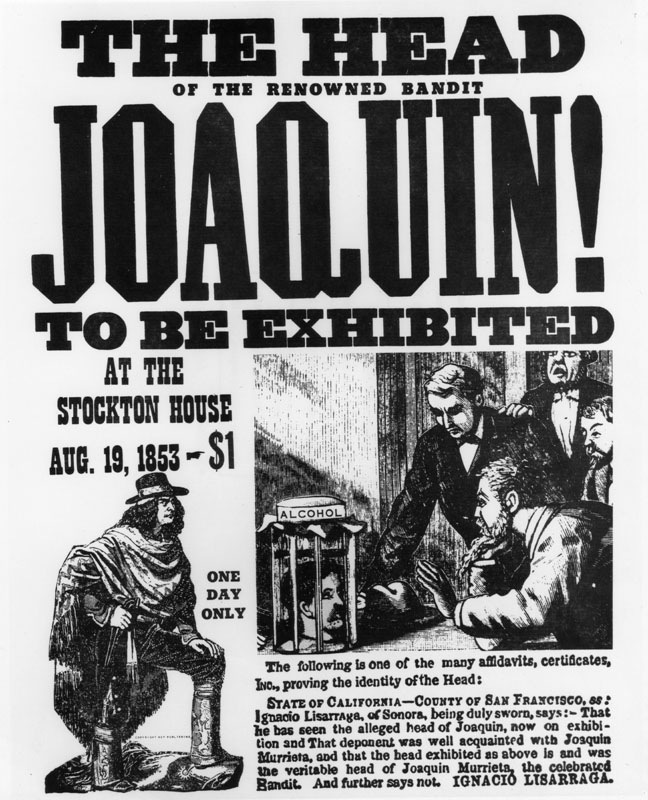
Joaquín Murrieta refuses to die. First Captain Harry Love cuts his head off and puts it on display, then his legend gets whitewashed into the character Zorro, strange Hollywood versions show up over the years, then Rudolfo “Corky” Gonzales (with some help of others, I’ve heard) make him central to Chicano iconography in the poem I Am Joaquín. Books still come out. I keep having to write about him. And then there’s the recent The Head of Joaquín Murrieta on Amazon.

I’m not sure how to categorize it. Is an Amazon production “Hollywood?”


What is Hollywood these days? A place? A concept? How “international” and “independent” can it be with the prerequisite corporate connections?


Welcome to the Global Barrio. It needs heroes and mythologies as well as profits.


Details about the production are surprisingly hard to find, even with Google. Where was it filmed? Who put up the money? How did it come to be?


 I keep getting a whole lotta nada. As for what I could find . . .


The “creator,”’as they like to say these days, is Mauricio Leiva-Cock, born in Bogata, Colombia, and a graduate of Columbia University.


Joaquín is played by green-eyed Mexican actor Juan Manuel Bernal, who is dressed like Clint Eastwood’s Man with No Name, only he wears a sarape instead of a poncho.


At first, I wanted to say it was made in Mexico (sure wasn’t the USA), but it didn’t quite look like Mexico. There were also some interesting pronunciations “cabrón” and “chinga.” Think we may have a spaghetti western situation here, this being another global streaming multilingual release. 


Amazon is becoming its own country. 


There’s also a knife-wielding Chinese girl sidekick who seems to have escaped from a Hong Kong martial arts film, an Irish Obi-Wan Kenobiesqe alcoholic renegade priest, Indians, Mexicans, Chinese, and blacks. Captain Harry Love takes the Darth Vader role, while the California Rangers wear blue uniforms like the U.S. Calvary and are his stormtroopers while looking like the guys who come to the rescue at the end of a helluvalotta Hollywood westerns. 


Then there’s a Tarahumara/Rarámuri psychedelic trip. And this Joaquín is an artist.


This is beyond spaghetti western, or even tortilla western. Maybe it’s a rasquache western, trying to wrench the genre out of the clutches of the white supremacists. 


It’s entertaining enough. Lots of dazzling visuals, action, sex, and blood. 


And the surrealistic ending suggests more to come.


It’s not historically authentic, but who really knows the true story? Was Joaquín an avenging hero, or a racist serial killer? Could he have been both? Questions that can’t be answered without a time machine.

But then, this isn’t history, it’s myth, and it’s evolving into a new technological and geopolitical environment. I’ve called it mythoteching. 


It’s alive and well in the Global Barrio–not a place, more an entity without a location or body . . .


Or a decapitated legend.


Or as Ishmael Reed has said, a new loa.


Ernest Hogan will be teaching Papí Sci-Fi’s Ancient Chicano Sci-Fi Wisdom at Palabras Del Pueblo Writing Workshop, online May 20-21 and May 27-28. May 1st is the deadline to apply. Let’s take over imaginative literature, raza writers!

Thursday, March 10, 2022

Chicanonautica: !Joaquin Murrieta en Siglo XXI!

by Ernest Hogan

I grew up in a house where Joaquin Murrieta was considered a hero. He would come up in conversations between my dad and grandpa. Once Grandpa asked why there weren’t movies about Joaquin Murrieta. Dad said it was because Americans considered Joaquin to be criminal and murderer. Oh, the look of shock on Grandpa’s face.


Later, in high school–this would be the early Seventies at the start of the Chicano Movement--they showed us the film of Rodolfo "Corky" Gonzales’ poem I Am Joaquin. The teachers thought it was “unnecessarily arty”--gringos just don’t get how style is important in getting across your message. I thought it was crystal clear.


Granted, knife-wielding Joaquin is a bit heavy for modern pop culture, still he is compelling. He was white-washed into a Spanish nobleman, Zorro (who in turn inspired Batman), just as Bass Reeves was made into the Lone Ranger. There’s something about daring vigilantes, be they wild westerners or postmodern superheroes.


Also, apocalyptic times call for messiahs who have to be bigger than life, and who can leap across cultures–even civilizations–with a single bound.


So maybe it’s at long last time for Joaquin to step onto the stage of global corporate multimedia pop culture, and for Chicanos to be “discovered” (remember Columbus) in the process. After all, the legend of Joaquin Murrieta is essentially the origin story of the Chicano identity. Before that there were just Mexicans and Americans, and Latinx wasn’t even a dream in a distant future. 


So with Blood and Gold: Legend of Joaquin Murrieta, Jeffrey J. Marioette and Peter Murrieta crystalize it for the 2st century, in a way that will satisfy both aficionados of gory shoot ‘em ups, and scholars of ethnic studies and California history.


It starts out with the basic revenge story that can be seen in the origin of Batman, Star Wars: A New Hope, and tons of pulp fiction and action movies. Joaquin and his bride come to California, which has been recently acquired by the U.S. of A., to pursue a better life in the Gold Rush, and they run into racism. The bride is raped and killed, and Joaquin nearly killed, but after Tres Dedos/Three Finger Jack helps him recover and gives him some Obi-Wan Kenobe type training, he goes on a vendetta, killing some of his wife’s murderers.


How many movies have you seen with that plot? But this is only the beginning of the book. Joaquin keeps seeking out the murderers, while starting a career as a bandit. The newspapers tell of a moustachioed Mexican Murderer–the origin of the stereotype.


But things are never simple and stereotypical. He develops a Robin Hood-type relationship with the “Mexicans” of California, and runs afoul of those who want to establish a white-dominated state. Joaquin learns that avenging angels don’t get to live happily ever after. The lives of messianic folk heroes tend to end in bloody sacrifices.


It’s all told in an action-packed, rip-snorting manner that tears the western, and Aztlán, away from the white supremacists. There are also a lot of historical details that make it more than a bloody spectacle. They even manage the incredible feat of staying true to Harry Love displaying the decapitated head in a jar, and have a happy ending.


I’ve got a feeling that it will be a big part of  21st century Chicano myth-making.


Ernest Hogan is the author of High Aztech, and the Father of Chicano Science Fiction. He often indulges in guerrilla mythoteching.

Thursday, January 30, 2014

Chicanonautica: The Transethnic Evolution of Joaquin Murrieta and Zorro


Sometimes stereotypes can be appealing -- take that of the dashing, romantic swashbuckling hero who defeates bad guys and sweeps women off their feet. If the media loves anything, it’s heroic sex symbols, and add a bit of Latin spice, and ooh-la-la! There’s something that can sell.

That’s what happened with Zorro. But taking a good look at Zorro, just what is his ethnicity? Latino? Hispanic? The story is long and complicated.

It widely accepted that the fictional Zorro was inspired by the real Joaquin Murrieta. The legend of Murrieta, the Robin Hood of California, has been popularized since the dime novel days. There have been a few movies, and even spaghetti westerns, but the tale of a man becoming a bandit/avenger after his wife is killed by Anglos, who then is killed and decapitated by ex-Texas Ranger Captain Harry Love, never quite fit the formula of Hollywood success. 

The legend of Joaquin Murrieta -- that inspired Rudolfo “Corky” Gonzoales’ iconic poem I am Joaquin -- remains an oddity, like his head that was preserved in alcohol and put on display. 

The more commercial character Zorro came out the imagination of Johnston McCully in The Curse of Capistrano, serialized in All-Story Magazine in 1919. Johnston pushed the story back in time to California’s Spanish Colonial period. Murrieta was a Mexican -- though Pablo Neruda claimed him as a Peruvian in his play The Splendor and Death of Joaquin Murieta -- while Zorro, and his alter ego Don Diego Vega, are Spanish nobles, safely white enough for the readers of pulp magazines. Spanish words are all in italics. Unlike Murrieta, no motivation is given for Don Diego’s becoming a masked vigilante -- it’s as if he just thought it would all be fun.

I wonder if Carlos Slim and Bill Gates put on masks and fight evil when things get dull . . .

The only mention of race in the novel is of the “natives” who magically appear when ever someone needs food or drink. 

I imagine a Nollywood version with an all-black cast . . .

In 1920 it was adapted into The Mark of Zorro. McCully must have been pleased. The 1924 Grosset & Dunlap edition of the novel takes the title of the movie, and is dedicated to Douglas Fairbanks, THE “ZORRO” OF THE SCREEN, and is ILLUSTRATED WITH SCENES FROM THE PHOTOPLAY.

In one of these scenes Zorro defends the fair Lolita from some scruffy-looking “natives.”

So Zorro, though based on a Mexican --whose banditry was a response to racially-motivated injustice -- was a white Hispanic. White actors like Tyrone Power played him. But a strange thing happened. He became more “Latino” over the years.

In the Disney-produced 1957-1959 TV series, he was played by Guy Williams, whose real name was Armand Joseph Catalano, of Italian/Spanish heritage. There have been South American and Filipino versions, along with the Antonio Banderas movie and the Isabel Allende novel. There’s just no stopping this masked man.

Meanwhile, Joaquin Murrieta is still around, outside of the corporate pop culture machine. Disney has expressed no desire to appropriate him. Like his head that mysteriously disappeared in the 1906 San Francisco earthquake, his legend will haunt cyberspace and inspire outlaw cultures of the future.

Ernest Hogan, father of Chicano speculative fiction, is working on a secret project about a masked Mexican.