Showing posts with label Disney. Show all posts

Friday, December 01, 2017

A Film for Your Brain: Coco

Melinda Palacio
Miguel and his guitar in the movie Coco, photo from Google Images.


Pixar's new blockbuster Coco may also have added benefits to your coco, cabeza, and brain. That is if the film inspires folks to take up the guitar. I saw the film on Monday with my friend Lora who was still crying as we exited the theatre. We both enjoyed the meticulous animation, hilarious dialogue, and themes surrounding Día de Los Muertos, family, and honoring your antepasados. The film has a beautiful story, even though (SPOILER ALERT) Coco dies. The movie will warm the heart of any who might cry cultural appropriation without bothering to see the film.

True, many who never grew up with the tradition of honoring loved ones of the Day of the Dead might have already made a tradition of skeleton face painting, donning lots of marigolds, skeleton garb, and Frida Kahlo dresses during Halloween, or anytime during October. I must admit I had been skeptical about any kind of animated film about the tradition of Día de los Muertos, ever since learning about the controversy from cartoonist and satirist Lalo Alcaraz, who blasted Disney in 2013 for wanting to trademark the phrase Día de los Muertos in anticipation of the upcoming movie's merchandise. But in a genius move, Pixar brought in Lalo as part of a team of consultants in an effort to get Coco and all the film's details right.

I haven't seen all the current movie related merchandise, but I did notice that the Coco guitars are front and center at many places that sell musical instruments, especially guitars. Over the past two months, I've renewed my interest in learning how to play the guitar. In September, I dusted off one of Steve's old guitars and started practicing. My diligence paid off and for my birthday Steve took me guitar shopping. As pretty as they are, I didn't fall for the Coco guitars Disney and the Guitar Center were pushing. The guitar that found me was at a local music shop, Jensen's in Santa Barbara. I am the ecstatic owner of a gorgeous Martin Road Series guitar. It's probably the best birthday present anyone has ever given me. I will have to practice much more to become worthy of such a gift.

One of the more interesting things I've read about playing a musical instrument is that it serves as a total body workout for your brain. Read the article or watch the Ted Talk (thanks to fellow bloguera Olga for calling my attention to this piece). No other creative outlet works both sides of the brain the way playing a musical instrument does.


In the film, Coco, the main character, a boy named Miguel, must choose between his passion for music and his family. (LAST SPOILER ALERT) The film's heart-warming ending is a win-win with Miguel gaining his family's blessing to play the guitar. I truly do hope the movie inspires children of all ages to pick up the guitar. I can attest that it is loads of fun and a great hobby. I feel smarter already. The Coco guitar is one marketing gimmick I can get behind. Pixar did a good thing by bringing in Lalo Alcaraz, and their team of Latino consultants. Anyone who loves animated films, musicals, or a good story will not be disappointed. If guitar isn't your jam, pick up another instrument, your brain will thank you.


Me with my new guitar
Martin Road Series, hecho en Mexico and Pennsylvania

Thursday, January 30, 2014

Chicanonautica: The Transethnic Evolution of Joaquin Murrieta and Zorro


Sometimes stereotypes can be appealing -- take that of the dashing, romantic swashbuckling hero who defeates bad guys and sweeps women off their feet. If the media loves anything, it’s heroic sex symbols, and add a bit of Latin spice, and ooh-la-la! There’s something that can sell.

That’s what happened with Zorro. But taking a good look at Zorro, just what is his ethnicity? Latino? Hispanic? The story is long and complicated.

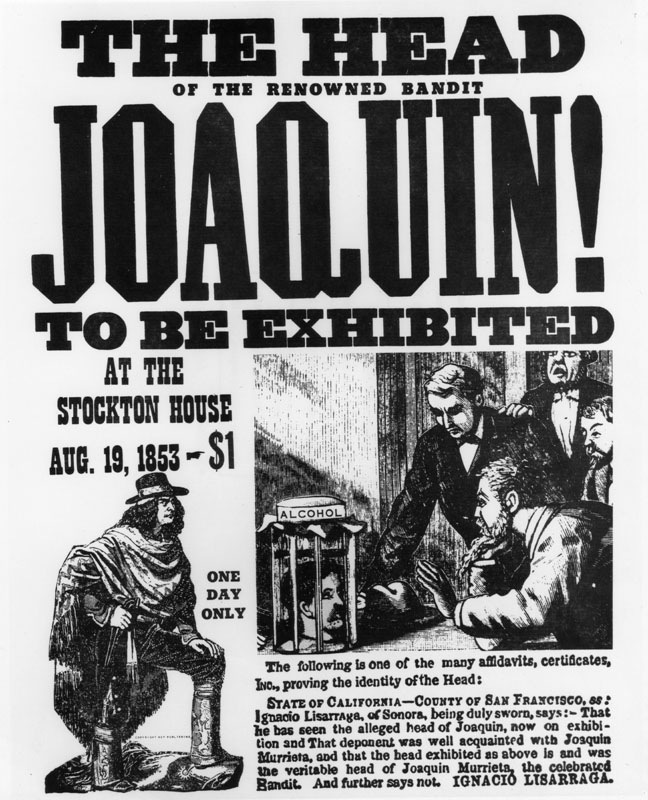
It widely accepted that the fictional Zorro was inspired by the real Joaquin Murrieta. The legend of Murrieta, the Robin Hood of California, has been popularized since the dime novel days. There have been a few movies, and even spaghetti westerns, but the tale of a man becoming a bandit/avenger after his wife is killed by Anglos, who then is killed and decapitated by ex-Texas Ranger Captain Harry Love, never quite fit the formula of Hollywood success. 

The legend of Joaquin Murrieta -- that inspired Rudolfo “Corky” Gonzoales’ iconic poem I am Joaquin -- remains an oddity, like his head that was preserved in alcohol and put on display. 

The more commercial character Zorro came out the imagination of Johnston McCully in The Curse of Capistrano, serialized in All-Story Magazine in 1919. Johnston pushed the story back in time to California’s Spanish Colonial period. Murrieta was a Mexican -- though Pablo Neruda claimed him as a Peruvian in his play The Splendor and Death of Joaquin Murieta -- while Zorro, and his alter ego Don Diego Vega, are Spanish nobles, safely white enough for the readers of pulp magazines. Spanish words are all in italics. Unlike Murrieta, no motivation is given for Don Diego’s becoming a masked vigilante -- it’s as if he just thought it would all be fun.

I wonder if Carlos Slim and Bill Gates put on masks and fight evil when things get dull . . .

The only mention of race in the novel is of the “natives” who magically appear when ever someone needs food or drink. 

I imagine a Nollywood version with an all-black cast . . .

In 1920 it was adapted into The Mark of Zorro. McCully must have been pleased. The 1924 Grosset & Dunlap edition of the novel takes the title of the movie, and is dedicated to Douglas Fairbanks, THE “ZORRO” OF THE SCREEN, and is ILLUSTRATED WITH SCENES FROM THE PHOTOPLAY.

In one of these scenes Zorro defends the fair Lolita from some scruffy-looking “natives.”

So Zorro, though based on a Mexican --whose banditry was a response to racially-motivated injustice -- was a white Hispanic. White actors like Tyrone Power played him. But a strange thing happened. He became more “Latino” over the years.

In the Disney-produced 1957-1959 TV series, he was played by Guy Williams, whose real name was Armand Joseph Catalano, of Italian/Spanish heritage. There have been South American and Filipino versions, along with the Antonio Banderas movie and the Isabel Allende novel. There’s just no stopping this masked man.

Meanwhile, Joaquin Murrieta is still around, outside of the corporate pop culture machine. Disney has expressed no desire to appropriate him. Like his head that mysteriously disappeared in the 1906 San Francisco earthquake, his legend will haunt cyberspace and inspire outlaw cultures of the future.

Ernest Hogan, father of Chicano speculative fiction, is working on a secret project about a masked Mexican.

Thursday, May 23, 2013

Chicanonautica: Report From Disney Barrio


I have a strange relationship with Disney. My parents took me to the grand opening of Disneyland while I was still in the womb. During the Great Depression, Walt offered my grandfather a job that Grandpa turned down because it didn’t pay enough to support his family. I fell in love with cartooning early, but Mad Magazine, CARtoons, and underground comix put me on a different path.

So I wasn’t surprised when Disney announced that it wanted to trademark Día de los Muertos and that Latinos reacted like rebellious cartoonists. Mexican cartoonist Palo Jasso had his character El Certoado suggest that Latinos fight back by pirating the image of Mickey. Simultaneously, Lalo Alcaraz, creator of the comic strip La Cucaracha drew a giant skeletal Mickey monster attacking a city like Godzilla. And a wonderful image of Mickey as an Aztec sacrifice appeared on Facebook.

I dutifully reposted. After all, I was in on this too. My novel Smoking Mirror Blues takes place during a futuristic Día de los Muertos. Would my publicizing it be a violation of the trademark?

It was fun. I didn’t expect it to go anywhere. Disney keeps buying up the culture of the world. People keep forgetting that Snow White was German and Cinderella was French. Popular culture keeps getting appropriated by corporate culture. There seems to be no stopping it.

Then, within twenty-four hours of the news breaking, Disney announced that it was withdrawing the request and changing the title of the proposed Día de los Muertos movie. Apparently the social media ruckus was the reason.

By the sacred blood from Quetzalcoatl’s penis, it worked!

The reason seems to be that in this here 21st century we're living in a different world. I remember back when “popular” culture was more like folk culture, coming from places other than New York and Hollywood. The communications technology revolution has changed that. Corporate culture is lusting after global markets these days. This means looking beyond traditional borders.

Which is funny, because at the same time people want their borders reenforced, even militarized.  This is because once you cross your own border you become a minority and an alien. And that is scary.

With their Día de los Muertos project, Disney was reaching out to Latinos. It like the Republicans reaching out to us while wanting to seal the borders: “Let’s see -- you want sealed borders, but hold the police state?”

Good luck, amigos.

Meanwhile, it's the Latino Hemisphere vs. Disney Barrio. Can funky folk culture survive? Can we show them how?

We can try. And every now and then, the magic works.


Ernest Hogan is a cartoonist disguised a writer. His novels and stories are surrealistic and cartoony.