Showing posts with label Smoking Mirror Blues. Show all posts

Monday, August 20, 2018

Interview of Ernest Hogan


Interview of Ernest Hogan
by Xánath Caraza


Ernest Hogan is the author of High Aztech, Smoking Mirror Blues, and Cortez on Jupiter. Those novels, along with his short fiction have won him the reputation of being the Father of Chicano Science Fiction. His mother’s maiden name is Garcia, he was born in East L.A., and has been called the n-word many, many times over the years. His work has appeared in Amazing Stories, Analog Science Fiction and Fact, and Aztlan: A Journal of Chicano Studies, and other magazines and anthologies.


Who is Ernest Hogan? 

Damn good question! I’m actually too busy to think much about it. Too busy being it, whatever it is. I’m not to be confused with Ernest Hogan, the Father of Ragtime, but since he’s been dead for over a century, it shouldn’t be hard. As for defining myself as a writer, I seem to be stuck in the science fiction category because most of the publications willing to run my work have that genre’s name as part of the title, and there isn’t really any viable market for the gonzoid surrealistic stuff I do when not playing sci-fiista. The literary and corporate worlds tend to cringe in horror at my vulgarity and rasquache. It hasn’t been lucrative, but I can’t seem to stop, and some people enjoy it.


As a child, who first introduced you to reading?  Who guided you through your first readings? 

It’s all my parents’ fault. Dad always was reading something. He and my mom had books and all kinds of magazines all over the house. They encouraged our reading. I found it a great alternative to most of dull stuff on television. They also didn’t mind when I found weird stuff and brought it home.


How did you first become a writer?  Where were your first short stories written?

Reading was actually difficult for me at first. Dyslexia. (Did I spell it right?) Then I discovered comic books, and there was no stopping me. Since I was lousy at math, becoming a mad scientist was out of the question, so I decided to take advantage of my grotesquely overactive imagination and write. Especially after a teacher showed The Story of a Writer, a documentary about Ray Bradbury. I thought, “Yeah, I could do that.” Then my parents got me a typewriter to do my homework on, and started writing. My first publication was a letter in a comic book—I was hooked. From my typewriter to comic book racks all more the country, and before the Internet! This was in West Covina, California.


Do you have any favorite short story by other authors?  Could you share some lines along with your reflection of what drew you toward that short story?

Lately (I keep changing my mind about these things) I’ve been telling people “I See a Man Sitting on a Chair, and the Chair is Biting His Leg” by Robert Sheckley and Harlan Ellison. It was way ahead of its time—postcyberpunk back in the Sixties—and one of the first time I encountered what I like to do in my writing, which is throw around ideas, and create a volatile mix that seems to take on a life of its own before the reader’s eyes. It’s wild, crazy, fun, and gets you thinking about hey, what the hell’s the world coming to? It’s also a great example of a story that came from writers interacting with the world, and each other, which I believe is the way the imagination works best, rather than contemplating your navel in a dark, quiet room.


What is a day of creative writing like for you?

I’d love to just get up, and start plugging away on the latest project after breakfast/checking email/Facebook/Twitter, but my life is just too complicated. I’ve learned get used to being interrupted—the phone rings, the dog barks, email demands immediate attention, were those gunshots or firecrackers? Long hours at the computer don’t seem to happen, especially when you have a day job. I’ve also learned to write on the run. I used to use little notebooks, but in the last few years have been using an iTouch and Google Drive so I can work just about anywhere. Most of I’ve written recently was typed with one finger in the breakroom of the Cholla branch of the Phoenix Public Library. A real writer finds a way, no matter what the situation.


When do you know when a text is ready to be read? 

About the time I get tired of working on it. I also don’t consider a piece of writing to be finished until it’s been published and read, which of course can be a long, twisted road. Then after it’s published, you can see things that need changing, or you just plain changed your mind.


Could you describe your activities as writer?

Mostly, it the usual, writing, finding markets. I’m lucky in that since I have a reputation, they often come looking for me. Most of my short story sales from the last decade have come from answering email. I really should send things to more markets more often, but my career seems to do things on its own.


Could you comment on your life as a cultural activist?

Sometimes life forces you into the role of a cultural activist. What I started writing, I didn’t think my ethnicity would be an issue, but it turns out that the publishing industry, even though they won’t come out and admit it, believes that books, and culture in general, are a white people thing, and get nervous when people like me write about people that they don’t fit into their stereotypical visions of their audience. Yeah, times are changing, but it’s a slow and painful process. New York still won’t touch me with a ten-foot pole, but then that’s probably a good thing, because I’m writing what I want instead of beating myself bloody trying to create a “bestseller.” My showing up—or just existing—causes controversy. Since I’m not giving up, the world has no choice but to change.


What project/s are you working on at the moment?

I’m working on one of the novels I’d like to finish before I die (I’m getting old), Zyx, Or; Bring Me The Brain of Victor Theremin, a slapstick comedy about the Singularity starring my literary alter ego. And thinking about my first story collection. I’m also planning an art project, a temporary mural, for the library where I work (Did I mention that I’m also an artist?)


What advice do you have for other writers?

Way back in the Seventies, in a Creative Writing class, the teacher said, “If we’re lucky, one person in this room will get published.” Guess it was me. I didn’t give up. And I also probably wanted to be a writer more than the others. I have made sacrifices, as my Aztec ancestors have taught me. And don’t give up. Also, don’t be a snob. Don’t be afraid to try new things. Be prepared to change your definition of success.


What else would you like to share?

Buy Medusa Uploaded by Emily Devenport, because a rich wife can come in handy. I will be judging the First Annual Somos en escrito Extra-Fiction Writing Contest 2018 for Somos en escrito: The Latino Literary Online Magazine (deadline for entries is September 30). And an anthology I contributed to, Altermundos: Latin@ Speculative Literature, Film, and Pop Culture has just won the American Book Award.

Thursday, October 26, 2017

Chicanonautica: Not Ready for Dead Daze 2017


So here we are, hurtling toward the end of October in the Year of the Alien God 2017.

It’s also the first year of Trumptopia--wonder if we’ll eventually get a new calendar for that, or will mutilating the old one be all we have do? 

Mutilation . . .Transformation . . . The new realities always come with pain.

Sacrifices must be made.

Anyway, Dead Daze is just around the corner, and I’m not ready.
For those of you are wondering, “What the hell is Dead Daze?” It’s a stringing together of Halloween and the Days of the Dead (yes, that’s plural, there are two Dias de Los Muertos, cabrones!)  into a three-day celebration. It hasn't caught on yet, but sometimes these things take time.

There are those who don’t want to see electric jack-o-lanterns and plastic sugar skulls together, but for me Halloween has always been a Mexican kind of thing. One of my fondest East L.A. memories is of my first Halloween, back in the antediluvian nineteen fifties, with me in a Superman costume that my mother made, and the streets full Chicanos and Chicanas, towering over me, dressed as all kinds of monsters.

I introduced Dead Daze in my novel Smoking Mirror Blues. If you haven’t read it, Strange Particle Press has started work on a new edition. If you can't wait, copies of the first edition from Wordcraft of Oregon can still be had. My self-published ebook will also be available for a while.

It’s also the end of Hispanic/Latino culture month. The only thing I “did” was see copies of Latin@Rising used in a display in the library where I work. But then I celebrate and participate in La Culture every month of the year.

Like the story I’m finishing up where Aztlán has seceded from the U.S.A.--not that I think it should happen, but the thought experiment may stir up the sort of thinking that should come in handy as we build the future. El Presidente is trying to build his vision of a walled tomorrow, so why not suggest some alternatives?

It’s for a new Latinx SF/F anthology. Yes, another one.

No wonder I’m so busy. Recombocultural futurism is breaking out all over. Ideas are returning to science fiction, even in TV shows. Amid the global turmoil, new cultures are manifesting.

It's a lot better than back when the Book of Revelations and the zombie apocalypse were America's most popular visions of the future.

There's a lot for a humble Chicano sci-fi writer to do.

I don't have time to celebrate holidays. Or even remember them.
So there's no ofrendas for dead loved ones at my house. I'll have to remember them as my wife and I watch our favorite horror movies . . . if we can find the time.

Ernest Hogan wrote Smoking Mirror Blues after Tezcatlipoca, the Aztec warrior/trickster god, whispered the idea into his ear. Has Tezcatlipoca been whispering into El Presidente's ear?

Thursday, October 30, 2014

Chicanonautica: The Evolution of La Catrina


It’s the end of October, and it’s happening on a weekend: Halloween and Los Días De Los Muertos, that I modestly proposed be made into a three-day fiesta in my novel Smoking Mirror Blues

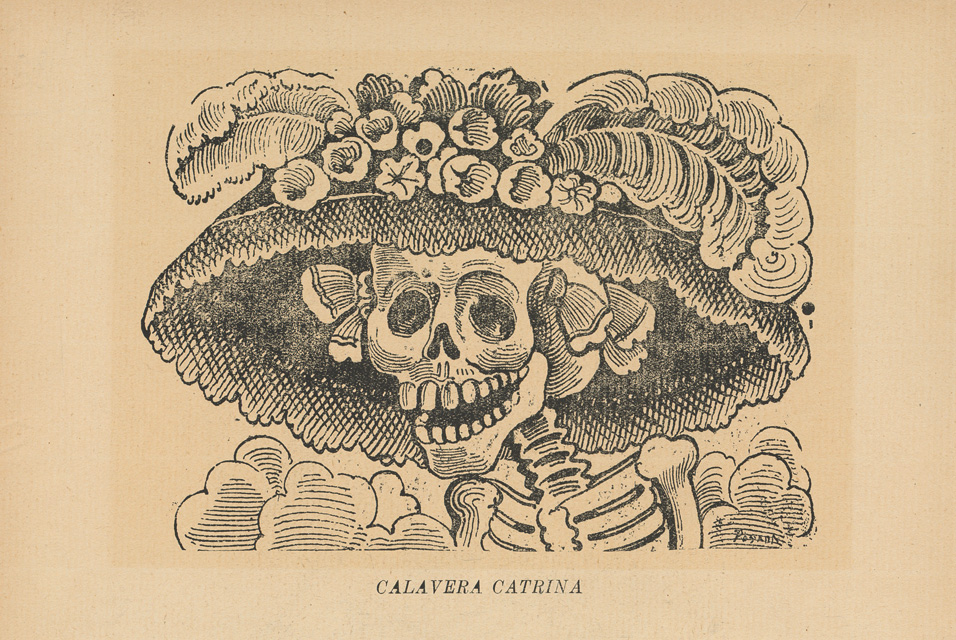
And we see her, popping up on the interwebs, and coming to your barrio soon -- La Catrina, the skull-faced lady with the fancy hat.

She first showed up in a zinc etching by José Guadalupe Posada somewhere around 1910, 1913-ish -- ¡LA REVOLUÇIÓN! Posada intended her as a caricature of the rich, catrina, in spanish meaning well-dressed, rich, fop, dandy.


The etching, and image, without the benefit of an internet or social media, struck a cord with Mexican culture, and became a popular icon.

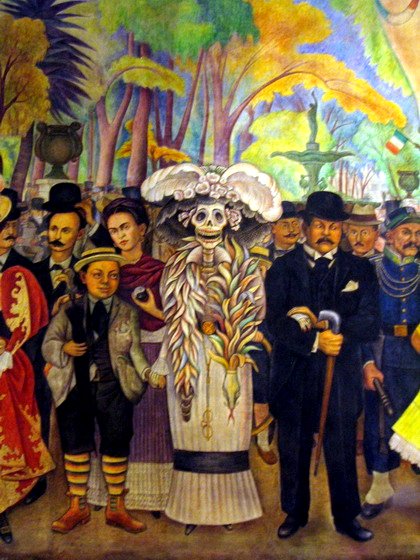
Diego Rivera modernized her between 1947 and 1948, providing her with dress and feathered serpent boa in his mural Sueno de un Tarde Dominical en La Alameda Central -- originally in the Hotel del Prado on Alameda Park, but moved after the building was damaged in the earthquake of 1985 and torn down. It’s now in the Museo Mural Diego Rivera, Mexico City, Tenochtitlán, La Capital Azteca. Rivera also made her an avatar of Aztec Mother Godess Coatlicue, adding another layer to her idenity.


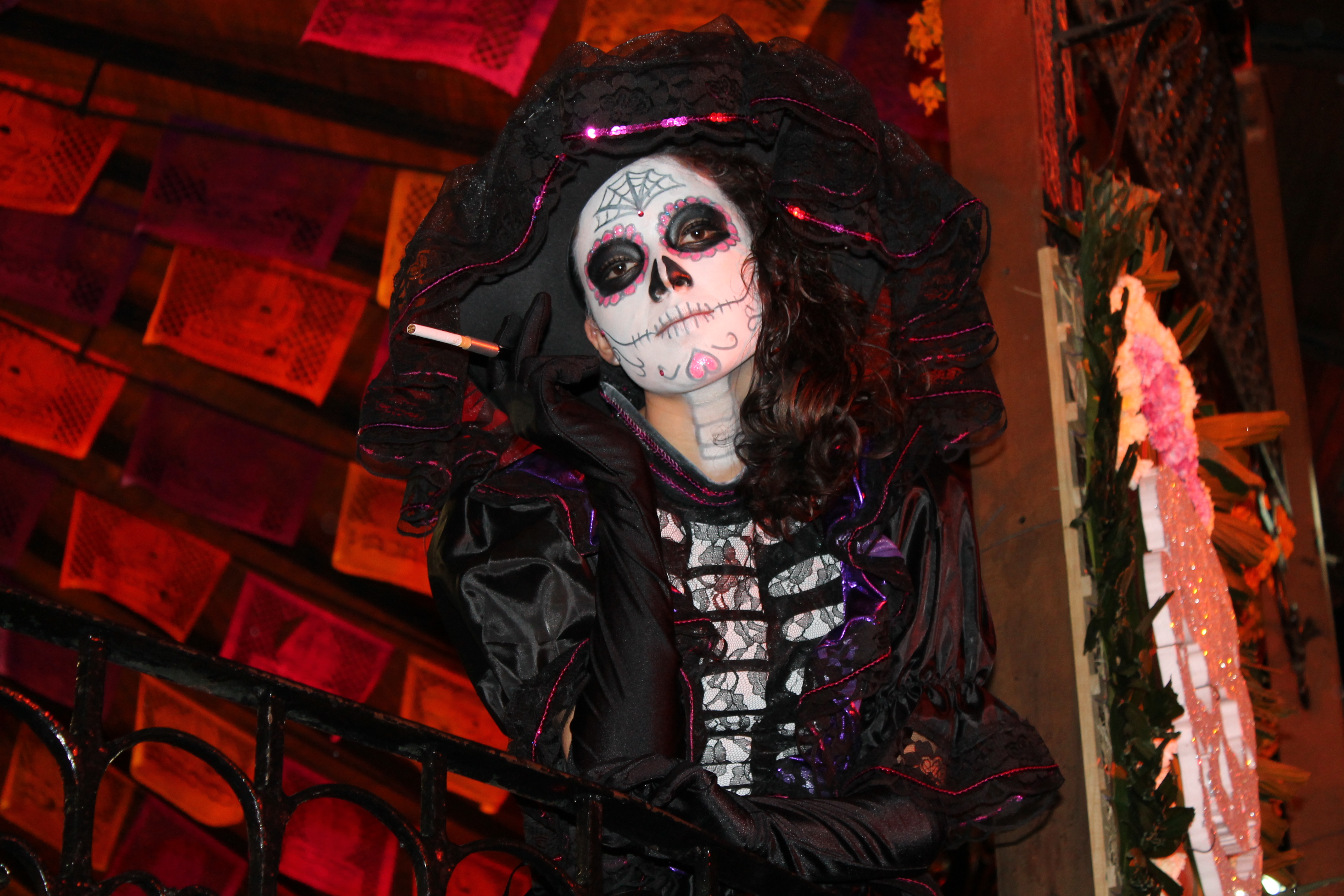
Since then, she’s evolved. Today’s Catrina wears the sugar skull face make up, and is glamorous -- taking us back to the 18th century Scots meaning, enchantment, magic, and the fact that the word is an alteration of grammar, which in the Middle Ages refered to occult parctices associated with learning -- and sexy in ways not yet franchised by Hollywood and the fashion industry. It’s a different, subversive concept of beauty, similar to that of the Goths, whose style is being toned down and absorbed by nerd culture, that is in danger of becoming another corporate marketing strategy.


I keep hoping the nerds will see beyond the suburban bubble that they are kept in, get inspired, go wild, and scare the crap out of those who are trying to control them. Encounters with La Catrina can help with this, because no one can control La Catrina. She’s a goddess -- like her sister Santa Muerte -- the return of an ancient, elemental thing that cannot be tamed.

Have a weird and wonderful Dead Daze!

Ernest Hogan’s Dead Daze novel, Smoking Mirror Blues is still available in the original trade paperback edition, and as ebooks through Kindle and Smashwords. A new Kindle version of his first novel Cortez on Jupiter has just become available. 

Thursday, September 26, 2013

Chicanonautica: How I Accidentally Created Chicano Sci-Fi


Suddenly, buzz about science fiction diversity is crackling through the air. And a monster called Chicano Sci-Fi is roaming the night. Frank S Lechuga keeps calling me its father. A DNA test may be in order.

But all those years of humping science fiction should get me something. I imagine her looking like Elsa Lanchester in The Bride of Frankenstein. Ummmm . . .

I do feel like shouting, “IT’S ALIVE! IT’S ALIVE!”

But I didn’t set out to become the father of Chicano Sci-Fi. I just happened to be a born-in-East-L.A. Chicano who wanted to write science fiction. I didn’t know that it was something I shouldn’t be doing. After all, this was America, and people kept telling me I could be whatever I wanted!

One day, I took that “write what you know” advice to heart, and wrote a non-science fiction fragment that turned in into a stream of fascinating Chicano characters inspired by my family and people I had known. These characters came to life -- again, “IT’S ALIVE!” -- like no others I’d created. 

Combine that with all the material from La Cultura that most readers would consider “new” and I realized that I was onto something. I experimented with putting Chicanos in a science fiction context that eventually became Cortez on Jupiter.

Being proud of my Aztec heritage -- sí, cabrones, my ancestors were cannibals, and I’m damn proud of it! -- I perversely projected it into the future, that evolved into High Aztech and Smoking Mirror Blues.

This hasn’t made me rich and famous -- I still have a day job, kids -- but it has been a constant source of inspiration that has me publishing short fiction to this day, and newfangled postcolonialists and Afrofuturists include me in their publications.

I was a pioneer -- which of course, is another way of saying illegal alien. I boldly went where no Chicano had gone before.

And I believe that this is only the beginning.

Chicano is when and where I’m from.  It’s a subset of Hispanic, which includes non-Mexican immigrants, and is a favorite way of describing crime suspects. Latino is global, from Latin America, coined back when the French saw us being ruled by a Francophone elite, but that lets in the French Canadians, Haitians, Francophone Africans, and the Portuguese-speaking Brazilians.

Latino is also favored by show biz. Those Latino sex symbols sell like crazy. 

It's also a hemispheric majority.

And lately, Chicano -- Xicano, Xicana/o --  has been seen as an attitude and political stance that I’m all for. Combine that with new developments that transformer lowriders, barrio cyberpunks, and other emerging subcultures are coming up with, and Chicano Sci-Fi could sweep the planet, and beyond.

After all, as I’ve said before, Chicano is a science fiction state of being

Which reminds me, I have to get back to my novel about a mariachi on Mars . . .

Ernest Hogan, was born in East L.A., and his mother’s maiden name is Garcia. He wanted to be a science fiction writer when he grew up. He succeeded.

Thursday, May 23, 2013

Chicanonautica: Report From Disney Barrio


I have a strange relationship with Disney. My parents took me to the grand opening of Disneyland while I was still in the womb. During the Great Depression, Walt offered my grandfather a job that Grandpa turned down because it didn’t pay enough to support his family. I fell in love with cartooning early, but Mad Magazine, CARtoons, and underground comix put me on a different path.

So I wasn’t surprised when Disney announced that it wanted to trademark Día de los Muertos and that Latinos reacted like rebellious cartoonists. Mexican cartoonist Palo Jasso had his character El Certoado suggest that Latinos fight back by pirating the image of Mickey. Simultaneously, Lalo Alcaraz, creator of the comic strip La Cucaracha drew a giant skeletal Mickey monster attacking a city like Godzilla. And a wonderful image of Mickey as an Aztec sacrifice appeared on Facebook.

I dutifully reposted. After all, I was in on this too. My novel Smoking Mirror Blues takes place during a futuristic Día de los Muertos. Would my publicizing it be a violation of the trademark?

It was fun. I didn’t expect it to go anywhere. Disney keeps buying up the culture of the world. People keep forgetting that Snow White was German and Cinderella was French. Popular culture keeps getting appropriated by corporate culture. There seems to be no stopping it.

Then, within twenty-four hours of the news breaking, Disney announced that it was withdrawing the request and changing the title of the proposed Día de los Muertos movie. Apparently the social media ruckus was the reason.

By the sacred blood from Quetzalcoatl’s penis, it worked!

The reason seems to be that in this here 21st century we're living in a different world. I remember back when “popular” culture was more like folk culture, coming from places other than New York and Hollywood. The communications technology revolution has changed that. Corporate culture is lusting after global markets these days. This means looking beyond traditional borders.

Which is funny, because at the same time people want their borders reenforced, even militarized.  This is because once you cross your own border you become a minority and an alien. And that is scary.

With their Día de los Muertos project, Disney was reaching out to Latinos. It like the Republicans reaching out to us while wanting to seal the borders: “Let’s see -- you want sealed borders, but hold the police state?”

Good luck, amigos.

Meanwhile, it's the Latino Hemisphere vs. Disney Barrio. Can funky folk culture survive? Can we show them how?

We can try. And every now and then, the magic works.


Ernest Hogan is a cartoonist disguised a writer. His novels and stories are surrealistic and cartoony.