Showing posts with label chicano sci-fi. Show all posts

Thursday, June 12, 2025

Chicanonautica: Writing in a Mass Deportation


by Ernest Hogan


There’s an old joke about someone asking a centipede how he walks with all those legs. He had never thought about, so he did . . . And never walked again. 


I tend not to think much about how I write. I just let it happen for the most part. Teaching a class about it forced me to think about it.  I’m happy to report that I’m not suffering the fate of that poor centipede. 


Good thing I only have two legs.


It actually has helped. I do have a process, albeit an eccentric one that is always open to change.


After the election, a story about mass deportation seemed like a natural. My inspiration usually comes from slugging it out with the real world. I loved hearing Ray Bradbury and Harlan Ellison talk about getting pissed off and it resulting in a story. 


I didn’t as much decide to write it as much as it started happening. It’s how it goes with me, the story manifests in my brain, and doesn’t stop until it’s written. A persistent story can keep at it for years, decades . . .


I always have stories in my brain, clamoring for my attention. Maybe someday there will a drug for it, complete with a long list of horrifying side-effects.


The idea came when I imagined being stopped at a checkpoint. Some dialogue started, and it came alive.


Then I came up with the title “Once Upon a Time in a Mass Deportation.”


I made some notes, and wrote an opening, then decided to wait until the actual mass deportation started, figuring on getting some gonzo inspiration.


Boy, am I glad I did.


Even though I was aiming for blood-thirsty satire, what I had come up with was way too rational. I had no idea that the reality would be so bugfuck. 


Rod Serling said he has to tone down reality for the Twilight Zone. Something a senator would say in real life would only be acceptable on TV from a Martian.


Things are different in the 21st century. In the glut of information and disinformation, people will believe anything, but reject reality even when it bites them on the ass. What’s a Chicano sciifista to do?


I kept up on things, taking notes on the extreme weirdness. Then I made it into a story. Not as much plotting it out but composing it like a painting by Hieronymus Bosch, a mural by Diego Rivera, or a comics panel by Will Elder clogged with “chicken fat” details. I turned my surrealist tendencies loose. Watched some Luis Buñuel, Buster Keaton, and Marx Brothers. It’s such a joy to indulge in being myself.


I’m so glad I’m not a journalist.


I think it does the dirty job. Now it’s after me to get it published.

It also got me warmed up to come up with a story to write as part of the online writing class I’m teaching. My confidence is ridiculous. 


Should be fiendish fun.


And even educational.


I thank Tezcatlipoca for my grotesquely large, powerful, and overactive imagination. And I make the occasional sacrifice.


Ernest Hogan is always imagining different worlds, sometimes better than ours, sometimes worse. Then he writes about them.

Tuesday, June 11, 2024

Shifter, What You Think It Means

 Review: Emma Pérez. Testimony of a Shifter. Houston: Arte Público Press, 2023.
ISBN: 978-1-55885-979-1


Michael Sedano


Speculative fiction writers expect a lot of imaginative cooperation from readers in exchange for a good story. Readers pick up a book like Emma Pérez' Testimony of a Shifter (link), expecting  at minimum, to be entertained and, in the best cases, provoked into discomfort by satirical elements inherent in "what-if" scenarios.

The story starts in 2058. Set in a place much like the United States, in a world where people are born male, female, or gender-shifters, into a racist classist society run amok in the hands of "the Impresario", a small-handed caricature of immense power and pedophilia.


Pérez does a good job restraining a satirist's impulse to pile on the parallels between the  dystopic leader of 2058, and a television impresario running for president of the u.s. in 2024. The parallels are telling and won't be missed even in a fast page scan.


The author's exaggerations don't stray far from actual events, like rounding up shifters, caging captives, separating children from adults. Read "immigrants" for "shifters" and there's nothing dystopic about the world of Testimony of a Shifter.


Viruses and an ongoing "woke war" have brown and black people, most of them shifters, on the losing end of health care and repressive law. One of the book's most horrid scenes depicts wholesale slaughter of ordinary people in the wrong place. This is a world where armed rebellion offers feeble opposition.


Pérez keeps the story compact. Coming in at under 200 pages, the novel threads plots about sexuality, power, armed intrigue, and magic. When one or another thread gets unruly, the author relies upon the testimony of the title to transition into new developments and twists.


Testimony of a Shifter comes from a prisoner, a captive of the assassination plot that unfolds with the Shifter, who begins the book as Ben but spends most of the plot as Alejandra, or Alex.


Poor Alex. She's not attractive--that's still a value in this dystopia--but Ben is handsome. Ni modo (he she is bilingual which is a crime), Alex has friends in the highest places of the revolution. Those friends don't explain much as they lead Alex into some deep caca, and she has no idea what's going to happen.


Readers find themselves as surprised as Alex as the rebellion unfolds before their eyes. It's part of the fun of letting the events take over, and, with this topic, allowing the author's license to envision what physical gender transmutation looks like:


The guards had a kid shifting on a slab of metal in the middle of the room, where they got on top of her and started doing things to her. Ugly sex things that she didn't want but, soon enough, she'd shift and become a boy with boy genitals. Then, they'd turn him over and someone else would get on the slab and do ugly sex things, and the boy genitals would shift back to girl genitals. The White Guards would repeat it again and again. The guards prodded and poked to see how many times they could get a shifter to transmute in an hour.


Readers coming to the novel for lurid sex things will find passages to titillate their imaginations, but not many. Testimony of a Shifter isn't for that reader. Readers looking for contemporary speculative fiction that entertains while engaging all manner of political and social responses find it in Testimony of a Shifter.


I'm not entirely satisfied with the book's revolution. Pérez' depiction of rebel leaders as cold manipulators has a feel of genuineness. I'm satisfied the Impresario gets a pocketful of justice. I'm not satisfied the repressive status quo simply replaces itself and the rebels achieve no substantive change. I'm dissatisfied the author opens a magical portal to a different dimension and that's the only way Shifters find peace, by disappearing.


Gente, we can't let it get this bad. You don't have to read Testimony of a Shifter to understand the necessity for decisive voting, but reading the novel doesn't hurt, either.


Thursday, April 18, 2024

Chicanonautica: Sci-Fi Gonzoing While Chicano in Class

by Ernest Hogan

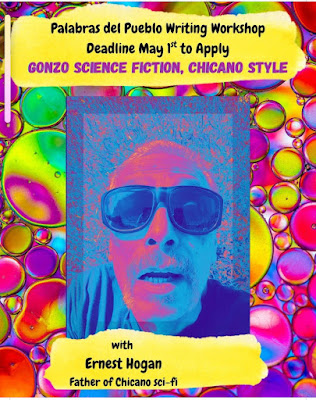
Once again, I taught a class at (problematic, it was online via good ol’ Zoom) the Palabras del Pueblo writing workshop. I called it “Gonzo Sciene Fiction, Chicano Style” to give myself a excuse to plug my new book, Guerrilla Mural of a Siren’s Song: 15 Gonzo Science Fiction Stories. Self-promotion is important, kids, do it whenever you can get away with it—hell, even when you can’t get away with it!  It’s called professionalism.


There I go, thinking like a teacher again . . .


When introducing themselves, students mentioned the Impostor Syndrome about being writers. I don’t have that problem; my credentials as one of the most successful Chicano writers of my generation are secure. But when it comes to being a teacher, that’s another plate of tacos.


I never wanted to be a teacher. I don't have a degree. I never did like school. All I have is over forty years of bizarre experience.


And there are people out there who like what I write. I guess it all counts for something. 


This was my second time doing this. I may get the hang of it yet.


I presented material from my updated notes. I tend to change my mind about things, and the writing biz keeps a-changing. I wrote a story over the course of the class, all the way sharing my creative process (hiljole! What a pretentious phrase). 


It was strange because I don’t usually think about what I do—I just do it. I find discussing the Art of Writing to be boring and irritating.


Interestingly enough, there were no surprises. I’ve been doing this so long that I know what I’m doing without having to ponder the mysteries of it all. Like I said, experience.


The story is called “Spawn of the New, Improved Tortilla Machine.” I was lucky enough to be inspired by all the craziness going on in the world, combined with the fact that I had promised I would write a story. The process was, and the result is, gonzo.


I’ve never been comfortable in a classroom. I tried hard to make this a non- or even anti-academic experience. Writing is not an academic activity and shouldn’t be.


Once again, I was impressed by the students. They were a diverse group from all parts of the Latinoid continuum. I tend to be Chicano-centric because Aztlán in the second half of siglo XX is where I come from, but I always enjoy other cultures that have been affected by contact with the Hispanic virus. We need to start cooperating on a global level—since we are most of the people in this hemisphere we need to come off as a majority so publishers stop dismissing us as a niche market. We have fantastic ideas coming out of a wide range of cultures—we keep creating new ones—that will make for great fiction that will entertain and enlighten the world.


For the next time—it pays well, often better than the writing itself—I will strive to make it more interactive and focus even more on the wants and needs of the students. Guess I’ll be updating those notes again.


One thing I need to work on is the market—where to send what you write. It’s something I need to do anyway. I’ve been spoiled this century, most of what I publish these days is the result of publishers and editors coming to me—thank Quetzalcoatl and Tezcatlipoca for the interwebs! But lately, I’ve built up a backlog of unpublished stories. I need to do some investigating of the mutating world of publishing. No doubt, there will be some hair-raising adventures.


Also, anybody interested in publishing one or more of these stories, besides this blog and Mondo Ernesto, I’m on Facebook, Twitter, and Instagram.


Another lesson in professionalism.


Ernest Hogan, the Father of Chicano Science Fiction, is the author of Guerrilla Mural of a Siren’s Song: 15 Gonzo Science Fiction Stories, a guidebook for the weirdness to come.

Tuesday, April 02, 2024

Review: Frankenstein Was Not the Monster


Review: Daniel A. Olivas. Chicano Frankenstein. Portland: Forest Avenue Press, 2024. (link)


Foto essay: Daniel A. Olivas and Desirée Zamorano in Pasadena CA conversation


Michael Sedano


Daniel A. Olivas has found a fountain of creativity in the classics. Olivas' stage play, Waiting for Godínez, calls upon Samuel Beckett's Godot for inspiration. The novel, Chicano Frankenstein, calls upon Mary Shelley and Boris Karloff while weaving in allusions to Faust and a taste of Tomás Rivera. 


Olivas and Desirée Zamorano talked mostly about the novel in a recent conversation at Vroman's in Pasadena. Theirs was such an engaging conversation I was ready to stand in the long line for a chance to get my copy signed. People who weren't there can get a notion of the 210-page book's background and the author's process in the edition's dozen ancillary pages, the Acknowledgements and Author's Note, and book club questions.


The character Faustina's surname, Godínez, offers a sly allusion to Olivas' play, but more so to the concept of faustian bargains, forsaking one's soul in exchange for personal gratification. That this not the character, Faustina Godínez, shows that one can know too much or look too hard. 


Faustina is the founding partner of the man's job. This powerful woman hooks up with an underling, who is a reanimated man. Faustina follows-leads the novel's quest to learn the reanimated man's forbidden past and meet family. It's the novel's idea of finding one's identity in a world indifferent and hostile to your presence.


Daniel A. Olivas and Michael Sedano at Vroman's


But that Faust has little to do with Olivas' Faustina Godínez. Olivas isn't after some remote connection to German opera. Maybe the author simply likes the name. Faustina's a powerful Chicana lawyer attracted to a handsome Chicano paralegal and doesn't let the disparity at work stop her. The  fact Faustina's paramour is a reanimated person has no asco factor in Faustina's erotic impulses, the man is just another male in Faustina's book.


For readers with a prurient interest in details, Olivas grants them euphemistic gratification in a "just us girls" scene.


Olivas plays on the asco factor to build the novel's agon, the villain is a conservative electorate intolerant of difference, diversity, inclusion. The U.S. president is a foul person fully in control of that electorate and she propels hateful ideas into the world. 


Then again, it's only a pinche book. Kick back and enjoy it. Chicano Frankenstein's a gem. A fast and easy read; don't turn it into a head-scratcher.


The monster of public fame, the Boris Karloff character considered to be "Frankenstein", does not resemble the man, Faustina's lover. The man is not a monster but an everyday person. There's no reason to be all asqueroso. The Shelley / Movie characters overlap with Olivas' the man character in that both have limb transplants, and they live as reanimated corpses, and they aren't named.


Pasadena and Oxnard provide the settings for a future world where hundreds of thousands of people have been brought back to life by industrial processes. Reanimated people provide cheap labor and are remarkably honest. They come with a full set of work skills but no personal history nor physical resemblance to their first-life selves. They're in every walk of life, looking like any other person. One of them could be the mail room clerk.


Faustina, the man, these are middle class Chicanos in love. They do cute things like share bath soap, debate pink or white conchas, get to know one another with bilingual cariño. The novel's a love story but if that were all, it wouldn't be as interesting and redundant, think "Guess Who's Coming to Dinner." 


Desirée Zamorano and Daniel A. Olivas share thoughts on the novel

Faustina has no trouble with loving and bedding a reanimated man, but there's lots of prejudice against stitchers, and peor, the president of the United States wants to lock them up, the reanimateds, the stitchers.


"Stitchers" is the "N" word for gente like the man. Olivas hides the character's name just as Shelley's reanimated character stays unnamed. Reanimated tipos count for shit to the foul-mouthed president of the United States. The president hates reanimateds with the kind of hatred arch conservatives hold for people of color. This wingnut president controls both houses of congress and has already outlawed the regeneration industry. 


Olivas acknowledges the fun.

Chicano Frankenstein is not only a love story but a political intrigue. The action carries us inside the Oval Office where things look bad for decent souls. The author chooses this setting to have a character named Toma explain that Victor Frankenstein created the Karloff-in-the-movies character so it's a misnomer to call reanimated people "Frankenstein". Toma!


Olivas reserves some special vitriol for Big Pharma, and newsmedia come off buffoonish. These elements--corruption, prejudice, buffoonery--hang over our lovers' affair and right to happiness.


Local color adds solid facts to highly speculative fiction, while adding to the author's and readers' fun. Olivas, a Pasadena resident, locates action around the city's Norton Simon Museum, Vroman's bookstore, the lovers plan take-out from Urbano Mexican Kitchen, the man's habitual run takes him along Hurlburt Avenue to Pasadena Avenue. 


Chicano Frankenstein is speculative fiction that speaks for itself. I see no profit in finding metaphoric correspondence triangulating issues involving immigrants and LGBTQ+ gente, with the fiction of reanimated people. It spoils the fun to look too closely, despite the publisher's blurb that here's a "retelling of the Mary Wollstonecraft Shelley classic that addresses issues of belonging and assimilation". 


There is a serious point about voting, however. The dead can vote and swing elections. That's the metaphor. The argument emerges, if the power hates you, take their power from them.


Daniel A. Olivas has a lot of fun with his story, explaining just enough for the willing suspension of disbelief that's necessary to savor fully Olivas the satirist's come-uppance to the conniving president. If it were summer I'd say this is a classic beach read, but it's Spring, a season of renewal, for reanimation. Sounds like a perfect season for reading Chicano Frankenstein.


Olivas is on book tour right now. He spoke to a packed house at Vroman's books alongside interviewer Desirée Zamorano, and Olivas will be in Portland soon. Check the author's website (link) for details.


Author Desirée Zamorano (link) holds the book about the man
who is Chicano but not Frankenstein.


Thursday, October 19, 2023

Chicanonautica: Pandemic Nostalgia With Gómez-Peña’s Mex Files

by Ernest Hogan


Is it too early for pandemic nostalgia? Please excuse me if it is. I’m a sci-fi vato, a mutant for whom the future never comes soon enough. I get high on future shock. 


Also, I’m a futurista because I’m not allowed to exist in the present. Just ask whatever bureaucracy is watching over us right now.


The chaos of the last few years has had me running myself ragged keeping up with it transformations. Nothing like a global monkey-wrench smashing into everybody’s business to do that. Suddenly, the word surreal is in news reports. The pandemic did that.


Now we are under the delusion that it’s over, but Covid ain’t gone. It’s just going through some mellower mutations. Even though a lot of people want to forget it ever happened, there’s wisdom in the meme, “That which does not kill us, mutates and tries again.”


Note that you also see the word mutation in news reports these days.


Back in the thick of the lockdown, Guillermo Gómez-Peña started reporting on it on his radio show/podcast (the terms are becoming interchangeable–the internet is absorbing radio), Gómez-Peña’s Mex Files.


I tried to be a loyal listener at first but turned out I was an essential worker and ended up in a bandido bandana and an orange, glowing vest running stuff out to cars in the library parking lot instead of finishing my novel in the summer of 2020. I also learned about Zoom, thanks to Guillermo and his wife, Balitronica.


Recently, Facebook reminded me about Mex Files, so I binged what was on the website.


¡Guao!


Not only does it deliver the Mad Mex’s harrowing, transborder Covid experiences that outweird the latest science fiction, it provides an excellent introduction to his work and the incredible world of performance art.


How can I describe it?


There are similarities with my work–Gomez-Peña and I both arrived on this planet in 1955, him in Mexico City, me in L.A.  we overlap over Chicano territory. He writes, and also performs, which takes him to interesting places. Art and politics cohabitate. It’s often funny but is more than satire. Alternate realities aren’t just described—they come to life, threaten to alter our world.


Sometimes it gets sci-fi (Chicano is a science fiction state of being) but is never restrained by the limits of the genre. 


And it adapts well to different media, live performance, gallery and museum installations, film and video, and radio. 


Sometimes it’s like bizarre comedy skits, other times it’s music that has been altered. Still other times, it’s honest accounts of fantastic experiences. 


And it’s not all nonstop dystopian bring downs. Often there are flashes of the kind of utopias we could create if we could just let La Cultura ride free on new technologies.


Where does the sci-fi end and the real life begin? Or should I say magic realism? Or is magic realism from a high tech society indistinguishable from science fiction? Is it all performance art?


Our bizarre times are masterfully captured here. I know that a lot of folks just want to forget it. Some would erase all the memory, the history. But we need this knowledge. 


You think the last few years were something? Just wait for the future. How long before 2020 is considered the good old days?


We need the wisdom of the Mad Mex to help us navigate the weirdness.


Ernest Hogan, the Father of Chicano Science Fiction has been in touch with Guillermo and Balitronica. Expect some wild stuff soon. He also highly recommends the documentary 100 Ways to Cross the Border.

Thursday, June 30, 2022

Chicanonautica: Cartel 2045 Exploits Itself

by Ernest Hogan

The title wasn’t very original, Cartel 2045 (also released as Juarez 2045), but the image of Danny Trejo–star of the Chicano sci-fi classic Machete movies– and a funked-out robot caught my interest. And it was on YouTube for free, so I went for it.


It starts with a quote from Isaac Asimov: “It is not only the living who are killed in war.” Not very profound, but they were at least trying to be literary.


In this 2045, the war on drugs has deconstructed the world. Iran is harassing Mexico, and the U.S. sends a bunch of Marines across the border on a secret mission. Seems a cartel has gotten hold of some combat “droids”-- the product of an evil tech company– and is forcing a kidnapped Mexican scientist to help them. Oh yeah, one of the Marines has a droid-controlling chip in his head, and was in prison, and was told that he could get his freedom if he succeeds and gets back alive.


Again, not very original. 


It takes far too long for Danny Trejo to show up. He does his crowd-pleasing scary Mexican/“bad hombre” act as the Santa Muerte-worshiping cartel boss. Which is what the script called for, but not the sort of Mexifuturismo I was hoping for.

Trejo does end up becoming a supervillain in the end. Too bad there wasn’t more of that stuff. 


It was released in 2017, the Trump years, so the film suffers from schizophrenia. What kind of movie is it supposed to be? Mexsploitation? An attempt to cash in on fears of a border “invasion?” Who was the intended audience? The ever-growing Latinoid wave, or fearful Anglos?


To quote a  token black Marine character: “This is Juarez 2045–technology is a motherfucker.”


Most of the characters are white, and male, and the only women are the scientist’s daughter, some strippers, and what Rush Limbaugh would have called “info-babes.”


It’s a typical war/action flick, shoot’em up stuff with sci-fi trimmings. And the sort of racism that not long ago was considered par for the course. Iran is prounced EYE-ran. Light-skined Mexicans, like the scientist and his daughter, are more “civilized” than the brown cast members.


But oddly enough, there is a lot of untranslated Spanish dialogue, without subtitles, as if it was assumed that everybody would understand it. Spanish swear words pepper the dialogue. The robots bristle with gold decorations, like gangster’s guns, which makes no sense, but looks cool. 


Too bad the Mexican characters are all so pinche stereotypical.


Danny Trejo manages to breathe life into his role. Too bad he isn't in more good movies. 


There’s lots of video game-ish CGI violence, which is the main selling point. After an unsatisfying bloodbath, where just about everybody dies, the chiphead hero who gets to say things like “You can go tell Santa Muerte that she can go fuck herself!” and “Violence solves problems–but it doesn’t always make you feel good.”


And somebody thought that this would make money . . .


Ernest Hogan’s visions of Latinoid futures can be read in stories in Speculative Fiction for Dreamers, and El Porvenir, ¡Ya!: Chitlalzazanilli Mexicatl

Thursday, June 06, 2019

Chicanonautica: Steelsnake Amok Again


Be on the lookout, Cultura fans! My postcyberpunk lucha libre antihero, Steelsnake, will be amok again tomorrow, June 7.

That’s because Unfit Magazine Vol. 3 is going live. You’ll be able to order electronic versions on Amazon and Smashwords, and there will also be a print version. It will include “PeaceCon,” a slapstick comedy about mind control and social unrest, starring (you guessed it) Steelsnake.

For those of you who don’t know, Steelsnake first appeared in my story “Novaheads,” about a drug derived from weaponized chili. It can be found in the anthology Super Stories of Heroes and Villains.

The release of Unfit Magazine Vol. 3 is not without a last minute pendejada. Amazon decided that Longshot Press didn’t have the rights to reprint the announced Philip K. Dick story, so there will be a Robert J. Sawyer story instead.

To make things even stranger, Google and YouTube searches revealed that there actually are a couple of real-life PeaceCons. Whoda thunk it? One is sponsored by harmless-looking folks who talk a lot and ask for donations--I wish them luck in their peacebulding. The other seems to be about cute Asian girls jumping up and down and screaming to some kind of newfangled pop music--hope they’re having fun.

Just to make things clear, here’s a disclaimer:

Any resemblance between the PeaceCon in my story of the same name and any other PeaceCons, real or imagined, is purely coincidental, and not meant in any way to offend or demean them.

My “PeaceCon” is a work of satire, intended to offend and demean a wide range of other people who totally deserve it and who will know it when and if they read it (which is unlikely). Meanwhile, there are all kinds of miscreants, ne’er do wells, and other kinds of horrible people who will get some chuckles out of it. The world needs more chuckles.

Gimme a break . . .

And go out and buy Unfit Magazine Vol. 3 while you’re at it!

Ernest Hogan is trying to finish a novel, about a science fiction writer who has lost track of where his life ends and the science fiction begins.