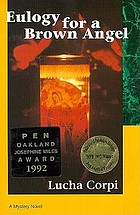
From Eulogy to Loa
Loa a un ángel de piel morena, Nuria
Brufau Alvira’s translation into Spanish of my novel Eulogy for a Brown Angel, was released late in 2011 by the
University of Alcalá de Henares’ Instituto Franklin, to whom I am indebted for making
this possible. I was thrilled, of course, and posted the news on my Facebook
wall. Michael Sedano sent his enhorabuena
to me. He commented that he was looking forward to reading the opening scene at
the National Chicano Moratorium march and riot in the novel in Spanish. He then
asked for my impressions, for my feelings when Gloria Damasco first “spoke” to
me in Spanish. I had asked myself similar questions when I had read the first
and the final drafts of Nuria Brufau Alvira’s splendid translation of my Gloria
Damasco mystery novel. Long before, I had also assisted Catherine Rodríguez-
Nieto when she translated my poetry into English, and voice in translation
became one of my concerns.
Of course,
literary provocateur that he is —in the best of ways— Michael then invited Nuria
and me to write companion pieces about our respective experiences as author and
translator for La Bloga. And here we are:
Lucha
Corpi
Oakland
(California), 2012
A translator´s account of the process
And once
again, Lucha and I have intertwined our discourses in order to ease the access to
the translation chamber, that frontier space between languages and cultures,
where we, as author and translator, have met. And it has been a real encounter
because we were coming from different locations with dissimilar ways of loving
the text we were going to work on.
Allowing
someone to translate one’s text constitutes the maximum act of generosity, because
despite the impossibility of having absolute control over the meaning of our
own words, we all write in the hope that we will be transmitting certain ideas
and values, and that we will be stimulating certain senses in our readers. Honestly
speaking, all writers aim at spreading a specific message, be it aesthetic or of
another kind. By allowing someone who is alien to such a creative act to
rewrite our text we assume the risk of that someone not sharing or even misunderstanding
its intended sense, or purpose. For that reason, having one’s text translated really
is, as I see it, an act of bigheartedness and trust. On the translators’ part, accepting
such a task implies the need to welcome each new text with the open attitude of
someone that is willing not only to understand and feel, but also to help
others to understand and feel too. After all, translating is allowing
communication between those who are different.
Luckily
enough, in this case our efforts of generosity and warm welcome, as well as of
mutual trust, have been greatly and mutually corresponded. Lucha had written
the text thinking of an American audience who is more or less familiarized with
the Chicano movement and its claims, but who might also hold some prejudices
about such community. She also wanted to show Chicanas who are not victimized but
proactive, who are able to combine their feminist agenda with their Chicana
one. And she applied different strategies in order to convey this whole message
of political claims, but also of cultural clarifications that allow for the
breaking down of the “single story” —as Chimamanda Amichie reminds us— about Chicanas.
Most
interestingly, Corpi chose a literary genre that is not usually linked to Chicanismo
or Chicano/a literature: a mystery novel. Most Chicano writers prefer to offer
fictionalized life-stories that allow them to show their (main character’s)
Mexican (family) origins and their struggles within the new American context. Also,
no particular attitudes were associated to one specific origin. She showed
people as humans, not as mere race or gender-associated characters. By doing so, she managed to alter some of the readers’
expectations. Content wise, Lucha opted for a female main character, Gloria,
and a female alter-ego, Luisa, that mostly silently accompanies her along the
many challenges she faces in her investigation, thus offering a split version
of herself. Both are decision takers. Lucha introduced male characters too, but
they never appear at a higher level than Gloria, Luisa or other female
characters. In addition, Lucha showed evil and good in both female and male characters,
as she showed tenderness and pain in both genders too. Down with stereotypes!
Moreover, she
tended to explicitly draw out Gloria’s thoughts, either as a narrator or in the
form of interior monologue, in order to explain, succinctly but sufficiently,
some cultural events in an effort to help readers contextualize the story. It
is a very subtle way of participating in the readers’ meaning construction
process.
Lucha offered
very detailed descriptions of certain scenarios so that we can all more easily
visualize the events. And she often mentioned —one way or another— the skin
color of the characters, which contributes to recall readers’ of their origin.
In that sense, she used language too. In some cases, some Chicano characters
mix English and Spanish, in others she just introduced some Mexican Spanish
words, for example to name objects that belong to the Mexican culture. However,
she did not reflect the “accent” that some Chicano characters may have had in
“real life,” as some authors prefer to do. This helps to keep a smooth reading
of the text, while it avoids contributing to enhance the “foreignness” of
certain characters: a wise strategy to blur the constructed images of Chicanos
within the broader American culture. This has been done by other bicultural
writers, like Rosario Ferré, for
instance, who translates into English her own books and alters the social
status of her characters by making them sound more polite in order to avoid
racial stigmatizations.
Lucha also
introduces some secondary characters that are relevant because of what they do,
though not because of who they are, and so appear without an explicit gender
(doctor, etc.).
These are some
of the choices and strategies Lucha made when she wrote Eulogy for a Brown
Angel in order to reach her literary target —to entertain through a fiction
story—, and to convey her message of disarticulation of stereotypes connected
to the Chicano culture.
In reality,
none of this was spoken between Lucha and me when we first exchanged emails,
and it might be that all these ideas are but the result of my personal
interpretation, but it seems to me that somehow Lucha understood what I had
read and seen between the lines. Of course the challenge for me as a translator
was to transmit all that, in content and through form, to a new audience both
in time and —mostly— in space. The new audience was broader. The Spanish
version should work for both Latin Americans and Spanish readers. Was the
message to be understood similarly? Are the stereotypes to be disentangled the
same?
In such
circumstances, some of the translation strategies to be adopted were clear to
me since the beginning. First, bilingualism had to be respected and shown. We
wanted the audience to be reminded of the difficulties of living in between
languages. Of course not all the story is to be written in both, but some
expressions in English should appear to recreate the Anglophone context where
the story takes place. Second, Mexican Spanish words referring to cultural
particularities should appear marked (in italics) to show the richness and the
distinctiveness of the Mexican-Chicano culture. Third, we added a glossary to
offer readers in Spain, Latin America, elsewhere, the chance to learn a bit
about this culture. Some translators prefer to add footnotes to ease the
understanding of such words right away. In this case, I thought that adding a
subtle intra-textual clarifying formulation of sentences —when needed— would
help to get a general idea, just in case readers preferred not to stop to find
out right then what a bandana or a sarape exactly are or look like. Lucha
agreed on all these suggestions and she helped me with the definitions of some
of these “culturemas,” as translation theorists call them in Spanish.
“I didn´t see
nothing. Understand? Nada.”
Mando looked at
Joel´s hand, put his palms out, and took a couple of steps back.
“How do we
know it wasn´t you who killed this chicanito?”
There was a double edge of contempt and defiance in Joel´s voice, which
surprised both Luisa and me.
Mando stood
his grounds across from us. His eyes moved rapidly from Joel´s face to his
torso and arms, locking on the camera hanging from his neck. A wry smile began
to form on Mando´s lips. He spat on the ground, wiped his mouth with the back
of his hand. “Later, vato,” he said,
waving a finger at Joel.
“Cuando quieras,” Joel answered back,
accepting the challenge. “Any time”, he repeated.
Irritated with
their childish confrontation, Luisa commanded, “Stop it! Both of you!” She
looked at Joel, then added, “A child is dead. That´s why we are here.”
—Nothing, I
saw nothing. ¿Entiendes? Nada. —Mando se fijó en la mano de Joel, alzó
las palmas y dio un par de pasos atrás.
—¿Y cómo sabemos que no fuiste tú quien mató a este chicanito?
Había un doble sentido de contención y reto en la
voz de Joel que nos sorprendió a las dos.
Mando se mantuvo firme frente a nosotros. Movió los
ojos con rapidez del rostro de Joel al torso y los brazos, hasta quedarse
mirando la cámara que le colgaba del cuello. Se le dibujó una sonrisa de ironía en
los labios. Escupió al suelo y se limpió la boca con el dorso de la mano.
—Luego, vato —respondió mientras amenazaba
con un dedo a Joel.
—Cuando quieras —acepto Joel—, any time —insistió.
Irritada por aquella disputa infantil, Luisa ordenó:
—Basta ya, los dos. Luego se dirigió a Joel—: Hay un
niño muerto. Por eso estamos aquí.
She was also
fantastic in filling my cultural gaps of the context. For instance, the many
University names that appear in the novel were confusing for me. However, there
was another challenge: the Spanish language itself. When the audience of the
United States reads the English Eulogy, every time a character is
described as dark, or a Spanish word is introduced, they visualize a Chicano
character. On the contrary, if the translation appears in Spain´s Spanish only,
no Spanish or other Latin American reader will visualize Mexicans or Chicanos,
they will see Spaniards. Or, at least, it will be strange for them to imagine
these speaking in peninsular Spanish. So, the text in Spanish needed to be
“Mexicanized” to be credible. Lucha read Loa
chapter by chapter trying to hear the dissonant voices in my text, and made
suggestions for changes. We both thought that adding more Mexican words than
the ones found in the original was not only legitimate but also very good for
the final result.
“Sí. Gloria.
Claro. Come in. I´m Cecilia Cadena,” she said while she walked to the playpen
and got the baby settled in it. Okay, Little Sister, don´t fuss. No. Stay
there.”
—Sí, Gloria.
Claro. Pasa. Come in. Soy Cecilia Cadena —explicó mientras caminaba
hacia el corralito y dejaba allí a la
niña—. Está
bien, hermanita, no hagas jaleo. ¿Eh? Quédate aquí.
And, I have to
confess, this is one of the parts of the process I have most enjoyed: discovering,
thanks to Lucha, expressions like darse un regaderazo, encender la
lavadora de trastes, meter a un
bebé en el corralito, and other just delicious sayings that
belong specifically to the Mexican variety of Spanish has been a real pleasure.
Lucha told me the Mexican words for some things, as they would sound more
natural for her. Instead of just introducing them, I opted to suggest including
those Mexican words, which do not appear as “Mexican” in the English version,
but they do in the translation, in the glossary. In addition to this, the
intercultural dialogue we kept electronically contributed much, as I see it, to
enhance that fantastic collaboration we have had all along the translation
process, as well as our mutual professional respect and affection.
On the other hand, it might be because Don
Quixote was written in Spain —who knows?—, but (at least some) Spanish speakers
might tend to think that their Spain’s Spanish is the purest version of this
already global language. It is not my intention to discuss such an idea,
especially since our Spanish might have been much more influenced by other
languages than the many other varieties of Spanish around the world, thus
becoming much less “pure”, and as if most Spanish speakers in Spain spoke our
beautiful language with absolute correction. In any case, whether we like it or
not, I feared that Spanish readers would see some Mexican expressions as “weird
Spanish”. Allowing that to happen would have contributed to our own
intra-linguistic cultural stereotypes, and I definitely wanted to avoid that. For
that reason, I tried to be very careful with the grammatical formulations,
their closeness to a correct and common standard Spanish, while allowing the
text to become more Mexican. It has been hard to find the balance. It is thanks
to our author-translator —Chicano-Spanish— negotiation that this has been
possible.
Also, there is
something Lucha said to me once, which made it all very obvious for me; she was
concerned about how Otilia sounded in Spanish. I realized then that I had
forgotten an identity intersection: the age-race one. Otilia, being a
grandmother of Mexican origin should sound much sweeter and down-to-earth than
in my first drafts. I have to admit that all the efforts of the world on my
part would not have been enough to give Otilia back her real voice. It was thanks
to Lucha that this was finally possible. Lucha gave Otilia her voice back in
all its dimensions. And she also cleaned Gloria´s.
As for the
neutral professional characters, we both agreed that altering the readers’
expectations would be good. So the neutral doctor appears as a female character
in the Spanish version, just as the neutral nurse appears as a male.
Descriptions
were also a challenge. Lucha had a neat image of the scenarios of the novel. In
some cases they were neat to me too, but in others I had to ask her for further
explanations. I particularly remember the description of one of the houses,
where there is a patio, a vineyard, etc. I even needed a drawing to finally see
with Lucha’s eyes and correctly explain that in Spanish!
As for
dialogues, I wanted to show the connection between Luisa and Gloria, their
natural understanding. In some cases I have divided sentences into two, or the
other way round, to make their conversations sound more natural. Last, but not
least, the translation of the title was also challenging. It had to bear the
same homage to the “brown angel” as in the original, but saying “ángel moreno”
did not sound just right. It shows too much. The word “loa” was chosen for its
poetic connections, whereas adding “la piel” made the title as ambiguous and
mysterious as the original. Only when you read the novel will you understand
why this is so important.
Of course,
other translation micro-decisions have been taken along the process, specially
connected to the smoothness of the reading in Spanish, which requires constant
elimination of repetitions, introduction of more complex subordinate clauses,
conversational adaptations, special attention to articles, rendering of
possession through verbal pronouns instead of possessive adjectives, and other
changes in grammatical categories —what we call “transposition”—, as well as
alterations in formulations and expressions — “modulation”—, and many other
details. But the most challenging ones, the macro-decisions that are
implemented at the macro and micro levels of the text, those that result from
an intersectional analysis before and during the translation process, those
have been discussed and negotiated with Lucha.
This fantastic
and stimulating translation journey is usually done with more preliminary
limitations and as a solitary adventure. On the one hand, it has been a real
pleasure to enjoy the institutional support of the Instituto Franklin,
represented by Cristina Crespo, and Ana Lariño later on. They have allowed me
to make translation decisions, for which the Instituto deserves fair credit and
my greatest gratitude. On the other hand, Lucha Corpi’s collaboration in the
project has been a blessing. It has implied for me constant reflection on the
choices made, bargaining for solutions that would please us both, and a mutual
personal recognition process. I think we are both happy with the result, and I also
believe we have both learnt something along the way.
If the
intention of the Instituto Franklin is to stimulate cultural encounters,
congratulations! Loa a un ángel de piel morena is a very
fruitful one. And one to be enjoyed by readers, who, on both sides of the
Atlantic, might —again, who knows?— broaden their views about Chicanos and Chicanas.
I began arguing
that translating implies an act of generosity and that requires an open and
collaborative attitude. After the account of this particular translation, you
might agree that Lucha’s Eulogy has
turned into our Loa. The author´s
generosity has increased the global dimension of her initial message of justice,
love, peace, tenderness and friendship. And I really hope that all my efforts
as a translator to treat her work as it deserved have been good enough as to spread
and strengthen such a message. This is “theory in the flesh”, dear readers, a fantastic
example of “closelaboration,” as we call it. Querida Lucha, I am as fond of you
now as I am of Loa and all its
characters. Gracias a ti, Lucha. Gracias.
Nuria Brufau Alvira
Khartoum
(Sudan), 2012
Meet Nuria

Dr. Nuria Brufau Alvira was born in 1980 in Salamanca (Spain), where she also carried out most of her studies, although she has also lived in Belgium, Italy and the UK at different stages of her University education. She gained her Ph Doctorate CUM LAUDE in 2009 at the University of Salamanca (Spain), where she also received the PhD Extraordinary Award 2009. In her Doctoral Thesis —Translation and Gender: a Proposal for a New Ethics of Translation in the Era of Transnational Feminism— she explored the areas of gender and translation. She holds a Bachelor’s Degree in Translation and Interpreting (University of Salamanca, 1998-2003), a Bachelor’s Degree in Arts and Humanities (University of Salamanca, 2002-2006), a Master’s Degree in Gender Studies (Autonomous University of Madrid, 2005-2007) and is an official Expert on Spanish as a Foreign Language Teaching (University Antonio de Nebrija, Madrid, 2009-2010). Her areas of research and interest are Translation Studies, Gender Studies, Cultural Studies, Communication and Text Management Studies.
She has lectured in various Universities in Spain (University of Salamanca, University of Alfonso X El Sabio [Madrid]), as well as in other institutions, and has published one book (Las teorías feministas de la traducción a examen: destilaciones para el siglo XXI, 2010) as well as quite a number of book chapters, articles and reviews in national and international magazines. She has attended many national and international conferences, and has participated in various research projects. In this sense, she is currently doing research on diversity management in higher education institutions.
In 2010 she arrived in Khartoum, where she worked for the Comboni College as a language teacher in Spanish, English and Italian, and at CLIK, for several months until she joined the Regional Institute of Gender, Diversity, Peace and Rights (RIGDPR) at the Ahfad University for Women (AUW) in February 2011. There, she lectures the courses Gender and Feminist Concepts and Theories, and Global and Regional Governance, at the four Master programmes offered. She is responsible for the MSc on Gender and Governance (GAG), and is also the Coordinator of the Norad-funded project RIGDPR 2010-2014.
She has worked as a freelance translator since 2003. She has so far translated 10 novels —two of which are Chicana novels— into Spanish for different publishing houses or institutions, as well as different non-fiction books and articles on history, art, gender, and translation. She is currently collaborating with an Iranian translator in the translation into Spanish of tales written by Iranian women authors.
Books Still Banned
"Oh brave new world to have such creatures in it!"
"We are such stuff as dreams are made on."
Those two lines from Shakespeare's
The Tempest are banned from Tucson Arizona's classrooms. The school board banned the play. What if some important college admissions writing test prompt comes from this banned play? Goodbye Cal or Harvard, hello Flagstaff, for Arizona's brightest.
Ignorant yokel didn't even know Prospero's speech, the evaluator will think.
The Librotraficante Caravan stands as a landmark satiric sharp stick in the eye of Arizona's abysmally failing public servants. Using mass media to keep alive the issue, Latinopia features running segment on the caravan. The
third episode is up now, at Latinopia. Jesus Treviño is filming on the bus when a multi-car pile up in their path almost puts the kibosh on the trip to Denise Chávez' Mesilla NM hospitality.
La Bloga's first bloguera, Gina Marysol Ruiz, is committed to reading banned literature aloud. I recorded page 123-124 from Bless Me, Ultima for Gina's
project.
You can view a larger screen and read the text slides at
Read! Raza.
Carlos Fuentes Conference At Cal State LA
La Bloga friend and conference planner extraordinaire Roberto Cantu shows he's on a quest to put together the perfect academic conference. With town and gown programming, this year's event seems destined to surpass such earlier conferences on Sor Juana, Octavio Paz, Mesoamerica.
Per the Conference website,
The 2012 Conference on Carlos Fuentes includes five sessions on the novels, short stories, and essays of Carlos Fuentes; one session on Ancient, Colonial, and Modern Mexico; and a full staging of one of Fuentes's plays: Orquídeas a la luz de la luna (1982), with actresses Alejandra Flores and Azalia Correa playing the roles of Mexican film icons María Félix and Dolores del Río. The conference also includes five keynote and featured speakers who are distinguished world scholars in the field of Fuentes studies. For more information on this conference, write to rcantu@calstatela.edu, or to this address:
Dr. Roberto Cantú
Professor of Chicano Studies and English
California State University, Los Angeles
5151 State University Drive
Los Angeles, CA 90032
Conjunto Festival Returns for Tres Equis
That's not a sponsorship plug for a light Mexican beer but the latino numeration identifying the thirtieth conjunto festival in San Antonio Texas, May 15-19. Events start early for the senior, run all night and all day for endurance tipas tipos.
Rosedale Park and the Guadalupe theatre host the various days. See the full schedule at the festival
website.
On-Line
Floricanto
Alma Luz Villanueva, John Martinez,
Iris de Anda, Claudia Hernández, Andrea Hernández Holm
“Presente
(Present, Always Alive)” by Alma Luz Villanueva
“Under the Thin Blue Sky” by John
Martinez
“Injustice I see” by Iris de Anda
“Mujer tras el telón / Woman Behind the
Curtain” by Claudia Hernández
"Harvest time in Pinal
County" by Andrea Hernández Holm
PRESENTE (Present, Always
Alive)
by Alma Luz Villanueva
Would they kill our
caramel skinned sons?
They would.
Would they kill our
cocoa skinned sons?
They would.
Would they fill their
prisons with our sun
kissed sons?
They would.
Would they steal their
blossoming dreams?
They would.
Would they steal the
stories, the truth, of
their people, their ancestors?
They would.
Will we allow them
to kill our sons,
to kill their spirits,
to silence our stories,
to silence our truths,
to silence our ancestors?
A rainbow of humans,
all sun kissed colors,
gather, millions of us
wearing hoodies, carrying
wetbooks to Arizona,
writing poems, writing
stories, writing novels,
of memory, truth, ancestors,
our wetbooks
always born
from the womb
of resistance, human
love. No,
we will
not allow
them, Trayvon
Martin, PRESENTE...
*Cesar Chavez, PRESENTE
*Martin Luther King, Jr.,
PRESENTE
Alma Luz Villanueva
San Miguel de Allende, Mexico
April 3, 2012
Into the Sixth Sun
To my son, Jules Villanueva-Castano,
who made it through the cultural gauntlet
and now helps others through,
always proud.
UNDER THE THIN BLUE SKY
by John Martinez
The mighty sun,
With its Monarchical sting,
Never saw, never
Cared, that there
Was dirt in my tray,
That the grapes
Were sweating
From my little brown hands
Pushing too hard,
But the Foreman cared,
His skin,
Alcohol puffed red,
Like Jackie Gleason,
He took my father
Over and they
Stood above me,
Under the thin blue sky,
Time, relentless,
But on my side
I was about to be taught a
lesson.
I heard them, mumbling
Saying things
As I hurried
To turn the wooded frame,
To prepare another
Paper, one bunch
Of grapes to hold
It down against
The calm wind,
“Your kids are fucking up my
field, Victor,”
I heard him say
From above,
I imagined him, a T.V., Clown,
The man at the Welfare window,
The black n white
Ward Cleaver,
Newspaper, in his face,
He was all of them to me
And then, I felt a kick
In my stomach
And my breath left me
Quicker than the song
Playing in my head,
Faster than a rat
Scurrying across the vine,
My breath went running
Down the row,
Laughing, my child’s laugh,
Grinning like my
Odd mouth does,
It was beginning to rise
Towards the sheep
Shaped clouds,
It was leaving me
And so I fell asleep
And dreamed of nothing
When I awoke,
My father, sad under
The shade of the vine,
Said to me;
“They are going to keep us here,
Mijo,
But you have to be careful with
the spreading.”
And as I watched from my knees,
Crushed grapes and warm sand
Pressed against my cheek,
The other side of my face
Like a fever,
When I watched my father
Walk, a crooked, Festus walk,
Down that row,
His grape knife dangling
From a string
Tied to his right wrist,
I thought about
What he thought
He had to do,
Because he, ultimately
Loved us all,
I thought about myself,
And how I would
Never forgive
These times,
But know them
To be my own
© John Martinez 2012
injustice i see
by Iris De Anda
justice is blind
she has been taken hostage
like the girls from
los angeles to juarez
she is forgotten
by passerby
sometimes she whispers
i hear her cry
justice is lost
she wants us to find her
like this time
will be different
she is ready
to step up
sometimes she wins
i fear not enough
justice is seeking
she removes her shackles
like the stories from
then and now
she is frozen
in time forever long
sometimes she sings
i hear her song
"we shall overcome
we shall overcome
we shall overcome someday"
injustice i see
unjust life
just once
give us this one
if we fight hard enough
we cannot fail
that our hearts may believe
truth and love prevail
Mujer tras el
telón
por Claudia
D. Hernández
¡Oh que
temple de mujer!
Suspiraste
agotada
Cada
noche bajo una
luna
dista.
Fuiste:
Hermana
Hija,
Tía,
Esposa,
Madre.
Con
manos pálidas
Acariciaste
los rostros
De tus
retoños.
Los nutriste con aromas
De viña
cosechada,
Entrelazada
con
Esencias
de:
Maiz,
Fríjol,
Y
Calabaza.
Les
diste de comer
Palabras
dulces
Que
rebosaron
En
espíritus
Luchadores.
(La
leña siempre
Ardió
en tu hogar)
¡Ya no
te escondas
Tras el
telón—
Brilla
con esplendor!
¡Oh que
temple de mujer!
Tu
abnegación dio a luz
A un
Héroe Nacional.
Woman Behind the Curtain
by Claudia D.
Hernández
Oh courageous woman
Who sighed exhausted
Every night under a
Distant moon.
You were a:
Daughter,
Sister,
Aunt,
Wife,
Mother.
Every night you caressed
Your offspring
With your pale hands.
You nourished them with
Harvested vineyard aromas,
Entwined with
Scents of:
Maize,
Beans,
And
Squash.
You fed them
Sweet words
And engorged
Their warrior
Spirits.
(The wood burned
Forever in your home)
Do not hide
Behind the curtain—
Shine with splendor!
Oh courageous woman,
Your dedication gave birth
To a National Hero.
Harvest time in Pinal
County
by Andrea
Hernandez Holm
I remember walking
Walking alongside my mother
My sisters so small still,
Me so small still,
And looking up, up, up
at the saguaro arms
stretched high above us
straight into the blue sky
fat, juicy fruit perched on their very tops.
The sound of the fruit
Dropping into our clutches
Like drumbeats
Heartbeats in the desert,
In the foothills of Table Top
Where the doves and quails
Greeted us
And our thanks floated away easily
On occasional breezes.
At the base of Table Top mountain
Today
The Neo-Nazis zoom across the delicate desert
On the backs of ATVs.
Their military weapons are draped across their shoulders
Hung low on their hips
Tucked into combat boots
And festering on the tips of their tongues.
The state would pay them
To harvest all the migrants they can find.
We are afraid
To go where we were welcome
Where the desert was kind to us
And let us love it back.
©Andrea Hernandez Holm 2012
BIOS
“Presente
(Present, Always Alive)” by Alma Luz Villanueva
“Under the Thin Blue Sky” by John
Martinez
“Injustice I see” by Iris de Anda
“Mujer tras el telón / Woman Behind the
Curtain” by Claudia Hernández
"Harvest time in Pinal
County" by Andrea Hernández Holm
Alma Luz Villanueva was raised in
the Mission District, San Francisco, by her Yaqui grandmother, Jesus
Villanueva- she was a curandera/healer from Sonora, Mexico. Without Jesus no
poetry, no stories, no
memory...
Author of eight books of poetry,
most recently, 'Soft Chaos' (2009). A few poetry anthologies: 'The Best
American Poetry, 1996,' 'Unsettling America,' 'A Century of Women's Poetry,'
'Prayers For A Thousand Years, Inspiration from Leaders & Visionaries
Around The World.' Three novels: 'The Ultraviolet Sky,' 'Naked Ladies,' 'Luna's
California Poppies,' and the short story collection, 'Weeping Woman, La Llorona
and Other Stories.' Some fiction anthologies: '500 Great Books by Women, From
The Thirteenth Century,' 'Caliente, The Best Erotic Writing From Latin
America,' 'Coming of Age in The 21st Century,' 'Sudden Fiction Latino.' The
poetry and fiction has been published in textbooks from grammar to university,
and is used in the US and abroad as textbooks. Has taught in the MFA in
creative writing program at Antioch University, Los Angeles, for the past
thirteen years.
Alma Luz
Villanueva now lives in San Miguel de Allende, Mexico, for the past five years,
traveling the ancient trade routes to return to teach, and visit family and
friends, QUE VIVA!! And taking trips throughout Mexico, working on a novel in
progress, always the poetry, memory.
John Martinez studied Creative
Writing at Fresno State University. He has published poetry in El Tecolote, Red
Trapeze and The LA Weekly. Recently, he has posted poems on Poets Responding to
SB1070 and this will be his fifth poem published in La Bloga. He has
performed (as a musician/political activist, poet) with Teatro De La Tierra,
Los Perros Del Pueblo and TROKA, a Poetry Ensemble (lead by poet Juan Felipe
Herrera) and he has toured with several cumbia bands throughout the Central
Valley and Los Angeles. For the last 17 years, he has worked as an
Administrator for a Los Angeles Law Firm. He makes home in Upland, California
with his beautiful wife, Rosa America y Familia.
Iris De Anda is a writer,
activist, practitioner of the healing arts, and co-founder of the company Las
Adelitas: Moda, Cultura, Revolucion. A native of Los Angeles she believes in
the power of spoken word, poetry, storytelling, and dreams. She can be
reached at
evoluxion777@yahoo.com
Claudia D. Hernández was born and raised in Guatemala. She holds a BA in
Liberal Studies with a minor in Art and a BCLAD teaching credential. She is a
bilingual educator in the city of Los Angeles and is currently working on a
Masters in Multicultural Education. She writes, illustrates, and
manually binds children’s books. Her photography, poetry, and short stories
have been published in
The Indigenous
Sovereignty Issue of The Peak,
Hinchas
de Poesía,
Chicana in the Midst,
Poets Responding to SB1070,
La Bloga’s on-line Floricanto, and in the first anthology of
Colectivo Verso Activo.
Andrea Hernandez Holm was born
and raised in Pinal County, Arizona. She grew up between Table Top Mountain and
the Estrella Mountain range. Her heart is happiest in the desert and her
writing is rooted there. Andrea prays daily for safety and peace to be restored
to Central Arizona, which has become a hotbed of anti-immigrant sentiment and
activism. Andrea is a student in the Mexican American Studies program at the
University of Arizona; a moderator for the Facebook page Poets Responding to
SB1070; and a comadre of Sowing the Seeds women’s writing collective. Visit her
at
www.andreahernandezholm.webs.com