Showing posts with label Los Angeles poetry. Show all posts

Friday, August 11, 2017

Long Awaited Poetry Book by La Bloga's Daniel Olivas

Melinda Palacio


New poetry book by La Bloga's Daniel Olivas


A good day is when writing comes easy and the book you've been waiting for makes up for the world turned upside down. It's a frightful sight outside my office, where the act of scribbling words on a page, erasing them, then transferring said words to a computer happens. What with a tweety, trigger-happy narcissist in charge of our country, it's easy to get lost in the rabbit hole of internet distraction, such as the biggest time suck of them all, facebook and posting a picture that documents your current situation or wishing one of your online friends a happy birthday or placing a heart or happy face emoji next someone's cute cat picture. It's hard to believe that a whole block of writing time can slip away doing theses things. It's a miracle any work gets done in the real world. At least, there are some professions left where dipping into the virtual world is not allowed on the clock.

One person who is not on facebook is one of the most prolific writers I know and he has a taxing day job as an attorney in the California Department of Justice's Public Rights Division. His job as a lawyer doesn't include the many volunteer positions he holds in the literary world as editor and board member and weekly blogger at La Bloga. Daniel Olivas is the force.

When Daniel offered an advanced copy of his new book of poems, Crossing the Border, I eagerly held up my hand. This collection of poetry, his first, is long awaited. I recall the book was going to debut in 2010, but the contract fell through due to the publishing house's financial problems. However, Daniel persisted and kept the collection intact and, lucky for us readers, the book will be available the fall, through a new publisher, Pact Press, as its debut title. Here's to exciting beginnings. Pact Press is an imprint of Regal House Publishing.

Some of the poems were published almost 20 years ago, as early as 2000, but the stories and sentiments are timeless. Honoring your personal narratives never goes out of style.

In "Papa Wrote," the poet describes a scene familiar to all writers, that moment when you are in front of a small audience, but you want to wait for that special person who promised they would show:  "we waited in awkward/silence, the espresso machine's/ hissing offering the lone/commentary." And when Daniel's father showed, during the Q&A, his father revealed Olivas's birthright as author.

I especially enjoyed reading, "Hidden in Abuelita's Soft Arms." As cliché as the grandma poem is, I personally cannot stop writing about my grandmother. It also takes hutzpah and skill to pull it off. Daniel's Abuela poem is a poem dedicated to children. She is "wrinkled and brown like an old paper bag" with "her too-perfect white teeth," and lives in a house "Painted yellow-white like a forgotten Easter egg."

Many of the poems in this collection cross their own border of poem as witness. As a lawyer, Olivas has the ability to see both sides of an argument and write in diverse voices and personas as in the title poem "Crossing the Border" or the last poem, a personal favorite, "La Tormenta at the Lost Souls Café" After the paintings by Gronk, where "La Tormenta ponders her identity--/Even her name's origin is hidden/In fog and memories of East L.A."


Fall back into poetry with Daniel A. Olivas's eighth book, Crossing the Border; official pub date is November 17, but you may pre-order today. 

Daniel Olivas

Sunday, October 18, 2015

"Put Your Name On It": Xochitl-Julisa Bermejo on Writing, Submitting, and Honoring Our Creative Work


Olga García Echeverría


Upon Celebrating America’s Birthday


In the morning, I explore the yellow hills
of Chavez Ravine and collect trinkets for my desk:
a hawk feather, a sun-bleached snail shell,
a rusted nail sitting within the brick base
ruins of a house. I imagine great-aunt Susana
collecting herbs from the hills hugging Teocaltiche.
In the afternoon, Uncle Manny recalls remedies
she concocted and the tiny quail eggs she fried
for breakfast with handmade tortillas the shape of boats.
My finicky father never ate from her table,
but Uncle Manny has had too many Budweisers
and is spilling memories of his favorite tia this 4th of July.
“She used to put me on her shoulders and carry me
across the river,” he says dreamily. This was before L.A.,
hair products, Ford cars, and the church youth group
where he met my aunt, and my dad met my mother. 
By dusk, tears dig into the creases of his face
like a stone creek. He hushes only to watch my cousins
launch bottle rockets from the street. Smoke tails up
and sparks shoot out over our heads. Colors flash bright
and disappear into the air like my uncle’s sobriety,
like Tia Susana, like the houses of Chavez Ravine.

Xochitl-Julisa Bermejo


If you're an Angelino with your eye on the literary scene, then most likely you've heard of Xochitl-Julisa Bermejo. She's shared her award-winning poetry with audiences throughout LA and beyond. She is the creator and curated of the quarterly reading series HITCHED, formerly held at Beyond Baroque and now being hosted at Holy Grounds.

Another important and exciting LA-based literary project is Women Who Submit, which Bermejo co-founded. This group encourages and supports women writers in the submission process for publication. When Xochitl isn't organizing, submitting her work or encouraging others to submit, she's teaching, grading, and reading articles on the pedagogy of working with English language learners.

Despite her busy schedule, Bermejo ekes out writing time, a veces in the afternoon, usually in the evenings, most often on weekends or in the summer when teachers' loads are generally lighter.

Her writing essentials? Música and a laptop. A source of inspiration she keeps returning to? Long walks in nature. 

Although Xochitl says she did not become serious about her writing until her mid-twenties when she pursued her MFA, it is obvious that the creative word has been brewing inside her since she was a chiquilla. At six, she wrote her first poem, and at 11 she not only wrote a western, she also won a Knott's Berry Farm contest with her submission.

Bueno, there is so much to say about Bermejo, but we'll let her say it herself. Here is our featured and estimada poeta sharing her insights on writing, publishing, building community, going beyond AWP drama/trauma, and talking about the importance of following our hearts and honoring our stories.
 
 
Welcome, Xochitl. Let's get right into it. I've been writing a lot about my parents lately, and as a result re-discovering ways in which they influenced my writing. I'm curious, ¿Qué dicen tus padres about you being a poet, and how have they influenced your creative journey?

My parents have always been very supportive of my writing career. I think it is because they are both artists at heart. My mother wanted to be an opera singer, but ended up dropping out of community college when her music teacher didn’t show much interest. She’s told me the story a few times. She was thinking of quitting school and went to tell her teacher and her teacher basically said, “OK.” As a teacher myself, I try to remember this.

As I was growing up, my memories of my dad tend to revolve around images of him in the garage creating objects in his wood-turning workshop. We still have a table he made in those days and my aunt still has the bed he made for her and her husband as a wedding present.

The thing is they were both immigrant children, and they are both the eldest in their families, so they didn’t have the freedom to pursue their artistic dreams. My mom had to take care of her little sister and brothers, and my dad had to go into the army. I think seeing me be a writer brings them joy, and whenever anything good happens, I definitely feel like it’s happening to all of us. 
 

My dad’s number one saying is, “Put your name on it, Mija!” Whenever I come to him with some good news he always says, “That’s good, Mija! Just remember, put your name on it!” To them creating something you are proud of, something you can attach your name to is of high importance.


As a Latina writer, have you always felt free to incorporate Spanish in your creative work?


No, I didn’t always use Spanish in my work. In graduate school, I had little sprinklings of Spanish here and there when I would write about my family, and that was the first time I had people telling me I had to italicize those words. I had never heard that because I hadn’t really studied writing academically before.

It wasn’t until I went to Las Dos Brujas writing retreat in New Mexico that I started to understand the wider conversation of using Spanish and other languages in writing. Las Dos Brujas was organized by Cristina Garcia. The mentors were Cristina, Juan Felipe Herrera, Chris Abani, Denise Chavez, and Kimiko Hahn. LDB was the first time I had ever experienced being in a workshop with a majority of writers of color, and it was the first time I felt I had connected with a mentor of color.  LDB really opened my eyes to what had already been going on within the community for some time. A book that really struck me was Slow Lightning by Eduardo C. Corral. I was really amazed by how much Spanish he used. Nearly whole poems in Slow Lightning were in Spanish. His book really opened my eyes to how far it can go.

As a teacher myself, I know how difficult it is to write during the school year, especially because we take so much work home.  What helps keep you on track with your writing during the school year?

The best thing I have to keep me writing at this time is a regular workshop group I have on Wednesday nights. There are three of us. We are all women, and we are all workshopping early drafts of novels. We each take turns reading 5-10 pages aloud for feedback. Thankfully, I generated like crazy over the summer, so all I have to do is show up, bring something I’ve already written, and be ready to listen. It feels low-pressure, and it keeps me thinking about writing in the week. And then I have something to work on when the weekend comes. This group has been a life preserver. It’s definitely keeping me afloat writing-wise.  
 
You were the 2013 Poets & Writers California Writer's Exchange poetry winner. What was that experience like?

It was very exciting. I got an all-expense paid trip to New York to meet with editors, agents, and writers. As a poet, I didn’t really have much connection to meeting the agents, but it was great to hear what they had to say. Some highlights were going into The New Yorker to meet Deborah Treissman, having a glass of wine with Yusef Komunyakaa, and listening to Alice Quinn recite a poem to me. Also, it was pretty amazing to feature at a reading in Manhattan at the Center for Fiction. Some of my oldest friends live in New York, so it was really cool to be able to share that moment with them. It felt good to know I had a loving support team so far from home. It was really special. The whole experience was special. Every night, when I got back to my room, and I was alone for the first time all day, I cried. I couldn’t believe it was happening to me and it was happening to me because of something I wrote. I felt really happy and grateful. 


Photo from Poets & Writer's E-Newsletter 3/14/13:
From left: P&W staff member Jamie FitzGerald, Laura Joyce Davis,
Yusef Komunyakaa, Xochitl-Julisa Bermejo,
and P&W Staff member Cathy Linh Che.

Can you briefly share what inspired you to start your HITCHED reading series?

I had gone to a reading at Avenue 50 Studio where Suzanne Lummis invited her students from her classes to feature with her. I liked how she used the reading to bring out new voices, so that was one of the events that inspired me to do a reading series revolved around mentorship. I was also newly out of grad school, and I wanted to promote my friends and other new writers like myself. It was kind of great because we were all newly out of grad school, so we still had close relationships with our mentors, and so I had a bit of a built in talent pool. At the beginning it was a way to get my friends some exposure and to build relationships with the older generation of poets and writers.

You've been hosting this series for the past 5 years. What have been some of the rewards?
 
The rewards have been many. For one, every time there is a HITCHED I walk away feeling moved. I feel a little selfish saying that, like I made this reading strictly for myself, but I hope if I’ve been moved then so have other people. I’ve also had the opportunity to meet so many writers and to introduce writers to the community. The way the reading usually works is I invite someone I know to feature, and then that person invites someone to feature with them. The person they invite can be a mentor, a student, a collaborator, a workshop partner, etc. So nearly every reading, I’m introduced to someone new, and nearly every reading someone is meeting someone new.
 
Have you seen important shifts in the literary scene during these past 5 years?
 
Something that makes me happy is seeing what I think is a bigger push in the last few years to have literature in public spaces. I see it with the Jessica Ceballos and Avenue 50’s Poesia Para la Gente series, with what Iris de Anda is doing with the “Love Corner” in El Sereno, with Liz Gonzalez’s new Uptown Word Reading Series in Long Beach, and with the Los Angeles Lit Crawl. I think this is important work.

And you'll be reading at Lit Crawl,  on October 21 with Women Who Submit. Here's the link to your event:

http://litcrawl.org/la/events/between-stage-and-page-interstitial-arts-foundation/
 
On the issue of submission: one thing is creating and another is getting our work out there. Alyss Dixson, Ashaki Jackson and you took a lead a few years ago in encouraging women writers (and in particular women of color) to submit. Can you tell us a little about starting up Women Who Submit? :
 
Women Who Submit came out of the first VIDA count. The women of VIDA started counting the number of women and men published in top tier journals like The New Yorker and Paris Review. What they found was that there was a large disparity between men and women being represented in these magazines. When editors were asked why they thought there was this disparity, the most common response was, "Women don't submit as often as men."

Women Who Submit was created in an attempt to change the rhetoric. The idea of submission parties, getting a group of women together to submit work and act as a support, came from Alyss Dixson. She invited Ashaki Jackson to work on this idea with her, and Ashaki invited me to work with the two of them. I didn’t even know about VIDA until I was brought into this project in 2011. Together we planned our first submission party. It was at my mom’s house, which I thought was great. For the first few years, it was a small group of women meeting in each other’s houses about 5 times a year, but over the last year we’ve become more global. We now have monthly submission parties with submission parties open to the public and new members every other month. We’ve also started doing panels, readings, and workshops. It is definitely growing, which is really exciting!


I've yet to go to a WWS meeting myself, but I want to share that I feel encouraged by WWS from afar. WWS has, on several occasions, inspired me to send something out, so gracias! Here's the link to WWS in case readers want to find out more: : https://womenwhosubmitlit.wordpress.com/


That’s amazing! I’m glad we could inspire you to submit. Not everyone can come to an event, but if women find some strength and support for submitting from our online presence, then that makes us happy. We are trying to create a supportive community online with our Facebook, twitter, and blog. We want women to know they can always come to these parties for encouragement, information, and support.

Finding a “home” for a literary piece can be challenging, especially when we are bilingual and write in mixed languages. There is always so much negotiation (between the self and the page) that happens prior to sending something out. Should I even send this there? If I do send it out and it's not a Latino journal, how much of the Spanish do I have to take out? etc. What advice can you give women writers out there who are grappling with some of these issues and questions?

I think my advice would be to make the best piece you possibly can, and try not to worry about who will take it. I know this is hard. I’m trying to do it right now with a YA novel I’m working on. My heroine is the daughter of migrant farm workers, and I’m always thinking, Is that too much Spanish? But I think we have to fight to stay true to who we are, and fight to stay true to the piece. Each piece is different and there is never one answer.
 
What I hope other poets do is write their hearts out, and make something that makes them proud, something they are proud to have their names on (like my father says), and then send it out. If you do that, I think you will find the right home for your work. I have an essay up at The James Franco Review right now where large chunks of dialogue are in Spanish. http://thejamesfrancoreview.com/2015/08/26/non-fiction-by-xochitl-julisa-bermejo/
I definitely worried no one would take it, but then I found out about The James Franco Review. Based off of their mission and the work they had previously published I thought, if anyone is going to take a chance on this piece it’s this place. And then they did, which was amazing! So I think being true to yourself, and looking for those places who are open to what you are doing is key.

I think that even when we do make efforts to submit, though, it can be pretty discouraging, and it can also be expensive. Although it's exciting to see more people of color presses and journals, it's still a very White and very male-dominated literary world. We've made many gains, but the racism is institutionalized.

This is true, but we have to keep pushing ourselves into these spaces. I spent a month this summer at a residency that was very white, and it wasn’t always comfortable, but as one mujer told me recently, “So what’s our option? To not go? No!” Being there made it possible to finally write a first draft of a book I’ve had in my mind for years, so no, we can’t stop doing it. But this is something I’ve been thinking about with Women Who Submit. We want to support women trying to move up into these prestigious spaces, which tend to be white and male. I’m curious about what we can do to help arm them before they go. I’m curious to figure out how we can support them from afar.
 
Money is also a big issue. To apply for prestigious awards and accolades is not cheap. Reading fees and application fees are no joke, and it only helps keep the writing world classist. One dream I have is to start some kind of scholarship fund just for application fees. If we could help women submit their work to places they normally wouldn’t because of fees and financial concerns, that would be huge.

Speaking of institutionalized racism and the need for more diversity in the literary world, you wrote a great blog on your recent experience with Red Hen Press, "Kate Gale, Red Hen, and What Poetry and Community Mean to Me." To quickly recap, in August you received a letter from Red Hen stating they were interested in publishing your poetry manuscript. In your blog, you shared that this was a dream come true, and yet it was quickly followed by that horrific Huffington Post blog by Kate Gale, “AWP is Us.” There was such a huge outcry in response to to Kate Gale's blog because it offended so many--the LGBTQ community, writers of color, writers with disabilities, and I think in general just writers with consciousness. Because of Gale's affiliations with Red Hen Press, you then made the difficult decision of not publishing with them. I imagine that must have felt both empowering and heartbreaking.

The decision not to publish was heartbreaking. Writing about the decision not to publish was empowering. Making the decision to make the blog piece public was frightening. Kate Gale’s article came out on Monday. I wrote the blog on Wednesday night and sent it off to two friends for feedback with the question, Can I really do this? I revised it Thursday night and didn’t sleep at all that night. Then first thing Friday morning, I decided if I didn’t do it right at that moment, I would never do it, so I did. My hands were shaking. Then Facebook kind of exploded, and the outpouring of support was just amazing. All day long, I kept crying mostly because people were being so supportive and writing beautiful messages to me. I didn’t expect that. It was a reminder that our poetry community can be a really good place. We can’t let the Kate Gales and Michael Derrick Hudsons of the world try to distort it. We have to be vigilant in speaking out, speaking our truths, and telling our stories.

You wrote in your blog, “'AWP is US' reminded me why I write poetry in the first place. Because privileged, white America isn’t going to tell my story, or the stories of those around me. Because writing poetry is my way of claiming space in a world that wants to push me out of the way. Because writing poetry gives me the power to create and build the world I want to see.” I think these words strike a cord with so many of us.

Thank you for that. I think this was what resonated with many people who reached out to me. In all of this I only had one negative commenter (which is kind of unheard of), and this person said, “In fact, Red Hen was going to tell your story–you just opted out because, like some others, you chose to interpret Gale’s piece very narrowly, reducing her to a stereotype.” But this misses the point. Writers of color and women writers, have to be careful. Of course, we all want to be published, and we want credibility and professional accolades. And for those who choose to pursue tenure tracks, getting published by top tier journals and presses is a necessity, but we also have to feel good about where our work lands. It’s our one major commodity, and we have to handle our publishing decisions with care.

I love that you turned that situation around. It's usually the publisher who has the power to say, “No,” but in this case you took that power back into your own hands and ultimately denied them the opportunity to publish your work.

Speaking of your work, can you briefly share what your manuscript, Built With Safe Spaces, is about?

Built with Safe Spaces is a collection of poetry inspired by Los Angeles, my grandmother, and the Arizona-Mexico border where I volunteered as a desert aid worker in the summers of 2011 and 2013. By traveling from the green hills of Los Angeles to the jagged canyons of the Sonoran desert, it is my hope these poems illustrate a speaker driven to activism by a need to honor her family's journey as Mexican immigrants.  

I have no doubt your manuscript will get picked up soon by a great publisher. I look forward to reading it, and of course, we want to review it here at La Bloga as soon as it comes out.

Thank you! I’ve been losing faith lately, so your words mean so much to me. I’ve often daydreamed about the book, and how it will feel in my hands, and how my name, Xochitl-Julisa Bermejo, will look across the bottom of the cover, but I haven’t been dreaming about that too much lately. I’m more excited about my new novel these days. The novel is where most of my energy has been going, but I hope one day soon, I’ll have both, and that will be an amazing day!


Xochitl-Julisa Bermejo is the 2013 poetry winner of the Poets& Writers California Writers Exchange. She has work published in American Poetry Review, CALYX, Acentos Review, Los Angeles Review, and The Nervous Breakdown. A short dramatization of her poem "Our Lady of the Water Gallons," directed by Chicano activist and Hollywood director, Jesús Salvador Treviño can be viewed at


https://xochitljulisa.wordpress.com/


https://womenwhosubmitlit.wordpress.com/

https://twitter.com/WomenWhoSubmit

https://xochitljulisa.wordpress.com/category/hitched/

http://www.labloga.blogspot.com/2015/03/hitched-moves-to-east-side.html

http://labloga.blogspot.com/2012/12/xochitl-julisa-bermejos-road-to-winning.html

http://thejamesfrancoreview.com/2015/08/26/non-fiction-by-xochitl-julisa-bermejo/

http://litcrawl.org/la/events/between-stage-and-page-interstitial-arts-foundation/

Sunday, April 19, 2015

"Peace Not Pieces": A Poem by Dorothy Randall Gray

For Dr. Martin Luther King Jr.

Four little girls went to a church to play
   and ended up in pieces
James Byrd went for a ride in Texas
   and ended up in pieces
Amadou Diallo went for his wallet
   in his doorway
   and ended up in pieces
His door with 41 bullet holes
   sold on the internet
   in pieces

Black women stripped searched in airports
Their dignity ripped to pieces
Black men stripped of manhood in the streets
Their lives forever in pieces
And I want peace
Not pieces

We are a country torn to pieces
   by bad karma
   cloaked in good intentions
Its jagged edges cut into our lives
   and the pain grows deeper every day

Arabs and airplanes fill us with suspicion
Anthems and anthrax order our days
Muslims are seen as murderers
While countries we've bombed
   still bleed with rage
   that comes back to haunt us
And I want peace
Not pieces

America is at war with its own
   the dissident
   the different
   the disenchanted
The chronically outspoken
The perpetually powerless
The bodaciously black
America is at war with its own
Bill of Rights, Constitution
   and the freedom
   it says it's defending

We are a country torn to pieces
   by police and politics and posturing
And barbecue mentalities
   bent on smoking out the enemy
   while calling itself a friend
The world doesn't need a friend
   who kills with friendly fire
And I want peace
Not pieces

Peace not pieces
Peace
   not just the absence of war
   but a state of mind
Peace
   not scribbled on
   thin papers of promise
But carved into thick timbers of veracity
Peace because my soul demands it
Peace because it is my birthright
Peace because its pot has been
   on the back burner too long
   and it's boiling over

Peace because
   "An eye for an eye makes one blind"
   says Gandhi
And I want to live to see this world
   dressed in the rainbow
   of all its possibilities
Peace because
   "I have a dream" said Dr. King
And I want to wake up to a new day
   with an ancestor song on my lips
"Free at last, free at last
Thank God almighty, we're free at last!"
Peace not pieces
Peace not pieces
Peace


"Peace Not Pieces" from the poetry collection Sharing the Same Sky. For more info on Dorothy Randall Gray and her work: http://dorothyrandallgray.com/


To work with Dorothy in person, here are two upcoming opportunities.
Dorothy's new women's writing workshop
From Fear to Fierceness: How To Be Brave on Your Page
Tuesdays, June 2 - 30 6:30 to 9:00 PM
Location: Downtown LA
For further details: www.DorothyRandallGray.com
 
Women Writers & Artists Matrix Soulful Spring Retreat
An Intimate, Intensive, Inspiring Weekend, May 1-3
Writing & Art Workshops, Marketplace, Dinner Salon, Meditation & More
Location: Saratoga Springs, NY 12866
www.WWAMatrix.com


Photo by Emma Rosenthal


From Brooklyn to Bombay, Iceland to India Dorothy enthralls audiences with her dramatic poetry performances, spellbinding stories and captivating humor.

She has facilitated creative writing, personal development, and empowerment sessions for women's groups, incarcerated youth, homeless populations, professional writing associations, HIV positive men, cancer survivors, university students, and business executives.

Dorothy is author of the acclaimed bestseller, Soul Between The Lines: Freeing Your Creative Spirit Through Writing (Avon/HarperCollins.) Her other published works include Muse Blues, Woman, Creative Rituals for Daily Living, Family, The Passion Collection, and A Taste of Tamarinda.

She has been a contributor to the NY Times, Conditions, Personal Journaling, Heart&Soul, Drum Voices, SisterFire, HealthQuest and many other anthologies and periodicals.

For years Dorothy has been an advocate for spiritual activism, personal empowerment, transformational creativity, and global healing. To implement this passion she founded the Heartland Institute for Transformation.

She has since shared the dais with the Dalai Lama, served as a UNESCO delegate, and supplied African schools with writing implements.


Among the numerous venues that have enjoyed Dorothy's creative works are Columbia University, Carnegie Mellon Institute, Claremont Colleges, Huntington Women's Studies Association, the United Nations, PEN America, Nuyorican Poets Café, Center for Policy Studies, The Kitchen, International Center for Cultural Studies, Open Center, Yari Yari Pamberi, and NYC Museum of Natural History.
 

Friday, March 13, 2015

Hitched Moves to the East Side

Melinda Palacio


A hidden oasis in Alhambra


Terry Wolverton, Luivette Resto, Melinda Palacio, Lisa Cheby, and Xochitl-Julisa Bermejo

Last Sunday, Hitched, the reading series, started by Xochitl-Julisa Bermejo at Beyond Baroque in Venice five years ago, to Alhambra at Holy Grounds Coffee & Tea


A week ago, everything was going without a hitch until two of the featured readers, Sharon Venezio and Karineh Mahdessian took sick. Terry Wolverton filled in for Sharon and I filled in for Karineh. In the spirit of women helping women and International Women's Day, there was an all-female lineup. 
Terry Wolverton opened the set with her powerful poems.
Lisa Cheby read from her new chapbook, Love Letters from Buffy the Vampire Slayer.
Lisa receives flowers.

Four years ago, I had the honor of reading in Hitched at Beyond Baroque with Alicia Partnoy, Ramon Garcia, Sholeh Wolpe  and Bilal Shaw. The space at Beyond Baroque is dark with all the doors and windows blacked out for an intimate theatre setting. Beyond Baroque is famous for being the place in L.A. where poets read. 
Bird fountain at Holy Grounds 

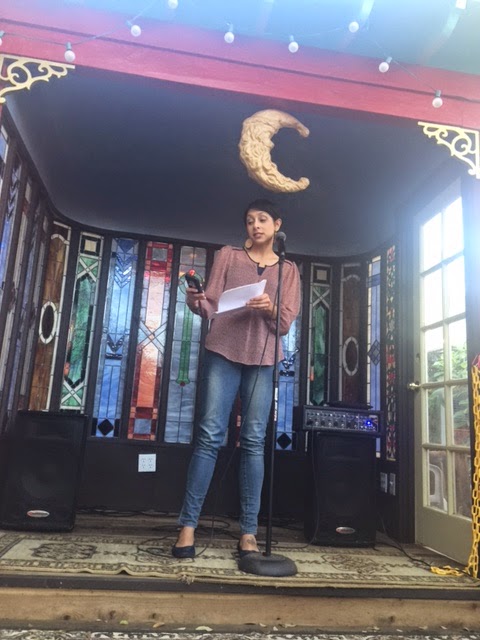
Holy Grounds is a light and airy oasis in the middle of East L.A.'s warehouse district. You really do feel like you're in church, listening to a poet read in front of a stage, surrounded by tall stained glass windows. 
Luivette Resto and Melinda Palacio

I was happy to heed the call of poetry and get "hitched" with Luivette Resto and fill in for Karineh who lost her voice and was under the weather. Luivette and I are often paired together at poetry events since we are both Tía Chucha Press poets. In fact, we have both represented Tia Chucha Press at several events and venues, including Beyond Baroque, the Los Angeles Times Festival of Books, Chicago's Guild Literary Complex, and the Words and Music Festival. 

Perhaps, this was why I felt comfortable reading in my temporary salon chanclas. In the morning, my sister Emily had insisted we get pedicures. This was my first pedicure since I broke my leg in July, and I had forgotten what a great deal of time needed for toe nails to dry. I had planned on putting on my shoes before the reading, but I was at home with fellow female poets on International Women's Day.

Luivette's butterfly tattoo and my spa chanclas.
Luivette closes the show with her memorable poems.
(No RBF here; (you had to have been there))

Poet, Xochitl-Julisa Bermejo was invited to be a curator at Beyond Baroque by then board member and poet, Jerry Garcia, who was also in the audience. In an email, she explained why she moved the series to Alhambra.

         "I was excited for the opportunity because it's a prestigious poetry center with a long history grounded in the Venice beat scene, but running the reading series grew difficult over time because it's a history and community I don't feel particularly connected to. I grew up going to school at the San Gabriel Mission and spent my weekends running after ice cream trucks at my grandparents' house in Boyle Heights, so the east side of L.A. is where my heart is. On top of that, so many exciting things have been happening in the last few years around the east and northeast parts of L.A. that I enjoy and support like the La Palabra and Blue Bird reading series at Avenue 50 in Highland Park, Las Lunas Locas women's writing circle at Here & Now in El Sereno, and the ZzyZx WriterZ, and I just hope HITCHED can add to the scene."

Alhambra avenue is full of surprises. Someone mentioned one of the furniture stores turns into a nightlclub. You never know what you might find, but a respite of poetry and cafe de olla is perfect for a Sunday afternoon. 

Hitched is a quarterly series. The next reading will be June 21 at 4pm and features Rachelle Cruz with Micah Tasaka and Ben Loory with Tommy Moore.  


Sunday, November 16, 2014

Open 24 Hours: An Interview With Suzanne Lummis


Olga García Echeverría


It's not surprising the Suzanne Lummis' newest collection of poetry, Open 24 Hours, was the winner of the 2013 Blue Lynx Prize. These are poems full of texture and poetic sass; they're urban dwellers that live in gritty places, where "...The rubble of smashed / glass makes the sidewalk shine..." In these poems "tenants bitch" and poets get stopped on street corners and asked, "Are you saved?"
 
These poems, born of earthquake and the "art of disaster" ride elevators, witness car crashes, dream about red shoes that do not quite fit. They are heavy-eyed in the A.M. and wide-eyed at night. They're Open 24 hours and they're over-caffeinated. You can hear the racing heat beat in verse...
 
because you've stayed up
all night on nothing
but blues and black
coffee and the sound
of windy traffic
outside your door
which reminds you
of death or is that
the coffee?
 
And although there is lost love and death and even a prisoner in a Chinese fortune cookie factory in this book of poems, there is no whimpering. Only late night Facebook posts that rage against bozos who insist that Obama is a Muslim, who call Oprah "fat," who write things like, "Let the socialists Marxist Libtards / go out and wash all the oil off the fish / and birds, ha, ha, ha." Lummis fires back with:
 
Maybe you just popped out this way,
an ignorant, crude baby determined
to get worse. Oh there's no hope, no hope
for you, except--this: read books, books of quality...
Read the true news or, at least, news
that's closing in on the truth, watch smart TV--
it exists! Aspire to be less stupid.
 
Not even the Sacred Word gets a free pass in Lummis' poetic world. Hey, if it doesn't pay the rent, crown the poet "Most Celebrated Aging Poet Princess in the Land," or birth worthwhile images, then Lummis declares:
 
Pack your bags. Take a hike.
Make yourself scare. Hit
the road, Jack. Blow
town. Split the spot. Buzz
off, push off, shove off. Go fish!
 
Packed with honesty and humor, Lummis delivers a solid collection of verses and curses in Open 24 Hours, and because she rocks she also joins us here today for an interview.
 
Suzanne, welcome to La Bloga and congratulations on your recent publication of Open 24 Hours and on receiving the 2013 Blue Lynx Prize. That must feel pretty wonderful.
 
Yes, I’d like to thank the screeners who did not pass earlier versions of this manuscript on to contest judges, because if it had won a prize and gone to press a few years earlier it wouldn’t have been as good. And some people’s favorite poems, fairly recent ones, wouldn’t have been in it. Moreover, Lynx House Press here on the West Coast is a better publisher for me than some of those others might’ve been. Yes, it was the right publisher, right time, and great good fortune for me.
 
That is very interesting and inspiring. As writers we sometimes think that rejection (of publication, for instance) is a tragic dead-end, but as you mention, sometimes being denied entry in one place/space leads to other possibilities. Are there others you'd like to thank for rejecting your work?
 
I’d also like to thank the two lesser literary journals that rejected “How I Didn’t Get Myself to A Nunnery,” because their rejection made it possible for Paul Muldoon to accept that poem for The New Yorker. (However, let me be clear, I would not like everyone to reject all my writings from here on out, with the idea that rejection is probably in my best interests. I think I’ve had enough for this lifetime, thank you very much.)
 
I love the cover and the title of Open 24 Hours. It feels like a welcome sign at a diner where the everyday and the odd-houred can enter. Is this what you meant by it or does the title mean something else entirely?
 
I’m so glad you like the cover—yes, it makes a forceful impression, nothing wispy about it. For me the title evokes the idea of night owls, restless people awake while others sleep, maybe leaning over a Styrofoam or porcelain cup in one of those low-end hangouts that stay open all night in L.A., donut shops and chain coffee houses. I mean it to refer to a marginal, nocturnal world. 
 
Did you have any challenges with deciding on the final title of your book?  
 
It came to me fairly early on, maybe a third of the way into the manuscript. I was feeling perplexed about what I might call this collection-in-progress. Then I glimpsed a particularly striking Open 24 Hours sign and new that was it. I knew I wouldn’t come upon anything better, and I didn’t.
 
The first section of your book, “Substandard Housing,” has a very strong sense of place. How did this section of your book evolve? Did you plan on creating a series of interconnected poems that lived in the same building or was it more of an organic process?
 
It’s odd, in a way, because I haven’t lived in that building for over 15 years. I wrote many of the poems while there, but continued to write about some of the tenants and memorable incidents after I’d left. I didn’t scope out a design for the manuscript ahead of time, no, in fact, it changed shape many times. At one point the middle section, now called “Broken and in Need of Repair,” was called “Hopeless Desire and Other Common Complaints.” It was damn hard to get these poems to lie down next to each other, because in terms of voice, and sometimes even style, they vary wildly, crazily. It’s not as noticeable now, not jarring anyway, because I finally did organize them so that one leads into the other without causing the reader to yelp in alarm. 
 
My favorite poems in this first section were "7.3" and "664-8630." The former because the poem, like any good earthquake, rattles. I love all those things you worry about in the poem as the earth's tectonic plates are rumbling beneath your feet. I think many of us Angelinos can relate. I've included an excerpt of "7.3" here for our readers to enjoy:
 
But I don't have time to review this life flashing
past my eyes like the preview of a low budget movie,
 
there's death to work on.
Who has copies of my unpublished works?
 
If my cats crawl out of the wreck, how will they live?
Does this mean I'm off the hook for those parking tickets
 
and credit card debts? Like a fool I follow
everyone's advice, leap for the doorframe,
 
which will snap like breadsticks when the floor
caves, the ultimate letdown.
 
When it stops my sense of The Real won't quit
shaking. Bad
 
Earth. The blue-dark mother holds us and her love
turns.
 
Your other poem "664-8630" really spoke to me because a dear friend of mine, tatiana de la tierra, died in 2012. We used to spend a good amount of time on the phone talking and texting. It was one of the things I missed most when she was gone. After she passed, and long after her phone had been disconnected, I used to sometimes send her random texts with some crazy hope that maybe she'd reply. Your poem that ends in that ringing with no answer really struck a cord and made me feel less crazy about wanting to reach the unreachable via a phone number.
 
Olga, thank you for this comment. Yes, it does seem this poem might apply to many lives, and many losses. The phone number was Ted Schmidt’s—he produced both my plays at The Cast Theater, which flourished from the 80s through the mid 90s, and an important playwriting award is named after him here in Los Angeles. However, years later I kind of wished I’d saved that poem for the phone number of the family home in San Francisco, the number that was in use for my entire adult life. When my father died, I called it one last time and felt it ring and ring in the house that would soon be sold. 
 
That childlike question in the poem (why do people die?) is so simple, but I am sure it resonates with anyone who has lost a loved one. Here is the poem you wrote for Ted Schmitt (1940-1990) and for so many others:
 
I pass this number
in my phone book, the seven everyday
digits a sequence I won't dial
anymore--
 
like passing a house abandoned but
filled with echoing
rooms that were lived in. Till
now.
 
If I called I would hear
...what? A buzzing like a station
shut down for the night,
the TV screen filled with
snow?
 
Or has the phone line snapped
overhead, the late messages
heading for a long
fall?
 
No good asking like a child
why do people die? I call
 
but in a room where a man's
things have been folded and packed
as if to follow him on the next train
after
 
a phone rings,
rings, and there is no
answer.
 
In the second section of your book, “Broken and In Need of Repair,” you take some writing rules given by poet professors and friends, such as “No self-pitying poems,” and you purposely break them. What inspired this cool rebellion?
 
During a UCLA lecture open to the public, the late short fiction writer Donald Barthelme mentioned a rule he advised his students never to break, and quite instantly I imagined a way I could write a poem that avoided the problem Barthelme seemed to warn against. That started me on the series. I collected these rules from poet professors, and some were serious, some given to me in a spirit of fun.
 
Did certain rules inspire more rebellion than others?
 
I discovered the rule had to present a real challenge or I couldn’t come up with anything good, and it had to come from a poet or reader who knew what they were talking about. Once, some random person I’d mentioned this series to said something like "I think there should be a rule no more poems about dogs and cats, because there are already so many of those." Well, that’s absurd. There isn’t really a super-abundance, and, anyway, most poems about animals, so long as they’re written by real poets, poets of talent, tend to be quite good. 
 
Do you have a favorite?
 
Above all I love the poem that closes The Selected Poems of Weldon Kees, the one that begins “What the cats do/To amuse themselves/When we are gone/I do not know.” And the reader is aware that Kees would eventually end his life by throwing himself off the Golden Gate Bridge (presumably, his body was never found). But the cats go on, “crying, dancing.” It’s such an innocent, almost childlike poem on the surface, but it takes on an eerie power because of what we know. Talk about structure—brilliant of Donald Justice [the editor of the collection] to place that poem at the end of the book.
 
Can you share a source of inspiration you keep returning to?
 
I continue to like a poem you don’t see anywhere anymore, very early W. S. Merwin, “The Sands,” and one that’s easy to find, “Sheep in Fog,” by Plath, and one that you can’t find anywhere, by someone few have heard of—and, indeed, I hadn’t heard of him-- “Looking for Bluefish” by Jon Swan. Oh, and one that can be found with a bit of luck, “Smudging,” by Diane Wakoski. Gorgeous, the way it gathers to a force at the end. Levine’s “The story of Chalk”—yes.
And as for the unruly side of the poetic spirit, Gregory Corso’s “Marriage,” and the fantastically wild and outrageous “Me viene, hay dias…” by Cesar Vallejo. I don’t know why that one isn’t used in creative writing workshops around the country—it’s so freeing.
 
In closing, here is an excerpt from one of Lummis' own unruly, freeing, and spirited poems.
 
This pale, feverish presence
inside your life is you,
and those are loud strangers
gripping beers. But why die,
ever, while stores shout out
their bargains, hot CD's,
and one can gaze at the bodies
who've stopped dancing now
and stand about jaggedly
because the doorways
of rock clubs pumped them
into open air? No doubt about it,
all this is for you.
Some Doo Wop tune
on the airwave says the night's
thousand shifting eyes
are on the watch. You guess
two of them are yours.
Tonight Mr. Good
or Bad might pluck you
from the crowd.
There's some place you're
supposed to be, some fun
you're supposed to have.
It's fate, your fate, and it's open
twenty-four hours.
 
 
To find out more about Suzanne Lummis: http://suzannelummis.com/
 
Photo by Phil Taggart


Suzanne Lummis' book Open 24 Hours won the Blue Lynx Poetry Award, and was just released by Blue Lynx Press this fall. Her poem "How I Didn't Get Myself to a Nunnery," appeared in the November 3 issue of The New Yorker. And—for contrast—she has two poems in the new anthology of noir poetry and crime fiction, Noir Riot, from Gutter Books. Suzanne is a long-time, influential teacher for the UCLA Extension Writers' Program, and the editor of the anthology to be published in 2015, Wide Awake: Poets of Los Angeles and Beyond, from The Pacific Coast Poetry Series, which was founded by Henry Morro.