
[publisher and author blurbs]
The Cavalie
 r in the Yellow Doublet
Arturo Pérez-Reverte, translated by Margaret Jull Costa
Putnam
From acclaimed and best-selling author Arturo Pérez-Reverte comes the fifth adventure of Captain Alatriste, "the brooding, charismatic hero of his wildly successful Spanish swashbuckling novels" (The New York Times).
In the cosmopolitan world of seventeenth-century Madrid, with its posh theaters and gleaming palaces, Captain Alatriste and his protégé, Íñigo, are fish out of water. But the king and court are keeping Alatriste on retainer—he has proved useful in the past. As a veteran with no other source of income, Alatriste chooses to remain, even as his “employment” brings him uncomfortably close to old enemies. Íñigo, now a young man and veteran of the Hundred Years War, chooses to remain with his master and press his ill-fated romance with the beautiful but sinister Angélica de Alquézar. Alatriste, for his part, begins an affair with the famous—and famously beautiful— actress María de Castro, and discovers that the competition for her favors may be much more dangerous than he’d bargained for, especially when Alatriste and Íñigo become unwilling participants in a court conspiracy that could lead them both to the gallows.
Thursday Night Widows
Claudia Piñeiro, translated by Miranda France
Bitter Lemon
Three bodies lie at the bottom of a swimming pool in a gated country estate near
 Buenos Aires. It’s Thursday night at the magnificent Scaglia house. Behind the locked gates, shielded from the crime, poverty and filth of the people on the streets, the Scaglias and their friends hide lives of infidelity, alcoholism, and abusive marriage. Claudia Piñeiro’s novel eerily foreshadowed a criminal case that generated a scandal in the Argentine media. But this is more than a story about crime. The suspense is a by-product of Piñeiro's hand at crafting a psychological portrait of a professional class that lives beyond its means and leads secret lives of deadly stress and despair. It takes place during the post 9/11 economic melt-down in Argentina but it’s a universal story that will resonate among credit-crunched readers of today.
Claudia Piñeiro was a journalist, playwright and television scriptwriter and in 1992 won the prestigious Pléyade journalism award. She has more recently turned to fiction and is the author of literary crime novels that are all bestsellers in Latin America and have been translated into four languages. Thursday Night Widows won the Clarin Prize for fiction and is her first title available in English.

Child's Play
Carmen Posadas, translated by Nick Caistor and Amanda Hopkinson
Harper
Luisa, a renowned mystery writer, is beginning her new novel, a story of psychological suspense that centers on the suspicious death of a child at an elite private day school. The author has a close familiarity with her setting: her thirteen-year-old daughter, Elba, is about to begin her academic year at the same school that Luisa once attended, a school much like the one in the novel.
But as her work progresses, the line between art and life begins to blur. Deeply repressed anxieties bubble to the surface, and she worries not only for her daughter's well-being but also for her own. As her new novel unfolds, events on the page ring with a disturbing familiarity—a troubling symmetry that is compounded when Luisa runs into two former classmates whose children also attend the school. The unexpected meeting brings to light a gruesome event the three shared.
When Elba is implicated in the accidental death of a classmate, past and present, real life and fiction, become one. Convinced that her novel has set in motion an unspeakable horror, Luisa must find a way to stop it—before everything she loves is lost.
The Holy Bullet
Luís Miguel Rocha, translated by Robin McAllister
Putnam

A fast-paced thriller about the conspiracy surrounding the 1981 attempted assassination of Pope John Paul II, from the author of the international bestseller The Last Pope.
An international journalist, a war-weary Portuguese veteran, a Muslim with visions of the Virgin Mary, a rogue priest, and members of the world's most powerful--and secretive--organizations come together after the suspicious death of Pope John Paul I. A few operatives bold enough to penetrate the Vatican's shadowy inner circle will investigate what went wrong--and try to prevent the popular new pope from meeting the same fate.
In London, journalist Sarah Monteiro is again drawn into the web of international conspiracy, and must reunite--reluctantly--with the mysterious priest/assassin Rafael, and the sinister mastermind known only as JC.
Sarah's and Rafael's commitment to truth and justice could prove to be extremely dangerous, for them and for John Paul II, especially if they discover the true power behind the papal throne.
Luís Miguel Rocha was born in Oporto, Portugal, and worked for many years in London as a television writer and producer. He now lives in Portugal, where he continues to write for television and film.
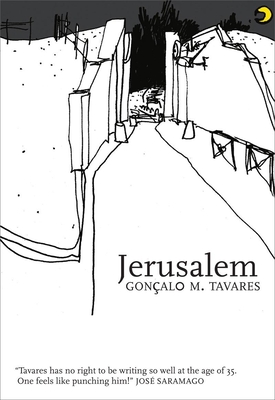
Jerusalem
Gonçalo M. Tavares, translated by Anna Kushner
Dalkey Archive
One morning late in May, between three and six a.m., a group of lonely men and women wait to be brought together, like the elements in an equation. Ernst Spengler is about to throw himself out his window. Mylia, terminally ill and in enormous pain, goes out to visit a church. Hinnerk Obst, who’s always been told by the neighborhood children that he looks like a murderer, walks the streets with a loaded gun. As these characters are manipulated and brought together, a world of violence, fear, pain, and uncertainty is portrayed, where human nature itself, and the mechanisms determining our actions, our fictions, and the elements of our imagination, are laid bare. Jerusalem is a terrifying and grimly humorous summation of the possibilities and limits of the human condition at the beginning of the 21st century.
Gonçalo M. Tavares was born in 1970. He has published numerous books since 2001 and has been awarded an impressive number of literary prizes in a very short time, including the Saramago Prize in 2005. He was also awarded the Prêmio Portugal Telecom de Literatura em Língua Portuguesa 2007 for Jerusalem.
The Last Reader
David Toscana, translated by Asa Zatz

Texas Tech University
In tiny Icamole, an almost deserted village in Mexico's desert north, the librarian, Lucio, is also the village's only reader. Though it has not rained for a year in Icamole, when Lucio's son Remigio draws the body of a thirteen-year-old girl from his well, floodgates open on dark possibility. Strangely enamored of the dead girl's beauty and fearing implication, Remigio turns desperately to his father. Persuading his son to bury the body, Lucio baptizes the girl Babette, after the heroine of a favorite novel. Is Lucio the keeper of too many stories? As police begin to investigate, has he lost his footing? Or do revelation and resolution lie with other characters and plots from his library? Toscana displays brilliant mastery of the novel--in all its elements--as Lucio keeps every last reader guessing.
Mexican novelist David Toscana describes his narrative aesthetics as "realismo desquiciado" (unrestrained realism), breaking with the Latin trend of magic realism through a prose that keeps an eye on the concrete experience of life in all its absurdity and lavish strangeness. In its original Spanish El ultimo lector was awarded the National Colima Prize, the Premio José Fuentes Mares, and the Antonin Artaud Prize and was also shortlisted for Latin America's most important literary award, the Romulo Gallegos International Novel Prize.

The Informers.
Juan Gabriel Vásquez, translated by Anne McLean
Riverhead
When Gabriel Santoro's biography is scathingly reviewed by his own father, a public intellectual and famous Bogotá rhetorician, Gabriel could not imagine what had pierced his icy exterior to provoke such a painful reaction. A volume that catalogs the life of Sara Guterman, a longtime family friend and Jewish immigrant, since her arrival in Colombia in the 1930s, A Life in Exile seemed a slim, innocent exercise in recording modern history. But as a devastated Gabriel delves, yet again, into Sara's story, searching for clues to his father's anger, he cannot yet see the sinister secret buried in his research that could destroy his father's exalted reputation and redefine his own.
After his father's mysterious death in a car accident a few years later, Gabriel sets out anew to navigate half a century of half-truths and hidden meanings. With the help of Sara Guterman and his father's young girlfriend, Angelina, layer after shocking layer of Gabriel's world falls away and a complex portrait of his father emerges from the ruins. From the streets of 1940s Bogotá to a stranger's doorstep in 1990s Medellín, he unravels the web of doubt, betrayal, and guilt at the core of his father's life and he wades into a dark, long silenced period of Colombian history after World War II.
With a taut, riveting narrative and achingly beautiful prose, Juan Gabriel Vásquez delivers an expansive, powerful exploration of the sins of our fathers, of war's devastating psychological costs, and of the inescapability of the past. A novel that has earned Vásquez comparisons to Sebald, Borges, Roth, and Márquez, The Informers heralds the arrival of a major literary talent.
Reviewed for La Bloga by Michael Sedano here.
Season of Ash
Jorge Volpi, translated by Alfred MacAdam

Open Letter
The Soviet biologist Irina Granina has experienced the worst of Communism, struggling to free her husband from the gulag for years. Following the rise of Gorbachev, her husband finally emerges a changed man, but then Irina is forced to witness the worst of capitalism, as her daughter Oksana disappears into the newly rapacious consumer society and she loses her husband again, this time to greed and a lust for power.
In the West, Jennifer Moore, the scion of blue-blooded American wealth, takes a high-ranking job at the International Monetary Fund, where she hopes to bring the tough love of the free market economy to the unenlightened masses the world over. But she also has to deal with a philandering husband, Jack Wells, whose pharmaceutical company is a market wonder built on a house of cards, and her sister Allison, a free-spirited anti-globalization activist.
Jorge Volpi's Season of Ash puts a human face on earth-shaking events of the late twentieth century: the Chernobyl disaster, the fall of the Berlin Wall, the collapse of Soviet communism and the rise of the Russian oligarchs, the cascading collapsing of developing economies, and the near-miraculous scientific advances of the Human Genome Project. A scientific investigation, a journalistic exposé, a detective novel, and a dark love story, Season of Ash is a thrilling exploration of greed and disillusionment, and a clear-eyed examination of the passions that rule our lives and make history.
___________________________________
So many books, so little time.
Later.


