Showing posts with label Mercy Tullis-Bukhari. Show all posts

Monday, December 18, 2023

Sobre The Little Deaths de Mercy Tullis-Bukhari por Xánath Caraza

Sobre The Little Deaths de Mercy Tullis-Bukhari por Xánath Caraza


Mercy Tullis-Bukhari nos presenta una colección de poemas donde la muerte está presente de manera metafórica y física. Como lectores nos hace reflexionar sobre el crecimiento personal, la dureza de vivir en el Bronx en la Ciudad de Nueva York, la muerte de seres queridos, la pérdida de la inocencia ante la vida. Tullis-Bukhari habla desde la diversidad que la ha rodeado toda su vida. Habla de los estereotipos y el empoderamiento que la voz poética percibe a través del dolor de experimentar rechazo, pérdidas o racismo. Tullis-Bukhari crea una voz poética femenina, liberadora y fuerte en sus poemas. No tiene limitaciones para contar las historias de crecimiento, que son generalmente dolorosas, pero que dan fortaleza y enseñan a vivir.


En su primer poema Mercy nos inivita a descubrir un país centroamericano, nuevo a los ojos de una gringa, como la voz poética se autodescribe en los versos. Un país, Honduras, no solo latino, sino una parte de la cultura garifona, de cultura afrolatina, novedosa para la voz poética y, quizá, para muchos de los lectores. Encapsula de manera irónica cómo el viaje se desmorona desde la idea de visitar a Mickey Mouse y, en lugar, llegar a la costa de Los Hondos y de cómo le salva la vida porque la experiencia de ese viaje le abre los ojos a una realidad que al principio fue contrastante pero que marca el resto de su existencia, de manera positiva, al conocer sus raíces, su comida, el encuentro con la cuna familiar y cultural, “…Esta Gringa chased chickens, danced punta, ate la comida of Split coconuts, heard her Mami Yell to curious passerbys con orgullo, ‘Ella es Gringa…’”


El tono de este poemario es la diversidad cultural donde Tullis-Bukhari se mueve. Lo muestra en sutilezas lingüísticas como en su segundo poema donde hace alusión a los genios, seres mágicos, que de manera simplificada pensamos como dadores de deseos. Sin embargo ella se remota a los genios originales, que aunque mágicos, son más malignos que benévolos. Crea un poema donde la voz poética abre sus puertas para alimentar, física y metafóricamente, al genio que encontró en la calle y al final le roba sus más preciadas posesiones sin agradecer el alimento ofrecido que ella preparó. Pienso que Tullis-Bukhari cuenta la historia de muchas mujeres que no son apreciadas por todo lo que ofrecen a entidades masculinas, mágicas o reales, en el mundo de hoy, “…The jinn put all he stole atop my favorite blanket, gathered the corners of the blanket together, swung the package over his shoulder & then, disappeared.”


La voz poética de The Little Deaths es madura. Es una voz experimentada con sabiduría que ha crecido y está consciente de la finitud de la existencia humana, del día a dia en el Bronx en Nueva York, en el país donde se vio forzada a sentir la pérdida de la muerte ya sea física, metafórica o psicológica pero que le ofrece a cambio creatividad, color y fortaleza para disfrutar de este breve pasar por el mundo.


The Little Deaths de Mercy Tullis-Bukhari fue publicado en 2023 por Get Fresh Publishing en los Estados Unidos.


Monday, August 14, 2023

Mercy Tullis-Bukhari Book Release by Xánath Caraza

Mercy Tullis-Bukhari Book Release by Xánath Caraza


Who is Mercy Tullis-Bukhari?


I am a poet, essayist, and fiction writer who is Bronx-bred Afro-Latinx, Honduran and Garifuna, of Jamaican descent. I am also a Callaloo Fellow, and obtained my MFA (my second Master's) in Creative Writing from The College of New Rochelle. I was named one of the “8 Authors Bringing Afro-Latina Stories to the Forefront” by Remezcla magazine and I was a Pushcart Prize nominee in 2016 for my essay "Black Dolls for Everyone." I am an English Language Arts high school teacher in the Southeast Section of The Bronx. Currently I am completing my first novel, having my third book of poetry edited, while living in New Rochelle, NY with my two children. 


As a child, who guided you through your first readings?


I am the youngest of seven. My sisters were readers, and would always go to our local library to borrow books. The Grand Concourse Branch behind Bronx Lebanon Hospital was our local branch. Whenever any of my sisters went to the library, my mother would force them to take me along. Being annoyed, they would take me, but would allow me to wander off in the library while they had their private time. 


My father used to get Archie comic books for me, as well. Every week, we would go to a particular newsstand in a subway station to get the recent Archie books. I was so young, that I cannot recall the newsstand or where we came from or where we were going, but we were always at this particular station. I remember enjoying the comic book on the way home, then rereading it several times before putting it aside, anxiously waiting for the next time we would be at that particular train station for another Archie comic book. 


How did you first become a poet?  


I used to journal my thoughts and feelings. Although I was the youngest of seven, the sibling who was closest to me in age was nine years older than me. My childhood was rather lonely, so my creativity was what kept me company and occupied my time. In one of those trips to the library, I borrowed an anthology of poems specifically geared towards children. I loved the images in the anthology, and the way the words were put together in a way that was different from a story. Immediately, I noticed how so much could be communicated in a few words, with connections that expanded my imagination. In my loneliness, I challenged myself to do the same, to say what I was feeling and what I was thinking in a concise and creative way.


What else would you like to share with our readers?


I am a Black woman who is of Latinx heritage. My children are Honduran-Pakistani-American, Black, with Muslim names. I speak openly about my experiences as a Black woman, and the fears I have for my children in this world we live in. I become taken aback when people immediately dismiss my experiences and fears as generalizations and paranoia. I am an intelligent woman, an extremely thoughtful individual who was raised to see people as individuals. We are, physiologically, not different from each other but as Toni Morrison states, we have all been raced. Because of how the world is created, especially with our current administration, I am constantly reminded of my blackness and of my children’s multi-ethnic background. As a mother with awareness, I feel obligated to inform my children of the ways of the world while still reminding them to be above ignorance and value others as individuals. I feel hurt when people who have always been good to me, whom I have considered my friends, feel hurt by my beliefs, when my beliefs come specifically from interactions with the world as a Black woman. I want white people to understand that my art is inspired by my experiences, not by theirs. I want white people to understand they need to listen to what people of color are saying about their experiences, without minimizing them. White people need to accept that slavery lasted 400 years in this country, and the institution ended--solely through a document--only 160 years ago. The residual effects of that institution inspires me as a writer and as a mother. 


Mercy, thank you for sharing some of your poetry with La Bloga readers. Congratulations on your upcoming book.


La Vida of an African-Latina American


You speak Spanish?

Let me hear you speak Spanish.

You grew up around a lot of Puerto

Ricans, right?

You Brazilian?

Black people don’t speak Spanish.

How is this light-skinned woman your mother?

Pero no saliste como tu mamá.

If only you had your mother’s skin color.

¡Este pelo musuco!

Get a perm to fix your hair.

You got some good hair…back there. You should not

have made them into dreds.

You Cuban?

You are not Black-Black.

Yo no speak-eh good inglés, pero eres Negra.

Yo no speak-eh espanish to you.

Those kids don’t look like you.

How are these light-skinned children yours?

Those kids must look like their father.

Whose children are those?

Are you their nanny?

Are you their babysitter?

Te casaste con un indio, mamita. Mejorasta

          la raza.

Mixed kids are so beautiful.

Mira esa negra.  ¿Qué se cree?

Comb her hair well before you bring

her in this salon.

You are exotic.

You are not like other Black women.

Speak Spanish to me.  I won’t understand

you, but, yo…that shit be turnin’ me on.

Teach your children Spanish.

We are not really Black.

You gotta be Dominican, ma.

You ain’t dark-skinned.  You Hispanic;

          you got that honey-brown tone.

¿Cómo conoces las pupusas?

How did you learn Spanish?

I don’t want grandchildren with

nappy hair.

You have pelo liso now.

Bebes café como un indio.

You are too pretty to be Black.

You are cute, but not pretty.

Pareces una mona.

No hay nada en esta tienda para ti.

Do you work here?

¿Cuánto?

Mira mami, ¿tus pelos abajo son como tu pelo arriba?

¡Qué fea la negra!

You must be proud of your

light-skinned mother.

Is all that your hair?

Being angry must be a cultural thing.

You won’t go far in life

          if you stay natural.

And, why do you know Spanish?


I Saw Celia Perform


…at S.O.B’s with my lover one night—

heard la habanera sing praises

to palm leaves waving whispers of a lost homeland,

of loved negritos bembones being killed,

to carnavals of life,

of salacious black girls con

enough tumbao to make men…


I listened to Celia’s songs,

knowing its familiarity but not its words,

telling my lover,

“Yeah, Abuelita used to play that song.

Abuelita told me her cipota stories,

Of hearing her neighbors say,

Celia está en el pueblo performing,

tenemos que ir.”


…in this West Village night club

overflavored with energy sucking in

other cipotes from abuelitas who had Celia

LPs stacked next to the record player

right under the deviled Jesucristo.

Lifting and showing just a little leg skin

suavecito con sabrosura,

I held on to my lover smiling for Celia’s voice,

emanating high notes without any pain,

louder than the band that needed her to

stay with the tempo.

I reveled in her trip of Latina-ness,

of giving position to Spanish speaking

Africans in the world of limbo-forced ethnic boxes

--I teared,

inebriated por que Cuba really estaba libre in this

smoke-filled, small venue as she waved her regal-colored dress

trimmed with glittering studs, and finessed a wig

spreading and shining

like a sunflower blossoming towards the sun.


My lover and I talked about AZUCAR! with

missed dreams of Cuban fantasies trapped in

highballs of coca, lima y ron, of Latinos

dismissing the non-Castilliano, of

women who still can rock a crowd

after generations of abuelitas and cipotes.


He held on to me because Cuba was freeing itself

from my Honduran-Jamaican existence as I sang


“¡No hay que llorar,

La vida es un carnaval¡”


and I called Abuelita at her home

aware of the hour difference and said

“Vi la reina, Abuelita.”


Vi La Reina.


La Gringa’s First Ride to Los Hondos


Esta gringa flew to Honduras when she was five years old on

the lie that she was going to meet Mickey Mouse because

esta gringa could not stop crying while boarding this

monstrous-size thing that was supposed to stay afloat


high in the air. We flew from Kennedy Airport into clouds,

then over pineapple plantations and banana fields, cows

roaming and campesinos working, sand and beaches con

hondos strong as the ancestors pleading from esta grown


gringa to go back. When we landed, esta gringa asked, Where

is Mickey Mouse? Because, of course, Mickey Mouse should

be waiting for esta gringa on the tarmac. Her mami ignored the

question. She pushed her pass the initial slap of hot humid air,

took her down the aircraft stairs, walked her across the tarmac

into the building of the airport. We searched for our suitcases

in a room where suitcases were thrown at random places on

the floor. We were like roaches scattering when the light goes


on, looking for our bags, yelling across the room “encontre una”

when we found a bag. Mami, slipping a ten dollar US bill

to the woman who manually checked the suitcases we found,

patted the top of the tightly packed items of clothes and soaps

and shoes and more clothes and unknown ducktaped packages

from Tia Melba y Tia Lorna y Tia Carmen (all of whom were

not really mis tias), for abuelita, fulano y fulano y fulano. We


had to return to the airport the following week for one missing

suitcase. Esta gringa, played futbolito barefooted in the sand

that was her soil. Within the confused gaze of the neighbors,

esta gringa swam in the sand granules, and poured buckets of

sand on her head. Esta gringa washed the sand off her body in

the big sink behind the house, the same sink her mami used

to handwash our clothes. Esta gringa chased chickens around

the house, danced punta, ate la comida of split coconuts, and

heard her mami yell to curious passerbys con urgullo, “¡Ella

es Gringa! ¡Ciudana Americana!” Esta grown Gringa looks


back at a time when Gringa status mattered. Esta gringa watched

a Garifuna man walk to a canoe with a net, come back to shore

with fish in his net. She watched a Garifuna woman take a fish

from that net, scrape the scales of that fish, split it open, salt it

and fried the fish en aceite de coco. Her mami squeezed lime on

the fried fish and tajadas. Esta gringa, ate fried fish con tajadas


for lunch. Gracias a dios, Columbus said, that Honduras saved

his lost ass from the depths of the storm, y esta gringa was

saved from a contrived fantasy world of fake-believe dreams

and its minstrel mouse.


Monday, March 13, 2023

Una noche de poesía por Xánath Caraza

Una noche de poesía por Xánath Caraza

The International Women’s Day Poetry Reading happened on March 8 from 7 p.m. – 8:30 p.m. on Zoom.  Here are some of the highlights and photos of la noche de poesía. Words by Nurehşan Guneri, the Intercultural Dialogue Student Association President, the first woman ISDA president, and a recent graduate of UMKC. 


“Intercultural Dialogue Student Association is dedicated to celebrating diversity.  We bring together students from multiple backgrounds, cultures, religions, countries, languages and more to get to know each other and learn about our similarities and differences while creating peace together.  International Women’s Day has celebrated women’s accomplishments worldwide for more than a hundred years.  Thus, our Intercultural Dialogue Student Association International Women’s Day Celebration each year is key in celebrating what and who we stand for. 


Tonight, in order to celebrate International Women’s Day, we have a poetry reading by our distinguished poets. I would like to share the names of our sponsors and co-sponsors. Our event is sponsored by the UMKC Intercultural Dialogue Student Association and the Kansas City Branch of the Dialogue Institute of the Southwest, which is a nonprofit organization in the Greater Kansas City Area and their executive director is Dr. Eyyup Esen. As well, the Women’s, Gender and Sexuality Studies, in addition to the Women’s Center, are co-sponsoring and their program coordinator is Ms. Chelsie Duckworth.” 


“Annette Hope Billings is an award-winning writer, fondly referred to by her readers as "Maya of the Midwest," Annette Hope Billings holds poetry nearest to her heart. She began writing full-time in 2015 after four decades of being a registered nurse. Her first collection of poetry, A Net Full of Hope, won the 2015 ArtsConnect ARTY Award in Literature.  She has written three collections of poetry, her most recent being Just Shy of Stars (Spartan Press). She holds a special interest in new poets and has co-hosted a monthly open mic, Speak Easy Poets, now in its tenth year. Her work can also be found in several anthologies and in print and online publications.”


“Xánath Caraza is a traveler, educator, poet, short story writer, and translator. She writes for La Bloga, and Revista Literaria Monolito. In 2021 It Pierces the Skin received Bronze Medal for the Juan Felipe Herrera Best Book of Poetry. In 2020 Balamkú received second place for the Juan Felipe Herrera Best Book of Poetry Award. In 2019 for the International Latino Book Awards she received Second Place for Hudson for “Best Book of Poetry in Spanish” and Second Place for Metztli for Best Short Story Collection. In 2018 for the International Latino Book Awards she received First Place for Lágrima roja for “Best Book of Poetry in Spanish by One Author” and First Place for Sin preámbulos / Without Preamble for “Best Book of Bilingual Poetry”. Her book of poetry Syllables of Wind / Sílabas de viento received the 2015 International Book Award for Poetry. She was Writer-in-Residence at Westchester Community College, NY, 2016-2019. Caraza was the recipient of the 2014 Beca Nebrija para Creadores, Universidad de Alcalá de Henares in Spain. She was named number one of the 2013 Top Ten Latino Authors by LatinoStories.com. Her books of verse Where the Light is Violet, Black Ink, Ocelocíhuatl, Conjuro and her book of short fiction What the Tide Brings have won national and international recognition. Her other books of poetry are Fără preambul, Μαύρη μελάνη, Le sillabe del vento, Noche de colibríes, Corazón pintado, Perching, Lips of Stone, Jackeline’s Butterfly, and Red Teardrop. Caraza has been translated into English, Italian, Romanian, and Greek; and partially translated into Nahuatl, Portuguese, Hindi, and Turkish.”


“Mercy Tullis-Bukhari is a poet, essayist, and fiction writer who focuses on the woman experience through individuality, motherhood, and sexuality. Mercy was named one of the “8 Authors Bringing Afro-Latina Stories to the Forefront” by Remezcla magazine and was a Pushcart Prize nominee in 2016 and 2018. Mercy’s third anthology of poetry, The Little Deaths, will be published by Get Fresh Books Publishing this year.” 


Monday, February 27, 2023

El Día Internacional de la Mujer por Xánath Caraza

El Día Internacional de la Mujer por Xánath Caraza


El Mes de la Historia de la Mujer se celebra cada año en marzo. Cada 8 de marzo se destaca esta fecha como el Día Internacional de la Mujer para reconocer contribuciones intelectuales, políticas, familiares y de activismo social en las respectivas comunidades donde muchas mujeres viven.  La historia ha pasado por alto, olvidado, reprimido, mal informado, no reconocido los logros de muchas mujeres a lo largo de los años, de los siglos, no solo en este país sino en todo el mundo.

Gracias a la perseverancia de tantas mujeres activistas, estas voces, junto con sus aportaciones a la sociedad, han salido a la superficie y han ido ganando terreno para ser reconocidas públicamente y alcanzar igualdad. 

No en todos los países somos afortunadas de poder honrar estos logros y de reconocer a tantas mujeres que han abierto brecha para cada una de nosotras.  Muchas se han quedado en el camino, otras han experimentado desapariciones forzadas, otras, experimentan violencia doméstica, social o pobreza. Para mí es un honor poder celebrar cada año este día, 8 de marzo, el Día Internacional de la Mujer, que nunca doy por sentado.

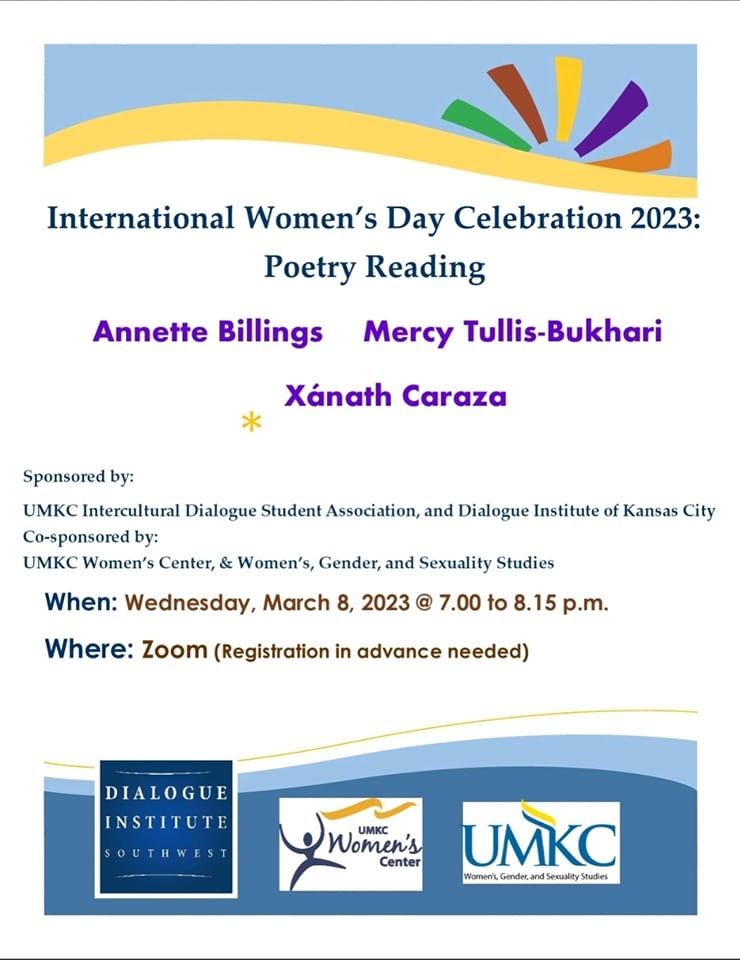
Este 2023, para el Día Internacional de la Mujer, El Dialogue Institute, la Asociación Estudiantil de Diálogo Intercultural de la Universidad de Missouri y El Centro de la Mujer y Estudios de Género y de la Mujer de UMKC celebrarán una lectura de poesía en Zoom el miércoles 8 de marzo de 7 a 8:15 p.m. CST.

Las poetas que formarán parte de este evento son Annette Billings, Mercy Tullis-Bukhari y yo.  Annette Billings es una poeta que radica en el estado de Kansas y Mercy Tullis-Bukhari es una poeta, ensayista y narradora, además de educadora del Bronx.  Para los que no me conocen, soy poeta, narradora y traductora. 

Espero, queridos lectores de la Bloga, que disfruten de este evento para el Día Internacional de la Mujer el próximo 8 de marzo de 2023 de 7 a 8:15 p.m. CST. Habrá que registrarse por adelantado.

¡Que la poesía nos salve!


Monday, January 30, 2023

Interview of Mercy Tullis-Bukhari by Xánath Caraza

Interview of Mercy Tullis-Bukhari by Xánath Caraza


Who is Mercy Tullis-Bukhari?

I am a poet, essayist, and fiction writer who is Bronx-bred Afro-Latinx, Honduran and Garifuna, of Jamaican descent. I am also a Callaloo Fellow, and obtained my MFA (my second Master's) in Creative Writing from The College of New Rochelle. I was named one of the “8 Authors Bringing Afro-Latina Stories to the Forefront” by Remezcla magazine and I was a Pushcart Prize nominee in 2016 for my essay "Black Dolls for Everyone." I am an English Language Arts high school teacher in the Southeast Section of The Bronx. Currently I am completing my first novel, having my third book of poetry edited, while living in New Rochelle, NY with my two children. 


As a child, who guided you through your first readings?

I am the youngest of seven. My sisters were readers, and would always go to our local library to borrow books. The Grand Concourse Branch behind Bronx Lebanon Hospital was our local branch. Whenever any of my sisters went to the library, my mother would force them to take me along. Being annoyed, they would take me, but would allow me to wander off in the library while they had their private time. 

My father used to get Archie comic books for me, as well. Every week, we would go to a particular newsstand in a subway station to get the recent Archie books. I was so young, that I cannot recall the newsstand or where we came from or where we were going, but we were always at this particular station. I remember enjoying the comic book on the way home, then rereading it several times before putting it aside, anxiously waiting for the next time we would be at that particular train station for another Archie comic book. 


How did you first become a poet?  

I used to journal my thoughts and feelings. Although I was the youngest of seven, the sibling who was closest to me in age was nine years older than me. My childhood was rather lonely, so my creativity was what kept me company and occupied my time. In one of those trips to the library, I borrowed an anthology of poems specifically geared towards children. I loved the images in the anthology, and the way the words were put together in a way that was different from a story. Immediately, I noticed how so much could be communicated in a few words, with connections that expanded my imagination. In my loneliness, I challenged myself to do the same, to say what I was feeling and what I was thinking in a concise and creative way.


What else would you like to share with our readers?

I am a Black woman who is of Latinx heritage. My children are Honduran-Pakistani-American, Black, with Muslim names. I speak openly about my experiences as a Black woman, and the fears I have for my children in this world we live in. I become taken aback when people immediately dismiss my experiences and fears as generalizations and paranoia. I am an intelligent woman, an extremely thoughtful individual who was raised to see people as individuals. We are, physiologically, not different from each other but as Toni Morrison states, we have all been raced. Because of how the world is created, especially with our current administration, I am constantly reminded of my blackness and of my children’s multi-ethnic background. As a mother with awareness, I feel obligated to inform my children of the ways of the world while still reminding them to be above ignorance and value others as individuals. I feel hurt when people who have always been good to me, whom I have considered my friends, feel hurt by my beliefs, when my beliefs come specifically from interactions with the world as a Black woman. I want white people to understand that my art is inspired by my experiences, not by theirs. I want white people to understand they need to listen to what people of color are saying about their experiences, without minimizing them. White people need to accept that slavery lasted 400 years in this country, and the institution ended--solely through a document--only 160 years ago. The residual effects of that institution inspires me as a writer and as a mother.  

Mercy, thank you for sharing some of your poetry with La Bloga readers.


La Vida of an African-Latina American


You speak Spanish?

Let me hear you speak Spanish.

You grew up around a lot of Puerto

Ricans, right?

You Brazilian?

Black people don’t speak Spanish.

How is this light-skinned woman your mother?

Pero no saliste como tu mamá.

If only you had your mother’s skin color.

¡Este pelo musuco!

Get a perm to fix your hair.

You got some good hair…back there. You should not

have made them into dreds.

You Cuban?

You are not Black-Black.

Yo no speak-eh good inglés, pero eres Negra.

Yo no speak-eh espanish to you.

Those kids don’t look like you.

How are these light-skinned children yours?

Those kids must look like their father.

Whose children are those?

Are you their nanny?

Are you their babysitter?

Te casaste con un indio, mamita. Mejorasta

          la raza.

Mixed kids are so beautiful.

Mira esa negra.  ¿Qué se cree?

Comb her hair well before you bring

her in this salon.

You are exotic.

You are not like other Black women.

Speak Spanish to me.  I won’t understand

you, but, yo…that shit be turnin’ me on.

Teach your children Spanish.

We are not really Black.

You gotta be Dominican, ma.

You ain’t dark-skinned.  You Hispanic;

          you got that honey-brown tone.

¿Cómo conoces las pupusas?

How did you learn Spanish?

I don’t want grandchildren with

nappy hair.

You have pelo liso now.

Bebes café como un indio.

You are too pretty to be Black.

You are cute, but not pretty.

Pareces una mona.

No hay nada en esta tienda para ti.

Do you work here?

¿Cuánto?

Mira mami, ¿tus pelos abajo son como tu pelo arriba?

¡Qué fea la negra!

You must be proud of your

light-skinned mother.

Is all that your hair?

Being angry must be a cultural thing.

You won’t go far in life

          if you stay natural.

And, why do you know Spanish?


I Saw Celia Perform 

…at S.O.B’s with my lover one night—

heard la habanera sing praises

to palm leaves waving whispers of a lost homeland,

of loved negritos bembones being killed,

to carnavals of life,

of salacious black girls con

enough tumbao to make men…


I listened to Celia’s songs,

knowing its familiarity but not its words,

telling my lover,

“Yeah, Abuelita used to play that song.

Abuelita told me her cipota stories,

Of hearing her neighbors say,

Celia está en el pueblo performing,

tenemos que ir.”


…in this West Village night club

overflavored with energy sucking in

other cipotes from abuelitas who had Celia

LPs stacked next to the record player

right under the deviled Jesucristo.

Lifting and showing just a little leg skin

suavecito con sabrosura,

I held on to my lover smiling for Celia’s voice,

emanating high notes without any pain,

louder than the band that needed her to

stay with the tempo.

I reveled in her trip of Latina-ness,

of giving position to Spanish speaking

Africans in the world of limbo-forced ethnic boxes

--I teared,

inebriated por que Cuba really estaba libre in this

smoke-filled, small venue as she waved her regal-colored dress

trimmed with glittering studs, and finessed a wig

spreading and shining

like a sunflower blossoming towards the sun.


My lover and I talked about AZUCAR! with

missed dreams of Cuban fantasies trapped in

highballs of coca, lima y ron, of Latinos

dismissing the non-Castilliano, of

women who still can rock a crowd

after generations of abuelitas and cipotes.


He held on to me because Cuba was freeing itself

from my Honduran-Jamaican existence as I sang


“¡No hay que llorar,

La vida es un carnaval¡”


and I called Abuelita at her home

aware of the hour difference and said

“Vi la reina, Abuelita.”


Vi La Reina.


La Gringa’s First Ride to Los Hondos

Esta gringa flew to Honduras when she was five years old on

the lie that she was going to meet Mickey Mouse because

esta gringa could not stop crying while boarding this

monstrous-size thing that was supposed to stay afloat


high in the air. We flew from Kennedy Airport into clouds,

then over pineapple plantations and banana fields, cows

roaming and campesinos working, sand and beaches con

hondos strong as the ancestors pleading from esta grown


gringa to go back. When we landed, esta gringa asked, Where

is Mickey Mouse? Because, of course, Mickey Mouse should

be waiting for esta gringa on the tarmac. Her mami ignored the

question. She pushed her pass the initial slap of hot humid air,

took her down the aircraft stairs, walked her across the tarmac

into the building of the airport. We searched for our suitcases

in a room where suitcases were thrown at random places on

the floor. We were like roaches scattering when the light goes


on, looking for our bags, yelling across the room “encontre una”

when we found a bag. Mami, slipping a ten dollar US bill

to the woman who manually checked the suitcases we found,

patted the top of the tightly packed items of clothes and soaps

and shoes and more clothes and unknown ducktaped packages

from Tia Melba y Tia Lorna y Tia Carmen (all of whom were

not really mis tias), for abuelita, fulano y fulano y fulano. We


had to return to the airport the following week for one missing

suitcase. Esta gringa, played futbolito barefooted in the sand

that was her soil. Within the confused gaze of the neighbors,

esta gringa swam in the sand granules, and poured buckets of

sand on her head. Esta gringa washed the sand off her body in

the big sink behind the house, the same sink her mami used

to handwash our clothes. Esta gringa chased chickens around

the house, danced punta, ate la comida of split coconuts, and

heard her mami yell to curious passerbys con urgullo, “¡Ella

es Gringa! ¡Ciudana Americana!” Esta grown Gringa looks


back at a time when Gringa status mattered. Esta gringa watched

a Garifuna man walk to a canoe with a net, come back to shore

with fish in his net. She watched a Garifuna woman take a fish

from that net, scrape the scales of that fish, split it open, salt it

and fried the fish en aceite de coco. Her mami squeezed lime on

the fried fish and tajadas. Esta gringa, ate fried fish con tajadas


for lunch. Gracias a dios, Columbus said, that Honduras saved

his lost ass from the depths of the storm, y esta gringa was

saved from a contrived fantasy world of fake-believe dreams

and its minstrel mouse.