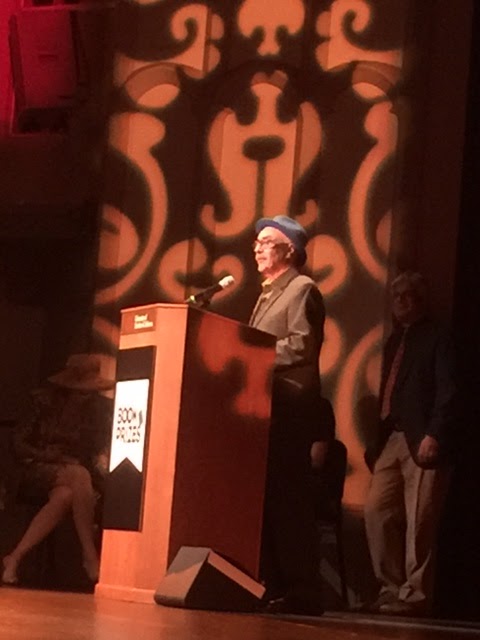
Guest post by Francisco Aragón
 |
| Juan Felipe Herrera (photo courtesy of Letras Latinas) |
JFH
testimonio on the occasion of a laureateship
I.
In 1984 the San Francisco Bay Guardian—a progressive weekly—published a poem titled “Autobiography of a Chicano Teen Poet.” It'd won First Prize in its annual poetry contest. It began:
I am a downtown boy, handcuffed
when I was eleven
for being accomplice to armed robbery.
I speak shoe-shine parlour brown and serve
as the only usher in Club Sufrimiento 2001
You can call me Johnny B. Nice.
The speaker in this irreverent piece goes on to invoke Thelonious Monk and Janis Joplin. I was in high school. This was my first encounter with Juan Felipe Herrera.
Two years later I joined the staff of the Berkeley Poetry Review (BPR) as a college sophomore. Reviewing submissions one day in the BPR’s campus office, I opened an envelope stuffed with Herrera’s poems—two would soon grace our pages. After the issue came out, we asked him to read in a series we held on the grounds of the Berkeley Art Museum on Sunday afternoons—the Swallow Café. He graciously agreed.
And yet I can’t paint with precision the particulars of our first meeting. Instead, I remember sitting in a metal folding chair in San Francisco, mesmerized by the performance he was giving at Small Press Traffic, a modest storefront on the corner of 24th and Guerrero—five-minutes on foot from the house I grew up in. Once, I sat in a café on 24th, below Mission just off Capp, sipping coffee and chatting with Herrera and Margarita Luna Robles. We’d gotten to know each other some, and we had a mutual friend: Francisco X. Alarcón. I remember buying Arte Público Press’ 1985 edition of Exiles of Desire, a collection whose first iteration had came out in 1983 with Lalo Press. Herrera did notpay a reading fee to enter a book contest. He got his start by publishing in, and for, his immediate community—a model I’m partial to. I remember devouring Exiles of Desire, but not only for its art. It was a book rooted, in good measure, in a geography that I considered mine: San Francisco’s Mission District—its cafés, BART stations, murals, street names: 16th, 24th, Valencia, Bartlett, Capp, Harrison. But there’s more. These were the Reagan years, and you knew it because some of the poems didn’t shy away from one of the pressing issues of that era: U.S. foreign policy in Central America. As a Latino of Nicaraguan descent who kept up with these things, I viewed Herrera as an early model on how one’s art need not be divorced from politics.

If Exiles spoke to me with its familiar cityscapes, Facegames,published in 1987 with As Is/So&So Press, is the book where he took notable strides in what I'll call a poetics of play. Here’s a gem I never tire of:
Inferno St.
I am dressed for the occasion.
My lover’s torso of enigmatic jade haunts you,
doesn’t it?
My grandmother’s last wish stalks
the plateaus where the night watchman lives.
Look at me
and the ravenous soldiers I break bread with.
Switchblade,
Little silver boy,
guide me into the multi-night.
I remember loving that last line, but lacking a tidy logic with which to express why. Herrera was that kind of writer for me: he was just fun to read. The term “non sequitur” wasn’t in my vocabulary then, so I wouldn’t have identified his brilliant use of non sequiturs here. I suspect my ear intuitively took in the subtle assonant rhymes that spilled from one stanza to the next—the sounds echoing, gluing the words, this wordscape, into place. “Inferno St.” was one of the 10 poems from Facegames that were included in, Half of the World in Light: New and Selected Poems (University of Arizona Press, 2008), winner of the National Book Critics Circle Award.
Here’s a piece that did not make that 10-poem cut, but which reads like a companion to “Inferno St.” and which I also recall delighting in:
Quazar
for Picazzo, Pancho “Big Man”, Rodrigo and “El Piloto”
I have tried to rule the world many times, alone
and in congregations.
I do it best when I get dressed up.
See my camouflage pants rolled up to the calf?
My lime green Greek shirt
puffed out like a chile relleno,
an earcuff
to check the stray mind
and my orange-black shoe laces tied
around my ankles for the would-be connoisseur of male
and female gesture.
All you have to do is discover a pageant;
raise up your left hand,
then run fast,
bring it in like hara-kari & tumble on the soft belly
of the earth;
Lust,
Laughter,
more L’s
and a so-what all over your Brown self!
If “Inferno St.” hints at something ominous—where a grandmother’s wish can stalk, where soldiers are ravenous, where you might need to pack a switchblade, Herrera is more light-hearted in this piece, though he still highlights fashion’s accoutrements (“an ear cuff//to check the stray mind”). But it’s the way that last line invokes Latinidad without taking itself too seriously that really seduced me:
and a so-what all over your Brown self!
In 1989 a Santa Cruz-based publisher, Alcatraz Editions, put out AKRILICA, Juan Felipe Herrera’s dazzling dual-language collection: the poems, written in Spanish, were translated into English by a team of four translators, along with the author.
Over 20 years later, Carmen Giménez Smith and I would form a partnership between Noemi Press and Letras Latinas. We’d seek to publish Latino/a writers whose aesthetic proclivities were more, shall we say, outside the box—defying expectation. When it came to deciding what to call this series, we thought about the poetry, and we thought about the trajectory…of Juan Felipe Herrera. Then we remembered that singular, collaborative, small press obra maestra: AKRILICA. And so we had the name (as homage) for our joint publishing project.
I continued, of course, to follow Herrera's work post-AKRILICA, admiring its ambition, its scope, its wild variety. But I have a soft spot for these early volumes. I suspect it has mostly to do with when I encountered them, those formative years.
And yet a place, a space, I associate with those years—let’s say 1982 to 1989—appears in a poem of Herrera's from a much later book, Notebooks of a Chile Verde Smuggler (University of Arizona Press, 2002). There's this poignant series titled "Undelivered Letters to Victor"—a reference to VictorMartinez, whom Herrera met at Stanford—that really caught my eye, # 9, in particular:
Undelivered Letters to Victor
#9
I want to rock in Tede Matthews's America and his Hula Palace—remember Tede Matthew's? Ted out-gay talking about Nicaragua, doing the reading series at Modern Times? Ted working hard through AIDS, through pain and the end, with gaunt face, febrile fingers, and starry eyes? Ted's drawn face calls and his clear eyes peer through me. Battles, missions, random intersections, chaos, time and culture boosters, explosions; I want writing to contain all this because we contain all this—is this closer to what you mean by saying we are Americanos? Is this your mission? You know, Victor, I am going to say it—no more movements, nothing about lines or metaphors or even about quality and craft, you know what I mean?
When the terms “San Francisco” and “bookstore” and “poetry” mingle in a conversation, inevitably someone will mention that mecca known as City Lights. I love the “poetry room” at the famed North Beach bookstore as much as anyone, but mypersonal mecca was Modern Times Bookstore on Valencia in the Mission.
In 2011, Modern Times was displaced and now resides—as Modern Times Bookstore Collective—on lower 24th, also in the Mission. Here’s what its website says about what I consider its golden era, given what the Mission has become today:
“In 1980, we moved into a store in the Mission district, a predominantly Latina/o neighborhood. At that time, writers, artists, and queers from all over were moving to the Mission, attracted by cheap rent, to take up residency next to already thriving Latina/o cultural spaces and movements, including Galeria de la Raza and the Mission Cultural Center.”
During high school and college (when I was home for a visit from UC Berkeley across the bay), I always anticipated the end of my fifteen-minute stroll to Modern Times—the browsing, the pulling poetry off the shelf to read, the putting it back, before walking back to my house on Fair Oaks maybe one, two hours later. I remember the time I purchased Ernesto Cardenal in English translation (I couldn’t yet read Spanish).
Tede Matthews was often the familiar friendly face I encountered at Modern Times. I had no idea who he was and what he represented. Francisco X. Alarcón would explain it to me years later. Juan Felipe Herrera would include a substantive gloss of him in his moving short essay, “Chicano Gay Poets,” published on the web at FoundSF—a community-based online resource (“Your place to discover & shape San Francisco history”).
This is what I bring, as a reader, to “Undelivered Letter to Victor, #9.”
When it came time, in 2006, to ask someone to write the Foreword to, The Wind Shifts: New Latino Poetry (University of Arizona Press, 2007), who else could I ask but him?
“The Sweet Vortex of the Singers” by Juan Felipe Herrera is a text he, and only he, could have written. Let me pluck a paragraph and you’ll see what I mean:
“In this vortex of creation, congestion, and notation, many artists, writers, subjects, things, and places are in gestation: Darío, Madrid, Montale, Beijing, Apollinaire, and Cendrars make cameo appearances, juxtaposed with metros, Hamas, and Mediterranean tides and further navigations of the poet’s speakers in fluid and borderless urban nations and cafés stumbling into loss and illuminations. Lorca rolls in wet and delirious and Nicaraguan. Terms repeat in tumbao rhythms, and pregnant fruit is sliced and devoured—bodegas, explosions, rooftops, and bullets. Prada, Gucci, and Havana drip into the body-flask, this abyss of letters.”
II.
Since the appearance of Rebozos of Love (Tolteca Publications, 1974), Juan Felipe Herrera, author of some twenty books, has distinguished himself as a poet, performance artist, children’s book author, teacher, university professor, and cultural activist for the last forty years.
While his more recent distinctions include the aforementioned National Book Critics Circle Award (2009), a Guggenheim Fellowship (2010), election to the Academy of American Poets’ Board of Chancellors (2011), and designation as the Poet Laureate of California (2012), I would argue that during the first twenty or so years of his literary activity, he pretty much glided under the radar, where recognition outside of California is concerned. It’s only been in the last ten or so years that his work has gained the national critical attention and acclaim it justly merits.
What thoughts swirl inside of me as I ponder that Juan Felipe Herrera has been named the next Poet Laureate of the United States?
In addition to the playfulness I’ve alluded to earlier, his is also a poetics of deep empathy toward the people that populate his writings. And to quote Rigoberto González from his Poetry Foundation blog post, Juan Felipe Herrera’s oeuvre also offers, crucially, “an important timeline of Chicano political history and social activism” in this country.
His persona embodies an exuberance that will, I predict, enrich and delight the men, women and children he will come into contact with during his term (s).
I don’t think I speak for myself only when I say that his selection is a long overdue gesture that acknowledges artistic communities that are often overlooked by oblivious gatekeepers.
In this sense, his U.S. Poet Laureateship, like no other in my view, feels, fully, like the People’s Poet Laureateship.
As this news sinks in, I find myself asking: what moments in recent (literary) history does this one feel akin to. These are mythree:
1. In 1990, early into my ten-year residence in Spain, I learned that the late Oscar Hijuelos had won the Pulitzer Prize. I immediately went to Madrid’s English language bookshop and purchased, The Mambo Kings Play Songs of Love. Reading it, I was transfixed by the way Hijuelos captured particular registers—modes of speaking—of his urban characters. They sounded like people I knew growing up. My heart swelled.
2. Two years later, in 1993, what I remember most about the news accounts of Toni Morrison winning the Nobel Prize for Literature, was the tenor, not the contents, of the comments made by Henry Louis Gates, Jr. I came away with, and was moved by, a deep sense that for Gates, an African American scholar, Toni Morrison’s Nobel was one of the highlights not only of his career, but of recent African American history. In other words, Morrison’s Nobel was something larger than herself.
3. (no surprise here): Richard Blanco’s selection as Inaugural Poet
Recently, Juan Felipe shared with me, over dinner, that when he was introduced to Georgette Dorn, the long-serving Head of the Hispanic Division at the Library of Congress, who’d been informed of his selection, she whispered to him:
“I’ve been waiting for you for a very long time.”
Note: This
essay first appeared on June 10, 2015, at Letras
Latinas Blog, a program of Letras Latinas—the literary initiative at the
University of Notre Dame’s Institute for Latino Studies
Francisco Aragón is the author of Puerta del Sol (Bilingual Press) and Glow of Our Sweat (Scapegoat Press). He
is also the editor of, The Wind Shifts:
New Latino Poetry (University of Arizona Press). A native of San Francisco,
he is a faculty member of the Institute for Latino Studies at the University of
Notre Dame, where he directs Letras Latinas, whose various projects include
“PINTURA:PALABRA, a project in ekphrasis,” a multi-year collaboration with the
Smithsonian American Art Museum’s travelling exhibit, “Our America: Latino
Presence in American Art.”
************************************************************************
New from Reyna Grande...
 |
| Reyna Grande on the migrant trail in Arizona. |
Thirty years ago last month, I crossed the border illegally through Tijuana. At nine years old, I found myself running through the darkness, trying to find a place to hide from "la migra." I crossed the border for one reason--to be reunited with my father. I was lucky. I made it on my third attempt, and I began my new life in the U.S. with my father by my side. I went on to become the first in my family to graduate from college, and later an award-winning writer published by
Simon & Schuster.
But I never forgot where I came from.
This is why I have launched a campaign to help migrants in need. For the next 45 days, I will be conducting a
fundraiser behalf of Casa Del Migrante, a migrant shelter in Tijuana.
Though the border wall has made it harder for migrants to cross the border through Tijuana, many migrants still arrive daily to this city just like I did 30 years ago. Many of these migrants arrive needing shelter, food, and a safe place free of abuse and peril.
Casa Del Migrante, a migrant shelter founded by Catholic priests, provides this safe haven for migrants by offering food, medical attention, psychological and spiritual support, legal services, and resources for job training and placement. In addition to the border crossers, many of the migrants arriving at Casa Del MIgrante are deportees from the United States. With almost 1,000 people being deported daily, shelters like Casa del Migrante are crucial. The facility provides assistance to these deportees who oftentimes are released in Tijuana with no money and no way to get back to their home. At Casa Del Migrante they receive three meals a day, a shower, clean clothing, and are allowed to stay at the center for up to 12 days.
Another group of migrants arriving at Casa Del Migrante are refugees from troubled areas of Mexico and Central America. These are people who are fleeing violence and persecution in their regions. They come with nothing but the clothes on their backs and the hope of obtaining humanitarian visas for entry into the United States.
Migrants in transit can find themselves in a vulnerable place, sometimes falling victim to kidnappings, extortions, rape, or worse. Casa Del Migrante is at the front line in the battle against abuses of migrants in transit.
Please help Casa del Migrante continue to serve the migrant population. Your donation today will put a roof over a migrant's head, food in his belly, and hope in his heart.
Thank you for making a difference in the life of a migrant!
Reyna Grande
*****************************************************************
A Pause for Peace
Peace. Cynthia Hurd, 54; Susie Jackson, 87; Ethel Lance, 70; Rev. DePayne Middleton-Doctor, 49; Hon. Rev. Clementa Pinckney, 41; Tywanza Sanders, 26; Rev. Daniel Simmons Sr., 74; Rev. Sharonda Singleton, 45; Myra Thompson, 59.
Peace.