Showing posts with label Juan Felipe Herrera. Show all posts

Friday, January 24, 2020

U.S. Poet Laureates to Visit Santa Barbara

Melinda Palacio


King Palms in Santa Barbara


Thanks to recent rains, Santa Barbara has returned to its lush, pre-drought splendor. If the clear winter skies and balmy weather prompts a visit to paradise, consider dates when you have the opportunity to hear the current and former U.S. Poet Laureates speak.

In less than two weeks, Joy Harjo will speak at the Santa Barbara Natural History Museum, February 5 at 7:30 pm, 2559 Puesta del Sol, SB, CA 93105.


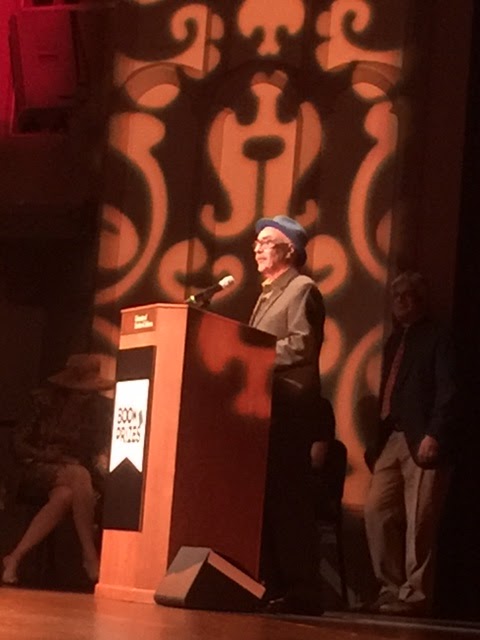
U.S. Poet Laureate Emeritus Juan Felipe Herrera visits speaks at the Santa Barbara Museum of Art, Sunday March 8 at 1:30 pm, 1130 State Street.

There's something very special about hearing a poetry event at a museum. For a poet, it means the opportunity to write your poetry based on the museum's exhibits. I hope to see many La Bloga readers at these two events. Clear your calendars.

Sunday, April 24, 2016

All That and a Bag of Poetry: Creative Writing with 5th Graders at Gulf Elementary


Olga García Echeverría


When we say poetry, it is really the vision for all voices. That's really what it means. People ask me, What is poetry, Juan Felipe? I say, It is freedom. That's what it is. That's what everybody has, and when you use your own voice, your own personal voice, freely, the real you, then we're all united.
 
--Juan Felipe Herrera
From the 21st U.S. Poet Laureate Inaugural Reading


Once a week, I venture south on the 110 towards San Pedro. My destination: Gulf Elementary School in Wilmington, California. My mission: creative writing workshops with 5th graders.
 
On the days I visit the 5th graders, I rise before the roosters crow. I sip on strong coffee in the shifting morning light. I pack energy snacks and a hearty lunch. It's an hour-plus drive from my home to Wilmington. On some parts of the commute, traffic clears and I fly. On others, the highway's arteries are clogged. I nudge forward like a slug, past downtown, the 10, the 105, the 405.
 
I know my exit is approaching when I spot the billowing white smoke of the oil refineries, a Wilmington trademark. These industrial chimneys coughing up smolder and fumes are hard on the eyes and lungs, but lately I've begun to envision the large pipes painted in rainbow colors, puffing out fat cumulus clouds. Soon it will rain poetry, I think. And as soon as I park my car and enter Gulf Elementary School, it does.
 
“Ms. Olga! Ms. Olga!” a preadolescent voice yells.
 
When I turn, a group of kids with wide sonrisas are waving their arms up into the sky as if they're flagging down airplanes. In an instant, this boisterous morning saludo shakes off the lethargy of post-traffic-trauma that has settled on my body like a heavy winter coat. I feel lighter—dare I say younger?--via these kids' enthusiasm. I wave back as if I were disco dancing. It's gonna be another great day in Wilmington, y'all.
 
 
During the next 5 hours, I'll meet with about 120 of these loud little people who smile a lot and ask such interesting off-topic questions...
 
“Is it true that if I drink coffee, I won't grow?”
“Can you please bring us a Chinese calendar next week?”
"What's your favorite taco?
“Do you believe in purple llamas?”
 
These are the brown, bilingual children of Wilmington, lovers of pizza, Cheetos, donuts, and tacos. They talk a lot and make their way through the day with a glazed look of wonder in their eyes. Do I believe in purple llamas? This could very well be my long-lost tribe.


I meet with five different classes during my visits at Gulf Elementary. I have about an hour with each group. 5th grade time, though, is a vortex. It's a location, a colorful crowded room full of desks, chairs, books, posters, activities, and awesome teachers who master Silence Signals. The teachers I work with orchestrate silence with a hand, a countdown, a clap, a stare. I watch in awe. Without a Silence Signal in the 5th grade, I have learned, you have to project your voice like a football coach or an opera singer. Without a Silence Signal your words may get drowned out by the beautiful buzzing of bees. To be honest, I am a sucker for noisy classrooms. Art, after all, rattles and strums and stomps and sings. In my college classes, I pull teeth to get students to share opinions and interact; here with the 5th graders, the rambunctious classes are, in my opinion, signs of success.  (All this to say that I have not mastered the Silence Signal).
 
When you're on 5th grade time, the minutes fly by faster than hummingbirds. “Less Is More” rings true week after week. The writing exercises need to be short, focused, and fun. If you loose them and they start to wander like a disoriented flock, good luck. I aim to keep the 5th graders engaged, all of us moving forward together as we graze on leaves of grass, poetry.


We practice Six Word Memoirs, sensory description, similes, metaphors, haiku, acrostic poems. We read and discuss Sandra Cisneros' “My Name” and then ponder why our parents named us what they did. What were they thinking? Are you named after someone? Whose name did you inherit? If your name were a color, what color would it be? If you could rename yourself for fun, what new names would you choose for yourself and why? Every week, we attempt to do as Juan Felipe Herrera's poem instructs, “Let Us Gather in a Flourishing Way...” We gather, we read, we play, we write, we blossom, we flourish.  
 
 
Along the way, even when one is flourishing, there are inevitable poetic mishaps. Some of the kids write memoirs with 5 or 7 words instead of 6. Syllable get miscounted. Line breaks and margins collapse and poems landslide off the page onto the desks. Someone's assignments disappear. Words are misspelled in both English and Spanish. Kids go overboard with the glitter glue. Students steal each others' lines and arguments ensue, “Hey! I said that first!” One student, ecstatic at having successfully completed her first haiku, yells out, “I wrote a jacuzzi!”


And yet, all of these things are part of the journey. Imagine what would happen to the creative spirit if we kept interrupting it (silencing it) with corrections? Three of our essential rules at Gulf Elementary are...express yourself, be creative, and have fun! There are other rules, of course, but these are the essential ones.
 
 
Last week, I invited poet and teacher A.K. Toney to join and guide us in the making of poetry books out of paper lunch bags. Ever since I learned the art of making paper bag books from A.K. back in 2014, I've been a paper bag convert and worshiper. (You can read a previous blog on A.K. and his poetry books at http://labloga.blogspot.com/2014/09/passion-power-and-paper-bag-poetry.html)


Much can be said about the day A.K. visited us at Gulf Elementary. The kids absolutely loved his charisma, humor, and 5th grade charm. We participated in call-and-response chants about honoring our words and the trees we write on. We broke up each class into two large groups. I took one side of the class, A.K. the other. Like the poets that we are, we went with the flow and handled paper bag emergencies and glitter glue catastrophes with calm. At times we needed a bullhorn to be heard, but it was exhilarating watching a room full of eager hands folding, cutting, pasting, creating.
 
 
After the last class left and we finished cleaning and packing up all our supplies, we laughed at the intensity of it all. It was a day full of mini-tornados and electrical currents. Whirlwind and lightning. I laid down on the floor for a few minutes to catch my breath and center myself. A.K. lifted his arms towards the ceiling, stretching. Yes, the 5th graders worked us to the bone. Yes, it was beyond WILD. But this is part of the gathering and the flourishing; this is what poetry-book-making in the hands of 5th graders looks like.


Poetry classes at Gulf Elementary are made possible by Amy Eriksen and Angels Gate Cultural Center, LAUSD, Principal David Kooper, Gulf staff, the awesome 5th grade teachers (Ms. Peralta, Ms. Uchida-Smith, Ms. Solache, Ms. Reiland, and Ms. French) and, of course, all the children who show up, open themselves up to poetry, and participate weekly.

Friday, April 22, 2016

Poetry, Awards, (and Shadows) in the Air

Melinda Palacio
Mayor Helene Schneider Proclaims Poetry Month in Santa Barbara.

April is National Poetry Month. I was fortunate to have witnessed the declaration of Poetry Month in Santa Barbara by Mayor Helene Schneider. She read the proclamation and handed the ornate sheaf to Santa Barbara Poet Laureate, Sojourner Kincaid Rolle.

Standing with SB Poet Laureate Sojourner Kincaid Rolle


Earlier in the month, I had the pleasure of seeing Juan Felipe Herrera receive the Robert Kirsch Award for lifetime achievement at the Los Angeles Times Book Awards, part of the festivities of the Los Angeles Times Festival of Books, held at USC April 9 & 10.
Juan Felipe Herrera 
It was wonderful to hear the polite audience erupt in grand enthusiasm for our poet who has just been appointed to second term as Poet Laureate of the United States, the first Chicano with the honor of National Poet Laureate.
The Poet's Shadow


Our Poet Laureate pays respect to his roots during his acceptance speech.

Walking back with his award and shadow.

Juan Felipe Herrera and Melinda Palacio


Initially, I wasn't going to attend the festival of books, let alone the awards ceremony, but I'm sure glad I did. I almost let a little rain and overall exhaustion from having rallied to make all of my reading and panel commitments at the AWP conference, only a week earlier in Los Angeles, and only a few days after the funeral services for my grandmother. My first day at AWP I struggled to find my voice. I arrived on Thursday and had missed the offsite reading for the Coiled Serpent release party (I also missed the Coiled Serpent events at the book festival due to not quite being myself after spending a month in Del Rio before my grandmother's funeral). In the evening, during the Con Tinta Pachanga and the reading for the Poetry of Resistance anthology,  I had the biggest frog in my throat. John Martinez filmed all the readers. I was not aware of being videoed or taped. However, I am glad the event was documented even if I wasn't able to give 100 percent. I followed through with the reading, along with my two panels, and an interview with the Griffith Park Reading Series. Although both Vicky Vertiz and Veronica Reyes, organizers of my AWP panels, along with Sara Finery Turgeon of the Griffith Park Reading Series, had given me an out and said that I did not have to attend, given my grievous state, I was determined to follow through with my literary commitments.

A week later, I kept asking myself why I had set so many plans in motion and had agreed to another big book event in Los Angeles. In my mind, I was thinking that this book event would be just for fun. I'd tag along with Reyna and we would catch up and relax and attend I was under no obligation to present or read. It would be a nerdy book vacation for two days, and a chance to acquaint myself with all of the changes in Downtown L.A. since I moved to Santa Barbara. However, after hearing that fellow Bloguero, Michael Sedano was in the hospital and that we wouldn't have a chance to catch up at the festival and seeing the rare sight of rain, along with a terrible accident on the 101, I had second thoughts about spending another weekend downtown. While I was driving to Los Angeles, I rehearsed a new script. I was going to tell Reyna that I would have lunch with her and then I was going to drive back home. Reyna Grande was one of the ceremony's presenters and she got me a ticket and seat in the front row. We missed most of the book festival, but arrived in time for Reyna to participate in the award ceremony's dress rehearsal while I spent an hour taking in as much of the book festival as I could. The best part was running into my old pen pal from High School. I thanked him for his handwritten correspondence and urged him to write me a new letter after all these years (I hope he does). In addition to Reyna's presentation and Juan Felipe's award, I was pleasantly surprised to see that La Bloga's own, Sam Quinones, was nominated for an award in the the Current Issues category for his book, Dreamland: The True Tale of America's Opiate Epidemic. Last, Valeria Luiselli's novel, The Story of My Teeth, won in the Fiction category. This same book also garnered the First Fiction award last year. Read Olga Garcia Echeverria's review of this unique novel on La Bloga. 


Reyna Grande presented the award for debut novel to Chigozie Obioma for The Fishermen.


It was nice to see La Bloga's Sam Quinones up for a Current Interest Award.

La Bloga Represents

Reyna Grande and Melinda Palacio

Happy Poetry Month. Read some new poetry anthologies for a sampling of voices: Coiled Serpent: Poets Arising from the Cultural Quakes and Shifts of Los Angeles, edited by La Bloga's Daniel Olivas and Neelanjana Banerjee, and Ruben J. Rodriguez (Tia Chucha Press 2016) and Poetry of Resistance: Voices for Social Justice (University of Arizona Press 2016), edited by Francisco X. Alarcón and Odilia Galván Rodríguez, Rare Feathers: Poems on Bird & Art, edited by Nancy Gifford Chryss Yost, and George Yatchisin (Gunpowder Press 2015).

If you missed hearing about my big poetry event and art show in Santa Barbara earlier this month, you can read about it here on La Bloga for April 08.

Happy Earth Day!
Happy National Poetry Month!
Happy Jazz Fest in New Orleans! 

Sunday, September 20, 2015

How A Girl in Pieces Owns All The Words: A Conversation with Isabel Quintero

Olga García Echeverría

Today we have la fabulosa Isabel Quintero in the house, chismeando conmigo about writing, publishing, and her YA novel, Gabi: A Girl in PIeces.

I have so much to say about this book full of barrio sass and sazón, but honesty, I don't think I can sum up the novel better than our own poet laureate, Juan Felipe Herrera. Here is what Herrera has to say about Gabi: A Girl in Pieces:


"Meet Quintero’s high school 'fat girl' Gabi, eating and starving and fighting and writing her way through the crushing pressures of high school boy desire, religious approval and Mexican cultural taboos of 'living in sin.' A 'smiling' good 'virgin' girl or an 'ofrecida,' 'slut'? And in-between these frozen and fearful versions of womanhood, there are blurred, bloated and violated girls: straight girl with gay boy, abandoned pregnant girl with 'parading' boy, raped girl with defender girl. And quinceañeras, and familia and suspensions and carne asada and churros where the soft body stretches, boils in grease and is cut to fit the Mexican girl mouth as it burns. Reminiscent of early Chicana writers such as Evangelina Vigil and Lorna Dee Cervantes, I cannot think of any book today for young adults as voracious, bold, truthful and timely – as this one. Who is courageous enough to read this prize-winning YA novel?"

If this blurb doesn't convince you that this book is a must-read, check out the bio at the end of this bloga that highlights all the awards Quintero's novel has received since it's publication in 2014, among them the 2015 William C. Morris Award for Debut YA Novel, the 2015 Tomas Rivera Mexican American Children's Book Award, and the California Book Award Gold Medal for Young Adult.

Pues, without further ado, here's the literary wiri wiri.

Isabel, so great to have you here at La Bloga. I loved your novel Gabi: A Girl in Pieces. It's wonderful to see a young strong Latina character who navigates her senior year and so many issues via her own wits and heart. She felt very real, very believable.
 
Gracias, Olga. I really appreciate that.

I enjoyed all the parenthetical comments throughout the novel that help capture Gabi's humor and sarcasm. Me hizo reir La Gabi muchas veces. It also made me think about how as a writer you must have some of that sarcasm, attitude, subversive back-talk. Where did you get that from?

Pues, one of my things my mom always told me was que era muy hocicona. I have always questioned things, though sometimes not verbally. Growing up it always bothered me how I was expected to behave because I was a girl and what I was allowed to want and not want. And I wanted everything--sex, dating, good grades, good schools, traveling, drinking, equality, justice.

But, I was often reminded that as a girl my options were limited. My mom didn’t want me to leave home to go to college because that meant que quería libertinaje. Freedom to do what I wanted was often, for some reason, attached to sex. Which is strange, but I guess it makes sense. Maybe my mom knew deep down, that having freedom also meant having ownership of my body and that scared her, porque quién sabe qué cochinadas I’d do.

This issue of freedom and gender roles shows up in your book in various way. Yet Gabi, even in her moments of struggle, shows a lot of agency.

Believing that one is free is different from acting like one is free, and I think that’s where Gabi has a hard time, because she knows she wants to do more than fantasize about what that freedom would be. We can think freeing thoughts all the time, thoughts hurt no one. But asserting freedom, pues agarte because it will most likely disrupt someone else’s power structures, and that gets ugly and often painful.
 
Were there any scenes in the book that you struggled with?
 
The abortion section was one. Only because I wanted to make sure I didn’t throw in this thing that I feel strongly about. So I did some research to make sure it was accurate. Another was one I can’t talk about or I spoil a section of the book. And then, Tia Bertha’s change at the end. At one of the high schools I visited, Lincoln Heights, a student asked me why I had waited so long in making Tia Bertha change. The truth is, she wasn’t going to, but I was rewriting that damn ending so many times, that I began to feel bad for her and yeah, she changed.
 
That's awesome, that in your constant reworking of the ending you began to feel sorry for your character Tía Bertha and that she got transformed in the process.
 
You know, pensándolo bien, the ending was what gave me the most trouble. It always ended with that last line, but the rest was different. Originally, there was a poem about Gabi accepting herself as she was, it was too forced, and I knew it but didn’t want to change it. My publisher finally made me face the reality. Though to be honest, I am still thinking of better ways to end the book.

That's funny. I remember a visual artist telling me once that even when his art was framed and up on the wall of a museum, he kept wanting to remove the glass and add lines and color. Speaking of images, one of my favorite sections of the book was the zine On The Female Body. 
 
You know, I am not a zinester, but I like zines, and I’ve tried to put together a few, and have some half finished ones.
 

Very Cool Body Pieces in Gabi: A Girl in Pieces

How did the zine part in Gabi: A Girl in Pieces evolve?

I learned about zines from Angela Asbell, an adjunct professor and activist at CSUSB. I liked the idea and tried to do some at home but didn’t like how they turned out and tossed them. One day she had a zine day at her house and, at this point I had already been working on the poem [used in this section of the book], and I starting making a zine that would go with the poem. I thought it would be a good format, though I wasn’t sure what I wanted to do with the zine when I was done with it. When I rewrote Gabi, from verse to prose, I knew that was why I had been doing the zine, for her, and that’s where it belonged. Cinco Puntos liked the idea, and at one point the zine was supposed to be a separate component, but that was too costly.


Were there things you couldn't or didn't include in the zine because it was a YA novel?

As for content, I think I got all I wanted in there. The targeted audience is not who I worry about; young people, I think, are more open about a lot of issues. Adults are the ones who often forget what it is like to be young and create a different reality about youth; one that is free of drugs, heartache, sex, and violence. Obviously, this is not true for everyone, but I’ve encountered adults who believe that drugs, violence, and sex in a teenager's life, not only among them but as a part of their daily existence, is a new phenomenon.

Yes, I totally agree. I think it's adults who create taboos around issues. But the youth, they seem to gravitate towards work that tells it like it is. How have young readers responded to your book?


Gabi from A Girl in Pieces Has Got It Right!
You know, the response has been better than I could ever have imagined. I get a lot of, “You’re talking about my high school!” or “That sounds just like my mom or my tía!” or “Thanks for painting fat girls in a real way.” So, those responses are great. I feel really good when readers can connect to Gabi’s questioning of gender roles, especially teens who are going through some of the same issues she is going through. I feel like I’ve done my job.

Did you always know this was a YA novel you were writing?

I think I did know it was YA when I began writing the book in 2007, but it was a novel in verse back then. I had just finished reading Juan Felipe Herrera’s crashboomlove, and K.L. Going’s Fat Kid Rules the World. Those books really helped me see what YA could be, and helped me remove some biases that I had about it. So, I began writing, Photographs of a Fat Girl, which was the original title. It was a much different book then, that although a first person narrative, revolved around photographs, not a diary.

I saw on Facebook recently that you were in Tulsa, Oklahoma, doing a series of readings there at the Martin Regional Library and at high schools in the area. How was that experience?

It was my first time in Oklahoma and I had a great time. The students were receptive, especially at East Central High School. After my presentation they had great questions about the writing process, publishing and of course the book. I’ve also been to some festivals, most recently I was at the San Antonio Book Festival and I did a Literary Death Match in which Luis Alberto Urrea was a judge. Dios mio, that was something. And this weekend it will be the Brooklyn Book Festival. It’s been a wonderful journey so far.
 
You know that golden rule that we always hear as writers, “write everyday”? What's your writing process like?

Tough question. I try to write everyday. Try. But it doesn’t happen. Sometimes I do get writer’s block. Daniel Jose Older, author of Shadowshaper, posted a blog post last week about how there is a myth around writing that we have to write our thousand words or more every day to be real writers, and that sometimes makes us feel ashamed when we don’t do it. I think I agree with him.

I write when I need to write, which is almost everyday. Some days, on really good days, I can write 8-10 hours without changing clothes, eating, or talking to anyone. On really bad days though, I can’t even put together an effing sentence. But I know I’ve gone too many days without writing when I start feeling really sad and lost.
 
And when you do write. What's your process?
 
When I do write, a ver, I prefer mornings or late evenings. If in the morning, I’ll drink black coffee and maybe some sort of carb filled goodness–pan dulce, cookies or toast. I love toast. Then I eat lunch, and get back to it. In the evening, I’ll write after dinner and I’ll drink cold black coffee, iced tea, lemonade, or just water, and go until I can’t anymore. Sometimes that’s a few hours, and sometimes that’s until 2:00 am. But that’s by no means a formula I live by. I do try to get in walks somewhere in there, too. Oh, and I read my work out loud to myself too.
 
Latino writers have been negotiating the use of Spanish in the publishing world for a very long time. It's refreshing to see more books like yours that 1) include Spanish and 2) don't feel obligated to italicize or translate everything.
 
To be honest, at first I did have the words in italics, but it felt wrong. Really wrong, because not only was it confusing with inner dialogue, but it seemed to exotify something I didn’t want to exotify. It made me feel like a traitor, but I didn’t know how publishing worked, and I didn’t have the confidence to say so. Cinco Puntos asked me if I really wanted to italicize the words and I said not really, and they said good because they didn’t either. Now, I wouldn’t think about italicizing the Spanish.
 
It's great to hear that Cinco Puntos encouraged dropping the italics. Did you encounter any resistance from others in the literary world?
 
Ha. There was only one major incident where something was written that said that one of the reasons I wouldn’t win the Printz was because my lack of a glossary. Which was really irritating, because I immediately put my teacher hat on, and wanted to say, “What do we do when we don’t understand a word in a text?”

Exactly. Look it up, verdad? It's good for the brain.
 
Luckily, librarians defended the lack of a glossary. I didn’t use Spanish where I didn’t need it; I created a character who is Mexican American, and speaks Spanish, English, and Spanglish. 
 
What advice would you give women writers out there who are wanting to publish their stories, poems, or first books?
 
Write, read, submit. A lot. If you want to write, write. Know that rejection is part of game and it is not personal (usually). Know that you will get writer’s block, but you can get through it. Likewise, know when to kill your darlings–sometimes it just doesn’t work. Get involved in a writing community, it was the best thing I ever did. It has helped me grow so much as a writer and you have a support group when things don’t go well and a cheering section when they do. It means a lot.

Be true to yourself, to your own voice, to what you want to write, not what you think others want you to write or you should be writing. As women, and as women of color, it can get tough out there. There are expectations about what and how we should be writing. I have a Native writer friend, Erika Wurth, author of Crazy Horse’s Girlfriend, who cannot find a home for her second novel because she keeps getting told it’s too dark. Too dark! I don’t think men would be told this. There are still assumptions about what women should write, and what women of color should write. I remember sitting at a workshop with another friend, a poet who is half-Native and half-Mexican, who doesn’t really speak Spanish, and one of the people in the workshop told her she should use Spanish in her work to make it authentic. I was like what the hell is going on? I think we are often asked to perform our cultures and gender in stereotypical, one-dimensional ways, in ways that make people comfortable, and when we don’t, when we say, “I’m queer/I’m transgender/atheist/don’t speak Spanish/don’t live on a reservation/like Hank Williams” people get upset and question our authenticity. But I say, fuck it, haci soy aunque les duela. No somos moneditas de oro, and god forbid we try to be.

RIP Michele Serros
An important lesson you have learned post the publishing of your first book?
 
Don’t be afraid to speak up for yourself. The late great poet Michele Serros’ gave me a great piece of advice, “Your book is your baby and no one is going to care about it like you would, so you need to stand up for it.” It’s hard to do at first but we have to do it. Also, it’s a lot of work to promote your book; it’s not just fancy sandwiches and breakfast tacos at book festivals. So, be ready a hecharle ganas con las dos manos.


Gracias for your time and all your thoughtful insights, Isabel. Anything else you'd like to add?
 
Thanks for the great questions. If you want more information about my work, appearances, or other chisme, follow me on Twitter @laisabelinpieces or visit my website laisabelquintero.com


Isabel Quintero is a writer and adjunct faculty instructor. The daughter of Mexican immigrants, she was born, raised, and resides in the Inland Empire of Southern California. Isabel also sits on on the board for a non-profit literary arts organization, PoetrIE. Gabi, A Girl in Pieces from Cinco Puntos Press, her first novel, is the recipient of the 2015 William C. Morris Award for Debut YA Novel, the 2015 Tomas Rivera Mexican American Children's Book Award, the California Book Award Gold Medal for Young Adult, 2015 Paterson Prize for Books for Young People, the 2015 Peggy Miller Award for Young Adult Literature, and was named a finalist for 2015 PEN Center USA Literary Award and the 2015 Walden Award. Gabi, A Girl in Pieces has also been included on the Amelia Bloomer Project List of Recommended Feminist Reading for ages 0-18, School Library Journal's Best Books of 2014, 2015 Capitol Choices: Noteworthy Books for Children and Teens, and is one of Booklist's Best Books of 2014, among other lists. In addition to writing fiction, she also writes poetry and her work can be found or is forthcoming in Huizache, As/Us Journal, The Acentos Review, The Pacific Review, and others.


Tuesday, September 08, 2015

Culminating Catharsis. La Familia, the Poem. Finding Cuba. Losing Voices. Hot Glass

Michael Sedano

It was the kind of invitation that piques my interest. A group of writers would workshop over a four week period then present a public reading of work that emerged from the workshop series. Some would be debut writers, I inferred, from the event description that noted

The purpose of project is to provide a new opportunity for those in the community, to tell their stories. It's through the process of these new opportunities that we hope to encourage the members of the community to gain a newfound sense of self, leading to empowerment.

With my ongoing project to photograph poets and writers reading their stuff aloud in quest of The Pefect Public Speaker Foto, the reading, dubbed Culminating Catharsis, would present writers at the front end of careers as readers of their own work. I would have the opportunity to photograph them here in their debut, then follow them through open mics, then their first feature at a Bluebird or La Palabra reading, then their book launch signing.

Jessica Ceballos

Highland Park’s Avenue 50 Studio hosted the workshops organized by Ebony Williams and facilitated by Avenue 50 Studio’s indefatigable arts liaison, Jessica Ceballos.

The workshops offered a therapeutic element, with such workshops as Gloria Enedina Alvarez’ Taller Espejo Voz, Embodied Narratives conducted with Zoë Etkin, A Conversation in Letters, with Our Emotional Pain with Jessica Ceballos, and What's Your Toy Story? led by series organizer Ebony Williams. The series garnered a grant from Poets & Writers Magazine through the James Irvine Foundation, and had added support from the Historic Highland Park Neighborhood Council.

Click here for details of the project.

Ebony Williams 

The reading space at Avenue 50 presented a wondrous challenge to the photographer who eschews flash. A searingly hot day, the main gallery would be heated by the west-facing storefront glass. The north-facing back gallery borders the Gold Line tracks with a drive-in portal that allows refreshing breezes but plays havoc with exposure.

To their credit every reader presented themselves fully, no microphone, no lectern, just them and their manuscript in front of the seated audience and a roving photographer. That’s a major hurdle, presenting yourself like this, no armor or barricade to hold onto. It’s all uphill for them from here.

Wyatt Underwood


I hope each reader took the time afterward to ask themselves three questions: what did I like about my reading? What will I do more of next time? What will I do less of next time?

Going into a reading with a plan gives the reader something specific to like, or change. For instance, the readers in “Culminating Catharsis” will want to develop three elements next time they take three minutes out of an audience’s life: Project, Personalize, Relax.

Carol

Project means talking louder but it doesn’t mean shout. Projection means channeling the energy of a phrase into its expression, speaking so the person in the back row can understand the words. Readers should remind themselves that their first objective is to be heard.

Personalize means eye contact more than anything, at first. Readers whose eyes remain on the device or typescript are only pronouncing words. A considered reading is a way to make and share something in common with the audience, looking people in the face is the first step in forming community.
Rossana Perez

Relax means movement and gesture, first, then play. Public readers grow tense, their muscles seize up, their eyes bore in on the page. Channel that energy into a gesture, a step or two forward and to the side. Enjoy what’s happening. Honor the labor put into the words and deliver those emotions and intuitions with clarity and the voice that speaks from the page.

Jacklin Romine

Note: One of the best ways a reader can develop vocal resources is reading to kids. No kid or group of kids will tolerate a dull reading. They will demand noises and voices and wide-eyed description from a completely engaged reader. Take that sense of relaxation with you to the next reading you do for adults.

DW Jacobs

Marta Mora


Dani

I hope Dani and Carol see this foto essay and send in their names. La Bloga-Tuesday apologizes for the omissions.

Late-breaking news
U.S. Poet Laureate "La Familia" Project to Launch

La Bloga friend, sci-fi writer Sabrina Vourvoulias, who edits Philadelphia's Al Día News broke the news:

La Bloga will share details of the submission process as those become available. Per Al Día, Herrera will personally select the monthly inclusions.


Literary Havana For the Año Nuevo


La Bloga friend Tom Miller, who authored Trading with the Enemy: A Yankee Travels Through Castro's Cuba, will lead a tour into Havana's literary life. Food, lectures, Hemingway, murals, cultura, free time fill the itinerary.

Per the tour's website, 
Meet the people of Cuba and enjoy the music and culture of the island. Your trip to Cuba will expose you to the island’s literary qualities as they have developed from pre-independence to the life of writers today. This visit allows Americans to understand the Cuban people and experience the country through the eyes of its writers with the expert guidance of a seasoned Cuban observer, Tom Miller.

For details on the itinerary, registration, business details, visit Miller's tour site, link here.


Floricanto in Memory of Lost Words

When words die. (for Manuela Ochoa)
By Arnoldo García

My grandmother suffers a stroke
and the natural world receives a mortal blow.
The healer, la curandera, dies.
With her,
the plants that spoke through her hands
the plants that allowed us to ingest them
the plants that healed stomachs, bee stings,
fevers, rashes, upset emotions, made
conversations flow deep into the evenings
preceded by prayers and riddled
with laughter, healthy gossip, insights
the plants that illuminated stars and nights
died with her.
In the season that was to be winter for
my skin and autumn for my eyes.

Abuelita's nature, la naturaleza humana,
the crowbar of her tongue
prying open the language of leaves, roots, seeds
germinating words that rub, soothe, relax

Dirt under her fingernails
her palms smooth as her face
where leaves, roots, seeds rest
before ingestion,
before toasting them
on a griddle the size of her lungs,
her heart a molcajete firme

What lies behind my eyes?

Fields, horizons, hands,
humans rocking gently back and forth,
silhouettes harvesting the future

My grandmother kneeling between
two rows of green beans
picking
then suffering a heart attack

Behind my eyes
the sing of a frog
the whirlwind
a Yakama ancestor in our migrant camp
the broken horse of loneliness
who eats grass from my hand

I spend nights
ironing towels
until they are untouchably hot
and press them up against
my grandmother's breasts
her angina has flared up
and the heated towels ease the pain
and this is her final remedy
before getting up to make tortillas
and beans for tacos that we'll eat in eight hours for lunch
which she'll wrap in wax-paper

Everyone is at work
the harvest season
spares no time
spares no one

She is in pain (because she told me)
She cringes and leans left as if someone
has just punched her breast
and screeches out a syllable of hurt.
She leans up against the table
where there is a stack of testales
ready to be unrolled into tortillas
She momentarily rubs her left arm
and under her breast
with the right hand she quickly
pulls and flips the three tortillas
that are cooking on the comal...

She will die working in the fields.
We bury her as the harvest season is close to ending
Her casket is rained upon.
We celebrate, eat food, make music, laughter, families.
Tomorrow we return to work without her.

*

With her left: mint, chile verde, pipian, enchiladas, jardines, rosas, lirios, unknown plants, their leaves and seeds, aceite de víbora de cascabel, her hands that coerced fevers and pain out of our bodies with gentle massages, her daily rituals, foodmaking, working in her gardens after work, loving her grandchildren, speaking with her sons and daughters every day and night. Her prayers and praying, her daily visits with neighbors, her footprints in the fields, her hands on the vegetables.


12-Year Old Kids Can Learn Glass-blowing: Worthwhile Fund Raiser for L.A. Eastside Kids

La Bloga friend and extraordinary glass sculptor Jaime Guerrero is in the final days of a fund-raiser to build a glass-working studio in Boyle Heights. Jaime's skill and experience are free. The money goes to buy the special ovens and hardware used to create art in glass.

Please read Jaime's letter then give what money you can so kids can learn this rare skill with the capacity to create uniquely beauteous arte.

We have about a week to reach our goal and we are dead in the water. If you were thinking of helping but were waiting to see how far we got; this is the time to make a contribution...we are so close. If you already donated but now are in a place to contribute a little more, please do so. The last 4 days have not been very productive. So we are asking you to please help us get over the top. Ideally we are trying to reach a $20k goal. This will ensure that we stay open and give us enough resources to give employment to some of my former students. With their help I can teach more classes and reach more local youth as well as give much needed employment to some of my former students.

Friends, I have never asked anyone for money before; it's not something I am particularly good at or feel comfortable doing. But many of you have been witness to the work I have done and the lives this work has impacted. The age to reach youth before they get socialized in the streets is 12 years old. My free workshops will target this age group. Starting at the age of 12, I will be offering completely 100% free ongoing classes. I have taught in Watts for 4 years and have had huge success getting youth from this age group to respond positively to the art of glassblowing. Like a good friend recently posted, "These programs give the next generation the outlets and opportunities they need to succeed. Every piece made is an individual challenge followed by a great sense of accomplishment!" One thing I have noticed with a lot of these youth that find themselves in the crossroads is that due to their environment they have extremely low self-esteem. Glass blowing gives youth the confidence to tackle life challenges so they are more productive and better equipped to confront tough situations in a positive way. Many youth in underserved communities lack communication skills and the ability to work well with others. Glassblowing is a team effort so it forces them to interact and articulate their ideas to each other, which ultimately gives them the tools to communicate and work better with others outside of glassblowing.

I work hard to give my students every opportunity available to them. I have taken them to two glass conferences, have facilitated a collaboration that ended up in a museum exhibition, have prepared them to produce items to sell so they can generate income from their craft in several different market opportunities, and most recently I have taken students to NY on a scholarship awarded to them by the Corning Museum of Glass. I made sure their work was ready and photographed, wrote recommendation letters for them, and put their packets together. Then I sent in their packets so they could be considered for that opportunity. A lot of time and extra effort was put forth gladly without any sort of compensation to me, in many occasions made possible with my own resources. Why do I do this? I do it because I was once given a rare opportunity that made all the difference in the world to me. It's a small effort that can truly change someone's life. My only way to show my gratitude is to do the same for others. Below are a few photos of some of the things my students have participated in due to my efforts with the glass program in Watts. PLEASE HELP ME CONTINUE THIS WORK!

Link: https://www.kickstarter.com/projects/1443933664/a-chance-at-glass-a-resource-for-underserved-youth

Friday, June 19, 2015

Juan Felipe Herrera Week Continues on La Bloga/Guest Post by Francisco Aragón/ A campaign by Reyna Grande/ A Pause for Peace

Guest post by Francisco Aragón

Juan Felipe Herrera (photo courtesy of Letras Latinas)

JFH

testimonio on the occasion of a laureateship

I.

In 1984 the San Francisco Bay Guardian—a progressive weekly—published a poem titled “Autobiography of a Chicano Teen Poet.” It'd won First Prize in its annual poetry contest. It began:

I am a downtown boy, handcuffed
when I was eleven
for being accomplice to armed robbery.

I speak shoe-shine parlour brown and serve
as the only usher in Club Sufrimiento 2001

You can call me Johnny B. Nice.

The speaker in this irreverent piece goes on to invoke Thelonious Monk and Janis Joplin. I was in high school. This was my first encounter with Juan Felipe Herrera. 

Two years later I joined the staff of the Berkeley Poetry Review (BPR) as a college sophomore. Reviewing submissions one day in the BPR’s campus office, I opened an envelope stuffed with Herrera’s poems—two would soon grace our pages. After the issue came out, we asked him to read in a series we held on the grounds of the Berkeley Art Museum on Sunday afternoons—the Swallow Café.  He graciously agreed.

And yet I can’t paint with precision the particulars of our first meeting. Instead, I remember sitting in a metal folding chair in San Francisco, mesmerized by the performance he was giving at Small Press Traffic, a modest storefront on the corner of 24th and Guerrero—five-minutes on foot from the house I grew up in. Once, I sat in a café on 24th, below Mission just off Capp, sipping coffee and chatting with Herrera and Margarita Luna Robles. We’d gotten to know each other some, and we had a mutual friend: Francisco X. Alarcón. I remember buying Arte Público Press’ 1985 edition of Exiles of Desire, a collection whose first iteration had came out in 1983 with Lalo Press. Herrera did notpay a reading fee to enter a book contest. He got his start by publishing in, and for, his immediate community—a model I’m partial to. I remember devouring Exiles of Desire, but not only for its art. It was a book rooted, in good measure, in a geography that I considered mine: San Francisco’s Mission District—its cafés, BART stations, murals, street names: 16th, 24th, Valencia, Bartlett, Capp, Harrison. But there’s more. These were the Reagan years, and you knew it because some of the poems didn’t shy away from one of the pressing issues of that era: U.S. foreign policy in Central America. As a Latino of Nicaraguan descent who kept up with these things, I viewed Herrera as an early model on how one’s art need not be divorced from politics.


If Exiles spoke to me with its familiar cityscapes, Facegames,published in 1987 with As Is/So&So Press, is the book where he took notable strides in what I'll call a poetics of play. Here’s a gem I never tire of:

Inferno St.

I am dressed for the occasion.

My lover’s torso of enigmatic jade haunts you,
doesn’t it?

My grandmother’s last wish stalks
the plateaus where the night watchman lives.

Look at me
and the ravenous soldiers I break bread with.

Switchblade,
Little silver boy,
guide me into the multi-night.

I remember loving that last line, but lacking a tidy logic with which to express why. Herrera was that kind of writer for me: he was just fun to read. The term “non sequitur” wasn’t in my vocabulary then, so I wouldn’t have identified his brilliant use of non sequiturs here. I suspect my ear intuitively took in the subtle assonant rhymes that spilled from one stanza to the next—the sounds echoing, gluing the words, this wordscape, into place. “Inferno St.” was one of the 10 poems from Facegames that were included in, Half of the World in Light: New and Selected Poems (University of Arizona Press, 2008), winner of the National Book Critics Circle Award.

Here’s a piece that did not make that 10-poem cut, but which reads like a companion to “Inferno St.” and which I also recall delighting in:

Quazar
for Picazzo, Pancho “Big Man”, Rodrigo and “El Piloto”

I have tried to rule the world many times, alone
and in congregations.

I do it best when I get dressed up.

See my camouflage pants rolled up to the calf?
My lime green Greek shirt
puffed out like a chile relleno,

an earcuff

to check the stray mind
and my orange-black shoe laces tied
around my ankles for the would-be connoisseur of male
and female gesture.

All you have to do is discover a pageant;
raise up your left hand,
then run fast,
bring it in like hara-kari & tumble on the soft belly
of the earth;

Lust,
Laughter,
more L’s
and a so-what all over your Brown self!

If “Inferno St.” hints at something ominous—where a grandmother’s wish can stalk, where soldiers are ravenous, where you might need to pack a switchblade, Herrera is more light-hearted in this piece, though he still highlights fashion’s accoutrements (“an ear cuff//to check the stray mind”). But it’s the way that last line invokes Latinidad without taking itself too seriously that really seduced me:  

and a so-what all over your Brown self!


In 1989 a Santa Cruz-based publisher, Alcatraz Editions, put out AKRILICA, Juan Felipe Herrera’s dazzling dual-language collection: the poems, written in Spanish, were translated into English by a team of four translators, along with the author.

Over 20 years later, Carmen Giménez Smith and I would form a partnership between Noemi Press and Letras Latinas. We’d seek to publish Latino/a writers whose aesthetic proclivities were more, shall we say, outside the box—defying expectation. When it came to deciding what to call this series, we thought about the poetry, and we thought about the trajectory…of Juan Felipe Herrera. Then we remembered that singular, collaborative, small press obra maestra: AKRILICA. And so we had the name (as homage) for our joint publishing project.


I continued, of course, to follow Herrera's work post-AKRILICA, admiring its ambition, its scope, its wild variety. But I have a soft spot for these early volumes. I suspect it has mostly to do with when I encountered them, those formative years. 

And yet a place, a space, I associate with those years—let’s say 1982 to 1989—appears in a poem of Herrera's from a much later book, Notebooks of a Chile Verde Smuggler (University of Arizona Press, 2002). There's this poignant series titled "Undelivered Letters to Victor"—a reference to VictorMartinez, whom Herrera met at Stanford—that really caught my eye, # 9, in particular:

Undelivered Letters to Victor

#9

I want to rock in Tede Matthews's America and his Hula Palace—remember Tede Matthew's? Ted out-gay talking about Nicaragua, doing the reading series at Modern Times? Ted working hard through AIDS, through pain and the end, with gaunt face, febrile fingers, and starry eyes? Ted's drawn face calls and his clear eyes peer through me. Battles, missions, random intersections, chaos, time and culture boosters, explosions; I want writing to contain all this because we contain all this—is this closer to what you mean by saying we are Americanos? Is this your mission? You know, Victor, I am going to say it—no more movements, nothing about lines or metaphors or even about quality and craft, you know what I mean?

When the terms “San Francisco” and “bookstore” and “poetry” mingle in a conversation, inevitably someone will mention that mecca known as City Lights. I love the “poetry room” at the famed North Beach bookstore as much as anyone, but mypersonal mecca was Modern Times Bookstore on Valencia in the Mission.

In 2011, Modern Times was displaced and now resides—as Modern Times Bookstore Collective—on lower 24th, also in the Mission. Here’s what its website says about what I consider its golden era, given what the Mission has become today:

“In 1980, we moved into a store in the Mission district, a predominantly Latina/o neighborhood. At that time, writers, artists, and queers from all over were moving to the Mission, attracted by cheap rent, to take up residency next to already thriving Latina/o cultural spaces and movements, including Galeria de la Raza and the Mission Cultural Center.” 

During high school and college (when I was home for a visit from UC Berkeley across the bay), I always anticipated the end of my fifteen-minute stroll to Modern Times—the browsing, the pulling poetry off the shelf to read, the putting it back, before walking back to my house on Fair Oaks maybe one, two hours later. I remember the time I purchased Ernesto Cardenal in English translation (I couldn’t yet read Spanish). 

Tede Matthews was often the familiar friendly face I encountered at Modern Times. I had no idea who he was and what he represented. Francisco X. Alarcón would explain it to me years later.  Juan Felipe Herrera would include a substantive gloss of him in his moving short essay, “Chicano Gay Poets,” published on the web at FoundSF—a community-based online resource (“Your place to discover & shape San Francisco history”).

This is what I bring, as a reader, to “Undelivered Letter to Victor, #9.”

When it came time, in 2006, to ask someone to write the Foreword to, The Wind Shifts: New Latino Poetry (University of Arizona Press, 2007), who else could I ask but him?

“The Sweet Vortex of the Singers” by Juan Felipe Herrera is a text he, and only he, could have written. Let me pluck a paragraph and you’ll see what I mean:

“In this vortex of creation, congestion, and notation, many artists, writers, subjects, things, and places are in gestation: Darío, Madrid, Montale, Beijing, Apollinaire, and Cendrars make cameo appearances, juxtaposed with metros, Hamas, and Mediterranean tides and further navigations of the poet’s speakers in fluid and borderless urban nations and cafés stumbling into loss and illuminations. Lorca rolls in wet and delirious and Nicaraguan. Terms repeat in tumbao rhythms, and pregnant fruit is sliced and devoured—bodegas, explosions, rooftops, and bullets. Prada, Gucci, and Havana drip into the body-flask, this abyss of letters.”


II.

Since the appearance of Rebozos of Love (Tolteca Publications, 1974), Juan Felipe Herrera, author of some twenty books, has distinguished himself as a poet, performance artist, children’s book author, teacher, university professor, and cultural activist for the last forty years.

While his more recent distinctions include the aforementioned National Book Critics Circle Award (2009), a Guggenheim Fellowship (2010), election to the Academy of American Poets’ Board of Chancellors (2011), and designation as the Poet Laureate of California (2012), I would argue that during the first twenty or so years of his literary activity, he pretty much glided under the radar, where recognition outside of California is concerned. It’s only been in the last ten or so years that his work has gained the national critical attention and acclaim it justly merits.

What thoughts swirl inside of me as I ponder that Juan Felipe Herrera has been named the next Poet Laureate of the United States?

In addition to the playfulness I’ve alluded to earlier, his is also a poetics of deep empathy toward the people that populate his writings. And to quote Rigoberto González from his Poetry Foundation blog post, Juan Felipe Herrera’s oeuvre also offers, crucially, “an important timeline of Chicano political history and social activism” in this country.

His persona embodies an exuberance that will, I predict, enrich and delight the men, women and children he will come into contact with during his term (s). 

I don’t think I speak for myself only when I say that his selection is a long overdue gesture that acknowledges artistic communities that are often overlooked by oblivious gatekeepers.

In this sense, his U.S. Poet Laureateship, like no other in my view, feels, fully, like the People’s Poet Laureateship.

As this news sinks in, I find myself asking: what moments in recent (literary) history does this one feel akin to. These are mythree:

1. In 1990, early into my ten-year residence in Spain, I learned that the late Oscar Hijuelos had won the Pulitzer Prize. I immediately went to Madrid’s English language bookshop and purchased, The Mambo Kings Play Songs of Love. Reading it, I was transfixed by the way Hijuelos captured particular registers—modes of speaking—of his urban characters. They sounded like people I knew growing up. My heart swelled.

2. Two years later, in 1993, what I remember most about the news accounts of Toni Morrison winning the Nobel Prize for Literature, was the tenor, not the contents, of the comments made by Henry Louis Gates, Jr.  I came away with, and was moved by, a deep sense that for Gates, an African American scholar, Toni Morrison’s Nobel was one of the highlights not only of his career, but of recent African American history. In other words, Morrison’s Nobel was something larger than herself.

3. (no surprise here): Richard Blanco’s selection as Inaugural Poet

Recently, Juan Felipe shared with me, over dinner, that when he was introduced to Georgette Dorn, the long-serving Head of the Hispanic Division at the Library of Congress, who’d been informed of his selection, she whispered to him:

“I’ve been waiting for you for a very long time.”


Note: This essay first appeared on June 10, 2015, at Letras Latinas Blog, a program of Letras Latinas—the literary initiative at the University of Notre Dame’s Institute for Latino Studies


Francisco Aragón is the author of Puerta del Sol (Bilingual Press) and Glow of Our Sweat (Scapegoat Press). He is also the editor of, The Wind Shifts: New Latino Poetry (University of Arizona Press). A native of San Francisco, he is a faculty member of the Institute for Latino Studies at the University of Notre Dame, where he directs Letras Latinas, whose various projects include “PINTURA:PALABRA, a project in ekphrasis,” a multi-year collaboration with the Smithsonian American Art Museum’s travelling exhibit, “Our America: Latino Presence in American Art.”


************************************************************************


New from Reyna Grande...


Reyna Grande on the migrant trail in Arizona. 


Reyna Grande begins a new campaign on behalf of Casa Del Migrante, a migrant shelter in Tijuana.  

Thirty years ago last month, I crossed the border illegally through Tijuana. At nine years old, I found myself running through the darkness, trying to find a place to hide from "la migra." I crossed the border for one reason--to be reunited with my father. I was lucky. I made it on my third attempt, and I began my new life in the U.S. with my father by my side. I went on to become the first in my family to graduate from college, and later an award-winning writer published by 
Simon & Schuster.
     But I never forgot where I came from.
     This is why I have launched a campaign to help migrants in need. For the next 45 days, I will be conducting a fundraiser behalf of Casa Del Migrante, a migrant shelter in Tijuana.
     Though the border wall has made it harder for migrants to cross the border through Tijuana, many migrants still arrive daily to this city just like I did 30 years ago. Many of these migrants arrive needing shelter, food, and a safe place free of abuse and peril.   
     Casa Del Migrante, a migrant shelter founded by Catholic priests, provides this safe haven for migrants by offering food, medical attention, psychological and spiritual support, legal services, and resources for job training and placement. In addition to the border crossers, many of the migrants arriving at Casa Del MIgrante are deportees from the United States. With almost 1,000 people being deported daily, shelters like Casa del Migrante are crucial. The facility provides assistance to these deportees who oftentimes are released in Tijuana with no money and no way to get back to their home. At Casa Del Migrante they receive three meals a day, a shower, clean clothing, and are allowed to stay at the center for up to 12 days.  
     Another group of migrants arriving at Casa Del Migrante are refugees from troubled areas of Mexico and Central America. These are people who are fleeing violence and persecution in their regions. They come with nothing but the clothes on their backs and the hope of obtaining humanitarian visas for entry into the United States.
     Migrants in transit can find themselves in a vulnerable place, sometimes falling victim to kidnappings, extortions, rape, or worse. Casa Del Migrante is at the front line in the battle against abuses of migrants in transit.
     Please help Casa del Migrante continue to serve the migrant population. Your donation today will put a roof over a migrant's head, food in his belly, and hope in his heart. 

CLICK HERE TO DONATE.

        Thank you for making a difference in the life of a migrant!

         Reyna Grande


*****************************************************************

A Pause for Peace 

Peace. Cynthia Hurd, 54; Susie Jackson, 87; Ethel Lance, 70; Rev. DePayne Middleton-Doctor, 49; Hon. Rev. Clementa Pinckney, 41; Tywanza Sanders, 26; Rev. Daniel Simmons Sr., 74; Rev. Sharonda Singleton, 45; Myra Thompson, 59.
Peace.