Showing posts with label Paper Bag Books. Show all posts

Sunday, April 24, 2016

All That and a Bag of Poetry: Creative Writing with 5th Graders at Gulf Elementary


Olga García Echeverría


When we say poetry, it is really the vision for all voices. That's really what it means. People ask me, What is poetry, Juan Felipe? I say, It is freedom. That's what it is. That's what everybody has, and when you use your own voice, your own personal voice, freely, the real you, then we're all united.
 
--Juan Felipe Herrera
From the 21st U.S. Poet Laureate Inaugural Reading


Once a week, I venture south on the 110 towards San Pedro. My destination: Gulf Elementary School in Wilmington, California. My mission: creative writing workshops with 5th graders.
 
On the days I visit the 5th graders, I rise before the roosters crow. I sip on strong coffee in the shifting morning light. I pack energy snacks and a hearty lunch. It's an hour-plus drive from my home to Wilmington. On some parts of the commute, traffic clears and I fly. On others, the highway's arteries are clogged. I nudge forward like a slug, past downtown, the 10, the 105, the 405.
 
I know my exit is approaching when I spot the billowing white smoke of the oil refineries, a Wilmington trademark. These industrial chimneys coughing up smolder and fumes are hard on the eyes and lungs, but lately I've begun to envision the large pipes painted in rainbow colors, puffing out fat cumulus clouds. Soon it will rain poetry, I think. And as soon as I park my car and enter Gulf Elementary School, it does.
 
“Ms. Olga! Ms. Olga!” a preadolescent voice yells.
 
When I turn, a group of kids with wide sonrisas are waving their arms up into the sky as if they're flagging down airplanes. In an instant, this boisterous morning saludo shakes off the lethargy of post-traffic-trauma that has settled on my body like a heavy winter coat. I feel lighter—dare I say younger?--via these kids' enthusiasm. I wave back as if I were disco dancing. It's gonna be another great day in Wilmington, y'all.
 
 
During the next 5 hours, I'll meet with about 120 of these loud little people who smile a lot and ask such interesting off-topic questions...
 
“Is it true that if I drink coffee, I won't grow?”
“Can you please bring us a Chinese calendar next week?”
"What's your favorite taco?
“Do you believe in purple llamas?”
 
These are the brown, bilingual children of Wilmington, lovers of pizza, Cheetos, donuts, and tacos. They talk a lot and make their way through the day with a glazed look of wonder in their eyes. Do I believe in purple llamas? This could very well be my long-lost tribe.


I meet with five different classes during my visits at Gulf Elementary. I have about an hour with each group. 5th grade time, though, is a vortex. It's a location, a colorful crowded room full of desks, chairs, books, posters, activities, and awesome teachers who master Silence Signals. The teachers I work with orchestrate silence with a hand, a countdown, a clap, a stare. I watch in awe. Without a Silence Signal in the 5th grade, I have learned, you have to project your voice like a football coach or an opera singer. Without a Silence Signal your words may get drowned out by the beautiful buzzing of bees. To be honest, I am a sucker for noisy classrooms. Art, after all, rattles and strums and stomps and sings. In my college classes, I pull teeth to get students to share opinions and interact; here with the 5th graders, the rambunctious classes are, in my opinion, signs of success.  (All this to say that I have not mastered the Silence Signal).
 
When you're on 5th grade time, the minutes fly by faster than hummingbirds. “Less Is More” rings true week after week. The writing exercises need to be short, focused, and fun. If you loose them and they start to wander like a disoriented flock, good luck. I aim to keep the 5th graders engaged, all of us moving forward together as we graze on leaves of grass, poetry.
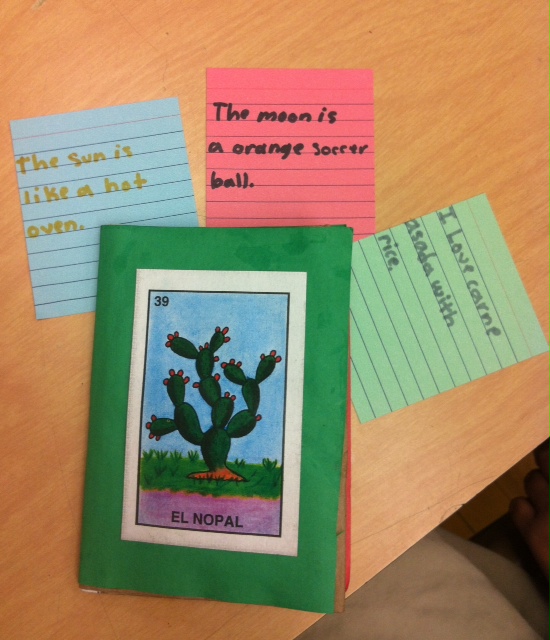


We practice Six Word Memoirs, sensory description, similes, metaphors, haiku, acrostic poems. We read and discuss Sandra Cisneros' “My Name” and then ponder why our parents named us what they did. What were they thinking? Are you named after someone? Whose name did you inherit? If your name were a color, what color would it be? If you could rename yourself for fun, what new names would you choose for yourself and why? Every week, we attempt to do as Juan Felipe Herrera's poem instructs, “Let Us Gather in a Flourishing Way...” We gather, we read, we play, we write, we blossom, we flourish.  
 
 
Along the way, even when one is flourishing, there are inevitable poetic mishaps. Some of the kids write memoirs with 5 or 7 words instead of 6. Syllable get miscounted. Line breaks and margins collapse and poems landslide off the page onto the desks. Someone's assignments disappear. Words are misspelled in both English and Spanish. Kids go overboard with the glitter glue. Students steal each others' lines and arguments ensue, “Hey! I said that first!” One student, ecstatic at having successfully completed her first haiku, yells out, “I wrote a jacuzzi!”


And yet, all of these things are part of the journey. Imagine what would happen to the creative spirit if we kept interrupting it (silencing it) with corrections? Three of our essential rules at Gulf Elementary are...express yourself, be creative, and have fun! There are other rules, of course, but these are the essential ones.
 
 
Last week, I invited poet and teacher A.K. Toney to join and guide us in the making of poetry books out of paper lunch bags. Ever since I learned the art of making paper bag books from A.K. back in 2014, I've been a paper bag convert and worshiper. (You can read a previous blog on A.K. and his poetry books at http://labloga.blogspot.com/2014/09/passion-power-and-paper-bag-poetry.html)


Much can be said about the day A.K. visited us at Gulf Elementary. The kids absolutely loved his charisma, humor, and 5th grade charm. We participated in call-and-response chants about honoring our words and the trees we write on. We broke up each class into two large groups. I took one side of the class, A.K. the other. Like the poets that we are, we went with the flow and handled paper bag emergencies and glitter glue catastrophes with calm. At times we needed a bullhorn to be heard, but it was exhilarating watching a room full of eager hands folding, cutting, pasting, creating.
 
 
After the last class left and we finished cleaning and packing up all our supplies, we laughed at the intensity of it all. It was a day full of mini-tornados and electrical currents. Whirlwind and lightning. I laid down on the floor for a few minutes to catch my breath and center myself. A.K. lifted his arms towards the ceiling, stretching. Yes, the 5th graders worked us to the bone. Yes, it was beyond WILD. But this is part of the gathering and the flourishing; this is what poetry-book-making in the hands of 5th graders looks like.


Poetry classes at Gulf Elementary are made possible by Amy Eriksen and Angels Gate Cultural Center, LAUSD, Principal David Kooper, Gulf staff, the awesome 5th grade teachers (Ms. Peralta, Ms. Uchida-Smith, Ms. Solache, Ms. Reiland, and Ms. French) and, of course, all the children who show up, open themselves up to poetry, and participate weekly.

Sunday, September 07, 2014

Passion, Power, and Paper Bag Poetry Books: An Afternoon with A.K. Toney


Olga García Echeverría

When I was in my 20's I believed that passion (be it for a particular person, for poetry, for social justice or for lo que sea) was everything. Without passion, there was no poetry, no ganas, no nada. Being a person without passion was like being a deflated brown paper lunch bag.

 
Deflated Lunch Bag: Metaphor for Passionless Person


Now in my 40's I still think passion is a wondrous thing, but I see passion as a moon; it waxes and wanes. Sometimes it's big and bright, and other times it's dark and dormant.

 
Passion Hanging Over Long Beach:
Waxing or Waning?

I love teaching, for example, but at times I've felt uninspired, disconnected. It's this way with writing too. I can't imagine my life without writing, but there have been moments (seasons actually) when poetry did not speak to me. When workshopping felt like a chore. When attending a poetry reading was torture. When despite my love for the creative Word, I did not feel inspired by It. Can I get a witness?


When inspiration wanes, have a cosmo...or two


Cosmos are short-lived, but it's really Octavia Butler's words that endure, “Forget inspiration. Habit is more dependable...Habit will sustain you whether you're inspired or not.” This I believe to be true. It is because of habit or ritual that I am here, still writing. Inspiration when it arrives is the high of highs, but sometimes as poets, as artists, as educators, as bloggers we have to jumpstart the passion. We have to take a deflated paper bag and make something marvelous of it.
 
Enter writer and poet A.K. Toney and his paper bag poetry books.
 
 
Aside from being a father, husband, and student, Toney is also a founder of Reading is Poetry, a Los Angeles based literacy program dedicated to improving reading and writing comprehension and enhancing expression through verse. Reading is Poetry, which has been around since 2005, works with all age groups but a primary focus of the organization has been K-5 inner-city children.
 
When I asked Toney to share a little about the mission of Reading is Poetry, he stated, “We encourage self esteem, writing, and we do it all through the tool of poetic license." Unlike prescriptive teaching approaches that focus on error correction, Toney explains that "poetic license allows a child, a student, anyone who is writing poetry to spell words phonetically or to use the abbreviation of a that word. That doesn't necessarily mean the word is spelled correctly, but it means that you can read the word and you understand what the writer is trying to communicate. I encourage that. When kids misspell words, we know what happens. Teachers do this all the time--spell it for them correctly. But in poetry, it doesn't matter. You can misspell a word. We tell our students, 'We want to encourage you, Reading is Poetry wants to encourage you to write more. We will show you how to spell the word correctly and make other words up too, but right now what we want you to do is write your feelings out no matter if they are misspelled. We want to get you to write more and we will teach you how to create an art form from that, which is poetry.'”

And how does Toney inspire and teach students to create an art form? Through reading, writing workshops, and book making.
 

A.K. con sus libros poderosos de papel


The first time I ever saw A.K. Toney's poetry books was at a Poets & Writers Workshop Leaders Retreat earlier this year. During the retreat, A.K. pulled out a small book about the size of a wallet and passed it around. It was decorated with cutout images, text, and it had several pockets where mini poems or passages were inserted. Being a fan of handmade books, I was instantly intrigued by these lunch bag libritos. Hence meeting A.K. Toney at Philippe's on Alameda this week for a Bloga interview and a bookmaking session.

It was obvious from the onset of our meeting that both of us are "crafty" kind of people. Aside from paper bags, A.K. brought packages of patterned paper, stickers, ribbon, and a paper cutter. When I started to pull out all my bookmaking materials, A.K. asked me, "Did you bring empty toilet paper rolls?" I knew then that this bookmaking session was serious. We got right to work, A.K. confessing that he likes crafting. "Not a lot of straight men can admit they like this kind of stuff, " he said, "Cutting, pasting, making things with your hands." And a little later, "I can't believe we're scrapping at a restaurant." If you haven't been to Philippe's, the upstairs rooms (generally empty) and the large tables are a scrapper's dream.
 
 
A.K. teaching me the art of paper bag bookmaking
 
When I asked A.K. how and why he uses these books in his program, he held one up and said, “This is something that helps get students into reading and writing. Kids generally don't want to write, so when I show them something like this and read from it and tell them about poetry, they become very enthusiastic.”

I can see how these libritos made out of recycled materials attract. They may not light up like Ipads, but they ignite other things—imagination and an instinct, a need to touch, explore, and create.

If you were a child in a classroom would you rather read a passage in a traditional textbook or one in a handmade book that unravels with surprise pockets like this?
 
A.K.'s paper bag book on Black history
 
The act of reading these books is a hands-on exploration. It's all tactile and visual and you can hear the rustling of tissue paper as if unwrapping a gift. Kindle cannot give you this. Isn't it lovely?
 
 
And when you create your own paper bag book, all things are possible. This is where power and magic come in. A woman can ripen like a papaya on a kitchen counter. A dove carrying a love letter in its beak can fly out of a hot-pink heart. You can cut out an ocean or a constellation and hold these in the palms of your hands, pondering what you will do with them. You can paste rain on a page right next to the words “I AM...” You can take an empty toilet paper roll and flatten it into a mini pocket, and then you can put a giraffe in there. All things are possible in scrapping and bookmaking.
You can even honor the dead like A.K. Toney and I did this past week. The book he created during our session was a tribute to the late Maya Angelou. His short poem to her in his book reads:


A AND B CUTTING UP!


She the little girl

Didn’t talk for long time…

Caged bird sang

Rose up as Poet Laureate

Phenomenal Woman

On the Dawn and Cusp
Of morning… only you
And Baraka can cut the
Rug on Langston…
You and he doing that
Schomberg…
Angelou Immortalized

Maya Angelou paper bag book with inspirational quotes


And my lunch bag book was for my querida amiga tatiana de la tierra.
 
 
Pages of a fragmented poem for tatiana
 

Since tatiana's passing in 2012, I have been writing poetic fragments for her, but up until now I haven't really known what to do with them. The paper bag book gave me an opportunity to create mini collage poems. Healing via fun. These libritos are good medicine. By the end of the session, I felt the high of artistic creation, my moon of inspiration waxing. Thank you A.K. Toney for the work you are doing and for sharing your art with me and our Bloga readers.


Healing Arts


There are many ways to make a book out of a lunch bag. A.K. Toney said he first learned the skill via a YouTube video. If you search under "lunch bag mini album" you will get dozens of instructional videos. Making albums or books out of recycled materials isn't a new art, but every artists/writer can take the basics and expand on them. In Toney's case, he's taken the lunch bag into the inner-city classroom to inspire interest in the literary arts and to empower students and all writers to scrap their truth. As the Reading is Poetry motto states, “Read to write...then write yr story.”

To learn more about Reading is Poetry: http://www.readingispoetry.com/


About A. K. Toney


In a few words, A. K. Toney is a poet, writer and performance artist. For almost 20 years Toney has been an active member of the renowned cutting-edge African American arts enclave World Stage Performance Gallery’s Anansi Writer’s Workshop in Leimert Park Village (Los Angeles), Ca. As a member of the World Stage Toney had the honor to be mentored under the tutelage of Community leaders and Jazz greats such as Billy Higgins (founder of the World stage). Since 1993 Toney’s skills as a performance artist have lead him across the nation and abroad. While studying through various workshops he was given the opportunity as a part of the Mellon/Pew Grant Series to lecture about Performance Art at the California Institute of the Arts. Empowered by teaching A. K. became a Literacy Coordinator in 2005 creating a literacy program called Reading Is Poetry. Toney has dedicated his life to teaching people how to express their truth through poetry and literacy. His work has been anthologized in the following books:

Tough Love: Cultural Criticism and Familial Observations on the Life and Death of Tupac Shakur, Edited by Michael Datcher and Kwame Alexander 1996

Catch the Fire: Cross Intergenerational Anthology, Edited by Derrick Gilbert aka D-Knowledge 1998

Black Love: An Anthology, based from writing workshops and publication through Beyond Baroque Literary Art Center, Edited by Michael Datcher 1999

Drum Voices Revue: A Confluence of Literary Culture and Vision Arts, Edited by Eugene B. Redmond 1999

Raising Fences: A Black Man’s Love Story, Written by Michael Datcher 2001

Caprice, Mischief, and Other Poetic Strategies: An Anthology of Poems Based on Twenty Little Poetry Projects, Edited by Terry Wolverton 2004

Catching Hell in the City of Angels, Life and Meanings of Blackness in South Central Los Angeles, Written by Joao H. Costa Vargas 2006