Showing posts with label AK Toney. Show all posts

Sunday, April 24, 2016

All That and a Bag of Poetry: Creative Writing with 5th Graders at Gulf Elementary


Olga García Echeverría


When we say poetry, it is really the vision for all voices. That's really what it means. People ask me, What is poetry, Juan Felipe? I say, It is freedom. That's what it is. That's what everybody has, and when you use your own voice, your own personal voice, freely, the real you, then we're all united.
 
--Juan Felipe Herrera
From the 21st U.S. Poet Laureate Inaugural Reading


Once a week, I venture south on the 110 towards San Pedro. My destination: Gulf Elementary School in Wilmington, California. My mission: creative writing workshops with 5th graders.
 
On the days I visit the 5th graders, I rise before the roosters crow. I sip on strong coffee in the shifting morning light. I pack energy snacks and a hearty lunch. It's an hour-plus drive from my home to Wilmington. On some parts of the commute, traffic clears and I fly. On others, the highway's arteries are clogged. I nudge forward like a slug, past downtown, the 10, the 105, the 405.
 
I know my exit is approaching when I spot the billowing white smoke of the oil refineries, a Wilmington trademark. These industrial chimneys coughing up smolder and fumes are hard on the eyes and lungs, but lately I've begun to envision the large pipes painted in rainbow colors, puffing out fat cumulus clouds. Soon it will rain poetry, I think. And as soon as I park my car and enter Gulf Elementary School, it does.
 
“Ms. Olga! Ms. Olga!” a preadolescent voice yells.
 
When I turn, a group of kids with wide sonrisas are waving their arms up into the sky as if they're flagging down airplanes. In an instant, this boisterous morning saludo shakes off the lethargy of post-traffic-trauma that has settled on my body like a heavy winter coat. I feel lighter—dare I say younger?--via these kids' enthusiasm. I wave back as if I were disco dancing. It's gonna be another great day in Wilmington, y'all.
 
 
During the next 5 hours, I'll meet with about 120 of these loud little people who smile a lot and ask such interesting off-topic questions...
 
“Is it true that if I drink coffee, I won't grow?”
“Can you please bring us a Chinese calendar next week?”
"What's your favorite taco?
“Do you believe in purple llamas?”
 
These are the brown, bilingual children of Wilmington, lovers of pizza, Cheetos, donuts, and tacos. They talk a lot and make their way through the day with a glazed look of wonder in their eyes. Do I believe in purple llamas? This could very well be my long-lost tribe.


I meet with five different classes during my visits at Gulf Elementary. I have about an hour with each group. 5th grade time, though, is a vortex. It's a location, a colorful crowded room full of desks, chairs, books, posters, activities, and awesome teachers who master Silence Signals. The teachers I work with orchestrate silence with a hand, a countdown, a clap, a stare. I watch in awe. Without a Silence Signal in the 5th grade, I have learned, you have to project your voice like a football coach or an opera singer. Without a Silence Signal your words may get drowned out by the beautiful buzzing of bees. To be honest, I am a sucker for noisy classrooms. Art, after all, rattles and strums and stomps and sings. In my college classes, I pull teeth to get students to share opinions and interact; here with the 5th graders, the rambunctious classes are, in my opinion, signs of success.  (All this to say that I have not mastered the Silence Signal).
 
When you're on 5th grade time, the minutes fly by faster than hummingbirds. “Less Is More” rings true week after week. The writing exercises need to be short, focused, and fun. If you loose them and they start to wander like a disoriented flock, good luck. I aim to keep the 5th graders engaged, all of us moving forward together as we graze on leaves of grass, poetry.
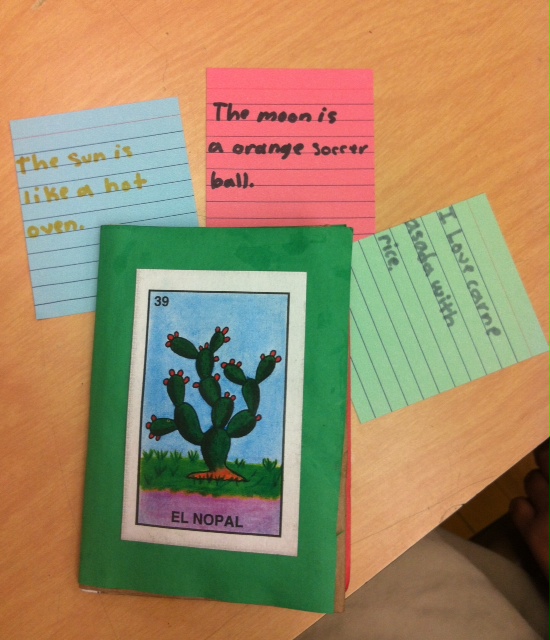


We practice Six Word Memoirs, sensory description, similes, metaphors, haiku, acrostic poems. We read and discuss Sandra Cisneros' “My Name” and then ponder why our parents named us what they did. What were they thinking? Are you named after someone? Whose name did you inherit? If your name were a color, what color would it be? If you could rename yourself for fun, what new names would you choose for yourself and why? Every week, we attempt to do as Juan Felipe Herrera's poem instructs, “Let Us Gather in a Flourishing Way...” We gather, we read, we play, we write, we blossom, we flourish.  
 
 
Along the way, even when one is flourishing, there are inevitable poetic mishaps. Some of the kids write memoirs with 5 or 7 words instead of 6. Syllable get miscounted. Line breaks and margins collapse and poems landslide off the page onto the desks. Someone's assignments disappear. Words are misspelled in both English and Spanish. Kids go overboard with the glitter glue. Students steal each others' lines and arguments ensue, “Hey! I said that first!” One student, ecstatic at having successfully completed her first haiku, yells out, “I wrote a jacuzzi!”


And yet, all of these things are part of the journey. Imagine what would happen to the creative spirit if we kept interrupting it (silencing it) with corrections? Three of our essential rules at Gulf Elementary are...express yourself, be creative, and have fun! There are other rules, of course, but these are the essential ones.
 
 
Last week, I invited poet and teacher A.K. Toney to join and guide us in the making of poetry books out of paper lunch bags. Ever since I learned the art of making paper bag books from A.K. back in 2014, I've been a paper bag convert and worshiper. (You can read a previous blog on A.K. and his poetry books at http://labloga.blogspot.com/2014/09/passion-power-and-paper-bag-poetry.html)


Much can be said about the day A.K. visited us at Gulf Elementary. The kids absolutely loved his charisma, humor, and 5th grade charm. We participated in call-and-response chants about honoring our words and the trees we write on. We broke up each class into two large groups. I took one side of the class, A.K. the other. Like the poets that we are, we went with the flow and handled paper bag emergencies and glitter glue catastrophes with calm. At times we needed a bullhorn to be heard, but it was exhilarating watching a room full of eager hands folding, cutting, pasting, creating.
 
 
After the last class left and we finished cleaning and packing up all our supplies, we laughed at the intensity of it all. It was a day full of mini-tornados and electrical currents. Whirlwind and lightning. I laid down on the floor for a few minutes to catch my breath and center myself. A.K. lifted his arms towards the ceiling, stretching. Yes, the 5th graders worked us to the bone. Yes, it was beyond WILD. But this is part of the gathering and the flourishing; this is what poetry-book-making in the hands of 5th graders looks like.


Poetry classes at Gulf Elementary are made possible by Amy Eriksen and Angels Gate Cultural Center, LAUSD, Principal David Kooper, Gulf staff, the awesome 5th grade teachers (Ms. Peralta, Ms. Uchida-Smith, Ms. Solache, Ms. Reiland, and Ms. French) and, of course, all the children who show up, open themselves up to poetry, and participate weekly.

Sunday, August 09, 2015

Disarticulated with Terry Wolverton In the Month of July

Olga Garcia Echeverría
 

Disjointed July
 
In July, things collided and came apart. My brother-in-law tumbled off a roof and broke his leg. I rear-ended a Lexus. In July, we got “Super Historic” rainfall in L.A. I saw lightning strike the ocean. In July, the dead haunted my heart. The moon fell apart piece by piece and then put herself back together again—twice in one month, Blue Moon. And then there was the disarticulated poetry that inspired and surprised...
 
Disarticulated Words
 
disarticulate: to make or become disjointed,
as the bones of a body or stems of a plant.
 

This past month, I had the opportunity to participate in Terry Wolverton's interactive online poetic project, dis•articulations 2015. Since the beginning of the year, Terry has invited a different poet each month to collaborate with her in the creation of "poetic disarticulations." Guests have thus far included Southern California writers Jessica Ceballos (January), Mike Sonksen (February), AK Toney (March), Angela Peñaredondo (April), Chiwon Choi (May), Elena Karina Byrne (June), and myself (July). This month, poet Sesshu Foster is the collaborating poet.
 
But what exactly is a poetic disarticulation? Here's a quick recipe to sum up how disarticulated poems get prepared and cooked on Terry's website.
 
Ingredients for Disarticulated Poems
 
2 poets
8 media headlines (4 per poet)
8 “fevered writings” (4 per poet)
1 timer
 
Prep and Cooking Time

On and off musings over the period of one month
 
Directions
 
1. Have each poet select 4 media headlines from dónde sea.
2. Swap these, so that each poet has the other's headlines. 
3. Have each poet freewrite a la brava (don't think too much, just write non-stop) for 3 minutes on each of the swapped headlines. The writings produced are the “fevered writings.” There should be 4 for each poet.
4. Swap again, so that each poet now has the other's fevered writings.
5. Read and let the words of the other poet brew.
6. Disarticulate the other poet's fevered writings with the goal of creating something entirely new. This means take the writings apart, move words and phrases, undo images and then stitch them back together without adding any new words. Only words included in the fevered writings can be used. Keep in mind, not every word has to be used. Repeat words if needed. Change the form of words if desired. For instance, change sandwich (noun) into sandwiched (verb) or love (verb) into lovely (adjective).
7. Most importantly play, play, play until an original poem rises from the disarticulated stew.
 
Wanna Give It a Try? Readers Can Play
One of the coolest things about dis•articulations 2015 is that readers can jump in  every month and play. Website visitors can use the posted headlines as writing prompts or the posted fevered writings to disarticulate a poem of their own. Reader Poems can be posted in the comments section of the website for others to read. At the end of the month, Terry selects a winning Reader Poem. The winner gets $25.00 and her/his bio posted on the site, as well as a link to the winning entry. If you're interested or curious, check out this month's prompts: https://disarticulations2015.wordpress.com/?s=August
 
An Interview with Terry Wolverton in the Middle of this Disarticulated Blog
 
 
Bio Sidebar: Terry Wolverton is the author of ten books of poetry, fiction and creative nonfiction, including Embers, a novel in poems, and Insurgent Muse: Life and Art at the Woman’s Building, a memoir. She is the founder of Writers At Work, a creative writing studio in Los Angeles, and is Affiliate Faculty in the MFA Writing Program at Antioch University Los Angeles. She’s also a certified instructor of Kundalini Yoga.
 
Terry, bienvenida! Can you share what has been the most rewarding part of your dis•articulations 2015 journey so far?
 
I’ve had the opportunity to meet and encounter the work of poets I didn’t know before (including you!) I’ve written poems I never would have thought my way to. And I’ve been told by a couple of collaborating poets that working on the process got them writing again after a dry spell.
 
 
What has that been like--working with a different poet each month?
 
It’s just fascinating to study how another poet thinks and how he or she uses language. I worked with one poet whose fevered writing contained no images of the body; that’s so different than my own work! Another poet was extravagant with adjectives, which made me aware that I can tend to be sparse. Others used words I would never use in a poem, but I challenged myself to do so. All this is expansive for me (and I hope for the other poets too.)
 
As writers/artists, we have to keep fueling our own visions and creations. What fuels the fire for this particular project?
 
This project reflects three of my particular loves—a focus on the process of creating (which for me is where art resides), experimentation, and working in community.
 
The concept of disarticulation seems to be at the heart of your project. What does “disarticulation” mean to you?
 
The word “disarticulation” literally means to take apart a body, or rather a skeleton, to separate the joints. I borrowed the term because I am taking apart bodies of writing—the passages of fevered writing—and separating them into their component parts of speech, nouns, verbs, adjectives, etc.
 

What Disarticulating Terry's Words Looked Like

It was quite a journey to take apart your fevered writings and play with your words, not knowing where I was going or why I was going there. At times I felt very challenged, but mostly it made me work within certain word boundaries. In the end, I wrote something unexpected and that was really cool. What exactly pulled you into this creative approach?
 
This process appealed to me because I felt myself falling into familiar ruts with my poetry, returning again and again to certain subject matter, imagery, moods. I wanted a process that would disrupt those patterns; I wanted to surprise myself.
 
I think a lot of writers can relate to what you are saying about familiar ruts that develop in our writing. I really appreciated the elements of disruption and surprise in the disarticulated exercises. I read on your website that you've done something similar before.
 
Although I’d been playing with aspects of this process, things came together in 2012; my partner (the poet Yvonne M. Estrada) committed to do fevered writing every day for 30 days; she and I would exchange prompts. She used the results differently to inspire poems but I began taking apart my fevered writing, and recombining it. In 2013 I did a blog project where I invited friends and strangers to give me prompts and I wrote a new disarticulations poem every week for a year.
 
Wow, that is a lot of poetry. It's impressive how you've stuck to the act of disarticulating, and yet how you've allowed it to evolve. What contributed to the shift from your blog project in 2013 to dis•articulations 2015?
 
Working with prompts from other people was great, but I wanted to explore even further disruption, so I had the idea of asking other poets to collaborate, working with poets with a wide variety of poetic styles, disarticulating and reconstructing one another’s words to make our poems.
 
There's a $25 prize for a Reader Poem winner each month and also collaborating poets are given $50 for their participation. I love this about your project! Are you funding this yourself? And if so, why?
 
Again, because I’m interested in process and community, I wanted to create a way for others to participate, in addition to the twelve poets I collaborate with. I decided the collaborators would all be Southern California based, but the readers who submit poems can be anywhere. The $25 prize I had hoped would provide more inspiration to participate; folks who have won the monthly reader poem challenge seem to be pleased with it. Also, I pay the collaborators $50 for their participation; I think poets should get paid, even if it’s a nominal fee. I initially wrote a grant for this project, but it wasn’t funded, so I had to set aside a little budget to fund it myself on a more modest scale.
 
Random Picture of the Ocean in July to Signal "End of Interview"


Three Poetic Disarticulations From the Month of July
 

I can't think of a better way to end a disarticulated blog than with disarticulated poems. My poetic exchange with Terry Wolverton this past month led to Terry's "The Milky Blues" and my "Wildfires" (both poems are included below). If you are interested in seeing more of the actual process, you can visit the dis•articulations 2015 website for a list of the actual prompts we exchanged and the fevered writings we produced.
 
The first poem included here was written by Manuel J. Velez, the winner of the Reader Poem for the month of July. Manuel took the headline prompt "What Gaining a Leap Second Means for a Hummingbird" and produced the following poem. Terry's poem and my own were created from the disarticulation of our exchanged fevered writings.
 
 
A Farmworker Offers Advice to Hummingbird Flying Among the Grapevines
by Manuel Velez
 
Never let them count the thrusts of your wings;
the subtle motions that stir in their minds
images of nightgowns floating across ballroom floors.
 
They’ll never see how each thrust tears away
at your body and weakens your soul.
 
Never let them see past your rainbow plumes;
the playful dance of colors that reminds them
of exotic pearls resting softly around their necks.
 
They don’t see that underneath the rainbow
lies the cold grey reality of a life spent at work.
 
Never let them measure the rhythm of your beating heart;
The soft vibrations that sing to them like a silent lullaby,
a serene moment of meditation.
 
They’ll never know that each beat is a growing
desperation for survival. No, hummingbird, never let them see who you truly are;
 
A creature trapped in the monotony of labor.
A perpetual existence of constant movement.
A life whose dream is for only enough nectar
to survive another day.
 
Let them be mesmerized by your motions and captivated by your colors.
Let them believe that your true beauty is to be free.
Let them value that which least defines you
because it’s the only way they’ll find any value in you at all.
 
 
MY MILKY BLUES
by Terry Wolverton
 
An atheist, a dolphin and a homo
walk into Heaven. God looks up but cannot
decipher their cratered faces. Rose water
spills onto the altar silk, marking it pink.
 
Long-stemmed and small-boned, I scatter whenever
rain spills against the church boat, unanchored in
a chalky sea. Amethyst breath of the moon
touches my face, baffles the infinite word.
 
You are native to the fierce depths, I am wrapped
in guns and dirty laundry. When we fuck we
go to Paradise, minus the amber ghosts.
All that upward leaping is just like marriage.
 
I keep imagining your sad, translucent
mouth, a haiku in space with no gravity.
Those plush goodbyes made me gasp with poetry,
La Luna pillowed on the surface of time.
 
Sharks are now people. Women are pagan. Earth
is littered with injury. Heaven spotted
with scientists, armed with examples. God knows
who are the dead, red jelly in the charred heart.
 
 
Wildfires
by Olga García Echeverría
 
I.
Bam! Just like that.
Another woman of color
eradicated by the system.
 
Why not start a wildfire
with all the newspaper articles?
 
It makes as much sense
as anything.
 
II.
She needed
more hummingbirds
more salvia
more seconds on the Universal clock
 
She needed
more nectar to sip
more time
to let it all hang out
to sit serenely, thinking
to small talk at dinner
to gossip with friends
 
She needed more time
to write
to birth
to live
 
to sleep
inside the safest place, her own navel,
spinning wheels of energy, yellow
Chakra vibrating, the mystery
of the undulating Universe
dripping from her fingertips
 
She needed more softness,
this purple-colored woman
bellowing through time,
wildfires in her eyes…