Olga García Echeverría
Today we have la fabulosa Isabel Quintero in the house, chismeando conmigo about writing, publishing, and her YA novel, Gabi: A Girl in PIeces.
I have so much to say about this book full of barrio sass and sazón, but honesty, I don't think I can sum up the novel better than our own poet laureate, Juan Felipe Herrera. Here is what Herrera has to say about Gabi: A Girl in Pieces:
"Meet Quintero’s high school 'fat girl' Gabi, eating and starving and fighting and writing her way through the crushing pressures of high school boy desire, religious approval and Mexican cultural taboos of 'living in sin.' A 'smiling' good 'virgin' girl or an 'ofrecida,' 'slut'? And in-between these frozen and fearful versions of womanhood, there are blurred, bloated and violated girls: straight girl with gay boy, abandoned pregnant girl with 'parading' boy, raped girl with defender girl. And quinceañeras, and familia and suspensions and carne asada and churros where the soft body stretches, boils in grease and is cut to fit the Mexican girl mouth as it burns. Reminiscent of early Chicana writers such as Evangelina Vigil and Lorna Dee Cervantes, I cannot think of any book today for young adults as voracious, bold, truthful and timely – as this one. Who is courageous enough to read this prize-winning YA novel?"
If this blurb doesn't convince you that this book is a must-read, check out the bio at the end of this bloga that highlights all the awards Quintero's novel has received since it's publication in 2014, among them the 2015 William C. Morris Award for Debut YA Novel, the 2015 Tomas Rivera Mexican American Children's Book Award, and the California Book Award Gold Medal for Young Adult.
Pues, without further ado, here's the literary wiri wiri.
Isabel, so great to have you here at La Bloga. I loved your novel Gabi: A Girl in Pieces. It's wonderful to see a young strong Latina character who navigates her senior year and so many issues via her own wits and heart. She felt very real, very believable.
Gracias, Olga. I really appreciate that.
I enjoyed all the parenthetical comments throughout the novel that help capture Gabi's humor and sarcasm. Me hizo reir La Gabi muchas veces. It also made me think about how as a writer you must have some of that sarcasm, attitude, subversive back-talk. Where did you get that from?
Pues, one of my things my mom always told me was que era muy hocicona. I have always questioned things, though sometimes not verbally. Growing up it always bothered me how I was expected to behave because I was a girl and what I was allowed to want and not want. And I wanted everything--sex, dating, good grades, good schools, traveling, drinking, equality, justice.
But, I was often reminded that as a girl my options were limited. My mom didn’t want me to leave home to go to college because that meant que quería libertinaje. Freedom to do what I wanted was often, for some reason, attached to sex. Which is strange, but I guess it makes sense. Maybe my mom knew deep down, that having freedom also meant having ownership of my body and that scared her, porque quién sabe qué cochinadas I’d do.
This issue of freedom and gender roles shows up in your book in various way. Yet Gabi, even in her moments of struggle, shows a lot of agency.
Believing that one is free is different from acting like one is free, and I think that’s where Gabi has a hard time, because she knows she wants to do more than fantasize about what that freedom would be. We can think freeing thoughts all the time, thoughts hurt no one. But asserting freedom, pues agarte because it will most likely disrupt someone else’s power structures, and that gets ugly and often painful.
Were there any scenes in the book that you struggled with?
The abortion section was one. Only because I wanted to make sure I didn’t throw in this thing that I feel strongly about. So I did some research to make sure it was accurate. Another was one I can’t talk about or I spoil a section of the book. And then, Tia Bertha’s change at the end. At one of the high schools I visited, Lincoln Heights, a student asked me why I had waited so long in making Tia Bertha change. The truth is, she wasn’t going to, but I was rewriting that damn ending so many times, that I began to feel bad for her and yeah, she changed.
That's awesome, that in your constant reworking of the ending you began to feel sorry for your character Tía Bertha and that she got transformed in the process.
You know, pensándolo bien, the ending was what gave me the most trouble. It always ended with that last line, but the rest was different. Originally, there was a poem about Gabi accepting herself as she was, it was too forced, and I knew it but didn’t want to change it. My publisher finally made me face the reality. Though to be honest, I am still thinking of better ways to end the book.
That's funny. I remember a visual artist telling me once that even when his art was framed and up on the wall of a museum, he kept wanting to remove the glass and add lines and color. Speaking of images, one of my favorite sections of the book was the zine On The Female Body.
You know, I am not a zinester, but I like zines, and I’ve tried to put together a few, and have some half finished ones.
 |
| Very Cool Body Pieces in Gabi: A Girl in Pieces |
How did the zine part in Gabi: A Girl in Pieces evolve?
I learned about zines from Angela Asbell, an adjunct professor and activist at CSUSB. I liked the idea and tried to do some at home but didn’t like how they turned out and tossed them. One day she had a zine day at her house and, at this point I had already been working on the poem [used in this section of the book], and I starting making a zine that would go with the poem. I thought it would be a good format, though I wasn’t sure what I wanted to do with the zine when I was done with it. When I rewrote Gabi, from verse to prose, I knew that was why I had been doing the zine, for her, and that’s where it belonged. Cinco Puntos liked the idea, and at one point the zine was supposed to be a separate component, but that was too costly.
Were there things you couldn't or didn't include in the zine because it was a YA novel?
As for content, I think I got all I wanted in there. The targeted audience is not who I worry about; young people, I think, are more open about a lot of issues. Adults are the ones who often forget what it is like to be young and create a different reality about youth; one that is free of drugs, heartache, sex, and violence. Obviously, this is not true for everyone, but I’ve encountered adults who believe that drugs, violence, and sex in a teenager's life, not only among them but as a part of their daily existence, is a new phenomenon.
Yes, I totally agree. I think it's adults who create taboos around issues. But the youth, they seem to gravitate towards work that tells it like it is. How have young readers responded to your book?
 |
| Gabi from A Girl in Pieces Has Got It Right! |
You know, the response has been better than I could ever have imagined. I get a lot of, “You’re talking about my high school!” or “That sounds just like my mom or my tía!” or “Thanks for painting fat girls in a real way.” So, those responses are great. I feel really good when readers can connect to Gabi’s questioning of gender roles, especially teens who are going through some of the same issues she is going through. I feel like I’ve done my job.
Did you always know this was a YA novel you were writing?
I think I did know it was YA when I began writing the book in 2007, but it was a novel in verse back then. I had just finished reading Juan Felipe Herrera’s crashboomlove, and K.L. Going’s Fat Kid Rules the World. Those books really helped me see what YA could be, and helped me remove some biases that I had about it. So, I began writing, Photographs of a Fat Girl, which was the original title. It was a much different book then, that although a first person narrative, revolved around photographs, not a diary.
I saw on Facebook recently that you were in Tulsa, Oklahoma, doing a series of readings there at the Martin Regional Library and at high schools in the area. How was that experience?
It was my first time in Oklahoma and I had a great time. The students were receptive, especially at East Central High School. After my presentation they had great questions about the writing process, publishing and of course the book. I’ve also been to some festivals, most recently I was at the San Antonio Book Festival and I did a Literary Death Match in which Luis Alberto Urrea was a judge. Dios mio, that was something. And this weekend it will be the Brooklyn Book Festival. It’s been a wonderful journey so far.
You know that golden rule that we always hear as writers, “write everyday”? What's your writing process like?
Tough question. I try to write everyday. Try. But it doesn’t happen. Sometimes I do get writer’s block. Daniel Jose Older, author of Shadowshaper, posted a blog post last week about how there is a myth around writing that we have to write our thousand words or more every day to be real writers, and that sometimes makes us feel ashamed when we don’t do it. I think I agree with him.
I write when I need to write, which is almost everyday. Some days, on really good days, I can write 8-10 hours without changing clothes, eating, or talking to anyone. On really bad days though, I can’t even put together an effing sentence. But I know I’ve gone too many days without writing when I start feeling really sad and lost.
And when you do write. What's your process?
When I do write, a ver, I prefer mornings or late evenings. If in the morning, I’ll drink black coffee and maybe some sort of carb filled goodness–pan dulce, cookies or toast. I love toast. Then I eat lunch, and get back to it. In the evening, I’ll write after dinner and I’ll drink cold black coffee, iced tea, lemonade, or just water, and go until I can’t anymore. Sometimes that’s a few hours, and sometimes that’s until 2:00 am. But that’s by no means a formula I live by. I do try to get in walks somewhere in there, too. Oh, and I read my work out loud to myself too.
Latino writers have been negotiating the use of Spanish in the publishing world for a very long time. It's refreshing to see more books like yours that 1) include Spanish and 2) don't feel obligated to italicize or translate everything.
To be honest, at first I did have the words in italics, but it felt wrong. Really wrong, because not only was it confusing with inner dialogue, but it seemed to exotify something I didn’t want to exotify. It made me feel like a traitor, but I didn’t know how publishing worked, and I didn’t have the confidence to say so. Cinco Puntos asked me if I really wanted to italicize the words and I said not really, and they said good because they didn’t either. Now, I wouldn’t think about italicizing the Spanish.
It's great to hear that Cinco Puntos encouraged dropping the italics. Did you encounter any resistance from others in the literary world?
Ha. There was only one major incident where something was written that said that one of the reasons I wouldn’t win the Printz was because my lack of a glossary. Which was really irritating, because I immediately put my teacher hat on, and wanted to say, “What do we do when we don’t understand a word in a text?”
Exactly. Look it up, verdad? It's good for the brain.
Luckily, librarians defended the lack of a glossary. I didn’t use Spanish where I didn’t need it; I created a character who is Mexican American, and speaks Spanish, English, and Spanglish.
What advice would you give women writers out there who are wanting to publish their stories, poems, or first books?
Write, read, submit. A lot. If you want to write, write. Know that rejection is part of game and it is not personal (usually). Know that you will get writer’s block, but you can get through it. Likewise, know when to kill your darlings–sometimes it just doesn’t work. Get involved in a writing community, it was the best thing I ever did. It has helped me grow so much as a writer and you have a support group when things don’t go well and a cheering section when they do. It means a lot.
Be true to yourself, to your own voice, to what you want to write, not what you think others want you to write or you should be writing. As women, and as women of color, it can get tough out there. There are expectations about what and how we should be writing. I have a Native writer friend, Erika Wurth, author of Crazy Horse’s Girlfriend, who cannot find a home for her second novel because she keeps getting told it’s too dark. Too dark! I don’t think men would be told this. There are still assumptions about what women should write, and what women of color should write. I remember sitting at a workshop with another friend, a poet who is half-Native and half-Mexican, who doesn’t really speak Spanish, and one of the people in the workshop told her she should use Spanish in her work to make it authentic. I was like what the hell is going on? I think we are often asked to perform our cultures and gender in stereotypical, one-dimensional ways, in ways that make people comfortable, and when we don’t, when we say, “I’m queer/I’m transgender/atheist/don’t speak Spanish/don’t live on a reservation/like Hank Williams” people get upset and question our authenticity. But I say, fuck it, haci soy aunque les duela. No somos moneditas de oro, and god forbid we try to be.
 |
| RIP Michele Serros |
An important lesson you have learned post the publishing of your first book?
Don’t be afraid to speak up for yourself. The late great poet Michele Serros’ gave me a great piece of advice, “Your book is your baby and no one is going to care about it like you would, so you need to stand up for it.” It’s hard to do at first but we have to do it. Also, it’s a lot of work to promote your book; it’s not just fancy sandwiches and breakfast tacos at book festivals. So, be ready a hecharle ganas con las dos manos.
Gracias for your time and all your thoughtful insights, Isabel. Anything else you'd like to add?
Thanks for the great questions. If you want more information about my work, appearances, or other chisme, follow me on Twitter @laisabelinpieces or visit my website laisabelquintero.com

Isabel Quintero is a writer and adjunct faculty instructor. The daughter of Mexican immigrants, she was born, raised, and resides in the Inland Empire of Southern California. Isabel also sits on on the board for a non-profit literary arts organization, PoetrIE. Gabi, A Girl in Pieces from Cinco Puntos Press, her first novel, is the recipient of the 2015 William C. Morris Award for Debut YA Novel, the 2015 Tomas Rivera Mexican American Children's Book Award, the California Book Award Gold Medal for Young Adult, 2015 Paterson Prize for Books for Young People, the 2015 Peggy Miller Award for Young Adult Literature, and was named a finalist for 2015 PEN Center USA Literary Award and the 2015 Walden Award. Gabi, A Girl in Pieces has also been included on the Amelia Bloomer Project List of Recommended Feminist Reading for ages 0-18, School Library Journal's Best Books of 2014, 2015 Capitol Choices: Noteworthy Books for Children and Teens, and is one of Booklist's Best Books of 2014, among other lists. In addition to writing fiction, she also writes poetry and her work can be found or is forthcoming in Huizache, As/Us Journal, The Acentos Review, The Pacific Review, and others.


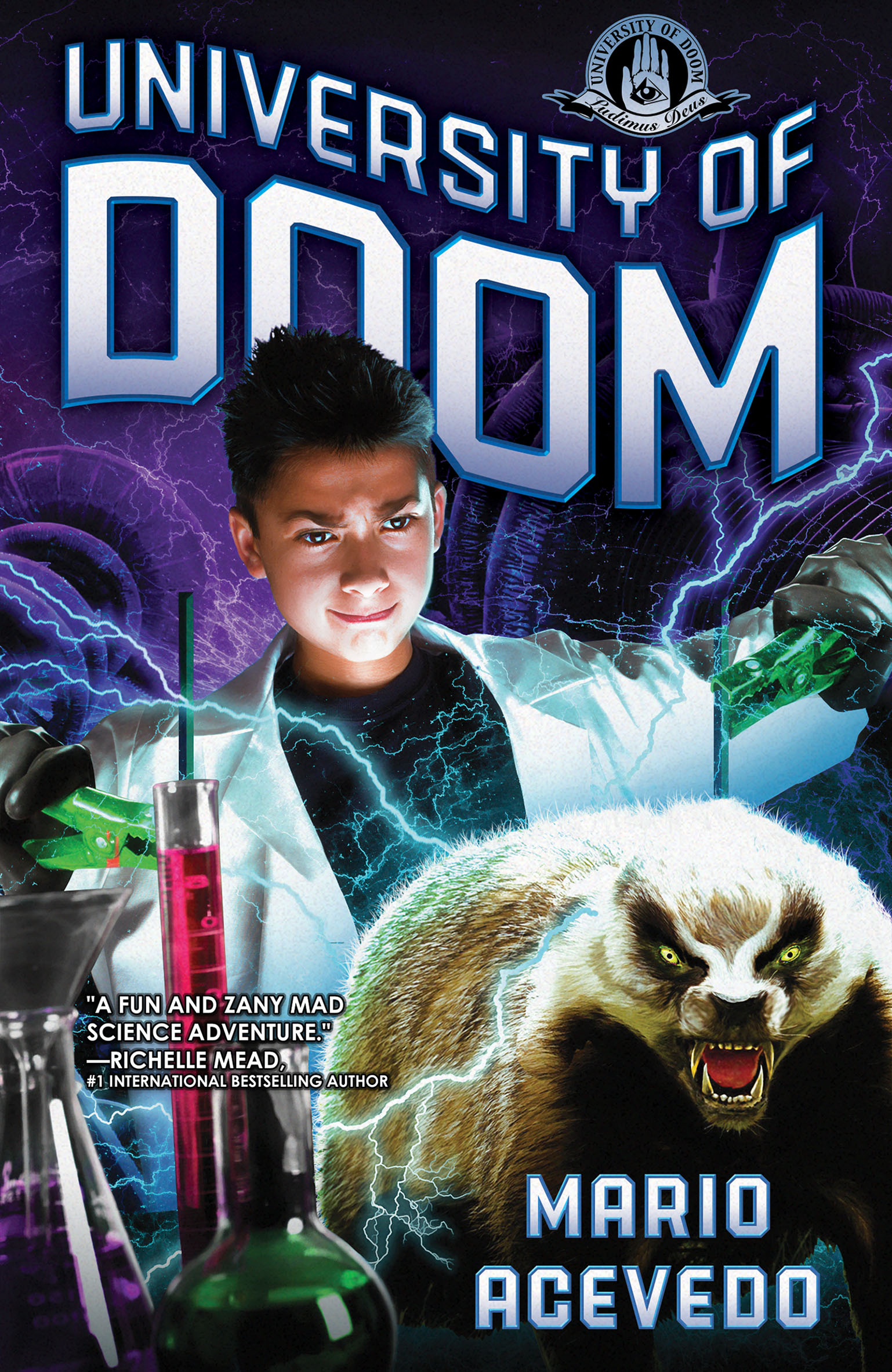 University
of Doom
is
about Alfonso Frankenstein, son of Dr. Eugenio Frankenstein, whose
life is thrown into turmoil when Dr. Moriarty and his son manage to
get Alfonso expelled and his father fired from their beloved
university. It seems that the infamous monster-maker Victor
Frankenstein fled to Mexico after the villagers raided his castle and
laboratory with all those pitchforks and torches . . . I would like
to see stories about the Frankenstein family in Mexico. The whole
scenario actually makes sense, and allows Acevedo to give this
monster fest a Chicano hero--and it’s about time, too.
University
of Doom
is
about Alfonso Frankenstein, son of Dr. Eugenio Frankenstein, whose
life is thrown into turmoil when Dr. Moriarty and his son manage to
get Alfonso expelled and his father fired from their beloved
university. It seems that the infamous monster-maker Victor
Frankenstein fled to Mexico after the villagers raided his castle and
laboratory with all those pitchforks and torches . . . I would like
to see stories about the Frankenstein family in Mexico. The whole
scenario actually makes sense, and allows Acevedo to give this
monster fest a Chicano hero--and it’s about time, too.


.jpg)


