Michael Sedano
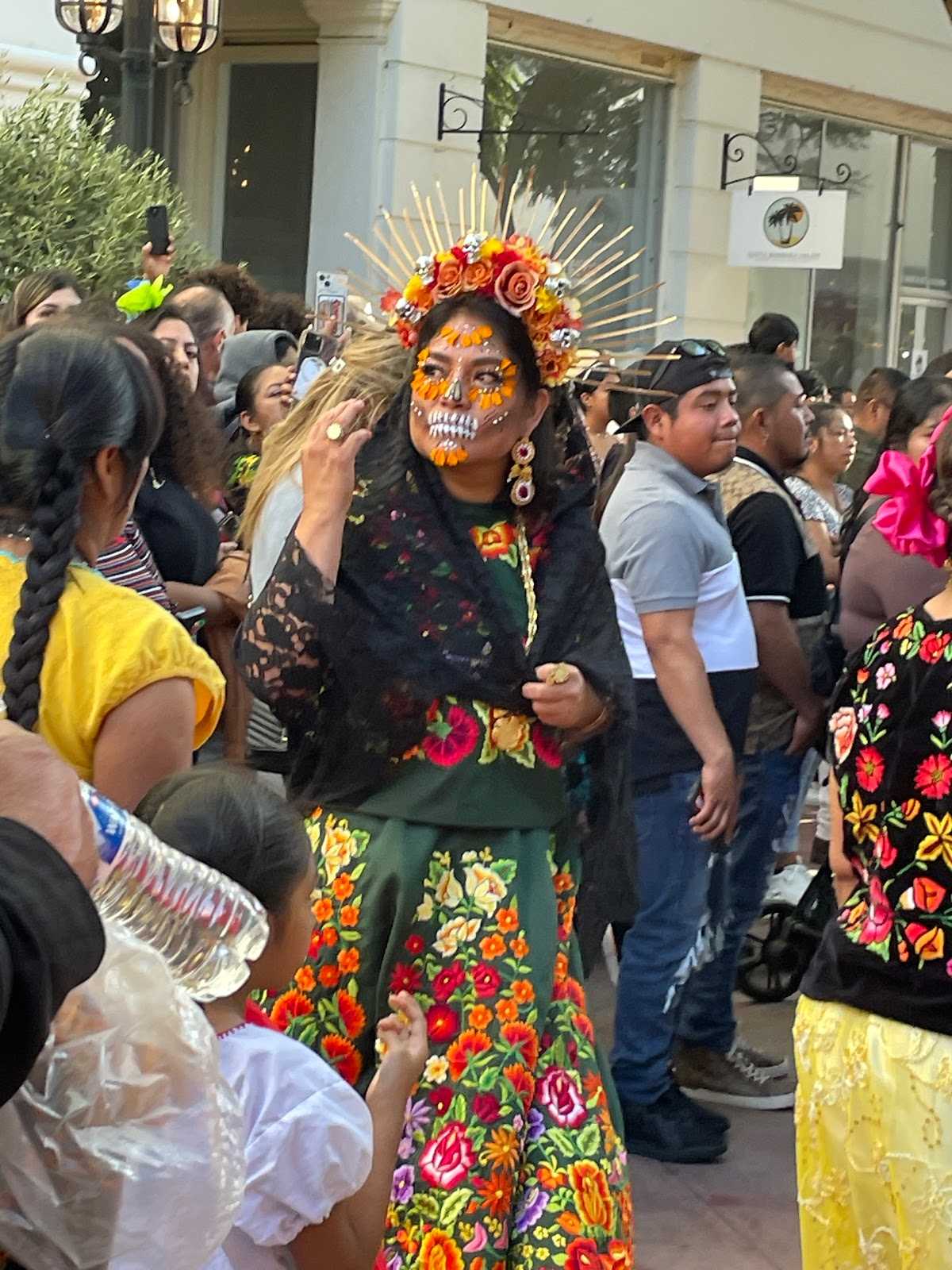
It’s that time of year when cultura shows. Gente paint their faces to resemble skulls, erect spectacular memorial altars, hold processions, art shows, and craft sales to honor our dead. It's Dia de los Muertos and calacas rule the day.
Calaca cultura captures artist imaginations to create particularly gratifying art and collectibles. It's a time turn-of-the-20th-century artist Jose Guadalupe Posada's popularity increases with countless tributes to Posada's style. In classrooms, activities remind kids the calaca motif in Mexican art antedates European incursion.
 |
| Calavera frieze recreates Templo Mayor wall, Museo Nacional de la Antropologia |
Calaca glitz sparkles across the US Southwest, Dia de Los Muertos splashes cultura across local news with an array of entrepreneurs hosting events from humble sidewalk congregations to this-year-better-than-last-year extravaganzas at cemeteries and concert grounds.
One elegantly cool small show was the Crewest/
Gregg Stone annual calaca show. Stone donated ceramic skulls for emerging and established artists. They painted and elaborated the small skulls then exhibited in Crewest’s annual
Top of the Dome shows. Be sure to click
the link. I collected several over the years. Sadly, Crewest gallery closed its doors and the annual shows with them.
The idea of decorated skulls rekindled this year in the form of giant papier mache skulls destined for
Dia de los Muertos USA, a Coachella Valley DDLM extravaganza making its premiere event. I’ve found the skull I’d love to add to my collection, it’s shown in process in the video below, Margaret Garcia's tiled skull.
Margaret Garcia invited La Bloga to have a look as she, volunteer Bonnie Lambert, and two apprentices, put the finishing touches on the massive beauty headed to the Imperial Valley city of Coachella. The truck is due in a few days so she's on deadline.
Garcia's assembled a professional crew.
Artist Bonnie Lambert volunteers her work and has been a key part of the team from its earliest hour. Be sure to visit Bonnie's gallery at
this link.
A pair of apprentices join the team with masonry and tile experience. Monumental scale art projects like Margaret Garcia's tiled calavera skull are job creators.
In a project imagined by producer
Rodri Rodriguez and Art Director Juan Rodriguez, artists were offered a papier mache skull to paint and decorate. Garcia told them she was happy to have the massive object but would not paint it. She saw the skull covered in tile. She also smothered it with love, as in labor of. And seeing this wonder, who wouldn't want to own it?
Over the past weeks, Garcia has been documenting her process on Facebook. Videos illustrate how she covers the papier mache with successive layers of fiberglass fabric. The crew trowels Portland cement across each curve and contours it by hand. Final layers brush on cement slurry for a smooth finish of its concrete skin that's the substrate for the tile.
Garcia buys tile shards, decorative beads, ceramic figures, adding her own found pieces. She lays cement mixture across the skull, section by section, sinking shards into place.
Walking around the creation finds a corazón surrounding a woman and man at dawn, setting out on a journey. Her blue shawl evokes Lupe, the curlicue at their feet at once suggest the black moon of tradition and a Mexica glyph, perhaps flor y canto symbols since flowers abound behind the couple.
Treating the eye at a wider scope, Garcia outlines the valentine heart in green shards with a tessellated lotus blossom pattern. The tight regularity of that pattern is hypnotic against the randomness inside the corazón. Other places geometry is irrelevant to pleasing gatherings of intensely bright colors and ceramic motifs.
A sirena floats quietly above an eyebrow. A gecko rises from a lobe. Eye concavities sparkle with blue beads in raggedly concentric circles.
With tile layed in place, the crew mixes grout into a stiff but pliant mixture. Owing to the irregular joints and surfaces, grouting is done by hand. Press the ball of putty onto the surface then work it tightly against both sides of the gap until the surface is tile, then a black line, then tile; no gaps, few exposed edges.
I arrive as the work takes on an extra laboriousness. The team is scraping away with razor blades, the task complicated by irregularities and the importance of avoiding scratches and gouges.
Margaret uses a Dremel tool’s abrasive bit to raise clouds of black dust. She works with artist’s precision, getting mostly grout and not clamshelling her ceramics nor dulling their shine. Garcia is due for a break so we go for ceviche.
Someone changed the grouting plan, Garcia reveals, getting it done instead of getting it done right. Grout that smears across its boundary needs to disappear, that's expected. Working to plan would have made the touch-up far less laborious. No one complains, they find the blade's preferred angle and scrape scrape scrape away the sandy black grit. The whole crew knows someone messed up. So it goes.
The crew is happy for the botana we bring for their lunch.
Excess grout gone, the tile gleams with appreciation.
The skull is a labor of love and explosion of creativity. Garcia's muse, Rhett Beavers, arrives from a landscaping task to scrape for a while.
Margaret Garcia's tiled calavera skull is a marvel of sculpture and cultura that belongs in the Norton Simon or my yard. I’m sure I cannot afford it, but I do have the perfect spot for it.
My Calaveras
One of my DDLM treasures is the chuparrosa skull, a gift from Gregg Stone. It's extremely fragile, as witnessed by the lost wing tip on the right of the foto. Lástima. Please do not touch.
 |
| Chuparrosa skull by Gregg Stone. |
Mexico City’s Zona Rosa struggles to awaken with the first stirrings of sanitation crews cleaning up after Saturday night’s raucous club-goers scattered McDonald’s bags and other trash on every available horizontal surface. I heard them from my window last night. By habit, I'm up early and heading out to walk las calles.
I aim for the antiques market where there’s usually a Sunday patio sale. I’m in luck.
The sleepy kid is probably a college student. Half-shaven, he's laid out his wares on a shabby blanket. Glass, china saucers, rusty hardware, assorted detritus of estate sales and a packrat eye for junk. I spot an expertly-hewn sandstone gargoyle. He knows its value but offers a discount. I'm not prepared to spend a hundred fifty bucks so I turn to his books. I scan the spines noting lots of Mexican history, some mass market art books, and a thin folded spine. I pull out a grey cardboard pamphlet and it’s a treasure. Posada.
In 1952 the Mexican Typographers Union struck a small collection of Calaveras and calaverones from Posada’s zinc plates. Printed on aging tissue paper they're impossible to display and eventually will be eaten by the paper. But at forty dollars the portfolio of eight letter-size sheets are one of those strokes of good fortune that happen to others.
 |
| Calaveron detail |
 |
| Calaverititas, size of a nickel coin |
Last Day for L.A. Veterans to Register for Jobs Fair
Today is the final day for Veterans in the Southern California region to enroll to participate in the inaugural "10,000 Strong" Hiring Event. This will be a
reverse hiring fair featuring a coalition of partners led from the Mayor's office.
A
reverse hiring fair is when pre-screened, veteran applicants attend the 10,000 Strong Hiring Event and are interviewed on site with employers who are currently looking to fill positions for their companies. Pre-screening allows for the best possible match between a veteran and a job opportunity.
Every veteran who enrolls by October 28th will be assigned an employment specialist who will help them prepare for the event and for future job searches if this event fails to match a Veteran's abilities to an available job.
The 9-5 interviewing event gets rolling November 5th 2014 at Goodwill Industries' Community Enrichment Center at 3150 N San Fernando Rd. Los Angeles, CA 90065.
Veteran Job Seekers must enroll by October 28th to receive assistance with resume and interview preparation. No Veteran will be turned away.
El Sereno DDLM in Fifth Year
That Coachella affair that Margaret Garcia's skull is in looks like a magnificent experience. For gente who cannot make the road trip past Palm Springs, Los Angeles' El Sereno takes a namesake approach to the celebration with a street festival now in its quinto iteration.
Artists, poetry, art, crafts, local businesses like Connie Castro from Hecho En Mexico restaurant will be on hand to greet and welcome locals and travelers from ancient lands.
Giving & Taking
Maximize Your Crowdfunding
It’s such a sound strategy, crowdfunding, that it’s a growth sector of the information industry. Google the term. Anyone with a computer can create a crowdfunding pitch, and a montón of them have.
Using homophily as the basis for asking strangers to give you money is a potent tactic. Who hasn’t received those emails? Lately there's been an upswell supporting an important book that Big Publishing won’t touch, the
Latino/a Rising anthology. The editor is soliciting submissions and contributions. If the submissions are worthy, and the money sufficient, the book gets published.
Crowdfunding works. Thousands of people have asked for and gotten millions of dollars from generous publics. Crowdfunding works for the credit card companies, too. Amazon Payments, for example, charges 2.9% plus thirty cents, to collect money for a crowd sourcer. In other words, if you give ten dollars to the project, fifty-nine cents goes into Amazon’s pocket and your causa receives $9.41
Call me a cheapskate. OK, that hurt. But I’m not giving money to Amazon or Paypal or some other card processor. That’s why crowdfunders need to include a mailing address in their pitches. A mailed-in check comes with no hidden processing fees, so when you give that ten dollars, ten dollars goes to the project.
There is a difference. A crowdfund is a pledge, not a donation. If the plea reaches deaf ears, no money goes out of your card to the project. With a check, you've given the money, no-strings attached. The project is at liberty to return your check or not. But then, that's what giving looks like, a one-way money flow.
So I’m offering a mailing address so you can support the
Latino/a Rising project to publish a speculative fiction anthology that would introduce a broad cross-section of raza writers to the huge worldwide audience for sci-fi and related genre literature.
Mail your check to support
Latino/a Rising to: Matthew David Goodwin, 246 Ardmore Ave., Apt. C, Upper Darby, PA 19082
Yodoquinsi in Late-breaking News from Oxnard
Remember this is a unique opportunity to hear prehispanic instrumental group Yodoquinsi.
October 31 2014
5:00 o'clock pm
Downtown Sol
328 W 3rd St , Oxnard , CA 93030
(805) 240-7765
This is the first time that
Yodoquinsi has come directly from Mexico. It's a rare opportunity to see and hear a live full range of pre -Columbian instruments.
Thanks to the support and hard work of the Mexican Consulate in Oxnard,
Downtown Sol, in coordination with
Ollinkalli Cultural Arts Center is able to share this concert with the Ventura County community.
For more information or to reserve your seat contact Downtown Sol or Yenelli Law
SPACE IS LIMITED !
Yenelli Law
Ollinkalli Cultural Arts Center
805 901 6171