Tuesday, December 12, 2006

Review - The Honey Jar


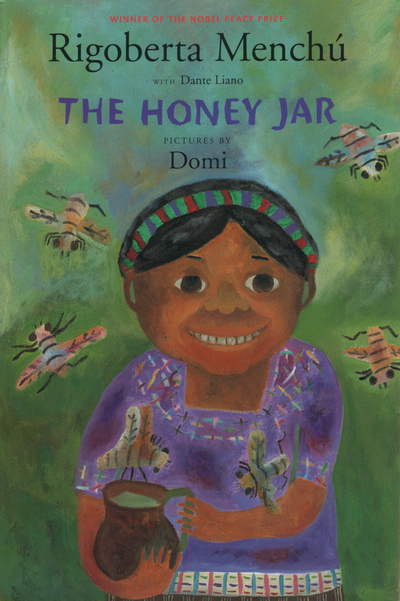
The Honey Jar by Rigoberta Menchú and Dante Liano
Illustrations by Domi
Publisher: Groundwood Books – http://www.groundwoodbooks.com/
ISBN: 0-88899-670-5

The Honey Jar is another collection of stories from 1992 Nobel Peace Prize winner and Maya activist, Rigoberta Menchú and Guatemalan National Literature Laureate, Dante Liano. These stories are re-tellings of ancient Mayan folktales and legends that the author grew up hearing from the storytellers in her village in Guatemala.

I loved the story of Grandfather Sun and Grandmother Moon who were lonely in the sky, a creation tale. It was very tender and sweet. The story tells of how Grandfather Sun and Grandmother Moon created the stars and how Grandmother Moon’s face became marked. There’s another tale called Where It’s Revealed That Each Thing Has A Spirit that I loved as well. Each of the 12 stories in this book entranced me and made me smile. They have a dreamy feel that makes me think of my indigenous ancestors and the storytelling tradition – the one I carry on to my grandchildren.

This book is an important one in that it not only preserves ancient tales, it brings them to a new audience and teaches the ancient love of nature. Any book that teaches and brings old tales to the light of the modern day is a treasure. We’ve lost so much of our history, our folklore and traditions that I really stand up and take notice when someone writes of these things, reclaims them if you will. It helps when the writing is as excellent as in this book, when you can almost feel you’re back in time, sitting with the elders at a fire listening to these stories as the night envelopes you. My favorite quote from the book is this one, “They will know that the earth does not belong to them, but that they are part of it. The earth will be a sacred place, a place created for the dreams of all generations. Chuchu’ib, Tata’ib! Thanks to your counsel, people will plant their dreams on the earth, and their dreams will blossom as if they were magic flowers”.

Domi’s illustrations add to the sense of fantasy, of being swept away in time. The colors of her palette are robust and vibrant, bringing to mind the rainforest, tropical jungles and the smell of the mountains. My favorite of her paintings in this book is the one on page 27 where the eyes in the forest seem are patterned in just such a way that they remind me of the glorious tails of the peacock.

Guest Post: Hugo Garcia, Periodismo a la brava

Blogmeister's note:
La Bloga reader Hugo Garcia retired recently from a career in Spanish-language journalism. Most recently, Garcia has been editor of Resident's Voice, an innovative newspaper serving Los Angeles' public housing residents. He spent a decade selling ad space for regional Spanish-language chains. He began his journalism career as a reporter for the Los Angeles Express, a Spanish-language daily launched in the mid-1970s, and went into sales when the Express folded.

When he isn't tending to his flock of wild cochineal, Garcia consults as a technical writer-translator for ISO- level industrial firms. Reading RudyG's accounts of Rudy's door-to-door sales life, led Hugo to share some experiences in the founding days of the L.A. Express.

from Periodismo a la brava
By Hugo Garcia

Guido and I had to file a minimum of 12 stories a day and fill up an eight page A section as much as possible. However, Miguel thought only the killing of the Pope or the president merited stories more than a page and half long. double spaced, typed in a Remington manual typewriter using carbon paper. Mari Carmen Gutierrez had the impossible task of filling an eight-page section with show biz and society items seven days a week. Jaime Guerra was the sports editor and had to fill a four-page section. Paul Potter was the translator and he translated stories from the City News Service (CNS). It is a newswire that all newspapers and TV and radio stations continue to suscribe to.

Story deadline was six P.M. so they could be sent to Tijuana via telex, but picture deadline was 1 P.M., the time Juanito would drive the material to the printing presses in Tijuana. Early the next morning he would bring that day’s edition to Los Angeles. The Express was the U.S. brother of El Mexicano de Tijuana, El Mexicano de Mexicali and El Mexicano de Ensenada, then the most influential newspaper chain in the state of Baja California. Norte.

Francisco Gutierrez and Rafael Rosales were the staff photographers. After we covered a story the reporters rushed to type it and the photogs to develop the film and print some proofs, for the reporter to chose the best one and make a print for Juanito by 1 p.m.

Miguel, our boss and leader, had started his newspaper career as a gopher in the newspaper shop and had progressed to reporter, becoming the ace political reporter of the El Mexicano chain. This was his first editor position. His boss, the publisher, was el Licenciado Enrique Galvan Ochoa. El Mexicano staffers told us that after he dedicated to then President Luis Echevarria Alvarez his book “La batalla de la Sal,” about the struggles Baja California farmers suffered because of the salinization of their farmlands, Echevarria elevated him from gadfly to publisher of the El Mexicano chain. He was also very instrumental in the launching of El Express in Los Angeles.

In spite of the working conditions, we felt part of a publication that was going to make a difference in people’s lives. And for me, it was the opportunity to work for a newspaper that championed the undocumented. I was fed up with the ignorant way the English language media covered immigration matters and the deafening silence from the existing Spanish language media. The previous year I spent many hours at the legal library on First Street reading everything I could find on immigration laws.

Strange but just like now there is HR 4437 by Republican Congressman. James Sensenbrenner that criminalizes the undocumented, in 1975 Democratic Congressman Peter Rodino introduced HR 8713, to criminalize the undocumented. Nothing has really changed in this country’s approach to the “gente sin papeles” in the past 30 years.

The next few months I spent interviewing politicians and wannabe politicians and the most important question was always “What is your position on the Rodino Bill?” Their answer to that question was either rabidly anti immigrant or totally clueless and in some instances crashed with the image many of them had crafted as friends of the Mexican American.

But before I could write immigration stories, I had to learn a few basics of Journalism 101. My first big story dealt with the launching of the Viking Space probe. Neither Francisco “Fico” the photographer nor I knew where the Jet Propulsion laboratories were located. We found them but arrived late for the press conference. I was very self-conscious of the stereotype of the always-tardy Mexican, especially with my time study background. I shouldn’t have worried for it was then that I learned about press hierarchy. First come TV, then radio, and then print media. When we got there, the press information officer was in the midst of the TV interviews. I availed myself of a thick press briefing book and thumbed through it while trying to listen to some of the questions. I didn’t want my story to just be a mere translation of the gringo stories.

When it was my turn Fico took a picture as I interviewed the press officer. He was very gracious, took me to another space probe, and had its different components move or rotate as Fico shot almost 100 pictures over and under the space vehicle. The interview lasted more than 30 minutes. On our way back I told Fico we had material for a series of articles that with his photos could fill up whole pages. He blinked hard and his enthusiasm disappeared as he told me “Maestro we left in such a hurry that I only had two shots in the camera and no more film.” What about all the shots I saw him take of the space probe? “I was using the flash but had no more film,” he answered.

Somehow, I refrained and kept to myself the barbs I could have told Fico. I would later learn that had been one of my best journalistic decisions for a photographer can make or break a reporter, especially a photographer like Fico.

I turned my story to Miguel, confident that it was a good one, full of unique insights, exclusive to the LA Express. I had not reached my desk when Miguel called me into his office. Was it that good? I asked myself.

“No, no maestro. This is not a novel. You don’t start by describing the weather and buildings. This is a straight news story.” He then told me what the lead should be. Although Miguel never went to journalism school, he had an uncanny ability for reciting great leads from poorly written stories, like mine. The story ran with a picture of me interviewing the press officer. This set a trend and Guido and subsequent reporters also appeared in the photos. A trend I would later learn was a no no in journalism.

But it was a Hollywood story that brought me my greatest five seconds of fame.


Los Blogueros and La Bloguera appreciate Hugo Garcia's sharing this history with La Bloga. The 1970s and 80s were an exciting time of change among the gente of that day. Garcia's role in this offers first-hand material students of journalism and historians will want to follow. Garcia promises to keep La Bloga updated.


Mid December already! My gosh. Next week, it's the middle of Posadas week. What are your plans? Share them in an email with La Bloga!


In the nine days leading up to December 24th, groups of revelers travel from home to home. Revelers traveling door to door are "Los de Afuera." They ordinarily sing songs of succor. Their counterparts are "Los de Adentro." The folks inside their warm homes are the innkeepers. For the first eight nights, the innkeeper turns away Los de Afuera, singing, "No room at the inn..." On the ninth night, the innkeeper flings open the door, invites everyone inside for merriment and celebration. People will do a whole Posada in a single evening, a load of fun, too, with some hands making tamales, others singing at the door, insiders getting organized for their side, late arrivers pressed into service on a drum or a guiro.

The Avenue 50 Studio and the Arroyo Arts
Collective invite the community to join us in a
Candlelight Posada for Immigrant Rights

Sunday, December 17, 2006

In the spirit of the season, and in celebration of the United Nations International Day of the Migrant, walk with us through one of Los Angeles's oldest, most diverse neighborhoods, singing together to the accompaniment of live musicians, and stopping at three art galleries along the route, where specific immigrant concerns will be highlighted with brief readings. Our walk will begin and end with music and refreshments at the Acorn Gallery, 135 N. Avenue 50, in Highland Park. Gather at 4pm in the yard behind the Gallery to learn the Posada song. The walk will begin at approximately 4:30pm, and will proceed, even in the event of rain.

The Posada is a traditional Mexican pre-Christmas procession inspired by the story of Mary and Joseph's search for shelter in Bethlehem. It has been adapted for this event to draw attention to the fact that the doors to basic human rights such as housing, education and medical care, as well as our historic right to habeas corpus, are being closed to migrants. We are a nation of immigrants. Join us on our symbolic search for shelter
that offers hope, justice and human dignity for all.

When: Sunday, December 17, 2006 starting at 4:30 pm
Where: 131-135 No. Avenue 50, Highland Park, CA 90042
Contact: 323/258-1435


'Tis the season, que no? No B.B. gun shots to the eye. See you next week.

mvs

Monday, December 11, 2006

Spotlight on elena minor

Monday’s post from Daniel Olivas

elena minor writes fiction, plays, poetry and commentary. Her work has been published in Poetry Midwest, Prism Review, BorderSenses, Vox, edifice WRECKED, The Big Ugly Review, 26, Quercus Review, Segue, Chicanovista, Facets, Banyan Review and Frontera and has new work forthcoming in Segue and Diner. She is a past First Prize recipient of the University of California at Irvine’s Chicano/Latino Literary Prize in drama, a past second place winner for poetry in the Sacramento Public Library’s Focus on Writers contest, and a past second place winner of the Facets Fiction Contest. minor has been, in addition, a short story finalist in the Pirate’s Alley William Faulkner Creative Writing Competition, the Elixir Press Fiction Chapbook Awards, the Phoebe Fiction Contest, and the Cutthroat Rick DeMarinis Short Fiction Award. She holds an MFA from Antioch University Los Angeles. minor is founding editor of Palabra, a magazine dedicated to Chicano and Latino literary art. For information on submission guidelines and subscriptions to Palabra, you may send an email.

Sandra Rodriguez Barron’s first novel, The Heiress of Water, has just been released by Rayo/HarperCollins. She's received much praise including from Isabel Allende who says: "Sandra Rodriguez Barron's exuberant prose yields an immensely entertaining reading experience. You are fraught with the certainty that she is a gatekeeper of the secrets of the sea." It has also been chosen as a Borders Original Voices selection for fall 2006. I’ll have more on Sandra soon.

◙ This holiday season, why not consider a gift from UCLA’s Chicano Studies Research Center? Journals, books, T-shirts, caps and mugs…perfect for that Chican@ or Friend-of-Chican@ on your list. See all the CSRC has to offer by clicking here.

◙ Speaking of gifts, have you visited Chicano Style yet? There are six stores in California or you can shop online. ¡Ajua!

◙ The December issue of Somos Primos is now live. It’s dedicated to Hispanic heritage and diversity issues and is produced by the Society of Hispanic Historical and Ancestral Research Celebrating which is celebrating its 20th Anniversary.

Red Hen Press has teamed up with the Geffen Playhouse to create a series of Monday night readings and conversations at the Geffen. Red Hen Press Managing Editor Kate Gale is the host of the new series. And tonight, December 11, Carolyn See and John Rechy share their "Los Angeles Stories."

Marcela Landres has all kinds of literary news online. Of note:

INTERNATIONAL LATINO BOOK AWARDS
Early Bird Discount Deadline: January 31
Full Price Deadline: March 16
Sponsored by the Latino Book & Family Festival. Authors can nominate themselves and self-published books are eligible. For guidelines, visit http://www.latinofestivals.com/home/

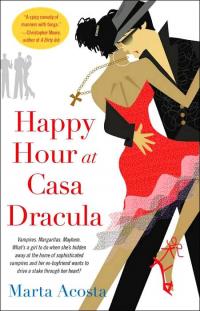
◙ I happened upon an interesting article in Publishers Weekly (December 4, 2006) by Marta Acosta, author of the hilarious novel, Happy Hour at Casa Dracula (Pocket Books). I asked her if we could republish it here on La Bloga and she kindly agreed. Here it is in its entirety:

Forget Intuition
Being labeled "women's fiction" may not be such a bad thing

by Marta Acosta

When I was seven, my dad took me to the Mystery Spot, in the redwoods near Santa Cruz, Calif. I dropped a marble on the floor and watched it roll uphill. I could not get my brain around the fact that the marble was defying the laws of nature as I knew them. I feel just as baffled now to learn that everything I thought I knew about book marketing is wrong.

I've always written for a diverse audience. Readers of my humor and feature articles are men and women, young and old. When my comic novel, Happy Hour at Casa Dracula, was published this summer, I was surprised and irked to see that, according to the book's jacket and marketing, Ihad suddenly become a writer of women's fiction and its subcategories (I'd thought my book had wider appeal). Let us ignore my predilection toward irkiness and focus on my presumption that these categories drastically limited my book sales by ignoring men as potential customers.

Art is all well and good when one has a trust fund, but I write for money, and sales are important to me. I did a little research on marketing. I expected to find evidence that everything that rises must converge, everything that goes up must come down, and that gender-specific marketing reduces readership by half.

Just as I was swayed by the optical illusion that the marble was rolling uphill, I trusted the perception that marketing my book only to women would limit sales. In both cases, my intuition was wrong.

The debate about gender in literature--men write fiction while women write women's fiction, chick lit, romance, etc.--has been going on for too long. Discussions always focus on whether women writers are being denigrated by having their novels placed in gender-specific categories. But people rarely talk about the reason for these categories from a sales perspective.

I talked to Joel Vincent, a marketing consultant in San Jose, Calif. He explained, "There's definitely a philosophy that satisfying one set of customers 100% is more effective than toning down your appeal to that segment in order to be attractive to other customers." When I expressedmy skepticism, he agreed that it seems counterintuitive to neglect huge groups of customers, but insisted that going "whole hog" with your most likely audience is a far more successful strategy.

Katy Munger, author of the Casey Jones comic mystery series, pretty much concurred: "As much as you hate being stereotyped or labeled, how do you stand out in a huge, overglutted market?" Munger considers herself a crime fiction writer, but her novels have been shelved in various sections, including mystery and chick lit.

These categories are determined by book merchandisers, not publishers, critics or authors, I learned. Vincent, who specializes in wine marketing, pointed out the role that snobbery plays on both the production and consumer sides. At what point does a writer choose perception of artistic merit over increased sales? "For artists, it's a very personal thing," Vincent said. "[But] if I wrote a book... I'd want to be in the chick lit section."

Nathan Barker, owner of Kayleighbug Books and Scrybe Press, publishers of sci-fi, fantasy and horror books, reiterated the popularity of such books: "Romance and chick lit outsell all other genres by almost five to one. Many great speculative fiction and comic titles are being releasedas 'chick lit' these days." According to Barker, in the last five years, more horror has been published in the romance genre than in the horror genre.

Barker thinks this odd categorization will eventually help speculative fiction, because "the lines are blurred, the books sell more, and the authors get paid higher advances." Still, I wonder how many men will pick up a novel from the Love Spell imprint because they're told it's a great werewolf story?

Finally, Barker told me, he goes through books to find out which ones are actually paranormals or horror novels being marketed as romance, "in an attempt to restore [those books] to general readership."

General readership... that's all I wanted in the first place.

Marta Acosta is the author of the comic, women's, vampire, chick lit, Latina, horror novel, Happy Hour at Casa Dracula. Her next book, Midnight Brunch, will be published in May.

◙ Speaking of ethnicity and literature, Jeffrey A. Trachtenberg (pictured), in an article published in The Wall Street Journal, offers the following headline: Why Book Industry Sees the World Split Still by Race. The subheadline is: In Many Stores, Black Authors Are Shelved Separately: Convenience or Disservice? Trachtenberg uses African-American horror novelist, Brandon Massey, as a primary example of this conundrum. It is a fascinating article and well worth your time. Not surprisingly, most of the issues are applicable to Latino/a writers. Massey calls having his books stocked in the African-American section "a double-edged sword." Massey is pleased that he can direct readers there but wonders if such placement "limits my sales." You may read the entire article here. I also suggest this interesting interview of Trachtenberg on book publishing and blogging.

◙ Just learned that Melinda Palacio profiles Reyna Grande in the new issue of Ink Byte.

◙ My holiday book list for children and teens appeared in yesterday’s El Paso Times.

◙ All done. So, until next Monday, enjoy the intervening posts from my compadres y comadre at La Bloga. ¡Lea un libro!

Friday, December 08, 2006

Este y Eso

Manuel Ramos

COLORADO AND NEW MEXICO PIONEERS
The Colorado Society of Hispanic Genealogy has published Hispanic Pioneers in Colorado and New Mexico, and is celebrating with a reception at the Colorado History Museum, 1300 Broadway, Denver, on December 9 from 2:30 to 4:30 PM. More details at the Society's website.

PROPS FOR A HOMEBOY
Congratulations to Denver writer, director, musician and activist, Tony Garcia. Here's the press release:

"El Centro Su Teatro
Executive Artistic Director Anthony J. Garcia has been awarded a $50,000 fellowship from the newly established United States Artists (USA).

Garcia, who was nominated by the National Association of Latino Arts and Culture (NALAC), is among the 50 fellows chosen by USA from over 300 nominees. USA selects fellows based on the nominee’s artistic quality, creativity, innovation, and risk-taking.

Garcia has been a member of Su Teatro since 1972 when he joined the company as a guitar player and singer. Garcia’s plays have garnered much critical acclaim including the Denver Post’s Ovation Award, the Denver Drama Critics Circle Award for Best New Play, and the University of California, Irvine Chicano Literary Award. Garcia also received a directing fellowship from Theatre Communications Group in 1989, which allowed him to visit theatre groups across the country and solidify his standing as one of the Southwest’s preeminent theater visionaries.

According to USA, 96% of Americans value art in their communities and their lives; however, only 27% value artists. This paradox is one of the main catalysts for USA’s inception. Through this unparalleled fellowship program, USA hopes to encourage creative output in the United States in order to invigorate the economy and celebrate our most talented creative thinkers.

Garcia received his honor at a public reception at the Lincoln Center in New York on Monday, December 4. For more information please call El Centro Su Teatro at (303) 296-0219."

LUMINARIAS DE SANTA FE DRIVE
December 8: 13th Annual Luminarias de Santa Fe Drive. Get in the holiday spirit by joining this popular cultural event that will focus on the history, tradition, and architecture of Santa Fe Drive, also known as the "Gateway to Denver." Marvel at the Luminarias light bags adorning storefronts, traditional Mexican dancers, and local carolers while viewing art in more than 30 galleries and artists' studios.5-9 pm. Free. Santa Fe Dr. area between 5th and 10th Avenues MAP.303-534-9740

PISTOLERA
Daniela Capistrano tells me that she is a Chicana Associate Producer and avid reader of La Bloga, both of which sound cool to me. Daniela also says that she thinks the NYC folklorico band Pistolera delivers "strong, positive messages," that they just finished a West Coast tour, and that they will be touring Europe and the Southwest in the spring. Daniela shot a performance clip at a recent Pistolera CD release party, which you can watch here. The band does Cazador, a song that deals with immigrants and immigrant rights. Again, cool. Daniela will direct the band's first music video this month. Check out the clip, watch for the band.

Sorry, not much from me this week-- winter-like weather and winter-like blues slowed me down.

Later.

Tuesday, December 05, 2006

Review: The Uncomfortable Dead. Taibo and Subcomandante Marcos

Michael Sedano

The Uncomfortable Dead. (What's Missing is Missing)

A Novel by Four Hands
Paco Ignacio Taibo II and Subcomandante Marcos. NY: Akashic Books, 2006. ISBN: 1-933354-07-0

Translation by Carlos Lopez.

Not that it really matters, but I wonder how this reads in Spanish?

"Soon as I got to the town I talked to the rep, whose name is Genaro and who is or was the husband of the deceased Maria. Well, she ain't deceased, not yet anyway. That's what we had to find out. So General told me that she went out for firewood and that later, well, she didn't come back again. Didya look for her? Yes! Ya didn't find her? No! He said how if he'd found her he wouldn't've called Headquarters. That was three weeks ago. So why didn't he call then? Cause there was still a chance she'd turn up. So, did he know which way she headed? No! Maybe she was taken by the Army or the paramilitaries and she was already deceased. Who was going to make his pozol and his tortillas? And who was going to take care of the kids?

So I says goodbye to Genaro, thinking how he was more worried about who was going to do his cooking than about the deceased, or not, Maria, and thinking that what he was remembering was not that he loved her or nothing like that, but all the work she did around the house and all." (19)

The speaker is Elias Contreras--not his real name--a Zapatista detective. The dialect he's using fits the Chiapas backwoods where Elias has gone to solve a missing person case. Subcomandante Marcos himself commissioned the case. The EZLN is poised to condemn government kidnaping and torture of Zapatista women, and El Sup wants Elias to make sure of the woman's fate.

But this is not the story the drives The Uncomfortable Dead. Maria's disappearance is one small background detail like so many that enrich this "four handed" novel. This is Subcomandante Marcos' hand, the Elias story. Rural characters. Lethal situations from Mexico's southernmost border. Dialect writing. Country and city. Alternating chapters, the odd numbers.

The second half of the novel, the even numbered chapters, is Taibo's. Hector Belascoaran Shayne is on a case involving mysterious politically charged voicemail messages from a dead man. There's a generous helping of government corruption, murder, and a delicious taste of the absurd. An Osama Bin Laden imposter is in actuality a chilango taco vendor employed by the CIA to make propaganda tapes to dupe the United States and world audience.

The Uncomfortable Dead is a mystery, so telling more is to spoil the fun the authors have in this collaborative romp. Marcos holds his own against the masterful Taibo. The novel is not a competition. From Taibo, acknowledgement of the correctness of Marcos' cause. From Marcos, an hommage to noir satire and a restrained political hand.

Together, the authors fashion a fun bundle of interlocking events and characters. They write well together. The indio comes up to The Monster--Mexico City--to learn city ways and be the conduit between Subcomandante Marcos and Shayne. The point of convergence between the two detectives will have readers laughing out loud at the fun of conjoined perspectives: The indio feels grateful having a warm city hat in the January air; in his chapter, Shayne chuckles at the outdated chapeau.

The United States reader will glean insight into Zapatista logic and sensibility, but will likely miss any significance in most of the Mexican names. Zedillo, Salinas, Fox, PRI and PRD will be familiar, but the large cast of henchmen, ministers, and petites bourgeoises only add to the flavor of authenticity. Travelers who enjoy el Defie will enjoy Taibo's and Marcos' celebration of the city, and will recognize the smog and the forests of television antennae. A reader who comes to the novel with more than a passing familiarity with contemporary Mexico, will find The Uncomfortable Dead doubly rewarding. Taibo and Marcos have come up with a highly involving detective yarn that anyone will find accessible and delightful.

The publisher, Akashic Books, has an impressive lineup of titles, attractively priced. Because many of the authors may be lesser-known to the U.S. reader, gift givers will find it useful to explore Akashic's other titles.

mvs

Announcements
Look for information on Dagoberto Gilb's new anthology, Hecho en Tejas. Con jota y todo, don't blame me, asi vino.


Happy birthday Sol. Rumor has it that La Bloga's bloguera Gina MarySol Ruiz recently earned a couple of choruses of las mañanitas.


Speaking of a girl child, my granddaughter, Charlotte, joined the family December 2 at 7:05 p.m.


Here we were expecting a Christmas baby. December 2d's more than perfect!

See you next week.

mvs

Monday, December 04, 2006

A LITTLE POETRY FOR MONDAY

from Daniel Olivas...

"Georgina S. Francisco is a Friend of Mine"

Georgina S. Francisco is a friend of mine,
and she is very particular about
two things: cheese and Margaritas.

“Cheese,” she purrs, “must be strong,
sharp and sweet, like dulce.”

She leans into me for emphasis.
“¿No?” she says through a red
O of a mouth.

“And there is only one way,” she whispers,
“to make a Margarita.”

I wave her off, my eyes bulging with
excitement, and tell her about my
latest Google search where I unearthed
the most remarkable Margarita recipe that
includes a bottle of beer.

Georgina’s eyes narrow into mere slits,
and she spits out a disgusted, “Feh!”

Before I can say more, she stands and
looks down at me with disdain.
“There’s only one way to make a Margarita,”
she sneers. “And it does not include beer.”

Georgina turns on her heel leaving me
desolate with nothing more than her
perfume’s scent and her rebuke’s sting.

[“Georgina S. Francisco is a Friend of Mine” first appeared in Poetry Super Highway.]

◙ RIGO REVIEWS IN EPT: “With a moving novel about the conflicts between cultures and neighboring nations, author Ana-Maurine Lara has expanded the terrain of American literature to include the experience of Haitians in the Dominican Republic. At its core, "Erzulie's Skirt" (Redbone Press, $15 paperback) is a love story between two women who travel different paths but share similar goals -- securing the survival of their African birthright as healers and spiritual guides for the next generation.” Read Rigoberto González’s full review here.

◙ INLAND EMPIRE IS HIP: The literary anthology Inlandia (Heyday Books), which showcases works of fiction, poetry, and nonfiction specifically focused on the Inland Empire, has hit the bookshelves. A number of Latino writers have pieces in the book, ranging from early explorers and settlers to Michael Jaime-Becerra, Juan Delgado, and Alex Espinoza. An all day event is planned on December 9th at the Riverside Public Library (click here for details). The festivities start at 10 a.m. and run until 6 p.m. There will be readings by Susan Straight (who also is a contributor and wrote the introduction for the book), Espinoza, Jaime-Becerra, Delgado, and a host of other fine writers. Aside from the readings, there will also be Taiko drum performers, food booths, live music, and historic photos on display. It should be a blast.

AND…speaking of Alex Espinoza, his first novel, Still Water Saints, will be released by Random House on January 30, 2007. There will be a simultaneous Spanish release, translated by Liliana Valenzuela (who has worked with Sandra Cisneros, Julia Alvarez, and Denise Chavez). Barnes and Noble has picked Espinoza’s novel for their Spring “Discover Great New Writers” program. Early reviews have been good, and people seem to be very excited about the book. Los Angeles Magazine as well as Latina will be reviewing it. I happily note that Espinoza has a short story in the anthology I’m editing for Bilingual Press, Latinos in Lotus Land, due out next year.

All done. I wanted this to be longer but I’m dealing with family medical issues. My post next Monday will be longer with an author spotlight and all sorts of news I’ve been gathering. ¡Lea un libro!

Friday, December 01, 2006

News That Fits

Manuel Ramos

A WRITER TO WATCH -- BUT WE KNEW THAT
Our very own Daniel Olivas has been chosen by LatinoStories.com as one of 2007's Top Ten "New" Latino Authors to Watch.

Well-deserved and congratulations to Daniel. He's in some very good company. The list includes several writers profiled on La Bloga. Here are the ten:

1) Christine Granados - Brides and Sinners in El Chuco

2) Sonia Nazario - Enrique's Journey

3) Rene Colato Lainez - I Am Rene, the Boy/ Soy Rene, El Nino

4) Daniel A. Olivas - Devil Talk

5) Francisco Aragon - Puerta del Sol

6) Sandra Rodriguez Barron - The Heiress of Water

7) Cristina Henriquez - Come Together, Fall Apart

8) Reyna Grande - Across a Hundred Mountains

9) Paul Cuadros - Home on the Field

10) Mario Acevedo -The Nymphos of Rocky Flats

MOUNTAIN & PLAINS REGIONAL BOOK AWARDS
Speaking of lists, the Mountain & Plains Independent Booksellers Association announced its titles shortlisted for the 2007 Regional Book Awards. In the Adult Fiction category is Cottonwood Saints (UNM Press) by Gene Guerin, winner of this year's Premio Aztlán. "Cottonwood Saints is a moving family saga, rich in lore and personality and the marvelous culture of New Mexico. Margarita Juana is a powerful woman, a survivor who perseveres against all odds, determined to hold things together. Her story, about the extreme courage of ordinary people, is sad and true and very inspiring."--John Nichols, author of The Milagro Beanfield War


Through Georgia's Eyes by Rachel Victoria Rodríguez (Henry Holt & Co.) is nominated in the Children's category. According to the publisher: "Georgia O’Keeffe saw the world differently from most people. As a child she roamed the prairie with a sketch pad in her hand, struggling to capture on paper what she saw all around her. At art school she learned to speak in paint on canvas. But Georgia felt confined by city life. She longed for inspiration, for vast expanses of space, and she found them both in the red hills and silent deserts of New Mexico. Lyrical and vivid, Through Georgia’s Eyes is a portrait of an exceptional artist, a woman whose eyes were open to the wideness and wonder of the world."

STORIES AND ART
Here's an interesting contest that combines two things we talk about a lot here on La Bloga, books and art. Stories on Stage and the Art Students League of Denver are running a contest where the idea is to create a short piece of writing (short fiction, narrative nonfiction, essay or poetry) inspired by selected works of art that requires no more than 10 minutes to read aloud, and that tells a story. Winning selections will be read by professional actors during the Stories on Stage/Art Students League's February 10, 2007 presentation Words of Art. Submission deadline is December 30, 2006. All of the art pieces are part of The Image of Words at the Art Students League of Denver, curated by Emilio Lobato. For more details and to see the artwork, go to the Stories on Stage website.

ANOTHER WRITING CONTEST
3rd Annual Arapahoe Community College Writers Studio Literary Contest for Colorado residents. $250 First Prize per category, plus publication in Progenitor. Categories: Fiction/Creative Nonfiction-up to 20 pp typed double-spaced. Poetry-up to three poems typed, single-spaced. Fees: $10 per category; $7 per ACC students. See guidelines at http://www.arapahoe.edu/deptprgrms/eng/writerscontest.html.

HELP PUBLIC RADIO COVER US LATINO BUSINESS AND CULTURE
I pass on this message from Marketplace, a program heard on public radio stations:

"The mainstream media has a pretty spotty record when it comes to covering the real issues in the Hispanic community. Do you see trends and stories that aren’t being reported in the news media? Do you work at – or have you started – a business that’s part of the growing Hispanic American economy?

Marketplace, the leading business show on public radio with more than 9 million listeners, wants your help to provide deeper coverage of the issues and emerging trends affecting Hispanic businesses, employees and communities.

Marketplace reporter Dan Grech reports on the Spanish-speaking community and businesses: your insight can help Dan and other Marketplace reporters cover Hispanic communities and businesses more accurately, more in-depth, and with more relevance. Your knowledge can inform the news.

Have you started a business? How is Hispanic culture affecting the American marketplace? What stories about the Hispanic community do you want to see in the news? Click here to introduce yourself to Marketplace.

What you share will help improve media coverage of Hispanic communities and businesses. Thank you for your time.

Regards,

Joellen Easton
Public Insight Analyst
Marketplace Marketplace Money Weekend America
American Public Media

365 DAYS/365 PLAYS
El Centro Su Teatro will join two high schools, eight colleges and 43 other theater companies from 18 Colorado cities to present Pulitzer prize-winning playwright Suzan-Lori Parks’s unprecedented 365 Days/365 Plays, Saturday, December 2 at 7 pm at El Centro Su Teatro, 4725 High Street in Denver.

Parks wrote 365 Days/365 Plays one day at a time over the course of one year. The project was originally conceived as a private meditation on Parks’s own life and art, but the themes turned universal, and the idea grew wings and has become, quite probably, the largest theater collaboration ever.

Colorado is not the only state involved in the project. Theaters from New York to Austin to Seattle to Atlanta are accepting the grail—more than 600 theater groups so far, and the number continues to grow.

El Centro Su Teatro will present Week 3 of the 52-week series, performing seven of Parks’s plays in one evening. The plays will be presented as free staged readings with minimal costume and set design, but plenty o' flourish.

Week 3 of Suzan-Lori Parks’s 365 Days/365 Plays will be directed by Su Teatro associate artists and staff members Valarie Castillo and John Kuebler and will star your favorite Su Teatro company actors. Join us for a night of fun, innovative theater—it’s a guaranteed good time (and it’s free). Call (303) 296-0219 for more information.

VINO Y CHOCOLATE
Adelante Mujer invites one and all to attend the 8th Annual Vino y Chocolate, December 7, 5 PM to 8 PM at the Centro San Juan Diego, 2830 Lawrence, Denver. Support the Immigrant and Battered Women's Project of Bienestar Family Services by bringing a gift of clothing, coats and toys for childrend birth to 10 years. There also will be a mercado where you can find Mexican shawls and table place mats woven by the women of Las Mujeres de Esperanza y Fe, based in Ciudad Juárez, Chihuahua. RSVP 303-297-8696.

Later.