Wednesday, June 03, 2009

International Latino Book Award 2010


Congratulations to the International Latino Book Award Winners!

CATEGORY A – CHILDREN AND YOUNG ADULT BOOKS

Best Educational Children’s Book - English
The Song of the Coconut – Adalucía - Cholita Prints & Publishing Co.

Best Educational Children’s Book - Spanish
Quiero Ser Poeta - Rafael Garcia Jolly, José Carbonell Pla, Antonia Moreno, María D. Torres Bañuls - LetraRoja
2ND Place: El secreto del dorado - Maria Villegas y Jennie Kent - Villegas Asociados S.A.
Honorable Mention: Figúrate: Animales, Fantasía y Mundo - María Villegas y Jennie Kent - Villegas Asociados

Best Educational Children’s Book - Bilingual
Dealing With Insults - Qué Hacer con los Insultos - Marianne Johnson - Rosen Publishing/Buenas Letras
2ND Place: Teo in Palo Verde - Adam Del Rio - Lectura Books
2ND Place: Ronaldinho - José María Obregón - Rosen Publishing/Buenas Letras
Honorable Mention: Las Abejas - Katie Franks - Rosen Publishing/Buenas Letras

Best Children’s Picture Book – English
Abuelos - Pat Mora - Groundwood Books
2ND Place: The Secret Legacy - Rigoberta Menchú - Groundwood Books
Honorable Mention: Kitchen Dance - Maurie J. Manning - Clarion Books

Best Children’s Picture Book – Spanish
Los Tres Reyes De Oriente - Lluis Farre - Bambú
2ND Place: El mejor mariachi del mundo - J. D. Smith - Raven Tree Press
Honorable Mention: Mira, Mira - Angels Navarro - Bambú

Best Children’s Picture Book – Bilingual
Rachel and the Lion - Stephanie Lainez - Story House Books
2ND Place: Colors!¡Colores! - Jorge Luján - Groundwood Books
Honorable Mention: The Storyteller’s Candle - Lucia Gonzalez - Children’s Book Press

Best Young Adult Fiction – English
Dark Dude - Oscar Hijuelos - Atheneum/Simon & Schuster Children’s Publishing
2ND Place: Amor and Summer Secrets - Diana Rodriguez Wallach - Kensington Publishers
Honorable Mention: Mr. Clean and the Barrio - David Bueno-Hill - Urbano Books

Best Young Adult Fiction – Spanish or Bilingual
El Asunto Galindo - Fernando Lalana - Bambú
2ND Place: Odisea - Albert Jané - Combel Editorial, S. A
Honorable Mention: Carlito’s Story - Max Benavidez & Katherine Del Monte – Lectura Books
Honorable Mention: No sapiens - Ariel González - Libros en Red

Best Young Adult Nonfiction - English
The Barefoot Shoeshine Boy - Al Rivera - Author House

Best Young Adult Sports/Recreation – English
Soccer’s Story & A Futbol Fable - Gil Sperry - Amigo del Mar Press

Best Young Adult Sports/Recreation – Spanish or Bilingual
Go Milka Go! ¡Core, Milka, Corre! - Raquel Benatar - Renaissance House

CATEGORY B – NONFICTION

Best Arts Book - English
The Journey of Frederic Edwin Church - Through Colombia and Ecuador - Pablo Navas Sanz de Santamaria - Villegas Asociados S.A.
2ND Place: Line: 7 Elements of Art - Jane Castillo - Crystal Productions
Honorable Mention: Yolanda M. Lopez - Karen Mary Davalos - Chicano Studies Research Center Press (UCLA)

Best Arts Book - Spanish or Bilingual
Manuel Hernández - Manuel Hernández - Villegas Asociados S.A.
2ND Place: Alicia Viteri: Memoria Digital - Alicia Viteri - Villegas Asociados S.A.
Honorable Mention: Herman the Jester and the ABC’s of Art - Rafael Filion - Author House

Best Biography - English
Crazy Loco Love - Victor Villaseñor - Arte Público Press
2ND Place: The Last Supper of Chicano Heroes - José Antonio Burciaga - University of Arizona Press
2ND Place: Paths to Discovery - Norma E. Cantú - Chicano Studies Research Center Press (UCLA)
Honorable Mention: Take Me With You: A Memoir - Carlos Frias - Atria Books/Simon & Schuster

Best Biography - Spanish or Bilingual
Bolívar, Delirio y Epopeya - Víctor Paz - Villegas Asociados S.A.
2ND Place: Llorando en la Oscuridad - Pablo Chapoy - Ediciones Del Ermitaño
Honorable Mention: Yagruma: Amores Prohibidos en Epocas de Tirania - Francisco Calderon Vallejo - Conceptos Editoriales
Honorable Mention: Un Sueño Americano - Oscar de la Hoya - Rayo
Honorable Mention: De Ciertas Damas - Carlos Lleras Restrepo - Villegas Asociados S.A.

Best Business Book - Spanish or Bilingual
El Latino más rico en los Estados Unidos - Rubén Ruiz - Wealth and Millionaire Publishing
2ND Place: Hablidades Para el Trato Personal en los Negocios - Dr. Camilo Cruz - Taller Del Éxito

Best Gift Book - English
Colombia by Color - Benjamin Villegas - Villegas Asociados S.A.
2ND Place: Holywood - Se Habla Español - Rafael J. Rivera-Viruet & Max Resto - Terramax Entertainment Publishing

Best Gift Book - Spanish or Bilingual
Secreto: El Libro De La Gratitud (The Secret Gratitude Book) - Rhonda Byrne - Atria Books/Simon & Schuster
2ND Place: Quiero Ser Poeta - Garcia Jolly, Carbonell Pla, Moreno, Torres Bañuls - LetraRoja
2ND Place: Pardon My Spanglish ¡Porque Because! - Bill Santiago - Qwirk Books
Honorable Mention: Gringosincrasias - Emma Sepúlveda - Asterión

Best History/Political Book - English
No Greater Love: The Lives and Times of Hispanic Soldiers - Major General Freddie Valenzuela, with Jason Lemons - Ovation Books

Best History/Political Book - Spanish or Bilingual
Principio y Fin Delmito Fidelista - José Alvarez - Trafford Publishing
2ND Place: Alberto Lleras - Alberto Lleras - Villegas Asociados S.A.

Best Reference Book - English
A Simple Guide to U.S. Immigration and Citizenship - Luis Cortes - Atria Books/Simon & Schuster

Best Reference Book - Spanish or Bilingual
De Inmigrante a Ciudadano - Luis Cortes - Atria Books/Simon & Schuster
2ND Place: El Latino más rico en los Estados Unidos - Rubén Ruiz - Wealth and Millionaire Publishing

Best Cookbook - English
Latin Evolution - Jose Garces - Lake Isle Press, Inc.

Best Cookbook - Spanish or Bilingual
Larousse De Los Postres - Paulina Abascal - Ediciones Larousse
2ND Place: Y Hoy ¿Qué Les Doy? - Lourdes Al cñiz y Lourdes March = Grijalbo - Random House Mondadori
Honorable Mention: La Comida de Italia - Un viaje para los amantes de la cocina - María Villegas & Sophie Braimbridge - Villegas Asociados

Best Health Book - English
The Art of Healing Latinos - David E. Hayes-Bautista & Roberto Chiprut - Chicano Studies Research Center Press (UCLA)

Best Health Book - Spanish or Bilingual
Mami, tengo hambre! - Jeamme Warren Lindsay, Jean Brunelli, Sally McCullough - Morning Glory Press
2ND Place: Y Hoy ¿Qué Les Doy? - Lourdes Al Cñiz y Lourdes March - Grijalbo - Random House Mondadori

Best Religious Book - English
Misa, Mesa y Musa Vol 2 - Kenneth G. Davis - World Library Publications
2ND Place: Laugh Your Way to a Better Marriage: Unlocking the Secrets to Life, Love and Marriage - Mark Gungor – Atria Books

Best Religious Book - Spanish or Bilingual
Autobiografia de un Yogui (revised) - Paramahansa Yogananda - Self-Realization Fellowship
2ND Place: Susurros de la Eternidad - Paramahansa Yogananda - Self-Realization Fellowship
Honorable Mention: Reconstruye Tu Vida: El Camino a la Felicidad Sin Limites - T.D. Jakes – Atria Books/Simon & Schuster

Best Self-help Book - English
The Barefoot Shoeshine Boy - Al Rivera – Author House
2ND Place: I Love You. Now What? Falling in Love is a Mystery. Keeping it Isn’t - Mabel Iam – Atria Books/Simon & Schuster
2ND Place: Family Activism: Empowering Your Community Beginning with Family and Friends - Roberto Vargas – Bennett-Koehler Publishers
Honorable Mention: The Latino’s Guide to Parenting - Suzanne Moreno - Ed-Ventures Publishing Co.

Best Self-help Book - Spanish or Bilingual
Triunfar en la Vida - Paramahansa Yogananda - Self-Realization Fellowship
2ND Place: ¿Se Habla Dinero? The Everyday Guide to Financial Success - Lynn Jimenez - John Wiley & Sons

Best Spiritual/New Age Book - Spanish or Bilingual
El Viaje - Siete pasos para diseñar y dusfrutar una vida con propósito - Lic. Rafael Ayala - Taller Del Éxito
2ND Place: Secreto: El Libro De La Gratitud (The Secret Gratitude Book) - Rhonda Byrne - Atria Books/Simon & Schuster
2ND Place: Autobiografia de un Yogui (revised) - Paramahansa Yogananda - Self-Realization Fellowship
Honorable Mention: El Latino más rico en los Estados Unidos - Rubén Ruiz - Wealth and Millionaire Publishing

Best Travel Book - English
Winter in Kandahar - Life in Afghanistan Before the Taliban - Ana M. Briongos - Trotamundas Press

Best Travel Book - Spanish or Bilingual
El Viaje de Frederic Edwin Church - por Colombia y Ecuador - Pablo Navas Sanz de Santamaria - Villegas Asociados S.A.

CATEGORY C – FICTION

Best Popular Fiction - English
Gunmetal Black - Daniel Serrano - Grand Central Publishing
2ND Place: Ghosts of El Grullo - Patricia Santana - University of New Mexico Press

Best Popular Fiction - Spanish or Bilingual
No sapiens - Ariel González - Libros en Red

Best Novel – Adventure or Drama - English
Brida - Paulo Coelho - Harper Collins
2ND Place: The Flowers - Dagoberto Gilb - Grove Press
Honorable Mention: If I Die In Juárez - Stella Pope Duarte - University of Arizona Press

Best Novel – Adventure or Drama – Spanish or Bilingual
Por La Vida De Mi Hermana (My Sister’s Keeper) - Jodi Picoult - Atria Books/Simon & Schuster
2ND Place: El Infinita en la Palma De la Mano - Gioconda Belli - Rayo
Honorable Mention: Luna llena. Cabalgando sin riendas - Carmela Escobar - Libros en Red
Honorable Mention: Nada Importa - Alvaro Robledo - Villegas Asociados S.A.

Best Novel – Historical Fiction - English
Alejandro and the Fishermen of Tancay - Braulio Muñoz - University of Arizona Press
2ND Place: Valfierno: The Man Who Stole the Mona Lisa - Martin Caparros - Atria Books/Simon & Schuster

Best Novel – Mystery - English
The Case Runner - Carlos Cisneros - Arte Público Press
2ND Place: The Paris Enigma - Pablo de Santos - Harper Collins
Honorable Mention: Gunmetal Black - Daniel Serrano - Grand Central Publishing

Best Novel – Mystery - Spanish or Bilingual
Sangre en el desierto - Alicia Gaspar de Alba - Arte Público Press
2ND Place: Tácticas contra el tedio - Mauricio Bernal - Villegas Asociados S.A.

Best Novel – Romance - English
The Heartbreak Pill - Anjanette Delgado - Atria Books/Simon & Schuster
2ND Place: More Than This - Margo Candela
Honorable Mention: Tarnished Beauty - Cecilia Samartin - Atria Books/Simon & Schuster

Best Novel – Romance - Spanish or Bilingual
Luna llena. Cabalgando sin riendas - Carmela Escobar - Libros en Red

Best Graphic Novel – Spanish or Bilingual
Aleida x anos - Vladdo (Vladimar Flórez) - Villegas Asociados S.A.
2ND Place: Ellos/Ellas - Silvia Vallejo - Villegas Asociados S.A.

Best Poetry Book - English
Half of the World in Light - Juan Felipe Herrera - University of Arizona Press
2ND Place: Primera Página: Poetry from the Latino Heartland - Latino Writers Collective - Scapegoat Press
Honorable Mention: The Buried Sea - Rane Arroyo - University of Arizona Press

Best Poetry Book - Spanish or Bilingual
Lugar de Origen - Place of Origin - Elena Lafert & Melina Draper - Oyster River Press
2ND Place: Susurros de la Eternidad - Paramahansa Yogananda - Self-Realization Fellowship
Honorable Mention: Secretos - Chuyin Rocha - Createspace

CATEGORY D – DESIGN (Title – Illustrator/Designer(s) - Publisher):

Best Cover Design
Take Me With You: A Memoir - James Perales - Atria Books/Simon & Schuster
2ND Place: Alicia Viteri: Memoria Digital - Villegas Asociados S.A.
Honorable Mention: The Richest Latino in America - Rubén and Richard Ruiz - Wealth and Millionaire Publishing

Best Cover Illustration
El secreto del dorado - Villegas Asociados S.A.
2ND Place: The Song of the Coconut – Adalucía - Cholita Prints & Publiching Co.

Best Interior Design
Manuel Hernández - Villegas Asociados S.A.
2ND Place: The Song of the Coconut – Adalucía - Cholita Prints & Publiching Co.

Best Use of Photos
Colombia es Color - Villegas Asociados S.A.

CATEGORY E – AUDIO

Best Children’s Audio Book – Spanish or Bilingual
Animals at the farm/Animales de la granja - Gladys Rosa-Mendoza - Me + Mi Publishing
2ND Place: My Family and I/Mi familia y yo - Gladys Rosa-Mendoza - Me + Mi Publishing

Best Non-Fiction Audio Book – Spanish or Bilingual
La Ley de la Atracción - Dr. Camilo Cruz

CATEGORY F - THE MARIPOSA AWARDS

Best First Book - English
Take Me With You: A Memoir - Carlos Frias - Atria Books/Simon & Schuster
2ND Place: Reclaiming Paris - Fabiola Santiago - Atria Books/Simon & Schuster
Honorable Mention: The Seamstress - Frances de Pontes-Peebles - Harper Collins
Honorable Mention: Carnival of Memories - Yocasta Fareri - iUniverse

Best First Book - Spanish
Luna llena. Cabalgando sin riendas - Carmela Escobar - Libros en Red
2ND Place: Pardon My Spanglish ¡Porque Because! - Bill Santiago - Qwirk Books
Honorable Mention: Herman the Jester and the ABC’s of Art - Rafael Filion - Author House
Honorable Mention: Secretos - Chuyin Rocha - Createspace

Tuesday, June 02, 2009

Review: Daniel Cano. Death and the American Dream. Final Report: National Latino Writers Conference. Notes.

Daniel Cano. Death and the American Dream. Tempe AZ: Bilingual Review Press / Editorial Bilingüe, 2009.
ISBN: 978-1-931010-54-2 (cloth) 978-1-931010-55-9 (paper)


Michael Sedano

Charley Trujillo leans into his story. The historical Tiburcio Vasquez had been a fluently bilingual upperclass scion of a Californio familia on the mid-19th century Monterey peninsula. Vasquez ran afoul of the clash of cultures--perhaps because he was too good at moving in and out of his hispanoparlante cultura and his equally educated Englich, I think—and went on the lam from la jura. Escaping a feared Mexican-killer lawman, Vasquez was pinched in West Hollywood by a local posse. In the newspapers of the day, Tiburcio’s personality won the day, but the jury hanged him anyway, no hard feelings, in 1875.

Trujillo, the author of Soldados, and Dogs From Illusion, writes with straightforward power about Chicanos in Vietnam, so his upcoming documentary film on this California legend should prove to be equally compelling. My conversation with Charley at the National Latino Writers Conference highlights the little-known, or mis-known, early history of Chicano culture in California. These people had stories; had newspapers, writers, an information culture, and that was a hundred years ago. So large a story, so small a memory.

Against that historical amnesia comes a much-needed historical novel, Daniel Cano’s
Death and the American Dream. Next year marks the centennial of the 1910 Mexican Revolution, along with a starting point in the chronology of Mexican immigration into California. In Death and the American Dream, populated by an unusual protagonist supported by strong women, set against a convincing historical landscape, Cano treats his reader to six years in the life of a fugitive from the Mexican revolution who settles into a Mexicano community, not in East L.A., but a barrio that occupied today’s Brentwood on the tony west side.

Any title with “American Dream” in it has to be writ large, and the main problem with
Death and the American Dream is it is writ too short. With success of this novel, it could become one in a series of historical novels tracking the conflicted biculturalism of that revolution-driven Chicano diaspora, in the person of Pepe Rios, who is not yet thirty as the novel ends in 1920. Pepe would be around 80 in 1970, the height of the Chicano Movement. It would be interesting seeing how Cano gets us there.

In 1911, eighteen year old Pepe Rios thrashes away from battle in Juarez to safety on the El Paso del Norte shore, where locals have set up picnics to take in the Mexican fireworks. Soldiering with Pancho Villa, Pepe gets tangled with the federales and believes he’s betrayed both his Villista compañeros and the feds, and killing his brother. Unable to tell his mother of his own role in the brother’s death, Pepe’s guilt launches him into headlong flight from the welter of confusions surrounding the battle and likelihood of execution by whichever side catches him first.

Crossing the river, Pepe kills an opposing soldier. Moving toward California, Pepe gets involved in killing a white man. Then Pepe’s best friend Seferino disappears into the hands of Los Angeles police and dies a suicide because he had it coming. These are the deaths that weigh heavily on Pepe—a son’s debt to his mother; the gallows; class and ethnic aporia--just as he’s about to get his first real taste of the American dream. The year is 1915. Pepe’s changed his name to José San Juan, and after years of subsisting on a steady diet of hard physical labor, San Juan—Cano always calls him Pepe--finds a dream job as a cub reporter at Martín Algodón’s newspaper, El ababar.

Cano puts strong women into Rios’ life. For his part, Pepe is not one of those “el hombre domina” tipos but willingly seeks his woman mentors. Ángela, the severe boss and cultural coach, continues where the priest left off back on el rancho, training the student’s mind. The alluringly beautiful Camilia, who years earlier has mentored Pepe Rios in passion, now his publisher’s wife, has gotten Rios/San Juan the life-changing break. Eusebia, a troubled woman, mother, and intimate confidant, disdains Pepe’s social whorl.

Mentored by seasoned bilingual veterana Ángela Durón, a writing career opens to the skilled letter-scribe and habitual diarist. Pepe hungrily takes to Ángela’s training. Secretly, he hopes one day to investigate Seferino’s murder, expose corruption, and bring a measure of justice to his “Just Us” excluded gente. Cano is spare but effective establishing the pervasive brutality of cop v. comunidad of the period, the Them and Us still extant. There’s no whining in Pepe’s bitterness. Cano allows Pepe and his neighbors seething outrage, moderated for similarly outraged readers by the dramatic irony that Pepe’s role is to be a tool. On one hand, the capitalist running dog Algodón keeps a willing Pepe on a financial leash. On the other hand, the anarchists cynically exploit Pepe, playing his ghosts against his better judgment, driving him to despicable and dangerous acts.

Language is no barrier to the monolingual Pepe. His beat is the newspaper’s society pages and occasional hard news piece. Los Angeles’ Spanish-speaking upper crust society opens to San Juan. Movers and shakers who love seeing their names and faces in the paper welcome the writer into their society, and Pepe’s a natural bon vivant and surreptitious interviewer. He gets good stuff that Ángela turns into interesting copy. Even without his own byline, other editors clamor for the reporter’s news. The money helps. With advanced skill, and notoriety, come danger. Ricardo Flores Magon comes to town to publish the famous
Régeneración. In hot pursuit: the cops, the feds, the Mexican feds, judges, anglo media. Magon will eventually get 20 years that cost his life.

Home life offers little comfort to the fatigued and deeply stressed reporter. He’s out late at fancy events, often, in the company of attractive women who seem available. His wife aspires to none of Pepe’s social graces. Her values rest in her home, family, and gente. Eusebia recognizes her indianness as polar opposite to what draws Pepe out of the home. She understands her role. She brought her own children to marriage with Pepe. She knows as does he, that Pepe settled on her, still haunted by the memories of another woman. She recognizes the constant presence of the glamorous ex-lover, Camilia, in Pepe's career.

Cano’s description playing the two women against each other illustrates the dysjunction of Pepe’s torment. His wife has just looked into a mirror noting proudly her Amerindianness:

Pepe saw strength and beauty as he looked into her eyes—not a woman’s socially accepted beauty—bright eyes, curved lips, or shapely body—but something deeper, a chasm that lulled and puzzled at the same time, an enigma that transcended the flesh. Where Camilia, his ex-lover and now the wife of his employer, radiated beauty, intelligence, charm, grace, and poise, Eusebia exuded simplicity and dignity. She existed like the morning sun, a cloud, a wave, a puff of dust, or a blade of grass.

In an interesting writer's tack, Eusebia suffers mental illness. Deep bouts of depression leave her confused and angry. To his credit, Pepe doesn't blame Eusebia for her illness. He doesn't help her, merely tolerating her absences when depression seizes her and family life goes around her. To Cano's credit, he doesn't blame Eusebia either. Conventional writers would say, "pobre Pepe, married to a crazy woman." Eusebia has values, integrity, and thinks critically. Her illness is a fact of life that she manages as best she can. But the illness appears to be winning and we begin to lose Eusebia as a character. This mental illness motif adds interest and value to an already involving story, a unique instance of a good book doing good.

I understand that Eusebia has to play third fiddle to Ángela and Camilia. They stand for power and social mobility; Pepe's chosen slice of the dream. Eusebia connects to home, earth, fecundity, fragility; things Pepe takes for granted, or ignores. And Death and the American Dream, after all, is Pepe's story.

Pepe's workdays and nights bring him superficial contact with strangers. His only close personal connections include Eusebia and a friend he knew in the old days. Lacking much outlet, Pepe seethes in constant outrage at restrictive covenants in housing, heavy-handed lawmen, resentful English-speakers, his publisher’s willingness to publish lies that curry favor with industrialists and anti-unionists of both the US and Mexican governments. Already intoxicated by rubbing up against big shots, he doesn't notice his increasing taste for booze. 

Pepe / San Juan becomes ensnared by the Magon movimiento. Ángela is one of the conspirators, and all along her mentoring has been directed toward Pepe’s recruitment. She reels him in like a fish on Santa Monica pier where Eusebia and Pepe met. The mentor tantalizes and torments Pepe with details of Seferino’s capture and suicide, with knowledge of that long-ago and far away killing. Pepe/San Juan becomes a spy for the Magones. When Ángela asks Pepe to use the publisher’s wife to spy on her husband, Pepe fails to recognize the organization’s manipulativeness. Instead his moral center spins ambivalently between getting the elegant former lover back into the sack, and betraying his obligation to Eusebia and their children. Tellingly, Pepe cannot make a convincing enough case for his wife’s side, but ends up driving the would-be lover into a towering rage that shatters their ties forever. Pepe is absolved of his responsibility to take effective action one way or the other. Is this as good as it gets?

Death and the American Dream is Cano’s second Pepe Rios novel. The eponymous 1991 title from Houston’s Arte Publico calls out “find and read me”, to learn how this current story fits into Cano’s earlier Rios story, and to observe a writer’s growth. This one’s a masterwork so the comparison will prove useful. While at the library, Daniel Cano’s Shifting Loyalties stands tall alongside Charley Trujillo’s as a must-read in United States war literature, and that of Chicanos in Vietnam combat.

The ending of 
Death and the American Dream will leave readers shaking their heads with surprise and mixed, mostly conflicted, emotions. Historical fiction has to follow the script, so there are no happy endings for Chicanas and Chicanos in 1920. Already the two older Rios boys are school dropouts; if it were 2009, they’d be skateboarders and asshole taggers. But it’s 1920 and the one is in and out of trouble, the other puts in hard physical labor but has begun spinning out of control. The older daughter has begun her own life, picking fruit up the central valley. Her kids will be in their seventies and eighties today, WWII veterans, Korean war vets, too, if she has as large a family as her mother. And medication is helping Eusebia's illness. But then, those are stories for another novel. Daniel?


Final Dispatch from Alburquerque...National Latino Writers Conference Wraps With Promise

I have been remiss and a poor guest in delaying thanking Carlos Vásquez and the National Hispanic Cultural Center for inviting my participation at the 2009 National Latino Writers Conference. Thank you, Carlos, Greta, Katie and the staff of the National Hispanic Cultural Center for a multi-faceted gem of a conference. 

I presented a workshop on reading your work aloud and attended workshops on writing poetry, novels, cultural journalism, screenplays, memoir, children's picture books, and panels featuring publishers, editors, and agents. Saturday morning, I observed the interviews between individual writers and a publisher, editor, or agent. Present a quality work, make a convincing presentation and the writer takes another step toward publication.


Vásquez limits attendance to fifty writers. People attend from across the nation and literary ascendencias. Mexico and Puerto Rico gente attend in good proportions. This year included at least one Colombian, a couple Salvadoreños, and gente I didn't get to meet from otros países. Enrollment cost is a well-kept bargain secret, but transportation is extra. As a result there's a good contingent of New Mexico writers. The conference draws a multigenerational group, from college freshman to retirees, from ex-Marines to ex-GIs. Collegiality is probably the second-most valuable experience writers take home from Alburquerque. It is a hotbed of Chicana Chicano Latina Latino stimulating literary discussion. 

Food service at the NHCC is unsurpassed. Registration includes breakfast, lunch, and banquet. Fruta, pan, burritos, salsa, come fresh to table. Main dishes taste and look good, presentation enhanced by attentive servers who don't let anyone down, even gente with food allergies and vegan writers. The conference program should list the mug shots and names of the key staff in that kitchen. ¡Ajua¡ to the cooks and servers.

Attention to detail--exemplified by the menu, the promptness and ease of getting everyone served and seated, but seen in all facets of programming--accounts for the smooth flow of the two and a half day literary festival. CPT rarely rares its head, events run on time. In the case of Open Mic, to the second. 


Scheduling features tracks for fiction, poetry, movie, children, young adult writing, and the critically important panels. Two or more subjects are workshopped during ninety minute periods. Writers elect a course of study, following a topic or instructor, or sampling broadly as a way of enlarging their writer's repertoire of genre. Workshop presentations range from hands-on writing sessions to lecture-discussion variants.

Some instructors recognize the obstacle of offering more than token feedback and abandon the hands-on notion altogether. Reyna Grande, for instance, breaks a novel into five elements, then uses a metaphor of painting a canvas to discuss writing a novel.  


Demetria Martinez does explication de texte, asserting that artifacts from everyday life are the stuff of memoir, then reading from Mother Tongue, where Martínez validates her assertion. 

Some workshop leaders elect to conduct writing exercises, filling paragraphs or lists to fit schemata of a play, or a character, or a poem. Valerie Martinez, for instance, outlines a view of poetic sensibility, then distributes  magazines and trinkets to foment vocabulary exercises that, who knows, could be, become, a poem? 

There truly is not time to read or get feedback on one's exercises. Workshop leaders who engage enrollees in a lot of writing invariably collect the work and promise to read and get back to the writer. Thankfully for some, a modicum of feedback comes at the tail end of the ninety minutes. The best prepared writers, preferring the focused feedback of considered reading, as opposed to extemporaneous first impression, have mailed manuscripts in advance, for their Saturday interview. One improvement Vásquez and organizers might consider is widening this tarea  model, with workshops springboarding from exercises completed prior to arriving.

One improvement definitely not worthwhile would be upping the limit on enrollees. This would be disastrous to the already minimal feedback provided in workshops. Worse, more gente would profoundly alter the personalized character of this warmly collegial, culture forming event. Aside from this, the NHCC staff is severely stretched to provide portable video projectors and audio for PC and Mac systems. For now, the conference is small enough to videotape, or videoconference. Interposed media like those is a far better method for enlarging the National Latino Writers Conference audience.

I placed my own presentation on "reading your stuff aloud to audiences" on my Read! Raza website. Using video from the 1973 Festival de Flor Y Canto, I illustrate important considerations writers plan for, whenever they get the opportunity to present their work to an audience. This is a talking script, not the fleshed out presentation, which I extemporize a la brava. This is the kind of workshop that would benefit from the tarea model. Bring the writer to Alburquerque with a rehearsed 10 minute reading. Meet in 3 or 4 person workshops for an hour and a half. Videotape, critique, revise, do it again (the next day). The drawback is not doing the illustrated lecture, which is so much fun owing to having so wonderful an audience. Sadly, I did not take my audience's photo.

Among the highlights of the conference is the Keynote Address. Last year, Rudolfo Anaya addressed the shape and place of Chicano writing. This year's speaker was the seminal critic and anthologist, Felipe de Ortego y Gasca. This Keynote, and the reading by the Premio Aztlán awardee, should be videotaped and distributed through the NHCC's website. Thankfully, we have the Web.


Here are four excepts from Dr. Ortego's address, titled,
La Tarea Y El Trabajo: Summary And Assessment Of Contemporary Latino American Literature. Click here for a full-text PDF of Dr. Ortego's address.

Over the years that I knew Tomas Rivera, the Chicano author of Y no se lo trago la tierra—first recipient of the Premio Quinto Sol Award in 1972—he would say of his writing, “Ta cabron la cosa,” meaning the task of writing was not always easy. Still, se require el trabajo, the writing must be done. In that sense, all of us who write—especially those of us Latinos who write about our experiences as Latinos—somos trabajadores de la raza. As Paul Tournier, the Swiss physician and philosopher put it in the Meaning of Persons (1957): We are not free of the task, but neither are we free of its responsibilities. The task (la tarea) looms large before us but the work (el trabajo) must be undertaken to complete the task. And what is that task? For us as Latinos and as writers that task is not just to add our literary voices to the chronicle of the human condition but to testify to the presence of our people in that chronicle. That task is formidable, even daunting, but not insurmountable.

. . . .

Given this distinction, the state of Latino American literature today is extraordinarily vibrant made more vibrant by the pulse of Latin American literature. Of course there's a connection. Somos primos. Representing "various Latino nationalities" as Carlos Vasquez has described the participants of this conference, Latino Americans are attuned to the pulse of Latin America. The reverse is not always true. Latino American writers are not as widely recognized in Latin America as Latin American writers are recognized in the United States. Few Latino American writers find their works translated into Spanish for a Latin American literary public. While there is a significant number of Latino American writers who write in Spanish, they are not lionized by that Latin American literary public as Latin American writers like Gabriel Garcia Marquez, Julio Cortazar, and Jorge Luis Borges--to name but a few--are lionized in the United States.

. . . .

The point is that the term “Latino Writers” most often directs inquiries to Latin American writers. The unfortunate truth of the matter is that few Americans outside of Hispanic literary specialists know very much about U.S. Latino literature today. To be sure, there are successful U.S. Latino writers like Sandra Cisneros Rudolfo Anaya, Denise Chavez, Piri Thomas, Miguel Algarin, Nicolasa Mohr, Achy Abejas, and Angel Castro. In the main, however, when pressed, uninitiated Americans will ask quizzically: Are there U.S. Latino writers. Who are they? What this points to is the woeful ignorance of Americans about U.S. Latinos despite their long historical presence in the United States. This also points to the woeful inattention to and neglect of Latino Americans in the daily mainstream of American life.

. . . .

In 1970 I sent a piece of fiction entitled “The Dwarf of San Miguel” to John DiStefano at the New England Review. Within a week he called me excitedly hoping I hadn’t commit-ted the story elsewhere. It was a good story, he said, and he wanted to publish it in the very next issue of the New England Review. I didn’t tell him his was the 21st journal I had sent it to. The 20 previous rejections told me they liked the story but that the beginning needed work or that the middle didn’t quite hold the story together or that the ending needed something punchier. For me this epi-sode confirms that a piece finds its publisher and that a writer must hold firm in trusting his or her art. Of the million words I’m sure I’ve written by now I don’t write with a publisher or a reader in mind.

Next year marks the tenth iteration of the National Latino Writers Conference. La Bloga is happy to announce the opening of registration, so be alert for los datos in November or December.

Rigoberto Gonzáles Reviews YA Novel in El Paso Times.

Dan Olivas didn't get a chance to remind readers of Young Adult literature to catch Rigoberto's take on Diana López' Confetti Girl, a novel of a parent's death, adolescent stirrings, with a generous helping of comedy, Gonzáles find it a satisfying book, concluding, 

López weaves Lina's bilingual and bicultural upbringing into the narrative seamlessly, giving young Latina readers an added element to connect with.

"Confetti Girl" is a satisfying read that belongs in the distinguished company of such young-adult Texana titles as Claudia Guadalupe Martínez's "The Smell of Old Lady Perfume."


Click here to review the entire piece.

La Bloga Guest Columnist This Thursday

La Bloga's Tuesday sign-off reminds readers La Bloga welcomes comments on the daily column. Simply clicking the Comments counter below launches the comment program. La Bloga also welcomes Guest Columnists. This Thursday, Lisa Alvarado is happy to share the column with Lydia Gil, a cultural journalist working for the Spanish news agency Efe. Lydia is covering Luis Urrea's reading of Into the Beautiful North at Denver's  Tattered Cover.


A busy Tuesday for me, for you, a Tuesday like any other Tuesday, except You Are Here. Thank you for visiting La Bloga.

mvs

Monday, June 01, 2009

Cruising with Mayto

By guest writer Álvaro Huerta

I have always been nervous about visiting my old neighborhood.

One day, my brother Salomon—a renowned Chicano artist—invited me and our two younger brothers, Noel and Ismael, to meet him at the Ramona Gardens housing project in East Los Angeles, where we grew up.

My brother had to retouch his mural in memory of Arturo “Smokey” Jimenez, who was murdered, according to many witnesses, by the cops in 1991. The unprovoked killing sparked days of protests and riots from local residents against a long-time history of police brutality and harassment in the neighborhood.

Two days later after receiving Salomon’s phone call, I drove my navy blue ‘67 Mustang to the projects.

More than twenty years ago I left the projects to attend UCLA.

I’d feared returning to my old neighborhood ever since, not knowing how my childhood friends and local homeboys would welcome me.

I abandoned them all: Buddy, Herby, Ivy, Chamino, Peanut Butter, Mayto and Fat Ritchie—there is always a fat kid. I left them in a hostile place. Together, we were safe. Separated, we became vulnerable.

My heart pounded as I approached the graffiti-decorated projects. I parked at the Shell gas station on Soto, near the 10 freeway. I looked at the rear-view mirror as I combed my dark black hair with my Tres Flores gel and reminded myself that this is where I came from. I gained my composure and slowly mustered a tough demeanor. Signs of weakness only attract the bullies in the projects. I started the engine, cruised over the railroad tracks and speed bumps, passed the vacant Carnation factory and parked in front of La Paloma Market—two blocks away from Smokey’s mural.

As I got out of my car, I was quickly confronted by the homeboys.

“Where are you from, ese?” one of the homeboys asked, slowly approaching me.

“Hey punk, what are you doing in our neighborhood?” another homebody demanded to know. He must have been only 13-years-old, but was ready to throw down.

Before I could answer, a stocky homeboy replied, “Hey man, leave him alone. I know this vato. We go way back.”

“Fat Ritchie, is that you?” I asked, relieved to be saved from the onslaught of blows that awaited me.

“That’s right,” he said, as he welcomed me with a bear hug.

“Hey bro, how’d you get so buff?” I asked, amazed at his transformation from the neighborhood fat kid to the muscular gangster. “Where do you work out? Gold’s Gym?”

“Na man, try San Quentin State Prison,” he proudly responded. “There ain’t no Gold’s Gym in the projects.”

“Oh,” I said, feeling like an idiot for asking such a stupid question. “By the way, have you seen Mayto?”

“I don’t know what happened to him,” Fat Ritchie responded. “Most of the guys we hung out with when we were kids are either dead, in jail, on drugs or got kicked out by the housing authorities. Only the dedicated ones stuck around to protect the neighborhood.”

As kids, we roamed the projects without paranoid parents dictating our every move. Life in the 1970s was not as violent. It was a time before crack and high-powered guns flowed into the projects without limit. While drugs and violence existed before the drug business skyrocketed and outsiders intervened in the projects, back then any problem among the homeboys usually resulted in an old fashion fistfight. And since no rival gang or outsider dared to come into the projects, Ramona Gardens was a haven for all of us.

We were just a bunch of project kids hanging out, playing sports and getting into trouble. Every time we got into trouble, Mayto was in the middle of it.

There was something special about Mayto. He was tall and muscular for an eleven-year-old. He had dark-skin and curly brown hair. He had great athletic skills that garnered him respect in the projects. Despite his crooked teeth, he was always smiling. He seemed restless, always planning for his next scheme and adventure. Like many kids in the projects, he didn’t have a father, making it difficult for his mother to constantly keep track of him and his two younger brothers.

Reminiscing about Mayto takes me back to the summer of 1978, when I played sports with my childhood friends all day long. Baseball season had just started. It was a hot Sunday morning. We met, like always, in front of Murchison Street School. We had no park in the projects so we played on Murchison’s hot asphalt playground. We brought our cracked bats, old gloves, ripped baseballs and hand-me-down Dodger T-shirts.

One by one, we scaled the school’s twelve-foot fence. Most of us climbed easily, like Marines performing boot camp drills. But Fat Ritchie struggled. Like many other times, he found himself sitting on top of the fence as Buddy shook it.

“Don’t mess around man,” Fat Ritchie pleaded with Buddy to stop.

“Hey Buddy,” said Mayto, “leave him alone or else I’ll kick your ass, again.”

Once on the playground, we picked teams. Suddenly, Mayto ran off towards the school bungalows without a word. The game was not the same without Mayto. We would miss his home runs and wild curveballs. He would even nose dive like Pete Rose when he stole second base. But the game
must go on, and we started to play without our best player.

Short a man, the team captains argued over the odd number of players to pick from. As a compromise, they decided that the team with fewer players got Fat Ritchie.

As the game began, we heard a noise coming from the janitor’s storage facility, adjacent to the empty bungalows with the broken windows.

“It’s just Mayto messing around,” yelled Chamino from right field.

In the bottom of the third inning, Mayto finally emerged from the storage area. He ran across the playing ground with his clothes drenched in motor oil.

“Nobody say shit or else,” he said, as he raced by us during our game.

“What did he say?” asked Buddy.

“Nothing,” I replied. “Let’s keep playing, it’s just Mayto being Mayto.”

“Come on, let’s play,” said Herby. “I need to go home before I Love Lucy starts.”

A few minutes later, a police helicopter appeared over the school’s storage area. Five cop cars surrounded the school. Before we could run, the cops cut the lock on the fence and stormed the playground like a SWAT Team.

We knew the routine. We got down on our knees, put our hands behind the back of our heads and waited to be spoken to. “Did any of you project punks see a kid run through here a few minutes ago?” said the tall white cop. “He’s about five feet tall and full of oil.”

Following the neighborhood code, we stayed quiet.

“Fine,” said the exasperated cop. “I want this playground cleared before I arrest all of you for trespassing.”

Frustrated, the cops drove away without a clue leading them to Mayto. We slowly picked up our bats, gloves and balls to leave the play yard.

Out of nowhere, Mayto reappeared and ran towards the storage room. This time, he emerged carrying a large, oily item. Fat Ritchie checked out the storage room.

“Mayto ripped off Toney-the-Janitor,” said Fat Ritchie in a panic.

We all ran home before the cops returned.

Days later, as we played tackle football on the parking lot, Mayto cruised by in a gas-powered go-cart. We chased after him on our bikes and skateboards, trying catch up to him.

It wasn’t your typical wooden go-cart that required being pushed from behind. It was a customized, low rider go-cart—cherry red, with velvet seat covers, a leather steering wheel and small whitewall tires with chrome plated spoke rims. The engine was positioned in the back, like a VW bug. It was a gem.

“Where did you get that low rider go-cart?” I asked with envy.

“I made it myself,” Mayto said without making a big fuss over his invention.

Aware of his tendency to stretch the truth a bit, I closely examined the go-cart. The frame consisted of parts from Mayto’s old Schwinn bike. The seat, under the velvet cover, was a milk crate from La Paloma Market. And I will never forget the steering wheel. Mayto took it from the stolen ’76 Cadillac El Dorado convertible the homeboys abandoned in the projects before they torched it. The steering wheel still had the shiny Cadillac logo in the center. The engine looked familiar, but I couldn’t figure out where Mayto got it.

“Read what is says on the engine,” Mayto said, impatiently.

I took a second look at the oily engine. I read aloud with a look of confusion, “Property of M.E.S.”

“Are you a dummy or what?” Mayto asked with a smirk. “M.E.S. stands for Murchison Elementary School.”

“Oh, man!” I said. “You stole that … I mean you got that from the storage room when the cops were looking for you at Murchison.”

“Why do you think they don’t clean the playground anymore,” he said. “Do you remember that big vacuum cleaner that Toney-the-Janitor drove after school while trying to hit us?”

“Yeah, that punk hit me one time,” I said.

“I hated that man,” said Mayto. “That’s what he gets for messing with us.”

“How about a ride?” I asked.

“Get on before the cops come by,” he replied.

We cruised around the projects in his customized, low rider go-cart, chasing down the little kids on their way to church and the winos in front of La Paloma market. Protecting their turf, the winos hurled empty Coors beer cans at us, missing us by a mile. Unfazed, Mayto stepped on the pedal. Not paying attention, he ran over a cat. It belonged to Mother Rose, the only black lady left in the projects. Fearing Mother Rose’s wrath, he kept driving until we got drenched from the gushing water coming from the yellow fire hydrant. Lacking a local pool, the homeboys would open the fire hydrant during the hot summer days for the kids to get wet.

Driving for over an hour, we eventually ran out of gas. Luckily, Mayto was always prepared. He had a small water hose handy and I volunteered to siphon some gas from an old Toyota Pickup that belonged to Father John from Santa Teresita Church. Mayto said that he was once an alter boy and that Father John wouldn’t mind if we borrowed some gas. Grateful for the ride, I went along with his story and siphoned the gas before mass was over.

The gasoline left a bad taste in my mouth. But that adventurous ride was worth every drop I swallowed.

Those were the days.

-----

The phone rings. It’s three a.m.. I slowly open my eyes, take a deep breath and nervously answer the phone.

“What’s wrong?” I ask, knowing that good news never comes at three a.m..

“Fat Ritchie’s dead,” my sister Rosa says.

I hang up the phone. I feel numb. I don’t know whether to scream or cry. Another childhood friend is dead. When is it ever going to end, I wonder aloud?

Like most of the kids from the projects, Fat Ritchie never had a chance from day one. He was a short, chubby kid who was constantly picked on by the other kids. Whenever we played handball, the kids would force him to stand against the wall until everyone had a chance to hit him with the ball.

Once, while playing football at Murchison, the quarterback gave him the ball and everyone, including his teammates, dog piled on him until he couldn’t breathe. Once he got up, everyone acted like they were innocent.

Since I last saw him, however, no one dared to pick on him. While Fat Ritchie had the respect of the neighborhood, it was another story with the cops. Pissed that they couldn’t bust him on anything major, the cops busted Fat Ritchie for armed robbery based on the word of a local snitch.

One week later, Fat Ritchie died while in custody. The cops said that it was suicide, but we’ve heard that story over and over again.

Three days after receiving the tragic news, I return to the projects to pay my last respects to Fat Ritchie and inquire about my old friends. I arrive late. The church is full. I decide to wait outside with the other mourners, waiting for the coffin to be taken to the hearse.

Suddenly, I see a tall homeboy with light-skin and curly brown hair carrying the coffin with three other homeboys. They’re all dressed in black with dark black shades hiding their tears.

“Is that Mayto?” I ask the nearest person next to me.

“What, ese?” he asks, sounding annoyed.

“Nothing man,” I reply, letting him know that I too was from the projects.

Once the homeboys gently place the coffin in the hearse, I quickly walk towards the tall homeboy as he makes his way towards a ’67 Impala low rider. He gets into his car and starts the engine.

“Mayto, is that you?” I yell out at the homeboy as he begins to drive away.

He glances at me with without a word, looks forward and makes his way towards the cemetery.

A tear slowly drifts down my cheek.

***
Guest writer Álvaro Huerta is a visiting scholar at UCLA’s Chicano Studies Research Center, and a doctoral student in city and urban planning at UC Berkeley. His story, "Los Dos Smileys," is featured in Latinos in Lotusland: An Anthology of Contemporary Southern California Literature (Bilingual Press, 2008). "Cruising with Mayto" first appeared in the Homeboy Review.

Friday, May 29, 2009

Mariachis, Museo, M&Ms, and More

NEW BOOKS
The following book summaries are taken from the UNM Press website -

Santa Fe Nativa: A Collection of Nuevomexicano Writing

Rosalie C. Otero, A. Gabriel Melendez, Enrique R. Lamadrid
University of New Mexico Press, November, 2009

The belief that land is sacred, embodying the memory and inheritance of those who sacrificed to settle it, is common among New Mexican Hispanos, or Nuevomexicanos, and Santa Fe serves as their unique geographic and symbolic center. The city will celebrate the four hundredth anniversary of its founding in 2010 and this anthology honors its role as the foundation of New Mexican Hispanic culture.

Divided into nine parts, this collection reflects the displacement that many Hispanos feel having watched their hometown transform into a tourist and art Mecca. Parts I and II pay homage to Santa Fe through the sentiment that Hispano writers express for the city. Parts III and IV provide historical maps for places that have been reconstructed or obliterated by development, while Part V is dedicated to Santa Fe's distinctive neighborhoods. Parts VI and VII express nostalgia for traditional lifeways. Part VIII illustrates the spirit of Santa Fe and Part IX reflects on traditions that stand the test of time.

Rosalie C. Otero is the director of the University Honors Program, University of New Mexico, Albuquerque, and the associate dean of University College. She has written several book chapters, articles, and short fiction.

A. Gabriel Meléndez is professor of American studies at the University of New Mexico, Albuquerque.

Enrique R. Lamadrid is a literary folklorist and cultural historian in the University of New Mexico's Department of Spanish and Portuguese. In 2005, he was awarded the Americo Paredes Prize by the American Folklore Society in recognition of his work as a cultural activist.


Juan and the Jackalope: A Children's Book in Verse

Rudolfo Anaya
Amy Cordova , Illustrator

University of New Mexico Press, November, 2009

When Rosita, the loveliest gal in the Pecos River Valley, offers her delicious rhubarb pie as first prize for the Great Grasshopper Race, a thousand love-struck vaqueros line up for the competition. Of course everyone believes that the legendary cowboy Pecos Bill, riding his giant grasshopper, Hoppy, is a shoo-in for the grand prize. Sure enough, Bill and Hoppy give an impressive performance, crisscrossing the Southwest in a raucous ride. But young Juan, who is hopelessly in love with Rosita, astonishes them all when he and Jack the Jackalope take a miraculous ride around the world and across the Milky Way. The daring pair return, covered in stardust, to claim the beautiful Rosita and her delicious pie.

Set in New Mexico, Anaya's fanciful story, coupled with Amy Córdova's vivid illustrations, brings the tradition of Southwestern tall tales to a new generation of young readers.

Ages 6 and up

Rudolfo Anaya, widely acclaimed as one of the founders of modern Chicano literature, is professor emeritus of English at the University of New Mexico. Anaya was presented with the National Medal of Arts for literature in 2001 and his novel Alburquerque (the city's original Spanish spelling) won the PEN Center West Award for Fiction. He has also received the Premio Quinto Sol, the national Chicano literary award, the American Book Award from The Before Columbus Foundation, the Mexican Medal of Friendship from the Mexican Consulate, and the Western Literature Association's Distinguished Achievement Award. He is best known for the classic Bless Me Ultima.

Amy Cordova lives in Taos, New Mexico, where she is co-owner of her own gallery, Enger-Cordova Fine Art. She has illustrated many children's books and teaches art to elementary school children at the Yaxche Learning Center.


NEW DIRECTOR AT MUSEO DE LAS AMERICAS
The Museo de las Américas (Museo) Board of Trustees announced that Maruca Salazar has been selected as the new executive director. Additionally, David Dadone, former director of operations for the Museo, has been promoted to deputy director. Salazar will assume the position in July.

We are delighted that Maruca Salazar will be leading the Museo de las Américas as the new Executive Director, stated George Martinez, Board president. She comes to us with a wealth of artistic, administrative, and curatorial experience. Furthermore, Maruca's relationships with teachers and artists throughout the region will greatly assist us in increasing the scope and reach of our education programs, while expanding our artistic vision.

Prior to joining the Museo, Salazar served as the arts coordinator and arts staff developer for Denver Public Schools. During her tenure, Salazar developed an integrated arts education program, and was responsible for the development and stewardship of the $6.5 million arts budget. She holds a Master's of Arts in Multicultural Education from the University of Colorado, Denver; and a Bachelor's of Arts in Multicultural Education from the University of Veracruz, Mexico.

This is the opportunity of a lifetime and a true honor, stated Salazar. As an artist and educator, as well as a long time supporter and participant of the Museo de las Américas, I am committed to advancing Museo's legacy of learning and sharing.

A longtime advocate for the arts, Salazar is a founding member and supporter of the Chicano Humanities and Arts Council, XicanIndie Film Festival, Pirate Gallery, and the Museo de las Américas. As a Visual Artist she has exhibited at local museums and galleries, including the Museo and the Museum of Contemporary Art in Denver.

This is an exciting time for the Museo, stated Martinez. The Board and staff are confident that Maruca will lead the Museo to new and exciting places, and cement our place as a cornerstone of Denver and the West's cultural community.

About the Museo de las Américas
Museo de las Américas (Museo) is the Rocky Mountain region's foremost museum dedicated to educating its community about the diversity of Latino Americano art and culture from ancient to contemporary. The Museo presents exhibitions and education programs that offer new views on Latin American art, advancing the role of Latino artists in the global cultural dialogue, and becoming a cultural hub for the local, national, and global community. The museum is centrally located in the historic Santa Fe Arts District - one of Denver's oldest Latino neighborhoods - at 861 Santa Fe Drive. For more information, please visit: www.museo.org.

Congratulations to Maruca! She's a great fit for the Museo.


HIT LIST READING AND SIGNING AT THE TATTERED COVER
On May 21, Mario Acevedo and I read and signed Hit List at the Tattered Cover here in Denver. We promoted the event as the M&M show and free M&M cookies were given to all who attended. I know that Mario and I had a good time and we think our audience did too. We sold a good number of books and read from our stories in the collection. Mario also read from Shortcut to the Moon by Alicia Gaspar de Alba, a prime example of the terrific writing that can be found in this book. Here's a bit from Alicia's story:

When you're from El Paso, you get used to the rough grain of the wind. The leaves turn piss yellow or brittle brown in the fall, not every shade of red and gold and purple, and the winter wind doesn't frostbite your thighs or turn your tears to icicles. In Iowa City, you learn the meaning of seasons. At the Black Angel Cemetery, where I spent untold hours practicing Iowa Writing Workshop techniques that felt like they were making me change from being left-handed to right-handed, the colored leaves of oaks and maples stood out among the headstones like fiery panes of stained glass. What I loved most about that year in Iowa, other than the cornfields and the blizzards and the daffodils blooming under the snow and the juicy double cheeseburgers at George's Bar, was getting blitzed on Cuervo and Colombian with my cousin Ivon in all-night, heart-to-heart sessions that we called "shortcuts to the moon."

I read from A.E. Roman' s Under the Bridge, a story that introduces Chico Santana, the private investigator that plays a lead role in Roman's debut novel, Chinatown Angel. You may recall that I interviewed Roman for La Bloga just before his book came out this past March. The book is great and you should pick it up if you are any kind of reader who appreciates exciting fiction, crime or otherwise. Here's part of what I read to the Tattered Cover audience:

My name is Chico Santana. I'm a private investigator. First off, I'm a nice guy, My wife Ramona says so, and she's part Haitian and part Dominican, so it must be true.

If you look closely at my nose, you can tell it's been broken twice. And if you pay attention to word on th
e street, you'll come to understand that the men who broke my nose are no longer eating anything that won't flow up a straw. I'm not a tough guy. A lot of tough guys are six feet under. I'm just lucky.

And I'm also not one of those PIs that sit at a desk with his feet up
, waiting for his bosses ... to throw him a bone. Nor am I one of those types who are always bragging how close they can come to your chin without hitting you. I have no .38, but I do have a license to bust your ass, and if I have to, I will bust your ass and maybe even the ass of somebody you love.

Mario's story leads off the collection. Oh, Yeah is a short piece but it has plenty of humor, surprises, and tension to whet your appetite for the rest of the stories. My story, The Skull of Pancho Villa, features Gus Corral, a character I've grown fond of and who is starring in the novel I've just started. Here are a couple of photos from the event.

Manuel Ramos and Mario Acevedo at the Tattered Cover, May 21, 2009


Mario and Manuel sign copies of Hit List: The Best of Latino Mystery


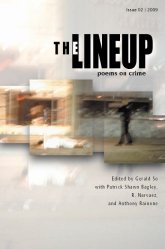
THE LINEUP


Buy The Lineup on Lulu.

Edited by Gerald So with Patrick Shawn Bagley, R. Narvaez, and Anthony Rainone

ISSN 1945-7510 6" x 9", 36 pages, saddle-stitched $6.00

Available from Lulu.com and fine independent bookstores

Help promote The Lineup

The Lineup: Poems on Crime, Issue 02, has arrived. What does poetry have to do with crime? As Patrick Shawn Bagley says in his introduction to the latest issue of this chapbook, Poets do not ask that question. People for whom poetry is a vital part of their reading life do not ask that question. ... So why do we write crime fiction, let alone crime poetry? One may as well ask why we write -- or read -- anything at all. We do it in an attempt to understand. We do it to find some kind of meaning in events that all too often leave victims, perpetrators and everyone around them damaged or destroyed. ... Here you will find proof beyond any reasonable doubt of poetry's relevance to modern life.

Get your hands on this book and dig deep into serious, provocative images. I'm honored that my poem, The Smell of Onions, is included. The Lineup has quite a lineup of contributors: Amy MacLennan, Jennifer L. Knox, Deshant Paul, Stephen D. Rogers, Sophie Hannah, Christopher Watkins, Carol Novack, John Harvey, reed Farrel Coleman, Patrick Carrington, Karen Petersen, Janis Butler Holm. I hear that issue 03 will have Sarah Cortez as one of the editors. Sarah is the co-editor of Hit List: The Best of Latino Mystery.


GUEST MUSIC REVIEW

Mariachi Classics: Mariachi Real de San Diego
Review by Flo, host of Cancion Mexicana, KUVO 89.3 fm, Denver

A picture may be worth a thousand words, but music is worth a thousand pictures. This is aptly illustrated by Mariachi Classics, a 2009 CD released by Mariachi Real of San Diego on the Mardi Gras Records label.

The CD has sixteen covers of songs that should be in the repertoire of any mariachi worth its salt. Many of the tunes evoke visions of girls in bright yellow, red, and blue swirling skirts with colorful satin ribbons in their hair. Others conjure up a snorting, prancing horse that rears up on its hind legs straddled by a charro waving his sombrero just as the Mariachi comes to a crescendo.

The table is set by the opening song, Las Mañanitas, signaling that what is coming is indeed a taste of old Mexico. In Mexico where most people follow the Catholic calendar, Las Mañanitas is traditionally sung to those celebrating the feast day of the Saint whose name they bear. In the United States, for people of Mexican heritage, no matter by how many generations or by how many miles they are distanced from Mexico, Las Mañanitas has become the “birthday” song.

All of the canciones on the CD are standards and the Mariachi Real de San Diego gives exciting renditions. A song becomes a standard by being played over and over again and in this case for decades. The songs have survived wars, crossed borders and been passed from generation to generation. Yet each time they are sung they sound as exciting as the first time but familiar enough that we know every word.

No matter how you translate it, the Mariachi Real de San Diego lives up to its name. In Spanish “real” means royal. This Mariachi’s vocal and instrumental mastery blend together seamlessly to create solid, soul-stirring renditions of these Mexican standards. If you only speak English, you’re also right - this is truly a REAL mariachi.
____________
Thanks, Flo - here's a video of Mariachi Real de San Diego


Later.


Wednesday, May 27, 2009

National Latino Writers Conference- Videos

Thanks to Jose B Gonzalez and www.LatinoStories.com for sharing these videos with La Bloga readers.

Malin Alegria
Estrella Alvarez is turning fifteen, and she's not happy about it. For as long as she can remember, her mother has been planning an elaborate quinceañera, complete with a mariachi band, cheesy decorations, and a hideous dress. Estrella is so over it.

Reyna Grande
Dancing with Butterflies is about four women who share a love of Folklorico dancing. It was inspired by Grande's own love of Folklorico, and her desire to bring it to Latino Literature.


René Colato Laínez
Together a little boy and his grandma discover a world of language and realize that loved ones have special ways of understanding each other.


Josefina Lopez
A journalist and activist, Canela believes passion is essential to life; but lately passion seems to be in short supply. It has disappeared from her relationship with her fiancé, who is more interested in controlling her than encouraging her. It's absent from her work, where censorship and politics keep important stories from being published. And while her family is full of outspoken individuals, the only one Canela can truly call passionate is her cousin and best friend Luna, who just took her own life.


Fred Arroyo
Remember that the dream of one is the dream of everyone. Ernest is searching for a place where he can live beyond his past.


Patricia Santana
Premio Aztlan at NHCC Latino Writers Conference
Having left her much-loved San Diego barrio, Yolanda Sahagún is now living in the university dorms when a series of events—her mother dies and her father sells their home—forces her to re-examine her life.

Tuesday, May 26, 2009

Review: Into the Beautiful North

Luis Alberto Urrea. Into the Beautiful North. NY: Little Brown, 2009.
ISBN-10: 0316025275
ISBN-13: 978-0316025270

Michael Sedano


Don't say anything negative when I ask this question: Into the Beautiful North is one of those novels a reader will not put aside until its conclusion, ¿No?

Absolutely yes.

But then the reader will ask if Urrea's current novel is worthy of the praise heaped upon the author's notably wonderful novel, The Hummingbird's Daughter?

No. It's not.

On the other hand, Hummingbird's Daughter is an impossible work to follow; that is one superb novel. Whatever you are reading next, stop that. Go to your library or bookseller and take delivery of The   Hummingbird's Daughter. Read it. You're welcome de adelantado.

Into the Beautiful North, is not Hummingbird's Daughter. How could it be? A buddy novel, Urrea wisely sets out not to build on Hummingbird but to do something completely different. And quite well, ese, if you get what I mean, y si no, pues, no. But Into the Beautiful North is one of those funny pieces that comes along only every once in a while, so, finishing the dramatic Hummingbird, read this next one; you owe it to yourself.

Would any film fanatic compare "The Wizard of Oz", let's say, to "El Norte," or, maybe "Spanglish"? As an intellectual romp, one might. Howzabout comparing Into the Beautiful North to "The Magnificent Seven?" Now there's the delightful parallel; not mine, but Urrea's. His crew of colorful characters venture out from backwater Sinaloa to the mercilless frontera of San Diego / Tijuana, perhaps the two worst cities in the world, on a "mission from God" like los hermanos azul. 

How refreshing to discover a border crossing story that is a comedy. Not that Into the Beautiful North, is not a deadly serious border crossing story; it is. But the crossing ain't the tale, it's the cultural gaps that define the limits of these characters' experience, and infuse the plot with a sense of dread that, thankfully, Urrea holds in abeyance.

On their first crossing, they get caught. Not in a calamitous tragedy for the three teenage girls, but for their friend, Tacho, a gay vato who's assumed the role of protector and adult. Tacho gets an asskicking by assholes from the ICE. La migra, the regular tipos, are just regular good people doing a job, but these newly appointed jerks have no sense of honor. But then, Urrea sets up the beating long in advance of the mid-novel crossing.

Tacho has a lot of smarts that, owing to Mexico's extreme poverty, never had the benefit of a classroom. He's not ashamed of his sexuality, nor do his fellow villagers shun him for being himself. Outsiders, like the corrupt cops who come through selling mota to tourist surfers, could make life a misery. Tacho laughs at their hatred by taking the stereotypically gay limp-wristed posture as the name of his bar, La Mano Caida. As Tacho and the three luscious teenage girls are being processed back to TJ at the San Ysidro lock-up, he calls out the name of his business. The mensos from ICE hear Tacho wrong; they hear a terrorist organization, "Al Kaeda." It's a funny phonetic trick but also a satiric gut punch. As a literary device, it strikes me as a contrivance. The one weak element in an otherwise brilliant novel. I wonder if Urrea came up with the joke first, then forced the plot to arrive at that moment?

Ni modo. Pretend you've never read Urrea's earlier work and take Into the Beautiful North for itself. You'll laugh, breathe sighs of relief, nod your head knowingly at the deadly serious facts that rest just beneath the surface of this wonderfully comedic satire of manners, love, lust, and immigration.

Memorial Day, 2009.

Every year I struggle to defeat my sentimental nature that tends to the maudlin. This year, I lost, and sank into a green funk, staring into the faces of some soldiers I trained with back in 1969. A friend asked if I know where these vatos are today, if they lived through that year? I do not know, and I do not want to know.


The storms start out there, on Monterey Bay. Grey blue haze obscures the horizon between sea and sky. Eyes front, but the vista compels our eyes to dart left, to take in the wondrous mottled light beyond the red roofs and yellow barracks, past the sparkling white sand of the firing range. On the water, bright patches where sunlight penetrates the morning dank define the luminous swell and ebb of the tide. Darker greys wash down from the ether shouting rain! Wetness swooshes across the water, heading directly toward us. “The Daily Dozen.” Windmill stretches. Jumping jacks. Jump thrust. “United States Army Drill Number One, Exercise Number Five, everyone’s favorite, the Push Up.” We drop to the front leaning rest position and begin the four count exertion. “One, two, three, ONE, Drill Sergeant, one two three TWO, Drill Sergeant…” Peripheral vision of breathtaking beauty counterweights a boot shouting in your ear, “keep your butt down, Trainee!”

We smell the rain coming, pushing the air before it, enveloping us in cool humidity that smells wet, that raises gooseflesh. Now we hear its relentless arrival. Below us, Ft. Ord has surrendered to its drenching. Visibility zero down there in forbidden territory. We are maggots, confined to The Hill.

The first heavy drops of water strike us, a few more, more. At the order we pull our waterproof poncho from our gear, hunker down under the protective sheet. We are forty green tipi spaced dress right dress across the platoon’s PT field. The rain noise drowns out any other sound but the swirling wind pushing up from the bay. An unrelenting volume of water strikes our heads and backs. We savor these moments of privacy, alone with our own thoughts and memories, for now the Army only this dull green light and the sound of the passing squall. We feel rivulets form, tingle, and stream the length of our spine as the water courses down to the ground. We are blind; we can see only our boot toes and the corona of daylight that glows at the periphery of our waterproof poncho. Mud splashes against our now scuffed, once spit-shined combat boots. Run-off forms around our toes, puddling fashions the outlines of our leather as erosion sculpts a memory of our presence on the land.

The noise abates. The rain passes. We obey. Ponchos off. Stand tall. Monterey Bay sparkles with magical light, whales, porpoises, salmon, sardines, Steinbeck…"U.S. Army Drill Number One, Exercise Number Five. The Push Up…”

We bitched and moaned. We laughed. I hope we all lived.


So here we are, the last Tuesday of May, a Tuesday like any other Tuesday, except you are here. See you in June.

La Bloga welcomes your comments. Mouse down to the Comments counter below and Klik. If you'd like to be a La Bloga Guest Columnist, click
here .