Showing posts with label Cancion Mexicana. Show all posts

Friday, August 20, 2010

Bits and Pieces


AZTLAN LIBRE PRESS PUBLISHES ALURISTA’S TUNALUNA

[press release from Aztlan Libre Press]

Aztlan Libre Press, a new, independent publishing company based out of San Antonio, Texas that is dedicated to the promotion, publication, and free expression of Xican@ Literature and Art, announces the publication of its first book, Tunaluna, by the renowned veterano Chicano poet, alurista. This is alurista’s first publication in ten years.

alurista is one of the seminal and most influential voices in the history of Chicano Literature. A pioneering poet of the Chicano Movement in the late 60s and 70s, he broke down barriers in the publishing world with his use of bilingual and multilingual writings in Spanish, English, Nahuatl and Maya. A scholar, activist, editor, organizer and philosopher, he holds a Ph.D in Spanish and Latin American Literature from the University of California in San Diego and is the author of ten books including Floricanto en Aztlán (1971), Timespace Huracán (1976), Spik in Glyph? (1981) and Z Eros (1995). His book, Et Tú Raza?, won the Before Columbus Foundation National Book Award in Poetry in 1996. Author of El Plan Espiritual de Aztlán, he is a key figure in the reclaiming of the MeXicano cultural identity, history and heritage through his integration of American Indian language, symbols and spirituality in his writings.

Tunaluna is classic alurista: passionate, sensuous, and political. alurista’s tenth book of poetry is a collection of 52 poems that takes us on a time trip through the first decade of the 21st century where he bears witness to the “Dubya” wars, terrorism, oil and $4 gallons of gas, slavery, and ultimately spiritual transformation and salvation. The “Word Wizard of Aztlan” is at his razor-sharp best, playing with his palabras as well as with our senses and sensibilities. alurista is a Xicano poet for the ages and a chronicler of la Nueva Raza Cózmica. With Tunaluna he trumpets the return of Quetzalcoatl, the feathered-serpent of Aztec and Mayan prophecy, and helps to lead us out of war and into the dawn of a new consciousness and sun, el Sexto Sol, nahuicoatl, cuatro serpiente, the sun of justice.

“alurista experiments on the edge, thickly layers multiple meanings onto each cryptic line through language play, brilliant code-switching (‘tu mellow dia’) and love songs to la raza. A statement of survival, he confronts the politics and the hypocrisy of ‘the estados undidos de angloamérica’ with an irrepressible rhythm, with the ‘slingshots in our hands’ of pre-Columbian truths, and with the ability to craft real words from our unreal world of avarice and oppression. alurista’s tenth book holds many spirit treasures calling out to us from between the lines. Con razón k he hears the haunting spirits beneath the surface—‘ayer pasé x tu casa/y me ladra/ron/los libros.’” (Carmen Tafolla, Ph.D., Doctor of Philosophy, poet and Visiting Faculty, University of Texas at San Antonio)

“Tunaluna is a work of hope, humor, outrage, and beauty by one of our most notable Chicano bards. alurista reminds his readers of the political possibilities of the poetic; in his poems, we hear the song of a people.” (Cristina Beltrán, Associate Professor of Political Science at Haverford College and author of The Trouble with Unity: Latino Politics and the Creation of Identity)

ISBN-13: 978-0-9844415-0-1 * $15.00 * 76 pages * Trade Paperback * Publication: October 2010 For more information, or to purchase Tunaluna, click on www.aztlanlibrepress.com, or contact the Publishers/Editors, Juan Tejeda or Anisa Onofre at the telephone number or e-mail address below.


302 Stratford Ct. | San Antonio, TX 78223 | 210.531.9505 | aztlanlibrepress.com | editors@aztlanlibrepress.com


CHILE HARVEST FESTIVAL

[announcement from the CHAC website]

Late summer brings freshly harvested chiles to Colorado, and with them, the aromas of chile roasting and authentic Chicano cuisine. This year, the Colorado tradition continues at Lakewood’ristraCropped_copy.jpgs Heritage Center. The Chile Harvest Festival celebrates contemporary Chicano art, traditional Spanish Colonial art, music, food and of course chiles, with beautiful views of the Rocky Mountain foothills as a backdrop.

Thanks to a partnership between the City of Lakewood and the Chicano Humanities & Arts Council (CHAC), the Chile Harvest Festival will be in full swing Aug 28 & 29.

The Chile Harvest Festival is an outreach effort to educate, enlighten and entertain the community with the many different facets of Chicano and Latino culture. Its goal is to give people a well-rounded cultural experience.

The festival will feature up to 75 artists, WeaverEppieLowRez.jpgshowcasing both contemporary and traditional art forms. There will also be music, dancing and storytelling as well as many other cultural and art activities for kids.

Several local restaurants will be on site, serving authentic Mexican cuisine along with other specialty foods featuring chiles. And of course, there will be nonstop chile roasting, so stock up your freezer with chiles for the winter. Demonstrators will be showcasing the art of making traditional chile ristras: dried chiles, strung together to be used in cooking throughout the year or just for decoration.

Bring the whole family to shop, eat and soak up a cultural experience. Tickets will be $5 for adults, $2 for children, and $1 off coupons are available at CHAC Gallery.

By the way - I'll be signing copies of King of the Chicanos at the Cultural Legacy booth on August 28 at 1:00 PM. Come on by, we can talk about chile.


Click on the image for details of KUVO's 25th anniversary party that also celebrates 25 years of Cancíon Mexicana and the final show for the long-time host, Flo.


HILARY DePOLO

Poetry and Performance

BEAT the heat with cool words

Join me for two performances this month (Denver):

(Third) Thursday August 19th ¤ Forza Coffee ¤

104th and Federal ¤ 7 pm

followed by an open mic

Saturday August 21st ¤ Ice Cube Gallery ¤ 3320 Walnut ¤

7 pm ¤ with Jeff Wittig on guitar

followed by an open mic on the theme of LIGHT

www.artconsultation.com

Poetry is the tunnel at the end of the light.~ J. Patrick Lewis

Hilary DePolo is a friend and a poet whose work I have admired for a long time. She's often done readings and created poems in conjunction with visual artists like Carlos Fresquez and Tony Ortega (whose painting Western Union Baker served as the inspiration for one of Hilary's poems.) I checked out her reading last night at the coffee shop where the emotions ran the gamut from sad reflections on a dying mother to whimsical odes to the seasons to a touching tribute to the Mexican immigrant baker and his lonely life in los estados unidos. You should try to make it to the event tomorrow night at the Ice Cube Gallery.


ALBUQUERQUE CULTURAL CONFERENCE

[website announcement]

September 3-6, 2010
We're holding our third Albuquerque Cultural Conference, titled Crisis, Community, and Performance: Building a Resilient Society. This event is full of performances, panels, report backs, and evening discussion. It reflects the state of heightened political, economic, social, and environmental crisis in the United States in the year 2010.

The Albuquerque Cultural Conference was first convened on Labor Day weekend 2007. Below is a portion of the original conference call.

We call upon organizers, writers and artists, and progressive journalists, teachers, and dreamers from all cultures to join us in building a new society while addressing the failures of the old. We will take up the vital issues of creating a just world through hard work, alternative forms of education, and new images of cultural transformation. Political, social, class, “race,” and gender issues will be addressed. Attention will be paid to critical topics including nuclear establishment, the people and the land, border crossings, cultural memory, and festivals of the oppressed.


Keep on readin'.

Later.

Friday, June 05, 2009

Five Reasons It's Great to be a Chicano in Denver

This post is motivated by similar articles I've read lately about why it's great to be a Latino in the U.S. or particular cities, etc. Lacking any brilliant inspiration for today's edition of La Bloga, I decided to steal the idea and give you my own list. No particular order, just how the pieces came to me. I have more than five reasons but I ran out of time. Maybe I'll continue with my list in future posts. If you have your own suggestions, send them in. Click on the comments link below.


1. Canción Mexicana - this radio program has been on the air for 24 years, an amazing run, and it's still as strong as ever. The show is broadcast on Denver's public radio jazz station, KUVO, 89.3 FM and on the Internet at www.kuvo.org. The show is hosted by Florencia Hernández-Ramos and Debra Gallegos every Sunday from 10:00 am to 1:00 pm (Mountain).

Here's what the KUVO website says about this very popular show that has become a cultural icon in the Rocky Mountain West: New Mexico, Colorado and Tejano music with information excerpts from Latino USA and News From Our Community. Canción Mexicana has dominated jazz89 KUVO's Sunday line-up in both audience and business support. The best of the best in Tex-Mex music, Canción Mexicana has been frequently recognized in Denver's major newspapers. The program consistently ranks in the top five slots on Sunday mornings in the Denver metro area and has enjoyed the number one spot. It's cumbia, it's rancheras, and a little bit of mariachi - it's all that and more; it's Canción Mexicana with the best New Mexico, Tejano and Colorado music. There's music on Canción Mexicana as well as reports from Latino USA with a glimpse into what's happening in the community. Get ready to dance!


2. La Raza Rocks - this show follows Canción Mexicana at 1:00 pm, Sundays, on KUVO. Pocho Joe and Gabe are the incredibly knowledgeable hosts of an hour of the best of Latino rock - new and old - Sunny & the Sunliners, Santana, Los Lobos, the Iguanas, Los Lonely Boys, and Dr. Loco and his Rockin' Jalapeno Band. Interviews and information are part of the show's presentation. Pocho Joe and Gabe dig deep into Chicano rock, coming up with groups like Thee Midniters, Tierra, Little Julian Herrera, El Chicano,War, the Blendells, Cannibal & the Headhunters, and the Premiers, but they also present the latest groups and singers. Over the years, this show has introduced Denver to Ozomatli, Quetzal, Alejandro Escovedo, the Blazers, and many more. As Pocho Joe likes to say, the show covers the "roots and branches" of Chicano soul music. It'll tear you up.


3. Su Teatro - this theater group sprung from the Movement more than thirty-five years ago (1971) as traveling agit-prop, consisting mostly of long-haired students. Today it is a well-established production company that every year amazes Denver audiences with the diversity and brilliance of Latino and Chicano theater. Under the direction of the long-haired Anthony Garcia, El Centro Su Teatro is about to enter a new phase with a multi-million dollar facility that promises to continue to enrich the Denver cultural scene with outstanding plays and events. In recent years, Su Teatro has presented remarkable theater such as Rudy Anaya's Bless Me, Ultima; Ollin; El Sol Que Tú Eres (Daniel Valdez and Tony Garcia collaborated on this Chicano version of the myth of Eurydice and Orpheus); Las Chicas de 3.5” Floppy; Death and the Maiden; and Catastrophe by Samuel Beckett. Annual events include the Neruda Poetry Festival (10 years), The XicanIndie Film Festival (11 years), and the Chicano Music Festival (12 years).


4. A bevy of writers and a strong literary tradition. Denver became the home for beloved poet Abelardo "Lalo" Delgado, author of one of the most famous Chicano poems ever published, Stupid America. Lalo probably is the best known Denver Chicano writer, but the city and the state have a long history of writers who have proudly preserved the story of Colorado's Chicanos and made a little of their own while they were at it. Names that immediately come to mind include Margie Domingo, Flor Lovato, Ramon Del Castillo, Anthony Vigil, Joe Navarro, and Corky Gonzales for I Am Joaquin, a classic bit of Chicano lit. (The Denver Public Library has arranged for a Rodolfo "Corky" Gonzales Exhibit at the Central Library, June 2 through September 20, 2009. A special reception to honor the exhibit is set for June 18 from 7 - 9 pm at the Central Library, 10 West 14th Avenue Parkway.)

The tradition continues and there are young poets reading and writing all over the city, with readings and slams happening at places like the Taza de Café where Café Cultura did a regular thing, Cafe Nuba, the Chicano Humanities and Arts Council, the Neruda Poetry Festival, Art From Ashes, etc. We got fiction writers, too - Mario Acevedo, Aaron A. Abeyta, Rudy Garcia, Emma Perez, Angel Vigil, Reneé Fajardo, and yours truly, to name a few. Denver is a city that loves to read; it has great independent bookstores and many author events. Now if we could just get a permanent book fair.


5. The Chicano Humanities and Arts Council (CHAC) and the Museo de las Américas. These two institutions sit on Santa Fe Drive in Denver's West Side. They provide art, artifacts, history, and venues for performance artists, poets, film-makers, and sculptors. CHAC has been around for thirty-one years, created by a group of artists who saw the need for their own space, devoted to their understanding of art and the creative process. That spirit still lives on at CHAC with ever-changing exhibits with themes such as Vida Artistica, the Poetry y Mas series of readings, and, returning this year, the Chile Harvest Festival (August 29 & 30).

The Museo has consistently presented world-class exhibits of Latino, Chicano and Latin American art, and has developed a national reputation for its adherence to its mission. As the website says, the Museo educates our community about the diversity of Latino Americano art and culture from ancient to contemporary through innovative exhibitions and programs. With the Latino population growing exponentially in the Denver and wider communities, the Museo plays an important role in building pride in the Latino community's heritage and promoting understanding among cultures. Other history and art museums in Denver cannot focus on one segment of the community in a sustained or comprehensive manner. The Museo was organized to fill this important niche in the cultural milieu. Under the leadership of newly-appointed director Maruca Salazar, a celebrated artist in her own right, the Museo should make an even bigger impression on the art-loving Denver residents.

The cool thing about this list is that you don't have to be a Chicana or a Chicano to enjoy the music, art, writing or history. We like to share.

Okay, send in your own suggestions for this list - is it really great to be a Chicano or Chicana, wherever you live? If so, why?


Later.

Friday, May 29, 2009

Mariachis, Museo, M&Ms, and More

NEW BOOKS
The following book summaries are taken from the UNM Press website -

Santa Fe Nativa: A Collection of Nuevomexicano Writing

Rosalie C. Otero, A. Gabriel Melendez, Enrique R. Lamadrid
University of New Mexico Press, November, 2009

The belief that land is sacred, embodying the memory and inheritance of those who sacrificed to settle it, is common among New Mexican Hispanos, or Nuevomexicanos, and Santa Fe serves as their unique geographic and symbolic center. The city will celebrate the four hundredth anniversary of its founding in 2010 and this anthology honors its role as the foundation of New Mexican Hispanic culture.

Divided into nine parts, this collection reflects the displacement that many Hispanos feel having watched their hometown transform into a tourist and art Mecca. Parts I and II pay homage to Santa Fe through the sentiment that Hispano writers express for the city. Parts III and IV provide historical maps for places that have been reconstructed or obliterated by development, while Part V is dedicated to Santa Fe's distinctive neighborhoods. Parts VI and VII express nostalgia for traditional lifeways. Part VIII illustrates the spirit of Santa Fe and Part IX reflects on traditions that stand the test of time.

Rosalie C. Otero is the director of the University Honors Program, University of New Mexico, Albuquerque, and the associate dean of University College. She has written several book chapters, articles, and short fiction.

A. Gabriel Meléndez is professor of American studies at the University of New Mexico, Albuquerque.

Enrique R. Lamadrid is a literary folklorist and cultural historian in the University of New Mexico's Department of Spanish and Portuguese. In 2005, he was awarded the Americo Paredes Prize by the American Folklore Society in recognition of his work as a cultural activist.


Juan and the Jackalope: A Children's Book in Verse

Rudolfo Anaya
Amy Cordova , Illustrator

University of New Mexico Press, November, 2009

When Rosita, the loveliest gal in the Pecos River Valley, offers her delicious rhubarb pie as first prize for the Great Grasshopper Race, a thousand love-struck vaqueros line up for the competition. Of course everyone believes that the legendary cowboy Pecos Bill, riding his giant grasshopper, Hoppy, is a shoo-in for the grand prize. Sure enough, Bill and Hoppy give an impressive performance, crisscrossing the Southwest in a raucous ride. But young Juan, who is hopelessly in love with Rosita, astonishes them all when he and Jack the Jackalope take a miraculous ride around the world and across the Milky Way. The daring pair return, covered in stardust, to claim the beautiful Rosita and her delicious pie.

Set in New Mexico, Anaya's fanciful story, coupled with Amy Córdova's vivid illustrations, brings the tradition of Southwestern tall tales to a new generation of young readers.

Ages 6 and up

Rudolfo Anaya, widely acclaimed as one of the founders of modern Chicano literature, is professor emeritus of English at the University of New Mexico. Anaya was presented with the National Medal of Arts for literature in 2001 and his novel Alburquerque (the city's original Spanish spelling) won the PEN Center West Award for Fiction. He has also received the Premio Quinto Sol, the national Chicano literary award, the American Book Award from The Before Columbus Foundation, the Mexican Medal of Friendship from the Mexican Consulate, and the Western Literature Association's Distinguished Achievement Award. He is best known for the classic Bless Me Ultima.

Amy Cordova lives in Taos, New Mexico, where she is co-owner of her own gallery, Enger-Cordova Fine Art. She has illustrated many children's books and teaches art to elementary school children at the Yaxche Learning Center.


NEW DIRECTOR AT MUSEO DE LAS AMERICAS
The Museo de las Américas (Museo) Board of Trustees announced that Maruca Salazar has been selected as the new executive director. Additionally, David Dadone, former director of operations for the Museo, has been promoted to deputy director. Salazar will assume the position in July.

We are delighted that Maruca Salazar will be leading the Museo de las Américas as the new Executive Director, stated George Martinez, Board president. She comes to us with a wealth of artistic, administrative, and curatorial experience. Furthermore, Maruca's relationships with teachers and artists throughout the region will greatly assist us in increasing the scope and reach of our education programs, while expanding our artistic vision.

Prior to joining the Museo, Salazar served as the arts coordinator and arts staff developer for Denver Public Schools. During her tenure, Salazar developed an integrated arts education program, and was responsible for the development and stewardship of the $6.5 million arts budget. She holds a Master's of Arts in Multicultural Education from the University of Colorado, Denver; and a Bachelor's of Arts in Multicultural Education from the University of Veracruz, Mexico.

This is the opportunity of a lifetime and a true honor, stated Salazar. As an artist and educator, as well as a long time supporter and participant of the Museo de las Américas, I am committed to advancing Museo's legacy of learning and sharing.

A longtime advocate for the arts, Salazar is a founding member and supporter of the Chicano Humanities and Arts Council, XicanIndie Film Festival, Pirate Gallery, and the Museo de las Américas. As a Visual Artist she has exhibited at local museums and galleries, including the Museo and the Museum of Contemporary Art in Denver.

This is an exciting time for the Museo, stated Martinez. The Board and staff are confident that Maruca will lead the Museo to new and exciting places, and cement our place as a cornerstone of Denver and the West's cultural community.

About the Museo de las Américas
Museo de las Américas (Museo) is the Rocky Mountain region's foremost museum dedicated to educating its community about the diversity of Latino Americano art and culture from ancient to contemporary. The Museo presents exhibitions and education programs that offer new views on Latin American art, advancing the role of Latino artists in the global cultural dialogue, and becoming a cultural hub for the local, national, and global community. The museum is centrally located in the historic Santa Fe Arts District - one of Denver's oldest Latino neighborhoods - at 861 Santa Fe Drive. For more information, please visit: www.museo.org.

Congratulations to Maruca! She's a great fit for the Museo.


HIT LIST READING AND SIGNING AT THE TATTERED COVER
On May 21, Mario Acevedo and I read and signed Hit List at the Tattered Cover here in Denver. We promoted the event as the M&M show and free M&M cookies were given to all who attended. I know that Mario and I had a good time and we think our audience did too. We sold a good number of books and read from our stories in the collection. Mario also read from Shortcut to the Moon by Alicia Gaspar de Alba, a prime example of the terrific writing that can be found in this book. Here's a bit from Alicia's story:

When you're from El Paso, you get used to the rough grain of the wind. The leaves turn piss yellow or brittle brown in the fall, not every shade of red and gold and purple, and the winter wind doesn't frostbite your thighs or turn your tears to icicles. In Iowa City, you learn the meaning of seasons. At the Black Angel Cemetery, where I spent untold hours practicing Iowa Writing Workshop techniques that felt like they were making me change from being left-handed to right-handed, the colored leaves of oaks and maples stood out among the headstones like fiery panes of stained glass. What I loved most about that year in Iowa, other than the cornfields and the blizzards and the daffodils blooming under the snow and the juicy double cheeseburgers at George's Bar, was getting blitzed on Cuervo and Colombian with my cousin Ivon in all-night, heart-to-heart sessions that we called "shortcuts to the moon."

I read from A.E. Roman' s Under the Bridge, a story that introduces Chico Santana, the private investigator that plays a lead role in Roman's debut novel, Chinatown Angel. You may recall that I interviewed Roman for La Bloga just before his book came out this past March. The book is great and you should pick it up if you are any kind of reader who appreciates exciting fiction, crime or otherwise. Here's part of what I read to the Tattered Cover audience:

My name is Chico Santana. I'm a private investigator. First off, I'm a nice guy, My wife Ramona says so, and she's part Haitian and part Dominican, so it must be true.

If you look closely at my nose, you can tell it's been broken twice. And if you pay attention to word on th
e street, you'll come to understand that the men who broke my nose are no longer eating anything that won't flow up a straw. I'm not a tough guy. A lot of tough guys are six feet under. I'm just lucky.

And I'm also not one of those PIs that sit at a desk with his feet up
, waiting for his bosses ... to throw him a bone. Nor am I one of those types who are always bragging how close they can come to your chin without hitting you. I have no .38, but I do have a license to bust your ass, and if I have to, I will bust your ass and maybe even the ass of somebody you love.

Mario's story leads off the collection. Oh, Yeah is a short piece but it has plenty of humor, surprises, and tension to whet your appetite for the rest of the stories. My story, The Skull of Pancho Villa, features Gus Corral, a character I've grown fond of and who is starring in the novel I've just started. Here are a couple of photos from the event.

Manuel Ramos and Mario Acevedo at the Tattered Cover, May 21, 2009


Mario and Manuel sign copies of Hit List: The Best of Latino Mystery


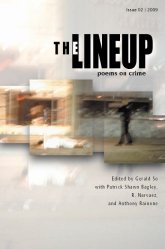
THE LINEUP


Buy The Lineup on Lulu.

Edited by Gerald So with Patrick Shawn Bagley, R. Narvaez, and Anthony Rainone

ISSN 1945-7510 6" x 9", 36 pages, saddle-stitched $6.00

Available from Lulu.com and fine independent bookstores

Help promote The Lineup

The Lineup: Poems on Crime, Issue 02, has arrived. What does poetry have to do with crime? As Patrick Shawn Bagley says in his introduction to the latest issue of this chapbook, Poets do not ask that question. People for whom poetry is a vital part of their reading life do not ask that question. ... So why do we write crime fiction, let alone crime poetry? One may as well ask why we write -- or read -- anything at all. We do it in an attempt to understand. We do it to find some kind of meaning in events that all too often leave victims, perpetrators and everyone around them damaged or destroyed. ... Here you will find proof beyond any reasonable doubt of poetry's relevance to modern life.

Get your hands on this book and dig deep into serious, provocative images. I'm honored that my poem, The Smell of Onions, is included. The Lineup has quite a lineup of contributors: Amy MacLennan, Jennifer L. Knox, Deshant Paul, Stephen D. Rogers, Sophie Hannah, Christopher Watkins, Carol Novack, John Harvey, reed Farrel Coleman, Patrick Carrington, Karen Petersen, Janis Butler Holm. I hear that issue 03 will have Sarah Cortez as one of the editors. Sarah is the co-editor of Hit List: The Best of Latino Mystery.


GUEST MUSIC REVIEW

Mariachi Classics: Mariachi Real de San Diego
Review by Flo, host of Cancion Mexicana, KUVO 89.3 fm, Denver

A picture may be worth a thousand words, but music is worth a thousand pictures. This is aptly illustrated by Mariachi Classics, a 2009 CD released by Mariachi Real of San Diego on the Mardi Gras Records label.

The CD has sixteen covers of songs that should be in the repertoire of any mariachi worth its salt. Many of the tunes evoke visions of girls in bright yellow, red, and blue swirling skirts with colorful satin ribbons in their hair. Others conjure up a snorting, prancing horse that rears up on its hind legs straddled by a charro waving his sombrero just as the Mariachi comes to a crescendo.

The table is set by the opening song, Las Mañanitas, signaling that what is coming is indeed a taste of old Mexico. In Mexico where most people follow the Catholic calendar, Las Mañanitas is traditionally sung to those celebrating the feast day of the Saint whose name they bear. In the United States, for people of Mexican heritage, no matter by how many generations or by how many miles they are distanced from Mexico, Las Mañanitas has become the “birthday” song.

All of the canciones on the CD are standards and the Mariachi Real de San Diego gives exciting renditions. A song becomes a standard by being played over and over again and in this case for decades. The songs have survived wars, crossed borders and been passed from generation to generation. Yet each time they are sung they sound as exciting as the first time but familiar enough that we know every word.

No matter how you translate it, the Mariachi Real de San Diego lives up to its name. In Spanish “real” means royal. This Mariachi’s vocal and instrumental mastery blend together seamlessly to create solid, soul-stirring renditions of these Mexican standards. If you only speak English, you’re also right - this is truly a REAL mariachi.
____________
Thanks, Flo - here's a video of Mariachi Real de San Diego


Later.