presents...
An Evening of Literature and the Arts
a wine, cheese, and tequila tasting
August 7, 2010 4:00-8:00pm Pan American Bank 3626 East FirstStreet Los Angeles, CA 90030
Tickets: $20 ($30.00 for couples) Featuring: A Meet-and-Mingle with LBFF 2010 Latino Authors, including: Alisa Valdes-Rodriguez, Javier Grillo-Marxuach, Lalo Alcaraz, Michele Serros, Rolando Ortiz, Montserrat Fontes, Melinda Palacio, Thelma Reyna, Amada Irma Perez, Victor Cass, David Bueno-Hill, René Colato Laínez, Reyna Grande, Javier Hernández, Philip Victor Colón, Laura Lacámara, Mike Padilla, Daniel Cano, Kathleen Contreras A Dance Performance by Grandeza Mexicana Folk Ballet Company! Book Signings Hosted by Tia Chucha's Bookstore! Author Readings! A Silent Auction! Door Prizes!
This wine and cheese fundraiser will benefit the Latino Book & Family Festival, which will take place on October 9th-10th at Cal State LA, Greenlee Plaza. Can't attend the fundraiser? VisitWWW.LBFF.US or call 760-434-4484 to make a donation or to find out more information.
AND... If you write in Spanish, take note: XXII CERTAMEN INTERNACIONAL DE POESIA Y NARRATIVA BREVE Continuidad de las Voces 2010 (Argentina) BASES 1. Cada autor podrá presentar de tres a siete poesías con una extensión máxima de treinta y dos líneas cada una, en el Género Narrativa una a tres obras con una extensión de doscientas veinte líneas en total. Tema y estilo libre.2. Las obras deberán ser inéditas, individuales, no premiadas con anterioridad, presentadas por triplicado, a máquina o por computadora; o en su defecto manuscritas con letra bien legible. Firmado con seudónimo y en sobre cerrado los datos personales. 3. Recepción hasta el 6 de agosto de 2010, se tendrá en cuenta el matasello del correo. 4. Las obras se deben enviar a Editorial De los Cuatro Vientos- Balcarce 1053 – Of. 1 (1064) Cap. Fed.- Bs. As.- 5. Se realizará una selección (autores más destacados) y los mismos integrarán cooperativamente una Antología; sobre estos autores antologados se definirán los premios existentes tanto para el Género Poesía como para el Género Narrativa. El jurado, que estará integrado por tres personas especializadas en el tema (Lic. en Letras, Lic. Ciencias de la Comunicación, Escritores, etc.) tendrá un plazo de noventa y cinco días corridos a partir de la fecha de cierre para expedirse y su fallo será inapelable. 6. El concurso no se declarará desierto bajo ninguna circunstancia. 7. Los trabajos no seleccionados y no antologados serán destruidos. 8. No se abonará ningún importe en concepto de inscripción, y un mismo autor no podrá aspirar a más de un premio en un mismo género. Los participantes podrán participar en ambos géneros si lo desean. 9. La Antología integrada por los finalistas será distribuida en forma gratuita en Talleres literarios, Centros Culturales, Embajadas de Argentina en 30 países, y entidades culturales que la solicitaran; está prevista además una importante donación a más de trescientas Bibliotecas Públicas, parte de la cual se realizará a través de la (C.O.N.A.B.I.P.) Comisión Nacional Protectora de Bibliotecas Populares. También estarán a la venta en diversas librerías. 10- En la entrega de premios se darán a conocer los integrantes del jurado. La misma se realizará el viernes 17 de diciembre de 2010, salvo que surgieran imprevistos de fuerza mayor, juntamente con la presentación pública de la Antología integrada por los Finalistas, ésta se realizará en la sala PSOE, Perón 940, Capital Federal, de la ciudad de Buenos Aires. 11- Serán otorgados los siguientes premios, tanto en Poesía, como en Narrativa: Primer premio: Edición y Publicación completa de un libro (64 páginas- 500 ejemplares), Medalla de Oro y diploma. Segundo Premio: Medalla de Plata y diploma. Tercer Premio: Medalla de Plata y diploma. Y cinco menciones para cada género, o las que el jurado crea meritorias. 12- Cualquier cuestión no prevista será resuelta por el Jurado. Consultas a: concursos@deloscuatrovientos.com.ar |
Las Blogueras Los Blogueros

Click to email a writer. Denver CO • Pasadena CA • The San Fernando Valley CA • Eagle Rock CA • Lincoln NE • Glendale AZ • Santa Barbara CA • Lincoln Heights CA • Kansas City MO • Santa Monica CA
Thursday, August 05, 2010
Books, Wine, Cheese & Tequila


Wednesday, August 04, 2010
From North to South/ Del Norte al Sur


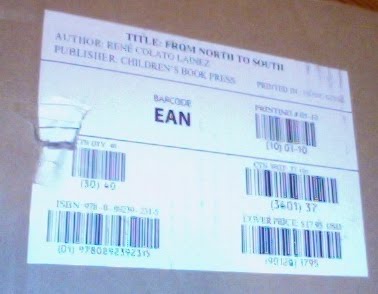
FROM NORTH TO SOUTH. Yes, this is the box. But you need to open it, just to be real sure.


Kirkus reviews FROM NORTH TO SOUTH
 FROM NORTH TO SOUTH/DEL NORTE AL SUR
Author: Colato Laínez, René
Illustrator: Cepeda, Joe
Review Date: August 1, 2010
Publisher: Children's Book Press
Pages: 32
Price (Hardback): $17.95
Publication Date: September 1, 2010
ISBN (Hardback): 978-0-89239-231-5
Category: Picture Books
After his mother is deported by U.S. immigration officials, José and his father go to visit her at Centro Madres Assunta in Tijuana, where she will stay with other women and children until she gets her papers and can return. Frankly a plea for sympathy for families torn apart by immigration rules, this tender story is gently told in Spanish and English texts, together or on opposing pages. Young José recalls his day: the border traffic jam, the joy of seeing his mother, gardening and a seed game with other children in the shelter missing their parents and a final bedtime story told in the car’s backseat. The author, a Salvadoran immigrant, teaches in a bilingual school where his students often experience family separations. Cepeda’s oil paintings, full-bleed single- and double-page spreads, use bright colors and a variety of perspectives to reinforce the joyfulness of the day. A road map of the area between San Diego and Tijuana serves as endpapers. The child’s perspective makes this a particularly moving glimpse of an increasingly common experience. (Picture book. 5-9)
Tuesday, August 03, 2010
On-Line Floricanto August 3
From the Facebook Group "Poets Responding to SB1070"
1. ”Trespasser Shoes” by Cesar Love
2. “We are all illegal” by Luise Alberto Ascencio Cortez
3. “Hands” by Odilia Galvan Rodriguez-Francisco
4. “By the time I get to Arizona” by Oscar Bermeo
5. “A Poet's Plan for World Peace” by La Tigresa (Dona Nieto)
6. “Native American Wisdom” by Susan Deer Cloud
7. “Ejido” by Fernando Martí
8. “Rear view mirror” by Dionisio de la Viña
"Trespasser Shoes"
by Cesar Love
Shoes perfect for the fastest dance
...
Shoes so cool
Even jaywalkers swoon.
Shoes that scale barbed wire
Two taps and you’re invisible
To every cop and guard.
Shoes that violate the dress code
Shoes that never came in a box.
The shoes that skip over stairs
That short-circuit escalators
Three taps and you leap above
Foul lines, flag poles, border checkpoints.
Trespasser shoes
Polished with a darker shade of saint.
Hiding in your closet
Waiting to walk on water.

“We are all illegal” by Luis Alberto Ascencio Cortez
We are all illegals angels and demons, who crossed the border into earth, we claimed this planet ours, but it wasn’t ours to claim, like the mother and her offspring’s they fight over who she loves more but she loves us all equally, as mother earth does Tonantzin, some say they are superior just because their skin is a brighter color, or that they have papers that say they can live in a country, where anyone who seeks a second chance can live and prosper, and then say those who crossed a wall can’t live here. Yeah we crossed a wall to come here but they crossed the sea, we crossed it today they crossed it yesterday, the pilgrims the first illegal aliens, we where native to this land. This was our Aztlan, our Mother earth not America, this was a place of culture, where everyone wore their own skin proud, now some of us walk down the streets hoping the police won’t come and stop us for the color of our skin, to ask us if we are illegal, As if we would destroy their country when in fact they benefit from our stay, to deport those who worked hard who are more loyal than some who are legal, but we can’t be scared, because they’ll win we must stand tall, chins up, walking strong, fists up because it’s through, we can’t take anymore of this segregation, deportation no more.
Luis Alberto Ascencio-Cortez

HANDS
by Odilia Galván Rodríguez
we storm
the border between
here and there
the border
has been replaced
by people
holding hands
outstretched
a human chain
across the southlands
our hands are joined
our hands holding
our hands sharing the power
from one palm to the next
a chain of energy
thousands of hands
held in hope
held in love
holding and sharing
in solidarity
for a new world
possible in positivity
in visions
of other realities
our hands
thousands
of our hands
red, yellow, black and white
hands
unmarked
undocumented
legal hands
just because they are human
hands
sending out a message
hands
sending out love
hands
saying basta ya!
hands
hands
holding
out the hate
hands
© Odilia Galván Rodríguez, 2010

By The Time I Get To Arizona
by Oscar Bermeo
The desert will be dusted with a thick sheet of snow.
Thousands of voices echoing amongst the dead cacti:
Lead us, lead us, there is no food here. Lead us back!
In the now brown mountains, laughter rolls downhill,
a curandero reaches into his bag, pulls out a snow globe
gives it a hard shake, cackles as he see the little flakes
run into each other, bounce like blind birds against
the glass some call home, others claim as border, and
the proudest in the flock declare all mighty nation.
**************************
**************************
**
Born in Ecuador and raised in the Bronx, Oscar Bermeo is the author of four poetry chapbooks, most recently To the Break of Dawn. He now makes his home in Oakland. www.oscarbermeo.com

A POET'S PLAN FOR WORLD PEACE
by La Tigresa (Dona Nieto)
When the children are young
Send them all to summer camp together:
Black, brown, white, red, yellow, caramel,
Mexican, African, Asian, European, Middle Eastern, Australian, Everybody
Let them share secrets and become best friends around the camp fire
Then when their hormones start to burst and bloom and leak and seep
Send all the teenagers to summer camp together:
So they fall in love and sneak off to the bushes to make out
Yellow skin, black skin, red skin, white skin, soft skin, newly bearded skin, sensuous adolescent skin
Skin rubbing skin
So that they fall in first love with each other
So that they make their first love with each other
So that they kiss and caress and yield and penetrate and make babies with each other
And then they get married and the in-laws meet each other
And suddenly we all remember
That we are all related
And there is only one family on earth:
Earthlings.
And that cutting up the body of our Mother with imaginary lines called borders
Is as stupid and obscene as trying to lasso the moon with a rope
Or trying to chop up the sun into little pieces
And grab the biggest share
And claim it for your own.
Copyright 2010 La Tigresa (Dona Nieto)

Native American Wisdom
by Susan Deer Cloud
Every so often people ask me
for my Native American wisdom.
First I stand there, silent.
Possibly I am remembering
all the times I’ve been a fool,
having a flashback to
a William Blake quip ~
“The road of excess leads
to the Palace of Wisdom.”
But the sky-eyed seekers see
my silence as smoke-signaling
my Native American wisdom.
Once this silent noble Indian
stops toking on holy memories,
I breathe dramatically, lifting
arms up like eagle wings.
I soar, “You have your own
native wisdom. Simply fly
far down into your heart
and all your whirling atoms.
It’s right there.”
Often I flap my wings happily
because I am thinking about
the firefly night a cousin flew
his van off a bridge, us in it,
too drunk and exuberant to die ~
or the Yuletide my sister sped
over parkway meridian Yield sign
and kept right on driving as if
we were in a cartoon, “Thwap!”
and nothing could ever touch
us and our laughing.
“Oh,” I add to those who hunger,
“if anyone charges you big bucks
for their traditional wisdom,
that is known as Native American
fakery.” Then I come in
for a landing, ask
if they’d care to barter
ten bucks for my poetry book.
Susan Deer Cloud
© Susan Deer Cloud 7.13.10


EJIDO
by Fernando Martí
Todos somos Marcos, todos somos Ramona,
todos somos ilegales, in somebody else’s eyes...
Tex the Indian gets up
from his blanket on the sidewalk,
wipes his stubbled chin with
the edge of his hand.
He hasn’t sold a thing today,
but above us business is good
at the 16th Street Hotel,
“chiva, chiva,” “mota, mota,” and “hey baby,”
we listen to the sounds of my street.
Tex points to a square of dirt carved
out of the concrete, where a tree used to be.
“That’s my ejido,” he says, “that’s
where I’ll plant my corn this year.”
We laugh, because the dirt is hard as rock,
and the only thing it’s good for
is growing candy wrappers and needles.
But Tex says, “I’ve been planting corn
in the desert all my life...” and
turns to a new customer.
Funny how borders have a way of
passing over us, funny how white people
like to surround the land they’ve taken with
concrete walls and shiny barbed-wire fences.
Funny how we find ourselves perdidos,
buscando asilo en el corazón de imperio,
donde nadie existe sin su precio,
y todo está de venta…
“And this one,” Tex says, “this little Zapatista doll,
she’s Ramona, y'know, the comandante:
You can have her for 50 cents…”
Todos somos Marcos, todos somos Ramona,
todos somos ilegales, in somebody else’s eyes.

REAR VIEW MIRROR
by Dionisio de la Viña
“Ahora vivo en la montaña, querido.
Te estoy extrañando, tú bien lo sabes.
--María”
I got the postcard this morning
A nice house nested among mountain trees
The little sky to see was gray
Everything green and wet.
One phrase repeats like a drum
“tú bien lo sabes… tú bien lo sabes”
The truth is … I don’t know
How should I know?

"Been on this lonely desert road."
Been on the road for two hours already
Been on this lonely desert road.
I hear the crunching of tire against gravel
Not much dust in my rear view mirror
Rained a little this morning
The smell of wet desert dirt is strong
The scenery recedes slowly in my
Rear view mirror where my memories
Are proud saguaros standing firm.
They belong on the desert hillsides
Like my flashbacks with this woman
Who whispers in my ear
“tú bien lo sabes… tú bien lo sabes.”
I ask myself if she wants me to find her.
Why not more instructions?
Why not say so? So why am I going
On this uncertain dirt road that
Now spins upward in my rear view mirror.
No more saguaros in my rear view mirror.
My memories remained down in the desert floor.
Hours ago....hours ago....
I am climbing up a memory-less landscape
Covered with pine trees and little gray sky.
Up ahead I see a little sign
“Sanctuary Bed & Breakfast” it says.
I take this uncertain turn
I notice that I am no longer breathing,
I feel the ice in my veins
I roll down the windows and smell
The cold air of estrangement
One more time I hear the chorus
“tú bien lo sabes… tú bien lo sabes”
I want to believe, I sadly admit
As my rear view mirror details
Several cars with license plates
From here and from there.

"As my rear view mirror details
several cars with license plates
from here and from there".
BIOS
1. ”Trespasser Shoes” by Cesar Love
2. “We are all illegal” by Luise Alberto Ascencio Cortez
 I am thirteen years old.
I write poems, because i ponder on my deepest thoughts, and I see the struggle of the so called "undocumented people" through my family's eyes. I hated this injustice from the start and that drove me to write more and more.
3. “Hands” by Odilia Galván Rodríguez

4. “By the time I get to Arizona” by Oscar Bermeo

Born in Ecuador and raised in the Bronx, Oscar Bermeo is the author of four poetry chapbooks, most recently To the Break of Dawn. He has been a featured writer at a variety of institutions including the Nuyorican Poets Cafe, Kearny Street Workshop, Rikers Island Penitentiary, San Quentin Prison, UC Berkeley, UNC-Chapel Hill, NYU and many others. Recent poems appear in Bestiary Magazine, 580 Split, Milvia Street Journal, and phat'itude Literary Magazine. He has taught creative writing workshops to foster youth in San Jose, bilingual fourth graders in Oakland, and to adults through the Oakland Public Library's Oakland Word program.
Oscar makes his home in Oakland, with his wife, poeta Barbara Jane Reyes. For more information, please visit: www.oscarbermeo.com.
5. “A Poet's Plan for World Peace” by La Tigresa (Dona Nieto)

Dona Nieto (born Donna Sue Scissors, aka La Tigresa) made
international headlines in the fall of 2000 when she blockaded logging
trucks with bare-breasted recitals of her poem, “I Am The Goddess,”
putting her body on the line in the struggle to save California’s
ancient redwoods. A Phi Beta Kappa, cum laude graduate of the
University of Michigan, she did graduate work in Creative Writing at
San Francisco State University, and received a Writer-in-Residence
grant from the Hedgebrook Farms Foundation for Women Writers. Her
writing has been featured on NPR and in The San Francisco Chronicle,
and her poems have appeared in numerous journals and anthologies. She
is the author of the newly-released book, NAKED SACRED EARTH POEMS
(Regent Press, 2010). As a spoken word artist she has opened for
Pulitzer Prize-winning poet Gary Snyder and is a frequent headliner at
poetry events in the San Francisco Bay Area.
The documentary film about her forest activism, Striptease to Save the
Tress, created a stir at Sundance 2002, and can be seen by clicking
“Watch” on her website, www.LaTigresa.net. Some of the poems in this
book are presented with jazz accompaniment on the CD, Naked Sacred
Spoken Word, also available on her website.
She lives on a houseboat in Sausalito, California.
6. “Native American Wisdom” by Susan Deer Cloud
 Susan Deer Cloud is a Métis Catskill Native of mostly Mohawk/Blackfoot lineage. She has received various awards and fellowships, including a National Endowment for the Arts Literature Fellowship, a New York State Foundation for the Arts Fellowship, a Chenango County Council for the Arts Literature Grant, First Prize in Allen Ginsberg Poetry Competition (twice), Prairie Schooner’s Readers’ Choice Award, and Native American Wordcraft Circle Editor’s Award for multicultural anthology Confluence. Deer Cloud’s most recent books are The Last Ceremony and Car Stealer (FootHills Publishing); her poems, stories and essays have been published in numerous literary journals and in anthologies such as Sister Nations and Unsettling America. She has also edited a Native anthology I Was Indian (Before Being Indian Was Cool) plus 2008 Spring Issue of Yellow Medicine Review, a Journal of Indigenous Literature, Art & Thought (she is now an adviser to Yellow Medicine). Currently Deer Cloud is editing FootHills’ Re-Matriation Chapbook Series of Indigenous Poetry and her next book of poems, Braiding Starlight, will be published by Split Oak Press this September. Susan dwells mainly in two third floor poet garrets with her Persian cat of Chinese name, Wu Wei (Doing Nothing) and her one constant lover, Poetry.
You can find Deer Cloud on Facebook or contact her at susan.poetrymatters@gmail.com.
7. “Ejido” by Fernando Martí
8. “Rear view mirror” by Dionisio de la Viña
 Like all children in Nicaragua in the 1960s, Dionisio de la Viña memorized poems to recite at school events. In San Francisco, California he received a B.A. in political science, an M.A. in Spanish Literature, and a Ph.D. in education. He has been very fortunate to have studied in Perugia, Italy as well as in Madrid Spain.Mr. de la Viiña has taughtSpanish literature and Education at the University of Arizona for the last 35years. He has had the opportunity to study in Italy, Spain and Brazil. This experience has taught him to appreciate the cultures of many people. He is the father of two daughters and resides in Tucson, Arizona.
Monday, August 02, 2010
Arizona Gov. Brewer’s Mexican Nightmare in the Future

The year is 2030. Not being able to sleep, former Arizona Gov. Jan Brewer finds herself alone in a strange, white room.
“Where am I?” she asks herself, as she experiences a recurring nightmare about Mexicans, before going back to sleep.
Always looking for a scapegoat for Arizona’s woes, even in her twilight years, Brewer’s dream places the burden of the state’s economic woes on individuals of Mexican decent, instead of the credit crises, housing bubble, banking deregulation policies, Wall Street greed and great recession.
Here’s goes a rough sketch of Brewer’s Mexican nightmare.
It has been over 20 years since she led Arizona into financial bankruptcy, following a series of anti-immigration laws that devastated the desert state’s already fragile economy. Not only did undocumented immigrants flee to other parts of the U.S. to avoid Arizona’s draconian laws, but also all people of Mexican descent, including citizens and permanent residents, who found the state too hostile for brown people.
Thanks to Brewer, a new term has been added to the American lexicon: Latino flight.
Gone are the Four C’s that have sustained Arizona’s economy for decades: cotton, cattle, citrus and copper. Gone are the Latino workers that toiled in these sectors; no more farm workers, miners, construction workers and small entrepreneurs; no more service workers, nannies, house cleaners, paid gardeners, bus boys, dishwashers, cooks, car wash workers and day laborers. Moreover, gone are the ethnic enterprises, catering to Latinos and mainstream communities alike, such as restaurants, construction companies, bakeries, local markets and clothing stores.
Apart from brown people fleeing this racist state in mass, the numerous lawsuits and national boycotts eventually took a toll on the state’s tourism sector, including retirement communities and long-term care facilities. This includes the loss of out-of-state business and trade with Mexico.
Consequently, the state government filed for bankruptcy, finding itself at the mercy of the federal government and President Antonio Villaraigosa.
The decline of Arizona, in Brewer’s delusional dream, started in 1942 when rural Mexicans successfully lobbied the U.S. and Mexican governments to create a guest worker program: the Bracero Program. As part of their master plan to enter the U.S. by the millions, the Bracero Program represented the Mexican Trojan Horse.
Contrary to the official story, where Mexican immigrants labored in the U.S. agricultural industry following WW II to meet labor shortage demands, this program was conceived by rural Mexicans as part of their plan to abandon their families, material possessions and personal dreams for a bigger goal: the browning of American society.
Instead of returning to Mexico, after their contracts expired during this two-decade program, the Mexicans sought refuge in America’s barrios, especially in the Southwestern states, such as California, Texas, Nevada and Arizona. They eventually made their way to the South, Midwest and other new destinations.
Once settled, the rural Mexicans—most of whom lacked formal education—met and organized at parks, churches and baseball games for decades without being detected. They disguised their covert activities during their Quinceañeras, weddings and funerals.
The Mexicans’ master plan against the American way of life consisted of a three-pronged attack: linguistic, demographic and employment.
First, learning from the French in Canada, the Mexicans decided to speak only in Spanish in order to challenge the dominant language. By maintaining their native language, the Mexicans could easily conspire in public settings without the English-only Americans becoming aware of their activities.
Also, the Mexican nannies (and house cleaners) all agreed to speak only in Spanish to the American children in their care. Refusing to be paid extra for the Spanish lessons, the domestic workers created a linguistic wedge between the American children and their monolingual parents.
Secondly, the Mexicans unanimously agreed to have a lot of babies. Over time, the Mexican population growth rate in the U.S. would eventually surpass the white-majority. While Mexicans agreed to have 8 babies on average, for instance, the Americans maintained their meager 1.5 babies on average.
Also, the Mexicans, meeting in maternity wards, decided to select the same baby names, such as Jose and Maria, to confuse the Americans. This allowed the Mexicans to easily exchange birth certificates, driver licenses and jobs.
“This is perfect,” one Mexican said at the original meeting. “Not only do we all look alike, we can exchange identities with each other.”
Lastly, the Mexicans initiated a long-term campaign of stealing manual labor jobs from American workers. Not only did the Mexicans take away these dead-end, low status jobs from American citizens, they also insisted on working for low wages without benefits.
“No, Mr. Smith,” said Jose at one meeting, “I refuse to work at the federal minimum wage. Please pay me in cash and don’t worry about any of that overtime and health coverage stuff.”
By doing so, the Mexicans created a lazy U.S. workforce and hampered America’s most prized virtue: the Protestant work ethic. Consequently, the Americans wasted no time in exporting all of the remaining manufacturing and factory jobs to foreign countries, whereby crippling the American economy.
****
Suddenly, Brewer awakes from her nightmare, finding herself in the same strange, white room. This time, however, she finds herself with company.
“Who are you all and where am I?” asks Brewer.
“I’m your doctor,” says the first person. “My name is Dr. Maria Gomez and you’re in a long-term care facility in Mexico.”
“Hello,” says the second person. “My name is Jose Gonzalez and I’m your nurse.”
“Good morning,” says the third person. “My name is Maria Cruz and I will care for all of your hygienic needs.” “I want to go home,” pleads Brewer.
“This is your new home,” says Dr. Gomez. “Your family couldn’t care for you anymore and they brought you here since Arizona exported all of their hospitals and long term care facilities.”
“Don’t worry,” Maria say, “In Mexico we have a saying, ‘Mi casa, es su casa.’ We’ll treat you like family.”
Without uttering another word, Brewer begins to weep.
[Álvaro Huerta is a Ph.D. candidate at UC Berkeley’s Department of City and Regional Planning, a Visiting Scholar at UCLA’s Chicano Studies Research Center, and a Visiting Lecturer Department of Urban Planning at UCLA. This essay first appeared in ImmigrationProf Blog.]
◙ PSA SPOTLIGHT AT THE ANNENBERG COMMUNITY BEACH HOUSE:
Featuring Chris Abani, Francisco Aragón, and Jenny Factor, with Alice Quinn
As part of the Beach=Culture series, the PSA presents a reading and moderated discussion with an eclectic mix of acclaimed contemporary poets. Co-sponsored by American Composers Forum, Los Angeles, The City of Santa Monica, and Red Hen Press.
Admission is free. Please make reservations online at beachhouse.smgov.net or call (310) 458-2257.
WHERE: Annenberg Community Beach House, 415 Pacific Coast Highway, Santa Monica, CA
WHEN: Tuesday, August 3
TIME: 6:30 p.m.
Sunday, August 01, 2010
She Does It Her Way: tatiana de la tierra

A DISCUSSION ABOUT PUBLISHING YOURSELF
By Myriam Kipielka Gurba
I don’t have to snort cocaine. I’ve got another Colombian pick-me-up, tatiana de la tierra. You can do tatiana like a drug. She travels into your veins and pops like a firecracker. Her writing has the same effect, though it can be hypnotic, too, a psychedelic lullaby. Her publications include For the Hard Ones: A Lesbian Phenomenology/ Para las duras: Una fenomenología lesbiana, Xía y las mil sirenas and the chapbooks Porcupine Love and Other Tales from My Papaya, Píntame una mujer peligrosa, and her latest, tierra 2010: poems, songs and a little blood. Since this Colombiana’s work is so explosive, she creates her own spaces in which to detonate. Her own minefields and pyrotechnic stages. I sat down with tatiana at her kitchen table, cracked geodes lining her walls and santos on bookshelves staring at us, their stomachs growling, to talk guerilla publishing.

Me: In what different forms have you self-published?
tatiana: All of ‘em (laughs)! esto no tiene nombre y conmoción [are two zines I worked on]. I was a founder, and it was a collective. We put the whole damn thing together. We put together the concept to getting material to printing, distribution, subscriptions. We figured out how to do grant writing.
M: How did the idea for esto no tiene nombre originate?

M: What have been your favorite benefits of self-publication?
t: The process itself. As you’re putting it together, you’re kind of envisioning. It’s its own process. I don’t know if I want to say it’s beautiful.
 We can call it that. I like being in a position of having to envision a project like that. It makes my wheels spin, and it makes think. It makes me apply my creativity in different ways. I didn’t grow up doing arts and crafts, I’m not artistic per se but it lets me express myself artistically beyond the word, and you can see I’m into color and pretty things (seated in a red rocking chair, she waves hands at retablos on walls, Colombian dolls on a shelf). I have an aesthetic of my own and play with that. So that’s one thing, the process of making it. It’s utilitarian in the sense that there it is, [a chapbook], you take it with you. I have it, I don’t have to buy it [from a publisher], I can give it away, decide how much to sell it for. Sometimes when I publish, I don’t get enough copies. It’s easier to share, and because it’s self-published and in small quantities, it doesn’t stain it for future publication. Like my story in Porcupine Love. I self-published it in my little chapbook and now it's going to be published in an anthology. So it gives you freedom. It’s like the first platform for the public. I actually publish what I want to perform so I have it with me to read. It gives a platform to try out pieces in public. I try to stick to what I have in my books when I read in public. This is why I did the new book, [tierra: 2010]. I had new material and I wanted all the material in one book. I tend to publish poetry, shorter pieces, and songs.
M: What have been the biggest drawbacks of DIY publishing?
t: Distribution. It goes through you unless you get a distributor. But when you have one, they take a large cut. There are few to any distributors that will deal with self-published chapbooks. It limits who material gets to. Limits it to who you know, where you go, where you get invited. For me, [promotion] is done in person.
t: I needed something to present, and I was doing more and more readings, and I had more and more material, and I needed somewhere for it to be. I’ve always really been on the margins in terms of language and sexuality and genre. It’s not that I’ve never submitted. I’ve hardly submitted poetry anywhere ‘cause I don’t know who’d publish it considering all of the above. I’m not part of the bigger picture by publishing myself. I’m not sure where I fit into the bigger picture. Self-publishing just seemed like a natural thing to do. In Buffalo, I started Chibcha Press. I published two other poets thru Chibcha. Little print runs. Beautiful little books. We were part of a group called El Salón de Belleza.

M: What is Chibcha?
M: Tell me about your books made of recycled materials. Where did the idea come from and how labor intensive are they to make?
t: The idea came form Buenos Aires’ Eloísa Cartonera. In the 90s, when Argentina’s economy collapsed, a group of publishers got together and started a press, and they take material from contemporary authors and classic stuff, and they get the cardboard from cardboard pickers. People became poor and went through trash and [Eloísa] bought [their cardboard] from them, and eventually they hired them, and they got writers and artists involved, and they did it in a way to work outside the system, without banks, because the banking system brought everything down, and this was their way to do it. Eloísa sells the books. They’re pretty rough. They have a ton of titles. Their content is good quality. That was my direct inspiration. I also went to Matanzas in Cuba (she shows me an Ediciones Vigia book Todo lo guardé by Ruth Behar and it’s an intense work of art, 3-D with tiny cardboard suitcases and cardboard mementos stuffing it). When I saw it I was like wow, I didn’t think I’d be doing that, but when I saw Eloísa’s books I was like well I can do that.

So I used books from Argentina for inspiration, and I observed how they were made, and through trial and error I came up with a way. My cousin helped me cut cardboard. I became a cardboard picker (she points at a cardboard pile by her cats’ scratching post). I have more in the garage. I’ve become a fixture at the Cambodian market. I use a lot of things from their boxes. All the materials are from my neighborhood. I have reams of paper from my life. I put those to use. My friends Ginger and Daniel gave me paper that I used for the table of contents and centerpieces. I didn’t pay anything for the materials, although I paid fifty cents for the dragon (she points at one of her books with a plastic dragon on the cover). It was placemat at a secondhand store.
t: Oh yeah. I would (laughs). For the money and because selling out implies reaching a wider number of people, and that’s good. I’d like to do that. There’s a beauty to being small and beauty to branching out. When you write you want your words to go all over. Words want to go. Words want to travel.
M: Have you ever engaged in criminal activity to put together self-published work? I know that some people use their employers copy machines, staplers, etc. It’s a way of getting back at the man, making him support your art. Does this behavior sound familiar?
t. Well, let’s just say that my Buffalo chapbooks, a good portion came to life thanks to University of Buffalo of libraries. I had liberty to…There were days when I would be in the library till midnight. They didn’t know what I was doing, but I was cranking out my books, on the days that I worked at night. The manager of night circulation would walk in as I was photocopying. I’de have my book all laid out and he’d (she impersonates the night manager covering his eyes) and I’d be sweating. It’s physical, like physical labor.
M: Did you build muscle?
t: I had to build muscle to publish. You must be fit to lug that shit around. And have attention to detail and be a super good organizer.
M: How can people buy your works?
t: Contact me directly. tatiana@delatierra.net

M: What advice do you have for writers and artists whose stuff might not fit the establishment’s mold? Their gelatina is too alternative. Should they cry?
t: Crying is bullshit. In a certain way, everything fits. When you’re alive, you fit. You may not fit within certain particulars, but that’s when you self-publish. That’s the good thing about today. Also, I’m not a graphic designer, and I don’t have these great graphic abilities electronically but, I do a lot of things the old fashioned way: cutting, pasting, collaging, arranging. You don’t need software to do that.
M: Yeah you need glue. Okay, so I’m going to put out a chapbook called Dientes Amables. Counsel me.
Myriam Kipielka Gurba is author of Dahlia Season; she teaches high school in Long Beach, CA.
Saturday, July 31, 2010
Grains of this and that
I've gotten the usual questions in those interviews, some about teaching, some about problematic situations. But I've always wondered why I'm never asked what is it that I like about teaching 6-7 year-olds. Should an interview committee ever ask, I don't know that I'd use the following as the answer.
I miss being a child. My brain misses the environment where it can properly best function--the age of 6. My mind waxes nostalgic for the times when wonderment about the world took priority over possession of material things. Teaching six-year-olds is as close as I can get to re-experiencing that.
Today material needs will hog my time: getting the outside of the house painted, instructing the electrician on details, buying this and that to prevent the house from going into some entropic sinkhole.
As I head to those duties, below I share with you a piece I wrote trying to put my head into that of a child's, attempting to understand how he might see our disciplinary attitudes from his imaginary world. The conversations herein, I hear all the time--parents giving their child innocuous instructions that make me wonder what makes the child persist. Hope you enjoy it.
As the four-year-old spread two gnarled fingernails to drop bits of gravel, one after another--their release precisely aimed and timed such that each wouldn't hinder the coming to rest of the last grain he'd deposited--in fact, he reenacted what he considered his favorite-est act of creation: conceiving a planet, a single granule at a time. This Creator was content to labor as long as necessary forming his new world, even though it might take several thousand years. At the least.
"Now, what are you doing?"
"Nuttin," he said, using his hand to wipe sweat from his upper lip.
"You should try to appreciate this more, 'specially 'cause I had to ask for the day off."
He'd learned it rarely paid to attempt placating her with an intelligible or even partial explanation of the unfathomable; this wasn't the first time she'd interrupted his constructions. He'd begun other worlds, occasionally some boasting their own moon. All had entailed intricate manipulations in the microcosm, incredibly so. But nothing deterred his creating. After all, it was as deeply rooted in him as was, seemingly, her propensity to impede his work.
"You just put on the expensive Easter outfit Grandma gave you this morning, and you'll just get it dirty. How do you think that's gonna make her feel?"
The Creator couldn't respond because none of her concerns fit his realities. He'd played a minor role in donning the outfit; it had been selected for and put on him, as usual, accompanied by orders to stand there like a mannequin. Plus, clothes got dirty, something out of his control, inevitable, entropic. And, it was beyond even his powers to grasp how someone twenty times his age might feel about anything.
But her remark did remind him of this morning when the idea for a different type of world had occurred to him. It had come to him as he'd played with his cereal.
"Don't play with your cereal. Think of all the starving children who never play with their food."
The non sequitur hadn't disturbed him, as he'd grown inured to them. But his cereal-play had transported his mind to a place he'd never imagined. What about making a really different kind of world?--one where she might remember how the two of them had once melded to one another.
Into this great new world he would inject memories of the passion in her face upon seeing him that first time in the delivery room; of the exhilaration she'd imparted when drawing him to her warming breast; of the wonderment she'd exuded when he'd taken his first step--scenarios and sensations emblazoned onto his heart, even if she hardly remembered them now. All his previous world-building would pale in comparison! He'd become so excited over the possibilities that he used the side of the bowl to catapult milk-cereal heavenward. Somehow, she hadn't shared in his enthusiasm.
Yet, why not make such a world? For her. Him returning her favors. Might she then, again--
"Pay attention! It's almost time." Onlookers like her and passers-by craned their necks or raised infants, anticipating the show about to start.
Meanwhile, his special world's mantle approached a crucial stage; it had completed its period of gestation. Mountain range and deep-canyon formation were the next, natural steps. Inspired, the Creator opted for a new substance--the white crumbs of something someone had serendipitously dropped on the sidewalk, within his reach.
"I've told you time and time again--"
The Creator knew better than to heed anything following the opening phrase he'd heard time and time again. At an early age he'd recognized the statement usually preceded the quashing of his world-building and thus interfered with his responsibilities, threatening the universe's continuation. So, for the sake of all that was glorious, he'd trained his brain to tune out such errata.
"Okay, it's time to stop that. The parade's starting."
As she grabbed his hand, he instinctively responded with the one act that might salvage his endeavors, and dripped droplets of saliva, bequeathing the moisture critical to life's onset.
"That's disgusting! Who taught you that?"
He knew better than to react to her opinion or confusion. No one had taught him; he'd been born like this, and attempts to enlighten her never bore fruit. Nor might her sanity have remained intact knowing the origins of his knowledge.
Despite her dragging him, he dug in his heels, leaned away, peered back, watching for his fluid to take.
When its flow leveled out to a standstill, the world's firmament reconstituted, glistened from genesis, blossomed with organisms furiously replicating themselves, supplanting what had held only sterility and desiccation. And making him smile wide.
"Look, here comes the Easter Bunny's float. We've got to move, or we'll miss it."
Normally she was too quick and strong for him, at least physically. Yet, in a few split seconds he knew he could bless his brave new planet a niche in eternity by gifting it its very own, first festive season. He had to.
An onlooker much girthier than her sidestepped between them, breaking her handhold. The release threw him toward his work struggling to thrive on the concrete; he barely averted a devastating landing. He lay there on his elbows, focusing, hoping.
As she knelt to lift him with one hand while brushing his clothes off with the other, she glanced down, at first, offhandedly. But the clamoring marching band, the oohing aahing crowd, and background, city din faded. On her second glance her brow wrinkled much as it always did when arguing about money.
As if his world knew, its first flashes of greenery shone into her eyes, tiny spurts of eruption drew strength from its core and miniscule tectonic plates heaved against gravity. In its miniature way, it reached for her, promising . . . so much.
Her brow lost its furrows, her breath abated, she shook her head as if attempting to break an enchantment. Her face grew angelic, he thought. Soft again. Like the mother she had first been. Her flicking at his attire forgotten, she freed his wrist, clasped his hands in hers. For one forever moment, her wide eyes gleamed of discovery, then loss. Twice she cleared her throat before managing a whispered, "Please come."
Outwardly, the Creator held his smile as they strolled side by side deeper into the raucous crowd, not worrying whether she understood his mission. After all, his soul thrived from faith that he would always have another opportunity at life, and not merely in his own time.
But inside himself, he chuckled because he understood better now how to reach and teach her. Next time a simple planet wouldn't suffice.
He'd need to advance to the level of a galaxy.
Or, maybe higher.
Win an autographed novel
Next Sat. I'll begin an interview with the most renowned Chicano writer who's almost unknown among Chicano readers. It will appear in two parts and include 2 giveaways of his novels, autographed in his unique artistic style. All you have to do to win is return here and answer one question.
Es todo, hoy
RudyG
Friday, July 30, 2010
New Books

A.E. Roman
Minotaur, August
The Superman Project peddles German philosophy, Hinduism, and American comic book mythology as a method toward self-improvement, but its members are hiding more than a few secrets. The leader of TSP is a man named Father Ravi. One of his daughters, Gabby, who is also Joey’s wife, is missing. Joey was accused by the TSP leaders of killing Gabby and has fled the police. Pablo and his mother insist he is innocent.
Compelled to believe in his old friend, and by the promised payment of a very valuable Superman comic, Chico investigates the competing interests in the organization, falling for a beautiful suspect and trying to look out for a friend’s troubled niece in the process.
A. E. Roman brings New York City and its eccentric characters to life in this second in the original and energetic Chico Santana series.
[I'm reading this book now and digging it. This is Roman's second novel - when I reviewed his first, Chinatown Angel, here on La Bloga, I said that it had an "authenticity that flows from the pages like the Hudson River pours into the Atlantic." So far there has been no let down in this second book. I will have a review in the next few weeks, maybe even another interview with the lively, and humorous, A.E. Roman. Watch for it.]

The Moses Expedition
Juan Gómez-Jurado
Atria, August
After fifty years in hiding, the war criminal known as the Butcher of Spiegelgrund has finally been tracked to a small town outside Vienna. Father Anthony Fowler, CIA operative and member of the Vatican’s secret service, the Holy Alliance, has been sent to deal with him. But first he wants something – a candle covered in fine filigree gold that was stolen from a Jewish family many years before.
But it isn’t the gold Fowler is after. As Fowler holds a flame to the wax a metallic object is revealed – the missing fragment of an ancient map. Soon Fowler is involved in an expedition to Jordan set up by the enigmatic head of Kayn industries, a reclusive billionaire who has links to the highest levels of the Catholic Church. But there is a traitor in the group who has links to terrorist organizations back in the US, and who is patiently awaiting the moment to strike.
From wartime Vienna to terrorist cells in New York and a lost valley in Jordan, The Moses Expedition is a thrilling read about a quest for power and the secrets of an ancient world.
The Moses Expedition by Juan Gómez-Jurado takes readers on a riveting journey to the deserts of Jordan to recover the Ark of the Covenant, the vessel that houses the Ten Commandment tablets. This intricate quest proves fatal when members of the Moses Expedition are systematically murdered by an infiltrator whose twisted soul is bent on revenge.
Juan Gómez-Jurado is an award-winning journalist and bestselling author. The Moses Expedition and his prize-winning first novel, God’s Spy, have been published in more than forty countries and have become international bestsellers. In 2010, Juan celebrated reaching 3 million readers worldwide. He is a recipient of the prestigious Premio de Novela Ciudad de Torrevieja. Gómez-Jurado lives with his family in Madrid, Spain.The Wolves of Fairmont
 Park
ParkDennis Tafoya
Minotaur, June
No one knows what the two boys were doing in front of a dope house on Roxborough Avenue in the middle of the night, what business they might have had with gangs like Green Lane or the Tres Nortes. Even though they had a thousand dollars with them, they were good boys. Everyone says, “They were good boys.”
Through the fast-paced interweaving of these four distinct voices, Dennis Tafoya, author of the acclaimed Dope Thief, tells the moving story of two kids in the wrong place at the wrong time, and the lengths that the people around them will go to find the truth.
Dennis Tafoya was born in Philadelphia and now lives in Bucks County, Pennsylvania. The Wolves of Fairmount Park is his second novel.
Pedigree
Georges Simenon
Random House, July

Pedigree is Georges Simenon’s longest, most unlikely, and most adventurous novel, the book that is increasingly seen to lie at the heart of his outsize achievement as a chronicler of modern self and society. In the early 1940s, Simenon began work on a memoir of his Belgian childhood. He showed the initial pages to André Gide, who urged him to turn them into a novel. The result was, Simenon later quipped, a book in which everything is true but nothing is accurate. Spanning the years from the beginning of the century, with its political instability and terrorist threats, to the end of the First World War in 1918, Pedigree is an epic of everyday existence in all its messy unfinished intensity and density, a story about the coming-of-age of a precocious and curious boy and the coming to be of the modern world.
[I am amazed by Simenon for the obvious reasons - his prodigious output, his consistent excellence, and the quirky, dark, foreboding and cynical Twentieth Century perspective that he mastered. ]
The Biennial of the Americas ends this coming weekend - overall, a successful effort for first-time Denver. Lydia Gil reviewed the exhibit The Nature of Things for La Bloga here - everyone should have checked out the art just because it was such an intriguing collection. As the program said, "The Nature of Things brings together the artworks and energies of twenty-four contemporary artists from North, South, and Central America. These artists and their works participate in exploring the four themes of the 2010 Biennial of the Americas: innovation, sustainability, community, and the arts. "
Not only did we see the stimulating and contradictory art but we also listened to a few music groups including the extreme Nortec Collective -- Flo and I managed to dance without looking too out of place among the young hipsters and aficionados - at least I think we managed that. The event ends with a slew of speakers, performances, roundtables, and exhibits. This discussion sounds timely:
Between the Lines: Exploration in Borderlands Culture -- This panel seeks to illuminate the cultures past or present that have been born from the US borderlands as well as how the physical boundary and perceptual mind-state of the border play a role in the identity, expressions, and the rich culture of these areas. Panel: Luis León (Moderator), Arturo Aldama (Mexico), René Fajardo (USA), Enrique "Ejival" Jiménez (Mexico), Maruca Salazar (Mexico and Director of the Museo de las Americas). Saturday, July 31 3:00 PM.
Later.