
Michael Sedano
On a foto foray in search of public arte, I came upon two work-in-progress murals, one depicting the Popocatépetl and Ixtaccíhuatl legend, the other a Virgen de Guadalupe. It was the mid 1970s.

I pulled over and talked to two teenagers hanging around the wall. They told me I was in Happy Valley, and no, they were not the artist but they were involved. They lived in the house up there.
They posed for a picture of the mural. Their little brother and sisters smiled down from the virgen’s head and I took their photograph, too.

I was thinking of those kids, struggling to remember that afternoon more precisely, as I drove up and down, up and down the rolling hills of El Sereno along Mercury Avenue.
In that old Ektachrome, the street sign angles into the frame like someone uses it as a swing and there's a white wooden fence protecting the children playing at the top of Lupe's wall.
Mercury Avenue crests a steep incline then drops headlong toward the foot of the next hill and the hard light of blank walls.The broken-hearted flechador al cielo and his victim are no more, their wall topped with an ugly stretch of raw wood fence that deflects one's gaze from blank wall while marring the look of a well kept house.

So it goes.
I stop and park where I parked across the street years earlier. Now there's a Stop sign, and it's in the same hole and at the same angle. Someone else is swinging from it, though. That house up there is gone, the land for sale.
Happy Valley Lupe has joined the list of lost and ruined murals of Los Angeles. Good-bye, Lupe.
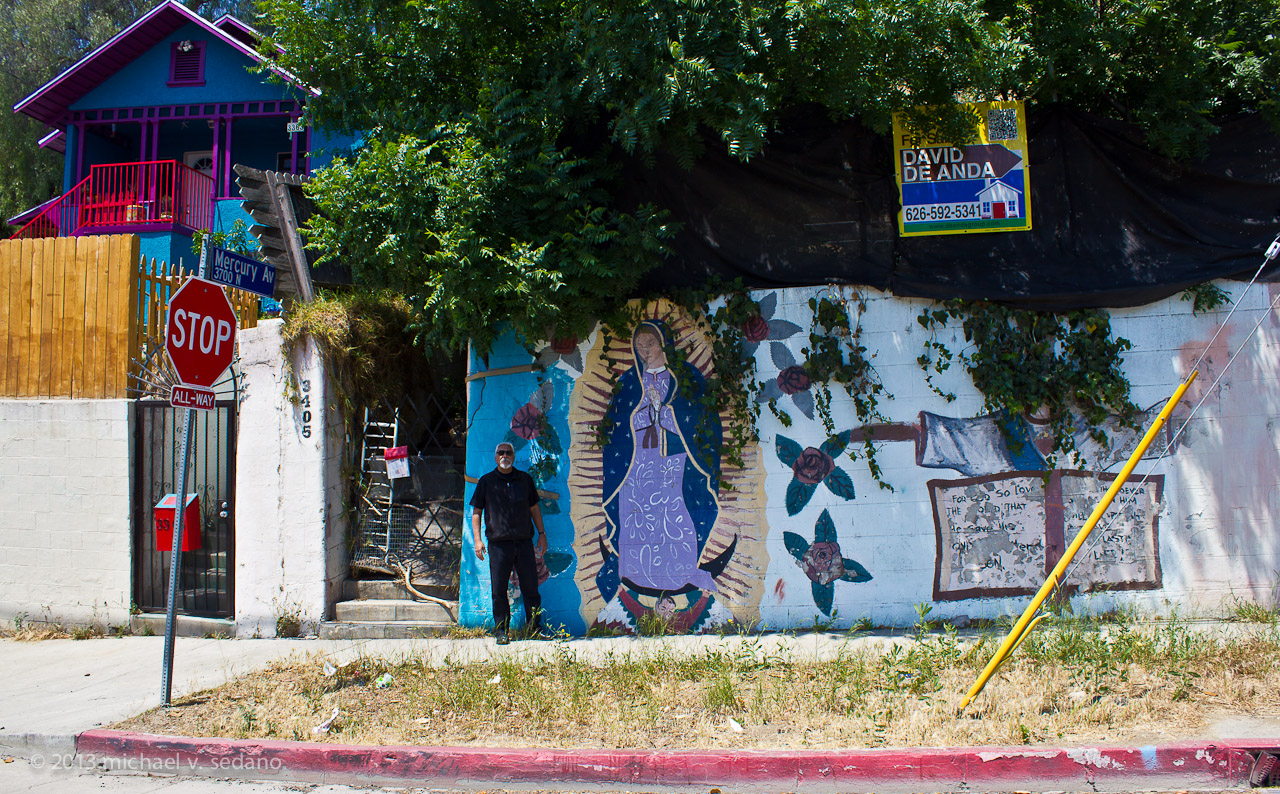
Over the years artists added floral motifs and color, not touching the figure. Vandals have not added their placas to this Lupe, but some hand has added a Jesus mural companion. That one peeled badly.
Ivy covers Jesus' face, while the same ivy delicately frames the virgin's head. That's been the case for a while. The image on Google Street View shows the same growth pattern. The earth honors her symbol.
There's no hope for a miracle. The Mural Conservancy of Los Angeles cannot rush in and save this one, as they have so many valued treasures of local cultura.
Structural damage condemns Happy Valley Lupe to destruction. Two steel straps extend across the corner in a last-ditch effort to hold the earth on her side of the wall. One day sooner than later, construction machines will pull down this wall and Lupe of Happy Valley will become part of that lost and ruined landscape of twentieth-century Los Angeles.


Here is a moment of silence for Happy Valley Lupe:
LitFest Pasadena Brings ChicLit to SoCal Readers
Bloguero Daniel Olivas' La Bloga-Monday column shared details of this Saturday's celebration of books and readers.

I look forward to the 2:00 panel Daniel moderates featuring four superb writers, Reyna Grande, Alex Espinoza, Melinda Palacio, Manuel Ramos.
Mail bag
Join Arte Publico's Day Without Sugar
Headlines blaring about fighting obesity carry such bad news that gente may turn away, not wanting to think of themselves, or their kids, as fat asses. Or muffin tops. Or beer bellies. Or panzónas panzónes. But as a nation, we are big-boned, still growing out of our baby fat, have captivating personalities, super-sized, we are.
Not to mention all the gente on a headlong charge from pre-diabetes to diabetes. And you don't have to be fat to be diabetic. And if you're diabetic you have a life's mission to monitor your health and take good care of yourself.
Prevention is the ounce of cure that saves a pound of lancets and pricked fingers.
Arte Publico press has a brilliant inspiration. Don't focus on endomorphism, strike at the cause.
No, not indolence, but consuming processed sugars. And, with raza at greater risk of developing diabetes, Arte Publico Press is supporting a bilingual campaign to fight obesity and disease by fighting sugar with a national "don't eat sugar all day" day.
Click here for access to the materials highlighted below from Arte Publico's email:

The bilingual coloring book by Diane de Anda illustrations by Janet Montecalvo has complicated pictures and simple badge-like drawings. I like that every element that can be a coloring piece, is. Like "The End" on the final page. Imagine a kid's relief after reading through the mild-handed propaganda and verbal sleight of hand, "I like pickle relish." "Pickle relish has pickles and corn syrup. Have all the dill pickles you want", a kid will enjoy the heck out of coloring-in those six magic letters.
Diane de Anda's coloring book is for older kids' reading competencies, but well within abilities of a pre-K kid to grasp. And besides, they don't really get a choice, do they, the tykes?

Day Without Sugar is not a national let's get together and buy the world a Coke event but something every classroom, organization, or community can simply declare. Pick a day and go for it a todo dar. Whatever day you choose, you'll find exercising food caution, like label-reading, an informative frustration. ¡Jehoshaphat! That stuff is in everything I eat!

May's First La Bloga On-line Floricanto
Abel Salas, Rose Valencia Sanchez, Mario Angel Escobar, Sharon Elliott, La Santa Cecilia, Francisco X. Alarcón trans.
Talisman, A Prayer Poem, by Abel Salas
Guerrera, by Rose Valencia Sanchez
Los indocumentados, por Mario Angel Escobar
Fortunate Cookies, by Sharon Elliott
ICE EL HIELO, Letra de la banda La Santa Cecilia, English version by Francisco X. Alarcón
Talisman, A Prayer Poem
by Abel Salas
If the word was inverted or the letter
took shape, the form or color that spoke
the blue or black or blood-orange tears like
the cold November rain in a pop culture
song long since forgotten, if the breath
held in a syllable of love and loss and
longing that resembles birth and death
at the same time or the pain that came
once with a phone call, your brother
crying on the other end, three states
away and your soul collapsing into
a cloud of disbelief because the baby
hummingbird you saw suffering on the
curb only days before foretold the sadness
with a whisper, a flurry and a heartbeat
racing under your fingers while you could
only lift it away and find a shaded place
for the featherless nestling to expire
If the fear and loneliness did not return
to remind you that words and poetry
are not enough not matter how many
times a book or the printed page remind
you that your life has been blessed, how
you have been the sum of text and type,
language spilling sometimes unchecked
across the screen or your palm in a pool
hall on the East Side where mariachis
and graying domino players make feeble
attempts to keep their demons in check
some embracing the headlong fall into
oblivion because it helps to numb the
truth you are feeling now as you recall
being told you were everything she never
knew she wanted, a lifetime ago like the
year-and-a half the honeymoons are said
to last, a story withering like an unfinished
poem or arc a trite novella takes before
it is sadly reduced to lines like these, to
photos on Facebook and forced distance
that stings with the inevitable and the finite
realization embodied in the voluptuous
curve of a Bodoni or Garamond typeface,
the tangible document or intransigent memory
coming apart at the seams stitched together
and pressed minutes later with an iron, if
the pronunciation of desire in translation
could erase the need and the absence like
heartbreak, then, and only then, would any
of this matter because you made a pinky swear,
locked the last digits from the beginning as if
to shield it all with a symbolic talisman,
protection and power like the bone pendant
she brought you from the other side of the world,
as a gesture that would bond or bubble you both
while staving off the tired tropes and remorse
that haunt us like the constellation of stars,
each luminous sphere a resplendent
redaction of lovers and friends who
remain only as participle phrases or
dangling prepositional possibilities
Copyright © 2013 Abel Salas. All Rights Reserved.
Guerrera
by Rose Valencia Sanchez
I fight inequity
with marvelous words.
My weapon of choice,
knowledge of past,
appreciation of present,
the ability to slay monsters
trying to destroy my future.
My life essence
enriched with the blood
of my heroes.
My ancestors
Warriors.
Healers.
Teachers.
I am glorious!
Well protected
within my armor.
White light that guides me.
Creators hands rebuke,
Evil intentions
Away from me.
I scoff at fear.
I do not accept defeat.
Guererra.
Me.
Copyright (c) 2013 Rose Valencia Sanchez. All Rights Reserved.
Los indocumentados
por Mario Angel Escobar
Los indocumentados,
tienen una forma muy peculiar
de mirar la tarde.
Cuando toman el autobús,
caminan taciturnos, absortos entre titanes
con la carne espesa pegada a la ventana.
Sacrifican palabras con un tenaz silencio
Pero cuando marchan;
rugen como la dinamita misma.
Pero es una marcha
Instantánea como lluvia repentina.
Luego se enrollan como cebolla
Se miran a los espejos con hipo
Mojan el asco con cerveza,
descosen su tez con el hábito
de poner intervalos.
Dicen que nunca son rebeldes
pues no caen en absolutos.
Tampoco quieren despertar
Al gigante que por amor al dólar
se vuelve un enanito
en el país de las maravillas.
Copyright (c) 2013 Mario Angel Escobar. All Rights Reserved.
Fortunate Cookies
by Sharon Elliott
Fortunate Cookies
you will begin a long journey
be aware of small insects and armadillos
receive riches beyond your wildest imaginings
make soup from stones
discover your lover among leaves and berries
be gifted with a new moon
shine like the sun
sing in your ancestral language
find a gold coin under your pillow
read a treasure book and bring it home
collect people like bouquets of gardenias
find the wisdom in the cold dark places of the ocean
dance barefoot in the dirt
become a silver star
grace the sky with wonder
chant to the river and the mountains
a gypsy woman will place a name in your pocket
you will lay face down in rich loam
all the world will sprout from your fingers
animals will follow you
seabirds light upon your shoulders
each corner of your smile
will be home to a belly laugh
words will drip from your pen like warm maple syrup
boundless beauty born of a murmur will envelop you
Copyright © 2013 Sharon Elliott. All Rights Reserved.
ICE EL HIELO
Letra de la banda La Santa Cecilia
Eva pasando el trapo sobre la mesa,
ella está mirando que todo brille como una perla.
Cuando llegue la patrona, que no se vuelva quejar.
No sea cosa que la acuse de ilegal.
José atiende los jardines, parecen de Disneyland,
maneja una troca vieja sin la licencia.
No importa si era taxista allá en su tierra natal.
Eso no cuenta para el Tío Sam.
El Hielo anda suelto por esas calles.
Nunca se sabe cuando nos va tocar.
Lloran los niños, lloran a la salida,
lloran al ver que no llegará Mamá.
Uno se queda aquí, otro se queda allá,
eso pasa por salir a trabajar.
Marta llegó de niña y sueña con estudiar.
pero se le hace difícil sin los papeles.
Se quedan con los laureles los que nacieron acá,
pero ella nunca deja de luchar.
El Hielo anda suelto por esas calles.
Nunca se sabe cuando nos va tocar.
Lloran los niños, lloran a la salida,
lloran al ver que no llegará Mamá.
Uno se queda aquí, otro se queda allá,
eso pasa por salir a trabajar.
ICE EL HIELO
Lyrics by La Santa Cecilia band
(Englishversion by Francisco X. Alarcón)
Eva cleans up tables with a rag,
Making sure that everything shines like a pearl,
Hoping that the boss woman won't again complain
And end up accusing her of being an illegal.
José takes care of gardens that look like Disneyland,
He drives an old truck without a license.
It doesn't matter that he was a taxi driver in his homeland.
That doesn't really matter to Uncle Sam.
ICE now roams loose on the streets.
We never really know when is our turn.
Children are crying when they leave school.
They're crying because Mom won't come.
Some are caught here, some over there,
That happens because they go out to work.
Marta arrived as a child and dreams of going to school
But that is difficult without papers.
The ones who are born here get the diplomas
But she never gives up and goes on struggling.
ICE now roams loose on the streets
We never really know when is our turn.
Children are crying when they leave school.
They're crying because Mom won't come.
Some are caught here, some over there,
That happens because they go out to work.
If the video doesn't play, click below:
http://www.jukebox.es/la-santa-cecilia/videoclip,ice-el-hielo,x5fzs0.html
Bios
Talisman, A Prayer Poem, by Abel Salas
Guerrera, by Rose Valencia Sanchez
Los indocumentados, por Mario Angel Escobar
Fortunate Cookies, by Sharon Elliott
ICE EL HIELO, Letra de la banda La Santa Cecilia, English version by Francisco X. Alarcón
 Abel Salas is a poet and journalist based in Los Angeles. His poems have appeared in The Austin Chronicle, ZYZZYVA: A Journal of West Coast Art & Literature, Beltway Poetry Quarterly, Cipactli, In Motion Magazine, Kuikatl: A XicanIndio Literary & Arts Journal and Huizache, the new literary journal published by Centro Victoria under the direction of Dagoberto Gilb. He currently edits and publishes Brooklyn & Boyle, a community arts newspaper distributed widely in LA’s East Side, and he has shared his poetry with audiences across the U.S., Mexico and Cuba, where he participated in the 13th Annual International Poetry Festival. His work as a journalist has been featured in the Los Angeles Times Magazine, LA Weekly, Latina Magazine, The New York Times, The San Antonio Current, The Brownsville Herald, OYE Magazine, Texas Observer, The Austin Chronicle and The Austin American-Statesman. Watch his most recent video poem here: http://www.youtube.com/watch?v=BKJFodvN3Bc&feature=youtu.be
 Rose Valencia Sanchez was born to Santos and Claudia Valencia in East Los Angele's California. Rose developed a love for words and reading at a young age, due to playing word games, and reading together with her family. She also enjoyed listening to the many stories of her fathers childhood in New Mexico. He painted such a vivid picture with his words, that Rose aspired to do the same.
Rose currently resides Arizona, and is fighting against racial intolerance and injustice aimed at the people she was always taught to be so proud of. The first thing you see when you walk up to Rose's front door is a sign on her front window that states "NO SB1070." She carries this statement inside her heart, and it fills up her every waking moment. She is fighting this war her words, her weapons is drawn, she is ready to battle.
 Mario A. Escobar (January 19, 1978-) is a US-Salvadoran writer and poet born in 1978. Although he considers himself first and foremost a poet, he is known as the founder and editor of Izote Press, the first Central American publisher in the United States. Escobar was born in La Union (El Salvador) on January 19, 1978. Escobar has stated that his exposure to “poetic sounds” began during his childhood and that his foundation in poetry stemmed from what he witness during the Salvadoran Civil War. Escobar began his writing career by the age of 13 as a poet. He cites Roque Dalton, Tato Laviera and Jaime Sabines as some of his early poetic influences. Escobar’s work has been feature in UCLA’s publication Underground Undergrads which recognizes the poet as an activist for the undocumented Student Movement. In 2004, Escobar was placed under arrest and was scheduled to be deported. In 2006, Escobar won his case for political asylum making him one of the last Salvadorans to win a political case fourteen years after the Salvadoran Peace Accords were signed in 1992. Escobar currently lives in Alhambra. Escobar has been featured in documentaries like Mimoun en Mario, studenten met een missie and in The healing Club. Some of Escobar’s works include Al corre de la horas (Editorial Patria Perdida, 1999) Gritos Interiores (Cuzcatlan Press, 2005), La Nueva Tendencia (Cuzcatlan Press, 2005), Paciente 1980 (Orbis Press, 2012).
 Born and raised in Seattle, Sharon Elliott has written since childhood. Four years in the Peace Corps in Nicaragua and Ecuador laid the foundation for her activism. As an initiated Lukumi priest, she has learned about her ancestral Scottish history, reinforcing her belief that borders are created by men, enforcing them is simply wrong.
She has featured twice in poetry readings in the San Francisco Bay area: at Poetry Express, Berkeley, Ca. in 2012 and La Palabra Musical in Berkeley, CA in 2013.
She was awarded the Best Poem of 2012, The Day of Little Comfort, Sharon Elliott, La Bloga Online Floricanto Best Poems of 2012, 11/2013, http://labloga.blogspot.com/2013/01/best-poems-of-2012.html
She has a book: Jaguar Unfinished, Sharon Elliott, Prickly Pear Publishing 2012, ISBN-13: 978-1-889568-03-4, ISBN-10: 1-889568-03-1 (26 pgs)
Ivy covers Jesus' face, while the same ivy delicately frames the virgin's head. That's been the case for a while. The image on Google Street View shows the same growth pattern. The earth honors her symbol.
There's no hope for a miracle. The Mural Conservancy of Los Angeles cannot rush in and save this one, as they have so many valued treasures of local cultura.
Structural damage condemns Happy Valley Lupe to destruction. Two steel straps extend across the corner in a last-ditch effort to hold the earth on her side of the wall. One day sooner than later, construction machines will pull down this wall and Lupe of Happy Valley will become part of that lost and ruined landscape of twentieth-century Los Angeles.


Here is a moment of silence for Happy Valley Lupe:
LitFest Pasadena Brings ChicLit to SoCal Readers
Bloguero Daniel Olivas' La Bloga-Monday column shared details of this Saturday's celebration of books and readers.

I look forward to the 2:00 panel Daniel moderates featuring four superb writers, Reyna Grande, Alex Espinoza, Melinda Palacio, Manuel Ramos.
Mail bag
Join Arte Publico's Day Without Sugar
Headlines blaring about fighting obesity carry such bad news that gente may turn away, not wanting to think of themselves, or their kids, as fat asses. Or muffin tops. Or beer bellies. Or panzónas panzónes. But as a nation, we are big-boned, still growing out of our baby fat, have captivating personalities, super-sized, we are.
Not to mention all the gente on a headlong charge from pre-diabetes to diabetes. And you don't have to be fat to be diabetic. And if you're diabetic you have a life's mission to monitor your health and take good care of yourself.
Prevention is the ounce of cure that saves a pound of lancets and pricked fingers.
Arte Publico press has a brilliant inspiration. Don't focus on endomorphism, strike at the cause.
No, not indolence, but consuming processed sugars. And, with raza at greater risk of developing diabetes, Arte Publico Press is supporting a bilingual campaign to fight obesity and disease by fighting sugar with a national "don't eat sugar all day" day.
Click here for access to the materials highlighted below from Arte Publico's email:

The bilingual coloring book by Diane de Anda illustrations by Janet Montecalvo has complicated pictures and simple badge-like drawings. I like that every element that can be a coloring piece, is. Like "The End" on the final page. Imagine a kid's relief after reading through the mild-handed propaganda and verbal sleight of hand, "I like pickle relish." "Pickle relish has pickles and corn syrup. Have all the dill pickles you want", a kid will enjoy the heck out of coloring-in those six magic letters.
Diane de Anda's coloring book is for older kids' reading competencies, but well within abilities of a pre-K kid to grasp. And besides, they don't really get a choice, do they, the tykes?

Day Without Sugar is not a national let's get together and buy the world a Coke event but something every classroom, organization, or community can simply declare. Pick a day and go for it a todo dar. Whatever day you choose, you'll find exercising food caution, like label-reading, an informative frustration. ¡Jehoshaphat! That stuff is in everything I eat!

May's First La Bloga On-line Floricanto
Abel Salas, Rose Valencia Sanchez, Mario Angel Escobar, Sharon Elliott, La Santa Cecilia, Francisco X. Alarcón trans.
Talisman, A Prayer Poem, by Abel Salas
Guerrera, by Rose Valencia Sanchez
Los indocumentados, por Mario Angel Escobar
Fortunate Cookies, by Sharon Elliott
ICE EL HIELO, Letra de la banda La Santa Cecilia, English version by Francisco X. Alarcón
Talisman, A Prayer Poem
by Abel Salas
If the word was inverted or the letter
took shape, the form or color that spoke
the blue or black or blood-orange tears like
the cold November rain in a pop culture
song long since forgotten, if the breath
held in a syllable of love and loss and
longing that resembles birth and death
at the same time or the pain that came
once with a phone call, your brother
crying on the other end, three states
away and your soul collapsing into
a cloud of disbelief because the baby
hummingbird you saw suffering on the
curb only days before foretold the sadness
with a whisper, a flurry and a heartbeat
racing under your fingers while you could
only lift it away and find a shaded place
for the featherless nestling to expire
If the fear and loneliness did not return
to remind you that words and poetry
are not enough not matter how many
times a book or the printed page remind
you that your life has been blessed, how
you have been the sum of text and type,
language spilling sometimes unchecked
across the screen or your palm in a pool
hall on the East Side where mariachis
and graying domino players make feeble
attempts to keep their demons in check
some embracing the headlong fall into
oblivion because it helps to numb the
truth you are feeling now as you recall
being told you were everything she never
knew she wanted, a lifetime ago like the
year-and-a half the honeymoons are said
to last, a story withering like an unfinished
poem or arc a trite novella takes before
it is sadly reduced to lines like these, to
photos on Facebook and forced distance
that stings with the inevitable and the finite
realization embodied in the voluptuous
curve of a Bodoni or Garamond typeface,
the tangible document or intransigent memory
coming apart at the seams stitched together
and pressed minutes later with an iron, if
the pronunciation of desire in translation
could erase the need and the absence like
heartbreak, then, and only then, would any
of this matter because you made a pinky swear,
locked the last digits from the beginning as if
to shield it all with a symbolic talisman,
protection and power like the bone pendant
she brought you from the other side of the world,
as a gesture that would bond or bubble you both
while staving off the tired tropes and remorse
that haunt us like the constellation of stars,
each luminous sphere a resplendent
redaction of lovers and friends who
remain only as participle phrases or
dangling prepositional possibilities
Copyright © 2013 Abel Salas. All Rights Reserved.
Guerrera
by Rose Valencia Sanchez
I fight inequity
with marvelous words.
My weapon of choice,
knowledge of past,
appreciation of present,
the ability to slay monsters
trying to destroy my future.
My life essence
enriched with the blood
of my heroes.
My ancestors
Warriors.
Healers.
Teachers.
I am glorious!
Well protected
within my armor.
White light that guides me.
Creators hands rebuke,
Evil intentions
Away from me.
I scoff at fear.
I do not accept defeat.
Guererra.
Me.
Copyright (c) 2013 Rose Valencia Sanchez. All Rights Reserved.
Los indocumentados
por Mario Angel Escobar
Los indocumentados,
tienen una forma muy peculiar
de mirar la tarde.
Cuando toman el autobús,
caminan taciturnos, absortos entre titanes
con la carne espesa pegada a la ventana.
Sacrifican palabras con un tenaz silencio
Pero cuando marchan;
rugen como la dinamita misma.
Pero es una marcha
Instantánea como lluvia repentina.
Luego se enrollan como cebolla
Se miran a los espejos con hipo
Mojan el asco con cerveza,
descosen su tez con el hábito
de poner intervalos.
Dicen que nunca son rebeldes
pues no caen en absolutos.
Tampoco quieren despertar
Al gigante que por amor al dólar
se vuelve un enanito
en el país de las maravillas.
Copyright (c) 2013 Mario Angel Escobar. All Rights Reserved.
Fortunate Cookies
by Sharon Elliott
Fortunate Cookies
you will begin a long journey
be aware of small insects and armadillos
receive riches beyond your wildest imaginings
make soup from stones
discover your lover among leaves and berries
be gifted with a new moon
shine like the sun
sing in your ancestral language
find a gold coin under your pillow
read a treasure book and bring it home
collect people like bouquets of gardenias
find the wisdom in the cold dark places of the ocean
dance barefoot in the dirt
become a silver star
grace the sky with wonder
chant to the river and the mountains
a gypsy woman will place a name in your pocket
you will lay face down in rich loam
all the world will sprout from your fingers
animals will follow you
seabirds light upon your shoulders
each corner of your smile
will be home to a belly laugh
words will drip from your pen like warm maple syrup
boundless beauty born of a murmur will envelop you
Copyright © 2013 Sharon Elliott. All Rights Reserved.
ICE EL HIELO
Letra de la banda La Santa Cecilia
Eva pasando el trapo sobre la mesa,
ella está mirando que todo brille como una perla.
Cuando llegue la patrona, que no se vuelva quejar.
No sea cosa que la acuse de ilegal.
José atiende los jardines, parecen de Disneyland,
maneja una troca vieja sin la licencia.
No importa si era taxista allá en su tierra natal.
Eso no cuenta para el Tío Sam.
El Hielo anda suelto por esas calles.
Nunca se sabe cuando nos va tocar.
Lloran los niños, lloran a la salida,
lloran al ver que no llegará Mamá.
Uno se queda aquí, otro se queda allá,
eso pasa por salir a trabajar.
Marta llegó de niña y sueña con estudiar.
pero se le hace difícil sin los papeles.
Se quedan con los laureles los que nacieron acá,
pero ella nunca deja de luchar.
El Hielo anda suelto por esas calles.
Nunca se sabe cuando nos va tocar.
Lloran los niños, lloran a la salida,
lloran al ver que no llegará Mamá.
Uno se queda aquí, otro se queda allá,
eso pasa por salir a trabajar.
ICE EL HIELO
Lyrics by La Santa Cecilia band
(Englishversion by Francisco X. Alarcón)
Eva cleans up tables with a rag,
Making sure that everything shines like a pearl,
Hoping that the boss woman won't again complain
And end up accusing her of being an illegal.
José takes care of gardens that look like Disneyland,
He drives an old truck without a license.
It doesn't matter that he was a taxi driver in his homeland.
That doesn't really matter to Uncle Sam.
ICE now roams loose on the streets.
We never really know when is our turn.
Children are crying when they leave school.
They're crying because Mom won't come.
Some are caught here, some over there,
That happens because they go out to work.
Marta arrived as a child and dreams of going to school
But that is difficult without papers.
The ones who are born here get the diplomas
But she never gives up and goes on struggling.
ICE now roams loose on the streets
We never really know when is our turn.
Children are crying when they leave school.
They're crying because Mom won't come.
Some are caught here, some over there,
That happens because they go out to work.
If the video doesn't play, click below:
http://www.jukebox.es/la-santa-cecilia/videoclip,ice-el-hielo,x5fzs0.html
Bios
Talisman, A Prayer Poem, by Abel Salas
Guerrera, by Rose Valencia Sanchez
Los indocumentados, por Mario Angel Escobar
Fortunate Cookies, by Sharon Elliott
ICE EL HIELO, Letra de la banda La Santa Cecilia, English version by Francisco X. Alarcón

Rose currently resides Arizona, and is fighting against racial intolerance and injustice aimed at the people she was always taught to be so proud of. The first thing you see when you walk up to Rose's front door is a sign on her front window that states "NO SB1070." She carries this statement inside her heart, and it fills up her every waking moment. She is fighting this war her words, her weapons is drawn, she is ready to battle.


She has featured twice in poetry readings in the San Francisco Bay area: at Poetry Express, Berkeley, Ca. in 2012 and La Palabra Musical in Berkeley, CA in 2013.
She was awarded the Best Poem of 2012, The Day of Little Comfort, Sharon Elliott, La Bloga Online Floricanto Best Poems of 2012, 11/2013, http://labloga.blogspot.com/2013/01/best-poems-of-2012.html
She has a book: Jaguar Unfinished, Sharon Elliott, Prickly Pear Publishing 2012, ISBN-13: 978-1-889568-03-4, ISBN-10: 1-889568-03-1 (26 pgs)


.JPG)


