Tuesday, June 16, 2015

The US Poet Laureate, Floricantos On-line and In-person, GF cooking.


Juan Felipe Herrera, United States Poet Laureate: A Photographic Celebration
Michael Sedano

Lynne Romero, Juan Felipe Herrera
Fall 1973. English major Mary Ann Pacheco and poet Alurista have invited every Chicana and Chicano poet and writer who could be lured to the University of Southern California—for free—to read at un festival de flor y canto. Outside the artist entrance, charlando and making eyes at the gorgeous poet Lynne Romero, saludando gente like the brown buffalo Oscar Zeta Acosta, Alurista, rrsalínas, the crazy gypsy Omar Salinas, Ricardo Sánchez, the young poet Juan Felipe Herrera greets arriving artists. An Army Veteran attending USC on the GI Bill, waits with them, camera in hand, capturing images for the campus newspaper, and posterity.

Juan Felipe Herrera, Ricardo Sánchez

Posterity keeps arriving, but almost didn’t. The floricanto disappeared from USC’s cultural memory. When the photographer, Michael Sedano, went looking for the videos recorded in 1973, only two collections in the world owned sets, one in Texas the other in California.

At UCR, librarian Barbara Robinson had purchased a complete set of the 1973 floricanto as a way of honoring Tomás Rivera, UCR’s Chancellor, who read at the USC festival.

When Sedano retired from a career in private industry, he sought out Herrera, who had become the Tomás Rivera Chair in the College of Humanities, Arts and Social Sciences at the University of California Riverside, and Robinson, who had become the Librarian for USC’s Boeckmann Center for Iberian & Latin American Studies. Herrera located the only U-Matic video player on campus. Absent that device, the digitizing project was dead from the start.

Together the three recovered the 1973 floricanto and celebrated its return to USC’s Digital Library with a reunion floricanto. 2010’s Festival de Flor y Canto Yesterday • Today • Tomorrow was funded by a Visions & Voices Grant awarded to Barbara Robinson.

Juan Felipe Herrera announces the honorees for the 2010 Tomás Rivera Pioneer Award for Performance

Cuca Aguirre García receives recognition as a pioneer of raza flor y canto.

Juan Felipe does things, not just poetry, with a lot of corazón. At the Festival de Flor y Canto Yesterday • Today • Tomorrow, he honors two members of "Las Tres Chatitas," a frontera song dance declamando act that toured the Juarez area.

Herrera writes about the rich history of Las Tres Chatitas in La Bloga. Awarding the 2010 Tomás Rivera Flor y Canto Pioneer Award for Performance not only profoundly moves the awardees, Cuca Aguirre García and Eva Aguirre Amezcua, the honor comes with a $5000.00 award that, for senior citizens, is like a million dollars. Puro heart, Juan Felipe Herrera. Te aventastes.


Herrera the photographer captures 2010's floricanto memories

Juan Felipe Herrera performs at 2010's Festival de Flor y Canto Yesterday • Today • Tomorrow


You can view the full videos of Juan Felipe Herrera’s performances at USC’s Digital Library at this link and this.  Here is a sampling of those performances.


The full set of 1973 videos and Sedano’s photographic collection are online; videos of all the 2010 reunion floricanto, documented by Jesus Treviño, will be available later in 2015.

Herrera's history with festivales de flor y canto is a wonderful story and a grand experience that continues to ever happier celebrations for that young poet by the door, Juan Felipe Herrera.

In 2012, California names Herrera its Poet Laureate. The Laureate takes to his responsibilities in uniquely nurturing ways. Aside from numerous public appearances, the Laureate launches a project to create The Most Incredible and Biggest Poem on Unity in the World. Click the link to share a selection of work making part of the biggest Unity poem in the world.


In 2011, Herrera is named to a six-year term as a Chancellor of The Academy of American Poets and participates in annual Chancellors’ Readings and discussions in New York City.


"'Hey Michael!' someone shouts as Sedano and his wife return from lunch, ready for the next session
of the Chancellors' meetings. The photographer spots a familiar watch cap and a waving hand as
the future Laureate heads to the airport and his flight back to California.

In 2014, Juan Felipe Herrera sets down his California laurels in a day of fun, sunshine, and celebratory voices at UCR. Herrera leads a chorus of children’s voices in one part of the program, a chorus of local artists in another. Sedano joins the chorus of locals.


Posterity will remember the second Fresno poet, and the first Chicano to become "Poet Laureate Consultant in Poetry," otherwise known as the United States Poet Laureate. His name joins a stellar array of U.S. poets dating to the 1937 establishment of the honor.

Poet Laureate Consultants in Poetry to the Library of Congress
• Juan Felipe Herrera
• Charles Wright (2014-2015)
• Natasha Trethewey (2012-2014)
• Philip Levine (2011-2012)
• W.S. Merwin (2010-2011)
• Kay Ryan (2008-2010)
• Charles Simic (2007-2008)
• Donald Hall (2006-2007)
• Ted Kooser (2004-2006)
• Louise Glück (2003-2004)
• Billy Collins (2001-2003)
• Stanley Kunitz (2000-2001)
• Special Bicentennial Consultants (1999-2000)
◦ Rita Dove
◦ Louise Glück
◦ W.S. Merwin
• Robert Pinsky (1997-2000)
• Robert Hass (1995-1997)
• Rita Dove (1993-1995)
• Mona Van Duyn (1992-1993)
• Joseph Brodsky (1991-1992)
• Mark Strand (1990-1991)
• Howard Nemerov (1988-1990)
• Richard Wilbur (1987-1988)
• Robert Penn Warren (1986-1987)

By Act of Congress in 1985, the present title of “Poet Laureate” replaces the earlier nomination,
“Consultant in Poetry to the Library of Congress.” These include:

• Gwendolyn Brooks (1985-1986)
• Reed Whittemore (Interim Consultant in Poetry, 1984-1985)
• Robert Fitzgerald (1984-1985)
• Anthony Hecht (1982-1984)
• Maxine Kumin (1980-1982)
• William Meredith (1978-1980)
• Robert Hayden (1976-1978)
• Stanley Kunitz (1974-1976)
• Daniel Hoffman (1973-1974)
• Josephine Jacobsen (1971-1973)
• William Stafford (1970-1971)
• William Jay Smith (1968-1970)
• James Dickey (1966-1968)
• Stephen Spender (1965-1966)
• Reed Whittemore (1964-1965)
• Howard Nemerov (1963-1964)
• Louis Untermeyer (1961-1963)
• Richard Eberhart (1959-1961)
• Robert Frost (1958-1959)
• Randall Jarrell (1956-1958)
• William Carlos Williams (appointed in 1952 but did not serve)
• Conrad Aiken (1950-1952)
• Elizabeth Bishop (1949-1950)
• Leonie Adams (1948-1949)
• Robert Lowell (1947-1948)
• Karl Shapiro (1946-1947)
• Louise Bogan (1945-1946)
• Robert Penn Warren (1944-1945)
• Allen Tate (1943-1944)
• Joseph Auslander (1937-1941)

According the Library of Congress, the Laureate’s specific duties remain ambiguously defined, “to afford incumbents maximum freedom to work on their own projects while at the Library. The poet laureate gives an annual lecture and reading of his or her poetry and usually introduces poets in the Library's annual poetry series, the oldest in the Washington area, and among the oldest in the United States.”

If posterity can make it happen, Sedano will be in the gallery for that big lecture at the Library of Congress, camera at the ready. A ver.

Juan Felipe Herrera’s appointment as Poet Laureate of the United States inspires Abel Salas to compose the following. This month's On-line Floricanto includes a similarly inspired poem by Francisco X. Alarcón.


Abel Salas reads "I Am the Open Veins"

I AM THE OPEN VEINS
By Abel Salas

in honor of Eduardo Galeano and w/ respect to Juan Felipe Herrera
on his being named Poet Laureate of the U.S.

I am the open veins of América Latina
Soy las venas abiertas and through them
courses the history of pain laced with
the stench of genocide. I am the open
arteries wrapped like disembodied tripas
around all of our necks like the shackles
of slavery in service of colonial and now
neo-liberal profit. I am the scream let fly
at the moon or the pale invaders from
dripping, blood-soaked coyote or eagle
or jaguar throats because I am also the
cutlass blade and the machine gun fire
and the incendiary chemical bomb at
least half of my lineage delivers each
day at the footstep of an earth that
moans with grief over the needless
crimson rivulets draining downward
over her flesh and staining the land
with sadness. I am the open veins
and the twisted cry of agony in the
gaping maw of displacement and a
dislocation in the wake of a scourge
called gentrification which some of
you don’t really believe is a bad thing
at all. Yes, I am the open veins that echo
with anger and pulse with the beat of
all our ancestors, those who could not
stem the tide of they who salivate at the
kind of wealth and youth and beauty on
the infinite parade of touch-screen luster
in high definition coming soon to a virtual
triple x playground near you while black
lives and brown lives matter less and less
each day when raging renegade officers
point guns at teenagers and handcuff
bikini-clad girls who did nothing wrong,
broke no laws and provoked no one.
I am the open veins and you will ignore
my dying gasps and the unchecked tears
because you are unwilling to accept your
responsibility for any of this as you toast
your Napa Cabernet in your renovated
Craftsman home, believing it’s enough
to feed your 2.3 children tamales made
by the vendor near their grade school or
that you hired her sister to walk them to
and from the kindergarten where her own
child is surrounded by the privilege and joy
his small broken heart will never truly know.


On-line Floricanto for June 2015
Graciela B. Ramírez, Javier Pacheco, Francisco X. Alarcón, Israel Francisco Haros López.


TU LIBRO
By Graciela B. Ramírez

Francisco:

Hablando de tu libro
Mariposas sin fronteras,
parece que…

Tomaste
un cuarzo
cristalino

Lo requebrajaste
con mágico
y filoso cincel

Saltaron
Chispazos
por doquiera

Cada átomo/
chispazo fue
un verso

En cada verso
Recogiste
todo lo físico

y spiritual
que habita
en la creación

Escogiste
la fragilidad =
de la mariposa

Para capturar
lo bello y trágico
del universo

Después
Reconstruiste
con tu mente

Tus manos,
tu papel
y tu pluma

El cuarzo
cristalino que es
tu libro

Con cariño,
Graciela B. Ramírez
2 de abril de 2015


YOUR BOOK
By Graciela B. Ramírez

Francisco:

Speaking of your book
Borderless Butterflies,
it seems that..

You took
a crystalline
quartz

You splintered
with a sharp and
magic chisel

Sparks
bouncing
everywhere

Each atom/
spark was
a verse

On each verse
you collected
everything physical

and spiritual
that dwells
in the creation

You chose
the fragility
of the butterfly

To capture
the beauty and tragedy
of the universe

Later
you reconstructed
with your mind

Your hands,
your paper,
and you pen

The crystalline
quartz that is
your book

With love,
Graciela B. Ramírez
April 2, 2015


Graciela B. Ramírez taught Spanish and Ethnic Studies at California State University, Sacramento. As a poet, she is the author of Educación una Epica Chicana and Poemas Buenos, Malos y Regulares, and has been part of poetry readings since the 1970s. Graciela has also written her memoirs, to be published as Mi Sombra y Yo. Since the 1970s, Graciela has organized many poetry readings in the Sacramento area. She was coordinator for 11 years of the group of writers: Los Escritores del Nuevo Sol, and helped edit the group’s anthology: Voces del Nuevo Sol, Cantos y Cuentos.


Dad
Javier B. Pacheco

(He died December 3, 2014, six months ago or, as if it were yesterday)

On Sunday he lost his balance
and fell off the chair
I rushed to his side,
and while lifting him up
assured him in a low, gentle voice
“Everything is alright, Dad,
I have you now, everything is alright.”

He gazed at me, almost startled
He knew he no longer had
control of his body
his limbs were free
of any attachment to the brain
he knew there was no longer a connection
but he stared at me
listening very attentively
perhaps because my soothing voice
was like a caressing whisper
without recrimination or blame
without judgment or attitude;

it was a soft breath
a gentle encouragement
from a voice he’d heard few times
coming from a place almost unknown:
it was my heart and soul
talking to him,
cradling him.
What a shame that I had waited
so long just to let him know
how much I adored him.
Tuesday he slipped into a coma
On Wednesday I felt his cold hands
and knew the cold would soon envelope
the entire house.


Papá
Javier B. Pacheco

(Murió el 3 de Diciembre, 2014, hace seis meses, ó, como si fuera ayer)

El domingo perdió su equilibrio
y se cayó de la silla
me apure a su lado,
y al levantarlo
le aseguré en una voz baja, apacible
“Todo esta bien, Papá,
ya te tengo, todo esta bien.”

Me miró, casi asustado
Sabía que él ya no tenía
el control de su cuerpo
sus extremidades estaban desconectadas
de cualquier atadura al cerebro
sabía que ya no había conexión
pero me miraba fijamente
escuchando atentamente
tal vez porque mi voz tranquila
era como un susurro acariciando
sin recriminaciones ni culpas
sin juicio ni actitud;

fue un aliento suave
un estímulo gentil
de una voz que pocas veces había oído
proveniente de un lugar casi desconocido:
fue mi corazón y alma
que le hablaron,
que lo acunaron.
Que lástima que yo había esperado
tanto tiempo para dejarle saber
lo mucho que lo adoraba.
El martes entró en una coma
El miércoles sentí sus manos frías
y sabía que el frio pronto cubriría
a la casa entera.


Javier B. Pacheco, poetry / poesia. Born in Palo Alto, CA, Pacheco is currently a homeless poet, pianist, composer, arranger, and unemployed ethnomusicologist. Masters in Music (UCLA 1986), & PhD in Ethnomusicology (UCLA 1994).


to Juan Felipe Herrera new Poet Laureate
By Francisco X. Alarcón

to Juan Felipe Herrera new US Poet Laureate

may the cilantro magic of your poetry always bring lots of joy to us all!
que el cilantro mágico de tu poesía nos traiga siempre mucha alegría!

© Francisco X. Alarcón June 11, 2015


excerpt from Borderless frontera haikus
By Israel Francisco Haros López

borderless frontera haikus
we have forgotten the names of each other
underneath the shedding skin
those names written in our blood
that have danced to tonatiuh tonantzin...
before they knew they were lovers


Israel Haros is currently working on 1000 border sketch poems as part of an artist residency. He has been accepted into the Immigration/Migration themed residency at Santa Fe Art Institute. He is a published author and has 6 published Adult Chicano Coloring Books. He is also currently working on 1000 sketches in a month as part of an inner artistic movement. He can be found using facebook as his office and also on his wordpress "waterhummingbirdhouse" Chicano from Boyle Heights with an B.A. in English From UC Berkeley and an MFA from California College of The Arts.


The Gluten-free Chicano Cooks
Fast Gluten-free Tortilla Española

A genuine tortilla española may require almost an hour to cook and turn, maybe even a second plate to flip the partially cooked dish onto, then slide that back into the frying pan to cook the other side. Good eating need not be that much work.

This fast and easy version uses microwaved half-cooked papa and doesn’t concern itself with a lovely presentation molded into frying pan shape and cut into pie-like wedges. This is chow to start the day with a flourish. ¡Adelante!


Ingredients
2 ir 3 pink papas
4 blanquillos
coarse-ground black pepper
salt (optional)
heavy cream or milk (optional)
6+ mini-smokies (optional)
diced or sliced onion (optional)
diced bell pepper (optional)
diced Serrano or other chile (optional)

Process
Whip eggs with a healthy splash of cream.
Microwave the washed papas on High for three minutes.
While the papas cool, make the egg mixture.


Slice the papas thinly.
Non-stick spray a frying pan.
Add a splash—to coat the bottom--corn or olive oil to the frying pan
Heat oil under medium flame.
Add the papas and let them brown on one side.
Add the optional veggies.
Turn the papas and let them begin to brown.


Add the lil smokies. Cook until the smokies are softened.

Pour in the blanquillo mix. Whirl the pan to distribute the eggs. The cream or milk thins and lends a velvety texture.

Cook until a spatula can lift the eggs and they’re brown underneath. Don't concern yourself with still-liquid egg mix here and there.

Flip the mixture by drawing a line with a spatula across the middle and flip each half.

Cook until the eggs are hard enough to your liking.

Serve with sliced tomatoes and tortillas de maíz.


¡Provecho!

Foto Ese. Floricanto in Person
Bluebird Reading Honors Eduardo Galeano

Los Angeles' leading art venue, Avenue 50 Studio, hosts two monthly Sunday poetry readings, La Palabra hosted by Karineh Mahdessian, and the Bluebird Reading Series hosted by Jessica Ceballos.

Sunday, June 14, Ceballos organized a tribute to legendary journalist, writer, novelist, poet, historian, philosopher, Eduardo Germán María Hughes Galeano (September 3, 1940 - April 13, 2015).

The reading celebrated the third year anniversary of the Bluebird Reading Series, as well as the recently conferred MFA for Vicky Vertiz. Advancing the celebratory mood was the acknowledgment of Juan Felipe Herrera's honor as the United States Poet Laureate.

Featured poets shared Galeano's work, or read their own inspired work included Abel Salas, Gloria Enedina Alvarez, Karen Anzoategui, Kenji Liu, Roberto Leni, and Yago S. Cura.

In addition, the popular Open Mic welcomed a number of poets for a two-minute opportunity to read.

No one knows if a future Poet Laureate was in the house for this honor of literary hero Eduardo Galeano.


Jessica Ceballos is one of the hardest-working poetry promoters in Los Angeles. She both Emceed the event and read her own work. As busy as she finds herself, Ceballos reading her own stuff is a rarely enjoyed event.


Artist Rafas contributes his Galeano portrait featuring key quotations from the literary hero.

Featured Poets


Jessica Ceballos draws a big hand for her rarely-seen performance of her own work.


Abel Salas, editor of Brooklyn & Boyle and promoter of Huizache reads the poem printed earlier in honor of Galeano and Juan Felipe Herrera.


Gloria Enedina Alvarez reads to musical accompaniment of Greg Hernandez.


Karen Anzoategui, a consummate performer, recently joined the cast of the run-away hit series on Hulu television, East Los High.


Kenji Liu opens veins to honor Galeano.


Roberto Leni waits in the SRO audience for his feature spot.


Roberto Leni's serio-comic presentation brings down the house.


Vickie Vertiz, who studied with Juan Felipe Herrera at UCR, recently earned her MFA.


Yago S. Cura, who enjoys writiing fútbol poetry, shares a Galeano masterpiece that weaves fútbol allusions with keenly satiric wit.  


Open Mic

Open Mic'ers inlcuded Christine Jordan, Graham Smith, Terri Martin Lujan, Seven, Zachary Jensen, Art Currim, Maestro Gamin, James Goyte, Francisco Letelier, Rossana Perez, Joe Parker and Dig Wayne. Not all are included in today's foto ese, mostly owing to lack of eye contact! One poet illustrates the disadvantage of the lectern/music stand. She is short and is barely visible behind the apparatus. 

Gente--poets--take advice from a two-time Poet Laureate! Juan Felipe Herrera observes the audience is half the poem. Make eye contact, move the lectern and commit yourself to the audience using all the technology of the body. Make words and phrases mean what you want them to mean, rather than be mere black spots on a page.


Christine Jordan


Dig Wayne


Francisco Letelier. His 14-year-old son watched dad wow the house.


Graham Smith


Seven


Terri Martin Lujan


Maestro Gamin

Monday, June 15, 2015

Axolote


Xánath Caraza

Guest Columnist Denise Oyuki Castillo
 

© Axolote 2015 (US)
Untitled (Madison WI)
Photograph 
 
Axolote is a multicultural student organization at the University of Wisconsin-Madison that was created in the fall of 2014 in an effort to raise awareness and bring visibility to current political issues in Mexico. The desire of forming an organization was always present, but it was not until after the violent events that occurred on September 26th 2014 in Ayotzinapa, that this group was formed and became active in Madison.

© Axolote 2015

© Axolote 2015

One of the first projects was a bilingual edition of  “Ayotzinapa. Desaparición política/ Forced Disappearances.” This is the first of the collection “Libros sobre la Marcha” and is available online through Pensaré Cartonera.  This book collects the testimonies of some of the survivors of the violent events in Guerrero, where three students were killed and the state police in an alliance with drug cartels kidnapped 43 students. These testimonies deny the official version that the Government gave about the incidents that occurred in September 26th. The book includes a brief history of Guerrero and their problems with drug cartels. It also gives information about the Raúl Isidro Burgos Rural Teachers College of Ayotzinapa and their political views. Throughout the pages of this book we can also find the voices of the protesters in México, voices that demand the safe return of the missing students from Ayotzinapa. These documents were gathered during the protests in Mexico in October 2014.

© Axolote 2015

© Axolote 2015

 
Axolote, as a group and with the consent of Pensaré Cartonera, started the translation and organized two Cartonera workshops in April. The money collected from these two events was sent to the families of the victims. Since all of the books were distributed, we are planning on organizing another workshop to create more. The bilingual edition is available online, and the Cartonera books can be created anywhere. In this way, all of the valuable information found within can be easily disseminated.

© Axolote 2015

 
© Axolote 2015
 
 
On May 2nd 2015, we participated in Strut! - a community procession planned by Mexican artist Laura Anderson Barbata that brought together different cultural organizations in Madison.

© Axolote 2015
 
 
© Axolote 2015
 
 
Right now, Axolote is organizing an exhibition for the main library of UW-Madison to take place during the months of September and October 2015. This exhibition “Ayotzinapa: Seeds Don’t Burn” will present two timelines of the drug war in México and the United States, as well as literature about Ayotzinapa, Guerrero, México and the United States, and ephemera collected from the protests in Mexico, such as posters and fliers. The objective is to show how these two countries are tied together through this situation. The exhibition will be available online as well. 

© Axolote 2015
 
© Axolote 2015
 
Axolote is a small group that is trying to do its part to help alleviate the current situation in Mexico. We know that indifference kills. We are happy to see that this small group is growing, and we want to create awareness in our community because the violence in México has to stop, and we need to help this happen.
 
© Axolote 2015
 

© Axolote 2015


Denise Oyuki Castillo

Denise Oyuki Castillo holds an MA in Hispanic Literature from the University of New Mexico and is pursuing a Ph.D. at the University of Wisconsin-Madison, with an emphasis in Colonial Spanish American Literature. 
 

Denise y Pablo
 

Sunday, June 14, 2015

Myriam Gurba: How Some Abuelitas Keep Their Chicana Granddaughters Still While Painting Their Portraits in Winter

Olga García Echeverría


"Abuelita carried our food home in plastic mesh bags with plaid designs. Waddling along the cemetery murals, she looked how a Mexican grandmother should, like a tropical babushka. Four feet, eleven inches of old lady. Rolls of diabetic weight held in place by a handmade dress. Silver hair cropped short by her own scissors. A yarn shawl flapping like a cape...No man would guess seeing her walk up the street that Abuelita was an artist, and no man would guess that my sister and I were subjects worthy of art. Abuelita thought we were. She turned us into creations."


The motif, el hilo, that runs through Myriam Gurba's latest collection of stories is death, and when it comes to writing about death, Gurba knows how to kill it. Yes, la muerte es triste (that's why La Llorona can't stop crying), but Gurba's stories remind us that from the mulch of the dead bloom flowers.

Ghosts colonize the pages of this book. Some of the ghosts are vain and smell of chorizo, like the misogynist abuelo who envies Juan Rulfo. There’s la abuela, the Mexican Scheherazade, who spins gruesome stories to keep her two Chicana granddaughters captivated and sitting still so that she can paint their portraits. There's 16 year old Andrew from East LA, who got his brains scrambled on concrete. There are, of course, Las Lloronas, the old school and the modern ones who undo their own motherhood. There's Nacho, a much-loved dog who was turned into a little pelt rug posthumously. There are hummingbird huevos that never hatch, and if you stare into a keyhole in one of the stories, you'll see a woman pacing, howling as she carries a little coffin in her hands. The hilo tugs and makes you read on.

If it sounds gory and dark, though, it's not. This is, after all, Death a La Queer Chicana, which is gay instead of morbid, which asks not only such important philosophical questions like "What is death?" but also "Who gives birds dyke haircuts?"
 
Although Pedro Páramo lurks in the pages of these cuentos, this isn't Juan Rulfo's Comala, where the dead are so alive that their constant “murmurings” suffocate the living. In Gurba's collection, despite the constant presence of death, the living live. It may be Guadalajara, Long Beach, Los Angeles, Mesoamerica. It may be preconquest Mexico, the 60's, 70's, 80's, 90's, 2012. It doesn't matter—the living do their thing. They get perms and ice-skate inside pyramid-shaped shopping malls. They touch their own sex and sniff, enthralled. They ditch school and eat spiced mangos on sticks. They bust their father having an affair with his secretary. They fall in love and suck on the nectar of ruins. They Facebook in the kitchen table late at night. They talk to ghosts. They photograph the dead and everything around them. They long so badly to touch Andrew's bashed-up brains. They do the Lambada at funerals with Mariachis. They embrace life/death like there's no tomorrow because there isn't; there's only right now and yesterday, yesterday, yesterday...echoing ghosts, memories that never die.

These stories, with their constant attention to fantastic and queer details, mesmerize and pull. Like those granddaughters who sat for their abuelita in winter, when the last story in the collection came to an end, all I could do was say, “Another.” Otra, Myriam. Otra.
 
 
To purchase How Some Abuelitas Keep Their Chicana Granddaughters Still While Painting Their Portraits in Winter: http://www.manicdpress.com/#painting


A native Californian, Myriam Gurba earned a BA with honors from UC Berkeley. Her first book, Dahlia Season, won the Publishing Triangle's Edmund White Award for Debut Fiction and was a Lambda Literary Award finalist. She is also the author of Wish You Were Me (Future Tense), menudo & Herb (self-published), and A White Girl Named Shaquanda (self-published). She blogs at lesbrain and often for The Rumpus and Radar Productions.


To view other blogas on Myriam the Great:
 

Saturday, June 13, 2015

Speculative fiction accepted – 3 announcements


Poetry & Flash Fiction Submissions Open

Grievous Angel is a SFF&H genre-only webzine. That means Science Fiction, Fantasy, Horror and related speculative fiction sub-genres, including Urban Fantasy, Mythos, Steampunk and Magical Realism, as well Humour/Satire riffs on these genre.

• We are looking for original Poetry (all forms, maximum 36 lines each + no more than five poems submitted at any one time) and Flash Fiction (maximum 700 words – yes 700 max). We are always happy to receive substantially shorter pieces of micro-fiction.

• Previously unpublished (no reprints) in English - and this also means not published on an author's own website.

• We accept submissions electronically via email - send to GrievousAngelSubs@icloud.com Please use Standard Manuscript Format – there is an excellent explanation here – BTW we're happy for italicised words to be typed as itals and we don't mind American-English or British-English spelling and grammar.

• Submissions can be within the body of an email or attached as a Word .DOC/.DOCX file or as an RTF or as a Mac Pages file but no PDFs. (And please state the number of words in your submission.)

At the risk of stating the bleedin' obvious, apart from the word length, the key factor with Flash Fiction is it has all the elements of a traditional self-contained short story, including a beginning, a middle and an end, even if some aspects may be implied. Flash Fiction is NOT an extract or vignette from a longer story and should never end with the words To Be Continued...

• We pay what what Duotrope and the SFWA classify as a "Professional rate", namely 6 US cents per word for fiction and US$1 per line for poetry. (Minimum payment for fiction: including prose poems & micro fiction: $10. Haiku: $5 each.) Payment usually within two weeks of publication.

• In return we acquire the First Electronic Worldwide Exclusive English-Language Rights (text) for six (6) months PLUS non-exclusive anthology rights for a planned periodic ebook anthology. We will extensively promote any published works on social media channels and some poetry may also be reproduced in the British Science Fiction Association's Focus magazine. However authors retain all other copyrights and after the initial 6 months – from the date of publication – you are free to republish the story or poetry anywhere and elsewhere in any format.

• Timescales: It is our intention to provide an acceptance or rejection note with 21 days of receiving a submission. We currently have an approximate 18 week/4 months backlog between acceptance and publication.

• Contact Details: Please ensure your name and email contact details (along with word count and title for fiction) are included with your submission. If you write under a pen-name/nom-de-plume include this information. And say a few words about yourself in a brief bio (max 25 words). Also, if you have a Twitter handle, let us know that as well.

• Forbidden Vices: We don't object to sex, violence and swear words – as long as they are pertinent to the story/poem and are not being used gratuitously. We are not interested in submissions advocating racial and religious hatred, sexism, child abuse, violence or any other topics generally regarded as unacceptable in the 21st Century. Edgy: Yes. Rapist, cannibal, chainsaw-wielding murder porn: No. We're not prudes, we just want content we and our readers will enjoy reading.

• No Multiple Submissions
• No Simultaneous Submissions
• No Re-Submissions: unless we specifically suggest it.
• No Reprints

A well written 300 word story or 16 line poem is far more likely to be accepted for publication whereas a poorly written, padded-out 700 word story or 36 line poem is a sure candidate for a rejection slip.
See more information on our website.


First anthology accepting submissions

Metasagas, a small independent publishing company dedicated to the goal of promoting futuristica, is accepting submissions for our first anthology of short fiction, Futuristica Volume 1. Deadline: August 31, 2015.

Guidelines
  • We pay 6 cents per word against a pro rata share of royalties.
  • We buy first rights and exclusive eBook rights for 6 months after the date of publication.
  • We do not purchase reprints.
  • We accept simultaneous submissions.
  • Manuscripts should be in standard manuscript format, between 3,000 and 10,000 words.

Story Criteria – Story content must be original. We do not accept fan fiction or derivative works.
We prize diversity, specifically stories that include multicultural backgrounds or lead characters of atypical ethnic origins. Basically, while we have nothing against heterosexual white American males, we feel they are already adequately represented in science fiction and we want stories about the rest of humanity. We are interested in character-oriented fiction.

Women Positive – Not every princess needs saving. We want stories with awesome female protagonists.
Sex Positive – If it isn’t consensual, it isn’t sex. Sexual content should be integral to the story, but not the whole story. No rape. Period.
Science Positive – Stories should explore science fiction, scientific fantasy, space opera, emerging technologies, etc.
We have a preference for near future, near Earth settings. No high fantasy, dragons or dinosaurs, unless they also have lasers.

We are committed to responding to submissions as quickly as possible. Manuscripts will be evaluated in the order in which they are received. See more information here.

Amazing Stories Writing Contest

On July 1st, 2015, Amazing Stories will open for submissions to the Gernsback Science Fiction Short Story Writing Contest. The final round will be judged by SFWA President Cat Rambo and SFWA members Dave Creek and Jack Clemons.

Three stories (1st, 2nd and 3rd) will receive 6 cents per word (up to $120.00) each in prize money. The authors will also be eligible for SFWA affiliate membership. The top ten stories will be published on the Amazing Stories website and will also be published in a follow-on anthology (electronic and/or print), which will also be paid at 6 cents per word.

All stories must be original, previously unpublished short stories, between 1,000 and 2,000 words in length.
Stories must be written on the theme of "What will our solar system look like 250 years from now - exploration, colonization, exploitation?" and must have a positive outlook. (Conflict welcome, resolution positive.) Submissions should follow standard short story manuscript format.
The contest will remain open until either 100 submissions have been received or July 31st, whichever comes first.
For further information, visit the website.

[La Bloga thanks author Sabrina Vourvoulias for these announcements.]

Friday, June 12, 2015

Juan Felipe Herrera Named National Poet Laureate. Anaya Poetry. The Revolutionary Art of Virgil Ortiz.


Librarian of Congress Appoints Juan Felipe Herrera Poet Laureate
June 10

 [Library of Congress Press Release]
Librarian of Congress James H. Billington today announced the appointment of Juan Felipe Herrera as the Library’s 21st Poet Laureate Consultant in Poetry, for 2015-2016. Herrera will take up his duties in the fall, participating in the Library of Congress National Book Festival on Saturday, September 5 and opening the Library’s annual literary season with a reading of his work at the Coolidge Auditorium on Tuesday, September 15.

“I see in Herrera’s poems the work of an American original—work that takes the sublimity and largess of “Leaves of Grass” and expands upon it,” Billington said. “His poems engage in a serious sense of play—in language and in image—that I feel gives them enduring power. I see how they champion voices, traditions and histories, as well as a cultural perspective, which is a vital part of our larger American identity.”

Herrera, who succeeds Charles Wright as Poet Laureate, is the first Hispanic poet to serve in the position. He said, “This is a mega-honor for me, for my family and my parents who came up north before and after the Mexican Revolution of 1910—the honor is bigger than me. I want to take everything I have in me, weave it, merge it with the beauty that is in the Library of Congress, all the resources, the guidance of the staff and departments, and launch it with the heart-shaped dreams of the people. It is a miracle of many of us coming together.”

Herrera joins a long line of distinguished poets who have served in the position, including Natasha Trethewey, Philip Levine, W. S. Merwin, Kay Ryan, Charles Simic, Donald Hall, Ted Kooser, Louise Glück, Billy Collins, Stanley Kunitz, Robert Pinsky, Robert Hass and Rita Dove.

The new Poet Laureate is the author of 28 books of poetry, novels for young adults and collections for children, most recently Portraits of Hispanic American Heroes (2014), a picture book showcasing inspirational Hispanic and Latino Americans. His most recent book of poems is Senegal Taxi (2013).

Herrera was born in Fowler, California, in 1948. As the son of migrant farm workers, he moved around often, living in tents and trailers along the road in Southern California, and attended school in a variety of small towns from San Francisco to San Diego. In 1972 he graduated from the University of California, Los Angeles (UCLA) with a bachelor’s degree in social anthropology. He then attended Stanford University, where he received a master’s degree in social anthropology, and in 1990 received a Masters of Fine Arts at the University of Iowa Writers’

Herrera has written over a dozen poetry collections, including Half the World in Light: New and Selected Poems (2008), which received the National Book Critics Circle Award and the International Latino Book Award. He is also a celebrated young adult and children’s book author. His honors include the Américas Award for both Cinnamon Girl: letters found inside a cereal box (2005) and Crashboomlove: A Novel in Verse (1999), as well as the Independent Publisher Book Award for Featherless / Desplumado (2005), the Ezra Jack Keats Award for Calling the Doves (1995) and the Pura Belpré Author Honor Award for both Portraits of Hispanic American Heroes and Laughing Out Loud, I Fly (1998).

For his poetry, Herrera has received two Latino Hall of Fame Poetry Awards, a PEN USA National Poetry Award, the PEN Oakland / Josephine Miles Award, a PEN / Beyond Margins Award, and fellowships from the Guggenheim Foundation, the National Endowment for the Arts, the Bread Loaf Writers’ Conference, and the Stanford University Chicano Fellows.

Herrera has served as the chair of the Chicano and Latin American Studies Department at California State University, Fresno, and held the Tomas Rivera Endowed Chair in the Creative Writing Department at the University of California, Riverside, where he taught until retiring in 2015. He is currently a visiting professor in the Department of American Ethnic Studies at the University of Washington, Seattle. Elected as a chancellor for the Academy of American Poets in 2011, he also served as the Poet Laureate of California from 2012-2015.


More information on the Poet Laureate and the Poetry and Literature Center can be found at www.loc.gov/poetry/.

# # #

Felicidades and congratulations and way-to-go!  We're totally proud of el maestro, Juan Felipe Herrera, from his friends and fans at La Bloga.  ¡Ajua!
___________________________________________________________________________________


New Poetry From Rudolfo Anaya


POEMS FROM THE RÍO GRANDE 
Rudolfo Anaya
Foreword by Robert Con Davis-Undiano
August

Volume 14 in the Chicana and Chicano Visions of the Americas Series

[from the publisher]
Readers of Rudolfo Anaya’s fiction know the lyricism of his prose, but most do not know him as a poet. In this, his first collection of poetry, Anaya presents twenty-eight of his best poems, most of which have never before been published. Featuring works written in English and Spanish over the course of three decades, Poems from the Río Grande offers readers a full body of work showcasing Anaya’s literary and poetic imagination.

Although the poems gathered here take a variety of forms—haiku, elegy, epic—all are imbued with the same lyrical and satirical styles that underlie Anaya’s fiction. Together they make a fascinating complement to the novels, stories, and plays for which he is well known. In verse, Anaya explores every aspect of Chicano identity, beginning with memories of his childhood in a small New Mexico village and ending with mature reflections on being a Chicano who considers himself connected to all peoples. The collection articulates themes at the heart of all Anaya’s work: nostalgia for the landscape and customs of his boyhood in rural New Mexico, a deep connection to the Río Grande, the politics of Chicanismo and satire aimed at it, and the use of myth and history as metaphor.

Anaya also illustrates his familiarity with world traditions of poetry, invoking Walt Whitman, Homer, and the Bible. The poem to Isis that concludes the collection honors Anaya’s wife, Patricia, and reflects his increasing identification with spiritual traditions across the globe.

Both profeta and vato, seer and homeboy, Anaya as author is a citizen of the world. Poems from the Río Grande offers readers a glimpse into his development as a poet and as one of the most celebrated Chicano authors of our time.

Rudolfo Anaya is Professor Emeritus of English at the University of New Mexico and author of numerous books, including The Old Man’s Love Story. Robert Con Davis-Undiano is Executive Director of World Literature Today magazine and Neustadt Professor of Comparative Literature at the University of Oklahoma.

___________________________________________________________________________________
 
Virgil Ortiz in Denver


Gallery view of Revolt 1680/2180: Virgil Ortiz
All artwork copyright Virgil Ortiz.
The work of amazing artist and designer Virgil Ortiz is featured in two excellent exhibits at Denver venues:  the Denver Art Museum (DAM) and the William Havu Gallery. You owe it to your aesthetic self to catch these exhibits before they leave town.  From preserving the history of the Pueblo revolt to science fiction to high fashion to commentary about current native life -- and much more.

Denver Art Museum: Revolt 1680/2180: Virgil Ortiz  
May 17, 2015 – January 10, 2016
Hamilton Building - Level 4 — Included in general admission. 
100 W 14th Ave Pkwy, Denver, CO 80204

[from the Denver Art Museum web page]
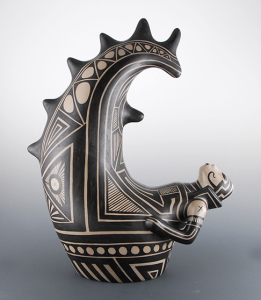
Virgil Ortiz is an internationally renowned ceramicist, fashion designer, and graphic artist from Cochiti Pueblo, New Mexico. He uses contemporary art to blend historic events with futuristic elements. Set against Ortiz’s graphic murals, this exhibition features 31 clay figures and invites visitors to immerse themselves in a storyline that Ortiz created that begins with the Pueblo Revolt of 1680. This is the first exhibition of his work to visually tell the whole story.

Curated by John Lukavic, associate curator of native arts, this exhibition is part of the Denver Art Museum’s initiative to expand the recognition of contemporary art by American Indian artists. Revolt 1680/2180: Virgil Ortiz is a special feature of Showing Off: Recent Modern and Contemporary Acquisitions.

An exhibition catalog is available in The Shops and online.

[from the artist's website]
Revolt 1680/2180:  Virgil Ortiz 
Set against Ortiz’s graphic murals, this exhibition features 31 clay figures and invites visitors to immerse themselves in a storyline that Ortiz created that begins with the Pueblo Revolt of 1680.
Woman and Bird (Femme et oiseau), 1968
© Successió Miró / Artists Rights Society (ARS), New York / ADAGP, Paris 2014.

While you're at the DAM visit the Joan Miró exhibit on the first floor. Outstanding. It closes June 28.


Aeronaut
The William Havu Gallery
1040 Cherokee Street, Denver Colorado
May 14 – June 20, 2015                                                                                                

[from the gallery website]
“Art is in my blood, ” says Virgil Ortiz, a Native of Cochiti Pueblo in New Mexico. Hailing from a family of renowned potters, Ortiz’s exquisite clay works are exhibited worldwide from the s’Hergotenbosh Museum in The Netherlands to Fondation Cartier in Paris. Ortiz uses contemporary art to blend historic events with science fiction. He is also known for his creation of apparel, jewelry and interior décor inspired and based on traditional Cochiti designs.

___________________________________________________________________________________


Later.