Friday, August 05, 2016

New Books - Events

Introducing a few new books for your late summer reading, including the latest from one of La Bloga's faves, Martin Límon, and bilingual science mysteries just in time for back-to-school. Also, in case you might want to catch me reading from my newest book, here's a list of upcoming events, celebrations, and literary happenings.  Hope to see you at one.
 

Manuel Ramos

New Books


Ping Pong Heart
Martin Límon
Soho - June

[from the publisher]
South Korea, 1974. US Army CID Sergeants George Sueño and Ernie Bascom are assigned an underwhelming case of petty theft: Major Frederick M. Schulz has accused Miss Jo Kyong-ja, an Itaewon bar girl, of stealing twenty-five thousand won from him — a sum equaling less than fifty US dollars. After two very divergent accounts of what happened, Miss Jo is attacked, and Schulz is found hacked to death only days later. Did tensions simply escalate to the point of murder?

Looking into other motives for Schulz’s death, George and Ernie discover that the major was investigating the 501st Military Intelligence Battalion: the Army’s counterintelligence arm, solely dedicated to tracking North Korean spies. The division is rife with suspects, but it’s dangerous to speak out against them in a period of Cold War finger-pointing. As George and Ernie go head-to-head with the battalion’s powerful, intimidating commander, Lance Blood, they learn that messing with the 501st can have very personal consequences.
 

 Martin Limón retired from military service after twenty years in the US Army, including ten years in Korea. He is the author of nine previous books in the Sergeant George Sueño series: Jade Lady Burning, Slicky Boys, Buddha’s Money, The Door to Bitterness, The Wandering Ghost, GI Bones, Mr. Kill, The Joy Brigade, and Nightmare Range. He lives in Seattle.


Gabrielle Lucille Fuentes
Touchstone - September

[from the publisher]
“A searing, beautifully written novel that captures the exhilaration and dangers of 1970s post-Franco Spain. Mosca, a bitterly jaded young woman, goes on a harrowing search for her missing brother—and the history that destroyed their lives. Violent, heartbreaking, unforgettable, The Sleeping World is a stunning debut” (Cristina García, author of Dreaming in Cuban).

Spain, 1977. Military rule is over. Bootleg punk music oozes out of illegal basement bars, uprisings spread across towns, fascists fight anarchists for political control, and students perform protest art in the city center, rioting against the old government, the undecided new order, against the universities, against themselves…

Mosca is an intelligent, disillusioned university student, whose younger brother is among the “disappeared,” taken by the police two years ago, now presumed dead. Spurred by the turmoil around them, Mosca and her friends commit an act that carries their rebellion too far and sends them spiraling out of their provincial hometown. But the further they go, the more Mosca believes her brother is alive and the more she is willing to do to find him.

The Sleeping World is a beautiful, daring novel about youth, freedom, and doing whatever it takes to keep a family together, in a nation whose dead walk the streets and whose wars never end.


One Minute Mysteries: More Short Mysteries You Solve With Science!Misterios de un minuto: ¡Más misterios cortos que resuelves con ciencias!
Eric Yoder and Natalie Yoder
Science, Naturally - August

[from the publisher]
Become a science sleuth with the bilingual edition of our award-winning book, One Minute Mysteries: Short Mysteries You Solve With Science! Each one-page mystery is featured in both English and Spanish.
 

Mysteries in earth, space, life, physical, chemical and general science are included. Now you can solve science brainteasers in two languages!

Conviértase en un genio de la ciencia con está edición bilingüe de nuestro premiado libro, Misterios de Un Minuto: ¡Más misterios cortos que resuelves con ciencia! Cada misterio de una página es disponible en inglés y español.

Incluidos están misterios sobre la tierra, el espacio, la vida, la física, la química y las ciencias naturales. ¡Ahora usted podrá resolver estos rompecabezas en dos idiomas!

These mysteries have a clever twist—you have to be a super sleuth, tapping into your science wisdom and critical thinking skills to solve them. Each story takes just one minute to read and challenges your knowledge in a variety of science disciplines. These brainteasers keep you engaged and eager to learn more. Written by the same father-daughter team that brought you the award-winning 65 Short Mysteries You Solve With Math!, this entertaining and educational book is great for kids, grown-ups, educators, and anyone who loves good mysteries, good science, or both!

Estos misterios contienen un giro impredecible, debes ser un súper detective, utilizando tus conocimientos científicos y pensamiento crítico para resolverlos. Cada historia se lee en solo un minuto y te desafía sobre una variedad de disciplinas científicas. Estos enigmas te mantendrán cautivado y ansioso de aprender más. Escritos por el mismo equipo de padre e hija que les presento el premiado libro de los ¡Misterios cortos que resuelves con matemática! Este entretenido y educativo libro es ideal para niños, adultos, educadores, o cualquier persona que disfrute de buenos misterios, buena ciencia, o ambos.


_______________________________________________________________________________


 My  Schedule of Upcoming Events
(more to be added)

August 14:  Reading, talking, signing books at the RUDOLFO "CORKY"GONZALES LIBRARY, 1498 N. Irving Street, Denver., 2:00 P.M. - 4:00 P.M.  I plan to read from my upcoming novel My Bad:  A Mile High Noir.
​
September 2:  TENNYSON STREET LIT CRAWL.  I'll be part of an entertaining group of writers at the Tea for Ewe, 4234 Tennyson Street, Denver, 7:00 P.M.
​
September 10:  COLORADO BOOK FESTIVAL, Central Library,  10 W. Fourteenth Ave. Pkwy, Denver, 11:00 A.M. - 4:00 P.M. I'll have a booth with books and I'm on a panel:  Mug Shots: Creating Memorable Sleuths , 1:15 P.M. - 1:55 P.M.,  with fellow mystery writers Rex Burns, Jennifer Kincheloe, and moderator Bruce Most.
​
September 24-25:  JAIPUR LITERATURE FESTIVAL, Main Library, 1001 Arapahoe Ave, Boulder, 9:00 A.M. - 7:00 P.M.  I'll be part of two presentations:  Of Murders and Mysteries:  Stories Behind Stories, with Margaret Coel and Laura Pritchett; and Race, Class and Gender with Michael Patrick MacDonald, Amrit Kaur Lohia, Andrew Lam and Marcia Douglas - times to be announced.
​
September 29:  UNIVERSITY OF COLORADO AT COLORADO SPRINGS. I spend the day on the beautiful UCCS campus talking with students, conducting a workshop, and making a presentation in the evening.
​
October 14-15:  ROCKY MOUNTAIN LITERARY FESTIVAL, Mount Vernon Country Club, Evergreen.  I'll be at this unique festival both days; my presentation is set for 11:30 A.M. on October 15.
​
November 3:  TATTERED COVER BOOK STORE, 2526 East Colfax Avenue, Denver, 7:00 P.M.  The celebratory launch for My Bad:  A Mile High Noir, my latest from Arte Público Press.  Hope you can make it.

Manuel Ramos is the author of several novels, short stories, poems, and non-fiction books and articles.  His collection of short stories, The Skull of Pancho Villa and Other Stories, was a finalist for the 2016 Colorado Book Award.  My Bad: A Mile High Noir is scheduled for publication by Arte Público Press in September, 2016.

Thursday, August 04, 2016

Chicanonautica: Original New Mexico Gangster

by Ernest Hogan


In these strange times when bookstores are becoming rare, I find a lot of reading material in antique stores. I was with my wife, cruising a section of Phoenix that is coming back to life, when I found something interesting not far from a faded Diego Rivera print. It was little pamplet: Vicente Silva: The Terror of Las Vegas by Carlos C. de Baca (research revealed that the “C” was for Cabaza – Cabeza de Baca? Cabeza de Vaca? Any relation?). The illustrations showed shootings and hanging in a dime novel style, and had captions in Spanish.

Sold!


Part of the Wild and Wooly West Books series from Filter Press of Palmer Lake, Colorado. 1978 was on the title page. The copyright was 1968. The illustrations were from de Baca's 1896 Spanish account. The last page dates “the present writing” at 1938.


This puts the story of Vicente Silva well before Hollywood, and the “bandito” stereotype. Maybe it's one of the sources.


Silva isn't romanticized. There's no Robin Hood shades to his image in the manner of Billy the Kid. He was a mean guy, who liked money and had a genius of organizing ways of getting it, and he didn't have anything against killing anybody who got in the way.


He organized a gang of desperadoes with colorful nicknames like El Romo (The Roman), El Lechusa (The Owl), El Moro (The Moor), El Mellado (The Dull One), El Candelas (The Icicles), Piedra Lumbre (Hot Rock), Patas de Mico (Pussyfoot), El Indio (The Indian), El Galivan (The Hawk), and El Menguado, (The Shrunken One).


They robbed and killed across Northern New Mexico, and were the reason for the creation of the Sociedad de Mutua Proteccion Unido (Society of Mutual Protection), a group along the lines of the Vigilantes of California.


It's hard to like Silva or his gang – de Baca uses the then-new term “gangster” to describe them -- so it's no surprise that American pop culture hasn't celebrated him. He was more a villain than hero, and was eventually killed by his own men.


And the criminal career of his gang went on afterwards. Prices were on their heads, and people collected – a Manuel C. de Baca, received $30,000.00 for his part in the investigations -- and the gangsters “walked the thirteen steps” and “have gone to face the Great Judge.”


Except for El Moro, AKA Martin Gonzalez y Blea, who ended up in the New Mexico State Hospital for the Insane at Las Vegas, New Mexico where, “At times he seems to live again the scenes of his horrible crimes, his awful wailing through the long night, sticking terror to the helpless inmate of the somber institution.”


The story would make good material for a western, echoing that crime does not pay.


But then I remember how my father would quote his grandfather, who was a genuine New Mexico cowboy, that who the good guys and bad guys were depended on who was in power.


Or maybe the election is getting to me.


Ernest Hogan is a law-abiding citizen who wrote High Aztech and Cortez on Jupiter.

Wednesday, August 03, 2016

Mamá the Alien/ Mamá la extraterrestre


Written by René Colato Laínez
Illustrated by Laura Lacámara

I am so happy that my new bilingual book Mamá the Alien/ Mamá la extraterrestre is available now. Last week, I received my author's copies. It is always great to see, feel and hug a book for the first time.

 The box is here!


Fantastic! My new book!


Mamá the Alien/ Mamá la extraterrestre 


When Mamá’s purse falls on the floor, Sofia gets a peek at Mamá’s old Resident Alien card and comes to the conclusion that Mamá might be an alien from outer space.

Sofía heads to the library to do some research. She finds out that aliens can be small, or tall. Some have four fingers on each hand, and some have big round eyes. Their skin can be gray or blue or green. But she and Mamá look like human people. Could Mamá really be an alien from another planet? 

Filled with imagination and humor, Mamá the Alien/Mamá la extraterrestre is a sweet and timely immigration story, and a tender celebration of family, no matter which country (or planet) you come from. 

Reviews

A delightful, original, clever, purposeful, multicultural alien tale.- Kirkus Reviews

… an exceptional story about immigration with a new twist. – Booklist


Book Trailers


Thank you, Fabiola and Ms. Hernández


René Colato Laínez has written more than a dozen award-winning books for young readers. A native of El Salvador, his goal is to write stories in which children of color are portrayed positively, with hopes and dreams for the future. This story was inspired by the many children of immigrants who have experienced the same misunderstanding as Sofía. When not writing or presenting at conferences or workshops, Colato Laínez teaches in a bilingual elementary school. He lives in Arleta, California, and you can find him online at renecolatolainez.com. 

Laura Lacámara is the creator of several award-winning children’s books; and she is a popular presenter at schools, festivals, and conferences. Born in Cuba, Lacámara was delighted to illustrate this story because it is clever as well as meaningful, especially since she was the same age as Sofía in the story when her own mamá became a United States citizen. Lacámara also had fun creating her own versions of aliens! She lives in Venice, California, with her husband and their daughter. Visit her online at lauralacamara.com. 


Tuesday, August 02, 2016

Review: Anaya's Sorrows. TTBF Update. Latino Family Book Fair in LA. New Mexico Arte at NHCC.

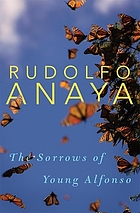
Review: Rudolfo Anaya. The Sorrows of Young Alfonso. Norman: UofOklahoma Press, 2016.
ISBN: 9780806152264 0806152265

Michael Sedano

There are stories within stories within stories in Rudolfo Anaya’s newest novel, The Sorrows of Young Alfonso. There’s the story of Alfonso the author, the title character. There’s the story of Agapita and the llano. There’s the story of the letter-writer in this epistolary novel. But more than any of those there’s the story of how one writer’s mind works, and because that writer is his generation’s most acclaimed author, The Sorrows of Young Alfonso takes its place as Rudolfo Anaya’s most rewarding work.

Here is a work that challenges casual reading. Complex, philosophical, engaging, The Sorrows of Young Alfonso will send readers back and forth through its pages, finding linkages, allusions, references, familiar ideas in new forms, new ideas in familiar forms. Above all, “sorrow” is synonymous with memory, some good, some painful. All of Alfonso’s sorrows—memories—are a way of reminding readers that memories make up our soul, that remembering is a way of recreating one's soul.

As with any novel, there’s the overlying story of the reader and the book. For readers, The Sorrows of Young Alfonso spills out in a stream-of-consciousness that requires attention, and perhaps, patience. The latter reflects the underlying story of the workings of a keen mind pulling together disparate memories of a literary life, revisiting ideas, memories, crafting a character’s soul while addressing the nature of memory and the writer’s own soul.

The story of Alfonso, the author, takes the form of an epistolary recounting. An unidentified voice addresses the similarly unidentified “K”. Whether K is an admirer, a relative, a scion, remains unspecified. Only that K is someone who deserves the letter-writer’s promise to relate Alfonso’s story. It’s a story told as if Alfonso is somehow absent from K’s world, perhaps dead, perhaps simply retired and out of touch.

The persona of the letter-writer offers a story in itself. Alfonso’s life-long companion who speaks authoritatively about Alfonso’s birth, whose memories contain Alfonso’s youth on the llano, high school, and university years. A voice who knows the sorrows of the title so intimately that the voice and Alfonso meld into the same person.

“K, my mother was like Alfonso’s mother, Catholic to the core. I identify with Alfonso; we had the same upbringing. As I write these letters, I become Alfonso. I am Alfonso.” 63

There remains a mystery around whether such intimate knowledge developed from experience or was gleaned in long hours sitting around in a bar or college dorm, good friends philosophizing their way out of dogma only to find themselves in a welter of challenging ideas.

At one point, the narrator identifies “Dennis” as Alfonso’s best friend. The writer raises Dennis’ name, then drops the person entirely from the narrative. Still, “Dennis, his best friend,” lingers in the reader’s mind; is the letter-writer this Dennis? Only four people would know what pleasures the college men enjoyed with the pizza shop girls, the women--whose names escape memory--and Alfonso and Dennis. Only Dennis would know that Alfonso’s greatest sorrow—losing his faith—would have developed during those late-night philosophical discussions. The letter writer, it turns out, is not Dennis. In the final letters, Anaya finally discloses the identity of the correspondent.

The story of Alfonso the author is very much the story of Anaya, the author. The narrator reveals how Alfonso wrote a book called Ultima, that it won El Premio Quinto Sol. The heart of Alfonso’s story is his second mother, the old woman of the llano, Agapita. Ultima and Agapita are two different people, though they share a thirst for nurturing boys in mind and spirit to ground them in the llano and the stories of their gente.

Agapita’s immense role gives this novel standing as Anaya’s literary autobiography. As when the letter-writer begins telling K about Agapita, it is as if time folds back upon itself so that Ultima and Agapita must exist simultaneously but distinctly:

“Who was Agapita? Was she just another name from those blessed names of long ago? Was she just another curandera? . . . . You know Ultima’s story. Fonso’s little book became quite well known. So I’m just trying to fill out the story, give it flesh as they say.” 61

Agapita and Ultima occupy the same mythic and literary space in the life of Anaya’s characters. Not as if Anaya feels driven to revisit his most successful character—or that the character insists on resurrection in this autobiography-like book. The Sorrows of Young Alfonso illustrate the workings of this writer’s mind, dealing with unfinished business, obligated to create, to write, at liberty to pass from idea to inspiration to focus and dissolution, and ultimately big ideas and profound thoughts.

Anaya unfolds the story in a spontaneous, spur-of-the-moment structure, alluding to incidents then divagating into some historical or cultural dissertation that seems to wander afar. Sometimes it does, but then the incident comes roaring into attention as the reader finally sees the connections that exist within the moments of memory.

Readers will find this on every page, informing every incident tiny or major. One of Alfonso’s seven sorrows, a crippling accident, comes as an aside on page 21, amid an allegory of a wheel of fortune, and the anti-randomness of el destino. “Martin, Alfonso’s father, believed that Fonso’s accident was the working of destiny.” Readers haven't learned of an accident yet, only now learning that one is coming.

Next a discussion of destiny and God’s will leads to a narrative concerning snakes, passing trains and the people inside them. There's Agapita’s magic, Ash Wednesday, La Llorona, a boy who breaks his neck diving into a water tank. These wrap into a connection between La Llorona, Medea, and video games.

The next letter talks about the boy who died in the watertank—water for the steam engines—then leads into a train-chasing game the boys play. The letter outlines how Alfonso’s hand gets caught on a speeding car and in the moment a hand and foot are mangled and the boy becomes a cripple.  Other memories intercede until twenty pages on, the story of the accident is fleshed out.

Agnes’ story is another sorrow that works itself slowly into being. This is likely Alfonso’s greatest sorrow, despite the narrator’s claim that his loss of faith was that. One’s first love holds a permanent space in memory, its absence an even bigger hole.

As the story of the injured boy’s recuperation develops, a fleeting mention of Agnes piques a reader’s curiosity. The familia has moved into a pueblo where Martin can find work and the boy improved schooling. The atomic bomb shakes schoolchildren's world. K’s correspondent says their names:

“June of the blue eyes. Agnes, who drowned. Mary Lou. Lydia, his cousin. Sadie he had kissed in the supply closet. Lloyd he always beat at marbles. Horse and Bones who were always so rough with him. Kiko, his fishing buddy. Bobby, Tony, Manuel, Chris, Abel, Red, Ernie, Ramon…” 80

The bomb, playground sports with a crippled hand and foot, then romance blossoms. Agnes reappears. She takes his crippled hand—no one but Agapita had touched it—and they walk to her home. Later they will swim in isolated places, lie naked in the warming sun. “Agnes was a creature of nature, as he was, a blessing.” The letter-writer adds, “Their days together make my story worthwhile.” Here is unparalleled joy, its loss unparalleled pain.

The narrative delivers an account of the river, of the pueblo Santa Rosa de Lima, how its name alludes to a miraculous curing of cripples, Alfonso sees the golden carp, Alfonso dives into shallow water and breaks his neck, watches himself drowning in an out-of-body experience.

The account fast-forwards to university days, ponders the formation of one’s soul, the power of curses and the presence of evil. Agapita cures Raphaelita from curse. The book’s most significant question builds from a bowl of menudo, and fond memories:

“Is soul memory? If soul is eternal, so is memory. . . . Are we merely repeating a life that has been lived before in other forms? In other places?” 107

Forty pages after first reading Agnes’ name, interrupted by the river, the soul, the fateful dive, Agnes is swept away by the river, her body found six days later, taken by La Llorona, the Coco Man, el Cucuy. “Now Agnes had become a spirit, a mermaid, a Persephone of the historic Pecos River that flowed past Santa Rosa de Lima.” Agnes has taken a big piece of Alfonso’s soul with her.

Moments likes these flow like a river out of disjointed time and the letter-writer's memory. The swift current floats huge questions, sustaining dramatic conclusions that will challenge and tempt attentive readers to discuss with friends, to thirst for more information. 

The Sorrows of Young Alfonso offers a richness that Anaya has not crafted before, not like this. The Old Man’s Love Story and Randy Lopez Go Home, masterpieces in their own right, make a deeply satisfying trilogy with Young Alfonso. Readers should complete all three as a set.

A story told in a book is finished only because a book has a first page and a last page. Alfonso's story, however, is continuous, it existed before page one, and continues after the final. Reading the trilogy is a way of linking the story emotionally and an avenue to greater understanding of this capstone work of Anaya’s art.

The Sorrows of Young Alfonso is a book that isn’t finished, still in the process of unfolding and spilling off the author’s hands. But a publisher is an unyielding power, pages have to fit between covers to reach booksellers and eventually, a reader’s hands. This is what we have for now, a capstone work, until Rudolfo A. Anaya’s duende and ever-renewing soul leads his pen to gift us with the continuation of young, and old, Alfonso’s sorrows. By the way, Rudolfo Anaya’s middle name is Alfonso.


Texas Teen Book Fest: Letters of Appreciation.

In recent weeks, La Bloga has spotlighted what appeared a travesty in Texas. A book festival that appeared deliberately to exclude raza writers and Young Adult books from a literary festival for teenagers.

In a delighting change of policy, the organizers of the Texas Teen Book Festival reversed course, invited the founder of Barrio Writers to a parley and meeting of minds. As a result, several authors have been invited to the festival, and TTBF scheduled a workshop for young writers, to be organized by Sarah Rafael Garcia, founder of Barrio Writers.

The Texas Teen Book Fest deserves recognition for opening its doors and reaffirming principles of openness, diversity, and inclusion. Several letter-writers do just that.

Sarah Rafael García
In a time when our society is divided by racial politics and a complex presidential race, it’s important to find a way to exchange dialogue, critical-thinking and build common ground for our youth and community. It’s also important to know the difference between establishing equity versus portraying diversity. I’m grateful to have such a conversation with the Texas Teen Book Festival (TTBF) organizers. Although the TTBF is a small event in comparison to the national headlines, I feel the dialogue we established will help build common ground in Austin, Texas. There is still a lot of work to be done and I’m excited Barrio Writers will be a part of it. Now some of the responsibility also lies on me, I hope to engage more folks, especially people of color, to join us, attend the TTBF, and promote more diverse books. With all of this in mind, the TTBF has the opportunity to influence young minds to think critically and beyond their own race and culture—with the addition of Mexican American authors to this year’s TTBF line up more young readers can open a book, find themselves in it and see their role models on and off the page.

—Sarah Rafael García
First Generation Graduate, Author, and Barrio Writers Founder
Santa Ana, California


Manny Galaviz
Dear Texas Teen Book Festival Organizing Committee,
I want to commend you on the new partnerships with Tomás Rivera Mexican American Children’s Book Award, Barrio Writers, and Red Salmon Arts for the Texas Teen Book Festival. As a first generation Mexican American graduate student at the University of Texas at Austin, I am pleased to see authors such as Guadalupe Garcia McCall, Joe Jiménez, Rene S. Perez II, and Isabel Quintero on the 2016 line-up. I am also pleased and excited to see that Barrio Writers will provide a writing workshop. Thank you for providing space for Mexican American authors, community organizations, and for demonstrating that indeed the Texas Teen Book Festival supports diversity.

Best,
Manny Galaviz
--
Manuel Guadalupe Galaviz
Graduate Student
Department of Anthropology
University of Texas at Austin
https://liberalarts.utexas.edu/anthropology/graduate/profile.php?id=mgg978


liz gonzález
In 1971, I was ten years old, and Island of the Blue Dolphins was my favorite book. It was the only book I knew of with a protagonist who was a little brown girl, like me. Although I read other good novels as I was growing up, I often returned to Island because visiting Karana was like coming home. Until my adulthood, it remained the only book I could find with a character that reflected me.

Fortunately, today, young people of color have many books to choose from with protagonists that reflect them--and by authors of color! Now, because of the additions to the Texas Teen Book Festival 2016, teens of color can learn about these books and see some of the authors speak. This, and the opportunity to participate in the Barrio Writers workshop, will be a valuable experience for them. For some, it will be life changing.

These additions will benefit everyone attending the festival, for we learn about people who are different from us through books.

Thank you for having your festival reflect the population in the great state of Texas. Your festival will be more inclusive and magnificent!

Thank you!

liz gonzález
Writer and Educator


Cristian Dominguez
I am so thankful that there is more diversity. More Latinos means more fun. People just need more diversity, and when they bring it together, it makes a fun loving place. Also, I forgot to mention that I am proud that Barrio Writers is partnered with Texas Teen Book Festival. It brightens my day because I am a Barrio Writer. Thank you so much!

—Cristian Dominguez, 13 year-old Barrio Writer in Austin, Tejas


Latino Family Book Fair Coming to Los Angeles


The festival site is adjacent to La Placita and Olvera Street, one of the founding commercial centros of historic Los Angeles. Only a short walk from Union Station, public transportation makes sense for families attending the festival and discussions.

Vendor applications are open and available at this link.


The National Hispanic Cultural Center has begun a renewal process with new staff leadership and a host of attractive programs. Visit NHCC's website for details of the August 7 reception for its new exhibition "The Art of Acquisition: New New Mexican Works at the NHCC", as well as tours of the Art Museum's collections.

Monday, August 01, 2016

Some Other Time Then

A poem by Vincent Cooper

Even though they died young
My haunting tíos died right on time
Filled with a bitterness of being free and
Heatwaves of depression on the westside.

Tío Jody was an angry man
But all senselessness of the modern era and legal murder
Would’ve taken its toll on him too. I could see the tíos making peace with
Ex-wives who tried to kill them in all the little other ways.

At a park in a barrio nearby, a man argues with his wife
While his daughter watches. She is a brown child
In her Sunday best, that doesn’t understand the hatred and coldness
Of her father pulling out a hidden gun from his waistband. She
Only knew the feeling of bullet to skull.

God saw it all.
God made sure that man was caught
And jailed…
God’s justice is not fulfilling.

Murdering children is the last stop for humanity.
Only a demon would shoot a child in the face.
At work, the news on TV is showing photographs of a tiny Syrian boy washed ashore; dead.
Everyone scrolls quickly through their cellphone social media timelines
So their meals or mood wouldn’t be ruined.

I stare and cry over the boy washed up,
And for the black men,
And brown men,
And black women, and brown women,

And Indigenous people that find themselves
Staring delicately into the barrel of a white terrorist’s assault rifle
Or a white policeman’s gun,
Our hearts racing and racing…

Then a plea:
Don’t shoot me God (or Devil)
I want to go home to my family/ partner/ friends.
They truly got their peace in death

Tío Mike died three times:
Once at mother’s house on Gerald street, across from Harlandale High School.
Second – at a hospital at Medical Center
Third – in a ghetto apartment on the access road of the 410 freeway.

It was a still winter
And mother’s car no longer worked.
Tío Mike & son slowly pulled up
In a used red Ford truck, he’d parked in front of the house like a hearse.

Wearing dark black shades against
Uncombed silver hair, a hint of stubble, he
Was wincing when he walked.
The rubber of his black cane punches the cement as he strode towards us.

Tío Mike wore a black T-shirt with a pack of cigarettes in the pocket,
Plain grey shorts, an expensive black fedora, and cheap black tennis shoes
Once a stout man, with an infectious smile in Navy dress but
Now is layered in Goodwill dapper.

Mikey, his son, spoiled and tatted up
Spent the morning yapping commentary
In circles around us
Like a lap dog

I mention the Dallas Cowboys, Tío Mike shakes his head in disapproval.
His eyes carry the weight of our Chicano struggle.
We pause, he wants to say something foul to me, instead
He checks mother’s car engine.

“The car still won’t turn on. Maybe call pick n’ pull to get a few bucks out of it.” He says.
She nods, walking away.
Mikey runs to his side and Tío Mike waves a frail hand in my direction.
They drive away.

The next time I saw Tío Mike
He said goodbye at a hospital, but then died in some apartment he tried calling home.
Diabetes.
Because he didn’t want to ask his familia for the right food, or money, or to care for him.

Later that year, I found an old phone,
Charged it and listened to saved voice-mails of his voice.
“Hey Vinny, It’s your Uncle Mike. Try to keep next week open on your calendar. There’s a new sushi place we should try out. Call me. “

I had called
Asking for the dinner to be just us
(without Mikey)
I could hear Tío’s heartbreak on the line.

“Some other time” he said in a splintered voice.
There was no other time.
Then Mikey, unwelcomed,
Stuck around Danny and Eddie’s house on Guadalupe St.

Still mourning their carnal
He was briefly a go-for
And much to the chagrin of the familia
Little by little the boy from suburbia was pushed out.

In time
Danny died and Eddie went to jail
Mikey – no longer protected begins to steal - small things.
He is sent to jail and continues where the tíos left off.

Like the boy washed ashore, Mikey is dead too.
Sitting in a cell, or floating in society, he spends his time
Talking like a cholo
to his father’s ghost.

Tío Mike loved his boy until the end of the ocean.
A Syrian dad, pointing at his boy, cries hard into the camera for American media.
Meanwhile, in the barrio of my time, a ghost child and her mother clasp each other forever
Somewhere in the darkness.

Vincent Cooper

Vincent Cooper is a Macondista living in the westside of San Antonio, TX. His chapbook Where the Reckless Ones Come to Die was published by Aztlan Libre Press in 2014. His poetry has been published in several zines and journals in south Texas. Cooper is currently working on his first full length book of poetry titled Zaramora.