Wednesday, February 17, 2021

Lupe Wong Won't Dance


By Donna Barba Higuera


Publisher : Levine Querido

Language : English

Hardcover : 272 pages

ISBN-10 : 1646140036

ISBN-13 : 978-1646140039


My gym shorts burrow into my butt crack like a frightened groundhog.

Don't you want to read a book that starts like that??

Lupe Wong is going to be the first female pitcher in the Major Leagues.

She's also championed causes her whole young life. Some worthy…like expanding the options for race on school tests beyond just a few bubbles. And some not so much…like complaining to the BBC about the length between Doctor Who seasons.

Lupe needs an A in all her classes in order to meet her favorite pitcher, Fu Li Hernandez, who's Chinacan/Mexinese just like her. So when the horror that is square dancing rears its head in gym? Obviously she's not gonna let that slide.

Not since Millicent Min, Girl Genius has a debut novel introduced a character so memorably, with such humor and emotional insight. Even square dancing fans will agree…


Review


"Higuera's debut is a home run, with a plot as multifaceted and compelling as her characters, whose nuanced voices and varied range of interests ring wholly true." -Publisher Weekly, starred review

"Higuera's debut is a home run, with a plot as multifaceted and compelling as her characters, whose nuanced voices and varied range of interests ring wholly true." -Publisher Weekly, starred review


"A humorous, fresh #OwnVoices title sure to appeal to social justice advocates and reluctant square dancers everywhere."     -School Library Journal


Donna Barba Higuera grew up dodging dust devils in the oilfields of Central California. She has spent her entire life blending folklore with her experiences into stories that fill her imagination. Now she weaves them to write picture books and novels.

Donna eventually traded the dust of Central California for the mists of the Pacific Northwest. She lives there with her husband, four children, three dogs and three two frogs. She is currently working on her debut picture book and next middle grade novel.


For info on all her books and educational guides visit www.dbhiguera.com


Tuesday, February 16, 2021

Guest Columnist: Running Out Of Time, Caregiver, Mi'Ja

Editor's Note: La Bloga welcomes guest columnists. Today's guest writer, San Diego artist Nicki De Necochea, continues La Bloga's explorations (link) of Memory, loss, and health. De Necochea writes out of personal experience. Families similarly stricken recognize the universality of such experiences. La Bloga welcomes questions, observations, personal stories. Use the "Post A Comment" link below.

We’re running out of time together.  

Nicki De Necochea 


We’re running out of time together.  

92 birthdays in and she has no idea that we’re running out of time.  My mother, perhaps the fortunate one, has no idea of loss, nor of her full scope of living, which her brain once processed for her, as naturally as breathing.  Her brain can no longer be relied upon.   

This exacting mechanism that allowed her instantaneous recall as easily as if pulling a book out of a bookcase has a corrupted hard drive, like a cranial computer in a state of crashing.  There are so many little things (and bigger more important things) she no longer grasps, sorts through, makes sense of.   The heartbreaking loss of everyday brain functions that we all take for granted, is not fathomable nor worrisome to her.   No cognition means no ability to grasp loss. 

This brain thief, Alzheimer’s, persistently invading her ability to be whole, wreaks losses that rob the whole family.  Each year, my mother and I face with lament how this disease leaves her with fewer physical and mental skills. Skills like talking on the telephone, picking a good apple in the produce section, handwriting as basic as signing her name, reading or even watching a television program with full awareness, now vanished. She doesn’t lament their loss. She no longer recalls these as part of everyday living skills.  

My mother’s brain power once gave her ability to remember countless phone numbers.  As recent as six years ago, she could walk up to an ATM and punch in her pin number. She could remember her social security number.   The family are the ones left to catalogue what she can no longer remember or do.   She has an unwelcome freedom from looking for things she has misplaced, of fretting over what she cannot recall. 

We’re running out of time together, and losing her completely is so very near.  The signs are physical too.  Her lovely strong, and some years ago robust frame is thinning. Absent muscle mass has gone for good.  

Most dear is her current solid awareness of love, and her ability to feel gratitude and connection.  The “I love you mija.”  “Thank you mija." "You’re a good girl, mija.” She still expresses her ability to love. Her brain still gives her permission to feel, to say. These will one day be buried, or too tangled with no outlet in those disintegrating brain synapses.   

My coping skills as her daughter (labeled caregiver by a society that has trouble grasping the strength of our cultura and the genetic obligation of our love), take form as resolute patience, loving appreciation for who she is, and foremost, Gratitude, from Spanish, apreciar. I am my mother’s daughter, and I am grateful for all this means. 

Being loving is still her forte.  She reaches out to me, to be a mother by finding my arm and caresses it as if trying to warm and comfort, or perhaps healing like a naturalist healer, a sobadora. Gratitude abounds when I focus on the things she still has, and still is.  The hugs, and affectionate kisses when I grab on for a gentle rock, a hug, or a dance in place. Her love of ice cream, and candy, and ability to delight in them, with a gracious thank you to boot--always offering me a bite of what she is eating, generous to a fault.   Grateful for her enjoyment of music, showing her delight by tapping her hand on her leg in time with the beats.  

My mother doesn’t remember my name, but knows who I am. I am her mi’ja.

I remind myself, we are running out of time together, and acknowledge that now is now.   I find the patience to just let her do, as long as she wants, because doing something is what’s left to her of her “mother” skills, not yet gone.

I lament all the subtle changes in her in the last six years; all forfeitures, the gains are almost nonexistent.  Capacities fall away, dependencies inch in and take over more of my time leaving her with even less.   The odd behaviors that seemed frustrating when they started are now missed when she can no longer do them.   The annoyances, like her need to pack and empty her dresser drawers almost daily became something I finally acknowledged as an activity that kept her focused on a task, and I let go of thinking of it as a negative I’d just let her do it, because she could.   She no longer does that, and I miss her mischief.   

Still verbal, somedays she makes some incredible, wise astounding statements.   She has given me surprising advice, and insights as if some extraordinary force possessed her for a few minutes to give her moments of lucid wisdom.   Other times less so, like she’s channeling and speaking for someone else and the messages are in code 

So, as my viejita turns 92 the Annie Lennox song is in my head rings true more often, these days, “No More I Love Yous.”  It’s the soundtrack of my dread and fear of the day when there are none of those left for her to share, because we’ve run out of time.   

There’s still a place for lots of joy, laughter and gratitude in our lives. She is so very sweet, and affectionate.   She says I love you and thank you often, such simple human courtesy that many don’t say often enough. I can still make her laugh, and help her feel joy with music or affection and silly talk.   

My favorite thing she still does when hugging me is when she says, “you’re beautiful mija”.  My mother not only is communicating, expressing her love, but she knows at moment who I am to her.  Gratitude; I take nothing for granted.  


B. Nicki De Necochea is a So Cal artist, residing in San Diego who embraces her art and writing as a form of creative self-expression.   She is a painter in oils, acrylic and mixed media.   Her writing addresses personal themes and experiences as another vehicle for using art for growth, human awareness, and for her own self-discovery.

Monday, February 15, 2021

Book Review: Piercing Insensibility with Poetry by Gabriel Hugo


Book Review: Piercing Insensibility with Poetry by Gabriel Hugo


Corta la piel / It Pierces the Skin

by Xánath Caraza

FlowerSong Press, 2020

Translated by Sandra Kingery


Reading Xanath Caraza’s newest collection of poetry Corta la piel/It Pierces the Skin is an experience in something that is quickly becoming unusual in this fast world of disposable memes and social media video clips. It Pierces the Skin pierces the senses as Violeta, the protagonist of this almost novelistic narrative, describes images of death from the victim’s point of view just as easily and vividly as she does images of love and desire. The smell death should have is not something we think of very often. The closest most of us in the U.S. have been to awakening in a field of dead human bodies is through images of Mel Gibson’s “Apocalypto,” a fictionalized account of brown people’s history in the Americas which fails to capture the full sense of death and dying because it never mentions the stench. Caraza is brilliant in bringing images of this and other scenes of blood, with and without the horror that can accompany them. In one poem, the blood can be the result of a violent assault by armed guerrillas upon innocent villagers in Central America, and in another, a paper cut upon the poet’s finger.


The work on which Caraza has embarked in this collection serves not only as a window into historical moments in the Americas and the world, but also as an instructional manual on how to write poetically. Poetry, the very word which inspires typical laypersons to roll our eyes into our skulls as we reach our hands at break-neck speed for a smart phone, a laptop, anything that could sooth our need for diversion if only for that very superficial moment, lest we be subjected to a heavy dousing of poetic and philosophical gasoline on the brain, which could lead to some kind of revelation or truth enveloping us as we blindly and deafly pass through this Earth.


Nonetheless, this aversion to the broad realm of poetry is not the fault of the poet or the layperson, but of society itself. Our teachers need to teach more from poetry books, as they teach from math books. Parents need to inculcate their children with the sensibilities of poets, for besides clergy, who among us is purest or more honest?  Poets advocate for the victims of oppression. Figures like Caraza depict for us the contradictions in our collective history, as in “The Sword,” a poem about Christopher Columbus and the violence he and the church unleashed through evangelism. We need to see this content dramatized for us in words in poetic stanzas, because no other vehicle manages to convey those images as powerfully as does the poet through the written word.


Among bilingual Spanish/English speakers as myself, a common utterance is that Spanish presents a better experience when reading poetry, because it just sounds much more romantic, profound, and dramatic when it needs to be. For the most part, in my experience, this has been the case. Yet, this general rule does not always hold true. Such was the case when I read “Falsa Alarma/False Alarm”, and the book’s namesake “Corta la Piel/It Pierces the Skin,” two of my favorite poems in this book. The entire collection was translated by Sandra Kingery and students at Lycoming College in Williamsport, PA. The translations themselves seemed to me not as the same poems merely interpreted in another language (translated from Spanish to English), but more like a continuation of the thought process, the inspiration stretched along, spread wider to encompass territory that constitutes a separate world with separate ideas, but clearly with similar sensibilities. At times throughout the pages, I felt that the English translation surpassed the original not in skill or depth, but in magnitude and urgency.


Caraza’s poetry is emotive, powerful, and transcendental in its tone and content. Corta la piel/It Pierces the Skin is a collection worthy of collecting and passing along to the next generation. It not only shows the pictures of our current and past world history interlaced with matters of the heart and urges of the human body, but also teaches an art form that seems to be on the brink of being forgotten. Thanks to Xanath Caraza, forgetting the power of poetry we will not.

Friday, February 12, 2021

Sampling Graphic Novels

 In no particular order, here are a few examples of a genre often overlooked in the literary conversation.  


A.W.O.L.
Elvira Carrizal-Dukes,
Ronnie Dukes
(Illustrator)

Duke Comics


[from the publisher]
Life on the Frontera has never been easy. It’s getting harder. How can you make the “right” decision when that’s not an option? We all have knuckleheads in our families and this makes life that much more complicated. Cruz has two days to ship out and possibly less to save her brother. The question is, where does her allegiance lie? It’s easy to think of life as black and white, good and bad, justice and criminal. But what about family versus country? Cruz has a hard choice to make with little time to do it. A.W.O.L. is an over 100 page, full color, action/ adventure.

[from UTEP]
Dr. Carrizal-Dukes is an Assistant Professor of Practice and Undergraduate Academic Adviser for Chicana/o Studies at The University of Texas at El Paso. She earned a Doctor of Philosophy degree in Rhetoric and Composition from UTEP, a Master of Fine Arts degree in Film from Columbia University in the City of New York, and a Bachelor of Arts degree from the University of Minnesota Twin Cities in Journalism and Chicano Studies and a minor in Theatre Arts. Her work centers on the lives of women and racially and economically disadvantaged people. She is a filmmaker and the writer, director, and producer of Mariposa (2006) and The Weeping Pimp (2015) and the author of the play Father’s Shadow / Sombra del Padre (Dramatic Publishing, 2001.) A.W.O.L. was exhibited at Tokyo Comic Con in 2018 and is available in English, Japanese, and Spanish.

__________________________


Killing the Cobra
Mario Acevedo
Alberto Dose
, Artist
IDW


[from the publisher]

Spinning out of the bestselling novel, The Nymphos of Rocky Flats, author Mario Acevedo brings his Iraq war veteran and vampire detective, Felix Gomez, to comics in this all-new tale of murderous mayhem involving the ruthless heroin merchants, the Han Cobras. But vampiric powers may not be enough to protect Felix or his lover from the vicious gangsters.


_______________________

Gabby Rivera
Dial Books

[from the publisher]
Juliet Milagros Palante is a self-proclaimed closeted Puerto Rican baby dyke from the Bronx. Only, she’s not so closeted anymore. Not after coming out to her family the night before flying to Portland, Oregon, to intern with her favorite feminist writer–what’s sure to be a life-changing experience. And when Juliet’s coming out crashes and burns, she’s not sure her mom will ever speak to her again.

But Juliet has a plan–sort of. Her internship with legendary author Harlowe Brisbane, the ultimate authority on feminism, women’s bodies, and other gay-sounding stuff, is sure to help her figure out this whole “Puerto Rican lesbian” thing. Except Harlowe’s white. And not from the Bronx. And she definitely doesn’t have all the answers . . .

In a summer bursting with queer brown dance parties, a sexy fling with a motorcycling librarian, and intense explorations of race and identity, Juliet learns what it means to come out–to the world, to her family, to herself.

Gabby Rivera is a Bronx-born queer Puerto Rican babe on a mission to create the wildest, most fun stories ever. She’s the first Latina to write for Marvel comics, penning the solo series AMERICA about America Chavez, a portal-punching queer Latina powerhouse. In 2017, Gabby was named one of the top comic creators by the SyFy network, and one of NBC’s #Pride30 Innovators. Gabby now makes magic on both coasts, currently residing in California. She writes for all the sweet baby queers and her mom, and hosts Joy Revolution, the podcast that brings together her favorite revolutionary humans to honor joy in a chaotic world.

___________________________


Suncatcher
Jose Pimenta
Random House Graphic

[from the publisher]
Filled with music, passion, supernatural secrets, and family, Jose Pimienta’s Suncatcher brings to life a contemporary story of a girl growng up in Mexicali, with a supernatural twist and a lot of music.

Beatriz loves music.

More than her school — more than her friends — and definitely more than her homework. After Beatriz discovers that her grandfather’s soul is trapped in his guitar, she becomes determined to get him out. But the only way to free him is to play the perfect song — his perfect song, a song that he never actually wrote down.

Fixated on freeing her grandfather, music slowly consumes Beatriz’s life. Soon she finds her self growing obsessed with perfection at the expense of her friendships, her band, and her health.

Beatriz won’t let anything stop her. Even if it means losing everything else.


_______________________________


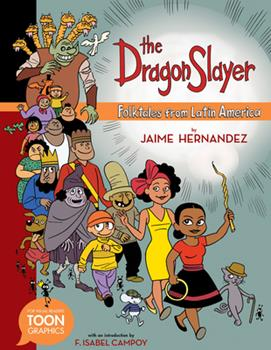
Jaime Hernandez
TOON Graphics

[from the publisher]
A fresh take on timeless tales! How would a kitchen maid fare against a seven-headed dragon? What happens when a woman marries a mouse? And what can a young man learn from a thousand leaf cutter ants? Famed Love and Rockets creator Jaime Hernandez asks these questions and more as he transforms beloved myths into bold, stunning, and utterly contemporary comics. Guided by the classic works of F. Isabel Campoy and Alma Flor Ada, Hernandez’s first book for young readers brings the sights and stories of Latin America to a new generation of graphic novel fans around the world.


Jaime Hernandez is the co-creator, along with his brothers Gilbert and Mario, of the comic book series Love and Rockets. Since publishing the first issue of Love and Rockets in 1981, Jaime has won an Eisner Award, 12 Harvey Awards, and the Los Angeles Times Book Prize. The New York Times Book Review calls him "one of the most talented artists our polyglot culture has ever produced." Jaime decided to create The Dragon Slayer, his first book for young readers, because "I thought it would be a nice change of pace from my usual grown-up comics." He read through tons of folktales to choose these three. What made them stand out? Maybe he saw himself in their characters. Jaime says, "I'm not as brave as the dragon slayer, but I can be as caring. I'm as lazy as Tup without being as resourceful. I am not as vain as Martina, but I can be as foolish."

Later.

___________________________

Manuel Ramos writes crime fiction. His latest novel, Angels in the Wind, will be published by Arte Público Press April 30.

Thursday, February 11, 2021

Chicanonautica: La Pocha Nostra Anthologized

by Ernest Hogan


Not even COVID-19 can keep La Cultura del Continuum Latinoid down. Didn’t have anything planned for the next Chicanonautica, but I didn’t worry. These are active times. Things are happening. Something will come. And it did.


I was fooling around, scanning through Facebook when I came across and announcement for San Francisco Living Archives’ La Pocha Nostra: An Experimental Anthology. It was a film, the sort of thing I would like to see being a fan of Guillermo Gómez-Peña (he does in performance art what I do in science fiction—we should probably collaborate someday . . .), his wife Balitronica, and the whole Pocha Nostra troupe in all its manifestations. I was going to file it under be on the lookout for, but noticed that the premiere was going to be special a weekend event online.


And there was a trailer:


I dropped everything and watched it.


¡Guao!


More than thirty years of video, cleverly assembled, makes for one helluva movie. It’s as much avantgarde sci-fi as art retrospective documentary. Science fictional conceptualization and characterization mix with out there aesthetics, bleeding into snippets from various pop cultures, creating new worlds—which is what we need with the world in the sorry shape that it is.


It’s the sort of thing I’d show in the drive-in theater/all-nite cable movie marathons I host in my dreams, snuck in between ancient monster movies, bizarre cult classics, and other cinematic outrages, demonstrating that performance art has become what science fiction convention hallway culture showed a promise for, before cosplay became devoted to worshiping corporate franchises.


We need more non-corporate culture.


I’m pretty sure this film will be popping in venues of various kinds, some the likes of which we have never seen before, soon.


Gómez-Peña, being a creature driven by social and audience interactions, was frustrated in the early days of the quarantine, but he’s bounced back, heroically adapting to the new virtual, cultural environment. He, Balitronica, and La Pocha have been doing so much, I can’t keep up with it, which is a good thing. 


When it comes to La Cultura, you can’t have too much.


Ernest Hogan, the author of High Aztech, Cortez on Jupiter, and Smoking Mirror Blues is surviving through these troubled times, working a novel, other writings, and other art forms.

Wednesday, February 10, 2021

The Total Eclipse of Nestor Lopez


By Adrianna Cuevas


Publisher : Farrar, Straus and Giroux
Language : English
Hardcover : 288 pages
ISBN-10 : 0374313601
ISBN-13 : 978-0374313609

2021 Pura Belpré Honor Book
NYPL Best Book of 2020
2020 Evanston Public Library Great Books for Kids

In this magical middle-grade debut novel from Adrianna Cuevas, The Total Eclipse of Nestor Lopez, a Cuban American boy must use his secret ability to communicate with animals to save the inhabitants of his town when they are threatened by a tule vieja, a witch that transforms into animals.

All Nestor Lopez wants is to live in one place for more than a few months and have dinner with his dad.

When he and his mother move to a new town to live with his grandmother after his dad’s latest deployment, Nestor plans to lay low. He definitely doesn’t want to anyone find out his deepest secret: that he can talk to animals.

But when the animals in his new town start disappearing, Nestor's grandmother becomes the prime suspect after she is spotted in the woods where they were last seen. As Nestor investigates the source of the disappearances, he learns that they are being seized by a tule vieja―a witch who can absorb an animal’s powers by biting it during a solar eclipse. And the next eclipse is just around the corner…

Now it’s up to Nestor’s extraordinary ability and his new friends to catch the tule vieja―and save a place he might just call home.


Review


"A charming and vibrant debut fantasy." ― Kirkus Reviews

"Readers will devour this fast-paced adventure as they root for Nestor and his ragtag bunch of friends and animal allies . . . In a unique take on South and Central American folklore, Cuevas brings to life an earthly type of twisted magic that transcends spells and transfiguration, extending into the feelings of belonging and finding a true home." ― Booklist

"With this heartwarming debut, Cuevas draws upon Central American legends and her Cuban heritage to flesh out Nestor’s experiences . . . crafting a tense, satisfying tale of magic, family, and finding one’s true home." ― Publisher's Weekly

"Cuevas crafts a riveting story based on folktales from Panama and Costa Rica." ― School Library Journal

Tuesday, February 09, 2021

Two Days of the Hummingbird: Respite and Brief Exhale

Allen's Hummingbird • A Young Female

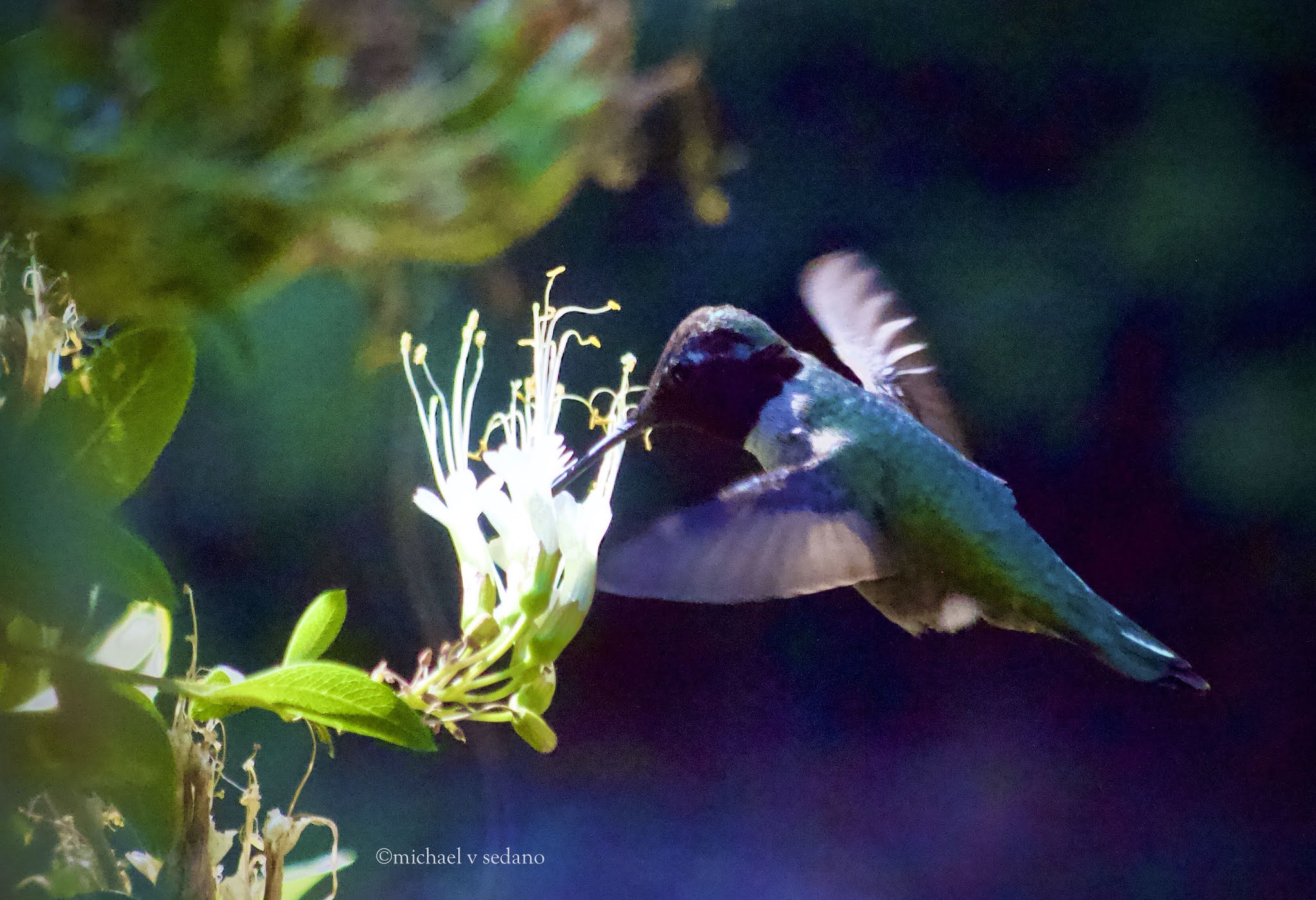
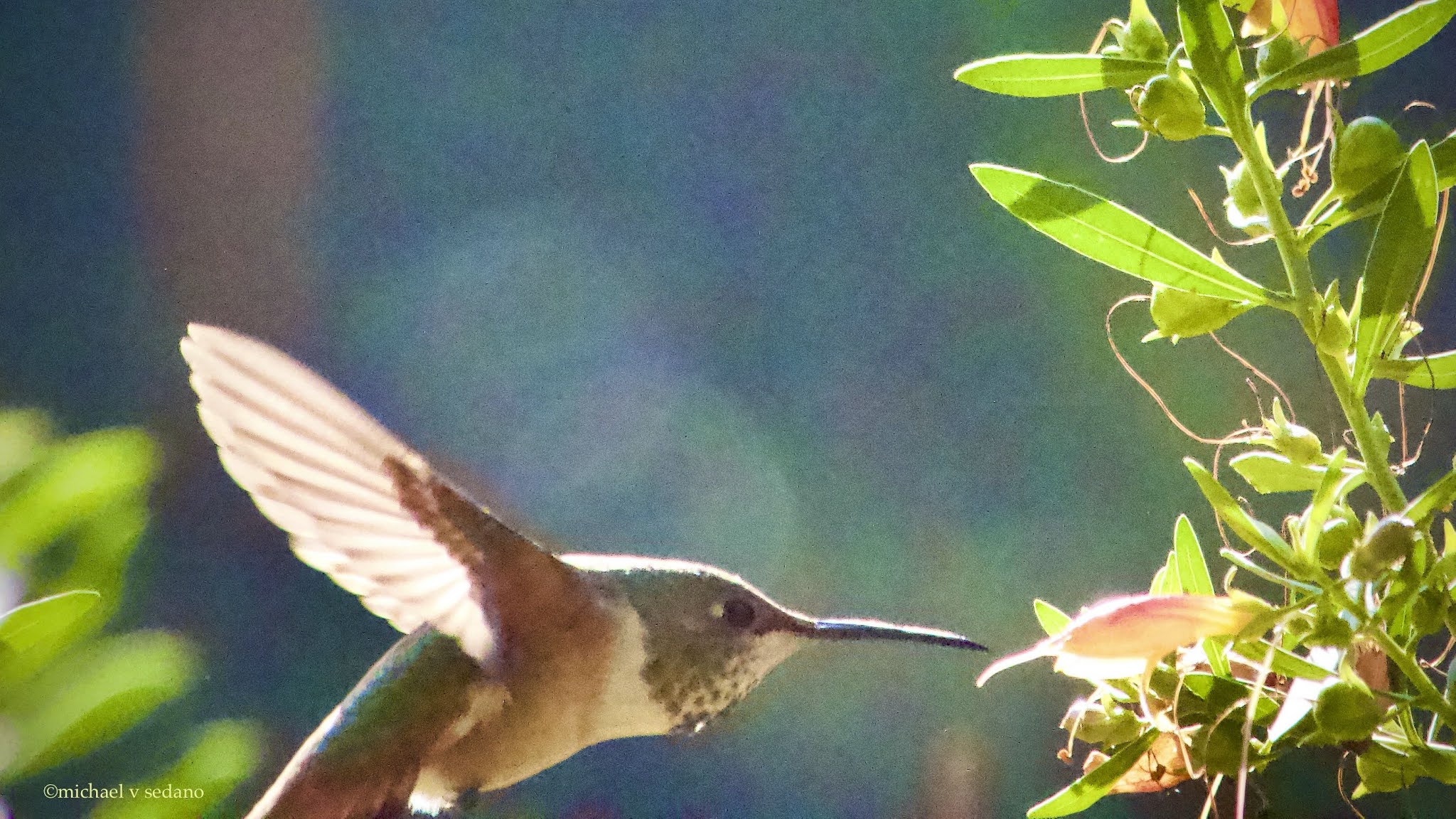
Spring has arrived at The Huntington Library where this young female will be forever young and vital like this moment. She hovers, beautiful, powerful, in control of her universe. No unravished bride of quietness, she. This Allen's Hummingbird has a future of floral abundance, surrounded with nectars to feed the young female's fecundity. 
•
I’ve been home from the Army only a week when Barbara has to go back to work. First day, year two, teaching high school English. This morning, she wears a light sweater over a colorful sundress. Her brown hair sits on her shoulders where she slings her purse strap, using both hands to cradle a canvas bookbag like she’ll cradle her daughter four years from now, hair greying. But right now, she’s leaving me to my own devices, no particular place to go in this brave new world.

Barbara stops at the door, turns, smiles at me. I lift my camera and take her picture. Barbara wheels about, steps out into the light and her own world.

Today, that Barbara smiles out at me from the photograph I'm holding. We make eye contact. "Hi, Barbara. It turned out good."

This young woman still lives, out there, inside the image and beyond the photo, a moment suspended in time held in my hand. She’s out there, barely out of reach on the other side of this picture. That's why I carry the foto. My Barbara's not here any more, Barbara has moved out of the light and into her own world. She's on her own.

Alzheimer’s dementia empties the person out of an individual. Barbara’s almost absent now. We have music—she knows the words to the Oldies. She has her sense of humor—she thinks Maybelline can’t help herself. The essential soul remains, a good person.

She doesn't walk well, limited by other ailments taking their toll, she often pushes a walker. She's fearful in the car, this woman who bought herself a T-Bird convertible when she retired. Like her, it doesn't run any more. "And she'll have fun, fun, fun, until they take the T-bird away."

Barbara’s spending a week living with her daughter. I’m on my own. Our daughter needs to spend this time with her mother. Barbara needs to catch up with her daughter. The Barbara in the foto would be immensely proud of what her kid is accomplishing. And our granddaughter, what an accomplished person already! A lot of joy and love is happening there. Barbara needs that while she still understands, maybe one last time.

Free time comes as a novelty to a care-giver, and a luxury not without a modicum of guilt over leaving my responsibility to someone else, I don't want to leave her alone, alone. Barbara lives in the moment, and right now, being with her daughter is the best thing for both of them. Sometimes Barbara forgets me. Right now she knows I'm not there with her, she remembers. That's good; I hope she doesn't suffer my absence. Absence hurts a lot.

A friend who’s been living with Alzheimer’s Dementia longer than I advised me to consider these open-ended days respite, a short exhale. Thank you, my friend. We care-givers have to help each other. 

Sometimes we need to forget. I do that with my camera. I use two days of my open-ended time to do so. Back before Plague-time, I pursued taking a perfect "reading your own stuff" artist portrait. Thanks to this pandemic, that goal's in abeyance, though poetry readings survive. Zoom. Mooz. 

Barbara’s photograph and I go in search of the perfect hummingbird foto at two of Southern California’s premier botanical gardens, “The Arboretum” and “The Huntington.”
•
Day One: Los Angeles County Arboretum
The Arboretum parking lot far as I can see down toward the entrance is parked up. I turn right and park in the most northernmost slot in the arboretum. I’m here for a good solid walk to the southernmost location, and this begins it well. 

My good, long, purposive walk guides my direction toward Tallac Knoll. The asphalt pavement gets you there on time, only a few distractions don’t delay me long. I've been scouting the arboretum for several weeks and today I've targeted prime places where I've invariably gotten a few exposures.

I’m here three hours later than earlier visits--my paid care-taker gives me four hours twice a week, 8-noon. It’s after noon at the sacred inca plant where today’s light has brightened Anna’s green-on-green appearance. 

The bush reaches the end of this year's bloom cycle. With only a few scattered flower clusters hanging freshly opened, hummingbirds have limited choices where to hover: advantage, photographer. 

I sit cross-legged on the mulchy tierra. Foiled again. The Anna’s shows up with a clean line of sight until he dips to savor a blossom cluster dragging along the earth, just out of vision of the hapless photographer. 

I stand and circle the bush, Cantua buxifolia x Cantua Glandulosa, “Sacred Flower of the Incas,” the plastic plaque informs. Set off the road 12 feet, she’s an afterthought to walkers headed past the bamboo forest toward the waterfall. 

The light at this time of day comes down at a sharp angle that catches the hovering bird’s back. The Anna’s belly gets good light reflected off the light-colored mulch floor and my white hoodie. 

 When he turns to look at me his red hood catches light just right. According to scientists, those feathers aren’t really that color. Just look at that photograph, an illusion. Thank you, light. Didn't Wittgenstein want us to imagine a red hummingbird?


A "perfect hummingbird foto" has action, discernible detail, and pleasing posture. The rump end foto of the floating Allen's would be a perfect pose, head-first. The foto is the full frame, a triumph at the near-focus limit of the lens. 

Day Two: The Huntington Library

Membership makes a difference. At San Marino California's The Huntington Library, Art Museum and Botanical Gardens, admission is twenty bucks to nonmembers. Mejor, the gardens open early to members with a reservation.

Arriving early gives a photographer the whole place to himself. The drawback at uncrowded eight a.m. on a foggy early Spring, many flower buds haven't opened and the hummingbirds are hiding out.

The Huntington's Desert Heritage Walk offers arresting floral settings that abound with hummingbirds. Getting great exposures like these requires patience and the right lens. As I walk the gardens I note flowering bushes, tubular flowers especially, and return to them.

The Desert Garden has cement sidewalks so the technqiue is stand motionless until whirring wings make you alert. This morning I sit behind the target bush. The light will be high and behind the plants and birds. I'm looking to fill the frame with scene and bird, I prefer not to crop or magnify the frame. This means, with the 300mm lens, sit within 6 feet of the flowers and be lighting quick with the lens. Those birds don't hang around long, especially when they see movement and hear a shutter clickclickclick.

Mission pretty well accomplished. The majority of fotos are full frame. Many of these are suitable for printing. Printing is time-intensive, so one of these days I'll not go to the botanical gardens in search of the perfect hummingbird foto. 

That perfect foto is out there where memories wait for a piece of photographic paper to anchor them to this earth. I have one, a perfect foto. It's that moment Barbara smiles clear-eyed just before she goes out to build a lifetime's memories and she did good, that young woman. She's out there, too.

I breathe, hold it. Briefly exhale. Ándale pues. It shoulda been different.

Photographer's Notebook. Chicano Photography is a lot like Anglo Photography. Anglos take Anglo photos. Chicanos take Chicano Fotos. I use a Canon T2i with a Canon 70-300mm lens. ISO4800, 1/4000s. Setting shutter priority as fast as the camera operates produces pleasing action-stopped moments. The aperture varies. A long lens at near distances will usually blur backgrounds. Images you need to blow-up often have too deep a focus, e.g. the full-frontal Allen's leading Day Two.