Wednesday, March 09, 2022

2022 Newbery Medal and Pura Belpré Ganadora


The Newbery Medal was named for eighteenth-century British bookseller John Newbery. It is awarded annually by the Association for Library Service to Children, a division of the American Library Association, to the author of the most distinguished contribution to American literature for children.


The John Newbery Medal for the most outstanding contribution to children's literature is The Last Cuentista by Donna Barba Higuera.


The Pura Belpré Award was established to acknowledge Latino/Latina authors and illustrators whose works best portrays, affirms, and celebrates the Latino cultural experience in outstanding work for children and youth. 


The Last Cuentista, written by Donna Barba Higuera, is the 2022 Pura Belpré Children’s Author Award winner. The book is published by Levine Querido. 


From Pura Belpré Award winner and Newbery Medalist, Donna Barba Higuera—a brilliant journey through the stars, to the very heart of what makes us human.


Había una vez . . . 


There lived a girl named Petra Peña, who wanted nothing more than to be a storyteller, like her abuelita.


But Petra's world is ending. Earth has been destroyed by a comet, and only a few hundred scientists and their children – among them Petra and her family – have been chosen to journey to a new planet. They are the ones who must carry on the human race.


Hundreds of years later, Petra wakes to this new planet – and the discovery that she is the only person who remembers Earth. A sinister Collective has taken over the ship during its journey, bent on erasing the sins of humanity's past. They have systematically purged the memories of all aboard – or purged them altogether.


Petra alone now carries the stories of our past, and with them, any hope for our future. Can she make them live again?


"Gripping in its twists and turns, and moving in its themes – truly a beautiful cuento."—New York Times


"Clever and compelling . wonderfully subversive."—The Wall Street Journal


"This tale packs a wallop. Exquisite."—Kirkus Reviews (starred)


"Gripping, euphonious, and full of storytelling magic."—Publishers Weekly (starred)


"A strong, heroic character, fighting incredible odds to survive and protect others."—School Library Journal (starred)


***


Donna Barba Higuera grew up in Central California and now lives in the Pacific Northwest. She has spent her entire life blending folklore with her experiences into stories that fill her imagination. Now she weaves them to write picture books and novels. Donna's first book, Lupe Wong Won't Dance, won a Sid Fleischman Award for Humor and a Pura Belpré Honor.


Her second novel, The Last Cuentista, received the John Newbery Medal and the Pura Belpré Award. It was named one of the Best Books of the Year by the Boston Globe, Minneapolis Star Tribune, Wall Street Journal, and TIME.


Tuesday, March 08, 2022

Sweet Fifteen: Colibrí, Picaflor, Hummingbirds, Chuparosa, Huitzilin Gallery

Michael Sedano

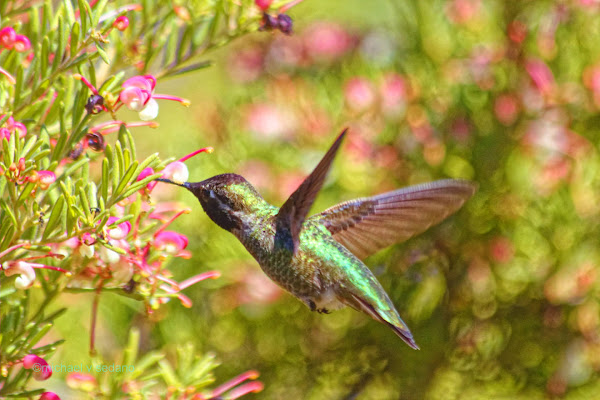
Last May (link) I recalled the incident that set me off on a quest to capture living hummingbirds with my camera. These birds move incredibly fast and abruptly to challenge an eye. But these feathered jewels like to park, observe, and fluff up, giving many a photographer a good portrait of a parked bird. 

My goal is photographing birds in mid-air, approaching a branch or lifting off from sentinel duty. The best opportunities come when a hungry creature floats at a nectar-rich blossom before diving in and disappearing save for a cola. Parked Colibrí return to the same plants, even the same flowers, so fast and abrupt become less a challenge. 

Foto settings make vastly different results. A long exposure produces arresting blur and strobe-like wings. A fast exposure turns wings into sculpture. Focus is critical and at the mercy of flitting darting floating disappearing capricious chuparosas. Yet, good fotos of hummingbirds can happen to the best of us. A good camera and long lens help a lot. 

I spend a couple hours a week standing in gardens doing my thing, so I get a bunch of good stuff. I cherish the ability of a photograph to extend time beyond the duration of a shutter click. That moment in time persists for as long as digital images last on paper, and, of course, on the world wide web, like La Bloga-Tuesday. For me, the respite of photographing tiny lives and gorgeous flowers provides immediate satisfaction that digital darkroom work, hours later, lets me extend into good memories.

Here is a set of fifteen hummingbirds, chuparosas, picaflores, colibrís, huitzilin, on some beautiful flowers. These birds and plants are at the Huntington Library and L.A. County Arboretum in Arcadia. Taking pictures like these, and sharing them on La Bloga-Tuesday, lets me say I added beauty to someone's life, y sabes que? that's a darn good accomplishment. 

Allen's Hummingbird and Echeveria

Black-chinned Hummingbird and Aloe

Black-chinned Hummingbird and Grevillea

Rufous Hummingbird Close-up and Extra-Close, Aloe

Black-chinned Hummingbird and Ocotillo

Rufous Hummingbird and Aloe

Rufous Hummingbird and Bottle Brush

With perceptions the GOPlague abates, Spring and Summer may see art sales resume in California. Outside the region, and until we've actually beaten the GOPlague, you can request Information on purchasing images on notecards, tee-shirts, and original prints here.

Monday, March 07, 2022

The Tucson Festival of Books returns in person to the University of Arizona Campus on March 12 – 13


The annual Tucson Festival of Books is returning to the beautiful University of Arizona campus on Saturday, March 12, and Sunday, March 13, after the COVID-19 pandemic canceled the 2020 event completely and led to an all-virtual event in 2021.

This year’s book festival will include 267 presenting authors representing over 15 different genres and 268 events throughout 31 venues during the two-day festival.

The guest authors include many La Bloga favorites including René Colato Lainez, Estella Gonzalez, Reyna Grande, Xochitl Gonzalez, Luis Alberto Urrea, Jaime Cortez, Yuyi Morales, Lilliam Rivera, David Bowles, Lizz Huerta, Zoraida Códova, Oscar Mancinas, JJ Amaworo Wilson, and many more!

I will be on two panels this year if you want to check them out:

1. Parables for Our Times 

(Saturday, March 12, 2:30 pm - 3:30 pm)

Using magic, mythic power and humor, these authors have written marvelous tales that address questions about justice, self-determination, survival and the power of collective action against tyranny. How did they craft these tales and what inspires them?

Panelists: Daniel OlivasJJ Amaworo Wilson
Moderator: Scott Glener

2. To Live and Die en La Ciudad: Chicanx Short Fiction in the Urban Southwest

(Sunday, March 13, 2:30 pm - 3:30 pm)

Three Chicanx authors discuss questions, issues, and processes of writing short fiction from and about urban Chicanx communities. Some of these questions are: How do we create, adapt, and sustain our cultural and communal expressions within Southwestern cities? And what do authors think about when trying to render these dynamics in short fiction?

Panelists: Estella GonzalezOscar MancinasDaniel Olivas
Moderator: Ivonne Ramirez

***

I will also be doing a book signing at University of Arizona Press Booth #238

(Saturday, March 12, 11:00 - 11:30 am)

I will be signing my University of Arizona Press titles (The Book of Want and The King of Lighting Fixtures) at the University of Arizona Press's booth #238.

We look forward to seeing you!


It’s a strange feeling anticipating the publication of a book for about two years and then realize the book has been born and is out in the world. My tenth book, How to Date a Flying Mexican: New and Collected Stories (University of Nevada Press), was published on February 22 and I have been so moved by the response. We’ve had several events already and, due to the pandemic, they’ve all been virtual, so many are available for watching if you missed any of them. Here are some links to a few book appearances, interviews, and reviews:

Vroman's Bookstore

Skylight Books

Chills at Will Podcast

Alta Journal

Poets & Writers

Los Angeles Review of Books

BuzzFeed

Many more events are planned throughout the year. For a complete list that is being updated as needed, visit my events page. And mil gracias for the support and well wishes for my newest literary baby!


Friday, March 04, 2022

Fifteen Years of the Poetry Buffet

 Melinda Palacio    


Poet Gina Ferrara of New Orleans has been running the Poetry Buffet at the Latter Library in New Orleans for fifteen years. I've been fortunate to participate in the reading since it started. The poetry series meets every first Saturday of the month. This month's offering, due to the lingering pandemic, will be on zoom. If you are in the mood for an early poetic feast, find your time zone and zoom in, 2pm Central and noon PST. I'm a little under the weather, but thanks to zoom, I will deliver my fifteen minutes like the pro I am. I will join our hostess, who will read, along with Julie Kane and Andy Young. 

Zoom link: https://us02web.zoom.us/j/86283753394...


The Poetry Buffet Poets for March 2022, Saturday, March 4 at 2pm central, noon pacific

Gina Ferrara lives and writes in New Orleans. She has four poetry collections including her most recent Weight of the Ripened (Dos Madres Press, 2020), a finalist for the Eyelands Poetry Prize. Her work has appeared in numerous journals including Callaloo, The Poetry Ireland Review and Tar River Poetry and was selected for publication in the Sixty-Four Best Poets of 2019 by Black Mountain Press. Since 2007, she has curated The Poetry Buffet, a monthly reading series in New Orleans. She teaches English and writing at Delgado Community College Julie Kane’s most recent poetry collection is Mothers of Ireland (LSU Press, 2020), winner of the Poetry by the Sea Book Award and a longlist finalist for the Julie Suk Book Prize. Previous collections include Rhythm & Booze, a National Poetry Series winner, and Jazz Funeral, winner of the Donald Justice Poetry Prize. With Grace Bauer, she co-edited Nasty Women Poets: An Unapologetic Anthology of Subversive Verse. Her poems appear in more than sixty anthologies including Best American Poetry and The Book of Irish American Poets from the Eighteenth Century to the Present. She has served as a Fulbright Scholar, Louisiana State Poet Laureate, Poets’ Prize Committee Chair, National Book Award in Poetry juror, and George Bennett Fellow in Writing at Phillips Exeter Academy. Professor Emerita of English at Northwestern State University of Louisiana, she currently teaches in the low-residency poetry MFA program at Western Colorado University. Melinda Palacio is a poet, author, and speaker. She lives in Santa Barbara and New Orleans. Her poetry chapbook, Folsom Lockdown, won Kulupi Press’ Sense of Place 2009 award . She is the author of the novel, Ocotillo Dreams (ASU Bilingual Press 2011), for which she received the Mariposa Award for Best First Book at the 2012 International Latino Book Awards and a 2012 PEN Oakland-Josephine Miles Award for Excellence in Literature. Her first full-length poetry collection, How Fire Is a Story, Waiting, (Tia Chucha Press 2012) was a finalist for the Milt Kessler Award, the Paterson Prize, and received First Prize in Poetry at the 2013 International Latino Book Awards. In 2015, her work was featured on the Academy of American Poets, Poem-a-Day Program. Melinda's latest poetry collection is Bird Forgiveness. Andy Young's second full-collection, Museum of the Soon Departed, was chosen for the inaugural Patricia Spears Jones Award and will be published by Camperdown NYC next year. She is also the author of All Night It Is Morning (Diálogos Press, 2014) and four chapbooks. She holds an MFA from the Program for Writers at Warren Wilson College and teaches at New Orleans Center for Creative Arts. Her work has recently appeared, or is forthcoming, in The Southern Review, Pank, The Journal of the American Medical Association, and The Cortland Review. Her poems have also been featured in contemporary and flamenco dance productions.

Thursday, March 03, 2022

The Greatest Chicano Classic Oldie of All time

                                                                                    
Rosie and the Originals on Stage

     It was a simple question I posted on my Facebook page, name the greatest oldie ever recorded. 
     Now, I purposely didn’t ask which is your favorite. That would defeat the purpose. I wanted to know what song my FB friends considered the best oldie, regardless of their personal favorite. Here is another way to put it. If my FB friends, which lean heavily on the raza side, could choose an oldie as our Chicano national anthem, which one would it be? 
      For me, I chose at the #1 spot, Rosie and the Originals, “Angel Baby (1961),” not because it was my favorite but because it seemed ubiquitous, everywhere and at all times, and #2, my personal favorite, Barbara Mason’s “Hello Stranger,” (1963), a heartbreaker of a love song. 
     This got me to thinking whether Mexicans across the country listen to oldies like Mexicans do on the West Coast. (I use Mexican to avoid the awkward “Chicano/Chicana”). Or another question, what do we even consider “oldies?” 
     When I was in the army, back in 1966, Chicanos from Texas weren’t especially “oldies” fanatics, not like West Coast Mexicans. They swooned more to the sounds of musica nortena, and a sound I wasn't familiar with, at the time,Tex-Mex, their favorite, Little Joe y La Familia, revered by San Antonio Chicanos. That got me to thinking about raza in Colorado, New Mexico, Arizona, Kansas City, Detroit, and Chicago? For that matter, what are oldies? Are they the same to all of us? 
     Most D-jays agree, a true oldie was recorded between 1953 and 1964, my older cousins' generation, the chop-top, hot rod crowd. The genre originated out of the East Coast doo-wop scene, where kids of all ethnicities hung out on street corners and sang their favorite tunes, voices only, no instruments needed. 
     I know in the 40s, before the war, West Coast pachucos danced to boogie-woogie, big-band music, and a blend of Mexican and jazz, like Lalo Guerrero’s Pacuco Boogie. Puerto Ricans on the East Coast probably listened to an island infused salsa, Willie Colon and Tito Puente. Then in the 50s, gospel, country, and jazz gave way to rock ‘n roll, picked up on the West Coast by the car club scene, mostly white kids (who could afford cars) and Mexicans. 
     By 1965, my generation, the Beatles, Rolling Stones, Temptations, the Motown sound, entered and modernized rock, leaving Art Laboe and his oldies extravaganzas at the El Monte Legion Stadium in the dust. What we called "oldies" weren't even that old, maybe ten to fifteen years old, using the Gregorian calendar, but when you compared it to the newer, harder-edged sound of Eric Clapton, Jimmy Page, Carlos Santana, Buddy Miles, Leon Russel, the El Chicano, Tierra, and Malo, they really did sound old. 
    For Chicanos in L.A. Thee Midniters was something of a transition band. They gave the oldies sound something of a face lift, but they tried not to show the stretch lines, keeping true to the original look, hence, many of my FB friends voted thee Midniters’ Sad Girl as the best oldie, when, in reality, the true version was written and recorded by Jay Wigging in 1963, a true oldie. 
     As the Baby Boom generation moved on to more modern styles of rock music, the 1960s’70s pachuco/cholo oriented culture stayed true to their oldies, never letting them fade completely. AM radio transitioned to the hip-cool FM rock stations, and oldies got buried into one of the antiquated AM stations. Ah, progress. 
                                                                                 

     However, oldies, as a cultural phenomenon never disappeared from the Chicano/Chicana consciousness. Many Mexicans still had their old vinyl, cassette, and CD collections. Now, with streaming, oldies are just a click away. 
     So, the answers to my FB question about the greatest oldie ever recorded came in fast and furious, some 75 responses in a couple of days, and some good ones, like Duke of Earl (1962), We Belong Together (1958), In the Still of the Night (1956), Earth Angel (1954), Only You (1955), I Only Have Eyes for You (1956), A Thousand Miles Away (1956), Forever My Darling (1956), You’ll Lose a Good Thing (1962), Sad Girl (1963), Daddy’s Home (1961), and so many others, but, like me, most chose Angel Baby as the grand prize winner, the greatest oldie ever recorded.
    This all got me to thinking. Who were Rosie and the Originals, this group that stole the hearts of millions back in 1961 and today, still? Surely, they must have had some big money behind them to have recorded such a monster hit. Record companies paid big money to song writing teams, many who came out of the East Coast.
     Turns out Rosie Mendez Hamlin, was the daughter of Ofelia Juana Mendez and Harry Hamlin, of Klamath Falls, Oregon. Rosies's family moved around a lot. She was raised in Alaska but visited her Mexican relatives in San Diego, whenever she could. In her early teens, her parents decided to move National City, next door to San Diego, where she attended Mission Bay High School. 
     Her dad played guitar and encouraged Rosie to learn to play piano. Something of a tom girl, who loved the outdoors, Rosie fell in love at 13. To prove her love, she sat down on her bed and wrote a poem, the first line, "It's just like heaven/Being here with you." 
     At 14, she got some friends, musicians, from her National City neighborhood together, to put her words to music, an unmistakable first chord, with a basic four-chord progression used in many oldies love songs as its musical foundation. In her unique, high, girlish voice, she continued her poem, “You’re like an angel/Too good to be true/Because I love you/I love you/I do/Angel Baby/My Angel Baby.” 
     At 14, before most girls could even date, had Rosie tapped into a Chicano spiritual consciousness, love as something divine, heavenly and angelic? As Mexican poet Octavio Paz wrote in Labrinth of Solitude, on the one hand, love as pure, holy, and blessed, like the Virgin Mary, and on the other side, "When you are with me my heart skips a beat/I can hardly stand on my own two feet," love as visceral, profound, and physical, Dona Marina, the flesh, the sinner, so in love with her master Cortez, she could barely stand, the yin and the yang of Mexican love.
    They called themselves Rosie and the Originals, Noah Tafolla, Gene Romero, Tony Gomez, Joe Yancho, Alfred Barrett, David Ponci, and Carl van Goodat. They practiced until they had the song down perfectly. 
     They found a man who recorded music in a corner of his airplane hangar, out near San Marcos, north San Diego, where they made their record. The sax player, Alfred Barrett, had to cancel. His mom wouldn’t let him get out mowing the lawn, so guitar player, Noah Tafolla, who had played some sax, taught Tony Gomez to play the sax part. Tony wasn’t as good as Alfred, so what you hear on the original recording is Tony trying his best. Ironically, it turned out to be one of the memorable sax lines in oldies history, in less than ten notes. 
     No radio DJ would listen to kids trying to get their song on the radio, so they asked a local department store manager if he’d play their song in the listening booth, where teenagers went to hear and buy music. He agreed, and, before long, kids began requesting Angel Baby. A music scout heard the recording and signed the group to a recording contract. Rosie was too young to receive credit for writing the song, so the oldest member of the group, David Ponci, received songwriting credits (this caused a lot of legal problems later, but eventually, Rosie received credit). 
    From there, everything was like a whirlwind. The group began performing. Rosie and Noah traveled to New York to perform six shows with Jackie Wilson. Angel Baby was a hit. Alan Freed, a K-Day disc jockey, and one of the biggest names in rock radio, heard the song, played it on his station, and it quickly reached #5 on his hit list. Dick Clark heard it and booked the group on American Bandstand. Rosie said she was first Latina to appear on American Bandstand. 
     From there, the song turned up in teenage households across the country. In 1995, Rosie and the Originals received honors from the Rock ‘n Roll Hall of Fame. John Lennon said Rosie was one of his favorite singers and recorded Angel Baby for a later album, and Led Zepplin made mention of them in their liner notes. 
     So, now, each time we hear Angel Baby, we know it was recorded in an airplane hangar by a group of Chicano and Anglo kids who were messing around with music, just trying their best, and their best turned out to be one of the greatest Chicano classics of all time.

Wednesday, March 02, 2022

2022 Tomás Rivera Book Award Winners


Texas State University College of Education created The Tomás Rivera Mexican American Children’s Book Award in 1995 to honor authors and illustrators who create literature that depicts the Mexican American experience. It is named in honor of Texas State University distinguished alumnus Dr. Tomás Rivera.


My Two Border Towns Hardcover 

By David and illustrated by Erika Meza  


Early one Saturday morning, a boy prepares for a trip to The Other Side/El Otro Lado. It's close--just down the street from his school--and it's a twin of where he lives. To get there, his father drives their truck along the Rio Grande and over a bridge, where they're greeted by a giant statue of an eagle. Their outings always include a meal at their favorite restaurant, a visit with Tío Mateo at his jewelry store, a cold treat from the paletero, and a pharmacy pickup. On their final and most important stop, they check in with friends seeking asylum and drop off much-needed supplies.


My Two Border Towns by David Bowles, with stunning watercolor illustrations by Erika Meza, is the loving story of a father and son's weekend ritual, a demonstration of community care, and a tribute to the fluidity, complexity, and vibrancy of life on the U.S.-Mexico border.


Indivisible 

By Daniel Aleman


Mateo Garcia and his younger sister, Sophie, have been taught to fear one word for as long as they can remember: deportation. Over the past few years, however, the fear that their undocumented immigrant parents could be sent back to Mexico started to fade. Ma and Pa have been in the United States for so long, they have American-born children, and they're hard workers and good neighbors. When Mateo returns from school one day to find that his parents have been taken by ICE, he realizes that his family's worst nightmare has become a reality. With his parents' fate and his own future hanging in the balance, Mateo must figure out who he is and what he is capable of, even as he's forced to question what it means to be an American.


Daniel Aleman's Indivisible is a remarkable story—both powerful in its explorations of immigration in America and deeply intimate in its portrait of a teen boy driven by his fierce, protective love for his parents and his sister.


Bright Star 

By Yuyi Morales  


With the combination of powerful, spare language and sumptuous, complex imagery characteristic of her work, Yuyi Morales weaves the tale of a fawn making her way through a landscape that is dangerous, beautiful—and full of potential.  A gentle voice urges her onward, to face her fears and challenge the obstacles that seek to hold her back.


With a voice full of calm, contemplative wisdom, readers are invited to listen and observe, to accept themselves—and to dare to shout!


In a world full of uncertainty, Bright Star seeks to offer reassurance and courage. Yuyi Morales' first book since her New York Times bestseller Dreamers explores the borderlands—the plants, animals, and insects that make their home in the desert, and the people who live and travel through this unique and beautiful part of the world. 


Created with a combination of techniques including hand-embroidered lettering, painting, sketching, digital paintings with textures from photographs of the Sonoran Desert, this stunning book is full of beauty—from the handwoven blanket of the endpapers through the last inspiring spread of young families facing their future with determination and hope


Tuesday, March 01, 2022

SNAFU: A Night At the Opera

Note: Esteban Torres completes advanced electrical training in preparation for four-year assignment in Europe. A series of military foul-ups sees the youngster re-trained to blowing up old bridges and patrolling the brand-new Iron Curtain. Torres' love of cartooning lands him full-time assignment in elite Bavarian environs. Assigned to Intelligence School in Oberammergau, he draws propaganda manuals, a dream job. He's recruited to infiltrate Romania as a spy but the plan never gets off the ground. Like any soldier, Torres' duty comes with adventures and mishaps. The ex-soldier enjoyed telling how his plans for an elegant night at the Munich Opera's first post-war La Boheme turns into a night in jail.


Excerpt from Chapter Three, The Autobiography of Esteban Torres As Told to Michael Sedano


1949, Germany


My big let-down of no job, is a move up to a great job. The first months in my overseas assignment, I work mostly in a comfortable office drawing cartoons for the Army newsletter. 


I’m also assigned regular Constabulary duties. That means, for all intents and purposes, I’m la chota.


In Böblingen, this teenager fresh out of the East Los barrio struts around decked out in shiny black helmet with two gold stripes, spit-polished boots laced-up to the ankles with bloused trousers and Sam Browne belt. 


I am the occupation army’s constabulary with authority over 12,000 mostly good people. I carry a weapon and live rounds. Locals call me das Blitz-Politzei after the lightning bolt on our shoulder patch.


I’m approaching my twentieth birthday. Back in the United States I still can’t vote and in California, can’t go buy a drink in a civilian bar. I can’t live in Montebello--because I’m Mexican--no matter how old I am. No Chicanos need apply.


Joining the military straight out of high school might not be for everyone. You aren’t everyone. Neither am I. Enlisting in the Army was my choice in 1949. I would not do anything differently today. 


== 1951 == Torres is now a Staff Sergeant 


The boy who left L.A. is a man now. Other men follow his orders. The man from East Los disciplines as needed, keeps matters in the platoon, no need to go up the chain of command. Under my leadership, my men fit together, my men become a team, efficient, effective, in control of the mission. Nothing can shake our confidence.


I had to laugh when I thought about my confidence once I’d been in Germany long enough to know my way around. I thought I was unstoppable, except I stopped myself.


Not looking back has been a good way for me to keep my eyes on what’s headed my way. That Boy Scout motto, Be Prepared, has lifelong value. In fact, the one time I left myself unprepared it cost me dearly.


One of the streets in town was a tailor’s row. Imported yardage had found its way into the economy and the tailors stocked a lot of green wool material, perfect for a young GI with a sense of style to have a custom-made Class “A” uniform made to his specifications.


Vanity can be a good thing, when you’re young and do elaborate things that put you into the cultural swirl of things, like the Munich Opera. 


My grandmother played opera records on Sunday mornings while I lay on the floor reading the funny papers in the Examiner and La Opinion. I laughed at the Katzenjammer Kids while German opera played in the background. Then came the war against Germany and the Katzenjammer kids, and German opera, sounded different. 


After the war, German music came back to life, and although the Opera House had been bombed out, the Munich Opera was doing La Boheme on a rebuilt stage.


I planned the event of a lifetime. A fabulous dinner, the opera in my custom-made Class A United States Army uniform. My brass would shine and reflect candelabra lights as I strode up the stairs into the hall. The center of attention.


I never made it.


I checked into a first-class hotel to get myself ready for my big cultural night. A hot shower, fresh shave, ribbons and brass in place. My “bespoke” custom-made uniform made me look like a diamond.


I had just tied my spit-shined dress shoes when a firm knock focused my attention on the unlocked door. It opened and two MPs walked into my room like they paid the rent. I recognized their pugnacity from my days as a Constabulary patrol.


“Where’s your pass, Soldier?”


Pass. 


A detail I’d neglected, I wasn’t prepared. 


These MPs weren’t boy scouts and sure were not going to do a good turn daily, let me go to La Boheme, my plans went up in smoke. 


The MPs did their duty. I was escorted to jail and that’s where I spent my night at the Opera, all dressed up fancy in my tailor-made Class A uniform, locked up with the drunken GIs. I definitely was the most turned-out jailbird in Germany that night.


I had the Pass. My Commander approved my leave, the Company Clerk typed up the Pass and handed it to me. I put the Pass in my fatigue jacket pocket and left it there. My jacket and pass were waiting for me when I reported to the Captain. He laughed.


Leadership looks like a laughing man behind a desk and a relieved man on the other side of the desk. The Commander figured my punishment was the cost of the ticket to La Boheme, the price of the hotel room, and the taste of stale bread sandwiches instead of Sauerbraten, Rotkohl, Kartoffelkloesse, and all the trimmings of a fancy German banquet on an enlisted man's pay.