Tuesday, March 27, 2018

Hitched. La Palabra. On-line Floricanto for the Only Earth We Live On.

Michael Sedano

Quarterly Poetry Reading Goes On With A Hitch


Holy Grounds Coffee and Tea (link) is the perfect place to be this Saturday afternoon even if the stretch of Alhambra Road in El Sereno looks like nothing special goes down around here. Here is an industrial landscape paralleling a railroad right-of-way. Across the street from a mural tagged alley, visitors are here for something special, the quarterly Hitched reading.

In the sequestered coffee house garden, people chat with one another. Some here for the ambiente, others here for the show. Gente here know each other, friends of the lineup, followers of the Hitched reading series, familiar faces from the busy El Lay poetry community. The garden delightfully fills with conviviality. As an added bonus, Holy Grounds sells Good Mexican Girl gluten-free sweets, along with deliciously brewed coffee. The establishment's core values reflect the service: Nourishment. Community. Culture.


Xochitl-Julisa Bermejo brought Hitched to Los Angeles’ far eastside from Venice in December. The series brings writers into community in multiple ways. Two readers, Jamie Moore, Marisol Baca, come from Fresno’s active literary community. Jean Chen Ho, Dana Johnson bring USC to the El Sereno venue, and Reed Maruyama is a 16 year-old Los Angeles poet.

Maruyama makes her debut public reading today, an experience she now shares with a plurality of her audience. Lots of familiar faces dot the crowd. I saludar Desirée Zamorano. Alex Espinoza and Kyle Behen sit with Brian Dunlap. I talk up Brian on “playing to the camera” when he reads in public.

Pasadena Rose Poets Gerda Govine and Carla Sameth have seats behind me and we talk about their Wednesday, April 11 midday reading (link) in Pasadena city council chambers for National Poetry Month.


Visit Hitched at its Facebook page (link) for full bios on the writers. The artists’ principal occupation ranges from high school sophomore to college professor. Their work appears in diverse places, from chap book to journalism to literary journal, including Huizache, The Magazine of Latino Literature, to collection to novel. The writers have hitched to a star and are well on their way.

Today's program features narrative prose work and some poetry. Billed as Hitched: California Women's Voices and a celebration of International Women's Day, Bermejo's invited an all-woman lineup. The five readers take advantage of Holy Grounds’ peaceful stage and  excellent public address system. Not a phrase or word  is lost to technology. The setting's visual satisfaction brings listeners closer than physically. There's a fitting constant din of coffee drinker chatter, tires swooshing past, sporadic glissandi of laughter punctuating the music of the day. Competent readings overcome distractions.

Prose poses challenges to photographers, shared by readers, though perhaps unaware to the latter. Reader and photographer want a dynamic photo, one illustrating the personality of this writer or, ultimately, the Platonic ideal foto of a Rodin-evoking “The Reader.” A perfect foto is possible and I seek it, for the satisfaction of mastering technology and of course, that perfect portrait.

Good and all right fotos are stock-in-trade from readings. Now and again a lens captures one glistening inspired moment: The perfect public speaker photograph.

Writers need good images. A book. A press kit or press release. A memento to send home to loved ones. Every poet should have a bio, a mug shot or action shot, and a web presence; marketing is what happens after you type "the end." A great portrait informs a writer's image, draws attention.

The inspired foto moment doesn’t happen accidentally, though it happens randomly. For the writer reading her own stuff, camera alertness can produce the moment if the photographer is paying attention, and the ineffable “everything” comes together.

I told Brian Dunlap to take a moment during a reading to look directly at the lens. Every reader should consider the lenses and smart phones in the audience. Either during a pause, or as the text reaches an emphatic moment, plan to break eye contact from the page. Memorize the next few words. Look out to the audience. Make contact. Say the lines, from memory. Mark this spot on the page.

Wait. Savor the moment, just for a fraction. You, the reader, had a plan and worked the plan. Now let the words speak for themselves hanging out there in the space of that planned pause. Look at the lens. Then back to your manuscript. The perfect foto came as the reader's eyes looked out, lips and mouth forming meaning, body and hands gesturing, exhibiting readiness to complete the performance.

The alert photographer has observed the reader’s style, listens to the narrative, anticipates the moment. At the key instant, the portrait is perfect if that’s the instant the shutter clicks. Eye contact. Mouth forming sounds. Face meaningful. Posture in control of the setting.


Reed Maruyama is a young activist and a sophomore at Clark Magnet High School where she writes for the school's newspaper, magazine, and yearbook. She spends most of her time writing, making art, and eating good food.
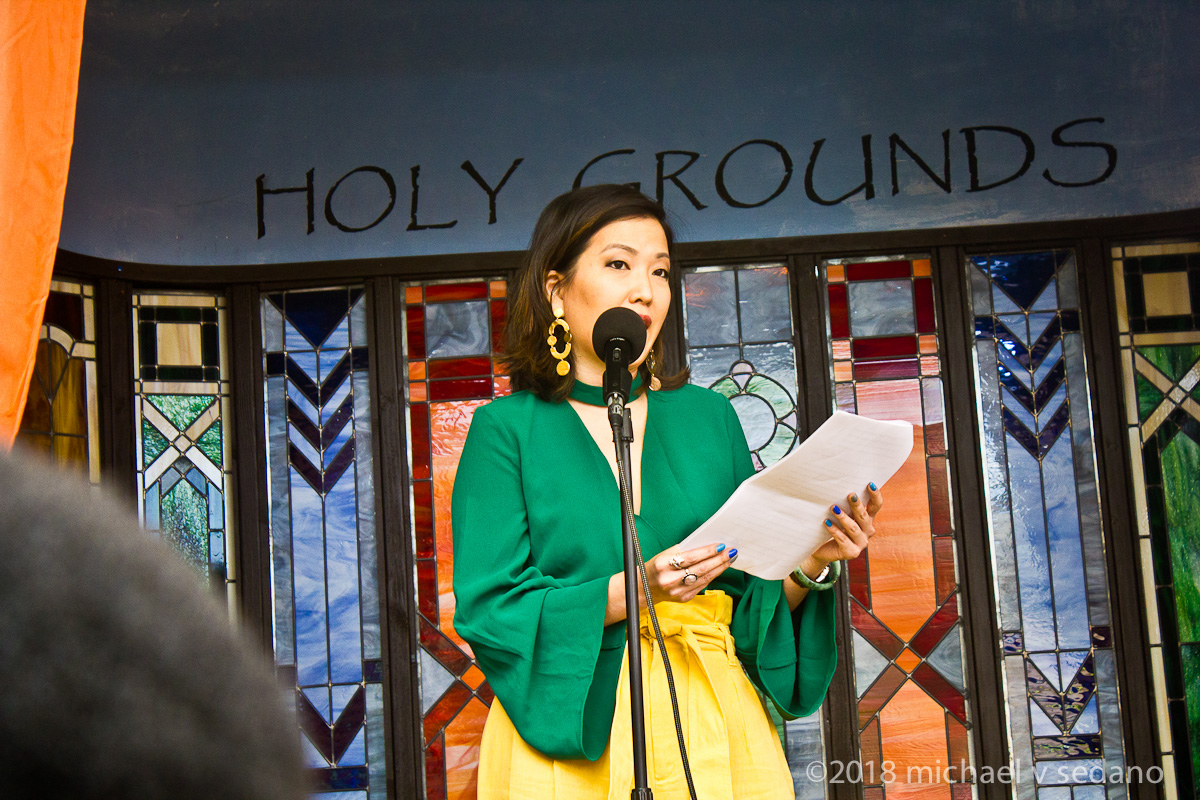

Jean Chen Ho is USC doctoral candidate in creative writing and literature. She's a board member of Kaya Press, an independent publisher of Asian diasporic experimental poetry and prose. Jean is working on a linked short story collection and trying to get herself together to write a novel.


Dana Johnson is pura southern California, growing up in the L.A. area and works as a professor of English at the University of Southern California.


Jamie Moore is a member of Women Writers of Color Central Valley. She works as an English Professor and Coordinator of the Puente Program at College of the Sequoias.


Marisol Baca lives in Fresno with her husband in a house in the center of town. Baca is an English professor at Fresno City College.


La Palabra Welcomes Host Angelina Sáenz To Long-Running Avenue 50 Studio Reading Series

Los Angeles hosts many long-enduring reading series. At the far westside along the Pacific sands, Beyond Baroque hosted Hitched for the better part of a decade. In Central L.A., the World Stage has kept the lights shining thirty years. For nearly twenty years, Avenue 50 Studio in Northeast L.A. has sponsored La Palabra. La Bloga first visited La Palabra in November 2008.

Angelina Sáenz greets her first La Palabra audience

La Palabra at Avenue 50 happens between 2:00 p.m. to 4:00 p.m., 4th Sunday of every month except December.

Sáenz' accession to this important curatorial responsibility represents continuity, a seamless juncture in the passage of literary history. The curator's goal reflects continuity among younger and older voices. Sáenz introduces a programming design to invite a high school poet to read alongside two featured poets. 

Samuel Davenport aka Rouze and Michael Sedano


Saturday, I arrive early enough to enjoy conversation with young poet Samuel Davenport aka Rouze, his mother, and his sister. The personable familia bursts justifiably with joy at Rouze's appearance today. Davenport is a senior at Cesar Chavez Social Justice Humanitas Academy where he works with spoken word master Tolteka. I look forward to seeing Tolteka and the GetLit team, including Rouze, at the upcoming GetLit Classic Slam (link).

La Palabra Reading Series at Avenue 50 Studio Featured Poets
Luivette Resto, Thelma Reyna, aka Rouze, Angelina Sáenz

Luivette Resto, a former La Palabra host, and Altadena Poet Laureate emerita Thelma Reyna lead the reading. Visit La Palabra's Facebook page for biographical details (link).


Luivette Resto's distinctive voice blends insight, wit, rage, and a Wonder Woman insouciance. There's lots of sorrow in the poet's world, and today's reading mirrors it. Resto, as every conscientious person, shares the devastation of Puerto Rico. For the poet, it's personal, the emotional toll has her worn down. She relates news relayed by her father where hurricane damage in his isolated town remains unaddressed, no construction, no power, no reason to hope.

Resto's poem for Puerto Rico reflects on character, beauty, and suffering in simultaneous measure. She shares a draft that struggles to burst spontaneously from the poet because the page is anchoring her. Look for Resto's next reading and hope she shares the poem.


After the presidential election, Reyna relates, she read Kübler-Ross on mourning, that in the process of grieving she found some satisfaction in imagining how people, casualties like Reyna, are talking about their injuries and what died. Those are the voices in her book, Reading Tea Leaves After [surname] (link).

Among things that died with the election, Reyna numbers friendships. Not the fatuous friendships of social media, though those, too. Enlisting Albie Preciado's voice, Reyna shares a farewell-to-us letter from a tea party brother to his sister. Reyna's trenchant insights and Preciado's emptiness-filled reading leave the audience stunned.  


Rouze expresses powerful words with restrained conversationality. Speaking quietly pulls in his listeners. His genuineness is persuasive. The La Palabra audience notes each word and expression, hearing more than what this poet has seen in his world. Saturday is a day of young people's marches across the nation. Rouze's audience hears the same determination and potential for positive change coming from all quarters.

When we chatted earlier, I asked Rouze to consider two things he liked about his reading the last time he performed, and identify one behavior he would like to change. Keep the first two and work on the second today. In the joy and hubbub following the reading I didn't take the time to ask the poet the same questions. When a poet works to keep the good and work on one opportunity at a time, every reading is better than the one before.

The audience gives Rouze a huge applause and his mom gives him a giant abrazo.
Open Mic

L-R, Top to Bottom: Victor Sotomayor, Harry Gipson, Jose Cordova, 
Rob Poetry Morrow, Saki, Omar Murgia.

L-R, Top to Bottom: H. Baki, Eddy Bellow-Sandoval,
Lea, Paula Achter

La Bloga On-line Floricanto: The Seventh Year of Memory ~ For Fukushima and for the Earth’s healing from wars, and humanity's indifference to natural law
Yumiko K.D., Odilia Galván Rodríguez, Meg Withers, Red Slider, Sharon Elliott, Theo Eliades, Sonia Gutiérrez, Dee Allen, Martina Robles Gallegos

The Moderators of the Poetry Community Poets Responding: Poetry of Resistance, submit nine poets with ten poems in commemoration.

“I Lost My Hometown” By Yumiko K.D
“Soulache” By Odilia Galván Rodríguez
“Ragged Mountain Dream” By Meg Withers
“Twin Sons” By Red Slider
“Water Death” By Sharon Elliott
“As Cherry Blossoms Fall” By Theo Eliades
“Days of Thunder”/Días de estruendos” By Sonia Gutiérrez
“The Repeat Performance” By Dee Allen
“Nuclear dreams" by Martina Robles Gallegos

I Lost My Hometown
By Yumiko K.D.

The blue sky and the clear ocean
no longer show the colour of happiness now
in my hometown of Fukushima
Gentle breeze used to welcome me back here
now feels so chilled

My beloved hometown
Peaceful streets with smiles on people’s faces
Where have they gone?
I’ve always believed
that I had a safe home to come back to

Even the most beautiful cherry blossom tree on the hill
looks lonely, reserved, isolated
in my hometown of Fukushima

Bright sunlight used to embrace me warmly
now feels darkish, unwelcoming, colder
My cherished hometown
Happy times with my close family and friends
Where have they gone?

I’ve always believed
that I had a secure home to come back to

I’ve never ever doubted
that my childhood heaven was there for me eternally


Soulache
By Odilia Galván Rodríguez
for all who long for a better world
and for never succumbing to government’s fabricated amnesia

no one
wants to take in
the truth of unsaid lies.
seawater looks just fine, let’s go
swimming

it’s Spring,
cherry blossoms
bloom. it’s like nothing’s wrong,
as if people are all still here
to see

new blooms
they fall like snow-
flakes, as if nuclear
winter now comes in pink petals
floating

under-
exposed. the truth
of unseen and silent
killers, who foul earth’s precious life ~
water

dreamtown
belongs to those
who long to return home.
our hope songs caught in sparrow throats.
soulache


Ragged Mountain Dream
By Meg Withers

August, 1940

Maple tree with their shapely henna palms
are washing their hands of summer again,
fanning the grasses in the yellow fields.
It’s the way of the world to do these things,
the way you did each autumn, as you made your way
into the Virginia woods, careful and quiet
You were twenty-two and clear-eyed
as any furry beast, long-toed, sliding
into the foliage.

You tread, with your Collie, sack of beans,
fishing gear and bedroll tucked tidy at your back,
your life a numinous green dream.
It was August, the summer of Maria Massie, slow
talk on the verandah, wading in the Tye River,
before Kwajelein and Suva, before Tokyo Bay and
the Pacific, so blue it hurt your eyes, the flotilla of haze gray
Navy battleships, floating in the bathtub of the Pacific, bombs
a child, slapping the water to see which ships would float,
in devastation it chose to make, with simple
chubby fists, the dead faces frozen forever.

Your ships sank, two of them in five years.
You almost survived in the fiery water, pulled each time
gasping, a slender freckled fish, crouched in the bottom
of some lifeboat passing.

Something inside you sank in those years,
some connection snapped, the way the smallest branch
in a morning forest can sound like gunshot,
some lifeline whipping back and away with fierce power,
the sudden release of tension from the break, slamming
you down, as sure as if you’d died there, in the terrible
heat, in the furnace of flaming water.

What you did afterward when there was no cure
for the invisible hole in your gut, not even a name
for the disease you suffered; I imagine it vast and
black, filled with cold ashes; a groan which lay unspoken
in your heart, gnawing a tiny dreadful sound,
the mastication of some horrid insect,
thousands of them, and only you could hear them.
But war was an honorable enterprise.

January, 1956

Eating tart oranges from the backyard tree,
frost scorching fingers and noses.
Bundled in winter on the back steps, I was proud
to be your eldest, the Chosen Child, the shining coin
in the dark pocket of your life, the one
for whom you spun stories, leaning out over the side
of the skiff, scooping tales from the dark lake of your memory,
silver story fishes, wriggling and leaping in the light of your vast
vocabulary. You left out the bloody gutting, the scaling,
parts unhealthy for my ears. your voice, vowel-laden,
the slow Virginia chant of it, rolling us into the green Piedmont
of your innocence. A dark humor carried inside
my mind in a wash of light, watercolors swathed on
fragile, layered vellums of memory.

Even the war years and terrible aftermath tinted – just for me.
Fiji in tropical washes, drinking in open-air bars, 7-foot
constabulary, scarlet, British military jackets, stiff
over pleated white skirts. Drinking Tooth’s lager, Brisbane,
and Red, Aussie sailor, who loved the sea as you did.
Drinking at the California bar in Sasebo, not for the first time,
pulled back over a cliff by a tiny woman, another lifeboat,
as all women were; your diminutive mother, her dark premonitions,
your wife’s stubborn, Italian peasant sense, my devotion,
when no one else would listen, when the relentless darkness moved
over you, unassuageable.

April, 1963

The charred oblivion visiting our house in your form,
empty bottles of Old Grandad, handfuls of Librium, locked-down
in J Ward. You struggle against five-point restraints.
Why is Dad tied up? Silence from your 50’s and 60’s
version of hejira for the spiritually too competent,
eventual tours of state hospitals, your uniforms with gold stripes
exchanged for backless gowns, the cadent military stride replaced
a shuffle of paper slippers, the sloping mouth, medication
electric shock. The worm in you gnawing, hungrier each year,
stripes on your shins from diminishing hatchways
as you come forward in the ship of your mind,
until there is nothing left but empty bottles and cans,
baked beans with spoons stuck in them, tipped
over on your important papers – a death you prayed for every day,
but could not manage to accomplish.

July, 1976

The last time of fire in your brief life, unconscious,
smoke taking you down, spiraling long and slow,
across the black water of your last night,
more flames charring your life, as if you were nothing
but a crumpled page in some unimportant book.
I did not believe in your young death, did not attend
your funeral, would listen to neither the sighs nor
the hallelujahs. I was drunk that year, at 30. I had grown
the same deadly messenger in my own mind,
the scratching noise inside my head, years of insomnia,
mad charge out of my own skin, a rash of journeys
when the gnawing became unbearable. I had learned
to hone my own heart, begged the empty promise
on a ticket, a bottle, a new lover.

August, 1994

After tossing my last bottle into some bush
on the first day of spring in 1985, in Honolulu
or London, or Albuquerque, or Oakland/New York/
Portland/…One place is as good as any other,
my self-created bit of Hell dragged behind me;
sick and noisy umbilicus. Arlington was muggy
that afternoon, cicadas scraping the summer sky,
water-laden, the air of predawn dreams, glazed
by humidity of memories, backwashed by ocean sounds,
or perhaps the sighs of a million sad children.
I passed unnoticed by motionless military guards,
atonement duty for those destroyed by wars
I crept to your graveside, crouched, overflowing
left you the gift of all those unshed tears, for you and
countless fathers of other daughters, row upon marble row
of the buried, hazy in the shade of black oak, maple, elm.
When I walked from that place, I left you
a flow of tears, a plastic statue of a Collie dog,
a sack of beans, and some licorice.
I wanted to give you all the things you would need
for your journey to your ancestors, everything
I could think of – to help you back to your mountains.


Twin Suns
By Red Slider

Wreathes wither on a monument for the dead, a cenotaph
for a past we can no more change than a future we are incapable
of creating—our gestures of reduction, of non-proliferation, of MAD
treaties scattered like flocks of doves over oil-soaked beaches,
upgrades to arsenals we pretend, most of the week, are not there,
nor the sullen nations dressed in solemn poses as if to care
about marks etched on old stone monuments, the echo of apologies
that cannot be made to a promise not to be kept— a silence we declare
artifact of peace, watch from both sides of its arched back
in the pitiless glare of twin suns—shadows on name-burnt walls.

From: Begin the Conversation Hiroshima/Nagasaki, 70 Years of Silence
http://poems4change.org/docs/hiroshima-album.pdf


Water Death
By Sharon Elliott
for all the contaminated oceans

in the depths
of dark unknowable wisdom
we live at the borders
of the sun-penetrated sea

in the hour of vertigo
questions will not be answered
candles will go out
hurricanes will move us
with their silent eye
the center of all storms

the price of fish
will be measured
in lives


As Cherry Blossoms Fall
By Theo Eliades

Fukushima cherry trees
blossom without a witness

radioactive blossoms
pretty as can be

fall like a thousand
tiny bombs

beautiful fallout
nuclear meltdowns

adrift on sea and air
flee the radiation

the tsunami surge
splintered worries piled high

atop buildings
that no longer stand

on the villages without children
only the old tread there

in the place that radiates
the promise of death

And cherry blossoms fall
No witnesses in sight

A terrible waste


Days of Thunder
By Sonia Gutiérrez

There are days of thunder
when ants must carry
food to places thousands
and thousands of miles away.

There are ant colonies,
where lightning bolts do not cease.
All around, there is no calm air;
the air chokes and lightning
strikes incessantly,
sparking fires and pillaging
what is sacred—the tiny chinks
in homes and the dozens
and dozens of tender figs
hanging from trees.

In spite of the elements,
injured ants rise to their feet
as brigades from far away colonies,
bring shovels and lamps to aid—
never forgetting
they are all ants.

Day after day through the rubble,
their screams reverberate.
With muddied faces,
they look for their beloved,
lift their fallen bodies,
and carry them away
because for ants,
saying good-bye is never easy.

Again and again ants resurface
amidst the hail and dark winds—
certain that together they will survive
the days of thunder.

Días de estruendos
Por Sonia Gutiérrez

Hay días de estruendos
cuando las hormigas deben
cargar comida a lugares miles
y miles de kilómetros de distancia.

Hay colonias de hormigas
donde los estruendos no cesan.
Todo alrededor, el aire no tiene calma;
el aire ahorca y los relámpagos
golpean sin cesar,
chispeando fuego y saqueando
lo sagrado—las grietas pequeñas
y las docenas y docenas
de higos tiernos
colgando de los árboles.

A pesar de los elementos,
las hormigas heridas se ponen de pie
mientras brigadas de colonias distantes
traen palas y lámparas para auxiliar—
nunca olvidando
que todas son hormigas.

Día tras día entre el escombro
sus gritos resuenan.
Con sus caras enlodadas,
buscan a sus seres queridos,
y se los llevan
porque para las hormigas
cuando una hormiga muere,
es difícil decir adiós.

Las hormigas, una y otra vez, resurgen
en medio del granizo y los vientos oscuros—
seguros que juntos sobrepasarán
los días de estruendos.


The Repeat Performance
By Dee Allen

yes, the dove
spreads its wings once more
and soars from the
olive branch, aims high,
a funny feeling called
fear startled it into moving,
anywhere but here, so the lovely
dove flies, bound for the powder blue
cloudless void, high above
the olive trees, scorching ground
and the repeat performance
of genocide
enacted below

guns of Assad
trained on his subjects
who want a certain
regime gone, enforced over
40 years of tyranny, create
through destruction over
8500 dead
the Syrian dead and the death tally
keeps on climbing, tanks shelling
Homs, family of five runs for cover in
ldlib, father, mother and children in tow,
hospitals are army torture sites, blue tile
in Damascus
gets a fresh coat of red today, there's no
desperation like the desperation of tyrants
holding onto power at the people's
expense, but to what end

the ghosts of older genocides return,
replayed scenes of violence from our
globe's sordid history, no lessons retained here,
no regard for human life,
Hutus kill Tutsis, Serbs kill Bosnians, Iraqis kill Kurds,
Khmer Rouge kill Cambodians, Nazis kill Jews,
Ottoman Empire kills Armenians
the dove was right to fly away from the scene

DA 21 April 2012 [ after Neeli Cherkovski ]
[ From my third book Stormwater: Poems [ 2012-2016 ]
POOR Press, 2017. ]
https://www.ushmm.org/confront-genocide/syria


Nuclear Dreams
By Martina Robles Gallegos

Childhood dreams failed to be dreams of joy, adventure, and fun.
They were not dreams of mischief or pranks,
nor were they dreams of hope or purpose.
No, those dreams were dreams of doom;
they were dreams of nuclear clouds
incessantly chasing everything into pure vapor or ashes.
Childhood nuclear dreams wouldn’t let me see a future,
but the face of ‘Jesus’ shining between bright clouds
gave me some degree of hope for the present.
I don’t want to regress to childhood dreams;
I kept running away from the nuclear cloud
that disintegrated everything it touched,
and I could never run fast enough.
No matter which way I ran,
the nuclear cloud was right behind!
Why must a child have these kinds of dreams?
Why can’t children dream about unicorns 🦄
or 🌈 or bunnies 🐰 or even a golden egg?
Why must children dream nuclear dreams
that destroy childhood dreams?
Never forget the Fukushima Reactor!
Learn from ‘accidents’ of nuclear plants,
and see the danger they pose to the world.
Childhood dreams are the seeds of the future;
don’t contaminate them with death!


Meet The Poets
“I Lost My Hometown” By Yumiko K.D
“Soulache” By Odilia Galván Rodríguez
“Ragged Mountain Dream” By Meg Withers
“Twin Sons” By Red Slider
“Water Death” By Sharon Elliott
“As Cherry Blossoms Fall” By Theo Eliades
“Days of Thunder”/Días de estruendos” By Sonia Gutiérrez
“The Repeat Performance” By Dee Allen
“Nuclear dreams" by Martina Robles Gallegos


Odilia Galván Rodríguez, poet, writer, editor, educator, and activist, is the author of six volumes of poetry, her latest, The Nature of Things, a collaboration with Texas photographer, Richard Loya, by Merced College Press 2016. Also, along with the late Francisco X. Alarcón, she edited the award-winning anthology, Poetry of Resistance: Voices for Social Justice, University of Arizona Press, 2016. This poetry of witness anthology, the first of its kind, because it came about because of the on-line organizing work of Alarcón, Galván Rodriguez, and other poet-activists which began as a response to the proposal of SB 1070, the racial profiling law which was eventually passed by the Arizona State Legislature in 2010, and later that year, HB 2281which bans ethnic studies. With the advent of the Facebook page Poets Responding (to SB 1070) thousands of poems were submitted witnessing racism, xenophobia, and other social justice issues which culminated in the anthology.

Galván Rodríguez has worked as an editor for various print media such as Matrix Women's News Magazine, Community Mural's Magazine, and Tricontinental Magazine in Havana, Cuba. She is currently, the editor of Cloud Women’s Quarterly Journal online; facilitates creative writing workshops nationally, and is director of Poets Responding to SB 1070, and Love and Prayers for Fukushima, both Facebook pages dedicated to bringing attention to social justice issues that affect the lives and wellbeing of many people and encouraging people to take action. Her poetry has appeared in numerous anthologies, and literary journals on and offline.

As an activist, she worked for the United Farm Workers of America AFL-CIO, The East Bay Institute for Urban Arts, has served on numerous boards and commissions, and is currently active in Women’s organizations whose mission it is to educate around environmental justice issues and disseminate an indigenous world view regarding the earth and people’s custodial relationship to it. Odilia Galván Rodríguez has a long and rich history of working for social justice in solidarity with activists from all ethnic groups.


Meg Withers has been writing to save her sanity since she was about 9. Published in literary journals and other creative projects, She has been anthologized several times, and has three published books: Must Be Present to Win (Ghost Road 2005), A Communion of Saints (TinFish 2008). Shadowed: Unheard Voices (Press at Fresno State 2014). The latter was edited with Joell Hallowell. The basis for Meg’s work is concern with the attempt to silence voices.


Red Slider. I am a N. California poet, woodworker and activist. I rarely submit work unless associated with some cause I happen to support. I have a fairly wide cv of publication credits. Among editors who have accepted my work for their publications are Jerome Rothenberg, Dale Smith, David Sutherland, Gene ('Gino') Doty, Janet Buck and editors of similar stature. "Twin Suns" is one of several poems to be found in the pamphlet, "Begin the Conversation —Hiroshima/Nagasaki, 70 Years of Silence". It is available in pdf format from http://poems4change.org/docs/hiroshima-album.pdf


Sharon Elliott has been a writer and poet activist over several decades beginning in the anti-war and civil rights movements in the 1960s and 70s, and four years in the Peace Corps in Nicaragua and Ecuador, especially in multicultural women’s issues.  She is a Moderator of Poets Responding to SB1070, and has featured in poetry readings in the San Francisco Bay area. Her work has been published in several anthologies and her poem “Border Crossing” appears in the anthology entitled Poetry of Resistance: Voices for Social Justice, Francisco X. Alarcón and Odilia Galván Rodriguez, eds.  She has read it in Los Angeles at AWP and La Pachanga 2016 book launch, in San Francisco, at the Féis Seattle (Scots gaelic language/culture workshop) Céiliedh in Port Townsend, WA and at Poetry Express in Berkeley.


Lia Eliades. She sits on the edge of the Indian Ocean, she farmed on the edge of the Australian Outback, she created an idyllic life on the island of Bali, and once called Bangkok her home, but in her heart she is a native New Yorker with a creative soul, whose journeying led to a life of travel, travails, writing, reflection and revelry. Her work is informed by her life and the wonderful people she met along the way, who helped her nurture her voice. Published works in Australia ~ "Outback I Am” Year of the Outback ABC (Australian Broadcasting Corporation) in print and recorded CD. "Letter to Phaon" in "The Writers Passage" Horst Kornberger, “Hindsight” Anthology "A Matter of Luck," Warnbro Writers Group. Upcoming - “Rock the Boat” Synonyms, A Short Story Collection by Serenity Press Publishing


Sonia Gutiérrez’s bilingual poems have appeared in the San Diego Poetry Annual, Konch Magazine, and Poetry of Resistance: Voices for Social Change. Her fiction has appeared in the London Journal of Fiction, Huizache, and AlternaCtive PublicaCtions. Sonia’s bilingual poetry collection, Spider Woman / La Mujer Araña, is her debut publication. She is a contributing editor for The Writer’s Response (Cengage Learning, 2016).

Currently, she is moderating Facebook’s Poets Responding, working on her manuscript, Sana Sana Colita de Rana, and completing her novel, Kissing Dreams from a Distance. Her libro artesano for children, El Lugar de los Alebrijes / The Place of Alebrijes (Nódulo Ediciones and *Asterisco Editora de Poesía) is forthcoming. Her poem, “Study Skills” / "Técnicas de estudios" / "Skills de Studying" appear in her manuscript, Legacy / Herencia. Francisco J. Bustos and Sonia Gutiérrez participated in Ilan Stavans's Don Quixote en Spanglish reading at the CECUT in Tijuana, Baja California.


Dee Allen. African-Italian performance poet currently based in Oakland, California. Active on the creative writing & Spoken Word tips since the early 1990s. Author of 3 books [ Boneyard, Unwritten Law and Stormwater, all from POOR Press ] and 15 anthology appearances [ Poets 11: 2014, Feather Floating On The Water, the first 4 Revolutionary Poets Brigade books, Rise, Your Golden Sun Still Shines and the newest from MoonShine Star Company, What Is Love? ] under his figurative belt so far.
Dee Allen is in the process of producing an upcoming 4th poetry volume entitled SKELETAL BLACK.


Martina Robles Gallegos was born and raised in Mexico and came to the United States at almost fifteen. While recuperating from a work injury and stroke, she got a Master’s degree from Grand Canyon University. Works appeared in the Altadena Poetry Review: Anthology 2015 and 2017, Hometown Pasadena, Spirit Fire Review, PSH, Silver Birch Press, Somos en Escrito, Lummox, vocal.media, and Basta! Selbor2015@yahoo.com

Monday, March 26, 2018

Cruising with Nayto


By Alvaro Huerta, Ph.D.
           
Part I

I have always been nervous about visiting my old neighborhood.

One day, my brother Salomon—an acclaimed artist—invited my younger brothers (Noel and Ismael) and I to meet him at our old neighborhood—East Los Angeles’ notorious Ramona Gardens housing projects. (Apart from his good looks, Noel possessed the most talent and smarts among the brothers and in the projects.)

Salomon had to retouch his mural in memory of Arturo “Smokey” Jimenez, who was murdered by the cops in 1991. His killing sparked days of protests and riots from local residents against a long history of police brutality and harassment in America’s barrios.

Two days later, after receiving Salomon’s phone call, I drove my 1967 Mustang to the projects.

Many years had passed since I left the projects to attend UCLA, as a 17-year-old freshman—majoring in mathematics.

I always felt nervous about returning to my old neighborhood ever since, not knowing how my childhood friends and local homeboys would welcome me.

I abandoned them all: Buddy, Herby, Ivy, Chamino, Peanut Butter, Nayto, Teto, Tavo, Joaquin and Fat Ritchie. There is always a fat kid. I felt like I left them and my family in a hostile place.  Together, we were safe. Separated, we became vulnerable.

My heart pounded as I approached the graffiti-decorated projects. I parked at the Shell gas station on Soto Street, near the 10 freeway.  I looked at the rear-view mirror, as I combed my dark black hair with my Tres Flores hair gel and reminded myself that this is where I came from. Be tough, I thought to myself. I gained my composure and slowly mustered a tough demeanor. Signs of weakness only attract the bullies in the projects. I started my engine, cruised over the railroad tracks, slowed down for the speed bumps, passed the vacant Carnation factory and parked in front of La Paloma Market—where our family got credit.

As I got out of my car, not far from Smokey’s mural, a couple of homeboys confronted me.

“Where are you from, ese?” one of the homeboys asked, slowly approaching me. Actually, it was more of a demand.

“Hey, punk, what are you doing in the projects?” a young homebody chimed in. He must have been only 13 years of age, but was ready to defend his neighborhood. Sometimes, being tough is the only thing that a kid from the projects has to hold on to.

Before I could answer, a stocky homeboy replied, “Hey, man, leave him alone. I know this vato.  We go way back.”

“Fat Ritchie, is that you?” I asked, relieved to be saved from the onslaught of blows that awaited me. There is something about pain that never appealed to me.

“That’s right,” he said, as he welcomed me with a bear hug.

“Hey, bro, how did you get so buff?” I asked, amazed at his transformation from the neighborhood fat kid to the muscular gangster. “Where do you work out?  Gold’s Gym?”

“Nah, man, try San Quentin State Prison,” he proudly responded. “There’s no Gold’s Gym in Ramona Gardens!”

“Oh,” I said, feeling like an idiot for asking a stupid question. “By the way, have you seen Nayto?”

“I don’t know what happened to him,” Fat Ritchie responded. “Most of the guys we hung out with as kids are either dead, in jail, on drugs or got kicked out by the housing authorities. Only the dedicated ones stuck around to protect the neighborhood.”

As kids, we roamed the projects without paranoid parents dictating our every move. Life back then was not as violent. It was a time before crack, PCP and high-powered guns flowed into the projects without limits. While drugs and violence existed before the drug business skyrocketed and outsiders intervened in the projects, back then, problems among the homeboys usually resulted in a fistfight. And since no rival gang or outsider dared to venture into the projects, Ramona Gardens was our haven—except when it came to the cops or housing authorities (who behaved more like prison guards).

We were just a bunch of project kids hanging out, playing sports and getting into trouble. Every time we got into trouble, Nayto was in the middle of it.

There was something special about Nayto. He was tall and muscular for an eleven-year-old. He was dark-skinned with curly brown hair. He had great athletic skills that gained him respect among his peers. Despite his crooked teeth, he was always smiling. He seemed restless, always planning for his next scheme and adventure. Like many kids from the projects, he didn’t have a father in the household, making it difficult for his mother to keep track of him and his two younger brothers.

Reminiscing about Nayto takes me back to my childhood, when I played sports with my friends all day long.  We liked playing baseball.  It was a hot Sunday morning.  We met, like always, in front of Murchison Street Elementary School.  We had no parks in the projects, so we played on Murchison’s hot asphalt playground. We brought our cracked bats, old gloves, ripped baseballs and hand-me-down Dodger jerseys.

One by one, we scaled the school’s twelve-feet fence. Most of us climbed easily, like Marines performing boot camp drills. Yet, Fat Ritchie struggled. Like many other times, he found himself sitting on top of the fence, as Buddy shook it.

“Don’t mess around man,” Fat Ritchie pleaded with Buddy to stop.

“Hey, Buddy,” said Nayto, “leave him alone or else I’ll kick your ass, again.”

Once on the playground, we picked teams. Suddenly, Nayto ran off towards the school’s bungalows without saying a word. The game was not the same without Nayto. We would miss his home runs and wild curveballs. He would even nose dive like Pete Rose, when stealing second base. But, the game must go on, where we started to play without our best player.

Short a man, the team captains argued over the odd number of players to pick from. As a compromise, they decided that the team with less players got stuck with Fat Ritchie.

As the game began, we heard a noise coming from the janitor’s storage facility, adjacent to the empty bungalows with the broken windows.

“It’s just Nayto messing around,” yelled Joaquin from right field.

In the bottom of the third inning, Nayto finally emerged from the storage area. He ran across the playing ground with his clothes drenched in what appeared to be motor oil.

“Nobody say shit or else,” Nayto yelled, as he interrupted our game.

“What did he say?” asked Buddy.

“Nothing,” I replied. “Let’s keep playing, it’s just Nayto being Nayto.”

“Come on, let’s play,” said Herby. “I need to go home before I Love Lucy re-runs start.”

A few minutes later, a police helicopter appeared over the storage area. Five LAPD cars surrounded the school. Before we could run, the cops cut the lock on the fence and stormed the playground like a SWAT Team.

We knew the routine: we got down on our knees, put our hands behind the back of our heads and waited to be spoken to.

“Did you street punks see a dirty Mexican kid run through here a few minutes ago?” said a white cop. “He’s about five feet tall and full of oil.”

Following the neighborhood code, we stayed quiet in unison.

“Fine,” said the exasperated cop. “Clear this playground before I arrest all of you for trespassing.”

Frustrated, the cops drove away without knowing about Nayto’s whereabouts.

Pissed off, we slowly picked up our bats, gloves and balls to leave the school playground.

Out of nowhere, Nayto reappeared and ran towards the storage room, again. This time, he emerged carrying a large, oily item. 

“Nayto ripped off Toney-the-Janitor,” said Fat Ritchie in a panic, while checking out the pillaged storage room.

We all ran home, before the cops returned.

Days later, as we played tackle football on the parking lot, Nayto cruised by in a gas-powered go-cart. We stopped our game and chased after him on our old bikes and skateboards.

It wasn’t your typical push-from-behind, wooden go-cart. It was a customized, low rider go-cart: painted cherry red, velvet seat covers, leather steering wheel and small whitewall tires with chrome-plated spoke rims. The engine was positioned in the back, like a VW Beatle. It had a Chevrolet emblem glued to the front.

It was a barrio gem!

“Where did you get that low rider go-cart?” I asked with envy.

“I made it myself,” Nayto said, not making a big fuss over his invention.

Aware of his tendency to lie, I closely examined the go-cart. The frame consisted of parts from Nayto’s old Schwinn bike. The seat—with the velvet upholstery—was a milk crate taken from La Paloma Market. And I will never forget the leather steering wheel, which Nayto took or borrowed from a stolen ’76 Cadillac El Dorado convertible that the homeboys abandoned in the projects. It still had the shiny Cadillac emblem in the center. In the front of the go-cart, the Chevrolet emblem also originated from a stolen car in the projects.

Once stripped by the homeboys, like a piñata at a kids party, the stolen car parts were up for grabs for the locals, prior to being torched.

The engine looked familiar, but I couldn’t figure out where Nayto got it from.

“Read what is says on the engine,” Nayto said, impatiently.

I took a second look at the oily engine. “Property of M.S.E.S?” I asked, not being able to decipher the acronym.

“I thought you were the smart one?” Nayto said with a smirk. “M.S.E.S. stands for Murchison Street Elementary School.”

“Oh, man!” I said. “You stole that … I mean … you got that from the storage room when the cops were looking for you the other day at Murchison.”

“Why do you think the school doesn’t clean the playground anymore?” he asked. “Do you remember that big vacuum cleaner that Toney-the-Janitor drove after school, while trying to hit us?”

“Yeah, that jerk hit me one time,” I said. 

“I hated that man,” said Nayto. “That’s what he get for messing with us.”

“How about a ride?” I asked.

“Get on before the cops come by,” he replied.

We cruised around the projects in his customized, low rider go-cart, chasing down the little kids on their way to church and the winos in front of Food Gardens Market. Protecting their turf, the winos hurled empty Budweiser bottles at us, missing us by a mile. Unfazed, Nayto stepped on the pedal. Not paying attention, he ran over a cat. It belongs to Mother Rose, the only black lady left in the projects. Fearing Mother Rose’s wrath, he kept driving until we got drenched from the gushing water from the yellow fire hydrant on Crusado Lane. 

Lacking a local pool, the homeboys would open the fire hydrant during hot days for the kids.

Driving for almost an hour, we ran out of gas. Luckily, Nayto was always prepared. He had a small water hose handy, where I volunteered to siphon gas from an old Toyota Pickup that belonged to Father John Santillan from Santa Teresita Church. Nayto claimed that he was once an altar boy, where Father John wouldn’t mind if we borrowed some gas.

Either way, there were some bad rumors in the neighborhood about Father John, so we didn’t consider it a sin.

Grateful for the ride, I siphoned the gas before the Sunday mass ended. The gas left a bad taste in my mouth. The Wrigley's Spearmint gum that my father gave me later that day didn’t help. That adventurous ride, however, was worth every drop of gas that I consumed.

Those were the days...

Part II

The phone rang. It was 3:00 a.m. I slowly opened my eyes, taking a deep breath before I answered the call.

“What’s wrong?” I asked, knowing that good news never comes this early.

“Fat Ritchie passed away,” Buddy said. “The cops killed him, where witnesses said he was not armed.”

I hung up the phone. I felt numb. Another childhood friend was killed. When was this ever going to end, I wondered aloud?

Like most of the kids from the projects, from day one, Fat Ritchie never had a chance. He was a short, chubby kid who was constantly picked on by the neighborhood bullies. Whenever we played handball, one of the bullies would force him to stand against the wall until everyone had a chance to hit him with the ball. Once, while playing football at Murchison, the quarterback gave him the ball and everyone, including his teammates, dog piled on him until he couldn’t breathe. When he got up, everyone acted like they were innocent. 

Since I last saw him, however, no one dared to pick on Fat Ritchie. Those who thrived in the penitentiary returned with a sense of respect and status. 

While Fat Ritchie had earned the respect of the neighborhood, it was another story with the cops.  Angry that they couldn’t bust him on a major crime, the cops falsely arrested Fat Ritchie for armed robbery based on the word of a local snitch. A couple of years later, upon his release, Fat Ritchie became another victim of police brutality.

Three days after receiving the tragic news, I returned to the projects to pay my last respects to Fat Ritchie. It was also an opportunity to reunite with my other childhood friends.

I arrived late. The church was full. I decided to wait outside with the other mourners, waiting for the coffin to be taken to the hearse. 

Suddenly, I saw a tall homeboy with dark skin and curly brown hair carrying the coffin with three other homeboys. They’re all dressed in black with dark sun glasses. 

“Is that Nayto?” I asked a stranger.

“What, ese?” he asked, sounding annoyed while he got closer to me.

“Back off, man,” I replied, letting him know that I, too, grew up the projects.

Once the homeboys gently placed the coffin inside the hearse, I walked towards the tall homeboy, as he made his way towards a 1967 Impala low rider.  He got into his car and started the engine. 

“Nayto, is that you?” I yelled out in his direction. 

He glanced at me and, with without a word, drove away towards the cemetery.

A tear came down my cheek.

[Dr. Alvaro Huerta is an assistant professor of urban and regional planning and ethnic and women’s studies at California State Polytechnic University, Pomona. He is the author of Reframing the Latino Immigration Debate: Towards a Humanistic Paradigm (San Diego State University Press, 2013). As a scholar-activist, he primarily publishes scholarly books and journal articles, along with policy papers and social commentaries. Occasionally, while traveling and lecturing throughout the country, he writes short stories based on his childhood experiences in East Los Angeles. He holds a Ph.D. (city & regional planning) from UC Berkeley. He also holds an M.A. (urban planning) and a B.A. (history) from UCLA. Note: Based on a compilation of true stories, where some of the names and scenes are changed, a version of this short story appeared in The Homeboy Review Issue 1 (Spring), 2009.]

Saturday, March 24, 2018

El Movimiento; a brief look by Antonio SolisGomez and Photographs by Oscar Castillo


No one knows why everyone started calling it "El Movimiento". But what else could we have called it for indeed there was a movement. It was as if, for a couple of centuries before, Chicanos had lain dormant and in repose. Now they were beginning to stir. They began to openly protest the plight of Chicano students being shuttled into industrial arts programs regardless of their individual aptitudes or talents and to openly protest the usual practices of police harassing barrio citizens for little reason. They began to protest inadequate medical facilities for Chicanos where inferior doctors practiced, and the criminal justice regulations that punished Chicanos with indeterminate sentences. They protested the higher-than average representation of Chicanos in the army fighting the Vietnam War, of under-enrollment in colleges and universities and of being overly represented in the lowest paid types of work.

Of course, it is not true that Chicanos were inactive during the preceding eras. There had been many instances when they had fought against injustices, particularly around employment practices but also against school segregation, police brutality, and hate-induced violence such as the Zoot Suit Riots.


L to R Art Torres, (?? ), Jane Fonda, Richard Alatorre, Edward Roybal


 Upon returning home to the United States, many Chicano soldiers who served during World War II became actively involved in community issues. One organization that should be mentioned is the GI Forum, which was very strong in the Southwest among Latino veterans from World War II. In East Los Angeles, the Community Services Organization (CSO) helped Chicanos become agents for social change. One such change person was Cesar Chavez and the CSO helped organize the campaign that led to the election of Edward Roybal first to the Los Angeles city Council and then to the US House of Representatives; Roybal was the first Latino from California since the late 1800s.
But the difference that began taking place in the later half of the 1960s was the grand scope of participation and the coming together in unity of diverse factions of the barrios that had begun to see that the problems and challenges they were facing were not unique to their particular faction but were widespread and affecting all of them exactly because they were Chicanos living in barrios. This perception created a difference and the unity that began to build was the result of parents, students, ex-cons, clergy, welfare mothers, Korean War veterans, Vietnam veterans, gang bangers, college educated professionals, World War II Veterans, all attended open community meetings and participated in conversations to explore their collective concerns as people living and working in barrios. Those meetings were by no means totally amicable or lacking in open dissent and even where there was some agreement on the larger issues such as educational reform, opposition to the Vietnam War and better health facilities, there was little consensus on strategies to achieve results.
         In the 1960s the majority of Chicanos were living in East Los Angeles proper, an unincorporated area, in barrios within Los Angeles, namely Boyle Heights, Lincoln Heights, El Sereno, Florence, Glassel Park, Montebello and in outlying areas such as El Monte, the San Fernando Valley, La Puente and Norwalk. Most Chicanos were citizens of this country, fully acculturated, fluent in English and with no desire to be anything but United States citizens.
         However, culturally, Chicanos straddled two worlds. In this respect, they were no different than other immigrant groups whose identity was a mixture of old and new world. The one difference that had become more apparent in the preceding decade was that there continued to be a strong influx of immigrants to the United States from Mexico and Central America, many of whom lived in large enclaves where the Spanish language was predominant.

         If there was a catalyst for the release of the pent-up feelings of resentment among Chicanos, it was the inception of the central valley Farm Workers strike, "La Huelga", led by Cesar Chavez and Dolores Huerta and the subsequent grape boycott in September of 1965. This massive nationwide call to action was a consciousness-raising event that allowed many of us to quickly identify with the struggle of campesinos to obtain safe working conditions and decent pay. It didn’t matter that "La Huelga" was taking place in the San Joaquin Valley and the town of Delano, far removed from the urban center of Los Angeles where I and my "Con Safos" friends lived. What did matter was that they were Chicanos hoping to improve their lot and facing tremendous obstacles in the form of rich growers supported by the elected officials at all levels, from the local sheriff to the state senators and representatives. This common thread also brought in Chicanos from other urban centers such as Denver, Chicago, Albuquerque, El Paso, San Antonio, Phoenix, Tucson and a host of other smaller towns throughout the Southwest and Midwest.
         Some Chicanos had gained experiences with the Civil Rights Movement of African Americans and had gone to demonstrations and picketed on their behalf. And some of us had been to protests against the House Un-American Activities Committee, but the Chicano "Movimiento" was different because its targets were impinging directly on our immediate lives and we jumped in with no holds barred.
And be very clear that never was a person that was the leader of the Movimiento, despite what some might say. It was a true collective of various factions and although there was no one person or group that one could say was the prime mover in East Los Angeles, there did exist a variety of individuals and organizations that provided leadership. One such early voice was the newspaper 
"La Raza" founded by Eleazar Risco in 1967 with the help of Father John Luce, an Episcopalian minister assigned to the Church of the Epiphany and Ruth Robinson Risco’s friend. "La Raza" took on the task of rallying support for a variety of Chicano issues and helping raise the awareness of barrio residents. Some of their articles were biased and vitriolic but they also contained elements of the truth of what barrio life was all about. Prior to his arrival in East Los Angeles, Eleazar Risco had worked with the farm worker newspaper "El Malcriado" so there was a strong connection between what was taking place in Chavez’ and Huerta's Delano and San Joaquin Valley and in East Los Angeles.
         Father Luce, a member of the Luce Family from New York, and his Church of the Epiphany were fully in support of the Chicano "Movimiento" and held many fund-raising events in other Episcopalian Churches in the greater Los Angeles area to provide financial assistance to "La Raza" newspaper and other groups promoting Chicano causes such as a Ballet Folklorico and bilingual preschool education.
         For a time, "Con Safos" also benefited when we were offered space in a large house that the church owned and had converted into offices. Our tenancy ended when the FBI raided the house and absconded with the entire contents of a forthcoming issue of the magazine. The fact that the feds were surreptitiously gathering and compiling evidence and infiltrating meetings was not well known at the time but eventually became apparent as FBI Director J. Edgar Hoover's dirty tricks and "political policing" were revealed. One of those FBI plants was in the Chicano Studies classroom at East Los Angeles City College of Arturo Flores our "Con Safos" editor.


Author


Another important early voice was that of Moe Aguirre, whose organization, League of United Chicanos Heroin Addicts (LUCHA) represented the concerns of both the imprisoned and ex-cons trying to leave their former lifestyles behind by obtaining legitimate employment and returning to their families. Those in LUCHA had a tremendous core identity and often moved as one, comprising a formidable voice in community meetings. Moe, who led them, was a big muscular man with a crooked nose and a scarred face that could easily alarm those that didn’t know him. He had been imprisoned for a good part of his life and was self educated and colorfully charismatic. He was also a staunch anti-Communist, having grown up during the patriotic era of World War II, which pitted him squarely against the leftist element of "El Movimiento" that coalesced around Bert Corona, a long-time left-leaning activist whose organizations were Centro Accion Social Autonoma (CASA) and the offshoot Casa Carnalismo (Brotherhood), a group that few outside the barrio knew existed. We in "Con Safos" knew because that group, along with the Brown Berets, wanted to take editorial control of "Con Safos", believing that our publication was too important not to be employed in furthering their agenda. Naturally, we resisted and thwarted their planned acquisition. Another group opposed to Moe was C.O.P.A. (Chicanos Organizados Pintos de Aztlan) also an ex-con organization.
         In the field of education, concerns were promoted by college organizations such as United Mexican American Students (UMAS), La Vida Nueva at East Los Angeles College and Movimiento Estudientil Chicano de Aztlan ( M.E.C.H.A.) The most organized parent group was the Educational Issues Coordinating Committee (EICC) led by the Reverend Vahac Mardirosian, a Baptist, born in Syria, raised in Mexico and educated in the United States. He was married to a Chicana, had a home in the barrio of El Sereno, and was a neighbor of our editor Arturo Flores. The EICC became the voice for educational change and embraced and led the defense of the thirteen individuals involved in the school blowouts (walkouts) of 1968. 
At the center of the student walkouts was a teacher at Lincoln High School named Sal Castro, who was temporarily incarcerated but was released when thousands of barrio residents organized a vigil at the jail. Defending the Thirteen was the Chicano lawyer Oscar Acosta aka "The Brown Buffalo" who was a frequent visitor to the "Con Safos" workshop and who asked us to publish the first few chapters of his novel Autobiography of a Brown Buffalo. Oscar also defended the individuals from the group Catolicos por la Raza who were arrested for protesting the construction of St Basil’s, a multimillion-dollar church in West Los Angeles. A flamboyant character, Oscar later became  known as a friend of the journalist and author Hunter Thompson and as the author of two well-known books The Brown Buffalo and also The Revolt of the Cucaracha People. He disappeared in Mexico in 1974.
         Coverage of the issues and problems faced by Chicanos by the established media outlets was minimal. Lacking media coverage, Chicanos developed their own voice. In East Los Angeles we a had a pro-feminist publication, first published in 1970, "Regeneracion" founded by Francisca Flores, a radical lesbian who often berated "Con Safos" for its decidedly macho slant and lack of females on staff.  “Regeneracion" was named after the publication of the Mexican anarchists, the Flores Magon brothers; it was was more of a magazine than a newspaper and it contained well developed articles. Francisca was also instrumental in forming the Commission Femenil Mexicana Nacional, that in the 1970’s established two bilingual daycare centers in barrios.
Oscar Zeta Acosta on left (related to Catolicos Por La Raza)
KMEX a Los Angeles Spanish language television station, first appearing in 1964, began programming in earnest for Chicano audiences in 1968, with the launching of "Cancion de la Raza". A total of sixty-five episodes appeared covering conditions and issues of importance to barrio residents. Two "Con Safos" members, John Figueroa and Arturo Flores, were hired as writers for the program. The following year, 1969, "Ahora!" a magazine format program was launched and   175 episodes were developed. Jesus Trevino, the Chicano filmmaker, cut his teeth there.
         Beyond East Los Angeles other publications were developed. The best known was from Espanola, New Mexico--"El Grito Del Norte" co-founded by Elizabeth Betita Martinez and Beverly Axelrod and was first published in 1968. We thus learned of issues facing New Mexicans and in particular about Reies Tijerina and his Alianza Federal de Mercedes that was fighting for federal land that they claimed rightfully belonged to descendants of land grant families. They temporally took possession of the Tierra Amarilla Courthouse, an action that impressed Chicanos everywhere because it was daring and unprecedented.
         Another important and more scholarly and academic publication than "Con Safos" was "El Grito: A Journal of Mexican-American Thought" first published in 1967 by Octavio Romano’s Quito Sol Publications, that went on to also publish in 1972 the famous novel by Rodolfo Amaya, Bless Me Ultima.
         "Con Safos", first published in June 1968 was non-academic and not connected to any university or college. It worked entirely on its own dime and retained a rare independence of spirit. With its "cuentos", poetry and art, along with its social-political commentary, it was intended to appeal to people in the barrios---even those not known as readers. While it was sometimes viewed as irrelevant to those in the Movement, it has come to occupy a place as a landmark event as the first ever Los Angeles Mexican-American literary magazine.
         Two conferences that encompassed a larger vision than that of East Los Angeles took place in 1969. The First National Chicano Youth Liberation was convened by Corky Gonzales, an activist from Denver who had gained prominence with his epic poem "I am Joaquin", that described much of the Chicano experience. The conference resulted in the development of "El Plan Espiritual de Aztlan" a nationalistic proclamation for self determination.
         The second was a conference held in Santa Barbara, California to develop a plan for the establishment of Chicano Studies programs throughout the California University system. Out of that conference came "El Plan de Santa Barbara".
Hand in hand with the understanding of their social situation, Chicanos began to openly affirm who they were, where they had come from and how they lived. Their history, their heroes, their arts, their food, their gardens, their past times, were praised and esteemed and held up for all to see. Folklorico dance groups began appearing, showcasing the costumes, dances, and music from indigenous Mexico. 
         Everywhere a public space was available, a mural emerged depicting images and scenes which reflected this newly found pride and with the hope that others might awaken and become part of "El Movimiento". The murals were collective and community-based with the entire community holding ownership. Although influenced by the Mexican muralists, Rivera, Orozco and Siquieros, rather than paint their murals on government-sponsored buildings as they had, Chicano muralists worked in public spaces--for example, in Estrada Courts and Ramona Gardens Public Housing Projects. Graffiti, seen by many as vandalism, came to be viewed as an important expression of a subculture that rebelled against authority. Along with the murals, individual artists began to paint, not only depicting the aforementioned cultural symbols but evolving an original point of view and style. Gilbert Sanchez Lujan (Magu), "Con Safos' " Art Editor became a major figure in the Chicano art movement and in 1973 was a founder of "Los Four" a group of artists. One mural painted by "Los Four" (Magu, Beto de la Rocha, Frank Romero and Carlos Almarez) was stored at UCLA for years until Castulo de la Rocha, Executive Director of Alta Med "liberated" it; i.e. he bought it from UCLA in 2012 for an undisclosed amount.


Mural at Ramona Gardens (Hazard Grande) painted by Artists from Mechicano Art Center


Arising with "El Movimiento" in East Los Angeles, Chicano Art provided a public forum for counter narratives. Often a portrait of life in the barrio, it helped establish specific Mexican-American themes and symbolism--such as low-rider cars--of the struggle for social justice.
What has been described, heretofore, were the events, people and creative expressions that helped to shape our worldview both on a personal and collective level. To a great extent "El Movimiento" also known as "La Causa", was polite and orderly but that was to change when the Moratorium on the Vietnam War took place August 29 of 1970. This was a mass gathering of 30,000 people from all walks of life and from various parts of the Southwest protesting the high percentage of Chicanos going to Vietnam and the disproportionate number of casualties that were resulting. We in "Con Safos" wholeheartedly believed in stopping the Vietnam War and therefore chose to participate in the march and to capitalize on the opportunity to sell magazines at the conclusion of the march at Laguna Park in East L.A.


 The route of the march was lined with thousands of people and thousands more were marching to the music from bands and street musicians, occasionally punctuated by the shouting of "Chicano Power" or other slogans such “Hell no, we won’t go.” A festive and celebratory atmosphere prevailed both during the march and at Laguna Park where we set up a table to sell our magazines and to serve our friends and customers from the gallons of San Antonio wine that we had taken with us. I was accompanied by my two children, Arturo Flores brought two of his and George Meneses had two of his as well.
         All was well for almost an hour when suddenly we heard shouting and saw people running away from one part of the park and coming towards us. Behind those running we could see small clouds of smoke that, we soon learned from others, was tear gas being released by the Los Angeles Sheriffs. Pandemonium spread and the safety of the young children in our midst was uppermost in our mind, fearing that the runaway crowd would trample them. Sergio Hernandez was given the task of driving the kids to safety while the rest of us gathered the boxes of magazines that we had brought, the table and the six gallons of wine. Arturo’s house was designated as the rendezvous point. We were soon there, debriefing and getting angrier than when we had left the park when we learned of the killing of the "Los Angeles Times" journalist Reuben Salazar, at the Silver Dollar Saloon in downtown Los Angeles. He had penned a few articles critical of the Los Angeles Sheriffs and other articles supporting issues that gave support to "El Movimiento".
        
 During the next few weeks of that year, plans were developed for a massive turnout to the annual East Los Angeles "16th of September" parade to affirm our Chicano ancestry and protest the actions of the Los Angeles Sheriffs at the Moratorium and in particular, the slaying of Reuben Salazar. Many of the participants in the parade were angry and were taunting the sheriffs that lined the entire parade route, shouting antagonistic refrains at them. Once the crowd arrived at Belvedere Park, speeches by the leaders of the parade seemed to add fuel to the prevailing mood and the sheriffs once again moved in just before the sun set. However this time the crowd fought back, throwing rocks and pieces of pavement at the intruders.
The Moratorium and the "16th of September" parade was seen by many as the conclusion of "El Movimiento", especially once the Vietnam War ended. No one declared so officially but it seemed as if everyone understood that it had ended and they packed their bags and left. Perhaps a new phase had begun but it was to be different, not quite so heady and exciting, not likely to create the drama in educational halls and the halls of justice and certainly unlikely to call forth thousands to the streets.
In this new phase there continued to be isolated incidents that would ignite protest such as those at East Los Angeles College where Arturo was teaching Chicano Studies and where he was caught between the administration's efforts to silence him and the efforts of a leftist /anarchist group to co-opt his classroom. Arturo was fired, students protested and were jailed. Arturo was re-instated and then the Chicano Studies building was fire bombed and Arturo was fired one final time.
There were other more positive happenings such as federal support for bilingual education, national awareness of the vital role played by farm workers, larger numbers of Chicanos enrolling in college and graduating and growing community support for Chicano art, music and dance. Many of these immediate manifestations would grow in importance in the years to follow.